ISSN 2234-3806 • eISSN 2234-3814
http://dx.doi.org/10.3343/alm.2016.36.2.101
Clinicopathological Implications of Mitochondrial Genome Alterations in Pediatric Acute Myeloid Leukemia
Min-Gu Kang, M.D.1,4, Yu-Na Kim, M.S.1,2, Jun Hyung Lee, M.D.1, Michael Szardenings, Ph.D.6, Hee-Jo Baek, M.D.2,3, Hoon Kook, M.D.2,3, Hye-Ran Kim, Ph.D.1,5, and Myung-Geun Shin, M.D.1,3,4
Departments of Laboratory Medicine1 and Pediatrics2, Environmental Health Center for Childhood Leukemia and Cancer3, Chonnam National University Medical School and Chonnam National University Hwasun Hospital, Hwasun; Brain Korea 21 Plus Project4, Chonnam National University Medical School, Gwangju; College of Korean Medicine5, Dongshin University, Naju, Korea; Department of Cell Therapy6, Fraunhofer Institute for Cell Therapy and Immunology, Leipzig, Germany
Background: To the best of our knowledge, the association between pediatric AML and mitochondrial aberrations has not been studied. We investigated various mitochondrial aberrations in pediatric AML and evaluated their impact on clinical outcomes.
Methods: Sequencing, mitochondrial DNA (mtDNA) copy number determination, mtDNA 4,977-bp large deletion assessments, and gene scan analyses were performed on the bone marrow mononuclear cells of 55 pediatric AML patients and on the peripheral blood mono- nuclear cells of 55 normal controls. Changes in the mitochondrial mass, mitochondrial mem- brane potential, and intracellular reactive oxygen species (ROS) levels were also examined.
Results: mtDNA copy numbers were about two-fold higher in pediatric AML cells than in controls (P <0.0001). Furthermore, a close relationship was found between mtDNA copy number tertiles and the risk of pediatric AML. Intracellular ROS levels, mitochondrial mass, and mitochondrial membrane potentials were all elevated in pediatric AML. The frequency of the mtDNA 4,977-bp large deletion was significantly higher (P < 0.01) in pe- diatric AML cells, and pediatric AML patients harboring high amount of mtDNA 4,977-bp deletions showed shorter overall survival and event-free survival rates, albeit without statis- tical significance.
Conclusions: The present findings demonstrate an association between mitochondrial ge- nome alterations and the risk of pediatric AML.
Key Words: Pediatric, Acute myeloid leukemia, Clinical outcomes, mtDNA, Copy number, 4,977-bp deletion
Received: June 19, 2015
Revision received: August 21, 2015 Accepted: November 10, 2015 Corresponding author: Hye-Ran Kim College of Korean Medicine, Dongshin University, 185 Geonjae-ro, Naju 58245, Korea
Tel: +82-61-330-3502 Fax: +82-61-330-3519 E-mail: [email protected]
Co-corresponding author: Myung-Geun Shin Department of Laboratory Medicine, Chonnam National University Medical School and Chonnam National University Hwasun Hospital, 322 Seoyang-ro, Hwasun-eup, Hwasun-gun, Jeollanam-do 58128, Korea
Tel: +82-61-379-7950 Fax: +82-61-379-7984 E-mail: [email protected]
© The Korean Society for Laboratory Medicine This is an Open Access article distributed under the terms of the Creative Commons Attribution Non-Commercial License (http://creativecom- mons.org/licenses/by-nc/3.0) which permits unrestricted non-commercial use, distribution, and reproduction in any medium, provided the original work is properly cited.
INTRODUCTION
Mitochondria are membrane-enclosed intracellular organelles present in most eukaryotic cells, and they have their own inde- pendent genome [1, 2]. Mitochondria generate most of the cel- lular requirement of adenosine triphosphate (ATP; a major en- ergy source), and are involved in cell signaling, cellular differenti-
ation, apoptosis, cell cycle regulation, and cell growth [3]. Hu- man mitochondrial DNA (mtDNA) contains 16,569 bp and rep- resents 0.1-1.0% of total genomic DNA [4]. It also harbors the coding sequences for the seven subunits of NADH-ubiquinone reductase (respiratory complex I), three subunits of the cyto- chrome c oxidase complex (respiratory complex IV), two sub- units of ATP synthase, and the coding sequences of two mito-
chondrial rRNAs, 22 mitochondrial specific tRNAs, and protein apocytochrome b (a component of ubiquinone cytochrome c re- ductase complex or ‘respiratory complex III’). All of these genes are continually expressed without the intervention of noncoding sequences, except for a small segment called the displacement- loop (D-loop), which contains some of the replication and tran- scription origins of mitochondria genomes [5]. mtDNA is 10- to 20- fold more susceptible to genetic mutation than nuclear DNA.
Moreover, the mtDNA repair system is relatively inefficient, since mtDNA is localized near the inner mitochondrial membrane, where it is exposed to reactive oxygen species (ROS) produced during ATP synthesis [4, 6, 7].
It has been recently suggested that mtDNA mutations are re- sponsible for tumorigenesis (the mitochondrial theory of cancer) [8, 9]. Recent studies have also demonstrated that mtDNA mu- tations increase the metastatic potential of tumor cells, owing to increased ROS overproduction [10].
Variations in mtDNA copy numbers can also result in disease.
It has been hypothesized that mtDNA mutations or decreases in mtDNA copy number reduce oxidative phosphorylation and en- hance the generation of ATP by glycolysis [11]. Altered mtDNA copy numbers have been observed in human hepatocellular carcinoma [12], and mtDNA depletion has been associated with infantile neurogenetic disorders [13]. Furthermore, de- creases in mtDNA copy number have been associated with breast cancer [14] and renal cell carcinoma [15], and with the pathogenesis of osteosarcoma in Chinese patients [16]. In con- trast, mtDNA copy numbers are significantly elevated in colorec- tal cancer tissues [3], and are associated with an increased risk of non-Hodgkin lymphoma [17].
Pediatric AML is a rare and heterogeneous disease, with an incidence of seven cases per million in children younger than 15 yr [18]. Although AML has long been recognized for its mor- phological and cytogenetic heterogeneity, recent high-resolution genomic profiling has demonstrated a complexity much greater than previously imagined. This complexity can be seen in the number and diversity of genetic alterations, epigenetic modifica- tions, and characteristics of leukemic stem cells. The broad range of abnormalities observed across various AML subtypes suggests that improvements in clinical outcomes require the development of specific therapies targeting each subtype of the disease and the design of novel clinical trials to test these strate- gies. Accordingly, it is unlikely that any further gains in long- term survival rates will be possible by mere intensification of conventional chemotherapy [19].
Previous studies have highlighted the different frequencies of
specific mitochondrial polymorphisms between pediatric ALL patients and normal controls. Specific polymorphisms have also been associated with prognostically important subgroups of leu- kemia [20]. However, relationships between pediatric AML and mitochondrial aberrations remain elusive. This study was per- formed to analyze mtDNA aberrations in pediatric AML patients and to evaluate the clinical implications of these alterations.
METHODS
1. Patients and controls
We enrolled 55 pediatric AML patients and 55 matched (age and gender) healthy controls from the Environmental Health Center for Childhood Leukemia and Cancer Cohort of Korea be- tween February 2004 and February 2012. Patients were en- rolled when they were diagnosed. In the cohort of pediatric AML patients, risk group classification was as follows (number/%):
low risk, 23 (41.8%); intermediate risk, 26 (47.2%); and high risk, six (11.0%) (Detailed information is provided in the Supple- mental Data Table S1 and S2). This study was approved by the institutional review board of Chonnam National University Hwa- sun Hospital (Hwasun, Korea). Peripheral blood (PB) and bone marrow (BM) samples were collected after receiving written in- formed consent from the patients and controls.
2. DNA extraction from pediatric AML patients and controls
Mononuclear cells were isolated from the PB and BM samples of pediatric AML patientsand controls. Total DNA was extracted by using a commercial kit (QIAamp DNA blood mini kits; QIA- GEN, Hilden, Germany).3. AML cell sorting
To compare mtDNA sequence alterations between AML cells and non-AML cells in the same patients, five patients were se- lected. The BM mononuclear cells were isolated by performing density gradient centrifugation for 10 min at 262 g. Cell pellets were then washed twice with phosphate-buffered saline (PBS), and the density of cells suspended in PBS was adjusted to 5 ×10⁶ cells/mL. Subsequently, 5 μL of anti-CD34 fluorescein isothiocyanate (FITC)-conjugated antibody and 5 μL of anti- CD45 phycoerythrin-cyanine 5.1 (PC5)-conjugated antibody (Beckman Coulter, Marseille, France) were added to 12-×75- mm tubes containing 100 μL of the cell suspension. After incu- bation for 20 min at 4°C, cells were washed with cold PBS and resuspended in 0.5 mL of PBS buffer. Cell sorting was per- formed on a flow cytometer (FACSAria, BD Biosciences, San
Jose, CA, USA). CD34+ CD45dim AML cells and CD34dim CD45+ non-AML cells were collected in 12-×75- mm tubes containing 100 μL of PBS.
4. Direct sequencing of the mtDNA control, the tRNA leucine 1, and the cytochrome b regions
PCR was performed to directly sequence the control region (nu- cleotides 16,024-16,569 and 1-576), tRNA leucine 1 (nucleo- tides 2,972-3,557), and cytochrome b (CYTB) (nucleotides 14,909-15,396) of mtDNA, by using the designated primer pair set (See Supplemental Data Table S3). PCR mixtures consisted of 50-100 ng of total DNA, 20 pmol of forward and 20 pmol of reverse primer, 0.4 mM of the deoxynucleoside triphosphates (dNTPs), 5 μL of the 10 × F-taq reaction buffer, 5 U of DNA polymerase (Solgent, Daejeon, Korea), and H2O (final reaction volume of 50 μL). PCR was carried out in a TAKARA PCR ther- mal cycler (TAKARA, Shiga, Japan). PCR products were purified by using the Expin PCR SV kit (GeneAll, Seoul, Korea). Sequenc- ing was performed by using the ABI Prism 3130XL Genetic Ana- lyzer and the BigDye Terminator v3.1 Ready Reaction Kit (Ap- plied Biosystems, Foster City, CA, USA).
The obtained mtDNA sequences were analyzed by using Mi- toAnalyzer (http://www.cstl.nist.gov/biotech/strbase/mitoana- lyzer.html) and the Revised Cambridge Reference sequence (http://www.mitomap.org/) in order to determine the presence of mtDNA polymorphisms and mutations.
5. Identification of mtDNA haplogroups in pediatric AML patients and controls
The mtDNA sequences of the control and coding regions were assigned to haplogroups as previously described [21]. The fre- quencies and distributions of the haplogroups in this study were compared with the previously published mtDNA sequence data [22] and data [23] obtained from Korean healthy donors.
6. Determination of mtDNA minisatellite instability
To determine the qualitative and quantitative profiles of the poly- C mtDNA length heteroplasmies in the hypervariable (HV)2 and HV1 regions, three mtDNA minisatellite markers, viz. 16,189 poly C, 303 poly C, and the 514 (CA) repeats were used. Each forward primer was labeled with HEX fluorescent dye (See Sup- plemental Data Table S3). First, the poly-C tracts of mtDNA were amplified in a 50-μL reaction mixture containing 50 ng of total DNA, 20 pmol of each component of primer pair, 0.4 mM of each dNTP, 5 U of DNA polymerase (Solgent), 5 μL of 10× buf- fer, and distilled water (DW). After the completion of PCR, 1 μL
of each PCR product and 0.5 μL of the gene scan internal size standard, labeled with the fluorescent dye ROX (Applied Biosys- tems), were added to 20 μL of deionized formamide. Denatured PCR products were separated by capillary electrophoresis (CE) by using the ABI Prism 3130 Genetic Analyzer and Gene Scan Analysis Software (version 3.1) (Applied Biosystems).
7. Determination of mtDNA copy number
To generate a standard curve for the quantification of mtDNA, purified PCR products of the CYTB and β-actin genes were in- serted into pGEM-T Easy vector. Escherichia coli JM 109 cells (Promega; Madison, WI, USA) were transformed with these con- structs to obtain the recombinant plasmids. Reaction volumes of 25 μL comprised 12.5 μL of 2 × Quantitect SYBR green PCR master mix (Qiagen, Valencia, CA, USA), 10 pmol of forward and of reverse primer (See Supplemental Data Table S3), RNase-free water, and 50 ng of the total DNA (or the standard).mtDNA copy numbers are expressed as ratios of the target gene (CYTB) ver- sus the standard (β-actin) [3].
8. Measurement of ROS
DCFH-DA and flow cytometry were used to detect changes in in- tracellular ROS levels. Briefly, 2´, 7´-dichlorofluorescein-diacetate (DCFH-DA) (Sigma, St. Louis, MO, USA) was dissolved in 95%
ethanol to a concentration of 5 mmol/L, stored in dark at 4°C, and diluted to 5 μmol/L with PBS just before use. Cell suspen- sions (1 × 10⁶ cells/mL) were placed in test tubes containing 10 μL of 2´, 7´-DCFH-DA and were incubated in a 37°C water bath for 20 min in the dark. After centrifugation for 5 min at 410 g and resuspension in 600 μL of PBS, intensities of dichlorofluo- rescein (DCF) green fluorescence were measured by using a FACSAria cell sorter (BD, San Jose, CA, USA).
9. Mitochondrial mass and membrane potential
To label mitochondria, we used cell-permeant MitoTracker probes (Invitrogen, Carlsbad, CA, USA), which contain a mild thiol-reactive chloromethyl moiety. MitoTracker green/red stock solutions were prepared in dimethyl sulfoxide (DMSO), and 1 ×10⁶ of cells were suspended in 500 μL of the RPMI 1640 medium (GIBCOInvitrogen, Carlsbad, CA, USA) containing 10%
fetal bovine serum (FBS) and supplemented with 2 μL of the MitoTracker green/red working solution (200 μmol). These mix- tures were then incubated in the dark at 37°C for 20 min, and subsequently placed on ice for immediate flow cytometric de- tection (FACSAria).
10. Quantitative assessment of the mtDNA 4,977-bp large deletion
Real-time PCR and gene scans were performed to quantitatively assess the mtDNA 4,977-bp large deletionin AML cells (and in the PB cells of matched healthy controls), which was measured as previously described [3].
11. Statistical analysis
The spectra of mtDNA mutational aberrations were assessed with respect to patient gender and age by using the chi-square test and the Student’s t-test. Logistic regression analysis was used to dissect the individual impact of mtDNA copy number and 4,977-bp large deletion for risk (odds ratio) of developing pediatric AML. Overall survival (OS) and event-free survival (EFS) were estimated by using Kaplan-Meier analysis. OS was defined as the time between diagnosis and death from any cause. EFS was defined as time between diagnosis and relapse or disease progression. Detailed specific mean value of each variable were described in supplemental data tables. Statistical significance was accepted for P values less than 0.05. The sta- tistical analysis was carried out by using SPSS for Windows ver- sion 18.0 (SPSS Inc., Chicago, IL, USA).
RESULTS
1. mtDNA sequence modifications in pediatric AML patients and controls
To analyze qualitative changes in the mtDNA sequence in the 55 pediatric AML patients and 55 controls, the 1,124 bp (nu- cleotide positions [np] 16,024-16,576) mtDNA control region known as ‘multiple mutational hotspots’ [24] (containing the ori- gins of replication and promoters for transcription [25]) was tar- geted, and the corresponding CYTB and tRNA leucine 1 regions were subjected to direct sequencing (See Supplemental Data Figure S1).
The 189 mtDNA sequence variants found in pediatric AML patients and controls are shown in Supplemental Data Table S4.
In controls, the mtDNA sequence alterations, which consisted of 49 polymorphisms, have already been listed in a published polymorphism database (http://infinity.gen.emory.edu/mitomap.
html). However, two novel sequence alterations (including un- published mtDNA polymorphisms) were detected. In patients, 56 mtDNA nucleotide changes were detected, and four new mtDNA variants were detected in BM cells.
2. Novel mtDNA alterations in AML cells and non-AML cells
To compare mtDNA sequence alterations between AML cells and non-AML cells in the same patients, direct sequencing of the mtDNA control region and of the CYTB and tRNA leucine 1 genes was performed. Among the five selected patients, one patient showed mtDNA sequence changes in AML and non- AML cells (Fig. 1).3. Length heteroplasmy in mtDNA microsatellites
Length heteroplasmy was observed in the np 303-315 poly C (HV2) and np 16,184-16,193 poly C (HV1) regions by sequenc- ing analysis. However, we were unable to sequence beyond the length heteroplasmy because of varying frame shifts in one indi- vidual [26]. It is important to distinguish between sequence het- eroplasmy (i.e., single nucleotide changes and small indels) and length heteroplasmy (i.e., varying numbers of a particular re- peated nucleotide; usually poly C). Low levels of a minor se- quence heteroplasmy (in which the minor species comprises less than 20%) are technically difficult to detect [6], because poly C regions usually interfere with sequencing.
Hence, the differently sized, fluorescently labeled PCR prod- ucts were separated by gene scan analysis to identify each mtDNA length variant within heteroplasmic mixtures. Gene scan analysis showed 303 poly C, 514 CA repeats, and 16,184 poly C length heteroplasmies in pediatric AML patients and controls, and 303 poly C and 16,184 poly C microsatellites were found to be unstable.
The length heteroplasmy patterns in the 303 poly C tract were classified into 15 types for pediatric AML patients, whereas 11 types in 303 poly C tract length heteroplasmies were observed in controls. For 16,184 poly C, 16 patterns were detected in pa- tients and 12 in controls. Moreover, heteroplasmies in the 303 poly C and 16,184 poly C tracts were more predominant in pa- tients than in controls (See Supplemental Data Table S5).
4. Distribution of mtDNA haplogroups in pediatric AML patients
The human mtDNA haplogroup is a population category that is defined by differences in human mtDNA. The general patterns and frequencies of haplogroups in patients were similar to those in controls. However, more mtDNA haplogroup subtypes were found in patients than in controls. In addition, mtDNA hap- logroup D4 showed a decreased risk of pediatric AML develop- ment (odds ratio [OR]: 0.21, 95% CI; 0.06-0.74, See Supple- mental Data Table S6).
5. Elevated mtDNA copy number in pediatric AML cells
mtDNA copy numbers were determined by relative quantitative PCR with the CYTB gene serving as an internal mitochondrialgene and the β-actin gene serving as an external nuclear gene (or standard). The mean mtDNA copy numbers (ratio of CYTB to β-actin) of pediatric AML cells and control cells were 3,971 and Non-AML cell
Non-AML cell
AML cell
AML cell 16093T>C
7CT6C
116 118 120 115 117 119 121
7CT6C
8CT6C 9CT6C 10CT6C 8CT6C 9CT6C 10CT6C 11CT6C
Fig. 1. AML cell-specific mtDNA sequence alteration. The mtDNA mutations were only identified in AML cells (CD34+ and CD33+ cells) and not in corresponding non-AML cells (CD2+ and CD3+ cells) from the same pediatric AML patient. (A, B) Sequence chromatogram of mtDNA hypervariable (HV) region 1 from non-AML cells and AML cells of the same patients showed the existence of an AML cell-specific mtDNA substitution mutation. (C, D) Electropherogram identified a length heteroplasmic mutation in the 303 poly C minisatellite in HV2 (nucleotide 303-315) in non-AML cells and in corresponding AML cells from the same patient.
Abbreviation: mtDNA, mitochondrial DNA.
A
C
B
D
Fig. 2. Increased mtDNA copy number and mtDNA 4,977-bp large deletion in pediatric AML. (A) mtDNA copy number was significantly higher in patients with pediatric AML than in controls. (B) An increased amount of mtDNA 4,977-bp large deletion was observed in pediat- ric AML patients than in controls.
Abbreviation: mtDNA, mitochondrial DNA.
5,000 4,000 3,000 2,000 1,000 0
0.00004
0.00003
0.00002
0.00001
0.00000
Control Pediatric AML Control Pediatric AML
mtDNA copy number 4,977-bp large deletion
P <0.0001 P <0.01
A B
1,767, respectively. mtDNA copy number was significantly higher for pediatric AML patients than controls (P <0.0001, Fig. 2A).
6. Elevated intracellular ROS levels in pediatric AML BM cells
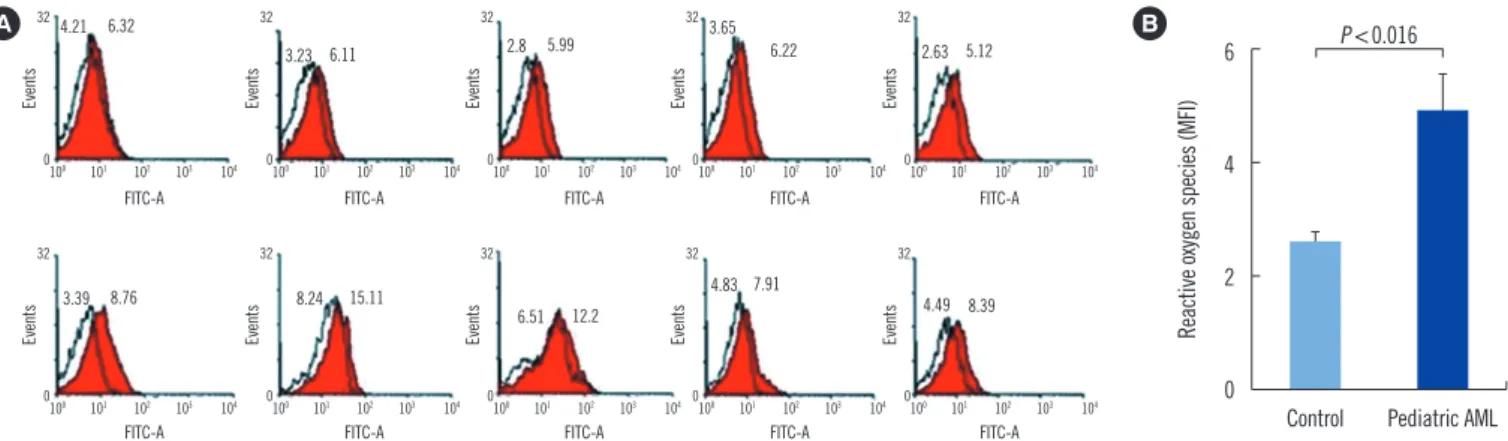
ROS (H2O2) levels in patient BM cells and in control PB cells were measured to determine whether intracellular ROS level af- fects mtDNA alterations in pediatric AML patients and controls.Intracellular ROS levels were found to be significantly higher in patients (4.96±1.96 mean fluorescence intensity [MFI]) than in controls (2.65±0.41 MFI) (P =0.016, Fig. 3).
7. Increase in the mitochondrial mass and membrane potential
There was no significant difference of mitochondrial mass be- tween patients and controls (Fig. 4A, B), and patients were found to have higher mitochondrial membrane potentials than controls (P =0.029, Fig. 4C, D).
8. Increased amount of mtDNA 4,977-bp large deletion in pediatric AML cells
The amount of the mtDNA 4,977-bp large deletion was signifi-
cantly higher in pediatric AML cells than in control cells (P <
0.01, Table 1, Fig. 2B).
9. Association between mtDNA copy number and pediatric AML
Multivariate unconditional logistic regression analysis (adjusted for age and sex) was performed to assess the association be- tween mtDNA copy number and the risk of developing pediatric AML. As shown in Table 1, a close relationship was found be- tween tertiles of mtDNA copy number and the risk of developing pediatric AML. When the first tertile was used as the reference group, the adjusted ORs (aORs) of the second and third tertiles were 1.29 (95% CI: 0.44-3.82) and 7.93 (95% CI: 2.42-25.98), respectively (P =0.001). Similarly, this trend was also observed between tertiles of the mtDNA 4,977-bp large deletion and the risk of pediatric AML (P =0.001).
10. Effect of the mtDNA 4,977-bp large deletion on the prognosis of pediatric AML
Pediatric AML patients harboring high amount of mtDNA 4,977- bp large deletion showed shorter OS (P =0.317) and EFS Fig. 3. Increased intracellular reactive oxygen species (ROS) in pediatric AML cells. (A, B) DCFH-DA and flow cytometry were used to de- tect changes in intracellular ROS levels. The level of intracellular ROS was significantly increased in pediatric AML cells (4.96±1.96 mean fluorescence intensity [MFI]) than in control peripheral blood cells (2.65±0.41 MFI).
Abbreviation: FITC, fluorescein isothiocyanate.
6
4
2
0
Control Pediatric AML
Reactive oxygen species (MFI)
P <0.016
A B
FITC-A FITC-A 100 101 102 103 104
100 101 102 103 104
100 101 102 103 104
100 101 102 103 104
100 101 102 103 104
100 101 102 103 104
100 101 102 103 104
100 101 102 103 104
100 101 102 103 104
100 101 102 103 104 FITC-A
FITC-A
FITC-A FITC-A
FITC-A FITC-A
FITC-A FITC-A 32
0
32
0
32
0
32
0
32
0
32
0
32
0
32
0
32
0
32
0
EventsEvents EventsEvents EventsEvents EventsEvents EventsEvents
4.21 6.32
3.23 6.11 2.8 5.99 3.65
6.22 2.63 5.12
3.39 8.76 8.24 15.11
6.51 12.2
4.83 7.91
4.49 8.39
Table 1. Odds ratio (OR) for developing pediatric AML according to tertiles of mtDNA copy number and 4,977-bp deletion
Tertile 1 Tertile 2 Tertile 3 P
mtDNA copy number
Unadjusted OR (95% CI) 1.0 (reference) 1.28 (0.44-3.75) 7.67 (2.42-24.25) 0.001
Adjusted OR (95% CI) 1.0 (reference) 1.29 (0.44-3.82) 7.93 (2.42-25.98) 0.001
mtDNA 4,977-bp deletion
Unadjusted OR (95% CI) 1.0 (reference) 6.55 (2.04-21.04) 7.60 (2.34-24.67) 0.002
Adjusted OR (95% CI) 1.0 (reference) 6.43 (1.98-20.89) 8.18 (2.45-27.38) 0.001
Abbreviations: mtDNA, mitochondrial DNA; CI, confidence interval.
(P =0.092), than those with low amount of mtDNA 4,977-bp large deletion (Fig. 5).
DISCUSSION
Although several studies on mitochondrial mutations in adult leukemia have been reported [27, 28], no such study has been performed on pediatric AML, and thus, we investigated mito- chondrial aberrations in pediatric AML patients and evaluated their clinical implications.
The mitochondrial D-loop is a major control site for mtDNA replication and transcription, and is more sensitive to damage than the other regions of mtDNA. It has been proposed that a high frequency of somatic mutations in the D-loop may be re- sponsible for the increase in the mtDNA copy number [29]. Our findings concur with the aforementioned reports. New mtDNA
variants and many polymorphisms in the control region and in the CYTB and tRNA leucine 1 genes were detected in pediatric AML patients and controls. The clinical behavior of controls with a newly detected mtDNA mutation in the tRNA leucine 1 gene needs to be carefully monitored, as tRNA leucine 1 is very im- portant for protein translation.
The analysis of nucleotide changes located in mtDNA minis- atellites showed that poly C tracts at np 303-315 and np 16,184-16,189 (in the D-loop region of mtDNA) had greater heteroplasmy lengths in patients than in controls. Mitochondrial genome instability has been strongly correlated with a high inci- dence of circular mtDNA molecules (of multiple lengths) in hu- man leukemic cells, and a positive correlation between the fre- quency of these molecules and the disease severity has been reported [30, 31].
Researchers have associated mtDNA haplogroups with vari- Fig. 4. Increased mitochondrial mass and membrane potential in pediatric AML cells. MitoTracker Green FM and MitoTracker Red probe were used to determine mitochondrial mass and mitochondrial membrane potential, respectively. (A, B) There was no significant difference of mitochondrial mass between patients (red colored histogram in A and black colored bar in B) and controls. (C, D) Mitochondrial membrane potentials were significantly elevated in pediatric AML cells (red colored histogram in C and black colored bar in D) than in control cells.
Abbreviations: PE, phycoerythrin; MFI, mean fluorescence intensity.
A
C
PE-Texas Red-A
PE-A PE-Texas Red-A
PE-A
PE-Texas Red-A
PE-A PE-Texas Red-A
PE-A
PE-Texas Red-A
PE-A PE-Texas Red-A
PE-A 100 101 102 103 104
100 101 102 103 104 100 101 102 103 104
100 101 102 103 104
100 101 102 103 104
100 101 102 103 104 100 101 102 103 104
100 101 102 103 104
100 101 102 103 104
100 101 102 103 104 100 101 102 103 104
100 101 102 103 104 32
0
32
0 32
0
32
0
32
0
32
0 32
0
32
0
32
0
32
0 32
0
32
0
EventsEventsEventsEvents EventsEventsEventsEvents EventsEventsEvents Events
1.79
1.7 3
4.5
1.96
1.9 3.68
5.1
2.22
1.6 5.2
2.6 393.4
210.1 589.5
374.8
379.6
217.3 595.9
472.7
446
217.1 993.7
425.9
800
600
400
200
0
500 400 300 200 100 0
Control
Control
Pediatric AML
Pediatric AML
Mitochondrial mass (MFI) Mitochondrial membrane potentials (MFI)
P <0.31
P <0.029 B
D
ous cancers, metabolic diseases, neurodegenerative diseases, and aging. A previous study showed that patients with mtDNA haplogroup M have an increased risk of breast cancer [32]. As mentioned earlier, mtDNA haplogroup D4 might be associated with a reduced risk of pediatric AML (See Supplemental Data Table S6). The number of patients enrolled in the present study was too small, and thus we suggest an extended investigation be conducted on a larger cohort to identify the relationships be- tween mtDNA haplogroups and the risk of pediatric AML.
In an attempt to identify severe aberrations in the mtDNA se- quence, we performed mtDNA copy number determination and 4,977-bp large deletion analysis. This study showed that the mtDNA copy number was significantly increased in pediatric AML cells than in the control cells. This finding may be ex- plained by an excessive need for ATP and by the mitochondrial dysfunction resulting from mtDNA alterations in AML cells. The mechanisms by which altered mtDNA copy number plays a role in the pathogeneses of diseases remain elusive. However, sev- eral reasonable mechanisms have been postulated. Alterations in the mitochondrial genome can alter mitochondrial gene ex- pression and lead to defective oxidative phosphorylation and to an enhancement in the production of ATP. Oxidative stress could potentially damage mtDNA or disturb mitochondrial com- ponents, including mitochondrial membranes. Thus, compen- satory machinery activated during cellular stress may lead to an increase in mtDNA copy number [29, 33]. Our results are in accordance with these proposals. Intracellular ROS levels were significantly elevated in BM cells of pediatric AML patients and
membrane potentials were elevated. However, although mito- chondrial mass was slightly increased, this increase was not sig- nificant. These findings support the aforementioned hypothesis, and suggest that increased mtDNA copy number is not due to increased mitochondrial mass. Nevertheless, the mtDNA turn- over rate and the proteins involved in the replication and degra- dation of mtDNA are important areas for future research [34].
In the present study, a higher rate of mitochondrial aberra- tions was detected in pediatric AML patients than in controls.
Furthermore, mtDNA copy number was found to be associated with an increased risk of pediatric AML. mtDNA 4,977-bp large deletion mutations have been implicated in aging and carcino- genesis. Meanwhile, a previous study on ALL patients found no difference in the amount of mtDNA in patients and healthy con- trols at the time of diagnosis [20]. However, the amount of mtDNA was found to be dependent on tumor type. In addition, mtDNA depletion has been reported in many studies on solid tumors, whereas increased mitochondrial mass was found in chronic lymphoid leukemia [12, 35-37].
This study shows that the extent of mtDNA 4,977-bp large deletion is significantly higher in pediatric AML cells than in control cells. These findings may be explained by events that occur during ATP synthesis. The overproduction of ROS not only affects mtDNA copy number but also the 4,977-bp large deletion. The present study also demonstrated that patients with more mtDNA aberrations are at greater risk of developing pedi- atric AML. Previous studies have correlated elevated mitochon- drial copy number with resistance to chemotherapeutic drugs Fig. 5. Impact of mtDNA 4,977-bp large deletion on survival. Overall survival (A) and event-free survival (B) tended to be shorter in pediat- ric AML patients (n =13) harboring high amount ( ≥0.00002) of the mtDNA 4,977-bp deletion than those (n =32) with low amount (<0.00002) of mtDNA 4,977-bp deletion. However, there were no significant differences between them.
Abbreviation: mtDNA, mitochondrial DNA.
100 90 80 70 60 50 40 30
100 90 80 70 60 50 40 30
0 50 100 150 0 50 100 150
Months Months
Overall survival (%) Event-free survival (%)
P <0.317
P <0.092
Low amount Low amount
mtDNA 4,977-bp large deletion mtDNA 4,977-bp large deletion
High amount High amount
A B
[38] and poor response to therapy [39] in adult hematological malignancies. In the present study, patients harboring a high amount of mtDNA 4,977-bp deletion had shorter OS (P =0.317) and EFS (P =0.092) than those with low amount of mtDNA 4,977-bp deletion.
In conclusion, mitochondrial aberrations were markedly more common in pediatric AML patients than in controls. Further- more, specific polymorphisms were found to be associated with the risk of leukemia. It appears that polymorphisms at and around the transcriptional control region potentially contribute to tumorigenesis
Authors’ Disclosures of Potential Conflicts of Interest
No potential conflicts of interest relevant to this article were re- ported.
Acknowledgements
This study was supported by grants from the Korean National Research Foundation (NRF), the Korean government (MEST) (No. 2011-0015304), the Leading Foreign Research Institute Recruitment Program of the NRF, the Korea Ministry of Educa- tion, Science and Technology (MEST) (No. 2011-0030034), and the National R&D Program for Cancer Control, Korea Minis- try of Health & Welfare (No. 2013-1320070).
REFERENCES
1. Chinnery PF and Schon EA. Mitochondria. J NeurolNeurosurgPsychia- try 2003;74:1188-99.
2. DiMauro S and Schon EA. Mitochondrial respiratory-chain diseases.
NEngl J Med 2003;348:2656-68.
3. Lim SW, Kim HR, Kim HY, Huh JW, Kim YJ, Shin JH, et al. High‐fre- quency minisatellite instability of the mitochondrial genome in colorectal cancer tissue associated with clinicopathological values. Int J Cancer 2012;131:1332-41.
4. Park SY, Shin MG, Kim HR, Oh JY, Kim SH, Shin JH, et al. Alteration of mitochondrial DNA sequence and copy number in nasal polyp tissue.
Mitochondrion 2009;9:318-25.
5. Anderson S, Bankier AT, Barrell BG, de Bruijn MH, Coulson AR, Drouin J, et al. Sequence and organization of the human mitochondrial ge- nome. Nature 1981;290:457-65.
6. Shin MG, Kajigaya S, Tarnowka M, McCoy JP Jr, Levin BC, Young NS.
Mitochondrial DNA sequence heterogeneity in circulating normal hu- man CD34 cells and granulocytes. Blood 2004;103:4466-77.
7. Richter C, Park JW, Ames BN. Normal oxidative damage to mitochon- drial and nuclear DNA is extensive. Proc Natl AcadSci USA 1988;85:
6465-7.
8. Ishikawa K and Hayashi J. A novel function of mtDNA: its involvement
in metastasis. Ann N Y AcadSci 2010;1201:40-3.
9. Penta JS, Johnson F, Wachsman JT, Copeland WC. Mitochondrial DNA in human malignancy.Mutat Res 2001;488:119-33.
10. Ishikawa K, Koshikawa N, Takenaga K, Nakada K, Hayashi J. Revers- ible regulation of metastasis by ROS-generating mtDNA mutations. Mi- tochondrion 2008;8:339-44.
11. Shadel GS. Expression and maintenance of mitochondrial DNA: new insights into human disease pathology. Am JPathol2008;172:1445-56.
12. Yin PH, Lee HC, Chau GY, Wu YT, Li SH, Lui WY, et al. Alteration of the copy number and deletion of mitochondrial DNA in human hepatocel- lular carcinoma. Br J Cancer 2004;90:2390-6.
13. Macmillan CJ and Shoubridge EA. Mitochondrial DNA depletion: preva- lence in a pediatric population referred for neurologic evaluation. Pedi- atr Neurol 1996;14:203-10.
14. Yu M, Zhou Y, Shi Y, Ning L, Yang Y, Wei X, et al. Reduced mitochon- drial DNA copy number is correlated with tumor progression and prog- nosis in Chinese breast cancer patients. IUBMB Life 2007;59:450-7.
15. Xing J, Chen M, Wood CG, Lin J, Spitz MR, Ma J, et al. Mitochondrial DNA content: its genetic heritability and association with renal cell car- cinoma. J Natl Cancer Inst 2008;100:1104-12.
16. Yu M, Wan Y, Zou Q. Reduced mitochondrial DNA copy number in Chi- nese patients with osteosarcoma. Transl Res 2013;161:165-71.
17. Lan Q, Lim U, Liu CS, Weinstein SJ, Chanock S, Bonner MR, et al. A prospective study of mitochondrial DNA copy number and risk of non- Hodgkin lymphoma. Blood 2008;112:4247-9.
18. Creutzig U, van den Heuvel-Eibrink MM, Gibson B, Dworzak MN, Ada- chi S, de Bont E, et al. Diagnosis and management of acute myeloid leukemia in children and adolescents: recommendations from an inter- national expert panel. Blood 2012;120:3187-205.
19. Rubnitz JE and Inaba H. Childhood acute myeloid leukaemia. Br J Haematol 2012;159:259-76.
20. Kwok CS, Quah TC, Ariffin H, Tay SK, Yeoh AE. Mitochondrial D-loop polymorphisms and mitochondrial DNA content in childhood acute lymphoblastic leukemia. J Pediatr Hematol Oncol 2011;33:e239-44.
21. Chalandon Y, Vischer S, Helg C, Chapuis B, Roosnek E. Quantitative analysis of chimerism after allogeneic stem cell transplantation by PCR amplification of microsatellite markers and capillary electrophoresis with fluorescence detection: the Geneva experience. Leukemia 2003;17:
228-31.
22. Hye-Ran Kim, Myung-Geun Shin, Mi-Ji Kim, Jong-Hee Shin, Soon-Pal Suh, Dong-WookRyang. Characteristics of mitochondrial DNA sequence polymorphisms and haplogroups in Korean population. Genes and Ge- nomics 2008;30:121-6.http://210.101.116.28/W_files/kiss3/ 09001745_
pv.pdf
23. Pfeiffer H, Steighner R, Fisher R, Mörnstad H, Yoon CL, Holland MM.
Mitochondrial DNA extraction and typing from isolated dentin-experi- mental evaluation in a Korean population. Int J Legal Med 1998;111:
309-13.
24. Stoneking M. Hypervariable sites in the mtDNA control region are mu- tational hotspots. Am J Hum Genet 2000;67:1029-32.
25. Chang DD and Clayton DA. Priming of human mitochondrial DNA repli- cation occurs at the light-strand promoter. Proc Natl AcadSci USA 1985;82:351-5.
26. Shin MG, Levin BC, Kim HJ, Kim HR, Lee IK, Cho D, et al. Profiling of length heteroplasmies in the human mitochondrial DNA control regions from blood cells in the Korean population. Electrophoresis 2006;27:
1331-40.
27. Chan DC. Mitochondria: dynamic organelles in disease, aging, and de- velopment. Cell 2006;125:1241-52.
28. Silkjaer T, Nørgaard JM, Aggerholm A, Ebbesen LH, Kjeldsen E, Hokland
P, et al. Characterization and prognostic significance of mitochondrial DNA variations in acute myeloid leukemia. Eur J Haematol 2013;90:
385-96.
29. Lee HC and Wei YH.Mitochondrial biogenesis and mitochondrial DNA maintenance of mammalian cells under oxidative stress.Int J Biochem Cell Biol 2005;37:822-34.
30. Clayton DA and Vinograd J. Circular dimer and catenate forms of mito- chondrial DNA in human leukaemic leucocytes. Nature 1967;216:652-7.
31. Clayton DA and Vinograd J. Complex mitochondrial DNA in leukemic and normal human myeloid cells. Proc Natl AcadSci USA 1969;62:
1077-84.
32. Fang H, Shen L, Chen T, He J, Ding Z, Wei J, et al. Cancer type-specific modulation of mitochondrial haplogroups in breast, colorectal and thy- roid cancer. BMC Cancer 2010;10:421.
33. James AM and Murphy MP. How mitochondrial damage affects cell function. J Biomed Sci 2002;9:475-87.
34. Clay Montier LL, Deng JJ, Bai Y. Number matters: control of mammalian
mitochondrial DNA copy number. J Genet Genomics 2009;36:125-31.
35. Tseng LM, Yin PH, Chi CW, Hsu CY, Wu CW, Lee LM, et al. Mitochon- drial DNA mutations and mitochondrial DNA depletion in breast cancer.
Genes Chromosomes Cancer 2006;45:629-38.
36. Wang Y, Liu VW, Xue WC, Cheung AN, Ngan HY. Association of de- creased mitochondrial DNA content with ovarian cancer progression.
Br J Cancer 2006;95:1087-91.
37. Mizumachi T, Suzuki S, Naito A, Carcel-Trullols J, Evans TT, Spring PM, et al. Increased mitochondrial DNA induces acquired docetaxel resis- tance in head and neck cancer cells. Oncogene 2008;27:831-8.
38. Carew JS, Nawrocki ST, Xu RH, Dunner K, McConkey DJ, Wierda WG, et al. Increased mitochondrial biogenesis in primary leukemia cells: the role of endogenous nitric oxide and impact on sensitivity to fludarabine.
Leukemia 2004;18:1934-40.
39. Kusao I, Agsalda M, Troelstrup D, Villanueva N, Shiramizu B. Chemo- toxicity recovery of mitochondria in non‐Hodgkin lymphoma resulting in minimal residual disease. Pediatr Blood Cancer 2008;51:193-7.