INTRODUCTION
Bladder cancer is among the most common newly diagnosed cancer in the Western population, with an
Lymph node yield in node-negative patients
predicts cancer specific survival following radical cystectomy for transitional cell carcinoma
Jack Crozier1, Nathan Papa1, Marlon Perera1, Michael Stewart2, Jeremy Goad2, Shomik Sengupta1,3, Damien Bolton1,3, Nathan Lawrentschuk1,3,4
1Department of Surgery, Austin Health, University of Melbourne, Melbourne, 2St Vincent’s Hospital, Melbourne, 3Olivia Newton-John Cancer Research Institute, Melbourne,
4Department of Surgical Oncology, Peter MacCallum Cancer Centre, Melbourne, Australia
Purpose: To determine the oncological implications of increased nodal dissection in node-negative bladder cancer during radical cystectomy in a contemporary Australian series.
Materials and Methods: We performed a multicenter retrospective study, including more than 40 surgeons across 5 sites over a 10-year period. We identified 353 patients with primary bladder cancer undergoing radical cystectomy. Extent of lymphadenecto- my was defined as follows; limited pelvic lymph node dissection (PLND) (perivesical, pelvic, and obturator), standard PLND (internal and external iliac) and extended PLND (common iliac). Multivariable cox proportional hazards and logistic regression models were used to determine LNY effect on cancer-specific survival.
Results: Over the study period, the extent of dissection and lymph node yield increased considerably. In node-negative patients, lymph node yield (LNY) conferred a significantly improved cancer-specific survival. Compared to cases where LNY of 1 to 5 nodes were taken, the hazard ratio (HR) for 6 to 15 nodes harvested was 0.78 (95% confidence interval [CI], 0.43–1.39) and for greater than 15 nodes the HR was 0.31 (95% CI, 0.17–0.57), adjusted for age, sex, T stage, margin status, and year of surgery. The predicted probability of cancer-specific death within 2 years of cystectomy was 16% (95% CI, 13%–19%) with 10 nodes harvested, falling to 5.5% (95% CI, 0%–12%) with 30 nodes taken. Increasing harvest in all PLND templates conferred a survival benefit.
Conclusions: The findings of the current study highlight the improved oncological outcomes with increased LNY, irrespective of the dissection template. Further prospective research is needed to aid LND data interpretation.
Keywords: Lymph node excision; Neoplasm staging; Survival; Urinary bladder neoplasms
This is an Open Access article distributed under the terms of the Creative Commons Attribution Non-Commercial License (http://creativecommons.org/licenses/by-nc/4.0) which permits unrestricted non-commercial use, distribution, and reproduction in any medium, provided the original work is properly cited.
Received: 20 February, 2017 • Accepted: 23 May, 2017 Corresponding Author: Jack Crozier
Department of Surgery, Austin Health, 145 Studley Rd Heidelberg VIC 3084, Australia TEL: +61-432535955, FAX: +61-383456055, E-mail: [email protected]
ⓒ The Korean Urological Association, 2017
estimated 77,000 new cases diagnosed in the US in 2016 [1].
Following progression to muscle-invasive bladder cancer (pT2), curative treatment of choice is radical cystectomy including regional lymph node dissection [2]. From time of
www.icurology.org
Investig Clin Urol 2017;58:416-422.
https://doi.org/10.4111/icu.2017.58.6.416 pISSN 2466-0493 • eISSN 2466-054X
diagnosis Australian bladder cancer patients have a 5-year survival rate of approximately 58% [3-5]. Accordingly, there is an inherent need for improved treatment regimens for these patients. Organ-confined muscle-invasive bladder tumours are often complex with up to 25% having lymph node metastasis [6]. There is mounting evidence suggesting the addition of pelvic lymph node dissection (PLND) to radical cystectomy provides superior oncological outcomes compared to non-PLND cohorts. Specifically, lymphadenectomy provides improved cancer staging, prolongs time to disease recurrence and cancer-specific survival [7-13]. As such, contemporary European Urological Association guidelines support radical cystectomy and regional lymph node dissection for curative treatment of muscle invasive bladder cancer [2].
The improved oncological outcomes following PLND have prompted changes to dissection practices, with clinicians adopting more extensive dissection templates [14]. The precise oncological benefits of varying dissection templates are unclear and this is reflected by uncertain guidelines.
Current data suggests that more extensive dissection results in improved oncological outcomes [15]. However there may be no added oncological benefit to superextended dissection above the mid-upper third of the common iliac vessels [10].
There is still no consensus regarding the boundaries or nomenclature of a standard set of PLND templates [15].
We aim to investigate the impact of lymph node yield and dissection extent on oncological outcomes in an Australian cohort treated surgically for primary bladder cancer.
MATERIALS AND METHODS
1. Patients
Following Austin Health Human Research Ethics Committee approval, we conducted a 10-year multi-
institution, multisurgeon retrospective review (approval number: LR227-15). Informed consent was waived. We included consecutive patients from January 2005 to December 2014, who underwent radical cystectomy for primary bladder cancer. Cystectomy was performed by over 40 different surgeons at 5 participating institutions including 3 private hospitals and 2 public hospitals in the state of Victoria, Australia. All surgeons have performed over 20 cystectomies. The final pathological report was examined and data collected included patient age, sex, type of surgery, tumour stage, total lymph node yield, location of lymph nodes collected, number of positive nodes and location of positive nodes. Pathological stage was defined using the 2009 American Joint Committee on Cancer staging system [16]. Cystectomies for reasons other than primary bladder cancer, e.g., metastatic rectal cancer, were excluded from this study.
2. Victorian cancer registry
Subjects were followed until 31st December 2014, the last date of censoring. Mortality data was collated through a centralised government agency, the Victorian Cancer Registry (VCR) that additionally records the cause of death.
The VCR is mandated by legislation to capture every cancer diagnosis in the state of Victoria. Their data record linked to our database using patient identifiers, date of birth, unique hospital identification number and date of surgery.
3. Definitions
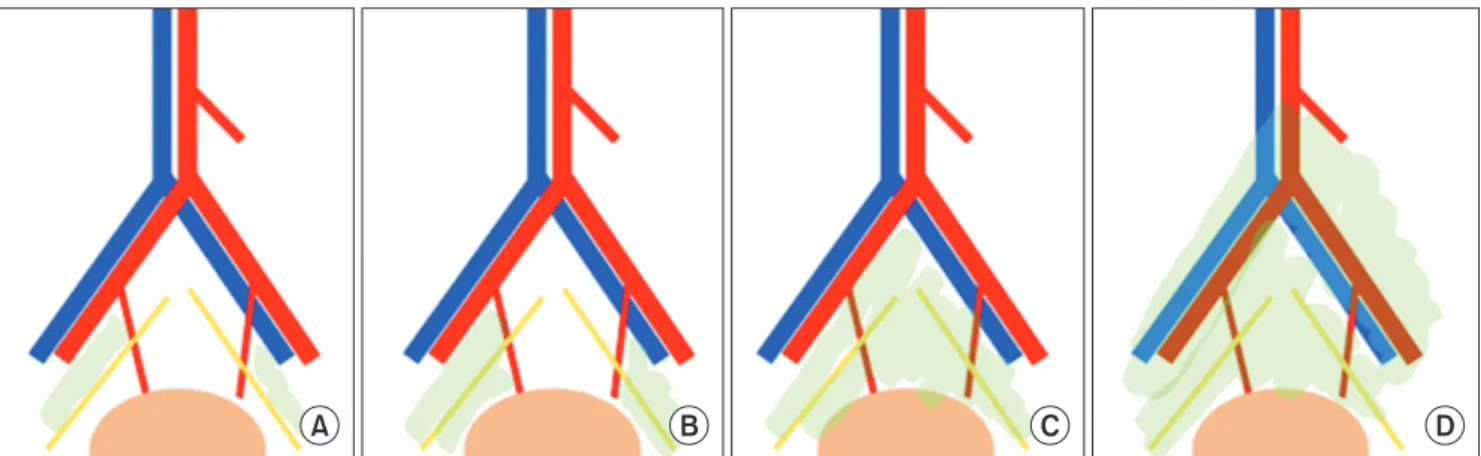
We defined “extended” surgery as a cystectomy on a female that included removal of the uterus. Extent of PLND was graded as follows: limited PLND included perivesical, pelvic not otherwise specified and obturator nodes and standard PLND (sPLND) included internal and external iliac nodes. Extended PLND (ePLND) included
A B C D
Fig. 1. Definitions of pelvic lymph node dissection templates. Limited pelvic lymph node dissection (PLND) (A), standard PLND (B), extended PLND (C), and superextended PLND (D).
lymphadenectomy between the aortic bifurcation and common iliac vessels (proximally) and the genitofemoral nerve laterally. Lymph node location was defined by the pathological report which itself is derived from what the operating surgeon determined when referring the specimen.
Fig. 1 highlights the varying PLND dissection templates.
4. Statistical analysis
Evaluation of the effect of LNY on bladder cancer- specific survival was undertaken by first categorising yield into 3 groups, 1 to 5, 6 to 15, and 16-plus nodes taken and generating a Kaplan-Meier plot. We then entered this variable into a multivariable Cox regression model simultaneously with sex, pathological T stage (as a 3 level categorical variable: T0/a/is/1, T2, T3/4), margin status and the continuous covariates of age at surgery and year of surgery. Additionally, we produced robust standard errors by including clustering by surgery site. Examination of Schoenfeld residuals showed that the proportional hazards
assumption was not violated. Further, we examined LNY as a continuous variable in a multivariable logistic regression model with the covariates and clustering as above. The outcome was defined as death from bladder cancer within two years following cystectomy with patients alive for at least 2 years as the comparator group. Predicted probabilities for LNY were generated holding the covariates as observed.
Finally, we assessed the predicted effect of node harvest in each dissection template using a multivariable logistic model including the above covariates and the number of nodes harvested in each template. Holding the covariates as observed and the node harvest at the other levels to zero generated the predicted probabilities in this model. Tests were 2 sided with significance set at 0.05 as per convention.
Analyses were performed using Stata v.12 (StataCorp LP., College Station, TX, USA).
RESULTS
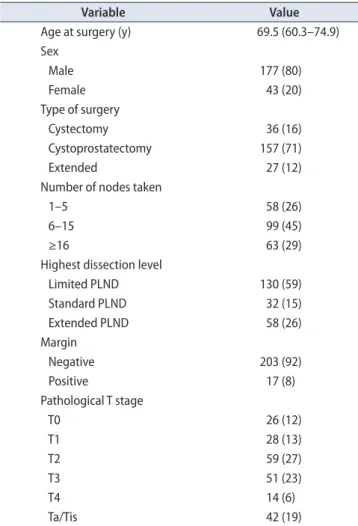
In total 353 patients were identified, of which 71 did not have any nodes taken and 62 were node positive, leaving a study cohort of 220 node-negative patients (62%
of total). The greater proportion of patients were male patients (80%) and received cystoprostatectomy surgery. Of the female patients, a majority (63%) also had concurrent hysterectomy. Of the included patients, 131 recorded a time on study of 2 years or more and 55 were followed for at least 5 years. Over the entire study period, 49 (22%) suffered cancer-specific mortality, 26 of which occurred within 2 years of surgery, with a further 14 (6.4%) dying of another cause. Demographic, surgical, and pathological data are summarized in Table 1.
1. Trends in node dissection
The proportion of surgeries with concomitant PLND to Table 1. Demographic, surgical, and pathological characteristics of the
study cohort (n=220)
Variable Value
Age at surgery (y) 69.5 (60.3–74.9)
Sex
Male 177 (80)
Female 43 (20)
Type of surgery
Cystectomy 36 (16)
Cystoprostatectomy 157 (71)
Extended 27 (12)
Number of nodes taken
1–5 58 (26)
6–15 99 (45)
≥16 63 (29)
Highest dissection level
Limited PLND 130 (59)
Standard PLND 32 (15)
Extended PLND 58 (26)
Margin
Negative 203 (92)
Positive 17 (8)
Pathological T stage
T0 26 (12)
T1 28 (13)
T2 59 (27)
T3 51 (23)
T4 14 (6)
Ta/Tis 42 (19)
Values are presented as median (interquartile range) or number (%).
PLND, pelvic lymph node dissection.
2005-2006 2013-2014
Numberofpatients
Year of cystectomy Level 1
Level 2 Level 3 70
60 50 40 30 20 10 0
2011-2012 2009-2010
2007-2008
Fig. 2. Populations of highest dissection level over time.
sPLND or ePLND steadily increased throughout the study period from 5.3% in 2005–2006 to 59% in 2013–2014 (Fig.
2). The number of nodes harvested in a cystectomy for our node-negative cohort similarly increased from a mean of 7.4 in the first 2 years to 17 in the latter 2 years (Fig. 3).
2. Effect of PLND in node-negative disease
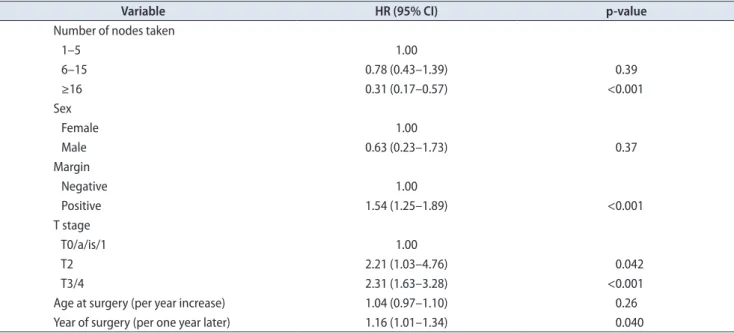
The number of nodes harvested from PLND was associated with time to cancer specific mortality. A Kaplan- Meier plot is shown in Fig. 4 with the log-rank test of overall difference between the groups reaching conventional significance (p=0.045). In a Cox proportional-hazards model with adjustment for pathological T stage, margin status, age at surgery, and year of surgery, node harvest independently predicted survival. Compared to cases where 1 to 5 nodes
were taken, the hazard ratio (HR) for 6 to 15 nodes harvested was 0.78 (95% confidence interval [CI], 0.43–1.39;
p=0.39) and for greater than 15 nodes the HR was 0.31 (95%
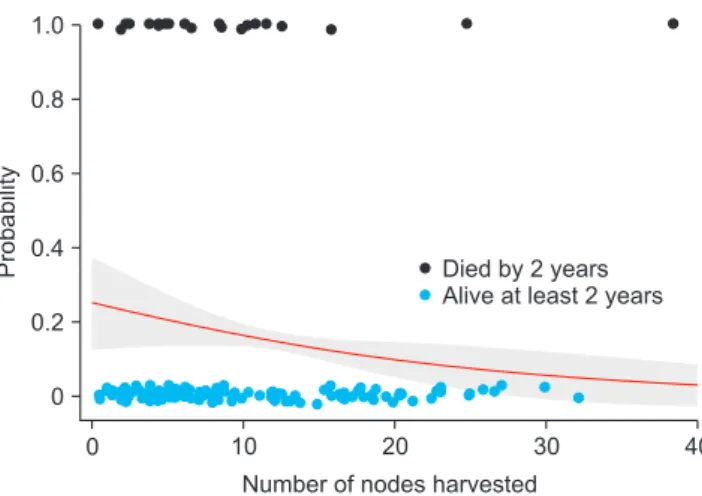
CI, 0.17–0.57; p<0.001) (Table 2). Analysing node harvest as a continuous variable in a multivariable logistic model yielded a predicted probability of bladder cancer death in 2 years of 16% (95% CI, 13%–19%) for 10 nodes taken, decreasing to 5.5%
(95% CI, 0%–12%) with 30 nodes taken (Fig. 5). Increasing node harvest in each dissection template was observed to decrease the chance of 2-year cancer-specific mortality (Fig. 6).
1 to 5 6 to 15
>16
2005-2006 2013-2014
Numberofpatients
Year of cystectomy 70
60 50 40 30 20 10 0
2011-2012 2009-2010
2007-2008
Fig. 3. Populations of number of nodes taken over time.
Survivalestimate
0 5
Years after cystectomy 1.00
0.75
0.50
0.25
0
Number at risk
>16 6 to 15 1 to 5
5 29 21 4
3 2
1 1 to 5 6 to 15
>16
10 39 28 17
47 30 32
62 37 43
77 44 63
99 58
Log-rank p=0.045
Fig. 4. Kaplan-Meier plots of bladder cancer specific survival grouped by number of nodes harvested with log-rank test.
Table 2. Multivariable Cox regression mode
Variable HR (95% CI) p-value
Number of nodes taken
1–5 1.00
6–15 0.78 (0.43–1.39) 0.39
≥16 0.31 (0.17–0.57) <0.001
Sex
Female 1.00
Male 0.63 (0.23–1.73) 0.37
Margin
Negative 1.00
Positive 1.54 (1.25–1.89) <0.001
T stage
T0/a/is/1 1.00
T2 2.21 (1.03–4.76) 0.042
T3/4 2.31 (1.63–3.28) <0.001
Age at surgery (per year increase) 1.04 (0.97–1.10) 0.26
Year of surgery (per one year later) 1.16 (1.01–1.34) 0.040
HR, hazard ratio; CI, confidence interval.
DISCUSSION
To our knowledge we present the largest Australian series investigating lymphadenectomy and disease specific survival in the surgical management of bladder cancer. The results of the current study highlight the increasing trend of aggressive node dissection in radical cystectomy patients.
Further, the current study has identified improved cancer- specific survival with increased lymph node yield in node- negative patients.
Our study identified the significant trend of increasing use of standard and extended lymph node dissection across the study period [14]. Such trends are consistent with a growing body of evidence highlighting improved oncological outcomes with more extensive lymph node dissections. Bi et al. [15] performed a meta-analysis comparing ePLND versus sPLND. Despite heterogeneity of definitions, this group defined ePLND included dissection of all lymph nodes between the aortic bifurcation and common iliac vessels (proximally), the genitofemoral nerve (laterally), and the circumflex iliac vessel (inferiorly) – consistent with ePLND in our cohort. Super-ePLND extended cranially to the level of the inferior mesenteric artery – representing a level of dissection that was not performed in our study. The pooled data analysis produced highlighted the superiority of ePLND and super-ePLND compared to sPLND, irrespective of nodal positivity status. Additionally, recent literature has directly compared the effect of ePLND and super-ePLND.
Intuitively, the principles of accurate nodal staging and local cancer control would support a super extended PLND.
However, such aggressive management regimes may expose patients to significant morbidity and longer operating
times. Accordingly, the potential oncological benefit must be considered against to potential morbidity. Oncologically, multiple groups have reported that super-ePLND has comparable disease free survival to PLND limited to below the aortic bifurcation [10,17]. Therefore, a dissection template limited to the aortic bifurcation proximally is reasonable – represented by the extended PLND cohort in our study.
Lymphadenectomy improves survival in both node- positive and node-negative cohorts. In our cohort of node- negative patients, we identified that increasing lymph node yield during PLND correlated with an improved oncological outcome. In the current cohort, increasing nodal harvest categorically from less than five nodes, to greater than five and greater than 15 nodes progressively improved cancer-specific survival. Our findings are corroborated by recent reports in contemporary literature [18]. May et al.
[19] assessed 1,291 node-negative patients following radical cystectomy and PLND. Converse to our study, this group did not identify the continuous number of lymph nodes as significant independent predictor of cancer-specific survival (HR, 0.98; 95% CI, 0.96–1.01; p=0.140). However, utilizing a cutoff value of greater than 16 nodes resulted in a decreased probability of cancer mortality.
Further, in our cohort, improved cancer-specific sur- vival with increased nodal yield occurred independent of dissection template. For limited, standard, or extended PLND, the risk of mortality reduced with more meticulous dissections (Fig. 5). Accordingly, it has been proposed that total lymph node yield may act as a quantitative measure of PLND quality [20]. Several groups have addressed whether a minimum number of lymph nodes should be assessed following radical cystectomy with PLND. Previous groups have proposed minimal nodal counts between 4 to 16 [9,19,21,22]. Conversely, other groups recommend thorough
Probability Died by 2 years
Alive at least 2 years
0 40
Number of nodes harvested 1.0
0.8
0.6
0.4
0.2
0
30 20
10
Fig. 5. Predicted probability (red line) of bladder cancer death within 2 years of cystectomy and 95% confidence interval. Black dots are pa- tients who died of bladder cancer and blue dots are patients alive at 2.
One patient alive at 2 years with 68 nodes harvested not shown.
Probability
40 Number of nodes harvested
30 20
10 0
0.25
0.20
0.15
0.10
0.05
0
Level 1 Level 2 Level 3
Fig. 6. Predicted probability of bladder cancer death within 2 years of cystectomy versus number of nodes taken at each dissection level.
anatomical PLND without minimum nodal counts [11].
The precise mechanism for increased nodal yield and resulting improved survival in node-negative patients is uncertain. It is likely that in this setting, the benefit of PLND is removal of underdetected micrometastases [23].
Removal of lymph nodes with micrometastatic deposit may improve survival by reducing overall tumour burden and allowing the immune system and chemotherapeutics to target a smaller number of cancer cells [24]. New techniques employing immunohistochemical analysis and reverse transcription real-time polymerase chain reaction can aid in detection of micrometastases [25,26]. It has been demonstrated that patients with micrometastases who are otherwise node-negative on routine analysis have a trend toward worse cancer specific survival and recurrence free survival than truly node-negative patients [25]. The observed predictive value of the lymph node yield may be a result of confounding patient, surgeon or institutional factors that may contribute to improved outcomes [19]. Specifically, high- risk patients may have a limited dissection while a more aggressive approach is employed in patients with superior premorbid function. Similarly, increased surgeon experience may improve quality of performing an aggressive PLND.
Lastly, as highlighted by May et al. [19], this association may be the result of the Will-Rogers stage-migration phenomenon. In this setting, the examination of increased lymph nodes results in the upstaging due to more extensive nodal sampling. Accordingly, these patients are reclassified as N1 that would have otherwise been classified as N0 with high nodal yield. Subsequently, patients that underwent more extensive PLND are likely to have superior oncologic outcomes as these patients are more likely to be truly node- negative [27,28].
There are several limitations to the current study.
Firstly, there are inherent limitations with the retrospective nature of the current study, given data is reliant of accurate documentation. Further, several pertinent treatment details were not available for data collection. Specifically, data pertaining to neo-adjuvant, adjuvant, salvage or palliative chemotherapy or radiotherapy were not available. Our study did not assess the impact of reviewing pathologist on lymph node yield. However prior study has shown the reviewing pathologist does not alter the reported lymph node yield [29].
Despite these limitations, as highlighted, this represents the most comprehensive Australian radical cystectomy database to-date.
CONCLUSIONS
The findings of the current study highlight the increased uptake in more extensive, meticulous PLND during cystec- tomy for node-negative patients. Our study highlights the improved oncological outcomes with increasing LNY, irrespective of the extent of dissection. Further, robust prospective clinical research is needed to aid interpretation of lymph node dissection data.
CONFLICTS OF INTEREST
The authors have nothing to disclose.
REFERENCES
1. Siegel RL, Miller KD, Jemal A. Cancer statistics, 2016. CA Can- cer J Clin 2016;66:7-30.
2. Witjes JA, Compérat E, Cowan NC, De Santis M, Gakis G, Le- bret T, et al. EAU guidelines on muscle-invasive and metastatic bladder cancer: summary of the 2013 guidelines. Eur Urol 2014;65:778-92.
3. Patel MI, Bang A, Gillatt D, Smith DP. Contemporary radical cystectomy outcomes in patients with invasive bladder cancer:
a population-based study. BJU Int 2015;116 Suppl 3:18-25.
4. Australian Institute of Health and Welfare. Cancer survival and prevalence in Australia: period estimates from 1982 to 2010.
Asia Pac J Clin Oncol 2013;9:29-39.
5. Vartolomei MD, Kiss B, Vidal A, Burkhard F, Thalmann GN, Roth B. Long-term results of a prospective randomized trial assessing the impact of re-adaptation of the dorsolateral peri- toneal layer after extended pelvic lymph node dissection and cystectomy. BJU Int 2016;117:618-28.
6. Ku JH, Kang M, Kim HS, Jeong CW, Kwak C, Kim HH. Lymph node density as a prognostic variable in node-positive bladder cancer: a meta-analysis. BMC Cancer 2015;15:447.
7. Simone G, Papalia R, Ferriero M, Guaglianone S, Castelli E, Collura D, et al. Stage-specific impact of extended versus stan- dard pelvic lymph node dissection in radical cystectomy. Int J Urol 2013;20:390-7.
8. Jensen JB, Ulhøi BP, Jensen KM. Extended versus limited lymph node dissection in radical cystectomy: impact on recur- rence pattern and survival. Int J Urol 2012;19:39-47.
9. Dhar NB, Klein EA, Reuther AM, Thalmann GN, Maders- bacher S, Studer UE. Outcome after radical cystectomy with limited or extended pelvic lymph node dissection. J Urol 2008;179:873-8.
10. Zehnder P, Studer UE, Skinner EC, Dorin RP, Cai J, Roth B, et al. Super extended versus extended pelvic lymph node dis-
section in patients undergoing radical cystectomy for bladder cancer: a comparative study. J Urol 2011;186:1261-8.
11. Koppie TM, Vickers AJ, Vora K, Dalbagni G, Bochner BH.
Standardization of pelvic lymphadenectomy performed at radi- cal cystectomy: can we establish a minimum number of lymph nodes that should be removed? Cancer 2006;107:2368-74.
12. Wright JL, Lin DW, Porter MP. The association between ex- tent of lymphadenectomy and survival among patients with lymph node metastases undergoing radical cystectomy. Cancer 2008;112:2401-8.
13. Holmer M, Bendahl PO, Davidsson T, Gudjonsson S, Måns- son W, Liedberg F. Extended lymph node dissection in patients with urothelial cell carcinoma of the bladder: can it make a dif- ference? World J Urol 2009;27:521-6.
14. Crozier J, Papa N, Sengupta S, Bolton DM, Lawrentschuk N.
Changing practice of pelvic lymph node dissection in manage- ment of primary bladder cancer. Minerva Urol Nefrol 2016;68:
106-11.
15. Bi L, Huang H, Fan X, Li K, Xu K, Jiang C, et al. Extended vs non-extended pelvic lymph node dissection and their influ- ence on recurrence-free survival in patients undergoing radical cystectomy for bladder cancer: a systematic review and meta- analysis of comparative studies. BJU Int 2014;113(5b):E39-48.
16. Cheng L, Montironi R, Davidson DD, Lopez-Beltran A. Stag- ing and reporting of urothelial carcinoma of the urinary blad- der. Mod Pathol 2009;22 Suppl 2:S70-95.
17. Møller MK, Høyer S, Jensen JB. Extended versus superex- tended lymph-node dissection in radical cystectomy: subgroup analysis of possible recurrence-free survival benefit. Scand J Urol 2016;50:175-80.
18. Morgan TM, Barocas DA, Penson DF, Chang SS, Ni S, Clark PE, et al. Lymph node yield at radical cystectomy predicts mor- tality in node-negative and not node-positive patients. Urology 2012;80:632-40.
19. May M, Herrmann E, Bolenz C, Brookman-May S, Tiemann A, Moritz R, et al. Association between the number of dissected lymph nodes during pelvic lymphadenectomy and cancer-spe-
cific survival in patients with lymph node-negative urothelial carcinoma of the bladder undergoing radical cystectomy. Ann Surg Oncol 2011;18:2018-25.
20. Siemens DR, Mackillop WJ, Peng Y, Wei X, Berman D, Booth CM. Lymph node counts are valid indicators of the quality of surgical care in bladder cancer: a population-based study. Urol Oncol 2015;33:425.e15-23.
21. Konety BR, Joslyn SA, O'Donnell MA. Extent of pelvic lymph- adenectomy and its impact on outcome in patients diagnosed with bladder cancer: analysis of data from the Surveillance, Epidemiology and End Results Program data base. J Urol 2003;169:946-50.
22. Leissner J, Hohenfellner R, Thüroff JW, Wolf HK. Lymphad- enectomy in patients with transitional cell carcinoma of the urinary bladder; significance for staging and prognosis. BJU Int 2000;85:817-23.
23. Roth B, Burkhard FC. The role of lymphadenectomy in radical cystectomy. Eur Urol Suppl 2010;9:19-24.
24. Youssef RF, Raj GV. Lymphadenectomy in management of in- vasive bladder cancer. Int J Surg Oncol 2011;2011:758189.
25. Gazquez C, Ribal MJ, Marín-Aguilera M, Kayed H, Fernández PL, Mengual L, et al. Biomarkers vs conventional histological analysis to detect lymph node micrometastases in bladder can- cer: a real improvement? BJU Int 2012;110:1310-6.
26. Matsumoto R, Takada N, Abe T, Minami K, Harabayashi T, Nagamori S, et al. Prospective mapping of lymph node metas- tasis in Japanese patients undergoing radical cystectomy for bladder cancer: characteristics of micrometastasis. Jpn J Clin Oncol 2015;45:874-80.
27. Buscarini M, Josephson DY, Stein JP. Lymphadenectomy in bladder cancer: a review. Urol Int 2007;79:191-9.
28. Sharir S, Fleshner NE. Lymph node assessment and lymphad- enectomy in bladder cancer. J Surg Oncol 2009;99:225-31.
29. Bochner BH, Cho D, Herr HW, Donat M, Kattan MW, Dal- bagni G. Prospectively packaged lymph node dissections with radical cystectomy: evaluation of node count variability and node mapping. J Urol 2004;172(4 Pt 1):1286-90.