Chemotherapy
Infect Chemother 2015;47(2):98-104
ISSN 2093-2340 (Print) · ISSN 2092-6448 (Online)
Received: March 2, 2015 Revised: April 6, 2015 Accepted: April 7, 2015 Corresponding Author : Ali Majidpour
Antimicrobial Resistance Research Center, Rasool-Akram Hospital, Niaiesh Ave., Sattrkhan Ave., Tehran, Iran.
Tel: 00982164352397, Fax: 00982166554063 E-mail: [email protected]
Alternative Corresponding Author : Maryam Adabi
Antimicrobial Resistance Research Center, Iran University of Medical Sciences, Tehran, Iran.
Tel: 00982164352397, Fax: 00982166554063 E-mail: [email protected]
This is an Open Access article distributed under the terms of the Creative Commons Attribution Non-Commercial License (http://creativecommons.org/licenses/by-nc/3.0) which permits unrestricted non-commercial use, distribution, and repro- duction in any medium, provided the original work is properly cited.
Copyrights © 2015 by The Korean Society of Infectious Diseases | Korean Society for Chemotherapy
www.icjournal.org
Spread of Efflux Pump Overexpressing-Mediated
Fluoroquinolone Resistance and Multidrug Resistance in Pseudomonas aeruginosa by using an Efflux Pump Inhibitor
Maryam Adabi
1, Mahshid Talebi-Taher
1, Leila Arbabi
1, Mastaneh Afshar
1, Sara Fathizadeh
1, Sara Minaeian
1, Niloufar Moghadam-Maragheh
2, and Ali Majidpour
11Antimicrobial Resistance Research Center, Iran University of Medical Sciences; 2Division of Microbiology, Department of Pathobiology, School of Public Health, Tehran University of Medical Sciences, Tehran, Iran
Background: Fluoroquinolone resistance in Pseudomonas aeruginosa may be due to efflux pump overexpression and/or target muta- tions. We designed this study to investigate the efflux pump mediated fluoroquinolone resistance and check the increasing effective- ness of fluoroquinolones in combination with an efflux pumps inhibitor among P. aeruginosa isolates from burn wounds infections.
Materials and Methods: A total of 154 consecutive strains of P. aeruginosa were recovered from separate patients hospitalized in a burn hospital, Tehran, Iran. The isolates first were studied by disk diffusion antibiogram for 11 antibiotics and then minimum inhibitory concentration (MIC) experiments were performed to detect synergy between ciprofloxacin and the efflux pump inhibitor, carbonyl cya- nide-m-chlorophenyl hydrazone (CCCP). Then to elucidate the inducing of multi drug resistance due to different efflux pumps activation in Fluoroquinolone resistant isolates, synergy experiments were also performed in random ciprofloxacin resistant isolates which have overexpressed efflux pumps phenotypically, using CCCP and selected antibiotics as markers for Beta-lactams and Aminoglycosides.
The isolates were also tested by polymerase chain reaction (PCR) for the presence of the MexA, MexC and MexE, which encode the efflux pumps MexAB-OprM, MexCD-OprJ and MexEF-OprN.
Results: Most of the isolates were resistant to 3 or more antibiotics tested. More than half of the ciprofloxacin resistant isolates exhibited synergy between ciprofloxacin and CCCP, indicating the efflux pump activity contributed to the ciprofloxacin resis- tance. Also increased susceptibility of random ciprofloxacin resistant isolates of P. aeruginosa to other selected antibiotics, in presence of CCCP, implied multidrug extrusion by different active efflux pump in fluoroquinolones resistant strains. All of Cip- rofloxacin resistant isolates were positive for MexA, MexC and MexE genes simultaneously.
Conclusion: In this burn hospital, where multidrug resistant P. aeruginosa isolates were prevalent, ciprofloxacin resistance and multidrug resistance due to the overexpression of fluoroquinolones mediated efflux pumps has also now emerged. Early recog- nition of this resistance mechanism should allow the use of alternative antibiotics and use an efflux pumps inhibitor in combi- nation with antibiotic therapy.
Key Words: Pseudomonas aeruginosa; Antibiotic therapy; Efflux pump; Ciprofloxacin, Carbonyl cyanide-m-chlorophenyl hydra- zone; Burned patients
Introduction
Pseudomonas aeruginosa is an opportunistic human pathogen and one of the leading causes of nosocomial infec- tions worldwide [1]and causes a variety of infections especial- ly in immunocompromised patients such as burned patients.
Infections caused by P. aeruginosa are associated with signifi- cant morbidity and mortality[2, 3]. The organism exhibits a high level of intrinsic resistance and only a limited number of antimicrobial agents are active against it [4]. In addition, P.
aeruginosa has acquired multiple mechanisms of resistance against all available anti pseudomonal agents [4, 5]. Fluoro- quinolones(FQ) are one of the major classes of antibiotics used in the treatment of infections caused by P. aeruginosa [1]
and Large-scale surveillance studies have reported an increas- ing rate of FQ resistance among clinical isolates of P. aerugi- nosa [6]. Overexpression of efflux pumps (EPs) and Target based mutation in gyrase and/or topoisomerase contribute to FQ resistance [4]. Of note, in vitro data indicate that at FQ con- centrations near the MIC, efflux mutants are preferentially se- lected before target mutations [7]. Analysis of the genome se- quence of P. aeruginosa revealed the existence of 12 potential resistance nodulation division (RND) efflux pump systems [1].
Of these, Six EPs have been well characterized thus far: Mex- AB-OprM, MexCD-OprJ, MexEF-OprN, MexXY-OprM, Mex- JK-OprM, and MexVW-OprM [8-10]. The first three have an important role in FQ resistances. All of the pumps can expel a variety of compounds ranging from detergents to structurally unrelated antimicrobial agents from the cytoplasm or peri- plasmic space [10, 11]. While each pump has a preferential set of antimicrobial agent substrates, the FQs are universal sub- strates for all known Mex pumps [12]. Phenotypic and genetic tests may be used in laboratories practice in order to identify
the presence of acquired resistance due to efflux pump over- expression among P. aeruginosa isolates. Increased expres- sion of efflux pumps could increases the MICs of many anti- microbials. A series of different compounds have been identified as efflux pump inhibitors (EPIs) with the ability to broadly inhibit several known multidrug EPs in P. aeruginosa.
In this study the resistance due to overexpression of the efflux system was evaluated by phenotypic test using efflux pump inhibitor carbonyl cyanide 3-chlorophenylhydrazone (CCCP).
CCCP is a known proton motive force and RND efflux pump inhibitor [13, 14], that can be added in Mueller-Hinton agar during its preparation. This phenotypic test is useful to detect efflux pump overexpression that contributes to or determines Fluoroquinolone and multi drug resistance in the study iso- lates. The minimum inhibitory concentrations (MICs) of anti- biotics for strains overexpressing an efflux pump are usually 2 or more folds higher than those strains of that species which didn’t have overexpressing an efflux pump.In this study, we hypothesized that the FQ resistant among P. aeruginosa iso- lated from burn wound infections (may be due to widespread use of FQ agents to treat burn wounds) could be in corporate with resistance to other existing antipseudomonal agents such as Beta-lactams and Aminoglycosides through FQ selected overexpression of multidrug efflux pumps. The specific aims of our study were to use CCCP as a screening agent to evalu- ate (i) the prevalence of efflux pump-mediated resistance among clinical isolates of P. aeruginosa (ii) the contribution of efflux pumps overexpression as the supposed mechanism for the multi drug resistance (MDR) phenotype in P. aerugi- nosa (iii) effectiveness increase of FQs in combined with an efflux pump inhibitor.
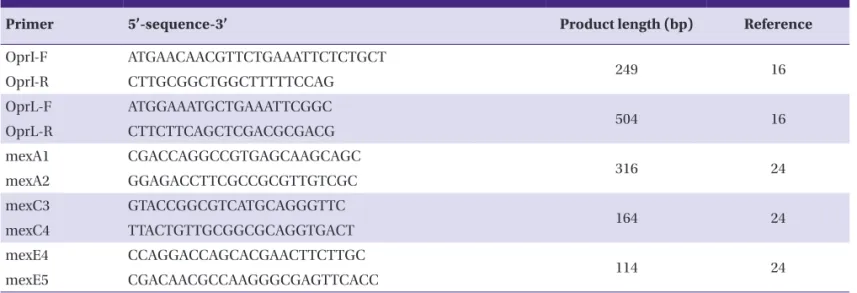
Table 1. Primers used in this study
Primer 5’-sequence-3’ Product length (bp) Reference
OprI-F ATGAACAACGTTCTGAAATTCTCTGCT
249 16
OprI-R CTTGCGGCTGGCTTTTTCCAG
OprL-F ATGGAAATGCTGAAATTCGGC
504 16
OprL-R CTTCTTCAGCTCGACGCGACG
mexA1 CGACCAGGCCGTGAGCAAGCAGC
316 24
mexA2 GGAGACCTTCGCCGCGTTGTCGC
mexC3 GTACCGGCGTCATGCAGGGTTC
164 24
mexC4 TTACTGTTGCGGCGCAGGTGACT
mexE4 CCAGGACCAGCACGAACTTCTTGC
114 24
mexE5 CGACAACGCCAAGGGCGAGTTCACC
Materials and Methods
1. Bacterial isolates
The study included a total of 154 P. aeruginosa non repeti- tive isolates recovered consecutively from clinical burn wound infections of separate patients at a burn hospital of Tehran, Iran. Bacterial isolates first were identified based on the stan- dard biochemical tests [15]. Then phenotypic identification was confirmed at the species level by using PCR amplification of OprI and OprL gene [16] (Table 1). Bacterial genomic DNA was extracted from the all isolates, as well as from the refer- ence strains of P.aeruginosa, by employment boiling method.
For this purpose, all isolates were inoculated aerobically on nutrient agar for 18-24 hour at 37°C. Depending on colony size, three to six colonies were picked from plates and mixed in to 0.1 mL DNase/RNase-free water in sterile 1.5-mL tubes to obtain a turbid suspension of bacteria (~ 1–2 × 10⁹ cells/
mL). The cell suspensions were held in a boiling water-bath for 10 min to lyse the cells and then centrifuged at 10,000 g at 4°C for 10 minutes. Finally the supernatant transmitted in sterile conditions into another tube and used as DNA tem- plate. Extracted DNA was stored at -20°C prior to PCR amplifi- cation. Also all the confirmed P. aeruginosa isolates were stored at -70°C in Trypticase soy broth supplemented with 10% glycerol until ready for testing. Control strains included PAO1 (wild type)[17] and P. aeruginosa ATCC 27853.
2. In vitro susceptibility testing
First the antibacterial susceptibility testing of selected P.
aeruginosa species was done by disk diffusion method on Mueller-Hinton Agar (Control S, Madrid, Spain). All isolates were tested for susceptibility to imipenem (10 μg), cefepime (30 μg), Ticarcillin (75 μg), Aztreonam(30 μg), Tobramycin (10 μg), Gentamicin (10 μg), Colistin (25 μg), Amikacin (30 μg), Ciprofloxacin (5 μg), Piperacillin (100 μg), Piperacillin-tazo- bactam (110 μg) (all from Mast, Merseyside. UK). Then, to in- vestigate the prevalence of Efflux pump mediated FQ resis- tance, synergy experiments were performed for all 154 strains of P. aeruginosa using ciprofloxacin, as a representative of FQ agents which are typically exported by all of 3 most important efflux pumps, and the efflux pump inhibitor. CCCP (Sigma-Al- drich, ST. Louis, MO, USA)was incorporated in Mueller–Hin- ton agar (Control S, Spain) at concentrations of 12.5 µm and ciprofloxacin susceptibility testing was performed by the two fold serial dilution method using a final inoculum of 106 cells/
mL in agar plates with and without CCCP [18]. Then to eluci- date the inducing of multi drug resistance due to different ef- flux pumps activation in Fluoroquinolone resistant isolates, synergy experiments were also performed in random cipro- floxacin resistant isolates which have overexpressed efflux pumps phenotypically, using CCCP and antibiotics selected as markers for beta-lactams [imipenem (IMI) & cefepime (CEF)] and Aminoglycosides [gentamicin (GEN)]. P. aerugi-
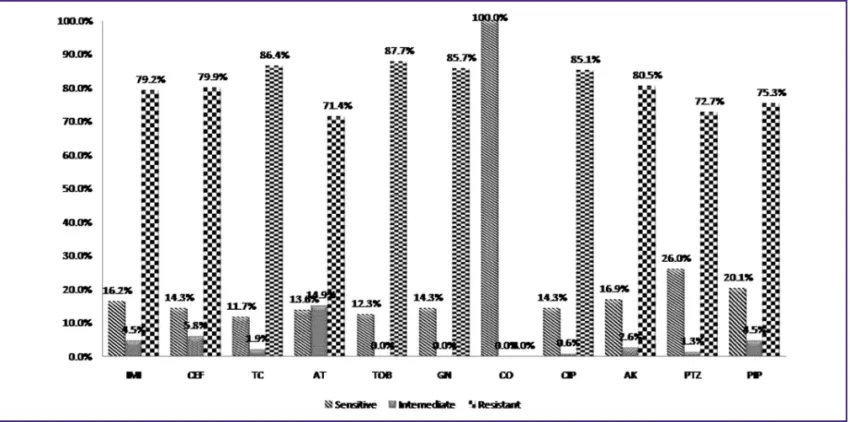
Figure 1. The susceptibility status of the isolates against 11 studied antibiotics according to disk diffusion. IMI, imipenem; CEF, cefepime; TC, ticarcil- lin; AT, aztreonam; TOB, tobramycin; GN, gentamicin; CO, colistin; CIP, ciprofloxacin; AK, amikacin; PTZ, piperacillin-tazobactam; PIP, piperacillin.
nosa ATCC 27853 and PAO1 was used as reference strain [19].
Both of these methods were carried out according to the guidelines established by the clinical and laboratory stan- dards institute (CLSI) [20]. The latter synergy tests were per- formed in order to check the contribution of efflux pumps to the resistance to FQs, Beta-lactams and Aminoglycosides that are selectively extracted by FQ mediated efflux pumps com- monly found in pseudomonads [ 21].
3. PCR for Mex-Opr efflux systems
To investigate the ratio between existing the different EPs genes and overexpressed efflux pumps ranges, all the isolates were tested by PCR for the presence of MexA, MexC and MexE genes, which are representative of MexAB-OprM, Mex- CD-OprJ and MexEF-OprN efflux systems respectively, using previously described primers [18, 22]. Primer designation and their sequences are shown in Table 1.
Results
154 strains of P. aeruginosa were isolated from hospitalized burned patients and confirmed using biochemical tests and confirmatory PCR assays. The antibiogram results represent- ing 143 (92.8%) of the P. aeruginosa isolates exhibiting resis- tance to two or more antibiotics. According to our anti- biogram results, all of the isolates only were susceptible to colistin. The most resistance was seen against tobramycin (87.7%) and the least resistance was seen against aztreonam (71.4%).The preliminary results of ciprofloxacin susceptibility test using the disk agar diffusion method showed that 85.1% of the P.aeruginosa strains were resistant to this antibiotic. Fig-
ure 1 summarizes the susceptibility status of the isolates against 11 studied antibiotics according to disk diffusion method. MIC for ciprofloxacin ranged from 0.5 to 128 mg/L, According to the established breakpoint values recommended by CLSI [20]. The P.aeruginosa isolates with MIC ≥ 4 mg/L are considered as ciprofloxacin resistant. The preliminary results of ciprofloxacin susceptibility test using the MIC method showed that 127 (82.5%) of the P. aeruginosa strains were re- sistant to this antibiotic. Results of Synergy tests indicated that by using CCCP as EPI, the MICs of ciprofloxacin for 51 (61%) of the ciprofloxacin resistant isolates decreased (2 to 256 folds) on the CCCP-supplemented plate. Table 2 shows the Ef- fects of CCCP on the Ciprofloxacin MIC reduction in cipro- floxacin resistant isolates of P. aeruginosa. Also in other syn- ergy tests by using CCCP and other antibiotics, we observed increased susceptibility of random selected ciprofloxacin re- sistant isolates to selected antibiotics as markers for beta-lact- ams [imipenem (IMI) & cefepime (CEF)] and Aminoglyco- sides [gentamicin (GEN)]. Table 3 shows the MIC values for ciprofloxacin measured in the absence and in the presence of 12.5 µm CCCP as efflux pump inhibitor in clinical strains of P.
aeruginosa. The MexA, MexC and MexE genes were ampli- fied by PCR in 147 (95.4%) isolates simultaneously, and 5 (3.2%) isolates revealed the presence of MexA and MexE si- multaneously. 1 (0.6%) isolate had only the MexE gen and 1 (0.6%) had none of the Mex genes. All of the ciprofloxacin re- sistant isolate had MexA, MexC and MexE genes simultane- ously.
Discussion
The findings of the present study clearly show the high inci- dence of resistant P. aeruginosa strains in burned patients for most of the antibiotics tested. It seems that resistance of P.
aeruginosa to most therapeutically antibiotics is common in burned patients of Iran. Almost of the isolates were resistant to two or more antibiotics tested, except colistin showing the highest (100%) antibacterial activity. Only 8 (5.2%) P. aerugi- nosa isolates were fully susceptible. In case of ciprofloxacin as an important therapeutically choice for P. aeruginosa we ob- served resistance among 85% of isolates and all of ciprofloxa- cin-resistant P. aeruginosa were resistant to one or more oth- er tested antibiotics except colistin with no detected resistance.
It could be a reason to approve our hypothesis that the FQ re- sistant among P. aeruginosa isolated from burn wound infec- tions could be in coordinate with resistance to other existing Table 2. Effects of CCCP on the Ciprofloxacin MIC in resistant isolates of
P. aeruginosa
Ciprofloxacin Resistant isolates, No. (%)
Fold reduction in MIC + CCCP
49 (39%) 0
42 (33%) 2
10 (8%) 4
4 (3%) 8
5 (4%) 16
8 (6%) 32
1 (1%) 64
0 (0%) 128
8 (6%) 256
CCCP, carbonyl cyanide-m-chlorophenylhydrazone; MIC, minimal inhibitory con- centration.
antipseudomonal agents through overexpression of FQ medi- ated multidrug efflux pumps, because these efflux pumps have broad substrate specificity, and extrude many antibiotic classes including B-lactams, quinolones and aminoglyco- sides[18]. Widespread use of FQ agents could be one of the main reasons to inducing FQ resistance among P. aeruginosa isolated from burn wound infections, so it has an adverse col- lateral effect on the susceptibility of P. aeruginosa to other ex- isting antipseudomonal agents through FQ selected overex- pression of multidrug efflux pumps. To more examination of this assumption, we employed the EPI compound, CCCP, to phenotypic investigation of efflux pump-overexpressed in clinical isolates of P. aeruginosa. Its why that the susceptibility of P. aeruginosa strains to antimicrobial agents can be signifi- cantly enhanced by pump inactivation [21]. According to our observations, many of clinical isolates of P. aeruginosa with a wide range of resistance phenotypes showed increased sus- ceptibilities to ciprofloxacin in the presence CCCP and the MIC of more than half of ciprofloxacin resistant strains de- creased two or more fold and the ratio of sensitive strains in- creased from 25% to 51%. The result of synergy tests observed
between CCCP and ciprofloxacin approved its selective extru- sion by the above efflux systems contribute to the ciprofloxa- cin resistance. The genetically investigation of existence of MexA, MexC and MexE genes, which are representative of MexAB-OprM, MexCD-OprJ and MexEF-OprN efflux systems respectively, showed that all of ciprofloxacin resistant strains have these 3 Mex genes simultaneously, but according to phe- notypic investigation of efflux pump, half of them showed overexpression of multidrug efflux pumps, so fortunately some of Eps are yet inactive. Also Increased susceptibility of ciprofloxacin resistant P. aeruginosa isolates to selected anti- biotics as markers for Beta-lactams [imipenem (IMI) &
cefepime (CEF)] and Aminoglycosides [gentamicin (GEN)], in the presence of CCCP implied multidrug extrusion by differ- ent active FQ mediated efflux pump in FQ resistant strains.
After the addition of CCCP, the accumulation of antibiotics could have increased, and thus led to lower MICs for P. aeru- ginosa isolates. Inhibition of efflux by CCCP in some isolates brought MICs down even to a level similar to those sensitive strains of P. aeruginosa. So efflux pumps have an important role in FQ resistant isolates of P. aeruginosa as an important Table 3. Ciprofloxacin resistant strains of P. aeruginosa used in this study and MICs of the four antibiotics selected as markers for Beta-lactams [Imi- penem (IMI) & Cefepime (CEF)], Fluoroquinolones [Ciprofloxacin (CIP)] and Aminoglycosides [Gentamicin (GEN)] tested in the absence or in the presence of the efflux inhibitor CCCP
Strains
MIC (mg/L)
IMI CEF CIP GEN
-CCCP +CCCP -CCCP +CCCP -CCCP +CCCP -CCCP +CCCP
208 256 4 1,024 0.5 128 0.5 4 2
209 128 4 1,024 0.5 128 0.5 1,024 1
211 256 4 1,024 0.5 128 0.5 1,024 1
212 256 2 1,024 0.5 128 0.5 1,024 1
215 256 8 1,024 8 128 0.5 1,024 1
322 128 128 1,024 0 128 0.5 32 1
477 256 4 512 512 8 0.5 256 128
481 32 8 64 32 16 2 1,024 512
483 32 8 64 64 16 1 1,024 512
488 128 8 64 32 16 0.5 128 64
517 256 128 1,024 512 8 0.5 256 256
520 256 128 1,024 1,024 16 0.5 256 256
529 128 64 512 256 16 0.5 128 16
538 256 256 1,024 512 16 0.5 256 128
539 64 4 512 256 16 0.5 128 128
599 128 64 1,024 64 16 0.5 128 64
PAO1 2 2 0.5 0.5 1 1 2 2
-CCCP, in the absence of carbonyl cyanide-m-chlorophenylhydrazone; +CCCP, in the presence of carbonyl cyanide-m-chlorophenylhydrazone.
and clinically refractory organism. A major beneficial conse- quence of inhibition of multiple efflux pumps demonstrated in this study is a notable decrease in the frequency of emer- gence of P. aeruginosa strains with clinically relevant levels of resistance to fluoroquinolones, also the efflux pump inhibitors appears to be an attractive approach to improvement of the clinical efficacies of other antibiotics that are substrates of such pumps [23]. Because the FQs are universal substrates for all known Mex pumps [10, 12]. Thus, FQ exposure as one of the main reasons to inducing FQ resistance among P. aerugi- nosa isolated from burn wound infections, could has the pos- sibility to select for mutants with the multidrug resistant phe- notype via efflux pump overexpression. By inhibiting Efflux pumps in combination with antibiotic therapy we could over- come some resistance among P. aeruginosa isolates. However we should consider the prevalence of efflux mediated resis- tance, besides other mechanisms that contribute to resistance to a particular antibiotic and interactions between different mechanisms of resistance. From our experience with clinical isolates of P. aeruginosa recovered from burned patients, it is evident that the utility of Efflux pump inhibitors should be in combination with antibacterial agents for antibacterial thera- py; these compounds may prove to be very useful for study of the contribution and prevalence of efflux in acquired and in- trinsic resistance to multiple antibiotics in other gram-nega- tive bacteria.
Most of resistance to FQs among pseudomonades contrib- ute to constitutively expressed efflux pumps. Therefore, efflux pump inhibitors are expected to enhance the activities of FQs.
FQ mediated efflux pumps from other gram negative bacteria also belong to the same family of transporters. This increases the possibility that a single inhibitor might be active against multiple efflux pumps [23]. While initial reports have demon- strated the multifactorial benefits of the Efflux pump inhibitor approach in combating drug resistance; substantial efforts are needed before inhibitors can be used clinically. Our efforts are focused on the evaluation of the activities of the CCCP agent.
Should our preliminary observations be confirmed in larger studies, it could be of importance to the ongoing efforts to elu- cidate the mechanisms of Efflux pumps mediated resistance development and identify clinically applicable inhibitors.
Acknowledgement
The authors would like to acknowledge to Iran University of Medical Sciences, for supporting this research. Also, we grate-
fully acknowledge to Antimicrobial Resistant Research Centre staffs for their co operations.
ORCID
Maryam Adabi http://orcid.org/0000-0002-5083-9061 Ali Majidpour http://orcid.org/0000-0001-7440-1817
References
1. Askoura M, Mottawea W, Abujamel T, Taher I. Efflux pump inhibitors (EPIs) as new antimicrobial agents against Pseudomonas aeruginosa. Libyan J Med 2011;6:5870.
2. Fagon JY, Chastre J, Wolff M, Gervais C, Parer-Aubas S, Stéphan F, Similowski T, Mercat A, Diehl JL, Sollet JP, Te- naillon A. Invasive and non-invasive strategies for man- agement of suspected ventilator associated pneumonia.
Ann Intern Med 2000;132:621-30.
3. Harris A, Torres-Viera L, Vekataraman L, DeGirolami P, Samore M, Carmeli Y. Epidemiology and clinical out- comes of patients with multiresistant Pseudomonas aeru- ginosa. Clin Infect Dis 1999;28:1128-33.
4. Hancock RE. Resistance mechanisms in Pseudomonas aeruginosa and other non fermentative gram-negative bacteria. Clin Infect Dis 1998;27 (Suppl 1):S93-9.
5. Sefton AM. Mechanisms of antimicrobial resistance: their clinical relevance in the new millennium. Drugs 2002;62:
557-66.
6. Kriengkauykiat J, Porter E, Lomovskaya O, Wong-Beringer A. Use of an efflux pump inhibitor to determine the prev- alence of efflux pump-mediated fluoroquinolone resis- tance and multidrug resistance in Pseudomonas aerugi- nosa. Antimicrob Agents Chemother 2005;49:565-70.
7. Köhler T, Michea-Hamzehpour M, Plesiat P, Kahr AL, Pechere JC. Differential selection of multidrug efflux sys- tems by quinolones in Pseudomonas aeruginosa. Antimi- crob Agents Chemother 1997;41:2540-3.
8. Chuanchuen R, Narasaki CT, Schweizer HP. The MexJK ef- flux pump of Pseudomonas aeruginosa requires OprM for antibiotic efflux but not for efflux of triclosan. J Bacte- riol 2002;184:5036-44.
9. Li Y, Mima T, Komori Y, Morita Y, Kuroda T, Mizushima T, Tsuchiya T. A new member of the tripartite multidrug ef- flux pumps, MexVW-OprM, in Pseudomonas aeruginosa.
J Antimicrob Chemother 2003;52:572-5.
10. Poole K. Efflux-mediated resistance to fluoroquinolones
in gram negative bacteria. Antimicrob Agents Chemother 2000;44:2233-41.
11. Gotoh N, Tsujimoto H, Tsuda M, Okamoto K, Nomura A, Wada T, Nakahashi M, Nishino T. Characterization of the MexC-MexD-OprJ multidrug efflux system in Delta- mexA-mexB-oprM mutants of Pseudomonas aerugino- sa. Antimicrob Agents Chemother 1998;42:1938-43.
12. Schweizer H.P. Efflux as a mechanism of resistance to an- timicrobials in Pseudomonas aeruginosa and related bacteria: unanswered question. Genet Mol Res 2003;2:48- 62.
13. Ikonomidis A, Tsakris A, Kanellopoulou M, Maniatis AN, Pournaras S. Effect of the proton motive force inhibitor carbonyl cyanide-m-chlorophenylhydrazone (CCCP) on Pseudomonas aeruginosa biofilm development. Lett Appl Microbiol 2008;47:298-302.
14. Pagès JM, Masi M, Barbe J. Inhibitors of efflux pumps in Gram-negative bacteria. Trends Mol Med 2005;11:382-9.
15. Barrow G, Feltham R. Characters of gram-negative bacte- ria in Cowan & steel manual for identification of medical bacteria. 3rd ed. Cambridge, UK: 2003;130-1.
16. De Vos D, Lim A Jr, Pirnay JP, Struelens M, Vandenvelde C, Duinslaeger L, Vanderkelen A, Cornelis P. Direct detection and identification of Pseudomonas aeruginosa in clinical samples such as skin biopsy specimens and expecto- rations by multiplex PCR based on two outer membrane lipoprotein genes, oprI and oprL. J Clin Microbiol 1997;35:
1295-9.
17. Hancock RE, Nikaido H. Outer membranes of gram-neg- ative bacteria. XIX. Isolation from Pseudomonas aerugi- nosa PAO1 and use in reconstitution and definition of
the permeability barrier. J Bacteriol 1978;136:381-90.
18. Pournaras S, Maniati M, Spanakis N, Ikonomidis A, Tassios PT, Tsakris A, Legakis NJ, Maniatis AN. Spread of efflux pump-overexpressing, non-metallo-beta-lactamase-pro- ducing, meropenem-resistant but ceftazidime-susceptible Pseudomonas aeruginosa in a region with blaVIM ende- micity. J Antimicrob Chemother 2005;56:761-4.
19. Bonfiglio G, Carciotto V, Russo G, Stefani S, Schito GC, Debbia E, Nicoletti G. Antibiotic resistance in Pseudomo- nas aeruginosa: an Italian survey. J Antimicrob Chemoth- er 1998;41:307-10.
20. Clinical and Laboratory Standards Institute. Performance standards for antimicrobial susceptibility testing; twen- ty-second informational supplement. Wayne, PA: CLSI;
2010.
21. Masuda N, Sakagawa E, Ohya S, Gotho N, Tsujimoto H, Nishino T. Substrate specificities of MexAB-OprM, Mex- CD-OprJ, and MexXY-OprM efflux pumps in Pseudomonas aeruginosa. Antimicrob Agents Chemother 2000;44:3322-7.
22. Quale J, Bratu S, Landman D, Heddurshetti R. Molecular epidemiology and mechanisms of carbapenem resistance in Acinetobacter baumannii endemic in New York City.
Clin Infect Dis 2003;37:214-20.
23. Lomovskaya O, Warren MS, Lee A, Galazzo J, Fronko R, Lee M, Blais J, Cho D, Chamberland S, Renau T, Leger R, Hecker S, Watkins W, Hoshino K, Ishida H, Lee VJ. Identi- fication and characterization of inhibitors of multidrug re- sistance efflux pumps in Pseudomonas aeruginosa: novel agents for combination therapy. Antimicrob Agents Chemother 2001;45:105-16.