Effect of frequency dependent multipath fading on non-coherent underwater communication system
주파수 종속 다중경로 페이딩이
비코히어런트 수중통신시스템에 미치는 영향
Jongjoo Kim, Jihyun Park, Minja Bae, Kyu-Chil Park, and Jong Rak Yoon
†
(김종주, 박지현, 배민자, 박규칠, 윤종락
†
)
Department of Information and Communications Engineering, Pukyong National University (Received April 29, 2016; revised May 23, 2016; accepted June 14, 2016)
ABSTRACT: Underwater acoustic communication channel is often defined as a multipath fading channel since the multipath arrivals from various paths interfere with each other and cause frequency dependent constructive or destructive interference in received signals. Therefore signal-to-noise ratio (SNR) of received signal fluctuates as a function of frequency. In addition, sea surface fluctuation induces frequency dependent time variant signal fading due to coherent component variation of surface bounce path. The frequency shift keying (FSK) system is known to be less sensitive and more robust under these interference and fading, and M-ary frequency shift keying (MFSK) system is adopted to increase a data rate. In this study, a bit error rate (BER) of 4 channels 4FSK system are examined in shallow sea multipath channel. Experimental results show that RS code reduces efficiently the BER of 4FSK system since frequency dependent time-varying fading is characterized to give burst errors. The BER of a different data rate or different source-to-receiver range depends on not only the channel coherent bandwidth but also frequency dependent multipath fading.
초 록: 수중음향 채널은 다양한 경로들이 상호 간섭하여 주파수에 따른 보강 또는 상쇄 간섭을 보이는 다중경로 페이딩 채널로 정의된다. 따라서 수신신호의 신호 대 잡음비는 주파수에 따라 변화한다. 아울러 해면변동은 해면 반사 경로의 코히어런트 성분의 주파수에 따른 시변 페이딩을 야기한다. 주파수 편이 키잉 시스템은 이러한 간섭과 페이딩 에 덜 민감하여 강인한 시스템으로 알려져 있으며 전송률을 높이기 위해 다진 주파수 편이 키잉 시스템으로 사용되고 있다. 본 연구에서는 4 채널 4진 주파수 편이 키잉 시스템의 비트오류율을 천해 다중경로 채널에서 실험하였다. 실험 결과 주파수 종속 시변 수중 음향 다중경로 페이딩은 연집오류를 발생시키는 특성을 보여 리드 솔로몬 코드가 4진 주파 수 편이 키잉 시스템의 비트오류율을 효과적으로 경감시키는지를 보였다. 따라서 데이터 전송율 혹은 송수신기 거리 에 따른 비트 오류율은 채널의 대역폭뿐만 아니라 주파수 종속 다중 경로 페이딩에 좌우됨을 보인다.
핵심용어: 수중음향통신, 다중경로 페이딩 채널, 주파수 편이 키잉, 심벌간 간섭, 리드 솔로몬 코드
†Corresponding author: Jong Rak Yoon ([email protected]) Department of Information and Communications Engineering, Pukyong National University, 45 Yongso-ro, Nam-gu, Busan 48513, Republic of Korea
(Tel: 82-51-629-6233, Fax: 82-51-620-6470)
I. Introduction
In underwater acoustic communication system, multipath
fading is an important consideration, particularly in shallow
water environments.
[1-3]
Firstly, the multipath delay spread
can cause inter-symbol interference (ISI) if the symbol rate
(2)
Fig. 1. Configuration of the experiment.
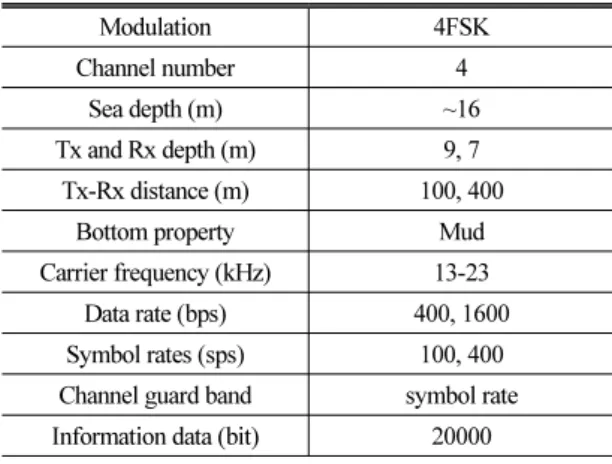
Table 1. Parameters of the experiment
Modulation 4FSK
Channel number 4
Sea depth (m) ~16
Tx and Rx depth (m) 9, 7
Tx-Rx distance (m) 100, 400
Bottom property Mud
Carrier frequency (kHz) 13-23 Data rate (bps) 400, 1600 Symbol rates (sps) 100, 400 Channel guard band symbol rate Information data (bit) 20000
increases for high speed communication. Secondly, the transmitter or receiver motion and sea surface fluctuations can result in Doppler spread and signal amplitude fading which can lead to an incorrect symbol decoding. Thirdly, the multipath arrivals from various paths interfere with each other and cause constructive and destructive interference in received signals which results in significant fluctuations in signal-to-noise ratio (SNR). All the resultant ISI, amplitude fading, and interference occur simultaneously in high speed communication. Furthermore, medium properties such as salinity and temperature change with time. Therefore multipath propagation delay changes with time. All of these factors can result in frequency and surface fluctuation dependent multipath fading.
[4,5]
The frequency shift keying (FSK) system is known to be less sensitive to the fading channel and more robust to combat the effects of time-varying shallow water in frequency non-selective multipath fading channel.
[6-10]
However, the FSK signaling scheme has a disadvantage owing to its low speed data rate. M-ary frequency shift keying (MFSK) is adopted to increase a data rate for a single user.
[11]
The Reed-Solomon (RS) code is a non-binary forward error correction code and effective to reduce errors such as in deep fading channels which induces burst error. The RS code is generally specified by three parameters (n, k, t), where n is the block code length, k is the length of information symbols and t is the length of error correcting symbols. n-k and t = (n-k)/2 are the measure of redundancy in the block and the number of correctable symbols, respectively.
[12,13]
A quadrature phase shift keying (QPSK)
with a convolution (2,1,3) and RS code (7,3,2) has been examined and it has been found that the latter code shows the better performance in multipath fading channel. However, frequency dependent multipath fading effect on the performance is not conclusive.
[14-16]
In this paper, we consider 4 channels MFSK (M = 4) system with and without RS code in shallow sea multipath fading channel. Experimental results show how the frequency dependent time-varying underwater acoustic multipath fading channel affects the bit error rate (BER) of MFSK communication system with RS code.
II. Experimental procedure
The experiment was conducted in about 16 m depth
ocean near Geoje island in Korea on OCT. 17, 2015. The
experimental configuration and parameters are shown in
Fig. 1 and Table 1. Fig. 2 shows the typical sea surface
photograph with 20 cm diameter plastic buoy. The ranges
(3)
Fig. 2. Typical sea surface with a plastic buoy.
Fig. 3. Lena image divided into four parts to be transmitted by four channels.
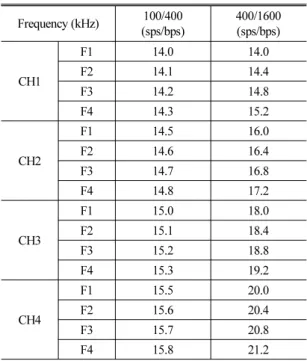
Table 2. Orthogonal frequency groups of 4 channels 4FSK for each data rate (kHz).
Frequency (kHz) 100/400 (sps/bps)
400/1600 (sps/bps)
CH1
F1 14.0 14.0
F2 14.1 14.4
F3 14.2 14.8
F4 14.3 15.2
CH2
F1 14.5 16.0
F2 14.6 16.4
F3 14.7 16.8
F4 14.8 17.2
CH3
F1 15.0 18.0
F2 15.1 18.4
F3 15.2 18.8
F4 15.3 19.2
CH4
F1 15.5 20.0
F2 15.6 20.4
F3 15.7 20.8
F4 15.8 21.2
between the transmitter (Tx) and the receiver (Rx) are set to be about 100 and 400 m. The depth of Tx and Rx are set to be 9 and 7 m, respectively. In both ranges, the Tx and Rx are fixed to avoid Doppler spread by their motion.
Fig. 3 shows the segmented Lena image allocated to each channel which has a set of 4FSK orthogonal frequencies.
The orthogonal frequency spacing is given by 1/T (T:
symbol period) and all four channel signals are transmitted simultaneously. Frequency guard-band between channels is inserted by 1/T to reduce inter-channel interference. To minimize an effect of time variant underwater channel and characterize the frequency dependent multipath fading effect on 4FSK system, each frame which consists of a synchronization and information signal, is limited as a length of 1s.
Table 2 shows orthogonal frequency groups for each data rate. Transmitting frequency covers from 14 to 21.2 kHz.
In order to estimate channel impulse response and frequency response (channel coherence bandwidth), a linear frequency modulated (LFM) signal of 13 to 23 kHz bandwidth was transmitted before information signal transmitting. The LFM signals were also used to get symbol synchronization and interference and frequency selective fading patterns.
III. Results and discussion
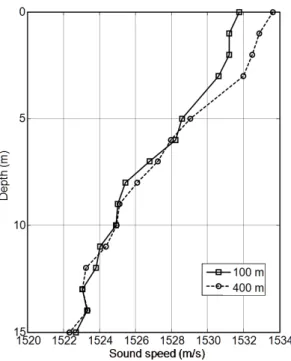
Fig. 4 shows the sound velocity profile. The channel impulse response was analyzed by multipath intensity profile (MIP) which is given by matched filtering the received LFM signal with the transmitted LFM signal. Fig.
5 shows the eigenray trace and the MIPs of 100 and 400 m Tx-Rx ranges, respectively. In Fig. 5(a) and (c), the numerical value of each eigenray means the first bounce grazing angle of a multipath with respect to the boundary plane.
The angle of the direct path is measured in the horizontal
direction. Only the arrival paths with the five highest that
may show high signal amplitudes are shown. Table 3
shows the relative time delay (ms) and grazing angle of
each eigenray at 100 and 400 m source-to-receiver ranges.
(4)
(a)
(b)
(c)
(d)
Fig. 5. Eigenray traces and multipath intensity profiles (MIPs): (a) eigenray trace of 100 m, (b) MIP of 100 m, (c) eigenray trace of 400 m, and (d) MIP of 400 m.
Fig. 4. The sound velocity profile.
Comparing the relative delay time of each eigenray in Table 3 to MIPs in Fig. 5(b) and (d), only first three eigenrays are observed at 100 m but five eigenrays at 400 m. The first strong signal of direct path is pretty stable in both cases. Owing to high intensity with low grazing angle, more path signals are observed in 400 m range. The fourth and fifth eigenrays are not observed at 100 m but additional eigenray with relative delay time of about 2 ms is observed at 400 m.
The channel frequency response spectra for both MIPs in Fig. 5 are shown in Fig. 6. In Fig. 6 it shows one side spectra and -3 dB bandwidths are about 60 and 72.5 Hz in 100 and 400 m ranges, respectively. Based on this result, channel coherence bandwidths at 100 and 400 m are considered as 120 and 145 Hz, respectively.
The signal bandwidth of 4FSK is about one fourth of data rate. Therefore 400 bps signal satisfy frequency non selective channels at 100 and 400 m but the 1600 bps signals not at both ranges. In theory, the signal of 400 bps data rate will be received without ISI and no error condition under high SNR. But in practice this is insufficient for no error condition owing to frequency dependent multipath fading and it will be explained below in Fig. 8 and Table 4.
Fig. 7 shows normalized receiving signal spectra of
LFM signal at both Tx-Rx ranges. Frequency responses of
LFM signal, hydrophone (B & K 8106) and power amplifier
(5)
Table 3. Relative time delay (ms) and first bounce grazing angle of each eigenray shown in Fig. 5(a) and 5(c).
Eigenray label number in Fig.
5(a) and 5(c)
① ② ③ ④ ⑤
100 m
Delay (ms) 0.0 1.0 1.0 2.8 3.5 Grazing angle
(°) 1.4 9.4 -9.4 18.3 -16.4
400 m
Delay (ms) 0.0 0.2 0.2 0.8 1.1 Grazing angle
(°) 0.4 2.4 -2.4 4.4 -4.4
Fig. 6. The channel coherence bandwidths in 100 and 400 m Tx-Rx ranges.
(a)
(b)
Fig. 7. Normalized spectra of received LFM signal in 100 and 400 m Tx-Rx ranges: (a) 100 m, (b) 400 m (frequency groups of 4 CHs of 400 bps).
Table 4. Received image of each channel and BERs without RS code (Data bits: 20000).
4CH-4FSK 400 bps 1600 bps
100 m
Error number 1185/20000 2353/20000
BER 0.06 0.12
400 m
Error number 0/20000 1072/20000
BER 0 × 0.05
(B & K 2713) are flat in frequency band of 13 to 23 kHz.
However, the envelope of overall level of the spectrum in Fig. 7 is weighted as to the source transducer frequency and shows the maximum level at about 17 kHz which is the resonant frequency of transducer (ITC 1001). The multipath interference or fading depends on frequency and Tx-Rx range. The dip and the maxima in spectra correspond to destructive and constructive multipath interference fre- quencies. Interference pattern of 400 m is more complicate that that of 100 m owing to the more multi-paths. The level difference between dip and maxima reaches up to more than 6 dB. Therefore, if carrier frequency locates in construc- tive frequency, then signal energy is more than 6 dB higher to destructive frequency resulting in the higher SNR.
The frequency groups of 4 CHs of 400 bps are designated as shown in Fig. 7 for both ranges. At 100 m, frequency groups of CH1 (14 -14.3 kHz) and CH3 (15-15.3 kHz) at
100 m are in destructive frequency but CH2 (14.5-14.8
kHz) and CH4 (15.5-15.8 kHz) in constructive frequency
(6)
Time (ms) (a)
Time (ms) (b)
Time (ms) (c)
Time (ms) (d)
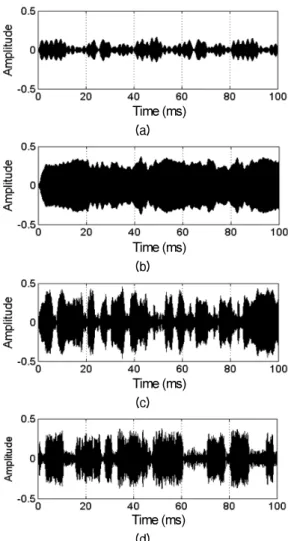
Fig. 8. Received signals waveforms at 100 m: (a) CH1/400 bps, (b) CH2/400 bps, (c) CH1/1600 bps, (d) CH2/1600 bps.
region. At 400 m, frequency groups of all 4 channels are in constructive frequency region.
Table 4 shows the received images and BERs without RS code of two different data rates at 100 and 400 m Tx-Rx ranges.
At 100 m and 400 bps, the errors occur in CH1 and CH3 since corresponding carrier frequencies are in the destructive or the lower SNR frequency region as shown in Fig. 7. The symbol energy level of CH1 is the lowest which is as low as -10 dB to CH2, so CH1 shows the most errors. Figs. 8(a) and (b) show the received symbol signal waveforms of CH1 and CH2. The signal level of CH1 is lower than that of CH2 since the carrier frequencies of CH1 and CH2 are in destructive and constructive interference region,
respectively. Fading is observed in both channel signal envelopes with time owing to sea surface fluctuation even if the channel is flat.
At 100 m and 1600 bps, the channels are frequency selective. The errors occur randomly as shown in image of each channel. Fig. 8(c) and (d) show the received symbol signal waveforms of CH1 and CH2. Both channel signals exhibit large variation because of both ISI and frequency dependent constructive or destructive interference. The four orthogonal frequencies of each channel have a chance to meet a dip frequency to give the lower SNR. Fading is also observed in both channel signal envelopes with time but its magnitude is larger than that at 400 bps since fading is due to sea surface fluctuation, ISI, and frequency dependent interference.
At 400 m, the bit errors of 400 and 1600 bps are less than those at 100 m, since the frequency selectivities of channels at 400 m less than those at 100 m.
In conclusion, the bit error depends on frequency selectivity or ISI, frequency dependent interference, and sea surface fluctuation. A random error correcting code may be effective in frequency non selective and relatively calm sea state channel in which fading magnitude is small.
However, a burst error correcting code will be more effective since fading magnitude will become large in frequency selective, rough sea state, and frequency dependent interference channel. Therefore, non-binary code such as RS code corrects efficiently these burst errors in frequency dependent multipath fading channel.
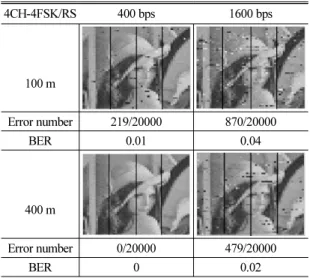
Table 5 shows the received images and BERs using RS
code (7,3,2). Comparing to the results in Table 3, the BERs
were reduced at least one third in both ranges and both data
rates. The 400 bps errors of CH1 and CH3 at 100 m which
are due to the destructive interference, are reduced by
adopting non binary RS code. The 1600 bps errors are also
reduced and RS code may correct the burst errors in deep
fading region as shown in Fig. 8(c) and (d). Therefore the
RS code is very useful to resist frequency dependent
multipath fading and ISI.
(7)
Table 5. Received image of each channel and BERs with RS code (Data bits: 20000).
4CH-4FSK/RS 400 bps 1600 bps
100 m
Error number 219/20000 870/20000
BER 0.01 0.04
400 m
Error number 0/20000 479/20000
BER 0 0.02
IV. Conclusions
Four channel 4FSK system for two different data rates was examined at two Tx-Rx ranges in time varying shallow water multipath channel. The frequency dependent multipath fading channel is characterized on basis of channel impulse response, coherence bandwidth, frequency dependent interference and signal waveform. The bit error of a different data rate or different Tx-Rx range depends on not only the channel coherent bandwidth but also frequency dependent multipath fading. Non binary RS error correcting code is adopted since the errors occur as burst in frequency selective, rough sea state, and frequency dependent interference channel. Bit error rate is reduced at least one third by adopting RS code.
Acknowledgement
This research was supported by the ‘ISABU Creative Research Program (PE99361)’ of the Korea Institute of Ocean Science & Technology (KIOST).
References
1. M. Stojanovic and J. Preisig, “Underwater acoustic communi- cation channels: Propagation models and statistical characteri-
zation,” IEEE Commun. Mag. 47, 84-89 (2009).
2. J. Park, K. Park, and J. R. Yoon, “Underwater acoustic communication channel simulator for flat fading,” Jpn. J.
Appl. Phys. 49, 07HG05 (2010).
3. P. A. van Walree, “Propagation and scattering effects in underwater acoustic communication channels,” IEEE J.
Oceanic Eng. 38, 614-631 (2013).
4. M. Badiey, S. E. Forsythe, M. B. Porter, and the KauaiEx Group, “Ocean variability effects on high ‐frequency acoustic propagation in KauaiEx,” in AIP Conf. Proc. 728, 322-325 (2004).
5. H. Medwin and C. S. Clay, Fundamentals of Acoustical Oceanography (Academic Press, New York ,1997), Chap.
13.
6. D. B. Kilfoyle, and A. B. Baggeroer, “The state of the art in underwater acoustic telemetry,” IEEE J. Oceanic Eng. 25, 1-27 ( 2000).
7. M. Siderius, M. B. Poter, P. Hursky, V. McDonald, and the KauaiEx Group, “Effects of ocean thermocline variability on noncoherent underwater acoustic communications,” J.
Acoust. Soc. Am. 121, 1895-1908 (2007).
8. J. Kim, K. Park, J. Park, and J. R. Yoon, “Coherence bandwidth effects on underwater image transmission in multipath channel,” Jpn. J. Appl. Phys. 50, 07HG05 (2011).
9. K. Park, J. Park, S. W. Lee, J. W. Jung, J. Shin and J. R.
Yoon, “Performance evaluation of underwater acoustic communication in frequency selective shallow water” (in Korean), J. Acoust. Soc. Kr. 32, 95-103 (2013).
10. C. Seo, J. Park, K. Park, and J. R. Yoon, “Performance of CODM in underwater acoustic channel with frequency selective fading” (in Korean), J. Acoust. Soc. Kr. 32, 377-384 (2013).
11. T. S. Pappaport, Wireless Communications, 2nd Ed. (IEEE, 1996), Chap.6. and Chap.7.
12. S. Lin and D. J. Costello Jr, Error Control Coding (Prentice-Hall, New Jersey, 1983), pp. 171.
13. J. G. Proakis and M. Salehi, Digital Communications, 5th Ed. (McGraw-Hill, New York, 2014) , pp. 471.
14. C. Seo, J. Park, K. Park, and J. R. Yoon, “Performance comparison of convolution and Reed-Solomon codes in underwater multipath fading channel,” Jpn. J. Appl. Phys.
53, 07KG02 (2014).
15. M. Bae, X. Dandan, J. Park, and J. R. Yoon, “Multipath fading channel characterization and performances of forward error correction codes in very shallow water,” J.
Korea Inst. Inf. Commun. Eng. 19, 2247-2255 (2015).
16. N Nasri, L Andrieux, A Kachouri, and M Samet, “Efficient
encoding and decoding schemes for wireless underwater
communication systems,” in 2010 7th international multi-
conference on systems, signals and Devices, 1-6 (2010).
(8)
Profile
▸JongJoo Kim (김 종 주)
He received the B.S. and M.S. degrees in Department of Information and Communications Engineering from Pukyong National University, Busan, Korea in 1993 and 2015, respectively. From 1997 to 2002, he has been a research engineer, R&D Center, LGUPlus Corporation.
From 2002 to 2012, he has worked in Xener Systems. Since 2013, he has been CEO, Newdeas Corporation.. His current research interests include underwater signal processing and real-time packet processing.
▸Jihyun Park (박 지 현)
He received the B.S. degree in Telematics engineering from Busan National University in 2000, and the M.S. and Ph.D. degrees in Information and Communications En- gineering from Pukyong National University in 2002 and 2008, respectively. His current research interests include underwater signal processing and underwater acoustic communi- cation system design.
▸Minja Bae (배 민 자)
She received the B.S. and M.S. degrees in Department of Information and Communica- tions Engineering from Pukyong National University, Busan, Korea in 1993 and 1995, respectively. Since 2007, she has been CEO, Genietech Corporation. Her current research interests include underwater signal processing and speech signal processing.
▸Kyu-Chil Park (박 규 칠)
He received the B.S. and M.S. degrees in Department of Electronic Engineering from Pukyong National University, Busan, Korea in 1993 and 1995, respectively and the Ph.D. degree in Division of Science and Technology for Intelligence, Graduate School of Natural Science and Technology from Okayama University, Okayama, Japan in 2000. Since 2002, he has been a Professor in Department of Information and Communi- cations Engineering, Pukyong National University, Busan, Korea. His research interests include Underwater Acoustic Signal Processing, Adaptive Signal Processing, Numerical Analysis, Optimization and Inverse Problem in Engineering.
▸Jong Rak Yoon (윤 종 락)
He received the M.S. and Ph.D degrees in ocean engineering from Florida Atlantic University in 1987 and 1990, respectively.