• 검색 결과가 없습니다.

Surgical Outcomes for Native Valve EndocarditisBong Suk Park, M.D., Won Yong Lee, M.D., Ph.D., Yong Joon Ra, M.D., Hong Kyu Lee, M.D., Byung Mo Gu, M.D., Jun Tae Yang, M.D.

N/A
N/A
Protected

Academic year: 2021

Share "Surgical Outcomes for Native Valve EndocarditisBong Suk Park, M.D., Won Yong Lee, M.D., Ph.D., Yong Joon Ra, M.D., Hong Kyu Lee, M.D., Byung Mo Gu, M.D., Jun Tae Yang, M.D."

Copied!
7
0
0

로드 중.... (전체 텍스트 보기)

전체 글

(1)

KJTCVS

The Korean Journal of Thoracic and Cardiovascular Surgery

Clinical Research

https://doi.org/10.5090/kjtcs.2020.53.1.1 pISSN: 2233-601X eISSN: 2093-6516 Korean J Thorac Cardiovasc Surg. 2020;53(1):1-7

Surgical Outcomes for Native Valve Endocarditis

Bong Suk Park, M.D., Won Yong Lee, M.D., Ph.D., Yong Joon Ra, M.D., Hong Kyu Lee, M.D., Byung Mo Gu, M.D., Jun Tae Yang, M.D.

Department of Cardiovascular Surgery, Hallym University Sacred Heart Hospital, Anyang, Korea

ARTICLE INFO

Received December 18, 2018 Revised July 31, 2019 Accepted August 6, 2019 Corresponding author Won Yong Lee Tel 82-31-380-1500 Fax 82-31-380-1900 E-mail [email protected] ORCID

https://orcid.org/0000-0003-0415-6849

This paper was presented at the 49th Fall Conference of the Korean Society for Thoracic and Cardiovascular Surgery.

Background: The aim of this study was to evaluate the short-term and long-term results of surgical treatment for native valve endocarditis (NVE) and to investigate the risk factors associated with mortality.

Methods: Data including patients’ characteristics, operative findings, postoperative re- sults, and survival indices were retrospectively obtained from Hallym University Sacred Heart Hospital.

Results: A total of 29 patients underwent surgery for NVE (affecting the mitral valve in 20 patients and the aortic valve in 9) between 2003 and 2017. During the follow-up period (median, 46.9 months; interquartile range, 19.1–107.0 months), the 5-year survival rate was 77.2%. In logistic regression analysis, body mass index (p=0.031; odds ratio [OR], 0.574;

95% confidence interval [CI], 0.346–0.951), end-stage renal disease (ESRD) (p=0.026; OR, 24.0; 95% CI, 1.459–394.8), and urgent surgery (p=0.010; OR, 34.5; 95% CI, 2.353–505.7) were significantly associated with in-hospital mortality. Based on Cox proportional hazard regression analysis, the statistically significant predictors of long-term outcomes were hy- pertension, ESRD, and urgent surgery.

Conclusion: Surgical treatment for NVE is associated with considerable mortality. The in-hospital mortality and 5-year survival rates of this study were 13.8% and 77.2%, respec- tively. Underlying conditions, including hypertension and ESRD, and urgent surgery were independent risk factors for unfavorable outcomes.

Keywords: Endocarditis, Surgery, Outcomes, Heart valve disease, Risk factors

Copyright © The Korean Society for Thoracic and Cardiovascular Surgery. 2020. All right reserved.

This is an Open Access article distributed under the terms of the Creative Commons Attribution Non-Commercial License (http://creativecommons.org/licenses/

Introduction

Infective endocarditis (IE) has considerable morbidity and mortality rates, and about half of all patients require surgical treatment. Despite therapeutic advances, the 1-year mortality of IE remains high, at 40% [1].

Various risk factors, such as the patient’s underlying dis- ease (including prosthetic valve endocarditis), complications of IE, the causative infectious organism, and echocardio- graphic findings, are associated with the clinical outcomes of patients with IE. Surgical timing is also a significant pre- dictor of mortality and morbidity in IE cases [2-4].

Recently, the increased use of prosthetic valves has led to changes in the potential causative organisms underlying IE. However, prosthetic valve endocarditis was excluded from this study due to differences in its prognosis com- pared to native valve endocarditis (NVE). We hypothesized

that certain risk factors for NVE, including the underlying disease, oral hygiene, intracardiac involvement, preopera- tive embolic events, the infectious organism, and surgical timing, would be associated with survival.

In the present study, we aimed to retrospectively evaluate the short-term and long-term results of surgical treatment for NVE and to investigate the risk factors associated with mortality.

Methods

Study subjects

Between March 2003 and February 2017, 29 consecutive

patients underwent surgical treatment for NVE at Hallym

University Sacred Heart Hospital. The median follow-up

period was 46.9 months (interquartile range [IQR], 19.1–

(2)

https://doi.org/10.5090/kjtcs.2020.53.1.1

KJTCVS

107.0 months), with full patient compliance. Data including patient characteristics, operative findings, postoperative results, and survival indices for the surgical treatment of NVE were retrospectively obtained from our institution’s database. The institutional review board of Hallym Uni- versity Sacred Heart Hospital approved this study without requiring informed consent (IRB approval no., 2017-I109).

Institutional strategies for infective endocarditis

Each patient underwent both transthoracic echocardiog- raphy (TTE) and transesophageal echocardiography (TEE).

In all cases except those requiring urgent surgical inter- vention, follow-up TEE or TTE was performed after com- pletion of conventionally recommended antibiotics treat- ment. Brain and abdominal imaging study conducted for all patients to find embolic infarction during admission.

Consultation to dental department for evaluating oral hy- giene status was done to prevent further IE. To determine the regimen of antibiotic treatment for each patient, infec- tious disease specialists provided suggestions and recom- mendations on the type of drug, period of treatment, and possible side effects.

Surgical procedure

For routine cardiovascular anesthesia and monitoring techniques, including Swan-Ganz catheterization, median sternotomy was performed to all patients by a single sur- geon. After the sternotomy, a cardiopulmonary bypass (CPB) was initiated with moderate systemic hypothermia (34°C). Histidine-tryptophan-ketoglutarate solution (Cus- todiol; Essential Pharmaceuticals LLC, Durham, NC, USA) was routinely used for cardiac arrest in antegrade or retro- grade fashion. Mitral valve surgery was typically per- formed via a transseptal approach followed by right atriot- omy, while the aortic valve operation was conducted by aortotomy. After removal of the infected tissue, including the valve, replacement or repair of the valve was per- formed. The anesthesiologist intraoperatively confirmed valve movement and leakage using TEE. After weaning off CPB, the sternum was closed with wires and plates.

Clinical outcomes

Early mortality was defined as eitheroccurring in-hospi- tal or within 30 days of surgery. Postoperative morbidity was recorded as follows. Postoperative bleeding and para- valvular leakage were considered to be present in cases re-

quiring reoperation. Low cardiac output syndrome (LCOS) was defined as either a prolonged (>48 hours post-surgery) intensive care unit stay due to abnormal preload, contrac- tility, heart rate, or afterload, or as the need to apply an in- tra-aortic balloon pump or veno-arterial extracorporeal membrane oxygenation. Acute renal failure was defined as renal failure requiring dialysis. A cerebrovascular accident (CVA) was considered to be present in any patient with the corresponding neurological symptoms whose condition was confirmed by brain imaging. We categorized infec- tions as pneumonia, mediastinitis, or sepsis. Pneumonia was defined as an infection requiring ventilator care and additional antibiotics. Mediastinitis was recorded as pres- ent in cases requiring surgical intervention. If bacteremia was identified after surgery, the condition was classified as sepsis.

All cases of mortality that occurred during the follow-up period were categorized as late mortality. Late morbidity included any admission during the follow-up period except for the purpose of preoperative anticoagulation bridging.

Statistical analysis

All categorical variables were represented as absolute fig- ures and percentages, and continuous variables were repre- sented as mean±standard deviation. Continuous variables were compared using the Student t-test, and categorical variables were compared using the chi-square test or the Fisher exact test when the minimum expected count was less than 5. Kaplan-Meier estimates were used for the anal- ysis of long-term survival. Univariate logistic regression was performed for the analysis of in-hospital mortality, while Cox proportional hazard regression was performed for the analysis of late mortality. Multivariate analyses were not performed due to the small sample size. All p-val- ues below 0.05 were considered to indicate statistical sig- nificance. All statistical analyses were performed using IBM SPSS Statistics ver. 24.0 (IBM Corp., Armonk, NY, USA).

Results

Baseline characteristics

The baseline characteristics, including demographic in-

formation and preoperative findings, of the 29 patients are

summarized in Table 1. The mean age of the patients was

57.1 years, and 6 patients were women. The underlying dis-

eases in our study population were as follows: hypertension

(3)

Won Yong Lee, et al. Surgical Outcomes for Native Valve Endocarditis KJTCVS

in 11 patients, diabetes mellitus (DM) in 5 patients, and end-stage renal disease (ESRD) in 3 patients. All patients except 5 who required urgent surgery were examined by a dentist to assess their oral hygiene, and poor oral hygiene that required treatment was reported in 11 patients. Four patients were found to have coronary artery disease, as evi- denced by coronary angiography. Mortality risk was calcu- lated for all patients using the European System for Cardi- ac Operative Risk Evaluation, with a median risk of 2.2%

(IQR, 1.8%–4.0%). Urgent operations were required in 5 cases, 4 to treat aggravated heart failure and 1 to treat re- current CVA. Patients showed various symptoms, of which fever was the most common (14 of 29, 48%). The second most common symptom was dyspnea (12 of 29, 42%), fol- lowed by general weakness (8 of 29, 27%). Neurological symptoms frequently appeared alone, and the rate of such

symptoms was relatively low (6 of 29, 21%). Preoperative embolic events were divided into 2 categories: CVA in 10 patients and peripheral embolism in 5, where all 5 patients experienced asymptomatic splenic infarction.

Preoperative echocardiography showed that 20 patients had IE in the mitral valve and 9 patients in the aortic valve.

A total of 26 patients had visible vegetation, and the mean size was 14.7 mm. With the exception of 2 patients with se- vere left ventricular dysfunction, the ejection fraction for all patients fell within the normal range, with a mean of 58.3%. The etiology of the infectious organisms was Strep- tococcus in 14 patients, Staphylococcus in 7, and culture- negative in 6 patients, while findings classified as “other”

included Bacillus in 1 patient and Enterococcus in 1 patient.

Early outcomes

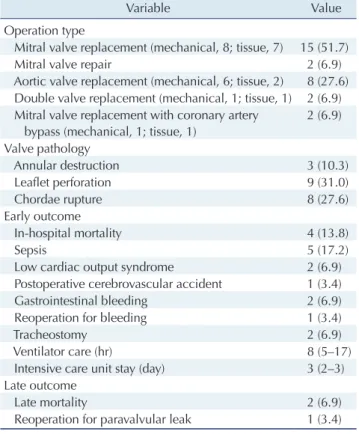
The operative and postoperative outcomes are shown in Table 2. Fifteen patients underwent mitral valve replace- ment, while 2 patients received mitral valve repair, includ- ing neo-chordae formation after removal of vegetation.

Eight patients underwent aortic valve replacement. Two patients underwent both mitral and aortic valve replace- Table 1. Patient demographics and characteristics (N=29)

Characteristic Value

Age (yr) 57.1±0.8

Female sex 6 (20.6)

Body mass index (kg/m

2

) 23.1±3.0

Hypertension 11 (37.9)

Diabetes mellitus 5 (17.2)

End-stage renal disease 3 (10.3)

Poor oral hygiene 11 (45.8)

Symptoms

Fever 14 (48.3)

Sepsis 8 (27.6)

Dyspnea (New York Heart Association class III or IV)

12 (41.4)

Neurological 6 (20.7)

Embolic events

Cerebrovascular accident 10 (34.5)

Peripheral 5 (17.2)

Coronary artery disease 4 (13.8)

European System for Cardiac Operative Risk Evaluation II (%)

4.0±4.8

Urgent surgery 5 (17.2)

Echocardiography

Intracardiac involvement

Mitral 20 (69.0)

Aortic 9 (31.0)

Vegetation 26 (89.7)

Vegetation size (mm) 14.7±6.9

Ejection fraction (%) 58.3±13.8

Microbiological findings

Streptococcus 14 (48.3)

Staphylococcus 7 (24.1)

Other 2 (6.9)

Culture-negative 6 (20.7)

Values are presented as mean±standard deviation or number (%).

Table 2. Operative and postoperative outcomes (N=29)

Variable Value

Operation type

Mitral valve replacement (mechanical, 8; tissue, 7) 15 (51.7)

Mitral valve repair 2 (6.9)

Aortic valve replacement (mechanical, 6; tissue, 2) 8 (27.6) Double valve replacement (mechanical, 1; tissue, 1) 2 (6.9) Mitral valve replacement with coronary artery

bypass (mechanical, 1; tissue, 1)

2 (6.9) Valve pathology

Annular destruction 3 (10.3)

Leaflet perforation 9 (31.0)

Chordae rupture 8 (27.6)

Early outcome

In-hospital mortality 4 (13.8)

Sepsis 5 (17.2)

Low cardiac output syndrome 2 (6.9)

Postoperative cerebrovascular accident 1 (3.4)

Gastrointestinal bleeding 2 (6.9)

Reoperation for bleeding 1 (3.4)

Tracheostomy 2 (6.9)

Ventilator care (hr) 8 (5–17)

Intensive care unit stay (day) 3 (2–3)

Late outcome

Late mortality 2 (6.9)

Reoperation for paravalvular leak 1 (3.4)

Values are presented as number (%) or median (interquartile range).

(4)

https://doi.org/10.5090/kjtcs.2020.53.1.1

KJTCVS

ment, but the infections in these cases did not involve mi- tral-aortic intervalvular fibrosa. Two patients underwent concomitant coronary artery bypass and mitral valve re- placement.

There were 3 major valve pathologies: annular destruc- tion in 3 patients, leaflet perforation in 9, and chordae rup- ture in 8. Nevertheless, these patients did not require addi- tional procedures for mitral-aortic intervalvular fibrosa or aortic root reconstruction.

In-hospital mortality occurred in 4 patients (4 of 29, 13.7%). Two patients died due to septic shock, one each on postoperative days 20 and 62. The first patient was relative- ly older (68 years) and had undergone a double valve oper- ation. In this patient, both C-reactive protein levels and leukocyte counts were high after surgery and continued to increase. The other patient had hypertension, ESRD, and asymptomatic preoperative CVA. He was re-intubated and was given additional antibiotics to treat pneumonia. After- wards, he suffered a new infarction along with gastrointes- tinal bleeding during the postoperative period.

The other 2 patients died due to LCOS on postoperative days 4 and 84. One patient underwent concomitant coro- nary artery bypass and mitral valve replacement. Postoper- atively, inotropic agents and continuous renal replacement therapy were administered but were unsuccessful. The other patient initially showed severe heart failure and un- derwent an urgent operation. After surgery, he received ex- tracorporeal membrane oxygenation, but did not survive.

Regarding complications, sepsis occurred in 5 patients, of whom 1 had methicillin-resistant Staphylococcus aureus as the etiology of the infection. Two patients exhibited LCOS, and both were recorded as cases of in-hospital mor-

tality. Postoperative CVA occurred in 1 patient who showed normal brain imaging and no neurological symptoms pre- operatively. Although appropriate protective agents were applied, gastrointestinal bleeding occurred in 2 patients.

One patient underwent reoperation for postoperative bleeding and was discharged on the 16th postoperative day without further complications.

Late outcomes

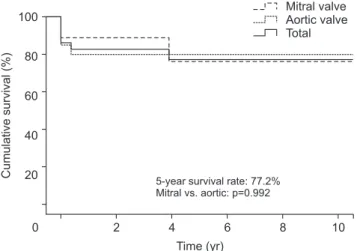
Kaplan-Meier analysis showed that the 5-year survival rate was 77.2%, with no significant difference according to the involved valve (Fig. 1). Two patients died during the follow-up period; the cause of death was lung cancer in 1 and a traffic accident in the other. One patient had a late postoperative complication (a paravalvular leak) on post- operative day 72. He underwent reoperation for the leak and was discharged without further complications. The details of each patient’s clinical course are presented in Supplemental Table 1.

Factors associated with clinical outcomes (early and late)

The results of a univariate analysis for early and late out- comes are shown in Tables 3 and 4. In logistic regression analysis, body mass index (p=0.031; odds ratio [OR], 0.574;

95% confidence interval [CI], 0.346–0.951), ESRD (p=0.026;

OR, 24.0; 95% CI, 1.459–394.8), and urgent surgery (p=

0.010; OR, 34.5; 95% CI, 2.353–505.7) were significantly as- sociated with the risk of in-hospital mortality. In Cox pro- portional hazard regression analysis, the statistically sig-

100

80

60

40

20

10

Cumulative survival (%)

Time (yr)

0 2 4 6 8

Mitral valve Aortic valve Total

5-year survival rate: 77.2%

Mitral vs. aortic: p=0.992

Fig. 1. Kaplan-Meier analysis in patients undergoing surgery for infective endocarditis.

Table 3. Univariate analysis of risk factors associated with in-hospital mortality

Risk factors for in-hospital mortality

Odds ratio (95%

confidence interval) p-value Body mass index (kg/m

2

) 0.574 (0.346–0.951) 0.031 End-stage renal disease 24.00 (1.459–394.8) 0.026

Urgent surgery 34.50 (2.353–505.7) 0.010

Table 4. Univariate analysis of risk factors associated with 5-year mortality

Risk factors for 5-year mortality

Hazard ratio (95%

confidence interval) p-value

Hypertension 10.57 (1.212–92.26) 0.033

End-stage renal disease 12.45 (2.456–63.13) 0.002

Urgent surgery 6.496 (1.288–32.77) 0.023

(5)

Won Yong Lee, et al. Surgical Outcomes for Native Valve Endocarditis KJTCVS

nificant predictors of long-term outcome were hypertension (p=0.033; hazard ratio [HR], 10.57; 95% CI, 1.212–92.2), ESRD (p=0.002; HR, 12.45; 95% CI, 2.456–63.13), and ur- gent surgery (p=0.023; HR, 6.496; 95% CI, 1.288–32.7).

Discussion

Our retrospective study focused on risk factors associat- ed with early and late survival based on a single-center da- tabase of surgical treatment for NVE. In logistic regression analysis, preoperative risk factors such as body mass index, ESRD, and urgent surgery appeared to increase in-hospital mortality. In our long-term survival analysis, the 5-year survival rate was 77.2%, and hypertension, ESRD, and ur- gent surgery were associated with long-term mortality.

Marks et al. [5] in 2015 reported that the underlying dis- ease was not significantly correlated with survival, even if the patient had a previous history of endocarditis, valve re- placement, or congenital heart disease. In contrast, the findings of the present study indicated that hypertension or ESRD significantly affected the survival of patients with NVE. Although no significant association was observed between DM and survival in this study, a previous study reported that DM was associated with the risk of in-hospi- tal death [6].

The importance of oral hygiene in patients with IE has long been emphasized [7,8]. This study assessed whether oral hygiene affected survival. Two patients (6.8%) had un- dergone previous dental procedures after which they devel- oped IE. This number is relatively small compared to those in previous studies [7,8]; however, it can be explained by the large number of patients in our study with IE of un- identified origin (14/29, 51.7%). Eleven patients (45.8%) ex- hibited poor oral hygiene upon dental examination. In our study, these 2 factors—oral hygiene status and dental ori- gin as the source of IE—showed no significant impacts on survival. This is thought to be the result of oral Streptococ- cus being less harmful than other organisms. In a previous study, oral Streptococcus was even found to have an OR <1 for in-hospital mortality, meaning that it had a preventive effect on mortality [1].

Because the cardiopulmonary physiology differs accord- ing to the valve, the side of the IE-affected valve may also be an important risk factor. Although the subjects in this study had only left-side IE, Gaca et al. [9] in 2013 reported that the surgical results for right-side IE were similar to those for left-side IE, with both showing a 7% in-hospital mortality rate. Though Lee et al. [10] in 2014 excluded drug users from their study, their results for right-side IE were

similar to those for left-side IE. Although no study has re- ported a significant difference between the results of aortic valve and mitral valve endocarditis, one study showed that the postoperative results of aortic valve and mitral valve en- docarditis may vary according to the underlying pathophys- iology and the surgical techniques used during treatment [6]. In our study, a subgroup analysis was conducted to compare the 2 valves. Both groups were similar except with regard to the valvular pathophysiology of chordae rupture (p=0.033) and showed no significant difference in early mortality (p=0.780; OR, 1.412; 95% CI, 0.126–15.78) or long- term mortality (p=0.992; HR, 1.009; 95% CI, 0.182–5.582).

Embolic events causing patient non-compliance could affect postoperative care and worsen outcomes. In this study, preoperative embolic events were not significantly related to survival; however, other studies have shown con- tradictory results. Chu et al. [11] in 2004 showed that pe- ripheral embolic events were significantly related to in-hos- pital mortality. Delahaye et al. [8] in 2007 assessed both Glasgow Coma Scale scores and cerebral hemorrhage, and both variables were reported to affect mortality. Our study included asymptomatic patients with only imaging-proven embolisms, which could explain our finding that having an embolism did not significantly affect survival.

Survival can be impacted by the microbiological etiology of the infection. Many studies have found that S. aureus, various species of fungi, and Gram-negative Bacillus were predictors of poor outcomes [1,7,8,11]. In this study, the in- fectious organism was S. aureus in 2 patients. Although poor outcomes were expected in these patients, they recov- ered well in-hospital and during the follow-up period, probably due to their young age and because they had no underlying disease. Further studies with a larger sample size will most likely yield different results depending on the infectious organisms present.

Surgical timing is also an important factor, as improper timing makes patient care more difficult. Urgent surgery indications mainly fall into 3 categories: heart failure ag- gravation, resistant organisms, and recurrent embolic events [12]. Compared with previous guidelines, the indi- cations for urgent surgery are being gradually expanded.

This trend is driven by a variety of factors, such as the de-

velopment of antibiotics, the proposal of new surgical tech-

niques, and evidence from recent studies [12]. However, the

need for urgent surgery remains an unpleasant situation

and may be a risk factor for poor outcomes, as shown in

this study. In contrast, Kang et al. [13] in 2012 reported

that urgent surgery was associated with lower rates of mor-

tality and complications, such as stroke. This discrepancy

(6)

https://doi.org/10.5090/kjtcs.2020.53.1.1

KJTCVS

may be explained by the fact that our study included con- ventional indications of urgent operations that were ex- cluded by Kang et al. [13]. San Román et al. [14] in 2007 re- ported that the decision of surgical timing was crucial and must be carefully made by the endocarditis treatment team during the active phase of the disease. We analyzed cases of delayed surgery after prolonged (>28 days) antibiotic management. Eleven patients underwent delayed surgery, 2 of whom died; however, these results were not statistically significant. Nonetheless, long-term antibiotic treatment without surgery is thought to have an effect on mortality, and further studies of this relationship are needed.

Since mechanical valves and tissue valves are known to produce no difference in survival rates [15], the valve was chosen in the same fashion as for patients undergoing nor- mal cardiac surgery. Our study included 16 mechanical valve operations and 11 tissue valve operations. These groups (mechanical and tissue) showed no significant dif- ferences in early mortality (p=0.162; OR, 5.625; 95% CI, 0.500–63.28) or long-term mortality (p=0.152; HR, 3.465;

95% CI, 0.632–19.00).

Limitation

This study is limited by its retrospective nature and small number of patients; additionally, its evaluation of cases treated only at a single center may limit the ability to generalize the results. In addition, principally due to the limited number of patients, the statistical findings of the present study may not be valid, even for parameters with a p-value were less than 0.05. Nonetheless, this study is meaningful in that it aimed to show the characteristics of patients and surgical outcomes at a single institution.

Conclusion

Surgical treatment for NVE is associated with consider- able morbidity and mortality. In our study, the 5-year sur- vival rate was 77.2%, and several variables were found to be associated with survival. Urgent surgery and underlying ESRD showed significant correlations with both in-hospi- tal mortality and 5-year survival. Therefore, patients with these risk factors should be closely observed to prevent un- favorable results.

Conflict of interest

No potential conflict of interest relevant to this article was reported.

Acknowledgments

This study was supported by research grants from Han- mi Healthcare, Inc.

We would like to thank the Division of Biostatistics (Hallym Institute for Clinical Medicine, Hallym University Medical Center) for the statistical support provided.

ORCID

Bong Suk Park: https://orcid.org/0000-0002-7543-5346 Won Yong Lee: https://orcid.org/0000-0003-0415-6849 Yong Joon Ra: https://orcid.org/0000-0003-2153-504X Hong Kyu Lee: https://orcid.org/0000-0002-9087-7783 Byung Mo Gu: https://orcid.org/0000-0001-9632-6803 Jun Tae Yang: https://orcid.org/0000-0002-6677-1102

Supplementary materials

Supplementary materials can be found via https://doi.

org/10.5090/kjtcs.2020.53.1.1. Supplemental Table 1. Details of patients undergoing surgery for infective endocarditis.

References

1. Murdoch DR, Corey GR, Hoen B, et al. Clinical presentation, etiolo- gy, and outcome of infective endocarditis in the 21st century: the In- ternational Collaboration on Endocarditis-Prospective Cohort Study.

Arch Intern Med 2009;169:463-73.

2. Gelsomino S, Maessen JG, van der Veen F, et al. Emergency surgery for native mitral valve endocarditis: the impact of septic and cardio- genic shock. Ann Thorac Surg 2012;93:1469-76.

3. Revilla A, Lopez J, Vilacosta I, et al. Clinical and prognostic profile of patients with infective endocarditis who need urgent surgery. Eur Heart J 2007;28:65-71.

4. Mirabel M, Sonneville R, Hajage D, et al. Long-term outcomes and cardiac surgery in critically ill patients with infective endocarditis.

Eur Heart J 2014;35:1195-204.

5. Marks DJ, Hyams C, Koo CY, et al. Clinical features, microbiology and surgical outcomes of infective endocarditis: a 13-year study from a UK tertiary cardiothoracic referral centre. QJM 2015;108:219-29.

6. Kaartama T, Nozohoor S, Johansson M, Sjogren J, Timane P, Rag- narsson S. Difference in outcome following surgery for native aortic and mitral valve infective endocarditis. Thorac Cardiovasc Surg 2019;67:652-8.

7. Habib G, Lancellotti P, Antunes MJ, et al. 2015 ESC guidelines for

the management of infective endocarditis: the Task Force for the

Management of Infective Endocarditis of the European Society of

Cardiology (ESC). Endorsed by: European Association for Car-

(7)

Won Yong Lee, et al. Surgical Outcomes for Native Valve Endocarditis KJTCVS

dio-Thoracic Surgery (EACTS), the European Association of Nucle- ar Medicine (EANM). Eur Heart J 2015;36:3075-128.

8. Delahaye F, Alla F, Beguinot I, et al. In-hospital mortality of infec- tive endocarditis: prognostic factors and evolution over an 8-year pe- riod. Scand J Infect Dis 2007;39:849-57.

9. Gaca JG, Sheng S, Daneshmand M, et al. Current outcomes for tri- cuspid valve infective endocarditis surgery in North America. Ann Thorac Surg 2013;96:1374-81.

10. Lee MR, Chang SA, Choi SH, et al. Clinical features of right-sided infective endocarditis occurring in non-drug users. J Korean Med Sci 2014;29:776-81.

11. Chu VH, Cabell CH, Benjamin DK Jr, et al. Early predictors of in-hospital death in infective endocarditis. Circulation 2004;109:

1745-9.

12. Baddour LM, Wilson WR, Bayer AS, et al. Infective endocarditis in adults: diagnosis, antimicrobial therapy, and management of compli- cations: a scientific statement for healthcare professionals from the American Heart Association. Circulation 2015;132:1435-86.

13. Kang DH, Kim YJ, Kim SH, et al. Early surgery versus conventional treatment for infective endocarditis. N Engl J Med 2012;366:2466- 73.

14. San Roman JA, Lopez J, Vilacosta I, et al. Prognostic stratification of patients with left-sided endocarditis determined at admission. Am J Med 2007;120:369.

15. Prendergast BD, Tornos P. Surgery for infective endocarditis: who

and when? Circulation 2010;121:1141-52.

수치

Table 2. Operative and postoperative outcomes (N=29)
Fig. 1. Kaplan-Meier analysis in patients undergoing surgery for  infective endocarditis.

참조

관련 문서