• 검색 결과가 없습니다.

Tricuspid Valve Re-Repair in Ebstein Anomaly Using the Cone Technique

N/A
N/A
Protected

Academic year: 2021

Share "Tricuspid Valve Re-Repair in Ebstein Anomaly Using the Cone Technique"

Copied!
4
0
0

로드 중.... (전체 텍스트 보기)

전체 글

(1)

ISSN: 2233-601X (Print) ISSN: 2093-6516 (Online)

− 35 −

Division of Cardiovascular Surgery, Department of Thoracic and Cardiovascular Surgery, Congenital Heart Disease Center, Severance Cardiovascular Hospital, Yonsei University College of Medicine

Received: January 5, 2015, Revised: June 27, 2015, Accepted: July 7, 2015, Published online: February 5, 2016

Corresponding author: Han Ki Park, Division of Cardiovascular Surgery, Severance Cardiovascular Hospital, Yonsei University Health System, 50-1 Yonsei-ro, Seodaemun-gu, Seoul 03722, Korea

(Tel) 82-2-2228-8480 (Fax) 82-2-313-2992 (E-mail) [email protected]

C

The Korean Society for Thoracic and Cardiovascular Surgery. 2016. All right reserved.

CC
This is an open access article distributed under the terms of the Creative Commons Attribution Non-Commercial License (http://creative- commons.org/licenses/by-nc/4.0) which permits unrestricted non-commercial use, distribution, and reproduction in any medium, provided the original work is properly cited.

Tricuspid Valve Re-Repair in Ebstein Anomaly Using the Cone Technique

Do Jung Kim, M.D., Jee Won Suh, M.D., Yu Rim Shin, M.D., Hong Ju Shin, M.D., Han Ki Park, M.D., Ph.D.

The management of recurrent tricuspid regurgitation after tricuspid valve repair in patients with Ebstein anomaly is difficult, and tricuspid valve replacement is most commonly performed in such patients. We report two cases of re- current tricuspid regurgitation in patients with Ebstein anomaly that were successfully re-repaired using the cone technique. The cone repair technique is a useful surgical method for reconstructing a competent tricuspid valve, and can be applied in patients who have undergone previous tricuspid valve repair.

Key words: 1. Congenital heart disease 2. Tricuspid valve surgery 3. Repair

4. Ebstein anomaly

CASE REPORTS 1) Case 1

A 33-year-old man with Ebstein anomaly and Klinefelter syndrome was referred to Severance Cardiovascular Hospital for the surgical treatment of severe tricuspid regurgitation (TR). The patient underwent surgical repair of Carpentier type B Ebstein anomaly when he was nine years old using the Danielson technique, which involves transversal plication of the atrialized right ventricle (RV) and anterior tricuspid annuloplasty. Chest radiography revealed mild cardiomegaly with a cardiothoracic ratio of 0.6. The cardiac rhythm was normal sinus on the electrocardiogram and Holter monitoring.

Echocardiography showed the typical features of Ebstein anomaly, but the patient also had a completely obliterated at- rialized portion of the RV and reduced true tricuspid annulus

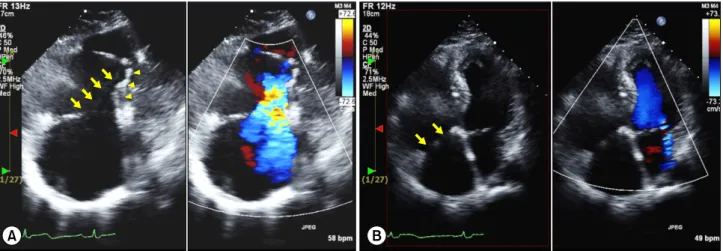
size. The septal and posterior leaflets were displaced into the RV and were attached to the ventricular wall. Although the leading edge of the anterior leaflet was mobile, its basal por- tion was tethered to the right ventricular wall. Severe TR was observed from the apically displaced coaptation site. The right atrium was dilated. The anteroposterior diameter of the true tricuspid annulus was 26 mm (Fig. 1A).

Although the patient was relatively asymptomatic, surgical repair was indicated for severe TR and right atrial dilatation.

The operation was performed through a redo median sterno- tomy. Under cardiopulmonary bypass and cardioplegic my- ocardial protection, the tricuspid valve was approached through an oblique right atriotomy. We noted that the atrialized RV had been horizontally obliterated in the previous operation, and that the stitches for the circumferential plication annulo- plasty had been placed along the anterior annulus of the tri-

Korean J Thorac Cardiovasc Surg 2016;49:35-38 Case Report

http://dx.doi.org/10.5090/kjtcs.2016.49.1.35

(2)

Do Jung Kim, et al

− 36 −

Fig. 1. Echocardiogram of case 1. (A) A preoperative apical four-chamber echocardiogram. The septal and posterior leaflets are apically displaced and adhere to the underlying myocardium (arrowhead). The leading edge of the anterior leaflet is mobile, although the basal por- tion is tethered to the ventricular wall (arrows). Color Doppler scanning reveals severe tricuspid regurgitation from the apically displaced leaflet coaptation site. (B) Postoperative echocardiography 15 months after the cone repair reveals a competent tricuspid valve at the true annulus level (arrows) without tricuspid stenosis.

cuspid valve. However, no trace of surgical manipulation of the leaflets could be observed. The posterior and septal leaf- lets were displaced to the ventricular apex and adhered to the underlying myocardium. The anterior leaflet was large, but partially tethered to the ventricular wall. We performed a cone reconstruction, including complete surgical delamination and recruitment of all undelaminated leaflet tissues. The ante- ro-inferior portion of the anterior leaflet and the posterior leaflet were detached from the annulus and their anomalous attachment to the RV as a single piece. The abnormal muscu- lar bands and tissues between the leaflets and the ventricular wall were then divided in order to mobilize each leaflet. The septal leaflet was carefully delaminated and mobilized, and a leaflet cone was constructed using the mobilized tissue and subsequently attached to the true annulus.

Post-repair echocardiography revealed edge-to-edge apposi- tion of the newly constructed tricuspid valve at the true annu- lus level, and the TR was measured as trivial with no stenosis. The postoperative course was uneventful, and the patient was discharged on postoperative day seven. An echo- cardiogram performed 15 months after the operation revealed a competent tricuspid valve without any deterioration of its function (Fig. 1B).

2) Case 2

A 51-year-old woman presented with dyspnea and frequent palpitations. She was classified as New York Heart Associa- tion (NYHA) functional class III. She had previously been di- agnosed with Ebstein anomaly and underwent surgical repair using the Carpentier method at the age of 27 years at another hospital. Chest radiography revealed mild cardiomegaly, with a cardiothoracic ratio of 0.6. Holter monitoring showed a nor- mal sinus rhythm with symptomatic paroxysmal atrial flutter and frequent premature ventricular complexes. Echocardiogra- phy revealed an apically displaced and undelaminated septal leaflet. Although the anterior leaflet was large and mobile, se- vere TR took place due to failed coaptation of the leaflets.

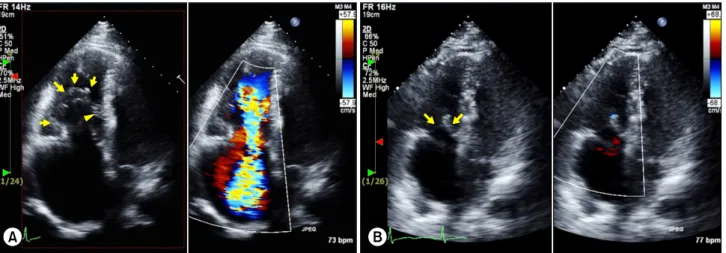
The right atrium and ventricle were dilated (Fig. 2A).

The operation was performed under conventional car- diopulmonary bypass and cardioplegic myocardial protection.

We noted that the atrialized portion of the RV had been pli-

cated vertically in her previous operation. A suture line for

the previous anterior leaflet reattachment was noted on the

antero-inferior portion of the tricuspid annulus. The anterior

leaflet was large and mobile, while the posterior leaflet was

incompletely mobilized from the ventricle. The apically dis-

placed septal leaflet was very hypoplastic and undelaminated

from the myocardium. After the performance of the maze

(3)

Tricuspid Re-Repair in Ebstein Anomaly

− 37 −

Fig. 2. Echocardiogram of case 2. (A) A large mobile anterior leaflet (arrows) and the displaced septal leaflet (arrow heads). Color Doppler scanning reveals severe tricuspid regurgitation. (B) The newly constructed leaflet edges are present at the true tricuspid annulus level (arrows), without any tricuspid regurgitation.

procedure with cryoablation and tricuspid valve repair, the anterior leaflet was detached from the annulus, and the poste- rior leaflet was surgically delaminated from the myocardium.

Although the septal edge of the anterior leaflet was able to be mobilized, the septal leaflet was too small to be dela- minated. A leaflet cone was constructed using the available leaflet tissue and reattached to the true tricuspid annulus. No further annuloplasty was required to reduce the annulus.

Intraoperative transesophageal echocardiography revealed no TR. Although the inflow velocity through the tricuspid valve mildly increased, a bidirectional cavopulmonary shunt was not placed because the severity of the tricuspid stenosis was mild, with a mean pressure gradient of 3 mmHg. She was extubated 17 hours after the operation and discharged in good condition on postoperative day 16. She was followed up 14 months later, and was found to be in NYHA functional class I at that time. Follow-up echocardiography revealed no TR or progression of tricuspid stenosis (Fig. 2B). Follow-up Holter monitoring revealed a normal sinus rhythm with asympto- matic premature atrial and ventricular contractions, and no evidence of atrial tachyarrhythmia was observed.

DISCUSSION

Ebstein anomaly is a cardiac malformation that affects the tricuspid valve and right ventricle. The anatomic and func-

tional features of the anomaly cause TR, which ultimately re- sults in the dilation of the right atrium and ventricle and pro- vides a substrate for the development of atrial and ventricular arrhythmias [1]. Various surgical techniques have been devel- oped to repair Ebstein anomaly, and most techniques use a large anterior leaflet as a functional monocusp valve to ach- ieve tricuspid valve competence [2-4]. In contrast, the cone repair technique creates a cone-like valve structure that allows leaflet-to-leaflet coaptation, resembling the normal tricuspid valve [5]. This procedure has been clinically shown to lead to lower morbidity and mortality, with a low incidence of tricus- pid valve replacement or reoperation [6,7].

The most important part of the procedure involves the sur- gical delamination of the available leaflet tissue. In case 1, the posterior and septal leaflets were successfully delaminated and incorporated into the leaflet cone to build a competent and non-stenotic valve. In case 2, the anterior leaflet was large and mobile, while the septal leaflet was too small to be incorporated into the cone structure. It may be assumed that the lack of adequate leaflet tissue was the reason for the mild post-repair tricuspid stenosis. Although no surgical treatment was necessary for tricuspid stenosis in this patient, a bidirec- tional cavopulmonary shunt can alleviate significant stenosis by reducing systemic venous return into the right atrium [8].

Another major aspect of the cone repair procedure is the

vertical plication of the atrial portion of the RV to obliterate

(4)

Do Jung Kim, et al

− 38 − the atrialized RV space and to reduce the tricuspid annulus size. In our cases, this procedure was not performed, because the atrialized portion of the RV had been completely obliter- ated by the transverse and vertical plication method used in the previous operations. Moreover, no further annular plication was required due to the aggressive annular size reduction per- formed in the previous operations. The scar tissue at the tri- cuspid annulus from the previous repair provided a firm and safe base to reattach the newly-created leaflet cone.

The feasibility of the cone technique for tricuspid valve re-repair has already been shown by Dearani et al. [9]. In the present cases, the cone technique for tricuspid valve repair was successfully performed, and postoperative echocardiog- raphy confirmed the presence of competent tricuspid valves at the true annulus level. Therefore, both patients were able to avoid valve replacement, and their NYHA functional classes improved. Furthermore, no deterioration of tricuspid valve function was observed in either case over a year of fol- low-up.

In conclusion, the cone repair technique is useful for re- constructing a competent tricuspid valve in patients with Ebstein anomaly, and is feasible even in patients who have undergone previous tricuspid valve repair.

CONFLICT OF INTEREST

No potential conflict of interest relevant to this article was reported.

REFERENCES

1. Attenhofer Jost CH, Connolly HM, Dearani JA, Edwards WD, Danielson GK. Ebstein’s anomaly. Circulation 2007;115:

277-85.

2. Carpentier A, Chauvaud S, Mace L, et al. A new reconst- ructive operation for Ebstein’s anomaly of the tricuspid valve.

J Thorac Cardiovasc Surg 1988;96:92-101.

3. Danielson GK, Driscoll DJ, Mair DD, Warnes CA, Oliver WC Jr. Operative treatment of Ebstein’s anomaly. J Thorac Cardiovasc Surg 1992;104:1195-202.

4. Hetzer R, Nagdyman N, Ewert P, et al. A modified repair technique for tricuspid incompetence in Ebstein’s anomaly. J Thorac Cardiovasc Surg 1998;115:857-68.

5. Da Silva JP, Baumgratz JF, da Fonseca L, et al. The cone reconstruction of the tricuspid valve in Ebstein’s anomaly:

the operation: early and midterm results. J Thorac Cardiovasc Surg 2007;133:215-23.

6. Lee C, Kwak JG, Lee CH. Cone reconstruction for tricuspid valve repair in a patient with Ebstein’s anomaly: a case report.

Korean J Thorac Cardiovasc Surg 2009;42:509-12.

7. Vogel M, Marx GR, Tworetzky W, et al. Ebstein’s malfor- mation of the tricuspid valve: short-term outcomes of the

“cone procedure” versus conventional surgery. Congenit Heart Dis 2012;7:50-8.

8. Raju V, Dearani JA, Burkhart HM, et al. Right ventricular unloading for heart failure related to Ebstein malformation.

Ann Thorac Surg 2014;98:167-73.

9. Dearani JA, Said SM, Burkhart HM, Pike RB, O’Leary PW, Cetta F. Strategies for tricuspid re-repair in Ebstein malfor- mation using the cone technique. Ann Thorac Surg 2013;96:

202-8.

수치

Fig. 1. Echocardiogram of case 1. (A) A preoperative apical four-chamber echocardiogram
Fig. 2. Echocardiogram of case 2. (A) A large mobile anterior leaflet (arrows) and the displaced septal leaflet (arrow heads)

참조

관련 문서

Therefore depending on the size of the fracture in the veneering porcelain, intraoral repair methods using surface treatment and composite resins may

In this study, therefore, the method for measuring residual stresses using ESPI technique that is one of the laser applied measurement technique excellent in the view

Taylor Series

[r]

In this study we will survey the changes in DNA repair factors during aging in rat, including mismatch repair (MMR), base excision repair (BER), and double-strand break

The index is calculated with the latest 5-year auction data of 400 selected Classic, Modern, and Contemporary Chinese painting artists from major auction houses..

Based on the results of root cause analysis, the following corrective action to mitigate the erosion and corrosion damage at hot leg check valve were

‰ doing things fast may require more logic and thus more space. ‰ example: