• 검색 결과가 없습니다.

Laparoscopic uterine artery occlusion before cervical curettage in cervical ectopic pregnancy: Safe and effective for preventing massive bleeding

N/A
N/A
Protected

Academic year: 2022

Share "Laparoscopic uterine artery occlusion before cervical curettage in cervical ectopic pregnancy: Safe and effective for preventing massive bleeding"

Copied!
4
0
0

로드 중.... (전체 텍스트 보기)

전체 글

(1)

Articles published in Obstet Gynecol Sci are open-access, distributed under the terms of the Creative Commons Attribution Non-Commercial License (http://creativecommons.

org/licenses/by-nc/3.0/) which permits unrestricted non-commercial use, distribution, and reproduction in any medium, provided the original work is properly cited.

Copyright © 2015 Korean Society of Obstetrics and Gynecology

Case Report

Obstet Gynecol Sci 2015;58(5):431-434 http://dx.doi.org/10.5468/ogs.2015.58.5.431 pISSN 2287-8572 · eISSN 2287-8580

www.ogscience.org 431

Introduction

Cervical ectopic pregnancy is highly associated with for mas- sive bleeding and occurs in 1/8,600 to 1/12,400 pregnancies [1]. Predisposing factors for this condition includes previous dilation and curettage [2], use of Intrauterine devices, endome- triosis, uterine fibroids, previous cesarian sections, and history of assisted reproductive technologies [3,4]. Cervical pregnancy is usually diagnosed using transvaginal ultrasonography that identifies the gestational sac and peritrophoblastic blood flow or embryonic heartbeat at the cervix level with empty uterine cavity [5]. Painless vaginal bleeding is reported in 90% of cervi- cal pregnancies, and such bleeding is often massive [1].

Cervical ectopic pregnancy can be treated medically or surgi- cally. Methotrexate (MTX) has become the first-line uterine-con- serving treatment in stable women. MTX can be administered either with systemic or directly into the gestational sac alone [2].

However, in unstable patients, surgical removal of the ectopic pregnancy and bleeding control is preferred over medical treat- ment. Moreover, in the case of uncontrollable bleeding, even hysterectomy may be required.

If surgical curettage is planned, intraoperative bleeding can be reduced by using preoperative procedures such as uterine artery embolization (UAE) [6-8], laparoscopic uterine artery occlusion (LUAO), ligation of the uterine arteries at cervical branches, vasopressin injection, or cerclage of the internal cervical os to

compress feeding vessels [9-12]. In addition, postoperative bleeding can be controlled using Foley balloon catheter for cer- vical tamponade.

We present 4 cases of cervical ectopic pregnancies treated in one university hospital. The medical charts for all 4 cases were reviewed, and all records and results were included from admis- sion via the emergency room or outpatient department of ob- stetrics and gynecology to discharge from the hospital, follow- up at the outpatient clinic, even readmission after 6 months to 2 years. UAE was performed by one radiologist within Radiologic Intervention Clinic of Inje University Haeundae Paik Hospital, and cervical curettage was performed by 2 different surgeons in obstetrics and gynecology.

All cases were diagnosed using a pelvic examination, trans-

Received: 2015.1.19. Revised: 2015.4.23. Accepted: 2015.4.29.

Corresponding author: Yong-Il Ji

Department of Obstetrics and Gynecology, Inje University Haeundae Paik Hospital, 875 Haeun-daero, Haeundae-gu, Busan 48108, Korea

Tel: +82-51-797-2020 Fax: +82-51-797-2030 E-mail: [email protected]

Laparoscopic uterine artery occlusion before cervical curettage in cervical ectopic pregnancy: Safe and effective for preventing massive bleeding

Hong-Seok Choi, Na-Young Kim, Yong-Il Ji

Department of Obstetrics and Gynecology, Inje University Haeundae Paik Hospital, Pusan, Korea

Cervical ectopic pregnancy is associated with high risk for massive bleeding conditions. Cervical ectopic pregnancy can usually be treated by methotrexate injection or surgery. We present 4 cases of cervical ectopic pregnancy that were treated successfully with different uterine-conserving methods. By comparing our experience of 4 cases managed in different ways, we found that laparoscopic uterine artery occlusion before cervical curettage is more effective method for preventing massive bleeding.

Keywords: Ectopic pregnancy; Hemostatic techniques; Laparoscopy; Therapeutic occlusion; Uterine artery embolization

(2)

www.ogscience.org 432

Vol. 58, No. 5, 2015

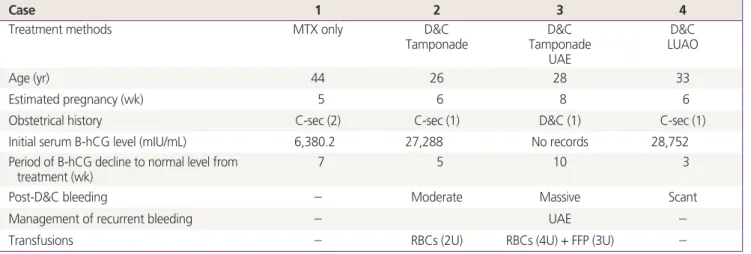
vaginal ultrasonography, and serum beta-human chorionic gonadotropin (B-hCG) levels. Uterine-conserving surgical/medi- cal treatment was performed in all patients, and no patients required hysterectomy, even during follow-up. Serum B-hCG levels were followed up until they reached normal levels (<10 mIU/mL). The methods of treatments, initial and follow-up se- rum B-hCG levels, amount of blood transfusions, recurrence of bleeding, needs for additional treatment, and complications for next pregnancy, of all four cases were compared. Demographic data for the 4 patients; obstetrical histories and characteristics are described in Table 1.

In 1 patient, only medical treatment was administered, and the other 3 patients underwent cervical curettage with postoperative cervical tamponade by using a Foley catheter. In each patient, the following different methods were used to prevent intraopera- tive bleeding: postoperative Foley catheter tamponade alone, preoperative and postoperative UAE, and pre-curettage LUAO.

The pregnancies were at gestational 5 to 8 weeks, and the initial serum B-hCG levels ranged 6,380 to 28,752 mIU/mL.

Case report

1. Case 1

In this patient, systemic MTX was administered. The pregnancy was at gestational 5 weeks. Vaginal bleeding was observed, but vital signs were stable, and initial serum B-hCG level was 6,380 mIU/mL. MTX was injected intramuscularly, the dose of which depended on 50 mg/m2. For 1 week, mild vaginal bleeding persisted, and hemoglobin level decreased slightly

to 11.1 from 12.1 g/dL. Serum B-hCG level decreased to <1.2 mIU/mL after 7 weeks.

2. Case 2

In this patient, cervical ectopic pregnancy was terminated surgically without prior preventive procedures. The pregnancy was at 6 weeks, and the patient’s initial serum B-hCG level was 27,288 mIU/mL. After cervical curettage, a Foley catheter was postoperatively inserted into the endocervix. Intraoperative blood loss was >500 mL, and active bleeding was noted after curettage of the cervical ectopic mass. To control the bleeding, 2 Foley catheters were inserted for tamponade: a 20 Fr 3-way catheter with 30 mL ballooning and and 8 Fr catheter with 4 mL ballooning. A serial complete blood count was checked postoperatively. Hemoglobin levels decreased drastically, and two units of red blood cells (RBCs) were transfused in 1 day.

After 24 hours, the Foley catheter tamponade was removed, and bleeding was minimal. Serum B-hCG level had decreased to normal by 5 weeks after the operation.

3. Case 3

In this patient, curettage of a cervical ectopic pregnancy and UAE were performed. The pregnancy was at gestational 8 weeks.

Initial serum B-hCG level was unknown, but gestational sac with fetal pole and yolk sac were defined at the endocervical canal.

After cervical curettage and UAE, Foley catheter inserted for tam- ponade. Intraoperative and postoperative blood loss was <100 mL, and hemoglobin level did not significantly decrease postop- eratively (i.e., from 11.6 to 10.7 g/dL). Twenty-four hours post- operatively, the tamponade catheter was removed. However, 2

Table 1. Characteristics and treatment of 4 cases of cervical ectopic pregnancies

Case 1 2 3 4

Treatment methods MTX only D&C

Tamponade D&C

Tamponade UAE

D&C LUAO

Age (yr) 44 26 28 33

Estimated pregnancy (wk) 5 6 8 6

Obstetrical history C-sec (2) C-sec (1) D&C (1) C-sec (1)

Initial serum B-hCG level (mIU/mL) 6,380.2 27,288 No records 28,752

Period of B-hCG decline to normal level from

treatment (wk) 7 5 10 3

Post-D&C bleeding - Moderate Massive Scant

Management of recurrent bleeding - UAE -

Transfusions - RBCs (2U) RBCs (4U) + FFP (3U) -

MTX, methotrexate; D&C, dilation and curettage; UAE, uterine artery embolization; LUAO, laparoscopic uterine artery occlusion; C-sec,

cesarian section; B-hCG, beta-human chorionic gonadotropin; RBC, red blood cell; FFP, fresh frozen plasma.

(3)

www.ogscience.org 433 Hong-Seok Choi, et al. Treatment of cervical ectopic pregnancy

weeks later, the patient visited the emergency room with massive re-bleeding. Hemoglobin decreased to 6.7 g/dL, and vital signs were unstable. Emergency UAE and Foley catheter tamponade were performed, and 4 units of packed RBCs and 3 units of fresh frozen plasma were transfused. Serum B-hCG levels decreased gradually to 18.8 mIU/mL after 10 weeks. Although bleeding control and resuscitation were successful, but after 2 years, the patient was diagnosed with placenta previa totalis within her next pregnancy. Furthermore, she delivered at 28+5 weeks due to preterm premature rupture of membranes with massive bleed- ing, and emergency caesarian section was performed. Placenta previa totalis and placenta accrete were diagnosed intraopera- tively caused massive bleeding. Postoperative bleeding was per- sisted, necessitating Bakri balloon tamponade (300 mL) and addi- tional emergency UAE. Postoperative intensive care unit care was needed, with extensive transfusions (11 pints of RBCs, 4 pints of fresh frozen plasma) were needed during hospitalization periods.

4. Case 4

In this patient, surgical curettage of a cervical ectopic preg- nancy was performed after medical treatment failed. The preg- nancy was at gestational 6 weeks, and initial serum B-hCG level was 28,752.5 mIU/mL. Although intramuscular MTX was injected once with dose of which based on a 50 mg/m

2

body surface area, the patient’s serum B-hCG level increased to 35,439 mIU/mL after 1 week. Vaginal bleeding persisted and increased. To surgically remove the ectopic mass and for bleed- ing control, LUAO was performed before cervical curettage.

Access to the uterine arteries on both right and left sides lapa- roscopically, and hemostatic clips were applied (Fig. 1). After clipping both uterine arteries, cervical curettage was performed as usual. The estimated intraoperative and postoperative blood loss was 40 mL. After 24 hours, bleeding had stopped. After 1 week, serum B-hCG level decreased to 69.2 mIU/mL, and after 3 weeks, the levels reached 0 mIU/mL. Abnormal vaginal bleeding was not seen after surgery, until 3-month follow-ups.

Discussion

Cervical ectopic pregnancy is associated with high risk of mas- sive bleeding preoperatively, intraoperatively, and postopera- tively because of rich blood supplies. The event occurs during reproductive years, and many patients wish to become preg- nant again normally. Uterine-conserving treatment is needed, but high risk of bleeding makes difficult to treat these cases

effectively. Therefore, lowering bleeding risk and effective re- moval of the ectopic pregnancy mass is the main challenge in these cases.

In case 1, treatment with systemic MTX was successful. How- ever, serum B-hCG level declined gradually within 7 weeks, even though initial serum B-hCG level was lower than other cases. This case possibly had failed to resolve and continued to be at risk for bleeding, as observed in case 4.

The comparison between case 3 and 4 showed that per- forming UAE before cervical curettage in case 3 successfully controlled bleeding preoperatively, but B-hCG level declined for 10 weeks, and massive bleeding recurred during her next pregnancy, for which re-embolization for bleeding control and massive transfusion were needed. In addition, UAE and cervi- cal curettage required at least 2 to 3 hours to be performed and treatments were given separately at different departments (Radiologic Intervention Clinic and the operation room).

This may be critical because of the time required. If the pa- tient presents continuous bleeding, immediate surgical proce- dure is needed. In this respect, LUAO before cervical curettage as in case 4 was the better choice for time saving. UAE needs at least 45 to 60 minutes, and only could be performed by radiologic specialists at radiologic department [13]. But dila- tion and curettage after LUAO could be performed immedi- ately in the operating room; no need for transfer and prepare separately, and able to anesthetize patient at a time. In LUAO, Bleeding was controlled as effectively as with UAE, and intra- operative and postoperative bleeding were not critical.

In case 4, postoperative serum B-hCG level declined much

faster than in case 3. However, decline in serum B-hCG levels

Fig. 1. Laparoscopic uterine artery occlusion before cervical curettage.

(4)

www.ogscience.org 434

Vol. 58, No. 5, 2015

is a controversial way of measuring because cases 3 and 4 dif- fered in terms of pregnancy week, initial B-hCG level, preop- erative medication, and the surgeon’s skills.

Both UAE and LUAO can be classified as “minimally inva- sive” methods that preserve fertility by preventing hysterec- tomy. Both methods are effective, but LUAO is considered a safer alternative to UAE (e.g., for lower risk of ovarian failure due to radiation) for treating uterine fibroids [13-15]. Cramp- ing pain due to uterine ischemia following UAE and LUAO is considerable. 30% of patients complaint in UAE, but none for LUAO in a previous comparative research [13]. Effectiveness of both techniques are similar, but in a bleeding state, LUAO could save time and reduce blood loss more effectively than UAE. Thus, if surgical treatment for cervical ectopic pregnancy is indicated, cervical curettage after LUAO could be the prefer- able surgical technique, because it is safe, effective treatment with good outcomes.

Conflict of interest

No potential conflict of interest relevant to this article was reported.

References

1. Ushakov FB, Elchalal U, Aceman PJ, Schenker JG. Cervi- cal pregnancy: past and future. Obstet Gynecol Surv 1997;52:45-59.

2. Jeng CJ, Ko ML, Shen J. Transvaginal ultrasound- guided treatment of cervical pregnancy. Obstet Gynecol 2007;109:1076-82.

3. Weyerman PC, Verhoeven AT, Alberda AT. Cervical preg- nancy after in vitro fertilization and embryo transfer. Am J Obstet Gynecol 1989;161:1145-6.

4. Ginsburg ES, Frates MC, Rein MS, Fox JH, Hornstein MD, Friedman AJ. Early diagnosis and treatment of cervical pregnancy in an in vitro fertilization program. Fertil Steril 1994;61:966-9.

5. Dialani V, Levine D. Ectopic pregnancy: a review. Ultra- sound Q 2004;20:105-17.

6. Hirakawa M, Tajima T, Yoshimitsu K, Irie H, Ishigami K, Ya-

hata H, et al. Uterine artery embolization along with the administration of methotrexate for cervical ectopic preg- nancy: technical and clinical outcomes. AJR Am J Roent- genol 2009;192:1601-7.

7. Nakao Y, Yokoyama M, Iwasaka T. Uterine artery embo- lization followed by dilation and curettage for cervical pregnancy. Obstet Gynecol 2008;111(2 Pt 2):505-7.

8. Zakaria MA, Abdallah ME, Shavell VI, Berman JM, Dia- mond MP, Kmak DC. Conservative management of cervi- cal ectopic pregnancy: utility of uterine artery emboliza- tion. Fertil Steril 2011;95:872-6.

9. Davis LB, Lathi RB, Milki AA, Dahan MH. Transvaginal ligation of the cervical branches of the uterine artery and injection of vasopressin in a cervical pregnancy as an initial step to controlling hemorrhage: a case report. J Reprod Med 2008;53:365-8.

10. De La Vega GA, Avery C, Nemiroff R, Marchiano D. Treat- ment of early cervical pregnancy with cerclage, carbo- prost, curettage, and balloon tamponade. Obstet Gynecol 2007;109(2 Pt2):505-7.

11. Trojano G, Colafiglio G, Saliani N, Lanzillotti G, Cicinelli E. Successful management of a cervical twin pregnancy:

neoadjuvant systemic methotrexate and prophylac- tic high cervical cerclage before curettage. Fertil Steril 2009;91:935.e17-9.

12. Wang Y, Xu B, Dai S, Zhang Y, Duan Y, Sun C. An efficient conservative treatment modality for cervical pregnancy:

angiographic uterine artery embolization followed by im- mediate curettage. Am J Obstet Gynecol 2011;204:31.e1- 7.

13. Park KH, Kim JY, Shin JS, Kwon JY, Koo JS, Jeong KA, et al. Treatment outcomes of uterine artery embolization and laparoscopic uterine artery ligation for uterine myoma.

Yonsei Med J 2003;44:694-702.

14. Committee on Gynecologic Practice, American College of Obstetricians and Gynecologists. ACOG Committee Opinion. Uterine artery embolization. Obstet Gynecol 2004;103:403-4.

15. Hald K, Langebrekke A, Klow NE, Noreng HJ, Berge AB,

Istre O. Laparoscopic occlusion of uterine vessels for the

treatment of symptomatic fibroids: Initial experience and

comparison to uterine artery embolization. Am J Obstet

Gynecol 2004;190:37-43.

수치

Table 1. Characteristics and treatment of 4 cases of cervical ectopic pregnancies

참조

관련 문서