
Stable Isotopes of Ore Bodies in the Pacitan Mineralized District, Indonesia
10
0
0
전체 글
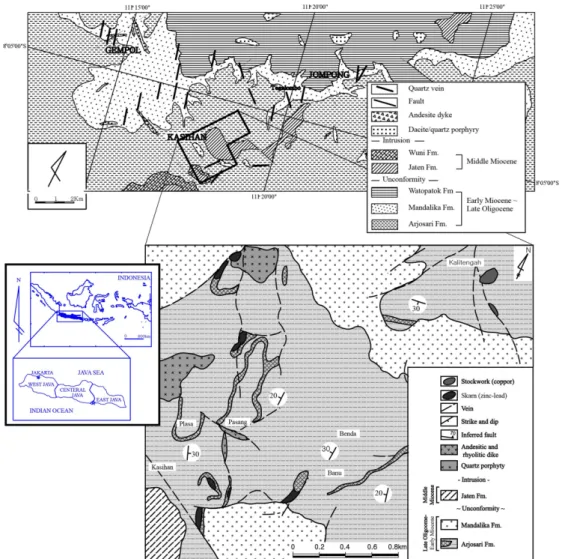
(2) 16. Jin-Kyun Han and Sang-Hoon Choi. 9.6 and 9.7‰; skarn quartz, 6.3-9.6‰; skarn calcite, 4.7 and 5.8‰; stockwork quartz, 3.0-7.7‰; stockwork calcite, 1.2 and 2.0‰; vein quartz, -3.9 – 6.7‰. The calculated δ18Owater values decrease progressively with variety of deposit types (from skarn through stockwork to vein), increasing paragenetic time and decreasing temperature. This indicates the progressively increasing involvement of isotopically less-evolved meteoric waters in the Pacitan hydrothermal system. The ranges of δDwater values are from –65 to –88‰: skarn, -67 to -84‰; stockwork, -65 and -76‰; vein, -66 to -88‰. The isotopic compositions of fluids in the Pacitan hydrothermal system show a progressive shift from magmatic hydrothermal dominance in the skarn and early hydrothermal ore mineralization periods toward meteoric hydrothermal dominance in the late ore mineralization periods. Key words : Cu-Zn-Pb-Au, skarn, hydrothermal, stockwork, vein, stable isotopes, Pacitan mineralized district, Indonesia. 1. Introduction Extensive base-metal and/or gold bearing skarn and hydrothermal ore mineralizations have been. found recently in the Pacitan mineralized district of the south western portions in the East Java, near the boundary of central Java, Indonesia (Han and Choi, 2012: Fig. 1). This is the new discovery of. Fig. 1. Geologic map of the Pacitan mineralized district and Kasihan mineralized area for showing location of skarn and hydrothermal stockwork ore bodies. Star symbol represents the location of the district..
(3) Stable Isotopes of Ore Bodies in the Pacitan Mineralized District, Indonesia. base-metal (and/or gold) occurrences in the unexplored Southern Mountain zone of East Java, as the results of the new prospecting work undertaken during 1991-1993 by the Mineral Exploration Program of Korea Mining Promotion Corporation (KMPC). The Southern Mountain zone (Van Bemmelen, 1949) lies on the southern margin of the eastern portions in the Java and consists of mixed sequences of Tertiary to Quaternary sedimentary and volcanic rocks (Fig. 1). Most of base-metal and/or gold bearing skarn and hydrothermal ore mineralization in the district occur in three areas: Kasihan, Gempol and Jompong (Fig. 1). Previous studies of the Pacitan mineralized district were concerned with ore mineralogy and geochemical environments of hydrothermal vein deposits and skarn mineralogy of skarn deposits (Choi et al., 1995; Han and Choi, 2012). Metallic ore bodies in the Pacitan mineralized district are classified into two major types: 1) skarn type replacement ore bodies, 2) fissure filling hydrothermal ore bodies (Han and Choi, 2012). Skarn type replacement ore bodies are developed typically along bedding planes of limestone as wall rock around the quartz porphyry and are composed mineralogically of skarn minerals (clinopyroxene, garnet, and epidote), magnetite, and base metal sulfides. They were formed at temperatures of about 450oC to 300oC and pressures of about 500 bars from fluids with XCO2 less than about 0.1 (Han and Choi, 2012). Hydrothermal ore bodies differ mineralogically in relation to distance from the quartz porphyry as source igneous rock. Cu(-Zn) stockworks are located in or near the quartz porphyry, whereas Pb-Zn(-Au) veins occur up to 6 km from the quartz porphyry (Fig. 1). Cu(-Zn) ore deposition at hydrothermal stockwork ore bodies in the Kasihan area occurred at temperatures of about 430oC to 250oC. Pb-Zn(-Au) ore deposition at hydrothermal veins in the Gempol and Jompong area occurred at temperatures of about 400oC to 200oC (Choi et al., 1995; Han and Choi, 2012). Hydrothermal ore bodies in the district are porphyry style stockworks (herein after stockworks) as proximal ore mineralization and fissure filling hydrothermal veins as distal ore mineralization. Skarn type replacement and hydrothermal stockwork ore bodies occur only in the Kasihan area, hydrothermal veins are located mainly in the Gempol. 17. and Jompong area. This paper presents the results of our investigations of stable isotopes related to the ore mineralization in order to help to understand the evolution of oreforming fluids in the Pacitan mineralized district.. 2. Geology The geology of the Pacitan district on the Southern mountain zone of the southwestern margin of East Java is shown on the geologic map in Figure 1. Rocks of the Pacitan district mainly consist of a mixed sequence of sedimentary rocks intercalated with lavas and volcanoclastic rocks (Van Bemmelen, 1949). These rocks are divided into the Late Oligocene to Early Miocene Arjosari, Mandalika and Watupatok Formation, and the Middle Miocene Jaten and Wuni Formation. The younger igneous rocks intrude the above formations and range in composition from dacite to andesite. A number of small porphyritic intrusions and andesitic dykes ubiquitously intrude the above mentioned volcanics and sedimentary rocks. The geology of the Kasihan area as main mineralization area consists of sedimentary rocks of the Arjosari, Mandalika and Jaten Formation, and quartz porphyry as younger intrusive (Fig. 1). The Arjosari Formation, the lowermost unit in the Kasihan area, largely exposed in the area. The Formation consists of upwardly fining polymict conglomerate-sandstone-siltstone-mudstone sequences. It is interbedded with limestone which occurs as lenticular and/or thin bed with poor lateral continuity. The Mandalika Formation, which occupies widely in the north and south margin portions of the area, has a volcanic and sedimentary facies overlying conformably the Arjosari Formation. The Jaten Formation of Middle Miocene, which overlies unconformably the Arjosari and Mandalika Formation, consists of polymictic conglomerate, tuffaceous sandstone, mudstone, lignite, carbonaceous shale and tuff. A number of small porphyritic intrusions of dacitic to andesitic compositions crop out within the west and north portions of the area. As most of these intrusives occur within Late Oligocene to Early Miocene sediments, a Middle Miocene or younger age is inferred. The ore mineralization in the district is likely to be associated with quartz porphyry (Han and Choi, 2012)..
(4) 18. Jin-Kyun Han and Sang-Hoon Choi. 3. Ore Mineralization The ore mineralizations of the skarn and hydrothermal stockwork (and/or vein) types are developed in the district. The skarns in the Kasihan area consist of several vertically stacked orebodies that developed at limestone layers in the sedimentary facies of the Arjosari Formation (Fig. 1). In detail, spatial distribution of skarns reflects original lithologies and a complex overlapping series of veins that developed during periods of metasomatism. The skarns are characterized with relatively fine-grained pyroxene, garnet and epidote. Skarn types originating from limestone consist mainly of fine-grained, massive clinopyroxenegarnet, garnet, garnet-epidote, and epidote skarns. Clinopyroxene occurs as a continuous solid solution of diopside and hedenbergite (from nearly pure diopside up to 34 mole percent hedenbergite), with a maximum 28.2 mole percent johannsenite component (Han and Choi, 2012). The early and late pyroxenes of Kasihan skarns are diopsidic and salitic, respectively. They fall in the field typical Cu-dominated (diopsidic field) and Zn-dominated (salitic field) skarns, respectively (Einaudi et al., 1981, Einaudi and Burt, 1982, Malo et al., 2000). Garnet displays a relatively wide range of solid solution between grossular and andradite with up to ≈2.0 weight percent MnO (Han and Choi, 2012). Garnet in early pyroxene-garnet skarn ranges from 49.1 to 91.5 mole percent grossular (mainly ≥78mole % grossular). Garnets in late garnet and garnet-epidote skarns range from 2.8 to 91.4 mole percent grossular (mainly ≥70 mole % for garnet skarn; Han and Choi, 2012). Epidote compositions indicate solid solutions of clinozoisite and pistacite varying from 65.8 to 76.2 mole percent clinozoisite (Han and Choi, 2012). Phase equilibria indicate that skarn evolution was the result of interaction of water-rich fluids (XCO2 ≤0.1) with original lithologies at ≈0.5 kb with declining temperature (early clinopyroxenegarnet and garnet skarn, ≈450 to 370oC; late garnetepidote and epidote skarn, ≈370 to 300oC) (Han and Choi, 2012). Ore mineralization in the skarn ore bodies is of a hydrothermal metasomatic origin and represents mainly Zn-Pb with Cu mineralization (Han and Choi, 2012). Most copper and zinc-lead ore mineralization occur in the clinopyroxene-garnet and garnet-epidote. skarn, respectively. The ore mineralogy is simple. Base-metal sulfides, Fe-oxides, and sulfosalts typically fill interstices between skarn minerals, and occur mainly as massive. The ore mineralization may be divided broadly into two groups based on average grades of Cu, Zn and Pb, and mineral assemblage: proximal stage, copper-iron mineralization; distal stage, zinc-lead mineralization. Ore mineralization of proximal stage is characterized by chalcopyrite, bornite and hematite as copperiron mineralization. Distal stage consists mainly of sphalerite and galena as Zn-Pb mineralization with magnetite and hematite (Han and Choi, 2012). The hydrothermal ore mineralizations in the district occur in the upper sedimentary rock member of the Arjosari and Mandalika Formation, and quartz porphyry (Fig. 1). Hydrothermal ore bodies in the Kasihan area which consist of mainly stockworks with locally quartz veins (Fig. 1) contain more concentrations of sulfide and sulfosalts minerals than those of the Gempol and Jompong areas (Han and Choi, 2012), including chalcopyrite, sphalerite, galena and aikinite with minor amounts of pyrrhotite, electrum and Pb-Bi sulfosalts. The hydrothermal ore deposit is mainly porphyry style stockworks (herein after stockworks) as proximal ore mineralization. Whereas, the other ore deposits which are mainly vein type in the Kasihan, Gempol and Jompong area characterized by Zn-Pb and/or Au mineralization as distal ore mineralization. The ore vein generally display repeated pinching and swelling along strike and dip direction with concomitant lens-shaped ore shoot. The veins are often reopened and filled by clear euhedral quartz veining. Hematite occurs as specularite crystals, is characteristic of all the later mineralization in the district.. 4. Stable Isotope Studies Recent studies have demonstrated the utility of stable isotopes in elucidating the metamorphic and hydrothermal history of ore-bearing skarn and hydrothermal deposits. In this study we measured the carbon, oxygen and sulfur isotope compositions of host rock, skarn, hydrothermal and ore minerals, and the hydrogen isotope compositions of fluid inclusion waters extracted (by crushing) from quartz in the Stable Isotope Geology and Geochemistry Laboratories of the University of Missouri-Columbia..
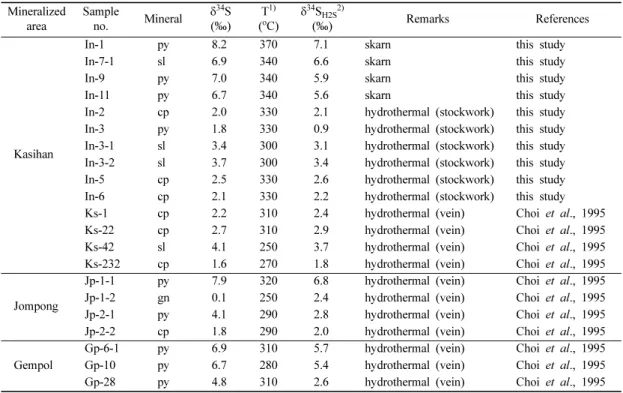
(5) Stable Isotopes of Ore Bodies in the Pacitan Mineralized District, Indonesia. 19. Table 1. Sulfur isotope data for sulfide minerals from the ore bodies in the Pacitan mineralized district Mineralized area. Kasihan. Jompong. Gempol. Sample no. In-1 In-7-1 In-9 In-11 In-2 In-3 In-3-1 In-3-2 In-5 In-6 Ks-1 Ks-22 Ks-42 Ks-232 Jp-1-1 Jp-1-2 Jp-2-1 Jp-2-2 Gp-6-1 Gp-10 Gp-28. Mineral py sl py py cp py sl sl cp cp cp cp sl cp py gn py cp py py py. δ34S (‰) 8.2 6.9 7.0 6.7 2.0 1.8 3.4 3.7 2.5 2.1 2.2 2.7 4.1 1.6 7.9 0.1 4.1 1.8 6.9 6.7 4.8. T1) (oC) 370 340 340 340 330 330 300 300 330 330 310 310 250 270 320 250 290 290 310 280 310. δ34SH2S2) (‰) 7.1 6.6 5.9 5.6 2.1 0.9 3.1 3.4 2.6 2.2 2.4 2.9 3.7 1.8 6.8 2.4 2.8 2.0 5.7 5.4 2.6. Remarks skarn skarn skarn skarn hydrothermal hydrothermal hydrothermal hydrothermal hydrothermal hydrothermal hydrothermal hydrothermal hydrothermal hydrothermal hydrothermal hydrothermal hydrothermal hydrothermal hydrothermal hydrothermal hydrothermal. (stockwork) (stockwork) (stockwork) (stockwork) (stockwork) (stockwork) (vein) (vein) (vein) (vein) (vein) (vein) (vein) (vein) (vein) (vein) (vein). References this study this study this study this study this study this study this study this study this study this study Choi et al., Choi et al., Choi et al., Choi et al., Choi et al., Choi et al., Choi et al., Choi et al., Choi et al., Choi et al., Choi et al.,. 1995 1995 1995 1995 1995 1995 1995 1995 1995 1995 1995. 1). Based on fluid inclusion temperatures and paragenetic constraints (Choi et al., 1995; Han and Choi, 2012). Calculated using the sulfur isotope fractionation equations in Ohmoto and Rye (1979).. 2). Standard techniques of extraction and analysis were used (McCrea, 1950; Grinenko, 1962; Clayton and Mayeda, 1963; Hall and Friedman, 1963; Rye, 1966). Data are reported in standard δ notation relative to the CDT standard for S, SMOW for O and D, and PDB for C. The analytical error for each measurement is approximately ±0.1‰ for O, C and S, and ±1‰ for H (Tables 1 and 2). 4.1. Sulfur Isotope Sulfur isotope analyses were performed on twenty-one sulfides from the skarn ore bodies and the hydrothermal ore bodies (veins + stockworks) in the Pacitan district (Table 1). Sulfur isotope compositions in pyrite, chalcopyrite, sphalerite and galena from the district have a relatively wide range of values between 0.1 and 8.2‰. These sulfides from skarn and hydrothermal deposits range from 6.7 to 8.2‰ and from 0.1 to 7.9‰, respectively. Assuming appropriate depositional temperatures for each sulfides, based on the average homogenization temperatures of fluid inclusions in associated quartz and paragenetic constraints, the calculated δ34S. Fig. 2. Histogram of calculated sulfur isotope composition of H2S in fluids for skarn and hydrothermal sulfide mineralizations, Pacitan mineralized district.. values of H2S in skarn-forming and hydrothermal fluids are 0.9 to 7.1‰ (5.6 – 7.1‰ for skarnhosted sulfides and 0.9 – 6.8‰ for sulfides from hydrothermal deposits; Ohmoto and Rye, 1979) (Table 1 and Fig. 2). The apparent difference in δ34SH2S values between skarn (mean value: 6.3‰) and hydrothermal (mean.
(6) 20. Jin-Kyun Han and Sang-Hoon Choi. Table 2. Carbon, oxygen and hydrogen isotope compositions for various minerals and inclusion fluids, Pacitan mineralized district Mineralized Sample area no. In-2-1 In-2-2 In-6-1 In-9 In-22 In-39-2 In-231 In-225 Kasihan In-K-4 In-1 In-11 In-15 In-39-3 In-92 Ks-1 Ks-2 Ks-3 Jp-4 Jp-6 Jompong Jp-10 Jp-12 Gp-6-2 Gempol Gp-10 Gp-28. Mineral. Type. quartz magnetite quartz quartz quartz quartz quartz quartz magnetite calcite calcite calcite calcite calcite quartz quartz quartz quartz quartz quartz quartz quartz quartz quartz. skarn skarn skarn hydrothermal skarn hydrothermal hydrothermal hydrothermal skarn limestone skarn skarn hydrothermal hydrothermal hydrothermal hydrothermal hydrothermal hydrothermal hydrothermal hydrothermal hydrothermal hydrothermal hydrothermal hydrothermal. δ18O δ18O T1) (‰) (‰) (oC) 13.5 10.6 412 2.9 11.9 8.9 12.0 9.9 11.1 13.3 2.8 15.2 12.0 10.9 8.2 7.8 7.0 7.4 8.2 13.3 10.2 11.2 6.0 10.2 5.9 9.9. T2) δ18O3) (oC) (‰) 410 9.6 410 9.6 340 6.3 300 3.3 340 6.4 300 3.0 350 5.5 350 7.7 400 9.7 300 9.6 280 5.8 280 4.7 280 2.0 280 1.2 280 -0.6 320 1.2 300 1.3 310 6.7 270 2.2 300 4.3 230 -3.9 290 3.0 250 -3.0 310 3.4. δD δ13C (‰) (‰) -67. Remarks. -84 stockwork -74 stockwork stockwork stockwork. -65 -76 -7.0 -7.9 -7.4 -7.9 -7.7 -69 -66 -71 -76 -72 -65 -79 -79 -88 -81. host rock. stockwork stockwork vein vein vein vein vein vein vein vein vein vein. References this study this study this study this study this study this study this study this study this study this study this study this study this study this study Choi et al., 1995 Choi et al., 1995 Choi et al., 1995 Choi et al., 1995 Choi et al., 1995 Choi et al., 1995 Choi et al., 1995 Choi et al., 1995 Choi et al., 1995 Choi et al., 1995. 1). Calculated using the quartz-magnetite oxygen isotope fractionation equation of Matsuhisa et al. (1979). Based on fluid inclusion data with paragenetic constraints and equilibrium isotope temperature (Choi et al., 1995; Han and Choi, 2012). 3) Calculated using the mineral-water oxygen isotope fractionation equation of Matsuhisa et al. (1979), Javoy (1977), and Friedman and O'Neil (1977). 2). value: 3.1‰) deposit is noteworthy (Fig. 2). This variation is may be explained by host rock effect. The skarn deposits are developed in the lower sedimentary rock members of the Arjosari Formation which consist mainly mudstone, sandstone and limestone, whereas the hydrothermal deposits commonly occupied fractures in the igneous and/or volcano-sedimentary rocks (Fig. 1). Therefore, the sulfur in the fluids at the skarn deposits was derived from igneous source with mixing the amount of relatively heavy sulfur from the host rocks (sedimentary rocks), and the sulfur in the fluids at hydrothermal deposits had a local igneous source. The alternative possible explanation is increase in the SO4/H2S ratio (by progressive oxidation of the fluid) of the fluid with time. Fluid inclusion (Choi et al., 1995) and oxygen-hydrogen isotope data. indicate that the hydrothermal fluid evolved mainly through dilution and cooling from boiling, possibly due to mixing of local meteoric waters into Pacitan mineralizing system. Therefore, we must consider influx of local meteoric waters coupled with fluid boiling to explain the decrease in δ34SH2S values of the sulfides in the hydrothermal deposits. The assemblage of hematite + sulfides in the late ore mineralization of the hydrothermal deposits attests to relatively oxidizing fluid conditions with a mixed, SO4-H2S character. The change from skarn to hydrothermal mineralization is also shown in Figure 2, and would have resulted in increased SO4/H2S ratios and corresponding decreases in δ34S values of H2S (Ohmoto and Rye, 1979). However, the overlap of the ranges suggests that a fluid with a δ34SH2S value of around 3.7‰ (as mean.
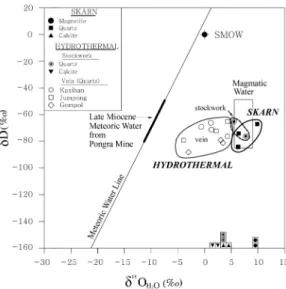
(7) Stable Isotopes of Ore Bodies in the Pacitan Mineralized District, Indonesia. value in the district) was responsible for sulfide mineralization in the each type area of Pacitan district. Ore mineral assemblages indicate that sulfur in the hydrothermal fluids was dominantly H2S (Choi et al., 1995). Therefore, the δ34S values of H2S (≈3.3‰) may be taken as an approximate sulfur isotope composition of the entire solution (δ34SΣS). These data indicate that such a fluid was responsible for mineralization and that the main sulfur in the district had a local igneous source, either directly by magma devolatilization or by leaching from surrounding igneous rocks. 4.2. Oxygen and Hydrogen Isotope Oxygen isotope composition of twenty-three minerals separates from skarns (2 magnetites, 3 quartzes, and 2 calcites) and hydrothermal deposits (4 quartzes and 2 calcites from stockworks, and 10 quartzes from veins) (Table 2). Minerals from the skarn have the following δ18O values: magnetite, 2.8 and 2.9‰; quartz, 11.9 to 13.5‰; calcite, 10.9 and 12.0‰. Quartz and calcite from hydrothermal deposits has δ18O values of 6.0 to 13.3‰ (stockwork, 8.9 – 13.3‰; vein, 6.0 – 13.3‰) and 7.8 to 8.2 ‰, respectively. A quartz-magnetite pair from skarn with equilibrium textures has a δ18O value of 10.6‰, yielding an apparent equilibrium isotope temperature of about 412oC (Matsuhisa et al., 1979; Javoy, 1977).. Fig. 3. Temperature versus oxygen isotope diagram showing the decrease of δ18Owater values with various deposit types and increasing paragenetic time at each deposit type in the Pacitan mineralized district.. 21. Utilizing appropriate mineral-water oxygen isotope fractionation equations for these minerals (Matsuhisa et al., 1979; Javoy, 1977; Friedman and O’Neil, 1977) and temperature estimates based on fluid inclusions and phase relations (Choi et al., 1995; Han and Choi, 2012), the following ranges of δ18O water values were calculated: magnetite, 9.6 and 9.7‰; skarn quartz, 6.3-9.6‰; skarn calcite, 4.7 and 5.8‰; stockwork quartz, 3.0-7.7 ‰; stockwork calcite, 1.2 and 2.0‰; vein quartz, -3.9 – 6.7‰ (Table 2 and Figs. 3 and 4). Calculated δ18Owater values decrease progressively with variety of deposit types (from skarn through stockwork to vein), increasing paragenetic time and decreasing temperature (Table 2 and Fig. 3). This indicates the progressively increasing involvement of isotopically less-evolved meteoric waters in the Pacitan hydrothermal system. Fluid inclusion waters were extracted by crushing from fifteen quartz samples at each type deposit and were analyzed for their hydrogen isotope composition. The ranges of δDwater values are from –65 to –88‰ (Table 2): skarn, -67 to -84‰; stockwork, -65 and -76‰; vein, -66 to -88‰.. Fig. 4. Plots of oxygen versus hydrogen isotope compositions showing stable isotope systematics of fluid compositions for skarn and hydrothermal mineralization, Pacitan mineralized district. Meteoric water line is from Craig (1961); The magmatic water box is from Taylor (1974). See the text for explanation on isotopic compositions of paleo-meteoric waters..
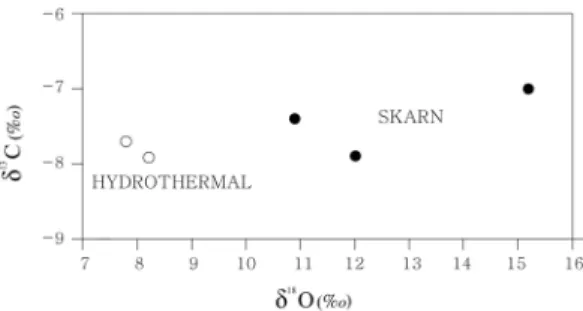
(8) 22. Jin-Kyun Han and Sang-Hoon Choi. There is no peculiar trend of the δD values with variety of deposit types, increasing paragenetic time and decreasing temperature. To assess the importance of meteoric waters in the Kasihan, Jompong and Gempol ore mineralizing hydrothermal systems in the Pacitan district and to interpret the measured δD values of inclusion waters, it is important to know the δD value of the local meteoric water at the time of mineralization. Unfortunately, the δD values of the local meteoric water at Miocene age are not known. In this study, the δD values are estimated from the δD values of the Porgera gold mine, Papua New Guinea (Richards and Kerrich, 1993). This mine is similar in mineralization age (Late Miocene), geographic location (6oS), and tectonic setting (an eastern portion of Irian Jaya Island, Indonesia) to Pacitan district (Choi et al., 1995). The measured range δD values for fluid in vein minerals from the Porgera hydrothermal ore deposit of Late Miocene age is –48 to –78‰ (Richards and Kerrich, 1993) which are assumed to represent the range of meteoric water compositions at the time of mineralization at Porgera. The δD values (-65 to -88‰) from the quartz in the Pacitan district are similar and/or slightly lower than those of the Porgera mine. Measured and calculated skarn and hydrothermal fluid compositions for the Kasihan, Jompong and Gempol area are shown on conventional oxygen versus hydrogen isotope diagram (Fig. 4). The δ18O and δD values from the skarn ore bodies fall within the calculated range of primary magmatic waters (Taylor, 1974) or slightly high (magnetite) and low (calcite) δ18O value, and may therefore represent primary magmatic water or water from any source whose isotopic composition is controlled by exchange with a large volume of igneous rocks at near magmatic temperatures (Fig. 4). Almost all of the δ18O and δD values from the hydrothermal deposits fall outside the range of magmatic waters toward more negative δ18O values. The δ18O values of early fluids for stockwork type mineralization in Kasihan area (Fig. 4) fall within the range of magmatic waters. These could represent mixing of magmatic or highly exchanged meteoric water with less exchanged meteoric water, or exchange of meteoric water with igneous rocks at elevated temperatures and low water/rock ratios. Therefore, the isotopic com-. positions of fluids in the Pacitan hydrothermal system show a progressive shift from magmatic hydrothermal dominance in the skarn and early hydrothermal ore mineralization periods toward meteoric hydrothermal dominance in the late ore mineralization periods. 4.3. Carbon and Oxygen Isotope Carbon isotope analyses were performed on calcite from limestone, and skarn and hydrothermal deposits. Calcite in and near skarn has δ13C values of –7.0 to 7.9‰ and δ18O values of 10.9 to 15.2‰. Hydrothermal calcite has δ13C and δ18O values of –7.9 to -7.7‰ and 7.8 to 8.2‰, respectively (Table 2 and Fig. 5). Stable isotope data for calcite indicate significant variation in oxygen isotope compositions with less variation of carbon isotope compositions (Table 2 and Fig. 5). Such a pattern is consistent with decarbonation reaction of a limestone in the presence of a water-rich fluid (So and Shelton, 1983). Carbon isotope compositions of recrystallized limestone reflect the degree of decarbonation due to the loss of 13C-enriched CO2 (Lattanzi et al., 1980), whereas the oxygen isotope compositions reflect isotopic exchange of the carbonate with a more 18O-depleted, water-rich fluid (Shelton, 1983; So et al., 1983a and b; Shelton et al., 1986 and 1987). Such a scenario is in agreement with the inferred fluid compositions based on skarn mineralogy and chemistry (Han and Choi, 2012). The relatively low XCO2 conditions (≈0.2) require the presence of an externally derived water-rich. Fig. 5. A δ13C versus δ18O diagram for carbonates from the Kasihan area. The pattern of data from recrystallized limestone, skarn, and hydrothermal calcite indicates decarbonation reaction of a limestone in the presence of a water-rich fluid..
(9) Stable Isotopes of Ore Bodies in the Pacitan Mineralized District, Indonesia. fluid component. If fluid compositions were controlled solely by the reaction stoichiometry, fluid compositions would be buffered internally to XCO2 values approaching pure CO2 (Lattanzi et al., 1980).. 5. Discussion and Conclusion The ore mineralizations of stockworks at Kasihan area (the early mineralization of the hydrothermal system in the Pacitan district) represent copper precipitation due to boiling at higher temperatures than those of the vein deposits (Choi et al., 1995). The vein deposits in each area represents a separate hydrothermal system: the mineralization at Kasihan were largely due to early fluid boiling coupled with later cooling and dilution, whereas the mineralization at Gempol and Jompong was mainly resulted from cooling and dilution by an influx of cooler meteoric waters. The oxygen and hydrogen isotope values from the skarn deposits in the district represent primary magmatic water or water from any source whose isotopic composition is controlled by exchange with a large volume of igneous rocks at near magmatic temperatures. Almost all of the δ18O and δD values from the hydrothermal deposits fall outside the range of magmatic waters toward more negative δ18O values. The δ18O values of early fluids for stockworks type mineralization in Kasihan area fall within the range of magmatic waters. These could represent mixing of magmatic or highly exchanged meteoric water with less exchanged meteoric water, or exchange of meteoric water with igneous rocks at elevated temperatures and low water/rock ratios. Therefore, the isotopic compositions of fluids in the Pacitan hydrothermal system show a progressive shift from magmatic hydrothermal dominance in the skarn and early hydrothermal ore mineralization periods toward hydrothermal dominance in the late ore mineralization periods.. Acknowledgements This work was supported by the research grant of the Chungbuk National University in 2014. The authors thank the survey team members who participated in the Mineral Exploration Program.. 23. References Choi, S.G., So, C.S., Choi, S.H. and Han, J.K. (1995) Genetic environments of hydrothermal vein deposits in the Pacitan District, East Java, Indonesia. Econ. Environ. Geol., v.28, p.109-121. Clayton, R.N. and Mayeda, T.K. (1963) The use of bromine pentafluoride in the extraction of oxygen from oxides and silicates for isotopic analysis. Geochim. Cosmochim. Acta, v.27, p.43-52. Craig, H. (1961) Isotopic variations in meteoric waters. Science, v.133, p.1702-1703. Friedman, I. and O’Neil, J.R. (1977) Data of geochemistry, Chapter KK, Compilation of stable isotope fractionation factors of geochemical interest. U.S. Geol. Surv. Prof. Paper 440-KK, 12p. Grinenko, V.A. (1962) Preparation of sulfur dioxide for isotopic analysis. Zhurnal Neorganicheskoi Khimii, v.7, p.2478-2483. Hall, W.E. and Friedman, I. (1963) Composition of fluid inclusion, Cave-in-Rock fluorite district, Illinois and Upper Mississippi Valley zinc-lead district. Econ, Geol., v.53, p.886-911. Han, J.K. and Choi, S.H. (2012) Ore Geology of Skarn Ore Bodies in the Kasihan Area, East Java, Indonesia, Econ. Environ. Geol., v.45, p.109-121. Javoy, M. (1977) Stable isotopes and geothermometry. Jour. Geol., v.133, p.609-636. Lattanzi, P., Rye, D.M. and Rice, J.M. (1980) Behaviour of 13 C and 18O in carbonates during contact metamorphism at Marysvill, Montana: Implications for isotope systmatics in impure dolomitic limestones. Amer. J. Sci., v.280, p.890-906. Matsuhisa, Y., Goldsmith, R. and Clayton, R.N. (1979) Oxygen isotope fractionation in the system quartzalbite-anorthite-water.Geochim. et Cosmochim. Acta, v.43, p.1131-1140. McCrea, J.M. (1950) The isotope chemistry of carbonates and a paleotemperature scale. J. Chem. Phys., v.18, p.849-857. Ohmoto, H. and Rye, R.O. (1979) Isotopes of sulfur and carbon. In: Barnes, H.L. (ed.) Geochemistry of hydrothermal ore deposits (2nd ed.). John Wiely, p.509-567. Richards, J.P. and Kerrich, R. (1993) The Porgera gold mine, Papua New Guinea: Magmatic hydrothermal to epithermal evolution of an alkalic-type precious metal deposit. Econ, Geol., v.88, p.1017-1052. Rye, R.O. (1966) The carbon, hydrogen, and oxygen isotopic compositions of the hydrothermal fluids responsible for the lead-zinc deposits at Providencia, Zacatecas, Mexico. Econ. Geol., v.61, p.1399-1427. Shelton, K.L. (1983) Composition and origin of ore-forming fluids in a carbonate-hosted porphyry copper and skarn deposit: A fluid inclusion and stable isotope study of Mines Gaspe, Quebec, Econ. Geol., v.78, p.387-421. Shelton, K.L., So, C.S., Rye, D.M. and Park, M.E. (1986) Geologic, sulfur isotope, and fluid inclusion studies of the Sannae W-Mo mine, Republic of Korea: Comparison of sulfur isotope systematics in Korean W deposits. Econ. Geol., v.81, p.430-446. Shelton, K.L., Taylor, R.P. and So, C.S. (1987) Stable iso-.
(10) 24. Jin-Kyun Han and Sang-Hoon Choi. tope studies of the Dae Hwa tungsten-molybdenum mine, Republic of Korea: Evidence of progressive meteoric water interaction in a tungsten-bearing hydrothermal systems. Econ. Geol., v.82, p.471-481. So, C.S., Rye, D.M. and Shelton, K.L. (1983a) Carbon, hydrogen, oxygen, and sulfur isotope and fluid inclusion study of the Weolag tungsten-molybdenum deposit, Republic of Korea: Fluid histories of metamorphic and ore-forming events. Econ. Geol., v.78, p.1551-1573. So, C.S., Shelton, K.L. and Rye, D.M. (1983b) Geologic, sulfur isotopic, and fluid inclusion study of th Ssang Jeon tungsten mine, Republic of Korea. Econ. Geol.,. v.78, p.157-163. So, C.S. and Shelton, K.L. (1983) A sulfur isotope and fluid inclusion study of the Cu-W-bearing tourmaline breccia pipe, Ilkwang mine, Republic of Korea. Econ. Geol., v.78, p.326-332. Taylor, H.P. Jr. (1974) The application of oxygen and hydrogen isotope studies to problems of hydrothermal alteration and ore deposition. Econ. Geol., v.69, p.843883. Van Bemmelen, R.S. (1949) The Geology of the Indonesia, v. IA, 1st edition. Govt. Printing Office, The Hague, p.104-136..
(11)
수치
관련 문서
