417
Korean J Ophthalmol 2011;25(6):417-420 http://dx.doi.org/10.3341/kjo.2011.25.6.417 pISSN: 1011-8942 eISSN: 2092-9382
Original Article
Attempts to Reduce the Progression of Myopia and Spectacle Prescriptions during Childhood: A Survey of Eye Specialists
Jong Jin Jung, Eun-Hae Lim, Seung-Hee Baek, Yong Ran Kim, Sang Mook Gong, Ungsoo Samuel Kim
Department of Ophthalmology, Kim’s Eye Hospital, Konyang University College of Medicine, Seoul, Korea
Purpose: To determine methods tried in clinical trials to reduce the progression of myopia in children, and spectacle prescribing patterns of hospital ophthalmologists.
Methods: A multi-sectioned survey composed of Likert items relating to the methods of reducing myopia pro- gression (orthokeratology lenses [O-K lenses], undercorrected glasses, and topical atropine) and the patterns of prescribing spectacles for children (including two cases involving a 5-year-old girl and an 8-year-old boy) were distributed to members of the Korean Ophthalmological Society, and the collected data was statistically analyzed.
Results: A total of 78 out of 130 ophthalmologists returned the survey. On a scale of 1 to 5, the mean rates of wheth- er the ophthalmologists think O-K lenses arrest myopia progression, and whether they recommend their patients to wear O-K lenses if indicative, were 3.06 and 2.75, respectively. Moreover, the mean rates of whether they con- sider that wearing glasses which are undercorrected would slow down the progression of the myopia, or if they think topical atropine helps in arresting myopia progression in children, were 2.34 and 1.27, respectively. In re- sponse to the case studies, the majority of practitioners preferred to prescribe the full amount found in cycloplegic refraction to pediatric patients with myopia.
Conclusions: Ophthalmologists in clinical practice encouraged children to wear O-K lenses more than under- corrected glasses as a way to retard myopia progression. However, the application of atropine is rarely tried in clinical trials. In managing pediatric patients with myopia (case specific), the majority of the practitioners chose to prescribe glasses with full cycloplegic correction.
Key Words: Atropine, Eyeglasses, Myopia, Orthokeratology lenses
ⓒ2011 The Korean Ophthalmological Society
This is an Open Access article distributed under the terms of the Creative Commons Attribution Non-Commercial License (http://creativecommons.org/licenses /by-nc/3.0/) which permits unrestricted non-commercial use, distribution, and reproduction in any medium, provided the original work is properly cited.
Received: August 24, 2010 Accepted: October 14, 2010
Corresponding Author: Ungsoo Samuel Kim, MD. Department of Ophthalmology, Kim's Eye Hospital, Konyang University College of Medicine, #156 Yeongdeungpo-dong 4-ga, Yeongdeungpo-gu, Seoul 150-034, Korea. Tel: 82-2-2639-7777, Fax: 82-2-2677-9214, E-mail:
Myopia, known to be the most common refractive error and childhood ocular disease in Asia, is a physiological proc- ess that the eye uses to adapt to the excessive near focal sur- roundings, which is easily correctable with optical devices [1]. Yet, the health risk associated with myopia should not be underestimated since the economic impact of routine optom- etry visits, contact lenses, spectacles, and refractive surgeries on the myopic population is considerable [1,2].
The onset age of myopia that is frequently mentioned is be- tween 5 and 15 years, and a number of studies have been con-
ducted to depict the prevalence rate of myopia worldwide.
The etiology, pathogenesis, and treatment of myopia have al-
so been debated over a long period of time in ophthalmic
countries [3,4]. Studies and statistics for myopia by country
have shown that both the incidence and progression rates of
myopia are high in Asian children [3,4]. There had been epi-
demiological evidence that children who spend more time
outside are protected from the development of myopia than
those who spend more time doing near-work [5]. Moreover,
methodological means to correct myopic refractive errors
such as orthokeratology and the use of atropine have been re-
viewed intensively in East Asia [6-10]. In this study, a survey
of Korean Ophthalmological Society members was con-
ducted in order to evaluate the opinions of practitioners about
some of the treatment modalities used to reduce myopia pro-
gression in children, as well as spectacle prescribing patterns
for preschool children with myopia (2 cases).
Korean J Ophthalmol Vol.25, No.6, 2011
418
Case 1
Age/gender: 5 yr/girl
Chief complain: for spectacle prescription Uncorrected visual acuity
OD 0.2, OS 0.15 Manifestation refraction
OD -1.50 sph, -0.50 cyl, 180 axis OS -2.00 sph, -0.75 cyl, 180 axis Cycloplegic refraction
OD -1.50 sph, -0.50 cyl, 180 axis OS -2.00 sph, -0.50 cyl, 180 axis Alternate cover test
Orthotropia at near & far
Answers
No prescription CR
PCR Undercorrection Etc
No response
Case 2
Age/gender: 8 yr/boy
Chief complain: recent progressive visual loss Corrected visual acuity (with old glasses) OD 0.5 (-4.00 sph -0.50 cyl 180 axis) OD 0.4 (-4.75 sph -0.50 cyl 180 axis) Manifestation refraction
OD -5.50 sph, -0.50 cyl, 180 axis OS -6.00 sph, -0.75 cyl, 180 axis Cycloplegic refraction
OD -5.00 sph, -0.50 cyl, 180 axis OS -5.50 sph, -0.75 cyl, 180 axis Alternate cover test
6Δ exophoria at near, orthotropia at far
Answers
MR CR Old glasses Undercorrection No response
Fig. 1. Detailed description of case 1 and 2 and the answers for preferred spectacle prescription of case 1 and 2. OD
= right eye; OS = left eye; CR = cycloplegic refraction; PCR = post-cycloplegic refraction; MR = manifestation refraction.
Materials and Methods
A questionnaire was distributed to the members of the Korean Ophthalmological Society working in hospitals or private clinics in South Korea. Questionnaires completed by the respondents were collected at the 2009 Annual Symposium.
The questionnaire was composed of two sections (one with multiple questions and another with two case specific questions).
In the first section, respondents were asked to rate according to the Likert scale (from 1 to 5) on three statements about whether they think orthokeratology lenses (O-K lenses), un- dercorrected glasses, or the use of topical atropine reduces myopia progression in children (statement 1,3, and 4), in ad- dition to one statement about whether they would recom- mend O-K lenses to their pediatric patients with myopia (statement 2). On a scale from 1 to 5, a response of 5 was con- sidered as ‘strongly agree with the statement,’ and 1 was con- sidered as ‘strongly disagree with the statement.’ In the sec- ond section, the respondents were asked about the patterns of prescribing glasses to their hypothetical pediatric patients;
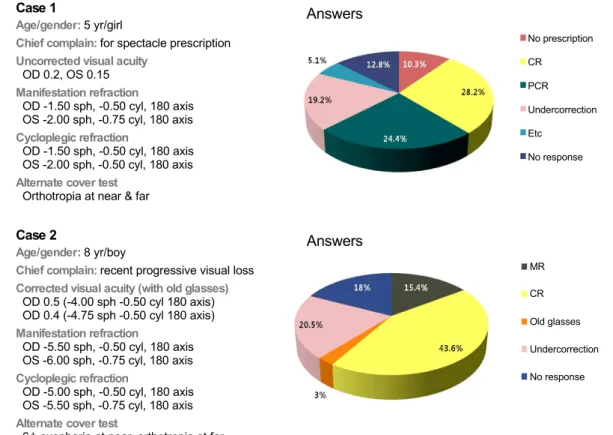
there were 2 case specific questions relating to a 5-year-old girl and an 8-year-old boy with detailed information includ- ing the child’s age, distance vision, distance cover test (DCT) and near cover test (NCT), manifest refraction, and cyclo- plegic refraction (case 1 and case 2, Fig. 1). Respondents were asked to indicate whether spectacles should be pre-
scribed, and whether this would be a full or partial correction.
The collected data was statistically analyzed.
Results
Seventy-eight ophthalmologists responded (56%) out of 130 who had consented to fill out the questionnaire. Responses to the four Likert scale items were analyzed. The majority of ophthalmologists practicing in Korea were neutral about the idea of the effects that O-K lenses have on reducing myopia progression. 16.7% (13 / 78) of the respondents strongly dis- agreed with statement 1, and did not recommend that their pediatric patients with myopia wear O-K lenses if indicative.
Only 6.4% (5 / 78) strongly agreed with statement 1, and the majority of the physicians chose to be neutral-to-negative about prescribing O-K lenses to children with myopia (Fig.
2). The mean rates in which the ophthalmologists thought that O-K lenses arrest myopia progression, and whether they would recommend that their patients wear O-K lenses if in- dicative, were 3.06 and 2.75, respectively.
Of the respondents, 32% (25 / 78) strongly disagreed that
optical undercorrection slows down the progression of my-
opia (statement 3), and the majority of ophthalmologists
were negative about children with myopia wearing glasses
that are undercorrected as a way to reduce myopia pro-
gression (Fig. 2).
JJ Jung, et al. Prevention of Myopia Progression in Korean Children
419
Statement 1. I think reshaping cornea with O-K lenses helps arresting
myopia progression in children. Statement 2. I recommend wearing O-K lenses to my pediatric patients with myopia (two people did not respond to the question).
Likert scale Likert scale
Statement 3. I think optical undercorrection helps arresting myopia progression in children (two person did not respond to the question).
Statement 4. I think topical atropine helps arresting myopia progression and I prescribe topical atropine in myopic children (one person did not respond to the question).
Likert scale Likert scale
Fig. 2. Analysis of the survey results about the prevention of myopic progression. Likert scale – 1, strongly disagree; 2, disagree; 3, unsure;
4, agree; 5, strongly agree. O-K lenses = orthokeratology lenses.
The mean rates corresponding to whether they consider that wearing undercorrected glasses would slow down the progression of the myopia, and whether using topical atro- pine could help arrest myopia progression, were 2.34 and 1.27, respectively. 79.5% (62 / 78) of the respondents strong- ly disagreed with statement 4. The majority of the oph- thalmologists who responded reacted negatively to the idea of using topical atropine to retard myopia progression in chil- dren with myopia (Fig. 2).
Two case records detailed myopic children, with one about a five year old girl, and the other about an eight year old boy.
For case 1, spectacles were prescribed with full correction according to the cycloplegic refraction by 28.2% of re- spondents, and full correction according to the post-cyclo- plegic refraction by 24.4% (Fig. 1). For case 2, spectacles were prescribed with full correction according to the cyclo- plegic refraction by 43.6% of practitioners, a reduced correc- tion both cylindrically and spherically by 20.5% (Fig. 1).
Discussion
A number of previous studies have evaluated the efficacy of several interventions to reduce the progression of myopia.
It is also well recognized in prescribing practices that un- corrected refractive error during childhood can result in the development of amblyopia and strabismus [11]. Some of the methodological means used to retard the progression of my- opia include bifocal and multifocal lenses, contact lenses, or- thokeratology lenses, atropine, pirenzipine, and tropicamide eye drops and ocular hypotensives [12-14]. However, there is no guideline produced by professional bodies to treat pedia- tric patients with myopia in Korea, and large-scaled random- ized clinical trials are necessary to evaluate the efficacy of such treatment.
The results of the present study suggest that Korean oph-
thalmologists are not well convinced by some of the methods
used to reduce myopia progression which are conveniently
applicable in clinical trials. The ophthalmologists that par-
Korean J Ophthalmol Vol.25, No.6, 2011