Ⅰ. 서 론
장애인은 구강건강 관리가 미흡하고 치료 필요성에 대한 인식이 부족하여 정기적인 검진이 중요하지만 난이도 높은 치료, 긴 치료 시간 그리고 상대적으로 낮은 수가로 인하여 주기적인 검진을 받기가 힘든 경우가 많다1,2).
◆ 원 저
장애 유형별 치과 검진 및 관리에 대한 비교연구
김동현∙신터전∙현홍근∙김영재∙김정욱∙이상훈∙김종철∙장기택*
서울대학교 치의학대학원 소아치과학교실
PATTERN OF CHECK UP AND DENTAL MANAGEMENT OF SPECIAL CARE NEEDS PATIENTS ACCORDING TO TYPES OF DISABILITIES
Dong-Hyun Kim, Teo-Jeon Shin, Hong-Keun Hyun, Young-Jae Kim, Jung-Wook Kim, Sang-Hoon Lee, Chong-Chul Kim, Ki-Taeg Jang*
Department of Pediatric Dentistry, School of Dentistry, Seoul National University
Regular dental visit of disabled patients is an important strategy for maintenance of oral health because of the lack of awareness of oral care. But there is limited information about follow up period in disabled pa- tients after dental treatment.
The aim of this study was to investigate the pattern of dental visit and dental management of special care needs patients according to the types of disabilities.
A total of 140 patients who received dental treatment at Seoul National University Dental Hospital from 2010 to 2012 were reviewed. Patients were divided 3 groups according to the types of disabilities (disorder of external physical function, disorder of internal organ, psychic disability). Patient’s characteristic, dental treatment performed, follow up period and frequency were investigated.
The mean follow up period was 28.2 months and average frequency of visit was 3.69 times per year.
There was no difference in period and annual visit between 3 groups, but significantly difference in cooperation with medical hospital in affiliation. Regular check-up was the most common dental treatment in all groups.
In psychic disorder group, the proportion of sedative treatment was significantly higher than other groups.
The results of this study provide information necessary for treatment planning and dental management of disabled patients. [J Korean Dis Oral Health Vol.12, No.2: 50-54, December 2016]
Key words : Special health care needs, Regular dental visit, Types of disabilities Abstract
*Corresponding author : Ki-Taeg Jang
103, Daehak-ro, Jongno-gu, Seoul, 03080, Republic of Korea Department of Pediatric Dentistry, School of Dentistry, Seoul National University
Tel: +82-2-2072-2782, Fax: +82-2-744-3599 E-mail: jangkt @snu.ac.kr
조 등3)은 성인 장애인 환자 중에 12%의 정도만이 3년이 상 주기적인 검진을 받았다고 보고하였으며 김 등4)도 장애 인 시설에 내원한 237명중에 37명만이 5년이상 장기간 검 진을 받았다고 보고하였다.
장애 유형별로 주기적인 치과검진의 중요성이 더욱 강조 되는데 뇌병변장애, 지적장애, 정신장애 그리고 자폐성장애 는 치과적 장애라고 분류되어 다른 장애유형에 비해 진료 시 난이도가 높아 지원을 받고 있다. 그러나 이러한 기준은 경험적 의견에 의거하여 분류한 것으로 이와 김5)은 지체장 애와 청각장애도 치과적장애로 포함해야 된다고 제안하며 치과적 장애의 범주를 넓힐 것을 주장하였다.
이 연구의 목적은 장애인의 장애 유형에 따른 내원 기간 과 치료의 종류, 그리고 이러한 내원에 영향을 주는 요인에 대해 분석해보고 장애인 환자의 지속적인 구강관리를 제공 하기 위한 방안에 대해 논의하고자 한다.
Ⅱ. 연구 재료 및 방법 1. 연구대상
2010년 1월부터 2012년 12월까지 서울대학교치과병원 소아치과에 내원한 남녀 어린이를 대상으로 후향적 연구를 진행하였다. 연구대상의 선정기준은 1) 장애인복지법에 따 른 장애유형에 해당하는 환자, 2) 의무기록상에 치료를 평 가할 수 있는 환자를 조사하였으며 이 중 제외기준으로 1) 여러 장애로 인하여 장애유형이 명확하게 구분되지 않은 환 자, 2) 이식 전 구강검진을 위해 내원한 환자, 3) 내원 횟수 가 2회 이하인 환자로 정하였다. 총 140명을 대상으로 의무 기록과 전산 기록을 조사하여 연구를 진행하였다.
2. 연구방법
환자의 분류는 보건복지부 장애인복지법 분류에 따라 3군 (외부 신체기능의 장애, 내부 기관의 장애, 정신적 장애)으 로 분류하여 비교하였다(Table 1). 의무 기록과 전산 기록 을 통해 환자의 연령 및 성별, 내원 기간, 시행된 치과 진료 의 종류, 부속 의과병원 동반 유무를 조사하고 비교하였다.
내원 기간은 12개월 미만, 12개월에서 36개월 사이 그리 고 36개월 이상인 경우로 분류하여 비교하였다. 시행된 치 과 진료는 특별한 처치 없이 검진만 시행한 경우, 치면 세 마, 불소도포 그리고 실란트 등의 예방치료를 시행한 경우, 약물을 이용하거나 전신마취를 동반한 진정치료의 경우 그 리고 이외 일반적인 치료를 시행한 경우로 분류하고 총 진 료 행위를 내원 횟수로 나누어 평균적인 내원 별 시행된 진 료를 백분율로 표시해 비교하였다. 부속 의과병원을 치과병 원과 같이 내원하는지 치과병원만 내원하는지를 분류하고
비교하였다. 부속 의과병원을 내원하는 환자를 대상으로 치 과병원에는 내원하지 않으나 의과병원에 계속 내원하는 경 우를 조사하고 비교하였다.
3. 통계분석
통계분석은 SPSS software for Windows ver. 23 (SPSS Inc., Chicago, IL, USA) 이용하여 분석하였다. 군 간 비교를 위해서 Chi-square test, one-way ANOVA, Kruskal-Wallis test를 이용하여 분석하였고 사후검정을 통해 군간의 차이를 비교 하였다. 통계 분석의 유의수준은 p < 0.05를 기준으로 하였다.
Ⅲ. 연구 성적 1. 연령 분포 및 성별
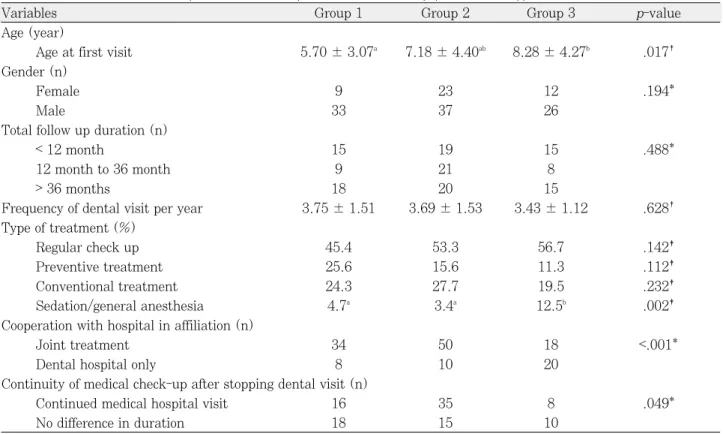
환자의 초진 시 연령분포는 0세에서 21세까지 분포하였 으며 전체 평균연령은 7.03 ± 4.10세 이었다. 장애 유형에 따라 초진 시 평균 연령은 각 군간 유의한 차이를 보였으며 정신적 장애군에서 외부 신체기능의 장애 군보다 연령이 유 의하게 높은 것으로 나타났다(p = 0.017). 성별에서는 각 군간 유의한 차이를 보이지 않았다(Table 2).
Table 1.Distribution of the patients according to the type of the disability by the current guidance for the disability grading of Ministry of Health and Welfare
Groups Number of
Percentage patients
1. Disorder of external 42 30.00%
physical function
Crippled disorder 8 5.70%
Brain disorder 24 17.10%
Visual disorder 6 4.30%
Auditory disorder 4 2.90%
2. Disorder of internal organ 60 42.90%
Renal disorder 14 10.00%
Cardiac disorder 31 22.10%
Hepatic disorder 10 7.10%
Convulsion disorder 5 3.60%
3. Psychic disability 38 27.10%
Mental retardation 32 22.90%
Autism 6 4.30%
2. 내원 기간 및 연간 평균 내원 횟수
전체 환자의 평균 내원 기간은 28.2 ± 23.9개월이었으 며 연간 평균 내원 횟수는 3.69 ± 1.46 회로 나타났다. 장 애 유형별로 평균적인 내원 기간, 그리고 평균 내원 횟수는 유의한 차이를 보이지 않았다(Table 2).
3. 치과 진료 종류
정신적 장애군에서 다른 두 군에 비해 진정치료에서 유의 게 높은 진료 비율을 보였다(p = 0.002)(Table 2).
4. 부속 의과병원 내원 유무
정신적 장애군에서 다른 두 군에 비해 부속 의과병원 검 진 없이 치과병원에서만 검진 받는 경우가 높게 나타났다(p
<0.001). 내부기관의 장애군에서 치과는 내원하지 않으나 부속 의과병원에는 계속적으로 내원하는 경우가 다른 두 군 에 비해 유의하게 많았다(p = 0.049)(Table 2).
Ⅳ. 총괄 및 고찰
조사된 140명의 환자 중 37.9%만이 3년 이상의 주기적 인 치과검진을 받는 것으로 나타났으며 내원 기간이 1년 이 내인 환자도 35%에 해당하는 것으로 조사되었다. 이 등6)은 발달장애 환자의 주기적인 검진 비율이 50%에도 못 미친다 고 보고하며 구강건강관리를 위해서는 치과의 정기적인 접 촉이 중요하다고 주장하였는데 이 연구 결과에서도 정기적 인 검진을 받는 경우가 장애 유형에 관계없이 적은 것으로 관찰되었다.
1년 이상 내원한 환자를 대상으로 연간 평균 치과 내원 횟수는 3.69회로 나타났고 장애유형별로 내원 횟수의 차이 는 보이지 않았다. 이는 심 등7)이 보고한 3.82회보다는 빈 도가 낮았지만 같은 연구에서의 비장애인의 내원 횟수보다 는 높았다.
환자분포는 지적장애, 심장장애, 뇌병변장애 순으로 나타 나 성인에서 지체장애가 가장 높은 비중을 보이는 것과 다 른 분포양상을 보였다. 지체장애는 선천적인 이유보다는 후 천적으로 얻어지는 경우가 많기 때문에 소아에서 지체장애 의 비율이 적은 것으로 생각된다.
Table 2.Characteristics of the patients and comparisons of follow up pattern and type of treatment
Variables Group 1 Group 2 Group 3 p-value
Age (year)
Age at first visit 5.70 ± 3.07a 7.18 ± 4.40ab 8.28 ± 4.27b .017� Gender (n)
Female 9 23 12 .194*
Male 33 37 26
Total follow up duration (n)
<12 month 15 19 15 .488*
12 month to 36 month 9 21 8
>36 months 18 20 15
Frequency of dental visit per year 3.75 ± 1.51 3.69 ± 1.53 3.43 ± 1.12 .628� Type of treatment (%)
Regular check up 45.4 53.3 56.7 .142�
Preventive treatment 25.6 15.6 11.3 .112�
Conventional treatment 24.3 27.7 19.5 .232�
Sedation/general anesthesia 4.7a 3.4a 12.5b .002�
Cooperation with hospital in affiliation (n)
Joint treatment 34 50 18 <.001*
Dental hospital only 8 10 20
Continuity of medical check-up after stopping dental visit (n)
Continued medical hospital visit 16 35 8 .049*
No difference in duration 18 15 10
* Chi-square test
�one way ANOVA
�Kruskal - Wallis test
Different superscript letters indicate statistically significant differences
초진시 연령은 정신적 장애군이 외부 신체기능의 장애군 과 내부기관의 장애군보다 높게 나타났다. 정신적 장애를 보이는 아동의 경우 유년기에는 그 특성이 잘 나타나지 않 고, 어린 시기에는 상대적으로 아동의 구강위생관리가 용이 하기 때문인 것으로 생각된다. 성별은 남성이 96명 (68.6%), 여성이 44명(31.4%)로 남성의 비율이 높았으나 장애 유형에 따른 성비의 차이는 보이지 않았다. 성비는 김 등8)이 조사한 결과와 유사한 경향을 보이며 국내 장애인 현 황에서 보고되는 남성의 비율(57.7%)보다는 다소 높게 나 왔다. 서 등9)은 남자 장애인의 치과 치료 비율이 여성보다 높다고 보고하며 남자 장애인 환자가 더 많은 치료기회를 받고 있는 것인지에 대한 조사가 필요하다고 하였으나 심과 최7)는 내원 환자의 성비가 다르지 않다고 보고하였는데 남 녀 성비 차이에 대한 추가적인 연구가 필요한 것으로 생각 한다.
치과 진료에 있어 특별한 치료 없이 정기적인 검진을 한 경우가 51.9%로가장 많았으며 선행연구에서 성인을 대상 으로 조사한 17.6%보다 높은 비율을 보였다3). 다음으로 일 반적인 치료 21.4%, 예방치료가 17.4%, 그리고 진정치료 가 6% 순으로 나타나 손 등10)이 조사한 비장애인의 환자에 서 치료 비율과 비교시 예방치료의 비율이 높게 나타난 것 으로 관찰되었다.
장애 유형별 치과진료 비교 시 외부 신체기능의 장애군에 서 예방치료의 비율이 높았으나 통계적인 차이는 보이지 않 았다. 정신적 장애군에서 다른 군에 비해 진정치료가 높은 비율을 차지 하고 있었는데 선행연구에서 보고된 결과와 유
사하였다9,11,12). 정신적 장애 환자는 낮은 협조도를 보이고
치료에 저항하는 경우가 많아 치과진료의 어려움이 크기 때 문에 진정치료의 비율이 높은 것으로 생각된다6,13). Pradhan 등14)은 정신적 장애 환자의 경우 신체적 장애 환 자보다 치료의 어려움으로 인하여 충전치료보다는 발치를 시행하는 경우가 많다고 보고하며 구강검진의 중요성에 대 해 강조하였다. 김 등4)도 꾸준한 구강관리를 할 경우 초기에 는 수복 및 치수치료의 비율이 높으나 후기에는 예방치료의 비율이 높아져 장기적으로 치료의 시간과 비용을 감소할 수 있다고 주장하였다.
정신적 장애군은 부속 의과병원 내원에 있어서도 다른 경 향을 나타냈다. 정신적 장애군에서는 치과병원만 내원하는 비율이 높았으며 반면 내부기관의 장애를 보이는 군에서는 의과병원과 같이 내원하는 경우의 비율이 높았다. 심과 최7) 도 정신적 장애의 환자가 장애 판정을 받은 뒤에도 장애 등 록을 유예하는 경향을 보인다고 언급하였는데 본 연구 결과 와 유사하다.
종합해보면 기존에 치과적 장애라 분류된 뇌병변장애, 지 적장애, 정신장애 그리고 자폐성장애 분류를 세분화할 필요 가 있으며 내부기관의 장애를 가진 환자와 보호자에게 구강
검진의 중요성을 알리는 것이 필요하다고 생각된다. 뇌병변 장애는 정신적 장애군과는 치료 내용 및 관리가 다르며 이 는 협조도가 부족하더라도 불수의적인 경우로 인한 경우인 지 행동조절이 힘든 경우인지에 따라 치료접근이 다르기 때 문이다13,15).
내부기관의 장애를 가진 환자의 경우 주 장애로 인하여 구강위생관리가 쉽지 않고 양치질의 제약이 있다. 또한 관 혈적인 치과치료가 시행될 경우 예방적 항생제 투여와 전처 치가 필요한 경우가 많아 주기적인 검진을 통해 예방치료의 중요성이 더욱 크다고 할 수 있다. 그러므로 환자와 보호자 에게 정기적인 의과 내원만큼 치과내원도 필요하다는 것을 강조해야 된다12).
본 연구는 3차 의료기관이 가진 특성으로 인하여 결론을 일반화하기에는 환자의 분포와 연령이 차이가 있을 수 있고 장애분류에 있어 보다 더 체계적이고 정확한 분석이 필요하 다는 제한이 있다.
그럼에도 이 연구를 통해 장애 유형별 환자의 주기적인 구강관리의 현황을 파악할 수 있으며 앞으로 이러한 환자의 치료에 있어 유의 사항을 제시하는데 도움이 될 수 있다고 생각한다.
Ⅴ. 결 론
장애인의 주기적인 치과 내원기간은 장애유형에 따라 다 르지 않았으나 치료 내용에 있어서 정신적 장애 환자에서 외부 신체기능의 장애 환자와 내부 기관의 장애 환자들에 비해 진정치료의 비율이 높았다. 주 장애로 인하여 의과병 원에는 내원하나 치과병원에 내원하지 않는 경우가 많이 관 찰되었으며 내부기관의 장애군에서 비율이 높았다.
치과의사는 환자와 보호자에게 구강건강의 중요성을 인 식시킴으로써 지속적인 구강관리를 받을 수 있게 하며 구강 질환을 예방하고 조기에 치료함으로써 건강한 구강상태를 유지할 수 있도록 해야 한다.
REFERENCES
1. Katz RV, Tillman HH, Bloch RM, Stojanovic M, Kaira A : Revisiting the status of oral health ser- vices in adult PM&R programs: a 40-year fol- low-up survey. Spec Care Dentist, 2015.
2. Kim YJ : Dental treatment considerations ac- cording to the types of disabilities. J Korean Dis Oral Health, 2:131-135, 2006.
3. Cho HL, Kim YJ, Yoon TY : A study on the sat- isfaction factors of the disabled when using den- tal care services. J Korean Dis Oral Health, 10:
9-21, 2014.
4. Kim SY, Choi SC, Park JH, Kim KC : The Evaluation of Dental Treatment Records in Charity Dental Clinic for the Disabled People. J Korean Dis Oral Health, 9:25-29, 2013.
5. Lee W, Kim YJ : A Comparison Study on Dental Treatment Time of Patients with Different Types of Disabilities. J Korean Dis Oral Health, 10:78- 83, 2014.
6. Lee HS, Yang JW, Kim MJ, Baek SH : The re- sult of the dental behavior treatment for the pa- tients with the developmental disorder in Seoul dental hospital for disabled. J Korean Dis Oral Health, 6:84-93, 2010.
7. Shim SH, Choi YG : A year review of outpatients in dental clinic of the municipal hospital for the disabled children. J Korean Dis Oral Health, 9:
18-24, 2013.
8. Kim JH, Nam OH, Lee HS, et al. : Oral health status of patients with special health care needs in Kyung Hee university dental hospital. J Korean Dis Oral Health, 11:53-57, 2015.
9. Seo KS, Jang KT, Kim HJ, Yum KW : The sta- tus of comprehensive dental treatment and type of disabilities of the patients treated under out- patient general anesthesia at the clinic for the disabled in Seoul national university dental hos-
pital. J Korean Dent Soc Anesthesiol, 6:82-88, 2006.
10. Son YJ, Hyun HK, Jang KT, et al. : The changes in practice patterns for the last 8 years(2001- 2008) in the department of padiatric dentistry, Seoul national university dental hospital. J Korean Acad Pediatr Dent, 37:97-101, 2010.
11. Lee H, Kim YJ, Hahn SH, et al. : A study on the dental treatment under outpatient general anes- thesia. J Korean Acad Pediatr Dent, 36:264-269, 2009.
12. Salles P, Tannure P, Castro GFB, et al. : Dental Needs and Management of Children With Special Health Care Needs According to Type of Disability. J Dent Child, 79:165-169, 2012.
13. Chang J, Lee JH, Son HH, Kim HY : Caries risk profile of Korean dental patients with severe in- tellectual disabilities. Spec Care Dentist, 34:201- 207, 2014.
14. Pradhan A, Slade GD, Spencer AJ : Factors in- fluencing caries experience among adults with physical and intellectual disabilities. Community Dent Oral Epidemiol, 37:143-154, 2009.
15. Chang J : Dental treatment under general anes- thesia: an overview of clinical characteristics of special needs patients. J Korean Dis Oral Health, 10:61-67, 2014.