논문 2012-49TC-5-8
LTE-Advanced에 적용되는 빠른 페이딩 채널의 새로운 채널 추정 방법
( Novel Channel Estimation Method in Fast Fading Channels Applied to LTE-Advanced )
사란쉬 말리크*, 셰를리 포루투갈*, 문 상 미*, 김 보 라*, 김 철 성**, 황 인 태***
( Saransh Malik, Sherlie Portugal, Sangmi Moon, Bora Kim, Cheolsung Kim, and Intae Hwang )
요 약
높은 도플러 확산에 의한 채널 통계의 정확한 전송 및 추정은 최근 및 미래의 이동 통신 시스템에서 고려되는 주요 문제 중 하나이다. 따라서 기존 채널 추정 기법의 한계를 극복하는 새로운 채널 추정 기술을 연구하는 것이 중요하다. 본 논문에서 는 첫 번째 OFDM symbol의 간단한 추정 후 새로운 채널 추정 방법인 파일럿 부반송파와 OFDM symbol의 나머지 채널을 추정하기 위해서 Kalman Filter를 사용하는 것을 제안한다. 또한 지금까지의 대부분 연구에서는 block-type이나 comb-type 파 일럿 배열에 초점 맞춰져 있는 것과 달리 LTE-Advanced의 파일럿 부반송파의 lattice-type 배열을 고려하여 설계한다. 이 외 에도 결과를 최적화하기 위해서 나머지 부반송파에 대한 채널 주파수 응답을 추정하기 위해 채널 임펄스 응답의 필터링과 Winer Filter를 사용한다.
Abstract
Accurate transmission and estimation of the channel statistics affected by high Doppler spread is one of the main issues of concern for the latest and future mobile communication systems. Therefore, it is important to research in novel channel estimation techniques that overcome the limitations of conventional methods. In this paper, we propose a novel channel estimation method that, after a simple estimation in the first OFDM symbol, uses Kalman filter to predict the channel in the rest of OFDM symbols with pilot subcarriers. Our method is designed considering the lattice-type arrangement of pilot subcarriers in LTE-Advanced, since most of the studies so far focus on block-type or comb-type pilot arrangements. In addition, to optimize the results, we use the filtering of channel impulse response and Wiener Filter for the estimation of the channel frequency response in the rest of the subcarriers.
Keywords: Channel Estimation, OFDM, LTE-Advanced
* 학생회원, ** 평생회원, 전남대학교 전자컴퓨터공학과 (School of Electronics & Computer Engineering Chonnam National University)
※ 본 연구는 지식경제부 및 정보통신산업진흥원의 대 학 IT연구센터 지원사업의 연구결과로 수행되었음.
(NIPA-2012-H0301-12-3005).
※ 이 논문은 2011년도 전남대학교 학술연구비 지원에 의하여 연구되었음.
접수일자: 2011년7월27일, 수정완료일: 2012년5월12일
Ⅰ. Introduction
There are several techniques used to estimate the channel in a wireless communication system. The effectiveness of these techniques depends on key factor such as the environment (indoor, outdoor, rural, urban) and the mobility between transmitter and receiver. Primarily, Least Square (LS) estimation is
the most simple of the conventional chanel estimations techniques, but it only works well for time-invariant channels or with low Doppler spread.
Minimum Mean Squared Error (MMSE) combined with a linear interpolation method is more effective than LS because it considers the channel correlation values. However for time-variant channels, it is necessary to implement techniques able to estimate or predict the variations of the channel in time, such as Wiener and Kalman filters. In this research, we want to proposed a method to estimate and predict the variations of channel in fast fading channels, considering the especial arrangement of reference signals in LTE-Advanced, since other papers are usually based on block-type or comb-type arrangements.
This paper is divided as follows, section II shows the arrangement of reference signals in 3GPP LTE- Advanced, section III briefly describes conventional channel estimation methods, section IV describes our proposal, section V shows our simulation results and finally section VI contains our conclusions.
Ⅱ. Reference signals in LTE-Advanced
LTE-Advanced uses signals known by both the transmitted and the receiver, sent in predefined
그림 1. 확장된 CP에서 하나의 안테나 포트에 대한 다 운링크 레퍼런스 신호 매핑
Fig. 1. Mapping of downlink reference signals for one antenna port in extended CP.
locations. This signals are called downlink reference signals[1]. By processing the received reference signals, the receiver can estimate the whole channel response for each OFDM symbol.
In the time-domain, for one antenna port, reference signals are transmitted during the first and fifth OFDM symbols of each slot when the normal cyclic prefix (CP) is used and during the first and fourth OFDM symbols when the extended CP is used. In the frequency-domain, they are inserted every six subcarriers.
1. Relationship between coherence bandwidth and reference signals in 3GPP
LTE-Advanced
In LTE-Advanced, the subcarrier space frequency
is 15 kHz. Since the reference signals in the frequency domain are located every 6 subcarriers, the reference signal bandwidth is 90 kHz. If the Channel Frequency Response (CFR) remains constant, the correlation in the frequency domain should have a value close to 1; while we choose a value of 0.5 as an indicator that the channel has changed. Based on this assumptions, we can estimate the coherence bandwidth for both situations using equation (1)[2]:
≥
(1)
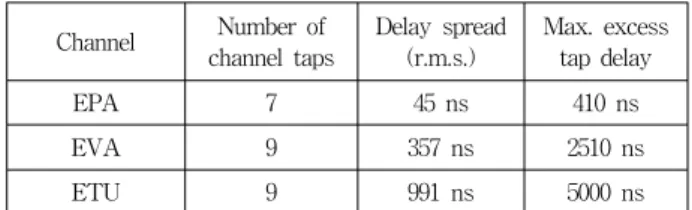
where is the correlation in frequency domain, and is the root-mean-square (RMS) delay spread given for LTE-Advanced extended channel models:
Extended Pedestrian A (EPA), Extended Vehicular A (EVA) and extended urban (ETU) channels(Table 1).
Channel Number of channel taps
Delay spread (r.m.s.)
Max. excess tap delay
EPA 7 45 ns 410 ns
EVA 9 357 ns 2510 ns
ETU 9 991 ns 5000 ns
표 1. 3GPP LTE-Advanced 채널 모델을 위한 지연 프로파일.
Table 1. Delay profile for 3GPP LTE-Advanced channel models.
Channel model
EPA 1.6 MHz 3.7 kHz
EVA 201.1 kHz 466.9 kHz
ETU 72.4 kHz 168.2 kHz
표 2. 20 MHz LTE-Advanced 시스템의 상관 대역폭.
Table 2. Coherence Bandwidth of 20 MHz LTE-Advanced system.
The results in Table 2 demonstrate that, basically, the channel is constant during the bandwidth corresponding to the spacing of reference symbols in frequency domain; and therefore, the reference signals in LTE-Advanced are able to keep track of the frequency selective fading.
2. Relationship between coherence time and reference signals in 3GPP LTE-Advanced
For the extended cyclic prefix case, there are 6 symbols in 1 slot (12 symbols per subframe).
Therefore, we can calculate 1 OFDM symbol period as:
Reference signals are transmitted during the first and fourth OFDM symbols in each slot. Therefore, the spacing of reference signals in time domain is:
∙
If the channel is constant in time, the correlation in the time domain should be close to 1; while we choose a value of 0.5 as an indicator that the channel has changed. Based on this assumptions, we can
Channel
Maximum Doppler Frequency
(Hz)
UE maximum speed (km/h)
*carrier freq. 2 GHz
EPA 5 3
EVA 70 40
ETU 300 160
표 3. 3GPP LTE-Advanced 채널 모델을 위한 최대 도플러 주파수.
Table 3. Maximum Doppler frequency for 3GPP LTE-Advanced channel models.
Maximum Doppler
Frequency
14.4 ms 33.3 ms
1.0 ms 2.4 ms
0.2 ms 0.6 ms
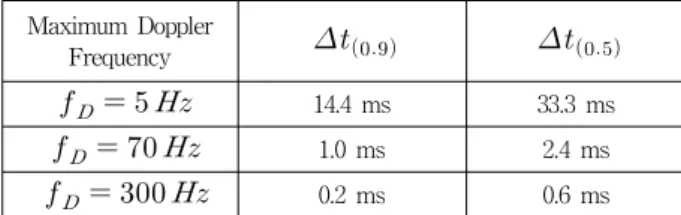
표 4. 20MHz 3GPP LTE-Advanced 시스템의 상관 시 간.
Table 4. Coherence time of 20 MHz 3GPP LTE-Advanced system.
estimate the coherence time for both situations, using equation (2) and the maximum doppler frequency corresponding to the LTE-Advanced channel models shown in Table 3.
≥
(2)
The results shown in Table 4 demonstrate that the spacing of reference symbols in time is less than the coherence time; therefore, the reference signals in LTE-Advanced are able to keep track of the time-varying fading channel.
Ⅲ. Conventional Channel Estimation Methods
In this section we briefly describe conventional techniques to estimate and/or predict the CFR.
1. LS Channel Estimation
LS is the simplest method to estimate the channel.
First, we calculate the CFR only in the subcarriers that contain reference symbols. We do so, by dividing the received reference signals between their transmitted value[3]:
(3)
The CFR for the rest of the subcarriers, is그림 2. LS 채널 추정 블록 다이어그램.
Fig. 2. Block diagram of LS channel estimation.
estimated with interpolation and extrapolation in frequency and time dimensions.
2. MMSE Channel Estimation
Another method to estimate the channel is the MMSE algorithm which has better performance than LS but is computationally more complex. MMSE calculates the Channel Impulse Response (CIR) that minimizes the mean square error between the actual and estimated CIR[4].
The channel in the frequency domain can be estimated with equation (4)
(4)
where is the noise variance, is the cross-correlation matrix between all subcarriers and the subcarriers with reference signals within the same OFDM symbol, is the autocorrelation matrix of the subcarriers with reference signals within the same OFDM symbol, and the superscript
∙ denotes Hermitian transpose. By replacing
in (4) with its expectation
,
the MMSE channel estimator in frequency domain can be expressed as:
(5)
where is a constant depending on the type of modulation and is the identity matrix. We can estimate the channel for the other resource elements using linear interpolation in time domain.그림 3. MMSE 채널 추정 블록 다이어그램.
Fig. 3. Block diagram of MMSE channel estimation.
3. Wiener Filter
The Wiener Filter (WF) uses the same principle than MMSE method[5] and it also eliminates noise effects in the channel estimation. WF allows us to keep track of the variations of the CIR in time-variant channels because it uses both the time and frequency correlations.
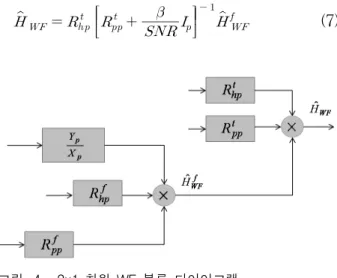
To simplify the complexity, the 2-dimensional WF is decompose into two separated WF's; one in the frequency domain and one in the time domain.
First, we obtain directly the channel estimation in frequency domain for the OFDM symbols with reference signal as:
(6)
Then we estimate the total channel frequency for all OFDM symbols using WF in time domain:
(7)
그림 4. 2×1-차원 WF 블록 다이어그램.
Fig. 4. Block diagram of 2×1-dimensional WF.
4. Kalman Filter
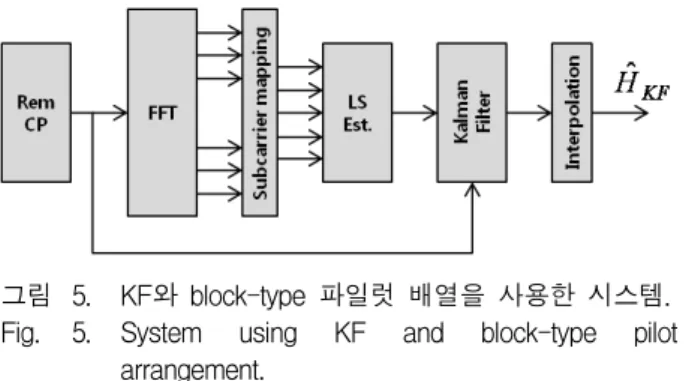
The purpose of the Kalman Filter (KF) is to use measurements observed over time, containing noise, and produce values that are closer to the true values of the measurements and their associated calculated values. In this section, we study the KF that is used to predict variations of the channel in time domain and which can also be applicable to frequency domain.
그림 5. KF와 block-type 파일럿 배열을 사용한 시스템.
Fig. 5. System using KF and block-type pilot arrangement.
The principle behind KF applied to channel estimation is that we can represent the CFR at time, as an infinite order autoregressive (AR) process[6].
where and are the order and the coefficient of the AR process, respectively. is a white Gaussian noise with zero mean and variance . For the case of first order AR process, and .
In order to reduce the computational complexity, only the first order AR process, i.e., is considered.
Therefore, we can represent the vector form of the CFR at time as:
The received symbol at time can be expressed in the form of a linear regression model:
.
Then, the channel estimate can be obtained by a set of recursions[7]:
IV. Proposed Channel Estimation Methods
In this section introduce and explain the proposed method to predict the channel in high conventional Fig. 6 shows the New Channel Estimator's block diagram that was designed considering the lattice-type reference signals arrangement of 3GPP LTE-Advanced (so far most of the studies focus on block-type or comb-type pilot arrangements). After FFT, the reference signals or pilots of the first OFDM symbols are extracted and we can estimate the CFR using a simple method, such as LS. Using the recursions of KF, we can estimate the variation of CFR for the later OFDM symbols containing reference signals. Then, we transform the CFR into CIR and eliminate the taps with index larger than ;
this way we eliminate the noise contained in those taps. Finally, we transform the CIR to CFR and estimate the channel for the rest of the subcarriers using WF in time dimension.
그림 6. 새로운 채널 추정 블록 다이어그램.
Fig. 6. Block diagram of the New Channel Estimator.
Ⅳ. Simulation Results
In this section we show the performance analysis of channel estimation methods. The simulations are performed in MATLAB using the simulation parameters of 3GPP LTE-Advanced shown in Table 5.
The time variant channel is modeled according to the values given for LTE-Advanced extended channel models in Table 1 and the maximum doppler
Bandwidth 20 MHz Sample frequency 30.72 MHz
Subframe duration 1 ms
Subcarrier spacing 15 kHz
FFT size 2048
Occupied subcarriers 1200 + DC subcarrier = 1201 No. of subcarriers/PRB 12
No. of available PRBs 100 CP size (samples) 512 (extended CP)
No. of OFDM
symbols/subframe 12 (extended CP) No. of reference signals per
PRB 8
Modulation scheme QPSK
Noise AWGN
No. of antennas 1x1
Channel estimation Techniques
LS with linear interpolation, MMSE, Wiener Filter, Creative CE Channel models
3GPP LTE-Advanced extended channel models:
EPA, EVA, ETU 표 5. 시뮬레이션 파라미터 (3GPP LTE-Advanced).
Table 5. Simulation parameters (3GPP LTE-Advanced).
그림 7. 최대 도플러 주파수 5Hz인 EPA 채널에서 서로 다른 채널 추정 기법을 이용한 BER 성능 Fig. 7. BER performance using different channel
estimation methods in EPA channel with max.
Doppler frequency of 5Hz.
Frequency values for each channel given in Table 3.
The frequency power spectrum follows the Jakes model. Following the results of section II, we assume the channel to be constant for 1 OFDM symbol.
Fig. 7 shows the BER performance of different channel estimation methods in EPA channel with max. Doppler frequency of 5Hz. For this case, the
그림 8. 최대 도플러 주파수 70Hz인 EVA 채널에서 서로 다른 채널 추정 기법을 이용한 BER 성능.
Fig. 8. BER performance using different channel estimation methods in EVA channel with max.
Doppler frequency of 70Hz.
그림 9. 최대 도플러 주파수 300Hz인 ETU 채널에서 서 로 다른 채널 추정 기법을 이용한 BER 성능 Fig. 9. BER performance using different channel
estimation methods in ETU channel with max.
Doppler frequency of 300Hz.
motion speed is low; therefore, as shown in sections II, the channel suffers little variation in time within one subframe and techniques like LS or MMSE with linear interpolation produce good results.
Fig. 8 shows the BER performance of different channel estimation methods in EVA channel with max. Doppler frequency of 70Hz. In this case, the mobile user moves with medium speed; therefore, as shown in section II, the channel suffers more variation in time within one subframe compared to the case of EPA. We can observe that the BER obtained with LS and MMSE starts to separate from the actual value, but WF and New Channel
Estimation (CE) produce more accurate results.
Fig. 9 shows the BER performance of different channel estimation methods in ETU channel with max. Doppler frequency of 300Hz. In this case, the mobile user moves with very high speed; therefore, as shown in section II, the channel suffers significant variations in time, even within one subframe. We can observe that the effectiveness of LS and MMSE is affected by the high Doppler spread; therefore it is necessary to employ techniques that consider the time correlation of the channel. We demonstrate through this simulation that our proposed technique, New CE, produces the best results for high Doppler spread environments.
V. Conclusion
In this paper we proposed a novel channel estimation method to improve transmission and reception of data in high speed environments. We designed our system considered the especial arrangement of reference signals in 3GPP LTE-Advanced and demonstrated through MATLAB simulations that the BER performance result in high Doppler spread is very close to the case of ideal channel estimation.
References
[1] 3GPP TS 36.211: “E-UTRA; Physical Channels and Modulations”, v9.1.0, March 2010.
[2] L. Somasegaran, “Channel Estimation and Prediction in UMTS LTE”, Master Thesis, Aalborg University, Vienna, Austria, Feb. 22nd - June 25th 2007.
[3] M. Simko, “Channel Estimation for UMTS Long Term Evolution”, Master Thesis, Vienna University of Technology, Austria, June 2009.
[4] J. Hou, J. Liu, “A Novel Channel Estimation Algorithm for 3GPP LTE Downlink System Using Joint Time-Frequency Two-Dimentional Iterative Wiener Filter”, University of Science and Technology of China.
[5] Y. Qin, B. Hui, K. Chang, “Novel Pilot-Assisted
Channel Estimation Techniques for 3GPP LTE Downlink with Performance-Complexity Evaluation”, 한국통신학회논문지, vol. 37, no. 7, Oct. 2007.
[6] B. Karakaya, H.Arslan, H. Cirpan, “An Adaptive Channel Interpolator Based on Kalman Filter for LTE Uplink in High Doppler Spread Environments.”, EURASIP Journal on WIreless Communications and Networking, vol. 2009, article ID 893751.
[7] W. Ling, L. Ting, “Kalman filter channel estimation based on comb-type pilot in time-varying channel”, International Conference on Wireless Communications, Networking and Mobile Computing (WiCOM), Sept. 2006.
저 자 소 개 사란쉬 말리크(학생회원)
2010년 라지프 간디 공과대학 IT학과 학사
2011년 3월∼현재 전남대학교 전 자컴퓨터공학과 석사과정
<주관심분야 : MIMO, OFDM, Relay>
김 철 성(평생회원)
1987년 Univ. of Arizona (박사) 1987년∼1989년 한국전자통신
연구원
1989년∼현재 전남대학교 전자컴퓨터공학부 교수
<주관심분야 : 이동통신, 디지털통신, MIMO, OFDM, RFID>
셰를리 포루투갈(평생회원) 2006년 파나마 공과대학
전자통신공학과 학사 2011년 전남대학교 전자컴퓨터
공학과 석사
2012년∼현재 파나마공과대학교 연구이사회 부위원장
<주관심분야 : MIMO, OFDM>
황 인 태(평생회원) 1990년 2월 전남대학교 전자공학과 학사 1992년 8월 연세대학교 전자공학과 석사 1999년 9월~2004년 2월 연세대학교
전기전자공학과 박사 1992년 8월~2006년 2월 LG전자 책임 연구원 2006년 3월~현재 전남대학교 전자컴퓨터공학부
교수
<주관심분야 : 디지털통신, 무선통신시스템,
mobile terminal system for next generation, physical layer software for mobile terminal, efficient algorithms for AMC, MIMO and MIMO-OFDM, Relaying scheme for wireless communication>
문 상 미(학생회원) 2012년 2월 전남대학교
전자컴퓨터공학부 학사 2012년 3월∼현재 전남대학교
전자컴퓨터공학과 석사과정
<주관심분야 : 이동통신, ICIM>
김 보 라(학생회원) 2012년 2월 전남대학교
전자컴퓨터공학부 학사 2012년 3월∼현재 전남대학교
전자컴퓨터공학과 석사과정
<주관심분야 : 이동통신, CoMP>