• 검색 결과가 없습니다.

A Proposal of the Olfactory Information Presentation Method and Its Application for Scent Generator Using Web Service

N/A
N/A
Protected

Academic year: 2021

Share "A Proposal of the Olfactory Information Presentation Method and Its Application for Scent Generator Using Web Service"

Copied!
7
0
0

로드 중.... (전체 텍스트 보기)

전체 글

(1)

1. INTRODUCTION

Smell output can be said to be the most explorative research area in Human Computer Interaction(HCI). The olfactory may provide robust memories and associate mechanism to build human senses[1, 2]. Although having many advantages, the lack of an effective scent generator, which generates various odors, restricts further research.

Recently, there has been great interest in a scent generator device that presents smell output and a commercial device has also appeared [3].

A researchers from Japan attempted to control smell with valves based on Ink-Jet technology, and had developed a technology to blend the diverse scents by combining dozens of scent ingredients[4]. Also, they developed a new odor recorder using an electronic nose based on a QCM sensor array to measure an odor and convert it into digital data in order for it to be represented[5]. It was applied to virtual reality for showing a cooking process, and may be extended to animation and video clip applications.

However, the system can only be used for the exact same sensors and scent generator.

The computer controllable olfactory display systems were commercialized by companies such as Digiscents[6]

and Trisenx[7].

Despite these efforts, the information related with olfactory is not sufficiently provided as multimedia information compared with seeing and hearing information. Suitable research needs to be carried out in order to provide information regarding smell related with olfactory working as multimedia information. Olfactory information has to include existing multimedia information instead of being used as independent information.

In order to use olfactory information in multimedia, we have to develop techniques for olfactory information as follows :

- How to derive information from smell - How to transmit smell information - How to use a scent generator

In this paper, we propose an olfactory information presentation method, which is a way for using smell as multimedia information. The information of smell can be derived from smell characteristics such as intensity, persistence, hedonic tone, and odor description. It has to change into a digital structure data format such as integer,

1

Dept. of Electronics Engineering, Hoseo University

2

Division of Electronics, Information & Communication Engineering, Kangwon National University

+
Corresponding author : [email protected] (Received : Jun. 22, 2012, Accepted : Jul. 2, 2012) http://dx.doi.org/10.5369/JSST.2012.21.4.249 pISSN 1225-5475/eISSN 2093-7563

A Proposal of the Olfactory Information Presentation Method and Its Application for Scent Generator Using Web Service

Jeong-Do Kim

1

and Hyung-Gi Byun

2, +

Abstract

Among the human senses, olfactory information still does not have a proper data presentation method unlike that regarding vision and auditory information. It makes presenting the sense of smell into multimedia information impossible, which may be an exploratory field in human computer interaction. In this paper, we propose an olfactory information presentation method, which is a way to use smell as multimedia information, and show an application for scent generation and odor display using a web service. The olfactory information can present smell characteristics such as intensity, persistence, hedonic tone, and odor description. The structure of data format based on olfactory information can also be organized according to data types such as integer, float, char, string, and bitmap. Furthermore, it can be used for data transmitting via a web service and for odor display using a scent generator. The scent generator, which can display information of smell, is developed to generate 6 odors using 6 aroma solutions and a diluted solution with 14 micro-valves and a micro- pump. Throughout the experiment, we confirm that the remote user can grasp information of smell transmitted by messenger service and request odor display to the computer controlled scent generator. It contributes to enlarge existing virtual reality and to be proposed as a standard reference method regarding olfactory information presentation for future multimedia technology.

Keywords : Olfactory Information Presentation Method, Scent Generator, Odor Display, Web Service, Multimedia Technology

(2)

float, char, string, and bitmap, which is an easy way to transmit information of smell for the web service and scent generator. The scent generator is developed to generate odors using aroma solutions with micro-valves and a pump, and display smell according to request information data based on olfactory information transmitted via a web service.

Throughout experimental work, we confirm that the proposed olfactory information presentation method can derive and transmit smell information, and the remote user who receives information requests odor display using a computer controlled scent generator.

2. OLFACTORY INFORMATION PRESENTATION METHOD

2.1 Presentation method for odor characteristic parameters

Unlike the senses for sight and hearing, the olfactory is controlled by complex chemical compounds, and only human accept it with emotion and feeling. Thus, this sense is difficult to convert into digital information, which limits the olfactory being used as a part of media information.

A guideline on how to convert olfactory sensations onto the data and reference method need to be created for olfactory in order to devise media information that can be used to convey scents as well as other media representing other senses.

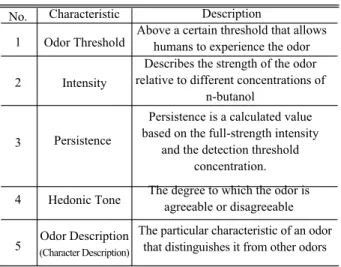
As a result from various researches for odors and sense of smell, we have learned that odors can categorized under five headings, which are described in Table 1.

Among the five headings for smell parameters, odor threshold is not important, because it is normally generated above the threshold for multimedia application. However, four other elements such as intensity, persistence, hedonic tone, and character description must be included in the presentation of olfactory information.

Intensity describes the strength of an odor sample and is measured at concentrations above the detection threshold.

It can be measured at full-strength(i.e., no dilution with non-odorous air) or diluted with non-odorous air. In either case, it can also be measured with a five-step scale using n- butanol, a standard reference chemical(ASTM 1988)[8, 9].

To learn about this scale, trained panelists sniff containers of n-butanol at different concentrations in water(Table 2).

Then, they are presented in diluted or full-strength(diluted is always presented first) odorous air samples that are rated against the n-butanol scale.

Persistence is a calculated value based on full-strength intensity and the detection threshold concentration. The slope of the line connecting these two points(on a log-log graph) represents the level of persistence(Fig. 1).

Persistence values are normally negative. Persistence indicates how easily the full-strength odorous air is diluted below the detection threshold. Odorous air that has a low persistence(more negativity) will have a steep slope, which indicates that it does not take much fresh air to dilute the odorous air below the detection threshold. Odorous air with a higher persistence(less negativity) will have a shallow slope, indicating that the air requires more dilution to drive it below the detection threshold. Inexpensive perfumes and colognes usually have less persistence than more expensive perfumes and colognes.

Table 1. Odor characteristic parameters

Characteristic Odor Threshold

Intensity

Hedonic Tone

Odor Description

(Character Description)

No.

1

2

3

4

5

Description

Above a certain threshold that allows humans to experience the odor Describes the strength of the odor relative to different concentrations of

n-butanol

Persistence is a calculated value based on the full-strength intensity

and the detection threshold concentration.

The degree to which the odor is agreeable or disagreeable Persistence

The particular characteristic of an odor that distinguishes it from other odors

Table 2. Odor intensity reference scale based on n-butanol

0 1 2 3 4 5

number Intensity category

Equivalent head space concentrati on of n-butanol in

air (ppm)

Mixture of n-butanol

in water (ppm) No odor

Very light Light Moderate

Strong Very strong

0 25 75 225 675 2025

0

250

750

2250

6750

20250

(3)

Hedonic tone describes the unpleasantness or pleasantness of an odor(ASCE 1995)[10]. It is typically rated using a scale that ranges from –10, which is unpleasant, to +10, which is pleasant. Neutral odors are recorded as zero. Unpleasantness usually increases with odor intensity. Pleasant odors may increase in pleasantness with odor intensity at low intensities but become less pleasant and even unpleasant at relatively high intensities.

Character descriptors are used to describe the character of the odor. The character of an odor is reported using odor class, which provides a referencing vocabulary for odor quality. Numerous “standard” odor descriptor lists are available. For example, an odor might smell like mint, citrus, earth, or any other select term used by trained panelists.

References for general odor classifications were given by Amoore[11, 12] and Flavornet[13]. Flavornet makes a compilation of aroma compounds found in human odor space. In addition, Flavornet classifies odors according to 25 classes. Class names are used to describe the character of the odor. Each class contains several odors and odorants.

Flavornet lists only those odorants that have been found in a human odor space at supra-threshold levels i.e. at levels likely to stimulate ORNs(Olfactory receptor neurons).

When numerous research results are combined, there are 5 ways to present odors, which are shown in table 3.

The first perception presentation may be defined as a labeling process in order to provide a name to the odor in text. The fifth presenting method with odor terminology may be omitted when it can be presented with the other 4 methods. Table 4 shows the relationship between odor characteristics and the presentation method.

From table 4, we can know that odor quality can be represented mostly by using the odor parameters of table 1.

○ is a very strong relation, △ is a regular relation, x is a weak relation.

2.2 Olfactory representation method using odor characteristic parameters

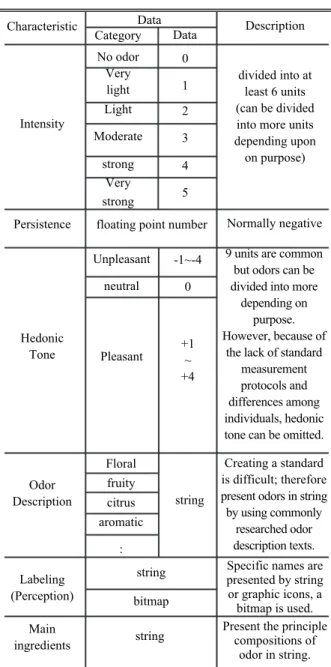
It is difficult to articulate the perception of odor, which is only described with the odor characteristic parameters shown in table 1. The perception of an odor is often similar to articulating a concrete name in words. The odor characteristics defined in table 1 are impossible to reify the perception presentation of odors. More parameter types such as name and label are used as an odor’s main ingredients with the previous defined parameters in table 1.

The labeling parameter is a form of bestowing a concrete name in words or graphical icons(bitmap) on the individual perception of an odor. For example, an odor description can use the term “floral” and the labeling parameter can use the term “lavender.” In real applications, the odor description and labeling parameter can use the preset odor classification tables. The main ingredients present the principle compositions of odors(odorants) in string format.

Table 5 demonstrates the presentation method for odors to be used as multimedia information.

Fig. 1. Persistence calculated from the log-log plot of intensity and dilutions[8].

Table 3. Representation method of odor quality

2 3 4 5 No.

1

Representation Method

Perception

Sensation Emotion Impression Odor Terminology

Description Type : flower, fruit, animal, fish

Individual : rose, jasmine, peach, cat etc sweet-smelling, burnt etc

like, dislike etc rustic, sensual, noble, elegant

simple, oriental etc

Table 4. Relations of odor characteristic and presentation

Odor Parameter

Intensity Persistence Hedonic tone Odor description

Representation method for odor quality Perception

x

△ x

Sensation x x x

Emotion

Impression

(4)

3. ODOR DISPLAY USING SCENT GENERATOR VIA WEB SERVICE 3.1 Scent generator

Odors are transmitted through an application service like MSN Messenger by the scent generator. For this service, we developed a simple scent generator, and transmit odors using the olfactory information presentation method, which is defined in the previous section.

The scent generator used for this experiment can generate 6 odors by using 6 aroma solutions and a diluted

solution. Also, 14 micro-valves are used to prevent any odor escape. Fig. 2 is a system block diagram of the Scent Generator.

The developed scent generator is connected to a PC (Personal Computer) using UART(Universal Asyn- chronous Receiver Transmitter), and the micro-pump is programmed by PWM(Pulse Width Modulation) to control the amount of air adjusting odor intensity. To regulate odor persistency regarding the generated odors to some extent, micro-valve opening time of a diluted solution was controlled in this experiment. Fig. 3 shows a scent generator developed for a web service.

3.2 Communication between user and scent generator

The communication between a user and the scent generator requests two data formats of information as shown by Fig 4. One is information for which the scent generator offers information with the scent generator to the user, and the other is information for which the user makes a request for the emission of odor to the scent generator.

The user can make requests for the emission of odor to be suited to the scent generator’s function by using information on the scent generator. Two data formats were developed based on the olfactory information presentation method.

Table 5. Olfactory presentation method suggested so that odors can be used as multimedia information

Characteristic

Intensity

Persistence

Hedonic Tone

Odor Description

Labeling (Perception)

Main ingredients

Data

No odor Very light Light Moderate

strong Very strong

Description

divided into at least 6 units (can be divided into more units depending upon

on purpose)

9 units are common but odors can be divided into more

depending on purpose.

However, because of the lack of standard

measurement protocols and differences among individuals, hedonic tone can be omitted.

Floral fruity citrus aromatic

: Category Data

0 1 2 3 4 5

floating point number Normally negative

Unpleasant neutral

Pleasant

-1~-4 0

+1

~ +4

string

Creating a standard is difficult; therefore present odors in string by using commonly

researched odor description texts.

bitmap

string Specific names are presented by string or graphic icons, a bitmap is used.

string Present the principle compositions of

odor in string.

Fig. 2. System block diagram of scent generator.

Fig. 3. Scent generator.

(5)

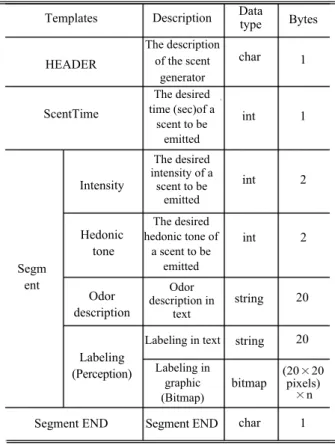
Table 7 shows the data format of the scent generator for providing smell information from the scent generator to the user, which was developed based on the method described in table 6, and the graphic icon by bitmap to show perception presentation for emotional communication. In this paper, odor description and the labeling template can use the preset smell classification tables, because of the difficulty associated with odor classification and description. In table 6, n means the number of preset smells

or blending capable smells in the scent generator.

Intensity template means the maximum intensity of each smell or aroma solution. Dilution template decides the possibility of dilution with each smell or aroma solution.

For example, if the intensity template has 2 3 3 and the dilution template have 0 1 1, then the first smell has a

“light” intensity and can’t be diluted and the second and third have “moderate” and can be diluted. With the second and third, the scent generator is requested to emit smell as intensity for “very light”, “light” or “moderate” by the user.

Table 7 shows the data format of a user request for smell presentation. In table 7, ScentTime is indicated by the number of seconds that a user wants to continue emitting the scent.

The information of table 6 is registered to the user’s computer. The user can ask for the emission of smell that meets the conditions specified in scent generators. Table 7 shows the data format for demanding the emission of a desired smell to scent generators.

3.3 Odor-messenger service

We experimented with transmitting odor by a messenger

Fig. 4. Information communication for olfactory user interface.

Table 6. The structure of data format for scent generator

Segment END

Description of the main ingredients of smells in an aroma solution as strings Templates

HEADER number

Description

The number of smells

Intensity

Dilution

Odor description

Labeling (Perception)

Main ingredients Segm

ent

bitmap Data type Bytes The description of the

scent generator char 1

The intensity of aroma solutions in a scent generator based

on table 6 The possibility of

dilution 0 : impossible

1 : possible The name of blended

smells can typically be given by using the

existing smell classification scheme.

String is used for the representation of

names The specific name of

a blended smell or labeling in the existing smell classification scheme.

Both string and bitmap are used for the labeling of smells.

int 2×n

int 2×n

char 1 string

string

string 2×n

2×n

(20× 20 pixels)

×n

20×n

Segment END

Table 7. The structure of data format for user request

Segment END Templates

HEADER

ScentTime

Description

Intensity

Hedonic tone

Odor description

Labeling (Perception) Segm

ent

bitmap

Data type Bytes

char 1

int

string

string

Segment END The description of the scent

generator

1 The desired

time (sec)of a scent to be

emitted The desired intensity of a

scent to be emitted The desired hedonic tone of

a scent to be emitted

Odor description in

text Labeling in text

Labeling in graphic (Bitmap)

int 2

int 2

20

20 (20×20

pixels)

×n

char 1

(6)

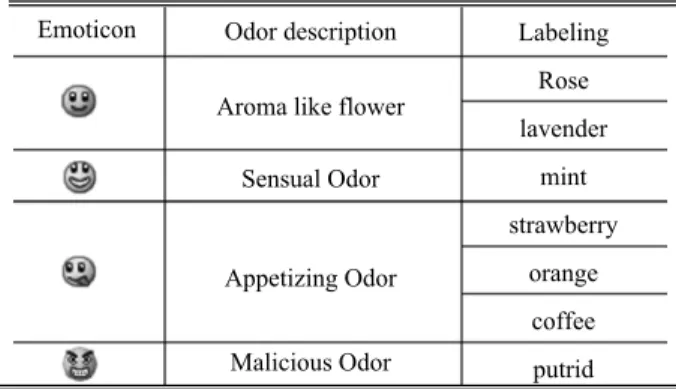
service. When a PC is connected to a network and the user is having a conversation, the scent generator transmits the information of the scent generator to the user in the form listed on table 6 and the scent generator is made to register its odor as the form of the emoticon to the other user's chatting window.

We used the graphical emoticon with text for odor description and the labeling of smells. Table 8 shows the used graphical emoticon

The user has only to type any word and click the emoticon on the left to choose the odor. Fig. 5(a) shows how to choose the odor, and (b) shows the written words and the emoticon.

If we click “send”, the user’s computer transmits the user request information to the scent generator’s computer in the form listed on table 8 and the scent generator's computer shows the text and generates the odor.

4. CONCLUSIONS & DISCUSSIONS

Recently, people started to become concerned about olfactory display. Odor augments the effect of pre-existing senses and can provide a stronger recalling effect than the current existing media. It can also provide tacit warning messages.

Research in odor transmission as multimedia information needs a standard interface for both odor transmission and scent generating devices. But until now, such a user interface for olfactory like that of vision or auditory is not presented. Olfactory is controlled by a complex chemical composition unlike vision and auditory, and human precepts with emotion and feelings, therefore it is difficult to convert such information into data. In this paper, we proposed an olfactory information presentation method, which is a way to use smell as multimedia information, and show an application for scent generation and odor display using a web service

Necessary reference guidelines that need to be referred in odor usage were presented. We presented the required presentation method when composing an olfactory user interface with these reference guidelines so it could be used in future olfactory user interface technology.

In the near future, olfactory display technology will accelerate the new computing environment and related industries. Especially, olfactory technology in MPEG(Moving Picture Export Group) will lead its application in areas like broadcasting/education, military/sports training and e-learning. Also, the development of olfactory presentation technology will enlarge current virtual reality and augmented reality techniques.

Due to this ripple effect, an olfactory display for the user interface method and a convenient editing model should be presented. We anticipate that the reference guideline for olfactory user interface, as well as required elements and methods for olfactory data presentation be used as a standard reference method with regards to a standardized olfactory user interface.

ACKNOWLEDGMENT

This work is supported by the research promotion fund (2012.5 – 2013.2) from Kangwon National University at Samcheok Campus, Korea.

Table 8. Odor description ICON used in odor-messenger

Emoticon Odor description

Aroma like flower

Sensual Odor

Appetizing Odor

Malicious Odor

Labeling Rose lavender

mint strawberry

orange coffee putrid

Fig. 5. Odor-messenger program and system structure.

(a) User interface for odor-emoticon input

(b) When odor-emoticon is shown

(7)

REFERENCES

[1] Jeseph Nathaniel Kaye, Symbolic olfactory display, MIT Media Lab. 2001.

[2] Ricardo Gutierrez-Osuna, Olfactory interation, encyclopedia of human-computer interaction, W.S.Bainbridge, Berkshire Publishing, pp. 507-511, 2004.

[3] Tan EC., Wahab A., Goh GH, and Wong SH. “PC- controlled scent system”, IEEE Transactions on Consumer Electronics 44. (1 February 1998).

[4] Takamichi Nakamoto, Hidehiko Takigawa, and Takao Yamanaka, “Fundamental study of odor recorder using inkjet devices for low-volatile scents”, IEICE Trans.

vol. E87-C, no. 12, pp. 2081-2086, 2004.

[5] Takamichi Nakamoto and Kenjiro Yoshikawa, “Movie with scents generated by olfactory display using solenoid valves”, IEICE Trans. vol. E89-A, no. 11, pp.

3327-3332, 2006.

[6] www.digiscents.com

[7] www.trisenx.com

[8] ASTM E544-99, Standard practice for referencing suprathreshold odor intensity, American Society for Testing and Materials, 1988.

[9] ASTM E679-91, Standard practice for determination of odor and taste thresholds by a forced-choice ascending concentration series method of limits, American Society for Testing and Materials, 1991.

[10] ASCE, Odor control in wastewater treatment plants, Manuals of reports on engineering practice, no. 82, American Society of Civil Engineers, 1995.

[11] Amoore, J. E, A plan to identify most of the primary odors, in C. Pfaffmann (ed.), Olfaction and Taste III, Rockefeller University Press, New York, pp. 158-171, 1969.

[12] Amoore, J. E, “Specific anosmia and the concept of primary odor”, Chemical Senses and Flavor 2, pp. 267 -281, 1976.

[13] http://www.flavornet.org/flavornet.html

Jeong-Do Kim received his BEng., MEng, and PhD. in Electronics Engineering Department from SungKyunKwan University, Korea. He is currently a professor at the Dept. of Electronic Engineering, Hoseo University, Korea. His research interests are information processing for the five senses and signal processing for sensor systems.

Hyung-Gi Byun received his MSc. in electrical engineering and electronics and PhD. in Instrumentation and Analytical Science from The University of Manchester(formerly UMIST), Manchester, U.K. in 1990 and 1995, respectively. He is currently a professor at Division of Electronics, Information

& Communication Engineering,

Kangwon National University at

Samcheok, Korea. His research

interests are signal processing and

pattern recognition applicable to

chemical sensing systems.

수치

Table 2. Odor intensity reference scale based on n-butanol
Fig. 1. Persistence calculated from the log-log plot of intensity and dilutions[8].
Table 5. Olfactory presentation method suggested so that odors can be used as multimedia information
Table 6. The structure of data format for scent generator
+2

참조

관련 문서