Melt Grafting of Citraconic Acid onto an Ethylene-Propylene-Diene Terpolymer (EPDM)
-Effect of Reaction Conditions and Initiator Type on the Melt Grafting of Citraconic Acid onto EPDM-
Jung-Soo Kim, Jong-Woo Bae, Jin-Hyok Lee, Gu-Ni Kim, Sang-Taek Oh, Young-Hee Lee
*,Han-Do Kim
*,†Industrial Materials Fusion Technology Center, Korea Institute of Footwear and Leather Technology, Busan 614-100, Korea
*
Department of Organic Material Science and Engineering, Pusan National University, Busan 609-735, Korea (Received December 17, 2012, Revised December 27, 2012, Accepted January 3, 2013)
EPDM고무와 씨트라코닉산의 melt grafting - 반응조건과 개시제에 따른 영향 연구 -
김정수·배종우·이진혁·오상택·김구니·이영희*·김한도*,†
한국신발피혁연구소 산업소재융합기술센터,
*
부산대학교 유기소재공학과
접수일(2012년 12월 17일), 수정일(2012년 12월 27일), 게재확정일(2013년 1월 3일)
ABSTRACT :Melt grafting of citraconic acid (CCA) onto an ethylene-propylene-diene terpolymer (EPDM) with various peroxide initiators was performed using a Haake Rheocorder. Finding the optimum running condition and concentration is critical for effective grafting and performance of grafted material. Therefore, this study focused on the effects of mixing (reaction) condition and monomer/initiator dosages on the grafting degree, grafting efficiency and crosslinking degree (gel content), melt flow index and mechanical properties of CCA-g-EPDM. As the grafting degree/crosslinking degrees increased, the tensile strength increased significantly, but elongation at break and melt flow index decreased. The initiator 2,5-di- methyl-2,5-di(tert-butyl peroxy)-hexane (T-101) appeared to meet for the best grafting(2.31%). The grafting degree increased markedly with increasing monomer CCA/initiator T-101 contents. The grafting degree also increased with increasing mixing temperature/time, and then leveled off or decreased/increased a little. The optimum monomer/initiator dosages and reaction temperature/time were found to be about 5/0.05 wt% and 180 ℃/15min, respectively.
요 약:Haake Rheocorder로 각종 과산화물 개시제를 사용하여 ethylene-propylene-diene terpolymer (EPDM) 에 단량체 citraconic acid (CCA)을 용융 그라프트 중합을 하여 그라프트 중합물 CCA-g-EPDM을 얻었으며, 이 때 효율적인 그라프트 정도와 우수한 성능을 지닌 그라프트 중합물을 얻기 위해서 최적의 반응조건과 최적의 단량체/개 시제 농도를 찾는 것은 매우 중요하다. 따라서 본 연구에서는 반응조건과 단량체 및 개시제 함량이 CCA-g-EPDM의 그라프트 정도, 그라프트 효율, 가교정도 (겔화도), 용융흐름지수(MI) 및 기계적 물성 등에 미치는 영향에 초점을 맞추었다. 그라프트 정도와 가교도가 증가함에 따라서 인장강도는 상당히 증가한 반면, 파괴신도 및 MI는 감소하였다.
개시제 중에서 2,5-dimethyl-2,5-di( tert -butyl peroxy)-hexane (T-101)가 가장 우수한 그라프트 정도 (2.31
%)를 나타내었으며, CCA와 T-101의 함량이 증가함에 따라 그라프트 정도가 크게 증가하였다. 그리고 그라프트 정도는 반응(혼합)온도 및 반응시간이 증가함에 따라 역시 증가하다가 어느 온도/시간 이상에서는 안정화 혹은 약간 감소하는 경향을 나타내었다. 이러한 영향으로 결과로부터 최적의 단량체/개시제 농도는 5/0.05 wt%이었으며, 최적 의 반응온도/시간은 180
oC/15분인 것을 알 수 있었다.
Keywords : melt grafting, citraconic acid, ethylene-propylene-diene terpolymer (EPDM), initiator
†
Corresponding Author. E-mail: [email protected]
Ⅰ. Introduction
Modification of conventional polymers by grafting and
graft-copolymerization techniques has received much academic
Jung-Soo Kim et al. / Elastomers and Composites Vol. 48, No. 1, pp. 39~45 (March 2013) 40
Sample code
Grafting components/contents Properties
EPDM
Monomer CCA (wt%)
Initiator (wt%)
MFI (g/10min)
*Hardness (shore A)
Specific gravity
Tensile strength
(MPa)
Elongation at break
(%)
Modulus at 100%
(MPa)
Modulus at 300%
(MPa)
Tear strength (kN/m)
Pristine EPDM 100 12 46-47 0.86 1.96 810 0.78 0.98 19.6
CCA-g-EPDM-D 100 5 DCP(0.05) 12 59-60 0.87 4.31 1180 1.27 1.67 26.5
CCA-g-EPDM-T 100 5 T101-1(0.05) 9 56-57 0.87 5.88 990 1.18 1.57 22.6
CCA-g-EPDM-P 100 5 P-14(0.05) 10 59-60 0.87 5.29 1095 1.27 1.57 23.5
* 190 ℃, 2.16 kg,
Table 1 sample code, grafting components, contents and properties of pristine EPDM and CCA-graft-EPDM samples and practical interest. Among all possible chemical modification
methods, free-radical grafting is probably the oldest, widely prac- ticed and the most inexpensive one. Further advantages are gained with the use of batch mixers or screw extruders as chemical re- actors, which allow the free-radical grafting reaction to occur without solvents. In principle, graft co-polymerization is an attrac- tive method to impart a variety of functional groups to a polymer.
1It is essential to modify the properties of a polymer according to tailor-made specifications designed for target applications.
Therefore, the modified polymers through grafting have a bright future and their development is practically boundless.
One of the most common monomers in the polymer mod- ification is maleic anhydride (MA) and its isostructural analogues.
MA and its isostructural analogues (maleic, fumaric, citraconic and itaconic acids and their derivatives) as polyfunctional mono- mers are being widely used in the synthesis of reactive macro- molecules to prepare high performance engineering materials.
2In the last decade, grafting of MA onto various thermoplastic poly- mers (predominantly polyolefins) by using reactive extrude sys- tems have been significantly developed. Fenouillot et al.
3de- scribed the fundamental aspect of the reactive processing of ther- moplastic polymers, including polymer grafting and/or functional- ization using MA and vinylsilanes.
Bhattacharya and Misra
1have documented graft copolymeriza- tion reactions initiated by chemical treatment, photo-irradiation, high-energy radiation techniques, etc. as a versatile means to mod- ify polymers. According to authors, there are several means to modify polymer properties such as blending, grafting, and curing.
Among these methods of modification of polymers, grafting and graft copolymerization are one of the most promising methods.
Rzayev
2has reported different methods of grafting, including re- active extrusion systems, grafting and graft co-polymerization of synthetic and natural polymers with MA and its isostructural analogues.
Dimitrova et al.
4has reported the melt free radical grafting of an oxazoline compound having basic reactive group onto
HDPE. There are a number of commercially available polymers containing acid reactive groups,
5such as MA-grafted onto ethyl- ene-propylene-diene terpolymer EPDM (Du Pont), SEBS(Shell), PP(Himont) etc. Peroxide-initiated melt grafting of maleic anhy- dride (MAH) onto a EPDM of high ethylene content (74 wt%) was performed using a Brabender Plasticoder.
6They found that both grafting and crosslinking reactions were mostly influenced by the dosage of the MAH and peroxide (2,5 - dimethyl-2,5- di-(t-butylperoxy)hexane), respectively. The targeted relative high MAH grafting at low gel content was reached at low concen- trations of both MAH (< 5 wt%) and peroxide(<0.2 wt%).
Pesetskii et al.
7-10has reported the itaconic acid grafting on LDPE and itaconic acid/glycidyl methacrylate grafting on PP. However, research work related to citraconic acid (CCA)-graft-EPDM is rarely available in the open literature. The objective of this study is to find the optimum condition which result in a easy processible/highly performance grafted rubber(CCA-g-EPDM) with adequate cross- linking degree (gel content).
In this context, this study focused on the effects of the type of initiator, peroxide initiator and monomer CCA concentrations, mixing(reaction) conditions on the grafting degree, grafting effi- ciency and crosslinking degree (gel content) of CCA-g-EPDM.
The relationship between grafting and melt flow index/mechanical properties of CCA-g-EPDM was also investigated.
Ⅱ. Experimental
Materials
EPDM (contents of ethylene, propylene and ethyl-
idenenorbornen: 70, 25.5 and 4.5 wt%, respectively, KUMHO
POLYCHEM, Korea), citraconic acid(CCA, Aldrich Chemical,
Milwaukee, WI), dicumyl peroxide(Perkadox BC-FF, Akzo Nobel
Co. Ltd, USA), 2,5-Bis(tert-butylperoxy)-2,5-dimethyl hex-
ane(Trigonox 101, Akzo Nobel Co. Ltd, USA), Bis(tert-butylper-
oxy-isopropyl)-benzene(Perkadox 14S, Akzo Nobel Co. Ltd,
Scheme 1. Melt grafting reaction of citraconic acid (CCA) onto an ethylene-propylene-diene terpolymer (EPDM).
USA), xylene (Junsei Chemical Co., Ltd, Japan), acetone (Junsei Chemical Co., Ltd, Japan) and ethanol(Junsei Chemical Co., Ltd, Japan) were used without further purification.
Melt grafting
Citraconated EPDM (CCA-g-EPDM) was prepared from cit- raconic acid (CCA)/EPDM/peroxide initiator(DCP, T-101 and P-14) using a melt grafting technique with a Haake Rheocorder (Rheocord 9000, Haake Co., Germany) at 50rpm and 160 ℃ for 15 min. Sheet samples (thickness: 2mm) of pristine EPDM and CAA-g-EPDM were prepared by milling using an open mill (Yasuda Seiki Co., Model 191-TM, 6") at 160-170 ℃, followed by compression- molding at 180 ℃ for 10 min.
The sample code and grafting components/contents of the pris- tine EPDM and CCA-graft-EPDM samples prepared in this study are given in Table 1. Melt grafting reaction of citraconic acid (CCA) onto an EPDM is presented in Scheme 1.
Characterization
Attenuated total reflectance (ATR)-Fourier transform infrared (FTIR 6200, Jasco, Japan) spectroscopy was used to confirm the chemical components of the pristine EPDM, CCA and CCA- g-EPDM. For each sample, 32 scans at a 4cm
-1resolution were collected in transmittance mode and recorded in the 2000~600cm
-1range.
The grafting efficiency i.e. the ratio of the grafted CCA to its total quantity added to the EPDM, was accepted as the parameter describing the course of the grafting process. Such efficiency was determined, as in other studies, on film samples of thickness be- tween 40 and 60 micrometer. It is based on the analysis of the monomer CCA added to the initial EPDM and that in CCA-g-EPDM, extracted in ethanol at 70 ℃ for 48h, or in acetone at 40 ℃ for 48h. Grafting degree (% grafting) and graft efficiency (%) of CCA-g-EPDM were determined by the following equations:
Grafting degree = (W
g–W
o) / W
o×100 Grafting efficiency = (W
g–W
o) / W
CCA×100
where the dry weights of CCA-g-EPDM extracted in acetone at 40 ℃ for 48h, pristine EPDM and added CCA are W
g, W
oand W
CCA, respectively. The weight of grafted CCA is W
g– W
o. Gel content (crosslinking degree) of the grafted EPDM was determined by soxhlet extraction in boiling xylene for 24h. The solution was filtered and the insoluble fraction has been dried in vacuum at 70 ℃ for 48h prior to weighing. The gel content was defined as the weight % of the insoluble part of EPDM-g-CCA. Gel content (crosslinking degree, wt%) was de- termined by the following equations:
Gel content (crosslinking degree, wt%) = W
insoluble/W
g× 100
Jung-Soo Kim et al. / Elastomers and Composites Vol. 48, No. 1, pp. 39~45 (March 2013) 42
Temperature(oC)
100 120 140 160 180 200
%Grafting
0 1 2 3 4 5
%Grafting
Grafting efficiency(%)/Gel content(%)
0 10 20 30 40 50
Grafting efficiency(%) Gel content(%)
Time(min)
0 5 10 15 20
%Grafting
0 2 4 6 8 10
%Grafting
Grafting efficiency(%)/Gel content(%)
0 20 40 60 80 100
Grafting efficiency(%) Gel content(%)
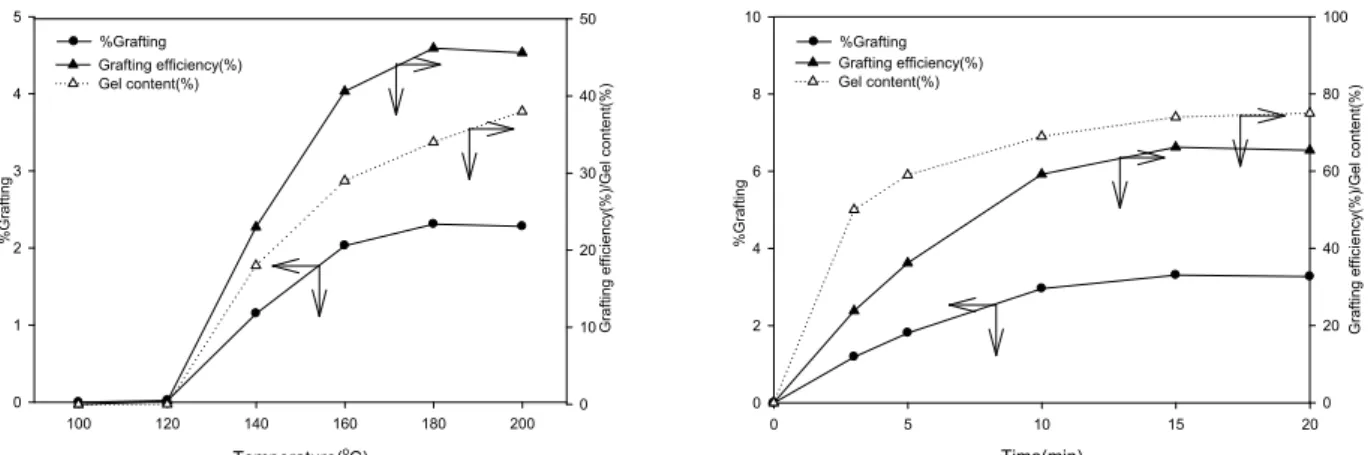
Figure 1. Effect of mixing temperature (a) and mixing time (b) on grafted CCA content and crosslinking degree of CCA-g-EPDM.
(a) CCA content: 5 wt%, initiator L-101 content: 0.05 wt% and mixing time: 15 min. (b) CCA content: 5 wt%, initiator L-101 content:
0.05 wt% and mixing temperature: 180 ℃.
Where the W
insolubleis the dry weight of insoluble EPDM- g-CCA after extraction in boiling xylene for 24 h and the Wg is the dry weight of EPDM-g-CCA extracted in acetone at 40
℃ for 48 h
The melt flow index (MFI) measurement of the samples was carried out on a Melt Indexer CS127-604(CSI Ltd., U.S.A.) ac- cording to the ISO 1133:1999 standard, where the test temperature was set to 190 ℃ and the nominal load was 2.16 kg. The tensile properties were measured according to the ASTM 638 specifica- tions using a Universal Testing Machine (UTM Model 3345, Instron, U. S. A.). The values quoted are the average of five measurements. The hardness was measured using a shore A dur- ometer (Asker, Kobunshi Co. Ltd, Japan) according to ASTM D-2240. The tear strength was measured using the Instron UTM 3345 using a 90
onick cut-crescent sample according to ASTM 624-86. The density was measured at 23 ℃ using a CCl
4-n-hep- tane density gradient column method.
Ⅲ. Results and Discussion
Effect of mixing (reaction) conditions on the grafting and crosslinking
From the results of effects of initiator type and dosages of ini- tiator and monomer on the grafting and crosslinking, which is described later, the obtained optimum initiator [2,5-Dimethyl- 2,5-di(tert-butyl peroxy)-hexane(T-101)] content (0.05 wt%) and monomer CCA content (5 wt%) were fixed to investigate the ef- fect of mixing(reaction) conditions on the grafting and crosslinking. Figure 1(a) shows the effect of reacting temperature
on the grafting and crosslinking at a fixed reaction time (15 min).
It was found that no reaction could occur at below 120 ℃. The grafting degree and grafting efficiency increased sharply with in- creasing reaction temperature up to about 180 ℃, and then de- creased a little. The crosslinking degree increased markedly with increasing reaction temperature up to 140 ℃, and then increased slowly. This indicated that the optimum reaction temperature for the best grafting was about 180 ℃. The effect of reaction time on the grafting and crosslinking at a fixed reaction temperature (180 ℃) is shown in Figure 1(b). The grafting degree/efficiency and crosslinking degree increased with increasing up to about 15 min, and then leveled off. This indicated that the optimum reaction time for the best grafting was 15 min. From these results, it was found that the optimum temperature/time of melt reaction was 180 ℃/15 min.
Effect of initiator type on the on the grafting, crosslinking and melt flow index (MFI)
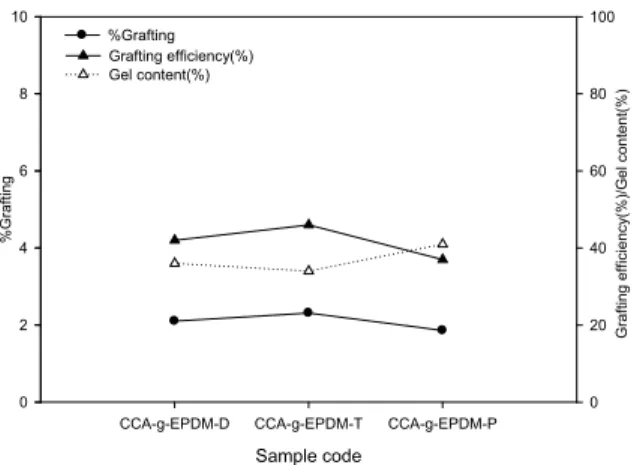
Figure 2 shows the effect of the type of peroxide initiator on
the %grafting, grafting efficiency and gel content of
CCA-g-EPDM. The %grafting and grafting efficiency increased
in the order of CCA-g-EPDM-T> CCA-g-EPDM-P> CCA-g-
EPDM-D. The CCA-g-EPDM obtained by using initiator T-101
had the highest %grafting and grafting efficiency. Generally the
nature of peroxide initiators is decisive for outcome in grafting
and macromolecular degradation. To ensure a high yield of grafted
product, it is advisable to use adequate peroxides, which have
thermodynamic affinity with backbone polymer EPDM and the
temperature range of decomposition of which corresponds to the
Sample code
CCA-g-EPDM-D CCA-g-EPDM-T CCA-g-EPDM-P 0
2 4 6 8 10
%Grafting
%Grafting Grafting efficiency(%)/Gel content(%)
0 20 40 60 80 100
Grafting efficiency(%) Gel content(%)
Figure 2. Effect of initiator type on grafting degree (%), grafting efficiency (%) and gel content(%)
thermal regime of reactive extrusion. The initiator 2,5-di- methyl-2,5-di(tert-butyl peroxy)hexane (T-101) appeared to meet for the most these requirements for melt grafting of citraconic acid onto EPDM. Therefore, we used 2, 5-dimethyl-2, 5-di (tert-butyl peroxy)hexane (T-101) as an initiator in this study.
The effect of the type of initiator on the melt flow index is shown Table 1. The melt flow index (MFI), the mass rates (g/10min) of flow of polymer through a specified capillary under controlled conditions(temperature: 190 ℃, the nominal load: 2.16 kg) of pristine EPDM and as-polymerized EPDM-g-CCA samples were measured to investigate the extent of reaction of EPDM with CCA during melt mixing. Generally, the MFI of polymer is di- rectly related with melt viscosity which depended on molecular weight (MW) and MW distribution and structure (branching/
crosslinking, polar/nonpolar). Additionally, in case of practical ap- plication, MFI is a critical factor deciding the melt processibility and the usability requirements of the customers of polymers. The MFI of CCA-g-EPDM with different initiators increased in the order of CCA-g-EPDM-D> CCA-g-EPDM-P> CCA-g-EPDM-T.
The increasing trend of MFI is reverse of that of grafting efficiency. The CCA-g-EPDM obtained by using T-101 had the lowest value of MFI. The lowest MFI of T-101 should be attribut- able to the highest grafting/crosslinking reactions. Therefore, the initiator T-101 was used to investigate the effect of dosages of monomer and initiator on the grafting and crosslinking described later.
Wavenumber(cm-1)
600 800 1000 1200 1400 1600 1800 2000
Transmittance(%)
Pristine EPDM
CCA
CCA-g-EPDM
1463 1436
1377
1704 1270
1704 1463 1436
1270
Figure 3. FTIR spectra of pristine EPDM, CCA and
CCA-g-EPDM. CCA: 5 wt%, L-101: 0.05 wt% and grafted CCA content: 4.15 wt%.
Characterization of CCA-grafted-EPDM
The FTIR spectra of pristine EPDM, CCA and grafted EPDM (CCA-g-EPDM, grafted CCA content: 2.31%) are shown in Figure 3. Pristine EPDM shows the characteristic bands of the asymmetric deformation of the methyl group at 1463 cm
-1, the methyl group of the diene group(CH
3-C=C) at 1436 cm
-1and the symmetric deformation band of methyl group at 1377 cm
-1. CCA shows the characteristic band of the C=O stretch peak at 1704 cm
-1and C-O stretch peak at 1270 cm
-1and 1180 cm
-1of carbox- ylic acid group of CCA component. By comparative analysis of spectra pristine EPDM, CCA and grafted EPDM, CCA-g-EPDM sample had both two characteristic peaks of pristine EPDM and CCA, indicating the presence of CCA component in EPDM.
Effect of initiator/monomer dosage on the grafting degree (wt%) and grafting efficiency/crosslinking degree (wt%)
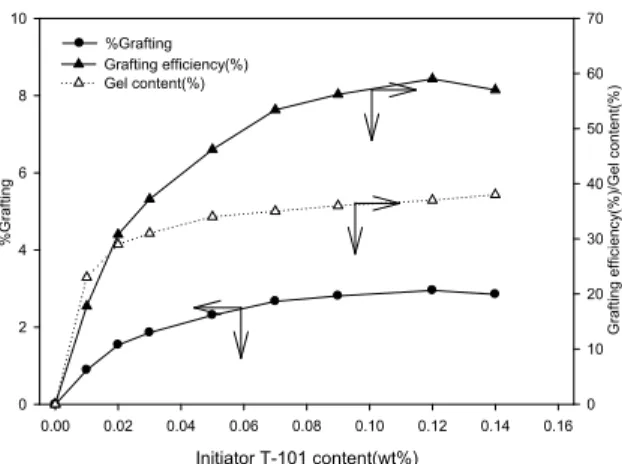
The effect of initiator [(2,5-dimethyl-2,5-di(tert-butyl per- oxy)hexane (T-101)] dosage on the grafting degree (wt%) and grafting efficiency/crosslinking degree (wt%) is shown in Figure 4. The grafting degree (%) increased markedly with increasing initiator dosage up to about 0.05 wt%, and then decreased a little.
The grafting efficiency (wt%) increased with increasing up to near
0.05 wt%, and then decreased a little. The crosslinking degree
(gel content, wt%) increased sharply with increasing initiator dos-
age up to around 0.02 wt%, and then increased very slowly. From
these results, it was found that the optimum dosage of initiator
T-101 was about 0.05 wt% for the best grafting and relatively
low crosslinking.
Jung-Soo Kim et al. / Elastomers and Composites Vol. 48, No. 1, pp. 39~45 (March 2013) 44
Initiator T-101 content(wt%)
0.00 0.02 0.04 0.06 0.08 0.10 0.12 0.14 0.16
%Grafting
0 2 4 6 8 10
%Grafting
Grafting efficiency(%)/Gel content(%)
0 10 20 30 40 50 60 70
Grafting efficiency(%) Gel content(%)
Figure 4. Effect of initiator L-101 content on grafting
degree(wt%) and crosslinking degree (wt%) of CCA-g-EPDM.
CCA content: 5 wt%, mixing temp.: 180℃ and time: 15 min.
CCA content(wt%)
0 2 4 6 8 10 12
%grafting
0 1 2 3 4 5 6
%Grafting
Grafting efficiency(%)/Gel content(%)
0 20 40 60 80 Grafting efficiency(%) 100
Gel content(%)
Figure 5. Effect of CCA concentration on grafting degree (wt%) and crosslinking degree(wt%) and crosslinking degree of CCA-g-EPDM. L-101 content: 0.05 wt%, mixing temp.: 180℃
and time: 15 min.
Figure 5 shows the effect of monomer CCA dosage on the grafting degree (wt%) and grafting efficiency /crosslinking degree (wt%). The grafting degree increased markedly with increasing monomer CCA concentration increased, and then leveled off or decreased a little. However, the grafting efficiency decreased linearly with increasing monomer concentration. The crosslinking degree (wt%) increased sharply in the initial stage of reaction, and then increased slowly. From these results, it was found that the optimum dosage of monomer CCA was about 5 wt% for the higher grafting and relatively low crosslinking.
Strain(%)
0 200 400 600 800 1000 1200
Stress(MPa)
0 2 4 6
Pristine EPDM CCA-g-EPDM-D CCA-g-EPDM-T CCA-g-EPDM-P