• 검색 결과가 없습니다.

Study on development of vessel shore report management system for IMO MSP 8

N/A
N/A
Protected

Academic year: 2021

Share "Study on development of vessel shore report management system for IMO MSP 8"

Copied!
11
0
0

로드 중.... (전체 텍스트 보기)

전체 글

(1)

Journal of the Korean Society of Marine Engineering, Vol. 40, No.5 pp. 418~428, 2016 ISSN 2234-7925 (Print)

J. Korean Soc. of Marine Engineering (JKOSME) ISSN 2234-8352 (Online)

http://dx.doi.org/10.5916/jkosme.2016.40.5.418 Original Paper

This is an Open Access article distributed under the terms of the Creative Commons Attribution Non-Commercial License (http://creativecommons.org/licenses/by-nc/3.0), which permits unrestricted non-commercial use, distribution, and reproduction in any medium, provided the original work is properly cited.

Copyright ⓒ The Korean Society of Marine Engineering

Study on development of vessel shore report management system for IMO MSP 8

Sobia Rind 1 ㆍ Soo-Jong Mo 2 ㆍ Yung-Ho Yu +

(Received January 6, 2016; Revised April 12, 2016;Accepted April 22, 2016)

Abstract: In this study, a Vessel Shore Report Management System (VSRMS) is developed for the International Maritime Organization (IMO), Maritime Service Portfolio (MSP) Number 8, which comprises vessel shore reporting. Several documents have to be completed before the arrival/departure of a vessel at a port, as each national port has its own reporting format and data. The present vessel reporting system is inefficient, time-consuming, and involves excessive paperwork, which results in duplications and errors. To solve this problem, in this study, the vessel reporting formats and data contents of various national ports are investigated, as at present, the reporting documents required by the current IMO standard includes insufficient information which is requested by national ports. Initially, the vessel reporting information of various national ports are collected and analyzed. Subsequently, a database structure for managing vessel reporting data for ports worldwide is devised. To make the transfer of data and the exchange of information of vessel reports much more reliable, efficient, and paper-free, VSRMS, which is a software application for the simplification and facilitation of vessel report formalities, is developed. This application is developed using the latest Microsoft C#.Net Programming Language in the Microsoft Visual Studio framework 4.5. It provides a user interface and a backend MySQL server used for database management. SAP Crystal Reports 2013 is used for designing and generating vessel reports in the original report formats. The VSRMS can facilitate vessel reporting and improve data accuracy through the reduction of input data, efficient data exchange, and reduction of the cost of communication. Adoption of the VSRMS will allow the vessel shore reporting system to be automated, resulting in enhanced work efficiency for shipping companies. Based on this information system and architecture, the consensus of various international organizations, such as the IMO, the International Association of Marine Aids to Navigation and Lighthouse Authorities (IALA), the Federation of National Associations of Ship Brokers and Agents (FONASBA), and the Baltic and International Maritime Council (BIMCO), is required so that vessel reporting is standardized internationally.

Keywords: MSP 8, IMO, VSRMS, Vessel reports

1. Introduction

The e-Navigation Strategy Implementation Plan (SIP) is currently being developed by the International Maritime Organization (IMO) for the analysis of user requirements. By comparing user needs with the present status, the discrepancies between them were identified and nine solutions were determined to solve the discrepancies. Among the nine solutions, five were selected, which are S1–S4 and S9, through the prioritization of importance and urgency. Using FSA (Formal Safety Assessment, which was submitted by Norway, seven RCOs (Risk Control Options) were determined and consequently 16 MSPs (Maritime Service Portfolios) were derived. During the procedure, not only the Sub-Committee on Navigation (NAV) in the IMO e-Navigation CG

(Correspondence Group), but also various international organizations, such as the International Hydrographic Organization (IHO) and the International Association of Marine Aids to Navigation and Lighthouse Authorities (IALA), played an important part [1].

After establishing the e-Navigation infrastructure, IT Services will be provided to enhance safe and economic navigation. IT Services or Maritime Service Portfolios (MSPs) should be sufficiently reliable and effective for the safety of navigation. Table 1 shows 16 MSPs that have been derived by the IMO after many logical processes and much debate. This paper focuses on MSP number 8, which comprises vessel shore reporting of the IMO. The IMO has ratified the Convention on Facilitation of International Maritime Traffic (FAL) to

† Corresponding Author (ORCID: http://orcid.org/0000-0001-8305-268X): Division of Information Technology Engineering, Korea Maritime and Ocean University, 727, Taejong-ro, Yeongdo-gu, Busan 49112, Korea, E-mail: [email protected], Tel: 051-410-4345

1 Division of Control Engineering, Graduate School of Korea Maritime and Ocean University, E-mail: [email protected], Tel: 051-410-4923

2 MEIPA, E-mail:[email protected], Tel: 051-410-5221

(2)

Journal of the Korean Society of Marine Engineering, Vol. 40, No. 5, 2016. 6 implement a standardized document format for the

arrival/departure of ships. In this study, FAL.5-Circ.36, which covers the guidelines for setting up a single window system in maritime transport, was reviewed [2]. These guidelines do not define any particular standard of ship reporting information in order to implement a Single Window System (SWS). A significant problem as ships travel between many ports is that they are required to complete many different ship reports in different formats, since ports in different nations do not follow any standard reporting data format.

Table 1: List of 16 MSPs determined by IMO

In the case of the Norwegian SafeSeaNet (SSN), which is part of the European SafeSeaNet, a vessel and voyage reporting system intended for use by commercial marine traffic arriving at and departing from Norwegian ports is used [2]. This is not sufficient to cover the ship reports of all ports of the world.

During the 17th Session of the IALA e-NAV Committee, MSP 8 vessel shore reporting (VSR), also based on SafeSeaNet, was discussed [3]. Rodseth O.J. attempted to integrate the International Electrotechnical Commission (IEC) and International Organization for Standardization (ISO) information models into the S-100 Common Maritime Data Structure (CMDS) for MSPs [4]. In the present study, the required vessel reports of various ports and coastal state authorities worldwide are investigated. As Figure 1 shows, 33 ports worldwide were investigated in order to collect aggregated vessel report

information of different national ports. Next, the required information was analyzed and a Vessel Shore Report Management System (VSRMS) was developed.

Figure 1: Investigated ship reports of 33 ports world wide

When a vessel proceeds to enter a port, it is required to complete a large number of documents for the port state control, customs office, quarantine office, etc., in order to obtain port clearance. The reporting documents and their styles differ not only according to the country, but also according to each port. Vessel reporting is mostly conducted manually on paper, which is inefficient and time-consuming, and similar reports are required to be submitted at multiple ports, resulting in repetition and errors. The current vessel reporting system gives the mariner an excessive workload at times when the vessel is entering ports or straits, which makes them busy and could leave the vessel in a dangerous situation.

To solve the issues concerning the present vessel shore reporting system, in this study vessel reporting documents of various countries and ports were investigated, as reporting documents have at present not been standardized and those of each national port have their own reporting style format and data contents. Table 2 shows a list of vessel reports of different national ports. After an exhaustive investigation, complete vessel report information was obtained covering almost all necessary information required for port clearance. In this study, the structure of the database designed to manage vessel reporting information for each port of various countries is discussed.

In order to make the transfer of data and the exchange of information much more reliable, efficient, and paper free, a software application called VSRMS was developed. VSRMS is capable of auto-managing and generating various types of vessel reports in the original report style and format of each national port. In the later sections, the developed system architecture, design, development, and its vessel report generation capability will be described in detail.

16 MSPs MSP1 VTS Information

Service (IS) MSP9 Telemedical Assistance Service(TMAS) MSP2

Navigational Assistance Service (NAS)

MSP10 Maritime Assistance Service(MAS)

MSP3

Traffic Organization

Service

MSP11 Nautical Chart Service

MSP4 Local port

Service (LPS) MSP12 Nautical Publications Service MSP5

Maritime Safety Information Service (MSI)

MSP13 Ice Navigation Service

MSP6 Pilotage Service MSP14 Meteorological information MSP7 Tug Service MSP15

Real time hydrographic and environmental information Service MSP8 Vessel Shore

Reporting MSP16 Search and Rescue Service

419

(3)

Study on development of vessel shore report management system for IMO MSP 8

Journal of the Korean Society of Marine Engineering, Vol. 40, No. 5, 2016. 6 Table 2: List of investigated vessel reports of various national ports

U.S. America

Common Vessel & voyage information , ISSC (International Ship Security Cert ), Crew List , Non Crew & passenger list , CDC (Certain Dangerous Cargo) List , Arrival/ Departure Update, Ballast water report, condition report, NBIC report, water report, DG report Long Beach Crew list, passenger list, crew effect list, store list, tank condition

Oakland Crew list, passenger list, crew effect list, store list, tank condition Portland Crew effect list , store list

Seattle Crew effect list, store list

Europe Rotterdam

(RTM)

Communication Info, Crew Effect list, Crew list, Departure report, ISPS per arrival report, ship store declaration , waste notification

FXT Crew list, Crew Effect list, Store list, general declaration, security report, waste notification HAM Crew Effect, Crew list, security report, store list, waste notification

LEH Crew Effect list, Crew list , store list , waste report Australia

Common Arrival report, AQIS BW Log, AUS Crew Effects List, Crew Report, Custom port of call list, impending arrival , voyage memo- 184B, report of ship store, Quarantine pre arrival report,

10 days before Crew3B, impending arrival 2 days before Quarantine pre-arrival report Port Hedland DUKC Input Form 2004

Canada

Common Crew Effects, Crew list , Effects declaration, General Declaration ,Passenger list , store declaration , stores, Vancouver report, voyage memo

China

Common Ship’s particulars, passenger list , Application for Radio PRATIQUE, cargo, crew effect , ship’s declaration, general declaration, china license, passenger list, crew list, ship storage, application for Radio PRATIQUE, General declaration

CHA Cargo declaration , crew list , general declaration , crew effects , declaration of health , ship’s store, voyage memo

GUANGZHOU Cargo declaration , store list, Application for radio PRATIQUE , crew effect , crew list, embarking check list , general declaration, IMO heath, NIL list , voyage memo, vaccination list, voyage memo0085L

KHH Crew effect list, crew list , general list , maritime declaration of health , NIL list ,store list

LIANYUNGANG Cargo declaration, crew effect , general declaration, seaman list , ship’s pre declaration , store list , IMO health, NIL LIST071, vaccination list , voyage memo

RIZHAO Cargo declaration, ship pre-declaration, store list, Application for Radio PRATIQUE, crew effect, crew list , general declaration, IMO health, NIL list , ship’s particulars, the embarking license, vaccination list , voyage memo00858

SHA

Common Cargo declaration (arrival), cargo declaration(Departure ), crew effect list , crew list , generation declaration (arrival), general declaration (departure), maritime declaration of health, pre-arrival notification , ship’s particulars, store list , vaccination list Report for docking Crew effect, store list, crew list ,ship’s particular, voyage MEMO083L

YIT

Arrival D.G.R.F, cargo declaration(ARR), cargo declaration(Blank form), Crew effect list(049D), crew effect list, crew list(049D), general declaration, maritime declaration of health, NIL list, RPM, ship’s particulars(A)_YIT, ship’s store declaration, store list, YIT before arrival 48 security related questions

JAPAN

Common Crew’s Effect declaration, Crew list, security relative report, store list, Voyage memo TOKYO Crew list, Crew effect072, ship’s store072

KOREA Busan

Free tax purchase report, free tax purchase report for Busan port, free tax report (for posting), free tax stuff, general list, list of free tax for passengers, list of personal belonging(seaman), maritime declaration of health, Nil list , personal belongings(passenger), Crew List, passenger List, Quarantine questionnaire, ships repair report , security relative report

Gwangyang Free tax stud, general list, health status report, NIL list , personal belongings (passenger), personal belongings(seaman), ship repair(the income) report

ASIA

Hong Kong Arrival declaration, contact point, crew list, general list, health , ISPS pre arrival notice, ISPS Pre notification , NIL list, Maritime declaration of health, Arrival Declaration of Dutiable Stores, Crew list, passenger list

India Arrival report, certificates, crew effect, crew list, currency, health, NIL list, request to radio PRATIQUE, store declaration , vaccination , voyage memo

Indonesia

Crew list, crew effect, ship’s particulars, health , book 9(maritime declaration of health), CGO DECL(Cargo declaration), crew effect, crew list, drug list, general declaration , NIL list, ship’s particulars , Singapore, store declaration , vaccination , voyage memo

Malaysia Cargo declaration, crew effect, crew list, drug list, general declaration , Imo health , ship’s particulars, store list , vaccination list ,voyage memo

Port kelang Crew effect list, crew list , general list , maritime declaration of health , NIL list , Store list , vaccination list Singapore General declaration, passenger list , crew list , arrival report, departure report

Srilanka Crew list , DG CGO(Dangerous cargo ), Effect declaration , general list , port authority , purpose report , ship’s sore list

Taiwan Foreign Money (IMO), general declaration , IMO health , IMO Store list , Money , NIL list , vaccination list , voyage memo086L, Crew List

420

(4)

Journal of the Korean Society of Marine Engineering, Vol. 40, No. 5, 2016. 6

2. Database Design

The database was designed to manage the data analyzed and collected through vessel reports required by each port of various countries. To make the database centralized and to avoid data redundancy, all the data attributes of vessel reporting information mentioned in Tables 3, 4, and 5 were categorized. This means that the related vessel reporting data was organized according to particular topics. For example, the “Voyage” category in Table 5 includes information such as the voyage number, purpose of call, period of stay, on board crew or passenger quantity, and buoy number. “Departure” includes information such as port name, date, and time. Similarly, other information was categorized according to the related attributes into “Arrival”, “Estimated Time of Arrival (ETA)”, “Estimated Time of Departure (ETD)”,

“Agent”, “Point of Reporting (POR)”, “Point of Contact (POC)”,

“Port of Call”, etc. With all the data organized and centralized, generation of reports is greatly facilitated.

Table 3: List of information for vessel Vessel Information

Identification IMO number, official number, Call sign Basic info

Vessel name, Previous name, Built year, Ship type, classification society, name of vessel charterer , passenger capacity Registered Nation / Flag, Port, Owner, Ship length

Weight Gross tonnage (GT), Net tonnage(NT), Dead weight (DWT)

Ship Owner Name , address Ship Operator Name , address

Ship’s Particulars

Ship’s Particulars

Length , Breadth/ beam, Draft, Height , Speed, Main engine, horse power, Date of keel laying, place of vessel built , TPC(Tones per centimeter), Fresh water Allowance(FWA), Depth, Berth

Safety inspection

Whether or not holding the report on inspection, last inspection place, date of last inspection , Whether is there any item to be re-inspected

License of competency for

seafarers

Rank, Number of license of competency, Date of valid

Person (Crew/ Passenger / Master or other )

Person Basic Info

First name, Last name, gender, nationality, date of birth, place of birth, age, passport number, country of issue, passport expiry date, seaman’s book number, rate, position of duty, inspection status, marine document Place Engaged , embarked

Date Joined, separated

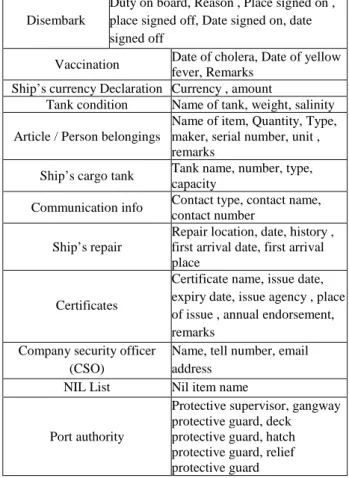
Disembark

Duty on board, Reason , Place signed on , place signed off, Date signed on, date signed off

Vaccination Date of cholera, Date of yellow fever, Remarks

Ship’s currency Declaration Currency , amount

Tank condition Name of tank, weight, salinity Article / Person belongings

Name of item, Quantity, Type, maker, serial number, unit , remarks

Ship’s cargo tank Tank name, number, type, capacity

Communication info Contact type, contact name, contact number

Ship’s repair

Repair location, date, history , first arrival date, first arrival place

Certificates

Certificate name, issue date, expiry date, issue agency , place of issue , annual endorsement, remarks

Company security officer (CSO)

Name, tell number, email address

NIL List Nil item name

Port authority

Protective supervisor, gangway protective guard, deck protective guard, hatch protective guard, relief protective guard Table 4: List of information for ballast water

Ballast water Management

Place

IMO Guidelines, management plane on board, management place implemented, Total Number of ballast water Tanks (BWT)discharge, Quantity BWT to be discharge, Alternative method,

Quantity BWT discharge exchange, No BW reason, BWDSS (Ballast water decision support system) implemented, Risk assessment number

Capacity(Total

BW capacity ) Volume, number of BW tanks on ship BW on board Volume, number of BW tanks Ocean depth Minimum, maximum Responsible

officer Name, title

Pump Number, volume

Ballast water History

Tank Name, Full capacity

BW Source port name, volume, date, temperature Exchange Method used , Sea depth

Exchange Location

Start latitude , end latitude , start longitude , end longitude Exchange Date

Time Start date time, End date time Exchange

Dilution Volume, percentage exchanged Exchange Empty

Refill Volume

Discharge Port name, date, volume, salinity

421

(5)

Sobia RindㆍSoo-Jong MoㆍYung-Ho Yu

Journal of the Korean Society of Marine Engineering, Vol. 40, No. 5, 2016. 6 Table 5: List of information for voyage

2.1 Vessel Reports and Information

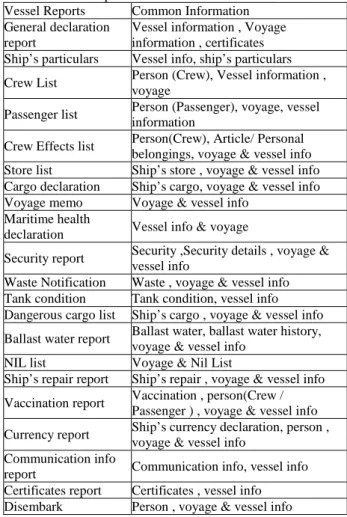
Table 6 shows the categories, described in detail in Tables 3, 4, and 5, that provide information for each individual vessel

report. For example, the “General declaration report” in Table 6 contains the categories of Vessel Information, Voyage Information, and Certificates described in Tables 3 and 5.

Similarly, the “Ship’s particulars” report contains the categories of Vessel Information and Ship’s Particulars described in Table 3. As most of the vessel reports require the same types of basic information such as the vessel and voyage information, the information was categorized in order to avoid duplication of data.

Table 6: Vessel reports and information Vessel Reports Common Information General declaration

report

Vessel information , Voyage information , certificates Ship’s particulars Vessel info, ship’s particulars Crew List Person (Crew), Vessel information ,

voyage

Passenger list Person (Passenger), voyage, vessel information

Crew Effects list Person(Crew), Article/ Personal belongings, voyage & vessel info Store list Ship’s store , voyage & vessel info Cargo declaration Ship’s cargo, voyage & vessel info Voyage memo Voyage & vessel info

Maritime health

declaration Vessel info & voyage

Security report Security ,Security details , voyage &

vessel info

Waste Notification Waste , voyage & vessel info Tank condition Tank condition, vessel info Dangerous cargo list Ship’s cargo , voyage & vessel info Ballast water report Ballast water, ballast water history,

voyage & vessel info NIL list Voyage & Nil List

Ship’s repair report Ship’s repair , voyage & vessel info Vaccination report Vaccination , person(Crew /

Passenger ) , voyage & vessel info Currency report Ship’s currency declaration, person ,

voyage & vessel info Communication info

report Communication info, vessel info Certificates report Certificates , vessel info Disembark Person , voyage & vessel info

2.2 Entity–Relationship Diagram (ERD) Model

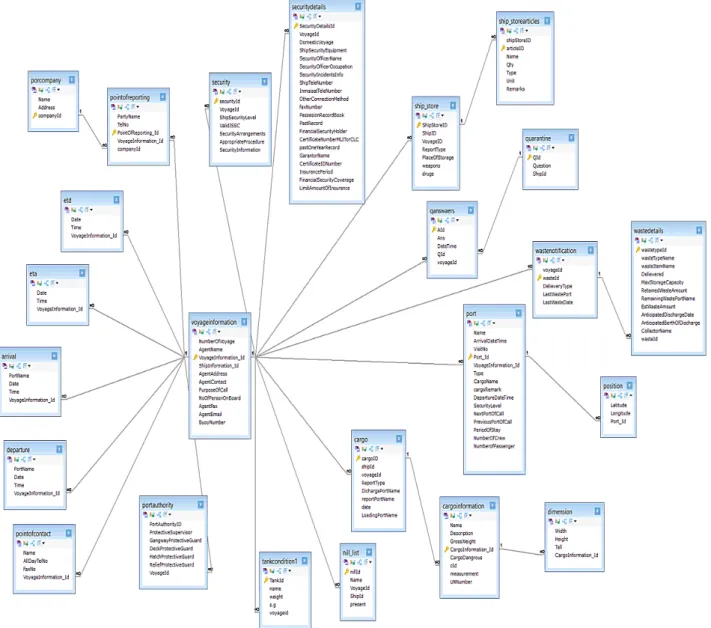
The Entity–Relationship Diagram (ERD) model identifies the concepts or entities and the relationships between these entities. It is often used as a way to visualize a relational database: each entity represents a database table, and the relationship lines represent the keys in one table that point to specific records in related tables [5]. As the ERD model developed in this study is too complicated to fully explain in this paper, only a part of it is described. Figure 2 shows the ERD model related to voyage information that was designed and normalized for managing the reporting data mentioned in Tables 3, 4 Voyage

Voyage Voyage number, purpose of call, period of stay, number of person on board, buoy number

Departure Port name, date, time Arrival Port name, date, time ETA (Estimated

time of arrival) Date, time ETD (Estimated

time of departure) Date, time

Agent Name, contact number, email address, email, fax

POR (point of reporting )

POR company name, Address, reporting party name,

reporting party number POC (point of

contact )

POC name, contact number, Fax number

Port of call Port name, arrival date time, departure date time, period of stay, number of crew, number of passenger, next port of call, previous port of call, visit number, security level, report type, cargo name, cargo load / unload.

Position Latitude, Longitude

Maritime Health Health quarantines, answers, Date Ship’s cargo

Ship’s Cargo

Report type, report port name, load port name, discharge port name, date

Cargo details

Cargo name, description, gross weight, dangerous cargo, measurement, UN number, Dimensions Width, Height, Tall

Ship’s Store

Report type, Place of storage, weapons, drugs, Article name, quantity, Type, Unit, remarks

Waste

Delivery type (All, some, none), Last waste port name, last waste date, waste item name, item type, max storage capacity, Amount of waste to be delivered, Amount of waste to be retained, Estimated amount of waste to be generated between notification and next port of call (m3), Anticipated berth of discharge date, Anticipated berth of discharge, Name of collector or Reception facility

Security

Ship’s Security level, Valid ISSC, Security arrangements, Appropriate procedure followed by ship, Security information

Security Details

Domestic voyage, Ship security equipment, Security officer name, Security offer occupation, security incidents info, vessel tell number, Inmarsat tell number, other connection method, fax number, possession record book available or not, records of pas ports of call available or not, holder of financial security available or no, Certificate number MLIT or CLC, Past one year record, grantor name, certificate ID number, insurance period, financial period, financial security coverage, limit amount of insurance

422

(6)

Journal of the Korean Society of Marine Engineering, Vol. 40, No. 5, 2016. 6 and 5. Any vessel is able to use the system database schema for their

maritime transport reporting system.

The ERD Information Schema for voyage information is described below.

2.2.1 Voyage Information Schema

Figure 2 shows the voyage information schema that contains voyage information-related entities with attributes, and the relationship between these entities, as described below:

1) Voyage information, estimated time of arrival (ETA), estimated time of departure (ETD), arrival, departure, port authority, point of contact, point of reporting, and point of reporting company.

2) Security (ship security information, valid International Ship Security Certificate (ISSC), security arrangements, appropriate procedure, ship level of safety) and Security details (security officer name, past record, financial security holder, insurance period, etc.).

3) Quarantine (health questions, last 10 ports of call, etc.) and Qanswer.

4) Ship store (place of storage on ship, weapons, drugs) and Ship store articles (name, quantity, unit, type, etc.).

5) Waste Notification (delivery type, last waste port, last waste date) and Waste details (waste type name, waste item name, delivered, maximum storage capacity, estimated waste amount, etc.).

6) Port (current port name, arrival port name, date time, next port, previous port, security level, number of crew, period of stay, cargo, etc.) and Position (latitude and longitude).

7) Cargo (report type, discharge port name, report port name, date, loading port name), Cargo information (name of cargo, description, gross weight, cargo dangers, measurement, UN number) and Dimension (height, length, and width).

8) Nil List (List of Nil items).

9) Port Authority (protective supervisor, deck protective guard, hatch protective guard, etc.).

10) Tank condition (name of tank, weight, salinity).

Figure 2: Voyage information schema

423

(7)

Sobia RindㆍSoo-Jong MoㆍYung-Ho Yu

Journal of the Korean Society of Marine Engineering, Vol. 40, No. 5, 2016. 6

3. System Architecture and Design

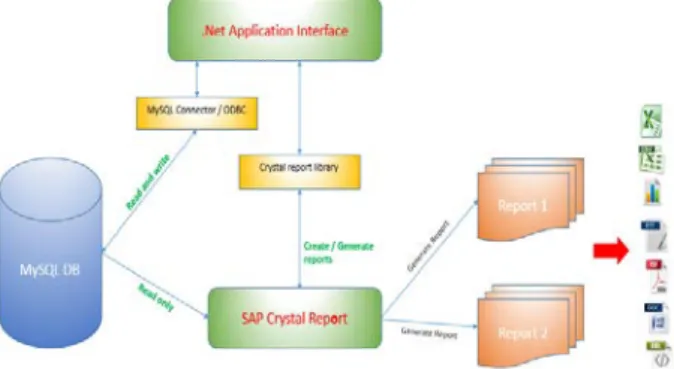
Architectural design is the initial design process of identifying the system and establishing a framework for system control and communication [6].

Figure 3: Architectural design of VSRMS

Figure 3 shows the architectural design of VSRMS.

The .Net application interface which is for handling the database is linked to the MySQL database via the MySQL Connector/ODBC (Open database connectivity). For manipulating and creating reports, the .Net application is linked via Crystal Report library to the SAP Crystal Report tool. It retrieves the vessel report information from the MySQL database and generates ship reports. The generated reports can be exported in multiple formats, such as MS Excel Spreadsheets, Comma Separated Values (CSV) files, XML files, Adobe PDF files, MS Word Documents, and Rich Text Files. The reports can be printed, saved to a USB flash drive, faxed, sent as an attachment to e-mails, or uploaded to a (local or cloud-based) reporting database as an XML file.

3.1 System Design and Supporting Tools

The design of the system consists of three main parts, as outlined below.

3.1.1 Application Interface

1) The application interface of VSRMS was designed using the Microsoft C#.Net programming language (Version 6.0) in the Microsoft Visual Studio framework.

2) The benefits of Microsoft C#.Net programming language are its robustness, ease of programming, excellent database connectivity, and ability to run on the two most common operating system platforms (Windows and UNIX) [7].

3) The application interface of VSRMS consists of different information wizards for entering the data required to generate reports.

4) The information wizards were designed by grouping the same kind of information in each wizard. For example, the

“Vessel” information wizard contains all the data entry fields related to vessel information, such as vessel name, IMO number, official number, registered nation, and gross tonnage.

3.1.2 Database

1) To add to, access, process, and manage the vessel reporting database, MySQL 5.7 RDBMS (Relational Database Management System), the most popular Open Source Structured Query Language (SQL) database management system, was used.

2) The SQLYog 7.11 was used as a Graphical User Interface (GUI) for MySQL, which is the most powerful MySQL manager and administration tool.

3.1.3 Report

1) The main purpose for developing VSRMS was to auto- manage and generate different types of vessel shore reports required for each national port.

2) For designing and creating dynamic vessel shore reports, the SAP Crystal Reports 2013 was used.

3) SAP Crystal Report is a great tool with complete features of reporting, integrated with Microsoft Visual Studio, and can access database source via an Open Database Connectivity (ODBC) connection [8].

4. Development

As mentioned above, the VSRMS database software application was developed to produce sophisticated ready-to- use vessel reports, allowing easy creation and modification.

4.1 VSRMS Information Wizards

The software application was developed by categorizing user-friendly information wizards for entering and retrieving data to generate vessel reports of each national port in their required report style format.

Figure 4 shows the main user interface of VSRMS. From this screen, the user can directly access any category of reporting information wizard input forms that are used to generate the necessary reports. In most cases, the information that is entered into the system is used to generate several different reports that comply with the requirements of a variety of shore-side authorities. At the bottom of the user interface is a button that is used to generate the reports.

424

(8)

Journal of the Korean Society of Marine Engineering, Vol. 40, No. 5, 2016. 6 Figure 4: VSRMS main window

Figure 5 shows the Voyage Information wizard that allows the user to enter or update the voyage information, such as voyage number, arrival port, departure port, ETA, ETD, and agent.

Figure 5: Voyage information wizard

Figure 6 shows the Vessel Information wizard that is used to enter or update the vessel information.

Figure 6: Vessel information wizard

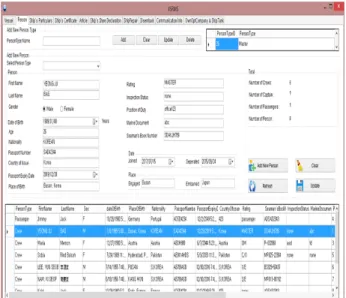
The Person Information wizard is used to enter or update any basic information related to people on board, including Master, Crew, Passenger, Officer, or others, as show in Figure 7.

Figure 7: Person (Crew/Passenger/ master or others) registration

For manipulating the reporting information, the user is able to perform different operations, such as Add, Update, Delete, or Clear. The updated information will be organized and ready to use for producing vessel reports.

4.2 Reports

The reporting data that are entered using the information wizards are stored in the database in several relational tables.

The data can be accessed through SQL queries using an SAP Crystal Report tool in order to generate the vessel reports. The process for creating a report consists of the following steps:

1) Decide which information is required.

2) Select appropriate tables (columns/rows) from the database.

3) Design the report layout.

4) Select the required fields (columns) from the tables and store them in the proper fields of report objects or cells.

5) Use subreport in the main report if needed, select the necessary data from the database, and store them in the proper fields of report objects or cells.

6) Create the report based on the results.

7) Generate and preview the report document.

8) Export the generated report in any given format such as .XML, .XLS, .DOC, .RPT, .PDF.

4.2.1 Example of Procedure to Generate Report

The following procedure illustrates the design, development, and generation of a “Crew List” report for the country “China”

and port “Guangzhou.”

425

(9)

Sobia RindㆍSoo-Jong MoㆍYung-Ho Yu

Journal of the Korean Society of Marine Engineering, Vol. 40, No. 5, 2016. 6 1) Observe the original crew list report format and data

contents of port Guangzhou, as shown in Figure 8.

2) Decide on the following information needed to create a report:

• Name of ship, port of arrival, date of arrival, nationality of ship, port arrived from.

• Crew information (full name, last name, rank, nationality, date of birth, place of birth and seaman’s book number).

3) Select the appropriate data fields that contain the above- mentioned information in the database by SQL Query. Figure 9 shows the selected data fields.

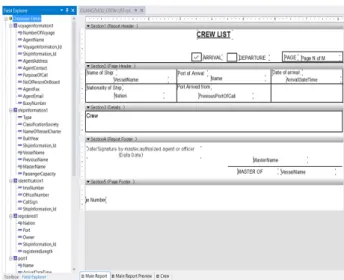
4) After designing the main report layout identical to the original report, drag and drop the required fields (columns) from the selected data fields and store them in the proper fields of report objects, as shown in Figure 10. In this case, the name of ship, port of arrival, date of arrival, nationality of ship, and port arrived from are shown.

5) For the crew information of the above main report, a subreport needs to be created using the same method of dragging and dropping data fields from the database, as shown in Figure 11.

6) In order to obtain the required data from the database for the Crystal Report, “selection experts” are used. Create selection experts of current voyage number and current port call as in the following code example:

{voyageinformation1.NumberOfVoyage}={? Voyage Number} and {port1.Name} = {? Port of call}

7) Finally, in order to generate the required crew list report, click “Generate Reports” from the main window of VSRMS shown in Figure 4. Then, select the required nation, port, and report type by using the drop down box as shown in Figure 12.

Figure 8: Original report format of China_ Guangzhou_Crew List

Figure 9: GUI view of database fields

Figure 10: Design view of crew list main report

Figure 11: Design view of crew list subreport

425

426

(10)

Journal of the Korean Society of Marine Engineering, Vol. 40, No. 5, 2016. 6 Figure 12: Select nation, port and report type

8) Select the current voyage number and current port of call to generate the report for the selected voyage and port as shown in Figure 13.

9) Figure 14 shows the generated crew list report for the country of China and port of Guangzhou using VSRMS.

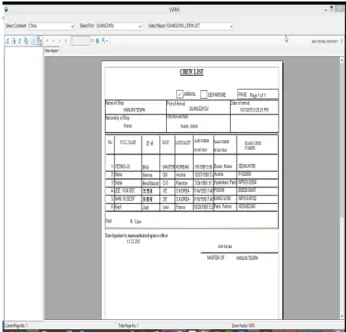
10) Export the crew list report in PDF format, as shown in Figure 15.

11) Similarly, all the vessel reports of each national port can be designed and generated in their required report formats using VSRMS.

12) Figure 16 shows a flow chart of the report generation process, and Figure 17 shows the interface view of the report generation of each national port using VSRMS.

Figure 13: Enter required data to generate report

Figure 14: Generated crew list report of nation China and port Guangzhou by VSRMS

Figure 15: PDF view of generated crew list by VSRMS

Figure 16: Flow chart of report generation process by VSRMS

Figure 17: Reports generation by VSRMS

427

(11)

Sobia RindㆍSoo-Jong MoㆍYung-Ho Yu

Journal of the Korean Society of Marine Engineering, Vol. 40, No. 5, 2016. 6

5. Conclusions

In this study, IMO MSP 8, which is a vessel shore reporting service, was developed. During the development, all types of vessel shore report information and document formats were investigated. The types of reports, information, and document formats vary extensively according to the nation and port. This paper examined the documents and information required for vessel shore reports from a wide range of ports and countries. The information required in ports and countries not included in this study is similar to that investigated; hence, the investigated information for vessel shore reports can provide a basis for international standards.

International standardization of vessel shore reports by the IMO will simplify the reports. However, this could require an excessive time frame. The developed VSRMS application can be conveniently used by shipping companies and vessels until standards are developed by the IMO. It is currently undergoing testing by a shipping company to verify its usability and reliability.

References

[1] Y. H. Yu, “Relationship of CSSA with other e-Navigation pillars and S-100 based products,” CSSA Workshop in Hamburg, Germany, 2014.

[2] IMO, FAL.5/Circ.36, “Guidelines for setting up a single window system in maritime transport,” 2011.

[3] IALA ENAV Committee 17th Session, “MSP 8 vessel shore reporting,” Centre de Congress du Quartz, Brest, France, 2015.

[4] O. J. Rodseth, “Integrating IEC and ISO information models into the S-100 common maritime data structure,”

MARINTEK, 2016.

[5] T. D. Jewell, I. Anderson, A. Chandler, S. E. Farb, K.

Parker, A. Riggio, and N. D. M. Robertson., Electronic Resource Management, Digital library Federation Washington, D.C. , 2004.

[6] B. B. Agarwal, Software Engineering, 2nd ed., 2009.

[7] J. Liberty and B. MacDonald , Learning C# 3.0, O'Reilly Media, 2008.

[8] M. Garrett. , Using Crystal Reports with SAP, SAP Press;

1st ed., 2010.

428

수치

Figure 1: Investigated ship reports of 33 ports world wide
Table 3: List of information for vessel  Vessel Information
Table 6: Vessel reports and information  Vessel Reports    Common Information    General declaration
Figure 2  shows the voyage  information schema that contains  voyage information-related entities with attributes, and the  relationship between these entities, as described below:
+5

참조

관련 문서