https://doi.org/10.4094/chnr.2018.24.3.27 4
CHNR
Validity and Reliability of the Korean Version of the Families’ Importance in Nursing Care-Pediatric Nurses’ Attitudes Instrument
Jina Oh
1, Yae Young Kim
2, So Yeon Yoo
2, Haeryun Cho
31Department of Nursing, Institute of Health Science, Inje University, Busan; 2Department of Nursing, Kyungil University, Gyeongsan;
3Department of Nursing, Wonkwang University, Iksan, Korea
Purpose: This study aimed to test the validity and reliability of the Korean version of the Families’ Importance in Nursing Care -Nurses’ Attitudes (FINC-NA) instrument developed by Saveman et al. Methods: The 222 pediatric nurses’ data were collected from 13 hospitals in South Korea and were analyzed using descriptive statistics, exploratory factor analysis, the Pearson correla- tion coefficient, and the Cronbach’s ⍺ in SPSS software. The AMOS program was used to conduct confirmatory factor analysis of construct validity. Results: Of the 26 initial items, 24 were ultimately selected after evaluating content validity, construct validity, and reliability. The following 6 factors were included in the Korean version of the Families’ Importance in Nursing Care-Pediatric Nurses’ Attitudes (KFINC-PNA): family as a ‘conversational partner’, ‘participant in care’, ‘supporter for the nurse’, ‘burden’,
‘recipient of empowerment’, and ‘its own resource’. Conclusion: The KFINC-PNA was partially modified to explain differences in language and culture, but its validity and reliability were verified. Pediatric nurses’ attitudes can be assessed using the KFINC-PNA, and adjustments to the care of hospitalized children and their families can be made based on these items. We recom- mend developing and verifying intervention methods that will improve family-centered care for hospitalized children and their families.
Key words: Family, Nurses, Attitude, Validity and reliability
INTRODUCTION
Family-centered care (FCC) is respectful and inclusive of the patient’s family in healthcare decision-making and can be applied in clinical settings regardless of the patient’s age or se- verity of illness [1]. FCC emphasizes the mutually beneficial partnership between healthcare providers, including nurses, and the patient and his or her family, and its main concepts are respecting and honoring families, sharing information, en- couraging participation and cooperation, and supporting fa- milies [1-3]. Extensive research has reported that FCC brings positive results to patients and their families and increases their satisfaction level, while also decreasing medical expen- ses, which contributes to the effective utilization of medical resources [4]. Therefore, the practice of nursing needs to seek methods to support the better implementation of FCC.
FCC is especially emphasized in the practice of pediatric nursing, and the Association for the Care of Children’s Health has declared FCC to be its major philosophy in pediatric nurs- ing [5], while the American Academy of Pediatrics (AAP) also Corresponding author Yae Young Kim
https://orcid.org/0000-0003-3214-8037 Department of Nursing, Kyungil University
50 Gamasil-gil, Hayang-eup, Gyeongsan 38428, Korea TEL +82-53-600-5662 FAX +82-53-600-5679 E-MAIL [email protected]
Received May 3, 2018 Revised Jun 6, 2018 Accepted Jun 8, 2018
This is an Open Access article distributed under the terms of the Creative Commons Attribution Non- Commercial License (http://creativecommons.org/licenses/by-nc/4.0/) which permits unrestricted non- commercial use, distribution, and reproduction in any medium, provided the original work is properly cited.
considers FCC as a main issue in pediatric health management [6]. In other words, FCC strengthens the role of the patient’s family in the care process provided by pediatric nurses, and the philosophy of FCC that care providers should assist fami- lies in making the best decisions is becoming global [2,4-6].
The patient’s parents and family members play very im- portant roles in caring for their hospitalized child in pediatric nursing practice in Korea [7,8]. In the clinical field of caring for children, the pediatric patient’s family members are joint re- cipients of care, while at the same time they are not passive re- cipients or representative of the patient; rather, they are com- panions who express the preferences and expectations of the pediatric patient [9]. FCC acknowledges the importance of family, respects the unique features and values of the family, and shares information with them for better decision-making, while sharing responsibility for the results [10]. Pediatric nur- ses, therefore, must have appropriate attitudes that recognize the importance of considering the child’s family as care recipi- ents along with the hospitalized child [9,10]. A recent study by Bae and Lee [11] on pediatric nursing also found that the part- nership between the hospitalized children’s parents and nur- ses had a significant influence on the quality of pediatric nur- sing. Meanwhile, research by Kim and Cho [7] suggested that the mothers of the hospitalized children wished to be respec- ted by the nurses, to participate in the nursing of their chil- dren, and to receive enough information to work together with nurses, but felt that they were not respected by the pedia- tric nurses or did not receive enough information. Many re- searchers are taking notice of the importance of FCC in pedia- tric nursing, and families also want to participate in children’s nursing; however, South Korea’s FCC practices in pediatric nursing currently do not meet such demands.
In order to put FCC into practice, it is very important for the nurses to recognize the importance of family and to have a supportive attitude towards families [12]. In fact, according to research by Coyne et al. [13], nurses’ lack of a philosophical background on FCC and negative attitudes towards families were the greatest obstacles in performing high-quality FCC.
As such, the attitudes of practicing nurses are important, and for more active utilization of FCC in the pediatric nursing field, the first step is for the attitudes of pediatric nurses when dealing with patients’ families to be assessed and improved.
In other countries, applied intervention studies of FCC on a wide range of subjects, not restricted to children, are being actively conducted [14]. Korean scholars have recently started to pay attention to FCC and have conducted descriptive stud- ies, such as a concept analysis on hospitalized children’s FCC [3], a concept analysis on parent participation in the care of hospitalized children [8], and an integrative review of fam- ily-centered rounds in care for hospitalized children [10].
Methodological research to develop tools based on FCC theo- ry has been conducted, including the development and test- ing of the Pediatric Nurse Parent Partnership Scale (PNPPS) [15] and the development of an instrument to measure the quality of care through patients’ eyes for hospitalized chil- dren [16]. However, no research has been done on nurses’ atti- tudes on the importance of family, which is a prerequisite for FCC to be practiced.
This study, therefore, analyzed a translation of the Families’
Importance in Nursing Care-Nurses’ Attitudes (FINC-NA) in- strument [17], which was developed to measure the attitudes of nurses regarding the importance of families, in order to val- idate whether the tool is compatible with the conditions of Korea. The FINC-NA instrument measures nurses’ attitudes that consider family as a resource that provides nursing care to patients and support communication with the family as an equivalent party, which means not considering the existence of the patient’s family itself to be a burden [12]. The FINC-NA tool was developed to measure Swedish nurses’ attitudes on the importance of families in nursing. It was then revised/
modified and retested for validity and reliability in 2011 by Saveman et al. [17]. When conducting research on tool devel- opment, a rational basis for the tool’s use must be proposed.
As a result, various verifications of its validity are needed, and when bringing a tool developed in a foreign culture into a Korea-specific context for use, social/cultural differences need to be considered and the instrument must go through a more detailed validation process [18]. The authors of this study, therefore, translated the FINC-NA instrument [17] into Kore- an and modified it to be compatible with the conditions of Korea. We developed the Korean version of the Families’ Im- portance in Nursing Care-Pediatric Nurses’ Attitudes (KFINC- PNA) and tested its validity and reliability.
1. Objectives
The purpose of this study was to test the validity and reli- ability of the KFINC-PNA measurement instrument.
METHODS 1. Research Design
This is a methodological study that translated the FINC-NA instrument [17] developed by Saveman et al. into Korean, adapted it to be compatible with the conditions of Korea in or- der to provide a measurement tool for pediatric nurses’ atti- tudes on the importance of families, and tested its validity and reliability.
2. Research Subjects
The research subjects of this study were pediatric nurses at university hospitals, general hospitals, and children’s hos- pitals. Nurses working in neonatal units, neonatal intensive care units, pediatric intensive care units, and comprehensive nursing care wards were excluded from this study. In order to conduct a reliable instrument analysis, the sample number should be 5~10 times more than the number of items, and when the number of items is 40 or less, the sample number should be 200 [19]. With this guideline in mind, this study set the sample number at 200 subjects. Anticipating a 10% drop- out rate, surveys were distributed to 222 subjects. Sampling was conducted by regions: 40% of the subjects resided in Seoul/Gyeonggi Province, 35% in Gyeongsang Province and Gangwon Province, and 25% in Jeolla Province and Chung- cheong Province. Sampling from Jeju Island was not perfor- med due to difficulties in recruitment. All 222 surveys were used in the final analysis since all data were collected without any dropout or incomplete responses.
3. Research Instrument
1) The FINC-NA
The FINC-NA is an instrument that measures nurses’ atti- tudes on the importance of family in nursing using 26 items. It was re-tested and modified by Saveman et al. [17], and before using this tool in this study, the authors of this study received approval from the developers for the translation and use of the tool. The developers recommended using the 2011 revi- sion for this study. The FINC-NA consists of 4 factor dimen- sions and a total of 26 items. The items are distributed among the factor dimensions as follows: family as a resource in nurs- ing care, 10 items; family as a conversational partner, 8 items, family as a burden, 4 items; and family as its own resource, 4 items. When the evaluation was developed in 2008, each item was on a 4-point scale [12] but the revision changed to a 5- point scale, measuring responses as “totally disagree (1 point)”,
“disagree (2 point)”, “neither agree or disagree (3 point)”,
“agree (4 point)”, and “totally agree (5 point)”. Higher scores indicate more supportive attitudes towards families. The in- strument satisfied content validity at the time of develop- ment. The Cronbach’s ⍺ for reliability of all items was .92, while the Cronbach’s ⍺ for the reliability of the factor di- mensions ranged from .73 to .87. The revision showed greater reliability than the original instrument [17].
2) Partnership between pediatric nurses and the parents of child patients
The PNPPS, an instrument that measures the partnership
between pediatric nurses and the parents of child patients [15], was used to assess the validity of the KFINC-PNA meas- urement tool, since partnership is a major concept of FCC and shares similarities with pediatric nurses’ attitudes on impor- tance of families. The developers approved its use before the authors used it in this study. The PNPPS has 7 factor dimen- sions with a total of 34 items: 9 items on reciprocity, 7 items on professional knowledge and skill, 6 items on sensitivity, 3 items on collaboration, 4 items on communication, 3 items on shared information, and 2 items on cautiousness. Each item was measured on a 5-point Likert scale with responses of
“strongly disagree (1 point)”, “disagree (2 point)”, “neither agree or disagree (3 point)”, “agree (4 point)”, and “strongly agree (5 point)”. Higher scores indicate a more positive part- nership between nurses and the parents of child patients. The Cronbach’s ⍺ for the reliability of all items was .92 when the tool was developed [15], and was .91 in this study.
4. Research Procedure
1) Translation and adaptation of instruments
Following the guidelines provided by World Health Orga- nization (WHO) on the process of translation and adaptation of instruments [20], we conducted a forward translation, held expert panels, and then performed a back translation. The adaptation of the instrument followed the process of qual- ification of content validity, pilot test, and finalization of the instrument. Prior to beginning the primary translation draft, the authors received approval to translate and to use the in- strument from the developers.
(1) Instrument translation
During the first stage of translation, in which the primary translation draft was developed, 3 pediatric nursing pro- fessors who were familiar with the terms used in the instru- ment and fluent in Korean and English each translated the in- strument separately. Literal translations were avoided, and the translations aimed to balance the goals of not distorting the original meaning and ensuring that Korean nurses could clearly understand the questions. During the second stage, the 3 pediatric nursing professors and a bilingual English trans- lator formed an expert panel and compared the 3 translations to the original instrument, analyzed expressions that showed cultural differences or discordances, and combined them into a single translated version. During the third stage, the trans- lation was sent to a professional translation agency for a back translation. After the back translation was finished, a native English-speaking professor reviewed the original and trans- lated versions to find differences in content. The content com- parison results came back as matching, and no questions were
modified at this stage.
(2) Content validity
Following the recommendation that content validity should be determined by 3~10 experts, and that when the same ex- perts is determining the qualification, at least 10~14 days should be given [21], the content validity was determined twice with a team of 3 pediatric nursing professors, 1 doctoral candidate in pediatric nursing, and 3 head nurses from the pe- diatric ward who were practicing professionals. The first con- tent qualification was conducted on October 16~28, 2017 and the second content qualification for the modified questions was conducted 10 days later on November 1~5, 2017. The con- tent validity index (CVI) measured the degree to which each item was related to pediatric nurses’ attitudes on the im- portance of families on a 4-point Likert scale with the follow- ing responses: “not related at all (1 point)”, “not related and revision is needed (2 points)”, “related but revision is some- what needed (3 points)”, and “very related and concise (4 points)” Opinions on the content of questions that needed to be revised were also collected. The rate of 3- and 4-point re- sponses to each question was calculated as the CVI, and ques- tions with a CVI of .80 or higher were preselected [21].
(3) Pilot test
Based on the recommendation that the pilot test should consist of a minimum of 10 persons [19], the pilot test was conducted among 28 nurses from the pediatric ward from November 22~30, 2017. The reverse items, number of items, and item layout were the same as the original instrument.
Participants were asked to respond to the questions on the Korean version of the instrument and to provide information about their general characteristics. Next, the time it took them to respond, the level of question comprehension, and the ap- propriateness of the composition of the survey (font size, sur- vey placement, length of questions) were evaluated on a 5-point scale. Interviews were conducted after the survey to learn whether any questions were difficult to understand or unclear, and a cognitive assessment process was applied be- fore finalizing the instrument.
2) Data collection
In order to protect the study subjects and to follow the princi- ples of research ethics, this study was approved by the Inje Uni- versity Institutional Review Board (IRB No. 2017-10-018-001) pri- or to conducting research. Data were collected in December 2017, and before investigating, the research objectives and methods were explained to the director of the nursing depart- ment of the hospitals, whose cooperation with data collection was requested. The researchers then visited the wards and
personally distributed the surveys, and collected them imme- diately as they were completed. Convenience sampling was used, resulting in the inclusion of 4 university hospitals and 1 general hospital from Seoul and Gyeonggi Province, as well as 4 university hospitals and 1 general hospital from Gyeongsang Province and Gangwon Province and 1 university hospital, 1 general hospital, and 1 children’s hospital from Jeolla Province and Chungcheong Province. Prior to conducting surveys, in- formation regarding the research background; objectives; par- ticipation period, process, and method; benefits and risks of participation, information related to the protection of person- al information; compensation for any loss due to research par- ticipation; information related to providing personal infor- mation; and information regarding withdrawal from partic- ipation were explained verbally, along with a hard copy of an information sheet. Nurses who voluntarily agreed to partic- ipate in the study signed the agreement form and individually filled out the survey forms. When the participants completed the survey, a small gift was provided to thank them for their time and effort. The survey data were anonymously coded and encrypted and saved on a Universal Series Bus (USB) drive.
The USB drive, collected agreement forms, and survey forms were sealed and kept in a locked cabinet in the researcher’s office.
3) Validity test
(1) Construct validity
In order to test construct validity, exploratory factor analy- sis and confirmatory factor analysis were conducted. Explora- tory factor analysis is a method used to identify validity by re- viewing the relationships between the instrument’s measure- ment concept, the characteristics of each item, and the factors [19]. This study then used confirmatory factor analysis to as- sess the compatibility of the developed instrument by testing the model fit, convergent validity, and discriminant validity.
(2) Criterion-related validity
Criterion-related validity is a method that tests validity by analyzing the correlation between a ‘gold-standard’ instru- ment, the validity and reliability of which has already been confirmed, and the newly developed instrument under study [19]. This study used the PNPPS as the criterion instrument for KFINC- PNA to test criterion-related validity because they share the same philosophical background and the PNPPS is an instrument for measuring partnership between pediatric nurses and the parents of child patients [15].
4) Reliability test
Reliability was tested through internal consistency. The Cronbach’s ⍺ for the items in each factor and for all items as a
whole was analyzed. The larger the sample number, the high- er the reliability. Therefore, in order to prevent errors in which the wrong test results are considered to indicate high reli- ability of an instrument, 111 samples were randomly selected and split-half reliability of the random sample was analyzed to determine the Cronbach’s ⍺[19].
5. Data Analysis
The collected data were analyzed using IBM SPSS Statistics 24 and IBM SPSS AMOS 24.
(1) The subjects’ general characteristics were expressed as real numbers, means, standard deviations, and percent- ages.
(2) In order to test content validity, the item CVI (I-CVI) and the instrument’s scale CVI (S-CVI) were measured. The S-CVI used the S-CVI/universal agreement (S-CVI/UA) technique, which calculates the S-CVI/average (S-CVI/
Ave), which is the average of each I-CVI, and the rate of I-CVI for which all expert responded with 3 or 4 points [22].
(3) Exploratory factor analysis was conducted after the Kai- ser-Meyer-Olkin (KMO) measure and the Bartlett test of sphericity identified that the collected data were com- patible with exploratory factor analysis. Data compati- bility is considered excellent if the KMO measure is greater than .90, good if the KMO measure is greater than .80, moderate if the KMO measure is greater than .70, average if the KMO measure is greater than .60, poor if the KMO measure is greater than .50, and un- acceptable if the KMO measure is less than .50. This study followed the standard that suggests that if the Bartlett sphericity test yields p<.05, it is compatible for factor analysis [23,24]. Since principal component anal- ysis, one of the factor extraction methods, and the or- thogonal rotation method, which induces a relatively independent factor to identify the structure, are appro- priate for evaluating content validity [24], factor analy- sis was conducted using principal component analysis from Varimax orthogonal rotation.
(4) The compatibility of the model for confirmatory factor analysis was evaluated using the absolute fit index chi- square (x2); the standardized chi-square (x2/df); good- ness of fit index (GFI); the adjusted GFI (AGFI); the com- parative fit index (CFI), which is an incremental fit in- dex; the normed fit index (NFI); the Tucker-Lewis index (TLI); and the root mean square error of approximation (RMSEA), which is a parsimonious fit index.
(5) Convergent validity was analyzed by construct reliabil- ity (CR) and average variance extracted (AVE).
(6) Discriminant validity was analyzed by the square root of AVE and the Pearson correlation coefficient.
(7) Criterion-related validity was analyzed with the Pear- son correlation coefficient.
(8) Item analysis used the mean and standard deviation, skewness, kurtosis, the item-total correlation (ITC), the Cronbach’s ⍺ when an item was deleted, and the mean and standard deviation for each item.
(9) For the reliability test, the Cronbach’s ⍺ was used for in- ternal consistency, as well as the random sample split- half reliability.
RESULTS 1. Content Validity Test
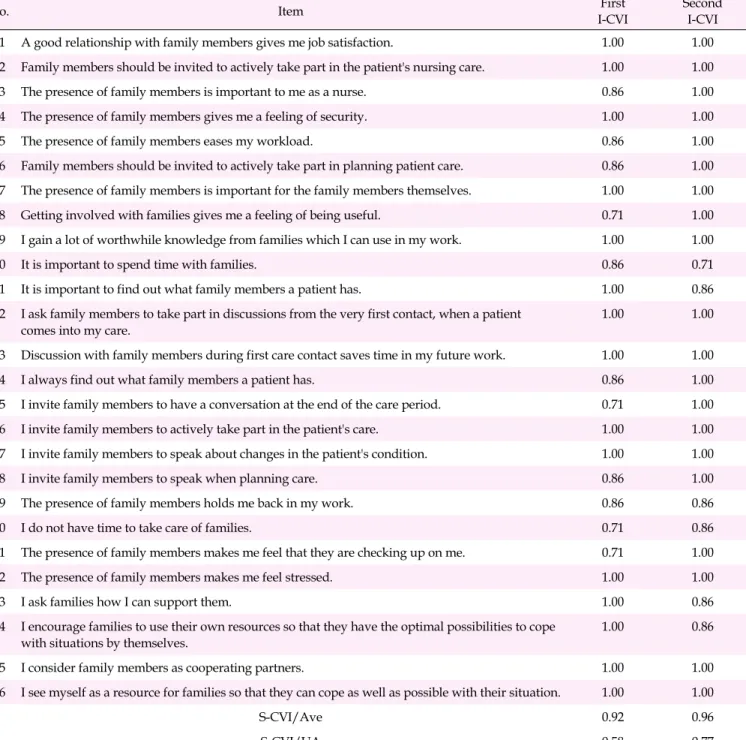
The results of the first expert content validity test performed showed that the CVI for the 26 preliminary items was .71~
1.00, the S-CVI/Ave was .92, and the S-CVI/UA was .58. No items were deleted based on the CVI results, but taking the ex- perts’ opinions into account, the wording of some of the 26 items was revised. The second expert content validity test showed that the CVI of the 26 items ranged between .71 and 1.00, the instrument’s CVI was S-CVI/Ave .96, and the S-CVI/UA was .77 (Table 1). No items were deleted based on the CVI results, while the wording of 2 items was revised.
2. Pilot Test
The results from the Pilot test that was conducted on 28 nurses from the pediatric ward showed that the average time it took to take the survey was 1.93±0.82 minutes. The overall question comprehension level was 4.21±0.79 points out of 5 points, while the appropriateness of font size was rated as 4.00±0.82, the survey layout was rated as 4.07±0.77, and the length of the questions was rated as 4.11±0.79 points. The cog- nitive assessment interviews suggested that no items were difficult to understand or unclear.
3. Subjects’ General Characteristics
The study subjects’ average age was 29.38±7.38 years and their total work experience was 81.51±88.46 months, while their work experience in the pediatric ward was 46.20±53.08 months. Of the subjects, 5.4% were head nurses, 12.2% were charge nurses, 82.0% were nurses, and 0.5% were nurse prac- titioners. Furthermore, 72.5% were single and 19.5% had child- ren. In terms of education level, 24.3% had graduated from technical colleges, 69.4% had completed 4 years of college, and 5.9% had graduated from graduate school. In terms of re-
Table 1. Content Validity (N=7)
No. Item First
I-CVI
Second I-CVI
1 A good relationship with family members gives me job satisfaction. 1.00 1.00
2 Family members should be invited to actively take part in the patient's nursing care. 1.00 1.00
3 The presence of family members is important to me as a nurse. 0.86 1.00
4 The presence of family members gives me a feeling of security. 1.00 1.00
5 The presence of family members eases my workload. 0.86 1.00
6 Family members should be invited to actively take part in planning patient care. 0.86 1.00 7 The presence of family members is important for the family members themselves. 1.00 1.00
8 Getting involved with families gives me a feeling of being useful. 0.71 1.00
9 I gain a lot of worthwhile knowledge from families which I can use in my work. 1.00 1.00
10 It is important to spend time with families. 0.86 0.71
11 It is important to find out what family members a patient has. 1.00 0.86
12 I ask family members to take part in discussions from the very first contact, when a patient comes into my care.
1.00 1.00
13 Discussion with family members during first care contact saves time in my future work. 1.00 1.00
14 I always find out what family members a patient has. 0.86 1.00
15 I invite family members to have a conversation at the end of the care period. 0.71 1.00
16 I invite family members to actively take part in the patient's care. 1.00 1.00
17 I invite family members to speak about changes in the patient's condition. 1.00 1.00
18 I invite family members to speak when planning care. 0.86 1.00
19 The presence of family members holds me back in my work. 0.86 0.86
20 I do not have time to take care of families. 0.71 0.86
21 The presence of family members makes me feel that they are checking up on me. 0.71 1.00
22 The presence of family members makes me feel stressed. 1.00 1.00
23 I ask families how I can support them. 1.00 0.86
24 I encourage families to use their own resources so that they have the optimal possibilities to cope with situations by themselves.
1.00 0.86
25 I consider family members as cooperating partners. 1.00 1.00
26 I see myself as a resource for families so that they can cope as well as possible with their situation. 1.00 1.00
S-CVI/Ave 0.92 0.96
S-CVI/UA 0.58 0.77
CVI=Content validity index; I-CVI=Item-content validity index; S-CVI/Ave=Average of item-content validity index; S-CVI/UA=Scale-content validity index/universal agreement.
ligious affiliation, 56.8% had no religion, 19.8% were Protes- tants, 12.2% were Catholics, 8.1% were Buddhists, and 3.2%
were Won Buddhists.
4. Construct Validity Test
The process of testing construct validity is described in
Figure 1. In order to identify compatibility with the 4 factors of the FINC-NA, confirmatory factor analysis and exploratory factor analysis were conducted. The model fit was low and the item structures that constituted the 4 factors were different from those of the original instrument. Therefore, exploratory factor analysis was conducted to investigate the structure of the KFINC-PNA. The results of the exploratory factor analysis
Figure 1. Flowchart of factor analysis.
conducted on the 26 items showed that KMO was .86, and the Bartlett sphericity test yielded x2=2560.84 (df=325, p<.001).
Factor analysis was conducted since the data were considered to be compatible for factor analysis [23,24] if the KMO meas- ure was higher than .60 and the Bartlett’s sphericity test p-val- ue was lower than .05. The commonality between the 26 items was .49~.74. Since all values were greater than .40, no items were deleted [25]. The factor loading (FL) was .42~.84, which satisfied the standard of being .30 or higher and not close to 1.0 [24]. Six factors were extracted and the explanatory power was 63.06%. The confirmatory factor analysis showed that the model fit was x2=720.29 (p<.001), x2/df=2.54, GFI=.79, AGFI
=.74, CFI=.81, NFI=.73, TLI=.79, and RMSEA=.08. The stand- ardized FL showed that the FL of item 20 was .40 and the FL of item 23 was .49, which did not satisfy the standard according to which FL should be .50 or greater [26]; therefore, items 20 and 23 were deleted.
The exploratory factor analysis results for 24 items showed that they met the standards, with KMO measures of .86, a Bartlett sphericity test result of x2=2374.30 (df=276, p<.001),
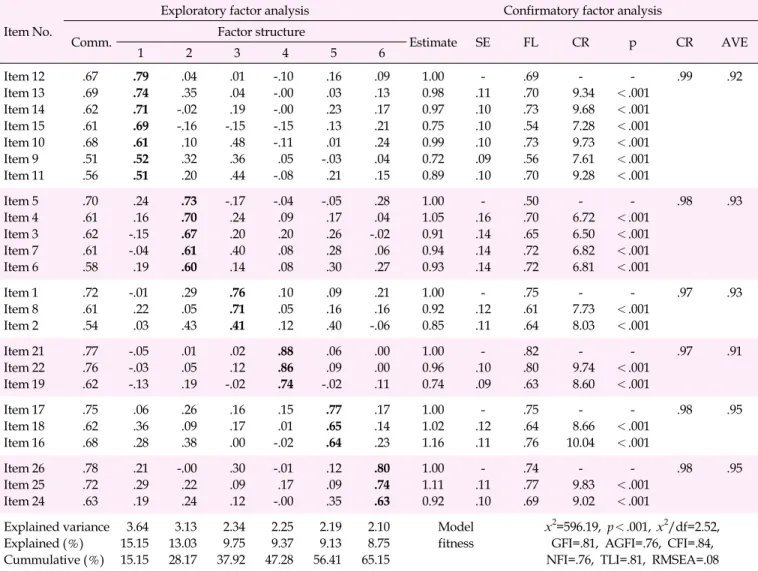
commonality of .51~.78, and FL of .41~.88. Six factors were ex- tracted and the cumulative explanatory power increased to 65.15%. Factor 1 was designated as “family as conversation partner”. This factor contained 7 items and had an explained variance of 3.64 and explanatory power of 15.15%. Factor 2 was “family as a participant in care”, and consisted of 5 items, had an explained variance of 3.13, and had an explanatory power of 13.03%. Factor 3, which was made up of 3 items, was
“family as a supporter for the nurse”, and showed an ex- plained variance of 2.34 and an explanatory power of 9.75%.
Factor 4 was “family as a burden” and had 3 items. The ex- plained variance was 2.25 and the explanatory power was 9.37%. Factor 5, which contained 3 items, was “family as a re- cipient of empowerment”. The explained variance was 2.19 and the explanatory power was 9.13%. Lastly, factor 6, with 3 items, was “family as its own resource”. The explained var- iance was 2.10 and the explanatory power was 8.75%(Table 2).
The confirmatory factor analysis results showed that the mod- el fit was x2=596.19 (p<.001), x2/df=2.52, GFI=.81, AGFI=.76, CFI=.84, NFI=.76, TLI=.81, and RMSEA=.08, and the FL was
Table 2. Factor Analysis of the KFINC-PNA (N =222) Item No.
Exploratory factor analysis Confirmatory factor analysis
Comm. Factor structure
Estimate SE FL CR p CR AVE
1 2 3 4 5 6
Item 12 Item 13 Item 14 Item 15 Item 10 Item 9 Item 11
.67 .69 .62 .61 .68 .51 .56
.79 .74 .71 .69 .61 .52 .51
.04 .35 -.02 -.16 .10 .32 .20
.01 .04 .19 -.15 .48 .36 .44
-.10 -.00 -.00 -.15 -.11 .05 -.08
.16 .03 .23 .13 .01 -.03 .21
.09 .13 .17 .21 .24 .04 .15
1.00 0.98 0.97 0.75 0.99 0.72 0.89
- .11 .10 .10 .10 .09 .10
.69 .70 .73 .54 .73 .56 .70
- 9.34 9.68 7.28 9.73 7.61 9.28
-
<.001
<.001
<.001
<.001
<.001
<.001
.99 .92
Item 5 Item 4 Item 3 Item 7 Item 6
.70 .61 .62 .61 .58
.24 .16 -.15 -.04 .19
.73 .70 .67 .61 .60
-.17 .24 .20 .40 .14
-.04 .09 .20 .08 .08
-.05 .17 .26 .28 .30
.28 .04 -.02 .06 .27
1.00 1.05 0.91 0.94 0.93
- .16 .14 .14 .14
.50 .70 .65 .72 .72
- 6.72 6.50 6.82 6.81
-
<.001
<.001
<.001
<.001
.98 .93
Item 1 Item 8 Item 2
.72 .61 .54
-.01 .22 .03
.29 .05 .43
.76 .71 .41
.10 .05 .12
.09 .16 .40
.21 .16 -.06
1.00 0.92 0.85
- .12 .11
.75 .61 .64
- 7.73 8.03
-
<.001
<.001
.97 .93
Item 21 Item 22 Item 19
.77 .76 .62
-.05 -.03 -.13
.01 .05 .19
.02 .12 -.02
.88 .86 .74
.06 .09 -.02
.00 .00 .11
1.00 0.96 0.74
- .10 .09
.82 .80 .63
- 9.74 8.60
-
<.001
<.001
.97 .91
Item 17 Item 18 Item 16
.75 .62 .68
.06 .36 .28
.26 .09 .38
.16 .17 .00
.15 .01 -.02
.77 .65 .64
.17 .14 .23
1.00 1.02 1.16
- .12 .11
.75 .64 .76
- 8.66 10.04
-
<.001
<.001
.98 .95
Item 26 Item 25 Item 24
.78 .72 .63
.21 .29 .19
-.00 .22 .24
.30 .09 .12
-.01 .17 -.00
.12 .09 .35
.80 .74 .63
1.00 1.11 0.92
- .11 .10
.74 .77 .69
- 9.83 9.02
-
<.001
<.001
.98 .95
Explained variance Explained (%) Cummulative (%)
3.64 15.15 15.15
3.13 13.03 28.17
2.34 9.75 37.92
2.25 9.37 47.28
2.19 9.13 56.41
2.10 8.75 65.15
Model fitness
x2=596.19, p<.001, x2/df=2.52, GFI=.81, AGFI=.76, CFI=.84, NFI=.76, TLI=.81, RMSEA=.08 KFINC-PNA=Korean version of the families' importance in nursing care–pediatric nurses' attitude; Comm.=Communalities; SE=Standardized estimates; FL=Standardized factor loading; CR=Construct reliability; AVE=Average variance extracted; GFI=Goodness of fit index; AGFI=Adjusted goodness of fit index; CFI=Comparative fit index; NFI=Normed fit index; TLI=Tucker-Lewis index; RMSEA=Root mean square error of approximation.
.50~.82 (Table 2).
Convergent validity was analyzed by CR, which was .97~
.99, and AVE, which was .91~.95, meeting the standard of a CR of .70 or higher and an AVE of .50 or higher [26] (Table 2).
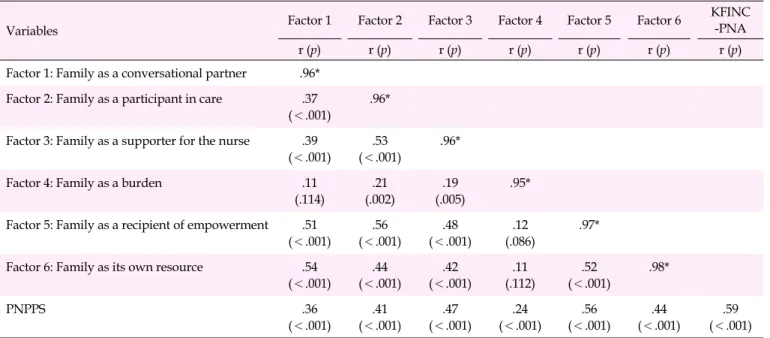
The discriminant validity results showed that the square root of AVE was .95~.98 and the correlation coefficient for each fac- tor was .11~.56, satisfying the standard that the square root of AVE should be greater than the correlation coefficient for each factor [26] (Table 3).
5. Criterion-Related Validity
The criterion-related validity was tested by analyzing the correlation between the KFINC-PNA score developed in this study and PNPPS scores. The KFINC-PNA and the PNPPS showed a significant static correlation (r=.59, p<.001). The
correlation coefficients for each factor ranged from .24 to .56, and all showed a significant static correlation (Table 3).
6. Item Analysis
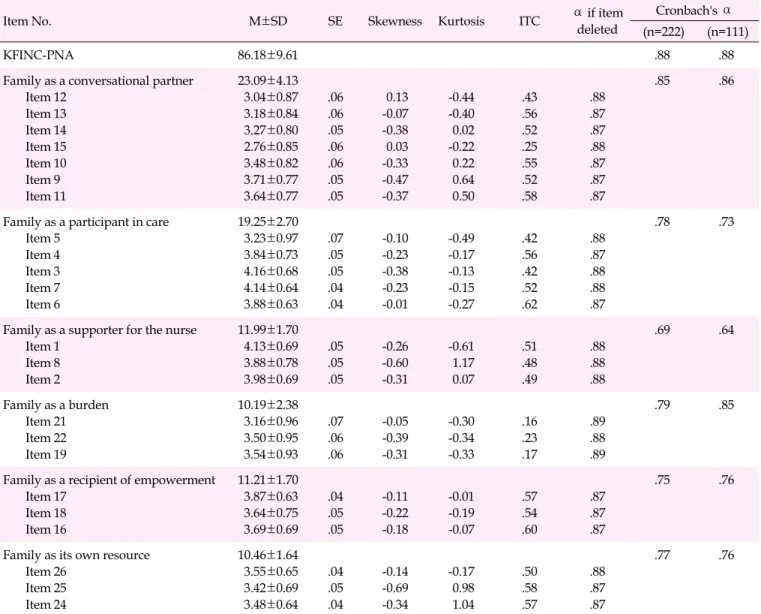
An analysis of the 24 items of the KFINC-PNA revealed that the mean of the items was 2.76~4.16 and the standard devia- tion was 0.63~0.97, showing no extreme values. Skewness was -0.69 to 0.13 and kurtosis was -0.61 to 1.17, showing no partic- ular skewness towards one side or the other. The ITC was .16~.62 and the Cronbach’s ⍺ was .87~.89 when items were deleted (Table 4).
7. Reliability Test
The Cronbach’s ⍺ of the KFINC-PNA was .88 and each fac-
Table 3. Correlation Matrix among Factors of KFINC-PNA and Pediatric Nurse Parent Partnership (N=222)
Variables Factor 1 Factor 2 Factor 3 Factor 4 Factor 5 Factor 6 KFINC
-PNA
r (p) r (p) r (p) r (p) r (p) r (p) r (p)
Factor 1: Family as a conversational partner .96*
Factor 2: Family as a participant in care .37 (<.001)
.96*
Factor 3: Family as a supporter for the nurse .39 (<.001)
.53 (<.001)
.96*
Factor 4: Family as a burden .11
(.114)
.21 (.002)
.19 (.005)
.95*
Factor 5: Family as a recipient of empowerment .51 (<.001)
.56 (<.001)
.48 (<.001)
.12 (.086)
.97*
Factor 6: Family as its own resource .54 (<.001)
.44 (<.001)
.42 (<.001)
.11 (.112)
.52 (<.001)
.98*
PNPPS .36
(<.001)
.41 (<.001)
.47 (<.001)
.24 (<.001)
.56 (<.001)
.44 (<.001)
.59 (<.001)
*Square root average variance extracted (AVE); KFINC-PNA=Korean version of the families' importance in nursing care–pediatric nurses' attitude;
PNPPS=Pediatric nurse parent partnership scale.
tor’s Cronbach’s ⍺ ranged from .69 to .85. Testing the reli- ability of 111 random samples showed that the Cronbach’s ⍺ was .88 for all factors and .64~.86 for each factor (Table 4).
8. Final Instrument
24 items were included in the final instrument with 6 sub- factors. The factors were designated as follows: family as a conversational partner (7 items), family as a participant in care (5 items), family as a supporter for the nurse (3 items), family as a burden (3 items), family as a recipient of empower- ment (3 items), and family as its own resource (3 items). Each item was measured on a 5 point Likert scale of “strongly dis- agree (1 point)”, “disagree (2 point)”, “neither agree or dis- agree (3 point)”, “agree (4 point)”, and “strongly agree (5 point)”. Higher scores indicated that the nurses’ attitudes to- wards families were more positive. It took approximately 2 minutes to respond to this instrument.
DISCUSSION
In order to validate an instrument, it is important to suggest various logical analyses to provide a rational basis for its use.
It is especially important to carry out the successive stages of testing the validity and reliability of translated instruments [18]. This study, therefore, selected subjects based on clinical circumstances in Korea and faithfully followed various ra- tional processes to test the validity and reliability of the
KFINC-PNA, which was revised/modified to be compatible with circumstances in Korea. This study is significant in that it provided a basis for the use of KFINC-PNA as a suitable in- strument to measure pediatric nurses’ attitudes on the im- portance of families, which is a predisposing factor for prac- ticing FCC.
When cultural differences should be considered when us- ing instruments, studies have suggested that evidence of con- tent validity should be provided [17]; therefore, starting from the translation stage, this study faithfully followed the WHO guidelines on the process of translation and adaptation of in- struments [20]. Furthermore, 7 experts tested the content val- idity twice, and the content of the items and the compre- hensiveness were tested through a pilot test targeting pedia- tric ward nurses. Through this process, the KFINC-PNA mea- surement instrument was finalized, and based on our results, it can be considered an appropriate instrument for measuring pediatric nurses’ attitudes on the importance of family in the practice of pediatric nursing in Korea.
This research conducted exploratory factor analysis, con- firmatory factor analysis, convergent validity testing, and cri- terion-related validity testing in order to present multiple pieces of evidence for the construct validity of the instrument.
Primarily, the confirmatory factor analysis and exploratory factor analysis of the data were conducted to determine whe- ther the 26 items and the sub-factors of the FINC-NA were compatible with the pediatric nursing field in Korea. After conducting exploratory and confirmatory factor analysis to
Table 4. Item Analysis and Reliability of the KFINC-PNA (N=222)
Item No. M±SD SE Skewness Kurtosis ITC ⍺ if item
deleted
Cronbach's ⍺ (n=222) (n=111)
KFINC-PNA 86.18±9.61 .88 .88
Family as a conversational partner Item 12
Item 13 Item 14 Item 15 Item 10 Item 9 Item 11
23.09±4.13 3.04±0.87 3.18±0.84 3.27±0.80 2.76±0.85 3.48±0.82 3.71±0.77 3.64±0.77
.06 .06 .05 .06 .06 .05 .05
0.13 -0.07 -0.38 0.03 -0.33 -0.47 -0.37
-0.44 -0.40 0.02 -0.22 0.22 0.64 0.50
.43 .56 .52 .25 .55 .52 .58
.88 .87 .87 .88 .87 .87 .87
.85 .86
Family as a participant in care Item 5
Item 4 Item 3 Item 7 Item 6
19.25±2.70 3.23±0.97 3.84±0.73 4.16±0.68 4.14±0.64 3.88±0.63
.07 .05 .05 .04 .04
-0.10 -0.23 -0.38 -0.23 -0.01
-0.49 -0.17 -0.13 -0.15 -0.27
.42 .56 .42 .52 .62
.88 .87 .88 .88 .87
.78 .73
Family as a supporter for the nurse Item 1
Item 8 Item 2
11.99±1.70 4.13±0.69 3.88±0.78 3.98±0.69
.05 .05 .05
-0.26 -0.60 -0.31
-0.61 1.17 0.07
.51 .48 .49
.88 .88 .88
.69 .64
Family as a burden Item 21 Item 22 Item 19
10.19±2.38 3.16±0.96 3.50±0.95 3.54±0.93
.07 .06 .06
-0.05 -0.39 -0.31
-0.30 -0.34 -0.33
.16 .23 .17
.89 .88 .89
.79 .85
Family as a recipient of empowerment Item 17
Item 18 Item 16
11.21±1.70 3.87±0.63 3.64±0.75 3.69±0.69
.04 .05 .05
-0.11 -0.22 -0.18
-0.01 -0.19 -0.07
.57 .54 .60
.87 .87 .87
.75 .76
Family as its own resource Item 26
Item 25 Item 24
10.46±1.64 3.55±0.65 3.42±0.69 3.48±0.64
.04 .05 .04
-0.14 -0.69 -0.34
-0.17 0.98 1.04
.50 .58 .57
.88 .87 .87
.77 .76
KFINC-PNA=Korean version of the families' importance in nursing care–pediatric nurses' attitude; ITC=Item-total correlation.
make the instrument compatible with Korean culture, 2 items were deleted, resulting in a final total of 24 items with 6 fac- tors for the KFINC-PNA. Although the KFINC-PNA could not maintain 4 factors, as in the original FINC-NA, the seg- mentation into 6 factors maintained its theoretical composi- tion and similarity to the original instrument.
The original names for factor 1, “family as conversational partner”, factor 4, “family as a burden”, and factor 6, “family as its own resource”, were kept. The other factors were modi- fied from the original by the authors of this study via a thor- ough investigation of the meanings of the items. Factor 4 and factor 6 were assigned the same items as the original; how- ever, “I do not have time to take care of families.” from factor 4 and “I ask families how I can support them.” from factor 6 were deleted. The 3 items included in the factor “family as
conversational partner” in the original instrument were re- classified under factor 5, “family as a recipient of empower- ment”. Furthermore, 2 of the 10 items that were included in the
“family as a resource in nursing care” factor were moved to the “family as conversational partner” factor and 3 items were newly assigned to the “family as a supporter for the nurse”
factor. The remaining 5 factors were carefully considered, and it was determined that rather than simply describing the fam- ily as a resource for nursing, it would be more appropriate to reconceptualize them as corresponding to “family as a partic- ipant in care”.
The KFINC-PNA instrument reflects the FCC concept and understands families as conversation partners, as participants in care, and as a recipient of empowerment; it also implies that families can be supporters for nurses. FCC for hospitalized
children means providing professional support to children and their families through the process of family participation based on empowerment and negotiation [2]. This means that the relationship between the professional health care pro- viders and family is important, and that the staff and family share responsibility for the child’s health management. The instrument developed in this study also saw empowerment, collaboration, and participation as important attitudes of nurses for treating families. This reflects what Saveman et al.
[17] have suggested: that pediatric nurses should not see the existence of the hospitalized child’s family as a burden, but rather have a flexible attitude so that they can respect them as partners in cooperation. Previous studies conducted in Korea suggested that mothers of child patients hospitalized in pe- diatric wards felt the need for respect and honor, explanation, participation, and cooperation. However, the actual level of patient or family participation in nursing was far from meet- ing the demands. Research in this field has reported that fam- ily participation and cooperation should be considered even more in order to improve the quality of nursing in the pedia- tric ward [7]. Therefore, if the attitudes on the importance of family that this instrument measures are set as goals for nur- ses, not only will the needs of mothers of child patients be met, but they will also be able to contribute to improving the qual- ity of nursing in the pediatric ward.
Out of the 2 items that were deleted, the item “I do not have time to take care of families.” was analyzed and was found to actually represent clinical realities in Korea, rather than being an issue regarding nurses’ attitudes on the importance of families. This is supported by a study that reported on the number of patients that individual Korean nurses each care for, which was greater than that of developed countries’
standards. This indicates that the time a nurse can spend on a patient is short and the patient cannot be provided with suffi- cient nursing care [27]. Furthermore, experts pointed out dur- ing the content validity testing that the other deleted item, “I ask families how I can support them.” is difficult to practice in actual clinical settings. This can also be regarded as reflecting the fact that in Korea, nurses do not have enough time to spend caring for the actual patient while also practicing FCC, which considers families of patients to also be care recipients and emphasizes cooperation.
Based on item analysis results, items with an ITC of lower than .30 can be considered not to contribute to the scale [19]. In this study, 4 items had an ITC lower than .30: “The presence of family members makes me feel that they are checking up on me.” (ITC=.16), “The presence of family members holds me back in my work.” (ITC=.17), “The presence of family mem- bers makes me feel stressed.” (ITC=.23), and “I invite family members to have a conversation at the end of the care period.”
(ITC=.25). The researchers in the current study, therefore, had in-depth discussions on whether these items should be de- leted, but made the final decision to keep them, taking into ac- count the significance of these items in regard to the concept of FCC. Therefore, future studies should continue to analyze these items and find ways to revise and modify them.
criterion-related validity was tested by analyzing the corre- lation between KFINC-PNA scores and PNPPS scores. All re- sults indicated a significant static correlation, and the total correlation coefficient was .59, indicating that it measured some of the same concepts but included differences as well. In other words, the PNPPS was developed with the goal of pro- viding individualized nursing care that meets the needs of hospitalized child patients and parents, while also being able to confirm the effects of such care [15]. Of the 7 sub-scales, the aspects on the mutual exchange of feelings, such as respect and sympathy, communication and information sharing be- tween the pediatric nurses and parents and medical staff, and information related to cooperation were all similar to this ins- trument. Furthermore, the results from this study indicated that the more supportive the nurses’ attitudes were on the im- portance of family, the greater partnership they had with the parents of the child patients. It is important to keep in mind that FCC is not yet an area of active research in Korea, which made it difficult to select a measuring instrument as a ‘gold standard’ for criterion-related validity testing. Future studies, therefore, should conduct more investigations of concurrent validity and predictive validity to continue this instrument’s validation.
In order to test the reliability of the KFINC-PNA, the Cron- bach’s ⍺ coefficient was used to check for internal consisten- cy and tested to see whether stable reliability was shown, even with small sample numbers. The reliability of the KFINC- PNA instrument was relatively stable, and the Cronbach’s ⍺ for each factor was .69 or higher, supporting reliability. The total score and scores per factor measured using this instru- ment can be used for future studies. This study evaluated in- ternal consistency in order to test reliability, but future studies should still conduct test-retest analysis for reliability [28]. Fur- thermore, half of the sample numbers in this study suggested that KFINC-PNA reliability was stable, but the Cronbach's ⍺ for the “family as a supporter for the nurse” factor dimension was slightly low at .64; therefore, future repeated studies should re-confirm the reliability of tis instrument.
High-quality pediatric nursing takes place when professio- nal care is performed on the basis of the child and parent’s in- teraction [9]. The main function of pediatric nursing is to sup- port children and their families [29], which means that family participation in pediatric nursing must be taken into account [30]. The pediatric nurse not only provides high-quality nurs-
ing to hospitalized children, but should also acknowledge the important role that the families of child patients play in pedia- tric nursing [13,17]. Although much research has emphasized the importance and significance of FCC, it is extremely diffi- cult to apply FCC in the clinical setting of Korea, and it seems like a hope for the distant future. We hope that this study will remind nurses of the importance of family in practicing FCC and that the KFINC-PNA instrument will not only be used to evaluate how pediatric nurses treat families but also will serve as a guideline for how to treat families. Furthermore, we hope that this study can play a role in establishing FCC as a part of clinical practice in Korea. This study conducted an instrument validation study among pediatric nurses in light of clinical cir- cumstances in Korea. However, this instrument can be used in general nursing situations in which nurses’ attitudes on the importance of family need to be assessed. Continuous vali- dation studies should be performed. Moreover, an instrument that not only evaluates the attitudes of nurses on the impor- tance of family, but also directly evaluates nurses’ recognition and performance of FCC, should be developed.
CONCLUSION
This study is significant in that it validated a Korean ver- sion of an instrument that can measure pediatric nurses’ atti- tudes on the importance of family in pediatric nursing and provided a basis to evaluate and improve nurses’ attitudes in order to provide high-quality FCC in the pediatric nursing field in Korea. This study’s 6-factor, 24-item, Korean-langua- ge KFINC-PNA was qualified in terms of its validity and reli- ability. Therefore, this instrument is suggested for use in fu- ture evaluations of nurses’ attitudes on the importance of fam- ilies in the pediatric nursing field. We also hope that future studies will continue to use this instrument at clinical sites to further generalize and validate this instrument to be compat- ible with Korea’s environment and culture. From the per- spective of health care policies, we expect that the items dis- cussed in this study will become a part of the discourse and a guideline used to support the active practice of FCC in clinical fields that care for children. As well more research to validate the original version of FINC-NA with different languages would be substantial of interest in order to identify the sim- ilarlity and dissimilarity of nurses; attitude on FCC among various cultures and circumstances including Korea.
Conflict of interest
No potential or existing conflict of interest relevant to this article was reported.
REFERENCES
1. Institute for Patient- and Family-Centered Care. Patient- and fam- ily-centered care [Internet]. Arlington: Institute for Patient- and Fa- mily-Centered Care; 2012 [cited 2017 October 20]. Available from:
http://ipfcc.org/about/pfcc.html.
2. Mikkelsen G, Frederiksen K. Family-centred care of children in hos- pital - a concept analysis. Journal of Advanced Nursing. 2011;67(5):
1152-1162. https://doi.org/10.1111/j.1365-2648.2010.05574.x 3. Jung SY, Tak YR. Family-centered care for hospitalized children:
Concept analysis. Child Health Nursing Research. 2017;23(1):28-36.
https://doi.org/10.4094/chnr.2017.23.1.28
4. Shields L, Zhou H, Pratt J, Taylor M, Hunter J, Pascoe E. Family- centred care for hospitalised children aged 0-12 years. The Coch- rane Database of Systematic Reviews. 2012;10.
https://doi.org/10.1002/14651858.CD004811.pub3
5. Bowden VR, Greenberg CS. Children and their families: The con- tinuum of care. 2nd ed. Philadelphia PA: Wolters Kluwer Lippin- cott Williams & Wilkins; 2010. p. 3-6.
6. American Academy of Pediatrics. What is youth and family-centered care? [Internet]. IL: American Academy of Pediatrics; 2017 [cited 2018 May 5]. Available from:
https://www.aap.org/en-us/professional-resources/practice-tra nsformation/managing-patients/Pages/youth-family-centered- care.aspx.
7. Kim YY, Cho H. A convergence study on nursing needs of hospi- talized children’s mothers and quality of care in pediatric unit.
Journal of the Korea Convergence Society. 2017;8(10):155-166.
https://doi.org/10.15207/JKCS.2017.8.10.155
8. Choi MY. Parent participation in care of hospitalized children:
Concept analysis. Child Health Nursing Research. 2014;20(2):105- 112. https://doi.org/10.4094/chnr.2014.20.2.105
9. Choi M, Bang K. Quality of pediatric nursing care: Concept analy- sis. Journal of Korean Academy of Nursing. 2010;40(6):757-764.
https://doi.org/10.4040/jkan.2010.40.6.757
10. Im M, Oh J. An integrative review on family-centered rounds for hospitalized children caring. Child Health Nursing Research. 2016;
22(2):107-116. https://doi.org/10.4094/chnr.2016.22.2.107 11. Bae SY, Lee I. The effect of child’s mother and nurse partnership
on the anxiety and perceived quality of nursing care of hospi- talized child’s mother. Journal of the Korea Academia-Industrial cooperation Society. 2017;18(7):516-528.
https://doi.org/10.5762/KAIS.2017.18.7.516
12. Benzein E, Johansson P, Årestedt KF, Berg A, Saveman BI. Fami- lies' importance in nursing care: Nurses' Attitudes--an instrument development. Journal of Family Nursing. 2008;14(1):97-117.
https://doi.org/10.1177/1074840707312716
13. Coyne I, O’Neill C, Murphy M, Costello T, O’shea R. What does family-centered care mean to nurses and how do they think it could be enhanced in practice. Journal of Advanced Nursing. 2011;67
(12):2561-2573. https://doi.org/10.1111/j.1365-2648.2011.05768.x 14. Kuo DZ, Houtrow AJ, Arango P, Kuhlthau KA, Simmons JM, Neff
JM. Family-centered care: Current applications and future direc- tions in pediatric health care. Maternal and Child Health Journal.
2012;16(2):297-305. https://doi.org/10.1007/s10995-011-0751-7 15. Choi MY, Bang KS. Development and testing of a pediatric nurse
parent partnership scale. Journal of Korean Academy of Nursing.
2013;43(2):194-202. https://doi.org/10.4040/jkan.2013.43.2.194 16. Cho H, Oh J, Jung D. Development of an instrument to measure
the quality of care through patients' eyes for hospitalized child.
Child Health Nursing Research. 2015;21(2):131-140.
https://doi.org/10.4094/chnr.2015.21.2.131
17. Saveman BI, Benzein EG, Engström ÅH, Årestedt K. Refinement and psychometric reevaluation of the instrument: Families’ impor- tance in nursing care--nurses’ attitudes. Journal of Family Nurs- ing. 2011;17(3):312-329.
https://doi.org/10.1177/1074840711415074
18. Lee K, Shin S. Validity of instrument development research in Korean nursing research. Journal of Korean Academy of Nursing.
2013;43(6):697-703. https://doi.org/10.4040/jkan.2013.43.6.697 19. DeVellis RF. Scale development: Theory and applications. 3rd ed.
Thousand Oaks, CA: Sage Publications; 2012. p. 31-158.
20. World Health Organization. Process of translation and adaptation of instruments [Internet]. Geneva, CH: World Health Organization;
2017 [cited 2017 October 12]. Available from:
http://www.who.int/substance_abuse/research_tools/trans- lation/en/.
21. Lynn MR. Determination and quantification of content validity.
Nursing Research. 1986;35(6):382-386.
22. Poilt DF, Beck CT. The content validity index: Are you sure you know what’s being reported? critique and recommendations. Re- search in Nursing & Health. 2006;29(5):489-497.
https://doi.org/10.1002/nur.20147
23. Kaiser HF. An index of factorial simplicity. Psychometrika. 1974;39 (1):31-36. https://doi.org/10.1007/BF02291575
24. Kang H. A guide on the use of factor analysis in the assessment of construct validity. Journal of Korean Academy of Nursing. 2013;
43(5):587-594. https://doi.org/10.4040/jkan.2013.43.5.587 25. Costello AB, Osborne JW. Best practices in exploratory factor analy-
sis: Four recommendations for getting the most from your analysis.
Practical Assessment, Research & Evaluation. 2005;10(7):1-9.
26. Han SS, Lee SC. Nursing and health statistical analysis. 1st ed.
Seoul: Hannarae Academy; 2012. p. 364-401.
27. Cho SH, Lee JY, June K, Hong KJ, Kim Y. Nurse staffing levels and proportion of hospitals and clinics meeting the legal standard for nurse staffing for 1996~2013. Journal of Korean Academy of Nurs- ing Administration. 2016;22(3):209-219.
https://doi.org/10.11111/jkana.2016.22.3.209
28. Polit DF. Getting serious about test-retest reliability: A critique of retest research and some recommendations. Quality of Life Research.
2014;23(6):1713-1720. https://doi.org/10.1007/s11136-014-0632-9 29. Hockenberry MJ, Wilson D. Wong’s nursing care of infants and
children. 10th ed. St. Louis: Mosby, Elsevier Inc.; 2015. p. 1-44.
30. Cho KC. A critical discussion on the academic fundamentals and the missions of child health nursing. Child Health Nursing Re- search. 2015;21(4):311-319.
https://doi.org/10.4094/chnr.2015.21.4.311