http://dx.doi.org/10.46670/JSST.2020.29.5.293 pISSN 1225-5475/eISSN 2093-7563
Battery-less Pork Freshness Monitoring Based on High-Efficiency RF Energy Harvesting
Nam Hoang Nguyen
1, Minh Binh Lam
1, and Wan-Young Chung
1+Abstract
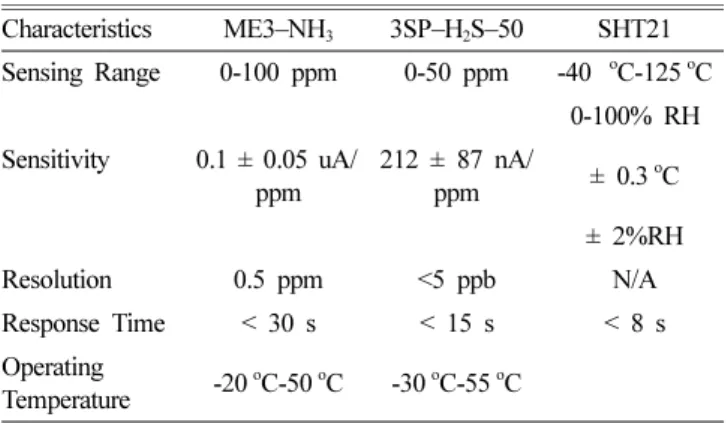
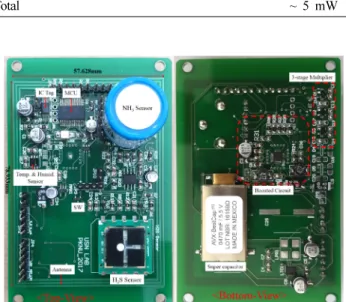
Food safety has emerged as a growing concern for human health in recent times. Consuming contaminated food may lead to serious health problems, and therefore, a system for monitoring food freshness that is both non-detrimental to the quality of food and highly accurate is required to ensure that only high-quality fresh food packages are provided to the customers. This paper proposes a method to monitor and detect food quality using a compact smart sensor tag. The smart tag is composed of three ultra-low-power sensors, which monitor four major indicators of food freshness: temperature, humidity, and the concentrations of ammonia and hydrogen sulfide gases.
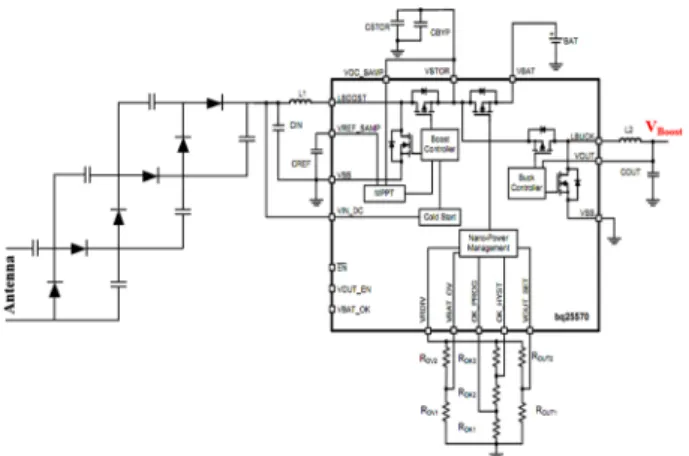
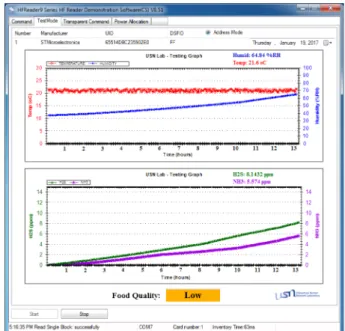
An RF energy scavenging circuit is integrated into the smart sensor tag to harvest energy from radio waves at a high frequency of 13.56 MHz to supply sufficient power to the tag. Experimental results show that the proposed energy harvester can efficiently obtain energy at a distance of approximately 40 cm from a 4 W reader. In addition, the proposed smart sensor tag can operate without any battery, thereby eliminating the requirement of frequent battery replacement and consequently decreasing the cost. Meanwhile, the freshness of preserved pork is continuously monitored under two conditions––room temperature and refrigerator temperature––both of which are the most common temperatures under which food is generally stored. The food-monitoring experiments are conducted over a period of one week using the proposed battery-less tag. Based on the experimental results, the food assessment is classified into four categories: fresh, normal, low, and spoiled.
Keywords: Chemical sensors, Ammonia Gas, Hydrogen Sulfide Gas, Food Freshness Monitoring, Battery-less, RF Energy Harvesting, RF Energy Scavenging
1. INTRODUCTION
Meat is one of the most common types of food consumed by humans every day. The freshness of meat has an influence on its flavor, taste, and nutritional value. As consuming spoiled meat may cause serious health issues, proper assessment and monitoring of meat freshness is essential to protect human health.
All foods have their own shelf life, which varies based on their type and storage conditions. Although different storage conditions, such as temperature, moisture, or light [1-3], do not exactly have any positive influence on the quality of food, they can prevent the deterioration of food quality, and hence, help to extend their shelf life. Until now, several methods have been proposed to determine the freshness of meat. Particularly in [4-5], the authors attempted
to clarify the methods and design an accurate system for monitoring meat freshness based on the changes in meat color or compounds during storage. These methods and systems, however, are bulky, expensive, and time-consuming, and therefore, are normally employed in food-safety agencies or laboratories rather than in supermarkets, stores, and customers’ homes. The freshness of meat deteriorates due to the growth of microorganisms, which convert the meat proteins into smaller compounds, resulting in the generation of gases such as ammonia (NH
3), hydrogen sulfide (H
2S), and H
2O [6-7]. Thus, there exists a clear relationship between meat freshness and changes in the concentrations of these gases. As a result, these concentrations can be employed as a real- time qualitative indicator of meat freshness during storage.
There are several devices that enable food-quality prediction, such as an electronic nose [8-9]. However, these solutions often require wired power supply or batteries for their operation, which increases the size of the system; moreover, frequent battery replacement leads to increase in system cost, which in turn, contributes to environmental pollution. Additionally, batteries, if subjected to negligent usage, can even cause an explosion. Recent application demands require devices that are small, easy to design, convenient to use, and harmless to users and the environment;
1
Department of Electronic Engineering, Pukyong National University, Busan 48513, South Korea
+