DOI: https://doi.org/10.7473/EC.2020.55.4.257
Characterization of Chlorinated NR using Pyrolytic Technique
Eunji Chae and Sung-Seen Choi
†Department of Chemistry, Sejong University, 209 Neungdong-ro, Gwangjin-gu, Seoul 05006, Republic of Korea (Received August 20, 2020, Revised August 31, 2020, Accepted September 7, 2020)
Abstract: Vehicle wiper blades are typically treated with chlorine to lower their friction coefficient with the windshield surface. In this study, a chlorinated, natural rubber (NR) vehicle wiper blade was characterized using a pyrolytic technique.
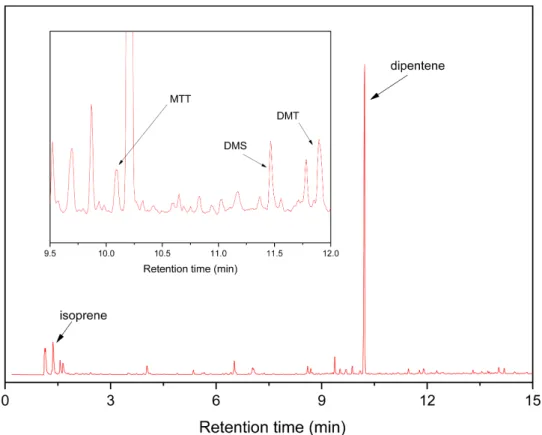
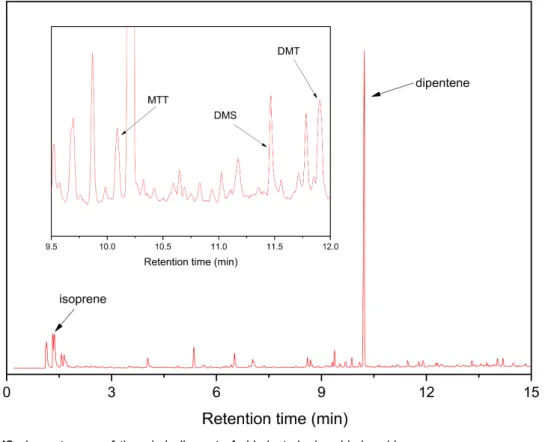
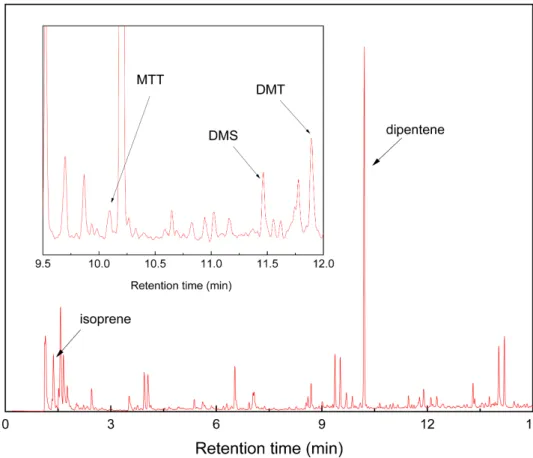
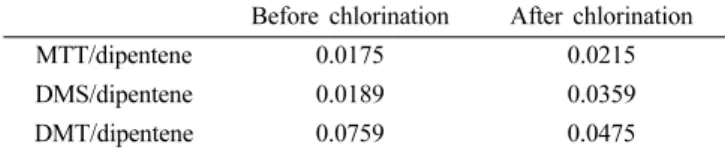
Unchlorinated and chlorinated wiper blades were pyrolyzed and the pyrolysis products were analyzed using gas chroma- tography/mass spectrometry (GC/MS). Besides isoprene and dipentene, the other principal pyrolysis products such as 1,5,8- p-menthatriene (MTT) and p,α-dimethylstyrene (DMS) were observed. The MTT and DMS ratios did not vary for the chlo- rinated nor unchlorinated samples when the entire rubber lip of the wiper blade was pyrolyzed. However, when only the lip surface of the wiper blade rubber was pyrolyzed (via scratching with a knife) the relative ratios of the chlorinated sample were much greater than those of the unchlorinated sample. As MTT is produced from the conjugated backbone of chlo- rinated NR that forms through HCl elimination during initial pyrolysis, and DMS is generated by the dehydrogenation of MTT, these two products could be used as markers for detecting chlorinated NR.
Keywords: wiper blade, Chlorinated NR, Py-GC/MS, 1,5,8-p-menthatriene, p,α-dimethylstyrene
Introduction
자동차 와이퍼 블레이드는 비 오는 날 중요한 자동차의 안 전 부품 중 하나로, 그 역할은 자동차 유리창 표면에 부착된 빗물, 오수, 눈, 먼지 등 시야를 방해하는 이물질을 제거하여 운전자의 안전을 확보하는데 있다.
1,2열, 햇빛, 오존의 영향을 받는 가혹한 조건에서도 자동차 와이퍼 블레이드의 형태가 유 지되고 사용 가능해야 한다. 와이퍼 블레이드의 가장 중요한 요구 특성인 닦임성은 고무 표면의 마모 저항에 의해서 큰 영 향을 받으며 마모나 오존 등에 의해서 저하될 수 있다.
와이퍼 블레이드 고무의 재료로 천연고무(NR)가 주로 사용 되고 있다.
1NR은 합성고무에 비해 햇빛, 오존, 산소, 오일 등 에 의해 쉽게 손상될 수 있다.
3NR의 내오존성과 내마모성을 보완하기 위해 클로로프렌 고무(chloroprene rubber, CR)나 스 티렌-부타디엔 고무(styrene-butadiene rubber, SBR)를 혼용해 서 사용하기도 한다.
1와이퍼 블레이드 고무의 표면 처리에 가 장 널리 이용하는 염소화(chlorination)는 고무의 마찰계수를 감소시킬 수 있는 간단하고 효율적인 방법이다.
1,3상온에서 수 분 동안 염소 용액에 담그는 것으로 표면을 염소화시킬 수 있다. 염소 용액은 차아염소산소듐(NaOCl)과 염산(HCl)을 위 주로 제조한다.
2-5식 (1)과 같은 NaOCl과 HCl의 반응에 의해 염소 가스(Cl
2)가 생성된다.
NaOCl + 2HCl → Cl
2+ H
2O + Na
++ Cl
(1) 염소화 과정은 치환, 첨가, 순환 공정을 수반하는 복잡한 메 커니즘으로 이루어지며, 불포화 탄화수소의 경우는 치환 반 응과 첨가 반응이 모두 일어날 수 있다.
6불포화 탄화수소의 염소화 과정은 주로 알릴 수소(allylic hydrogen)와의 치환 반 응을 통해 일어난다.
3염소 처리 전과 후의 고무 표면의 화학적 변화를 조사하기 위해 적외선분광법(IR)이나 접촉각 측정을 이용한다.
1,2,4,5비 충전 NR 필름을 IR 분석할 경우 염소화 후에 C-Cl과 관련된 3개의 특징적 봉우리(650 cm
1, 730 cm
1, 910 cm
1)가 나타 난다.
5하지만, 카본블랙으로 보강된 일반 고무 배합물의 경 우, 카본블랙에 의해 조사한 IR 파장이 대부분 흡수되어 IR 로 C-Cl 결합 여부를 제대로 분석하기 곤란하다.
4에틸렌 글 리콜(ethylene glycol)을 이용하여 염소 처리된 고무 표면의 접 촉각을 측정하면 처리 전과 비교하여 접촉각이 감소되는 것 을 볼 수 있다.
4하지만, 접촉각 측정으로는 직접적으로 염소 처리가 되었는지를 확인할 수는 없다.
IR과 접촉각 이외에 X-선 광전자 분광법(XPS)과 전자탐침 미량분석(EPMA)과 같은 표면 분석 방법을 이용하여 염소화 처리 여부를 평가하고 있다.
2,7NR 라텍스 필름을 염소화 처 리 후 XPS (Mg K
α(1253.6 eV) 사용)를 이용하여 분석할 경 우, 염소화 처리하지 않았을 때는 보이지 않던 Cl K
α봉우리 가 206 eV에서 나타난다.
7EPMA를 이용하여 와이퍼 블레이 드의 단면을 분석하면 염소의 침투 정도를 분석할 수 있다.
2†