• 검색 결과가 없습니다.

Pseudoaneurysm of Surgically Reconstructed Right Ventricular Outflow Tract Complicated by Superior Vena Cava Syndrome

N/A
N/A
Protected

Academic year: 2021

Share "Pseudoaneurysm of Surgically Reconstructed Right Ventricular Outflow Tract Complicated by Superior Vena Cava Syndrome"

Copied!
4
0
0

로드 중.... (전체 텍스트 보기)

전체 글

(1)

ISSN: 2233-601X (Print) ISSN: 2093-6516 (Online)

− 541 −

Department of Thoracic and Cardiovascular Surgery, Kyungpook National University School of Medicine

Received: August 5, 2014, Revised: September 23, 2014, Accepted: September 23, 2014, Published online: December 5, 2014

Corresponding author: Jong Tae Lee, Department of Thoracic and Cardiovascular Surgery, Kyungpook National University Hospital, Kyungpook National University School of Medicine, 130 Dongdeok-ro, Jung-gu, Daegu 700-721, Korea

(Tel) 82-53-420-5665 (Fax) 82-53-426-4765 (E-mail) [email protected]

C

The Korean Society for Thoracic and Cardiovascular Surgery. 2014. All right reserved.

CC
This is an open access article distributed under the terms of the Creative Commons Attribution Non-Commercial License (http://creative- commons.org/licenses/by-nc/3.0) which permits unrestricted non-commercial use, distribution, and reproduction in any medium, provided the original work is properly cited.

Pseudoaneurysm of Surgically Reconstructed Right Ventricular Outflow Tract Complicated by Superior Vena Cava Syndrome

Youngok Lee, M.D, Jong Tae Lee, M.D, Joon Yong Cho, M.D, Gun Jik Kim, M.D.

Pseudoaneurysm of the right ventricular outflow tract (RVOT) has been reported as a rare complication of RVOT reconstruction performed using conduit replacement or patch repair. Rarely, it may present alongside symptoms sec- ondary to the compression of adjoining mediastinal structures. We report the case of a patient who developed a symptomatic RVOT pseudoaneurysm one month after a total correction of tetralogy of Fallot. In the present case, superior vena cava syndrome was caused by compression of the superior vena cava, which was a very unusual presentation.

Key words: 1. Congenital heart disease (CHD) 2. Tetralogy of Fallot

3. Aneurysm, false

4. Superior vena cava syndrome

CASE REPORT

A 12-month-old girl underwent a complete repair of tetral- ogy of Fallot that included a ventricular septal defect closure and right ventricular outflow tract (RVOT) reconstruction. On the preoperative echocardiogram, the pulmonary annular Z score was -4.5. RVOT reconstruction was performed with an infundibulectomy, infundibular patch enlargement, pulmonary valvotomy, and pulmonary angioplasty. A thin walled Gore- Tex (W.L. Gore and Associates, Flagstaff, AZ, USA) vas- cular graft was used as the material for an infundibular patch, which was attached to the RVOT with a continuous 6-0 poly- propylene (Surgipro; Covidien, Mansfield, MA, USA) running suture.

On intraoperative transesophageal echocardiography, the pulmonary valve residual pressure gradient was 49 mmHg

and systolic pressure ratio between the right and left ven- tricles was 0.8 mmHG. However, we could not place a trans- annular patch because the patient had an anomalous coronary artery crossing the RVOT. The left anterior descending artery originated from the right coronary artery crossing the RVOT (Fig. 1). Therefore, we did not continue the procedure and treated the patient with a beta-blocker. Her postoperative course was uneventful, and she was discharged on post- operative day six.

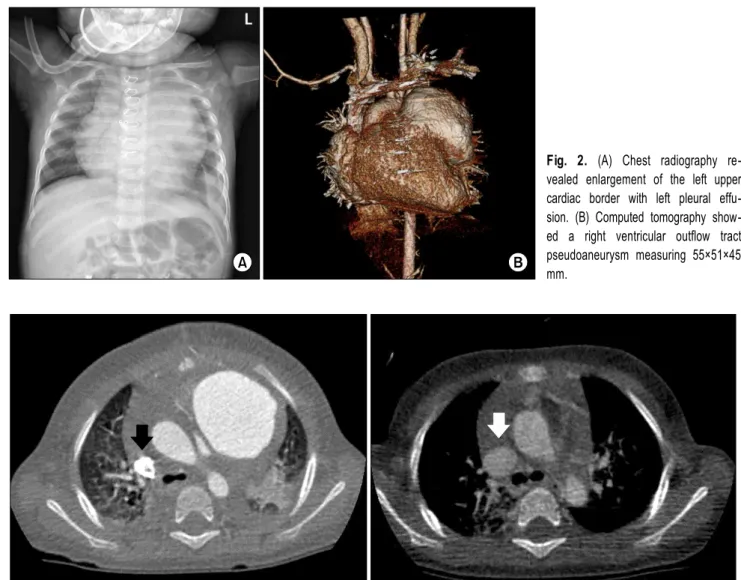
One month later, the patient was readmitted to Kyungpook National University Hospital complaining of cough, shortness of breath, and facial and upper extremity oedema over the previous three days. Chest radiography revealed enlargement of the left upper cardiac border with a left pleural effusion (Fig. 2A). In addition, transthoracic echocardiography showed a large aneurysmal dilatation of the RVOT with narrowing of

Korean J Thorac Cardiovasc Surg 2014;47:541-544 □ Case Report □

http://dx.doi.org/10.5090/kjtcs.2014.47.6.541

(2)

Youngok Lee, et al

− 542 − Fig. 1. An abnormal coronary artery is shown crossing the right ventricular outflow tract.

Fig. 2. (A) Chest radiography re- vealed enlargement of the left upper cardiac border with left pleural effu- sion. (B) Computed tomography show- ed a right ventricular outflow tract pseudoaneurysm measuring 55×51×45 mm.

Fig. 3. Computed tomography showed a narrowed superior vena cava compared with the previous image.

the superior vena cava and main pulmonary artery, secondary to compression by the aneurysm. Colour Doppler images re- vealed decreased blood flow in the superior vena cava.

Computed tomography (CT) showed a narrow communication between the RVOT and an aneurysmal sac. Through these findings, we confirmed an RVOT pseudoaneurysm measuring 55×51×45 mm (Fig. 2B). The superior vena cava was narrow compared to previous CT imaging (Fig. 3).

Because of the risk of a spontaneous rupture, we elected to

perform emergency surgery. A careful median resternotomy

was performed. A large serous pericardial and pleural effu-

sion was present around the RVOT. Under cardiopulmonary

bypass, the aneurysmal sac was opened, revealing patch de-

(3)

Pseudoaneurysm of Surgically Reconstructed Right Ventricular Outflow Tract

− 543 − hiscence at the proximal suture line between the infundibular patch and the ventriculotomy site. Communication between the RVOT and the pseudoaneurysm was confirmed, and the previous infundibular patch and all aneurysmal tissue were excised. Another RVOT reconstruction was performed using the same method and type of infundibular patch. However, in this procedure, the infundibular patch was attached to the RVOT with multiple interrupted pledgeted mattress sutures as well as full-thickness bites in the suturing of the right ven- tricular wall. Intraoperative transesophageal echocardiography showed residual pulmonary stenosis (pressure gradient, 36 mmHg) and normal right ventricular systolic function. The patient’s postoperative course was uneventful, and both her fa- cial and upper extremity oedema improved. She was discharged on postoperative day 10. Postoperative transthoracic echocardio- graphy, performed eight months after the reoperation, showed residual pulmonary stenosis (pressure gradient, 36 mmHg) with- out any indication of the development of an aneurysm.

DISCUSSION

Pseudoaneurysm of the RVOT is an infrequent complica- tion of cardiovascular surgical procedures that involve both a right ventriculotomy and RVOT reconstruction with patch re- pair or conduit replacement [1-3]. The pathogenesis and aeti- ology of pseudoaneurysms have been described as related ei- ther to obstructive RVOT or to elevated right ventricular sys- tolic pressure, leading to mechanical strain at the proximal suture line. However, other contributing factors such as pul- monary insufficiency, suture material and technique, trauma, complete heart block, and infection have also been implicated [1-3]. Regardless of the aetiology, a pseudoaneurysm arises from the small dehiscence of a portion of the reconstructed RVOT, permitting blood leakage into the surrounding space and resulting in a pericardial haematoma [1-4]. In this case, the pseudoaneurysm may have been caused by residual RVOT obstruction, especially because of inappropriate suture techniques, such as continuous running sutures and parti- al-thickness sutures in the right ventricular wall. Follow-up transthoracic echocardiography, performed eight months after reoperation, showed no aneurysmal changes in the RVOT.

Pseudoaneurysms may remain asymptomatic and are found incidentally during regular follow-up examinations [2,3]. How- ever, pseudoaneurysms progressively increase in size and may present, albeit rarely, alongside symptoms secondary to the compression of adjoining mediastinal structures, rupture, thro- mboembolism, and infection [1-4]. In the present case, superi- or vena cava syndrome was caused by compression of the su- perior vena cava, which was a very unusual presentation.

Transthoracic echocardiography has been reported as a reli- able method for diagnosing pseudoaneurysms [1-4]. However, it does not provide detailed information about the anatomical relationship between the pseudoaneurysm and surrounding structures. We found CT to be very helpful in evaluating the location and size of the pseudoaneurysm and determining its anatomical relationships. CT was also useful in evaluating the safety of performing another sternotomy in light of the possi- ble need for femoral or neck vessel cannulation before anoth- er sternotomy. Preoperative magnetic resonance imaging may also provide information helpful in choosing the best surgical approach [5]. However, magnetic resonance imaging is more time-consuming than CT, and is difficult to perform in hae- modynamically unstable patients.

Compared to true aneurysms, pseudoaneurysms pose an in- creased risk of rupture because of the absence of myocardial tissue in their walls [3]. Therefore, they are potentially life threatening if not treated. Once diagnosed, pseudoaneurysms require either reoperation or another intervention.

In conclusion, a pseudoaneurysm in a surgically re- constructed RVOT is a rare but potentially fatal complication.

It should always be suspected in patients with the relevant symptoms, and such patients must be followed up closely.

Precise and careful preoperative assessment, using echo- cardiography and CT, is important for ensuring the safety of surgery performed on these patients. Reoperation can be per- formed safely, with low risk of mortality or morbidity.

CONFLICT OF INTEREST

No potential conflict of interest relevant to this article was

reported.

(4)

Youngok Lee, et al

− 544 − ACKNOWLEDGMENTS

This research was sponsored by Kyungpook National University Research Fund, 2012.

REFERENCES

1. Sah S, Berdjis F, Valdez S, Gates R. Pseudoaneurysm of surgically reconstructed right ventricular outflow tract. World J Pediatr Congenit Heart Surg 2013;4:116-9.

2. Pillai SK, Reddy HP, Kulkarni S, Murthy KS, Cherian KM.

Pseudoaneurysm of homograft placed in right ventricular outflow tract. Ann Thorac Surg 2004;78:1068-70.

3. Antal AD, Cikirikcioglu M, Myers PO, Didier D, Kalangos A. Respiratory distress after surgery of RVOT pathologies: a word of caution on pseudoaneurysm development. Thorac Cardiovasc Surg 2010;58:356-8.

4. Calabro R, Santoro G, Pisacane C, Pacileo G, Russo MG, Vosa C. Repeat syncopal attacks due to postsurgical right ventricular pseudoaneurysm. Ann Thorac Surg 1999;68:252-4.

5. Murashita T, Hatta E, Imamura M, Yasuda K. Giant pseu-

doaneurysm of the right ventricular outflow tract after repair

of truncus arteriosus: evaluation by MR imaging and surgi-

cal approach. Eur J Cardiothorac Surg 2002;22:849-51.

수치

Fig. 3. Computed tomography showed a narrowed superior vena cava compared with the previous image.

참조

관련 문서