JCSJournal of Chest Surgery
Clinical Research Changes in the Prosthesis Types Used for Aortic Valve
Replacement after the Introduction of Sutureless and Rapid Deployment Valves in Korea: A Nationwide Population-Based Cohort Study
Hyeok Sang Woo, M.D.1, Ho Young Hwang, M.D., Ph.D.1, Ho Jin Kim, M.D.2, Joon Bum Kim, M.D., Ph.D.2, Sak Lee, M.D., Ph.D.3, Cheong Lim, M.D., Ph.D.4, Byung-Cheul Chang, M.D., Ph.D.5, Na Rae Lee, Ph.D.6, Youshin Suh, M.S.6, Jae Woong Choi, M.D., Ph.D.1
1Department of Thoracic and Cardiovascular Surgery, Seoul National University Hospital; 2Department of Thoracic and Cardiovascular Surgery, Asan Medical Center, University of Ulsan College of Medicine; 3Department of Thoracic and Cardiovascular Surgery, Severance Cardiovascular Hospital, Seoul; 4Department of Thoracic and Cardiovascular Surgery, Seoul National University Bundang Hospital, Seoul National University College of Medicine; 5Department of Thoracic and Cardiovascular Surgery, CHA Bundang Medical Center, CHA University, Seongnam; 6National Evidence-based Healthcare Collaborating Agency, Seoul, Korea
ARTICLE INFO
Received April 23, 2021 Revised June 26, 2021 Accepted July 14, 2021 Corresponding author Jae Woong Choi Tel 82-2-2072-4069 Fax 82-2-762-3566
E-mail [email protected] ORCID
https://orcid.org/0000-0002-0921-756X
Background: Sutureless and rapid deployment valves for aortic valve replacement (AVR) were introduced in Korea in December 2016. This study evaluated changing trends in the prosthetic valves used for AVR in Korea after the introduction of sutureless and rapid de- ployment valves.
Methods: From December 2016 to December 2018, 4,899 patients underwent AVR in Korea. After applying the exclusion criteria, 4,872 patients were analyzed to determine changes in the type of prosthetic valve used for AVR. The study period was divided into 5 groups corresponding to 5-month intervals.
Results: The total number of AVR cases was 194.88±28.78 per month during the study pe- riod. Mechanical valves were used in approximately 27% to 33% of cases, and the propor- tion of mechanical valve use showed a tendency to decrease, with marginal significance overall (p=0.078) and significant decreases in patients less than 60 years of age and in men (p=0.013 and p=0.023, respectively). The use of sutureless valves increased from 13.4% to 25.8% of cases (p<0.001), especially in elderly patients (>70 years) and those requiring con- comitant surgery. In a comparison between sutureless and rapid deployment valves, the use of Perceval S valves (a type of sutureless valve), gradually increased (p<0.001).
Conclusion: After the introduction of sutureless and rapid deployment valves in Korea, the rate of use of these new valves remarkably increased, especially in elderly patients and those requiring concomitant surgery. Further studies should investigate the clinical outcomes of these new prostheses.
Keywords: Aortic valve surgery, Korea, Rapid deployment valve, Sutureless valve, Trends
Copyright©2021, The Korean Society for Thoracic and Cardiovascular Surgery
This is an Open Access article distributed under the terms of the Creative Commons Attribution Non-Commercial License (http://creativecommons.org/licenses/
Introduction
Although surgical aortic valve replacement (AVR) is the standard treatment for aortic valve disease, there have been some limitations in applying conventional AVR in all pa- tients. Recently, transcatheter aortic valve implantation has been used for intermediate- and high-risk patients [1,2], and sutureless (or rapid deployment) AVR (SuAVR) has
also gained attention as a new alternative option for high- risk patients [3-5].
SuAVR involves a short aortic cross-clamp (ACC) time, since suture placement is not required, and enables straightforward implantation in limited surgical fields [6].
Currently, 2 types of sutureless aortic valves are available:
The Edwards Intuity Elite valve system (Intuity valve; Ed- wards Lifesciences, Irvine, CA, USA) and the Perceval S
https://doi.org/10.5090/jcs.21.033 pISSN: 2765-1606 eISSN: 2765-1614 J Chest Surg. 2021;54(5):369-376
https://doi.org/10.5090/jcs.21.033
JCS
valve (Perceval valve; LivaNova, London, UK). The Intuity valve system obtained the Conformité Européenne (CE) mark in 2012, and received Food and Drug Administration (FDA) approval in 2016 [7]. The Perceval valve obtained the CE mark and received FDA approval in 2011 and 2016, respectively [8]. In Korea, interest in sutureless valve sys- tems has increased since December 2016, when the Korean National Health Insurance Service (NHIS) began covering these valves.
Several other studies have explored national trends in valve use for AVR; the frequency of using mechanical valves has decreased, and the use of bioprosthetic valves has increased [9-13]. However, there are few studies with relatively recent national data on valve use for AVR sur- gery. In particular, limited data have been reported on na- tional trends in the types of prosthetic valves used for AVR since sutureless valves were introduced. Therefore, this study aimed to analyze the changing trends in the types of valves used in Korea after the introduction of the suture- less aortic valve.
Methods
Data source and patient characteristics
Data for the present study was obtained from the claims database of the Korean NHIS, which is a single insurer covering the entire Korean population that is managed by the government. The NHIS provides healthcare insurance coverage to the vast majority (>97%) of residents in Korea [14,15]. From December 2016, when SuAVR was approved for insurance coverage, to December 2018, 4,899 patients who underwent AVR using conventional prosthetic valves or sutureless aortic prostheses were identified based on the procedure codes of the Korean NHIS (O1793: aortic valve replacement, O1799: sutureless aortic valve replacement).
Excluding 23 patients who were under the age of 19 and 4 patients for whom age data were not available, a total of 4,872 patients were enrolled in this study (Table 1).
The patients were divided into 4 groups according to age (19–59, 60–69, 70–79, and 80 years or older). There were 1,114 patients (22.9%) aged 19–59, 1,434 patients (29.4%) aged 60–69, 1,774 patients (36.4%) aged 70–79, and 550 pa- tients (11.3%) aged 80 or older. Combined surgery was de-
Table 1. Patient characteristics
Characteristic Total (n=4,872) Mechanical valve
(n=1,493)
Bioprosthetic valve
(n=3,379) p-value
Age (yr)
19–59 1,114 (22.9) 927 (62.1) 187 (5.5) <0.001
60–69 1,434 (29.4) 505 (33.8) 929 (27.5) <0.001
70–79 1,774 (36.4) 58 (3.9) 1,716 (50.8) <0.001
>80 550 (11.3) 3 (0.2) 547 (16.2) <0.001
Male 2,800 (57.4) 936 (62.7) 1,864 (55.2) <0.001
Combined operation 2,250 (46.2) 789 (52.8) 1,461 (43.2) <0.001
Tricuspid valve 417 (8.6) 190 (12.7) 227 (6.7) <0.001
Mitral valve 847 (17.4) 409 (27.4) 438 (13.0) <0.001
Arrhythmia 534 (11.0) 229 (15.3) 305 (9.0) <0.001
Aorta 774 (15.9) 260 (17.4) 514 (15.2) 0.052
Coronary artery bypass grafting 645 (13.2) 108 (7.2) 537 (15.9) <0.001
History of diseases
Cancer 537 (11.0) 106 (7.1) 431 (12.8) <0.001
Hypertension 4,076 (83.7) 1,138 (76.2) 2,938 (86.9) <0.001
Dyslipidemia 3,548 (72.8) 959 (64.2) 2,589 (76.6) <0.001
Chronic obstructive pulmonary disease 2,358 (48.4) 625 (41.9) 1,733 (51.3) <0.001
Cerebrovascular disease 1,054 (21.6) 221 (14.8) 833 (24.7) <0.001
Peripheral vascular disease 1,587 (32.6) 398 (26.7) 1,189 (35.2) <0.001
Kidney disease 946 (19.4) 252 (16.9) 694 (20.5) 0.003
Congestive heart failure 2,633 (54.0) 768 (51.4) 1,865 (55.2) 0.015
Diabetes mellitus 2,243 (46.0) 601 (40.3) 1,642 (48.6) <0.001
Liver disease 1,388 (28.5) 410 (27.5) 978 (28.9) 0.291
Values are presented as number (%).
Hyeok Sang Woo, et al. Sutureless and Rapid Deployment Valves for Aortic Valve Prosthesis JCS
fined as the concomitant presence of the appropriate treat- ment code for tricuspid valve surgery, mitral valve surgery, arrhythmia surgery, aortic surgery, and coronary artery bypass grafting. A combined operation was performed in 2,250 patients (46.2%), including mitral valve surgery (n=847, 17.4%) and aorta surgery (n=774, 15.7%). To evalu- ate trends in the use of specific prosthetic valve types, the study period was divided into 5 groups corresponding to 5-month intervals.
Statistical analysis
Statistical analyses were performed using IBM SPSS ver.
26.0 (IBM Corp., Armonk, NY, USA). Data were expressed as the mean±standard deviation or proportions. The Kolmogorov-Smirnov test was used to confirm the nor- mality of the test data. The chi-square test or Fisher exact test for categorical variables and the Student t-test for con- tinuous variables were used to make comparisons between the 2 groups. The number of samples was too small to per- form normality testing by period, so normality testing was conducted by month. The Cochran-Armitage test was used to analyze trends in the proportion of prosthetic valves used. A p-value <0.05 was used as the threshold for statisti- cal significance, and a p-value ≥0.05 but <0.1 was consid- ered to indicate marginal significance.
This study was reviewed and approved by the Institu- tional Review Board of the National Evidence-based Healthcare Collaborating Agency (approval no., NECA IRB 19-006). The requirement for informed consent from individual patients was omitted since it was to be conduct-
ed on existing anonymous data from previous years.
Results
Overall trends of aortic valve replacement by prosthesis valve type
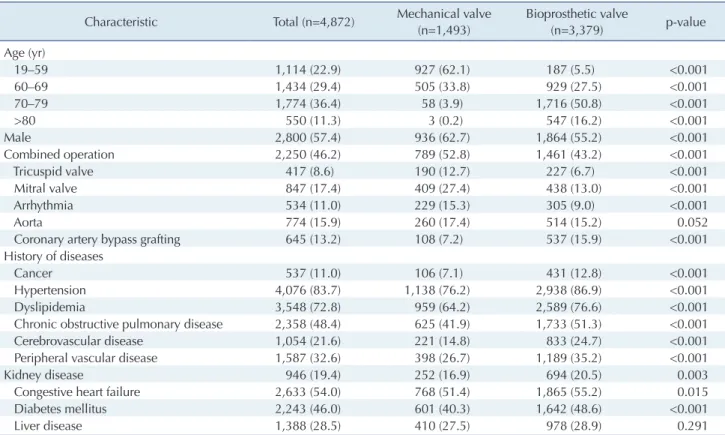
Fig. 1 shows the monthly trends in the types of prosthe- sis valves used for AVR for 25 months. Among the 4,872 patients, 1,493 patients (30.6%) underwent AVR with a me- chanical valve and 3,379 patients (69.4%) underwent AVR with a bioprosthetic valve. The number of total AVR cases per month was 194.88±28.78. The numbers of bioprosthet- ic and mechanical AVR cases were 135.16±22.19 and 59.72±11.16, respectively. In groups divided into 5-month period, although the number of AVR procedures decreased from 1,006 cases (20.6%) in the first period to 901 cases (18.5%) in the last period, there was no significant change in the total number of AVR cases (p=0.20). Mechanical valves were used in 27% to 33% of cases, and the propor- tion of mechanical valves showed a tendency to decrease with marginal significance (p=0.078) (Table 2, Fig. 2).
For the groups divided by age, the use of mechanical valves significantly decreased in patients <60 years of age (p=0.013), whereas there were no significant changes in the proportion of cases that used mechanical or bioprosthetic valves in patients who were ≥60 years of age (Table 2). The proportion of mechanical valves used in men ranged from 29% to 37%, and the proportion significantly decreased throughout the study period (p=0.023) (Table 2).
160 140 120 100 80 60 40 20
2016 Dec 2017
Jan 2017
Feb 2017
Mar 2017
Apr 2017
May 2017
Jun 2017
Jul 2017
Aug 2017
Sep 2017
Oct 2017
Nov 2017
Dec 2018
Jan 2018
Feb 2018
Mar 2018
Apr 2018
May 2018
Jun 2018
Jul 2018
Aug 2018
Sep 2018
Oct 2018
Nov 2018
Dec
No.ofAVRcases
0
CAVR with mechanical valve CAVR with tissue valve SuAVR with Perceval S.
SuAVR with Intuity
Period
Fig. 1. Number of aortic valve re- placement (AVR) procedures ac- cording to valve type. CAVR, con- ventional aortic valve replacement;
SuAVR, sutureless (or rapid deploy- ment) aortic valve replacement.
https://doi.org/10.5090/jcs.21.033
JCS
Trends of sutureless valve utilization
Among the 3,379 patients who underwent AVR with a
bioprosthetic valve, 686 patients (20.3%) underwent suture- less AVR. Intuity valves were used in 439 patients (64.0%), while Perceval valves were used in 247 patients (36.0%).
Conventional bioprosthetic valves were frequently used in patients aged 60–69 years, patients with liver disease, and patients requiring concomitant surgery. Sutureless valves were preferred in patients over 80 years old (Table 3).
The proportion of sutureless AVR to total bioprosthetic AVR was around 13.4%–25.8% in the groups divided by 5-month period. The proportion of sutureless AVR dra- matically increased from 13.4% in the first period to 25.8%
in the last period (p<0.001) (Table 4, Fig. 2). The use of Per- ceval valves significantly increased from 23.1% to 45.0%, while the use of Intuity valves significantly decreased from 76.9% to 55.0% during the study period (p<0.001).
In the 1,461 patients (43.2%) who underwent concomi- tant procedures, the use of sutureless valves significantly increased from 10.9% in the first period to 21.8% in the last period (p<0.001). There were no significant changes in the proportion of the use of sutureless aortic valves in patients
<70 years of age, but the use of sutureless valves increased significantly in patients ≥70 years of age (Table 4). In par- ticular, the use of sutureless valves increased from 18.8% to 27.4% in patients who were older than 80 years of age.
When comparing the use of the Perceval and Intuity valves, the use of the Perceval valve in patients aged 70–79 Table 2. Trends in prosthetic valve types in aortic valve replacement
Variable Total Dec 2016–
Apr 2017
May 2017–
Sep 2017
Oct 2017–
Feb 2018
Mar 2018–
Jul 2018
Aug 2018–
Dec 2018 p-value Total (n=4,872)
Overall 4,872 (100.0) 1,006 (20.6) 956 (19.6) 912 (18.7) 1,097 (22.5) 901 (18.5) 0.200a) Mechanical valve 1,493 (30.6) 327 (32.5) 306 (32.0) 282 (30.9) 297 (27.1) 281 (31.2) 0.078
Bioprosthetic valve 679 (67.5) 650 (68.0) 630 (69.1) 800 (72.9) 620 (68.8)
Male (n=2,800) 3,379 (69.4) 0.023
Mechanical valve 936 (33.4) 206 (35.2) 206 (37.4) 172 (33.9) 184 (28.8) 168 (32.6)
Bioprosthetic valve 380 (64.8) 345 (62.6) 336 (66.1) 456 (71.3) 347 (67.4)
Age 19–59 yr (n=1,114) 1,864 (66.6) 0.013
Mechanical valve 927 (83.2) 193 (86.2) 214 (87.7) 174 (82.1) 178 (78.4) 168 (81.2)
Bioprosthetic valve 31 (13.8) 30 (12.3) 38 (17.9) 49 (21.6) 39 (18.8)
Age 60–69 yr (n=1,434) 187 (16.8) 0.975
Mechanical valve 505 (35.2) 119 (40.6) 81 (28.5) 97 (35.1) 105 (33.1) 103 (39.0)
Bioprosthetic valve 174 (59.4) 203 (71.5) 179 (64.9) 212 (66.9) 161 (61.0)
Age 70–79 yr (n=1,774) 929 (64.8) 0.513
Mechanical valve 58 (3.3) 14 (3.6) 11 (3.3) 11 (3.6) 12 (2.9) 10 (2.9)
Bioprosthetic valve 373 (96.4) 319 (96.7) 291 (96.4) 402 (97.1) 331 (97.1)
Age >80 yr (n=550) 1,716 (96.7) 0.972
Mechanical valve 3 (0.5) 1 (1.0) 0 0 2 (1.4) 0
Bioprosthetic valve 547 (99.5) 101 (99.0) 98 (100.0) 122 (100.0) 137 (98.6) 89 (100.0) Values are presented as number (%).
a)p-values of normality testing for the overall number of aortic valve replacement procedures were calculated monthly, not periodically.
Fig. 2. Proportion of aortic valve replacements (AVRs) in 5-month periods according to valve type. CAVR, conventional aortic valve replacement; SuAVR, sutureless (or rapid deployment) aortic valve replacement.
100 90 80 70 60 50 40 30 20 10
2016 Dec
2017 Apr
2017 May
2017 Sep
2017 Oct
2018 Feb
2018 Mar
2018 Jul
2018 Aug
2018 Dec
AVR(%)
Period 0
SuAVR
CAVR with tissue valve CAVR with mechanical valve
Hyeok Sang Woo, et al. Sutureless and Rapid Deployment Valves for Aortic Valve Prosthesis JCS
Table 3. Characteristics of patients who received bioprosthetic valves Variable
Conventional bioprostheses
(n=2,693)
Sutureless or RD valves (n=686)
Intuity (n=439)
Perceval
(n=247) p-valuea) p-valueb) Age (yr)
19–59 152 (5.6) 35 (5.1) 29 (6.6) 6 (2.4) 0.579 0.017
60–69 766 (28.4) 163 (23.8) 118 (26.9) 45 (18.2) 0.014 0.011
70–79 1,378 (51.2) 338 (49.3) 201 (45.8) 137 (55.5) 0.375 0.015
>80 390 (14.5) 150 (21.9) 91 (20.7) 59 (23.9) <0.001 0.337
Male 1,500 (55.7) 364 (53.1) 246 (56.0) 118 (47.8) 0.215 0.037
Combined operation 1,221 (45.3) 240 (35) 165 (37.6) 75 (30.4) <0.001 0.057
Tricuspid valve 188 (7.0) 39 (5.7) 17 (3.9) 22 (8.9) <0.001 0.006
Mitral valve 382 (14.2) 56 (8.2) 39 (8.9) 17 (6.9) <0.001 0.358
Arrhythmia 260 (9.7) 45 (6.6) 33 (7.5) 12 (4.9) 0.012 0.177
Aorta 452 (16.8) 62 (9.0) 59 (13.4) 3 (1.2) <0.001 <0.001
CABG 440 (16.3) 97 (14.1) 55 (12.5) 42 (17.0) 0.016 0.106
History of diseases
Cancer 350 (13.0) 81 (11.8) 52 (11.8) 29 (11.7) 0.405 0.968
Hypertension 2,336 (86.7) 602 (87.8) 386 (87.9) 216 (87.4) 0.483 0.855
Dyslipidemia 2,056 (76.3) 533 (77.7) 346 (78.8) 187 (75.7) 0.232 0.348
COPD 1,385 (51.4) 348 (50.7) 216 (49.2) 132 (53.4) 0.743 0.286
Cerebrovascular disease 651 (24.2) 182 (26.5) 120 (27.3) 62 (25.1) 0.201 0.525
Peripheral vascular disease 965 (35.8) 224 (32.7) 147 (33.5) 77 (31.2) 0.119 0.536
Kidney disease 558 (20.7) 136 (19.8) 73 (16.6) 63 (25.5) 0.604 0.005
Congestive heart failure 1,479 (54.9) 386 (56.3) 236 (53.8) 150 (60.7) 0.526 0.077
Diabetes mellitus 1,304 (48.4) 338 (49.3) 204 (46.5) 134 (54.3) 0.691 0.050
Liver disease 808 (30.0) 170 (24.8) 112 (25.5) 58 (23.5) 0.007 0.554
Values are presented as number (%).
RD, rapid deployment; CABG, coronary artery bypass grafting; COPD, chronic obstructive pulmonary disease.
a)Comparisons between conventional bioprostheses and sutureless and RD valves. b)Comparisons between Intuity and Perceval.
Table 4. Trends in bioprosthetic valves by patient characteristics
Variable Total Dec 2016–
Apr 2017
May 2017–
Sep 2017
Oct 2017–
Feb 2018
Mar 2018–
Jul 2018
Aug 2018–
Dec 2018 p-value
Total (n=3,379) <0.001
Conventional bioprostheses 2,693 (79.7) 588 (86.6) 520 (80.0) 495 (78.6) 630 (78.8) 460 (74.2) Sutureless or rapid deployment valves 686 (20.3) 91 (13.4) 130 (20.0) 135 (21.4) 170 (21.3) 160 (25.8)
Perceval S 247 (36.0) 21 (23.1) 38 (29.2) 48 (35.6) 68 (40.0) 72 (45.0) <0.001
Intuity 439 (64.0) 70 (76.9) 92 (70.8) 87 (64.4) 102 (60.0) 88 (55.0)
Combined procedure (n=1,461) <0.001
Conventional bioprostheses 1,221 (83.6) 253 (89.1) 236 (85.5) 229 (81.5) 309 (83.1) 194 (78.2) Sutureless or rapid deployment valves 240 (16.4) 31 (10.9) 40 (14.5) 52 (18.5) 63 (16.9) 54 (21.8)
Age 19–59 yr (n=1,114) 0.250
Conventional bioprostheses 152 (81.3) 26 (83.9) 25 (83.3) 32 (84.2) 41 (83.7) 28 (71.8) Sutureless or rapid deployment valves 35 (18.7) 5 (16.1) 5 (16.7) 6 (15.8) 8 (16.3) 11 (28.2)
Age 60–69 yr (n=1,434) 0.287
Conventional bioprostheses 766 (82.5) 151 (86.8) 164 (80.8) 148 (82.7) 171 (80.7) 132 (82.0) Sutureless or rapid deployment valves 163 (17.5) 23 (13.2) 39 (19.2) 31 (17.3) 41 (19.3) 29 (18.0)
Age 70–79 yr (n=1,774) <0.001
Conventional bioprostheses 1,378 (80.3) 329 (88.2) 258 (80.9) 226 (77.7) 322 (80.1) 243 (73.4) Sutureless or rapid deployment valves 338 (19.7) 44 (11.8) 61 (19.1) 65 (22.3) 80 (19.9) 88 (26.6)
Age >80 yr (n=550) 0.007
Conventional bioprostheses 397 (72.6) 82 (81.2) 73 (74.5) 89 (73.0) 96 (70.1) 57 (64.0) Sutureless or rapid deployment valves 150 (27.4) 19 (18.8) 25 (25.5) 33 (27.0) 41 (29.9) 32 (36.0) Values are presented as number (%).
https://doi.org/10.5090/jcs.21.033
JCS
years (p=0.007) and ≥80 years (p=0.009) showed signifi- cant increases.
Discussion
There were 3 main findings of this study. First, the fre- quency of using mechanical valves in the aortic position declined. Second, the frequency of using sutureless or rapid deployment aortic valves significantly increased in patients aged >70 years or patients who required a concomitant procedure. Third, the frequency of using Perceval valves steadily increased, whereas the proportion of cases using Intuity valves decreased.
During the study period, the frequency of using me- chanical valves decreased with marginal significance. In particular, the use of mechanical valves in patients under 60 years of age significantly decreased from 86.2% to 81.2%. The age criteria for valve selection between me- chanical and tissue valves depend on patients’ lifestyle and choices, and the indications for using bioprosthetic valves have been expanded [16-21]. The latest guidelines pub- lished in 2020 suggested that for patients between 50 and 65 years of age who require AVR, individualizing the choice of a mechanical or bioprosthetic valve prosthesis based on patient factors and after informed shared deci- sion-making would be rational [21]. In addition, improve- ments in the technology of valve-in-valve transcatheter AVR could increase the number of patients who choose a bioprosthetic valve [22].
This study confirmed that the use of sutureless and rapid deployment valves has gradually increased after these new types of prostheses were introduced in Korea. In particu- lar, the use of sutureless and rapid deployment valves in- creased remarkably in patients over 70 years of age and those who required concomitant surgery. According to a previous meta-analysis, using a sutureless or rapid deploy- ment valve can reduce the ACC time and cardiopulmonary bypass (CPB) time by approximately 25 minutes [6]. Be- cause prolonged ACC and CPB times are associated with increased morbidity and mortality [23,24], surgeons may prefer to use a sutureless or rapid deployment valve for high-risk patients with other cardiac diseases. Considering the growth of the aging population and increasing demand for minimally invasive surgery, the use of sutureless or rap- id deployment valves is expected to increase in the future.
In addition, many recent studies have reported good mid- and long-term clinical outcomes of sutureless and rapid deployment valves in terms of safety, efficacy, hemody- namic performance, and durability [4,5,25,26].
When comparing sutureless (Perceval) valves with rapid deployment (Intuity) valves during the study period, the use of sutureless valves was seen to increase, whereas the use of rapid deployment valves decreased. In the first peri- od, the use of rapid deployment valves was 3.3 times more common than the use of sutureless valves. However, the use of sutureless valves gradually increased and reached a similar level as that of rapid deployment valves in the most recent period. These trends are related to the characteris- tics of the 2 valves. At first, the rapid deployment valve may seem more familiar to surgeons because the valve is combined with a preexisting valve (Carpentier-Edwards Perimount Magna Ease) with a sub-annular frame and can be inserted through aortotomy, which is usually used for conventional AVR. In the same context, sutureless valves require higher aortotomy, which could be a barrier to inex- perienced surgeons. However, the additional benefit of the sutureless valve in high-risk patients who have small sino- tubular junctions or aortic root calcification might have contributed to the increased use of this valve.
The present study has several limitations. First, although the surgical approach used depends on the choice of the prosthetic valve type, data on the surgical approach were not analyzed. Second, this study was designed to collect insurance claims data after sutureless valves were intro- duced to clinical practice. Since data were not collected on the use of prostheses before the introduction of sutureless valves, a comparison of the use of prostheses before and after the introduction of sutureless valves could not be made. Third, although the pathophysiology of the aortic valve (regurgitation or stenosis) and some anatomical fac- tors, such as leaflet status or dilated sinus of Valsalva, are commonly considered in valve selection, this claim data were impossible to obtain; likewise, it was not possible to analyze data related to echocardiography or computed to- mography. Therefore, the specific indications of each valve were not considered when analyzing trends in prosthesis use in this study.
Conflict of interest
No potential conflict of interest relevant to this article was reported.
Funding
This work was supported by the National Evidence-based Healthcare Collaborating Agency (grant no., NR19-002).
Hyeok Sang Woo, et al. Sutureless and Rapid Deployment Valves for Aortic Valve Prosthesis JCS
ORCID
Hyeok Sang Woo: https://orcid.org/0000-0003-4967-6004 Ho Young Hwang: https://orcid.org/0000-0002-8935-8118 Ho Jin Kim: https://orcid.org/0000-0002-0809-2240 Joon Bum Kim: https://orcid.org/0000-0001-5801-2395 Sak Lee: https://orcid.org/0000-0001-6130-2342 Cheong Lim: https://orcid.org/0000-0003-0913-7014 Byung-Cheul Chang: https://orcid.org/0000-0001-5005-8217 Na Rae Lee: https://orcid.org/0000-0001-6155-9906 Youshin Suh: https://orcid.org/0000-0002-2966-7904 Jae Woong Choi: https://orcid.org/0000-0002-0921-756X
References
1. Singh K, Bhalla AS, Qutub MA, Carson K, Labinaz M. Systematic review and meta-analysis to compare outcomes between intermedi- ate- and high-risk patients undergoing transcatheter aortic valve im- plantation. Eur Heart J Qual Care Clin Outcomes 2017;3:289-95.
2. Reardon MJ, van Mieghem NM, Popma JJ, et al. Surgical or tran- scatheter aortic-valve replacement in intermediate-risk patients. N Engl J Med 2017;376:1321-31.
3. Folliguet TA, Laborde F, Zannis K, Ghorayeb G, Haverich A, Shres- tha M. Sutureless perceval aortic valve replacement: results of two European centers. Ann Thorac Surg 2012;93:1483-8.
4. Szecel D, Eurlings R, Rega F, Verbrugghe P, Meuris B. Perceval su- tureless aortic valve implantation: midterm outcomes. Ann Thorac Surg 2021;111:1331-7.
5. Andreas M, Coti I, Rosenhek R, et al. Intermediate-term outcome of 500 consecutive rapid-deployment surgical aortic valve procedures.
Eur J Cardiothorac Surg 2019;55:527-33.
6. Hurley ET, O’Sullivan KE, Segurado R, Hurley JP. A meta-analysis examining differences in short-term outcomes between sutureless and conventional aortic valve prostheses. Innovations (Phila) 2015;
10:375-82.
7. D’Onofrio A, Tessari C, Filippini C, et al. Early and mid-term results of rapid deployment valves: the Intuity Italian Registry (INTU-ITA).
Ann Thorac Surg 2018;106:1742-9.
8. Concistre G, Chiaramonti F, Bianchi G, et al. Aortic valve replace- ment with perceval bioprosthesis: single-center experience with 617 implants. Ann Thorac Surg 2018;105:40-6.
9. Abe T, Kumamaru H, Nakano K, Motomura N, Miyata H, Takamoto S. Status of cardiovascular surgery in Japan between 2017 and 2018:
a report based on the Japan Cardiovascular Surgery Database: 3. val- vular heart surgery. Asian Cardiovasc Thorac Ann 2021;29:300-9.
10. Dunning J, Gao H, Chambers J, et al. Aortic valve surgery: marked increases in volume and significant decreases in mechanical valve use: an analysis of 41,227 patients over 5 years from the Society for Cardiothoracic Surgery in Great Britain and Ireland National Data-
base. J Thorac Cardiovasc Surg 2011;142:776-82.
11. Siregar S, de Heer F, Groenwold RH, et al. Trends and outcomes of valve surgery: 16-year results of Netherlands Cardiac Surgery Na- tional Database. Eur J Cardiothorac Surg 2014;46:386-97.
12. Isaacs AJ, Shuhaiber J, Salemi A, Isom OW, Sedrakyan A. National trends in utilization and in-hospital outcomes of mechanical versus bioprosthetic aortic valve replacements. J Thorac Cardiovasc Surg 2015;149:1262-9.
13. Carnero-Alcazar M, Maroto-Castellanos LC, Hernandez-Vaquero D, et al. Isolated aortic valve replacement in Spain: national trends in risks, valve types, and mortality from 1998 to 2017. Rev Esp Cardiol (Engl Ed) 2021;74:700-7.
14. Moon TJ. Light and shadows of the Korean healthcare system. J Ko- rean Med Sci 2012;27(Suppl):S3-6.
15. Song SO, Jung CH, Song YD, et al. Background and data configura- tion process of a nationwide population-based study using the Kore- an national health insurance system. Diabetes Metab J 2014;38:395- 403.
16. Bartus K, Sadowski J, Litwinowicz R, et al. Changing trends in aor- tic valve procedures over the past ten years—from mechanical pros- thesis via stented bioprosthesis to TAVI procedures—analysis of 50,846 aortic valve cases based on a Polish National Cardiac Surgery Database. J Thorac Dis 2019;11:2340-9.
17. American College of Cardiology/American Heart Association Task Force on Practice Guidelines; Society of Cardiovascular Anesthesiol- ogists; Society for Cardiovascular Angiography and Interventions, et al. ACC/AHA 2006 guidelines for the management of patients with valvular heart disease: a report of the American College of Cardiolo- gy/American Heart Association Task Force on Practice Guidelines (writing committee to revise the 1998 guidelines for the management of patients with valvular heart disease): developed in collaboration with the Society of Cardiovascular Anesthesiologists: endorsed by the Society for Cardiovascular Angiography and Interventions and the Society of Thoracic Surgeons. Circulation 2006;114:e84-231.
18. Nishimura RA, Otto CM, Bonow RO, et al. 2014 AHA/ACC guide- line for the management of patients with valvular heart disease: a re- port of the American College of Cardiology/American Heart Associ- ation Task Force on Practice Guidelines. J Thorac Cardiovasc Surg 2014;148:e1-132.
19. Nishimura RA, Otto CM, Bonow RO, et al. 2017 AHA/ACC focused update of the 2014 AHA/ACC guideline for the management of pa- tients with valvular heart disease: a report of the American College of Cardiology/American Heart Association Task Force on Clinical Practice Guidelines. Circulation 2017;135:e1159-95.
20. Falk V, Baumgartner H, Bax JJ, et al. 2017 ESC/EACTS guidelines for the management of valvular heart disease. Eur J Cardiothorac Surg 2017;52:616-64.
21. Otto CM, Nishimura RA, Bonow RO, et al. 2020 ACC/AHA guide- line for the management of patients with valvular heart disease: a re-
https://doi.org/10.5090/jcs.21.033
JCS
port of the American College of Cardiology/American Heart Associ- ation Joint Committee on Clinical Practice Guidelines. Circulation 2021;143:e72-227.
22. Takagi H, Mitta S, Ando T. Meta-analysis of valve-in-valve tran- scatheter versus redo surgical aortic valve replacement. Thorac Car- diovasc Surg 2019;67:243-50.
23. Al-Sarraf N, Thalib L, Hughes A, et al. Cross-clamp time is an inde- pendent predictor of mortality and morbidity in low- and high-risk cardiac patients. Int J Surg 2011;9:104-9.
24. Iino K, Miyata H, Motomura N, et al. Prolonged cross-clamping
during aortic valve replacement is an independent predictor of post- operative morbidity and mortality: analysis of the Japan Cardiovas- cular Surgery Database. Ann Thorac Surg 2017;103:602-9.
25. Filip G, Litwinowicz R, Kapelak B, et al. Mid-term follow-up after suture-less aortic heart valve implantation. J Thorac Dis 2018;10:
6128-36.
26. Williams ML, Flynn CD, Mamo AA, et al. Long-term outcomes of sutureless and rapid-deployment aortic valve replacement: a system- atic review and meta-analysis. Ann Cardiothorac Surg 2020;9:265- 79.