Ⅰ. 서 론
접착성 레진시멘트를 사용하여 retainer를 치아표 면에 접착하기 위해서는 법랑질의 산부식처리(1-4), 금 속피착면의 처리(5-19), 유지부의 설계(20-21), 접착제의 물리적 성질 및 조작과정(22-23) 등이 문제시되고 있다.
Rochette(24)가 하 악 전 치 의 periodontal splinging case에서 perforated retainer를 레진으 로 접착하는 기법을 소개한 이래, How와 Denehy는 cast metal perforated framework의 기법을 소개 하였으나 유지력과 레진의 노출에 의한 마모등이 문 제점으로 지적되었다.
Dunn 등(5), Tanaka 등(6-7)이 소개한 부식방법을 응용하여, Thompson 등(8-9), Livaditis 등(10-11), Del Castillo 등(12)은 금속피착면을 전기화학적으로 부식 처리하여 각 금속 성분에 따른 부식조건을 보고하였 고, Yamashida(13)는 금속피착면을 50㎛ aluminum oxide로 blasting한 후 EZ-oxisor로 산화처리하여 접착제와 화학적 결합을 도모하였다.
LaBarre 등(14)은 retention bead에 의한 macroretentive system으로부터, Hanson 등(15)과 Stokes등(16)은 다공성의 금속박막을 coating하여 얻 은 넓은 표면적에 의한 microretentive system으로 부터 렌진의 결합력을 얻을 수 있다고 보고하였고 Taleghani 등(17)은 mesh형태의 요철면과 전기화학 적 부식처리에 의하여 기계적인 결합을 얻을 수 있다 고 보고하였고, Crengers 등(18)은 sandblasting, Silicoating, Sn도금, 부식처리한 경우의 접착인장 강도를 측정하였으며, Laufer 등(19)은 Silicoating처 리와 부식처리한 군의 접착인장강도를 측정하여 Silicoating 처리한 군에서 접착인장강도가 뛰어남 을 보고하였다.
etched cast restoration은 보존적 술식으로 가역
적이고 치료기간이 짧으며 저렴하다는 장점이 있으 나, retainer의 정확한 표면적 측정에 의한 식각조건 의 어려움과 Ni-Cr계 합금인 ceramo-metal- restoration에 한정되므로 귀금속 합금의 사용이 어 려운 단점이 있다. 이에 본 연구에서는 금속 피착면 처리가 접착강도에 미치는 영향을 평가하기 위해서, 수종의 귀금속합금가 비귀금속합금의 표면에 sand- blasting, Silicoating, Rocatec 처리를 실시한 후의 접착인장강도를 측정한 결과, 다소의 지견을 얻었기 에 이에 보고하는 바이다.
Ⅱ. 실험 재료 및 방법
1. 실험재료
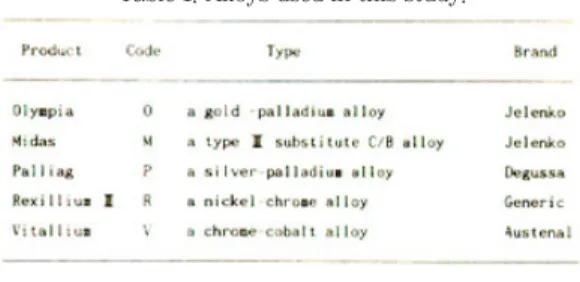
본 연구에 사용된 5종의 합금을 Table 1에 열거하 였으며, 각 재료의 주성분을 Table 2에 표시하였다.
Table 1. Alloys used in this study.
Table 2. Alloy listing including the major elements in each.
- 대한 치과 보철학회지 Vol. 29 No. 2, 1991 -
酸植架工義齒의 �屬被着面에 關한 硏究
全北大學交 齒科大學 補綴學敎室
朴 贊 云
2. 실험방법
1) 금속시편의 제작
접착강도 측정용 시편 제작을 위하여 직경 6.4㎜, 두께 2㎜의 납형을 제작하였고, 인산염 매몰재인 Hi-Temp 2(Whip Mix Co.)로 제조자의 지시에 따 라 매몰하였으며, 통법에 따라 소환하여 고주파유도 주조기(high-frequency induction casting machines : BEGO Co., Formax 35 EUM)로 주조 하였다. 주조된 시편은 ring을 완전히 식힌 후 매몰 재를 제거하였고, 50㎛ aluminum oxide(Biobond Alumimum Oxide, Dentsply International Inc, U.S.A.)로 80psi의 압력하에서 sand blasting하였 으며, 연마된 시편을 증류수에서 10분간 초음파 세척 하였다.
각 합금 시편은 금속피착면 처리방법에 따라 3개 의 군으로 분류하여 sand blasting, Silicoating, Rocatec처리를 실시하였다.
2) 접착과 접착인장강도의 측정
모든 금속시편은 금속피착면 처리가 완료된 후 10
㎏/㎟의 일정 압력하에서 Visio-Gem으로 접착하였 으며(Fig. 1), 각각을 2개의 군으로 분류하여 첫번째 군은 37℃의 증류수에서 24시간 방치하였고, 두번째 군은 5℃와 55℃에서 유지시간 30초로 1500회의 thermo-cycle을 시행하였다.
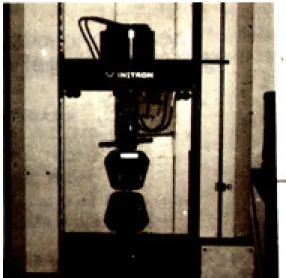
접착인장강도의 측정을 위하여 만능시험기 (Instron, Model 4201, Fig. 2)에 시편고정장치를 부착하여 용량 50㎏의 load cell을 이용하여 crosshead speed 1㎜/min에서 측정을 시행하였으 며, console에 내장된 파절되는 순간의 하중을 기록 하였다.
3) 결과분석
통계적 유의성을 검증하기 위하여 합금의 종류와 금속피착면의 처리방법에 따라 분산분석(oneway analysis)을 시행한 후 Scheffe의 다중범위검증법 (Multiple range rest)에 의해 각 군을 개별 비교하 였으며, 37℃의 증류수에 24시간 침전한 군과 5℃와 55℃ 사이에서 1500회 thermo-cycles 처리한 군간 의 유의성을 t-test로 검증하였다.
Ⅲ. 실험성적
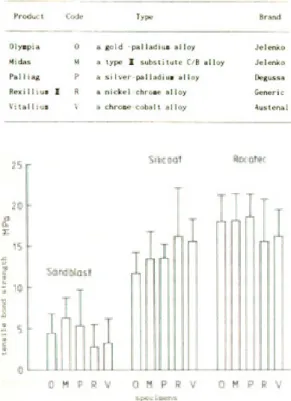
각 합금의 측정된 접착 인장강도는 요약하여 다음 과 같이 도표화하였다(Table 3, 4 Fig. 3, 4).
37℃의 증류수에 처리군에서는 각 합금간에 통계 학적으로 유의한 차이를 보이지 않았으나(P>0.05), 금속피착면 처리방법에 따라서는 Olympia 합금은 각 표면처리 방법간에 유의한 차이를 보였고 (P<0.01), 나머지 합금은 sandblasting처리군과 나 머지 군간에 유의한 차이를 보였다(P<0.01)(Table 3, Fig. 3).
5℃와 55℃ 사이에서 유지시간 30초로 1500회의 thermo-cycles 처리하였을 경우, sand blasting 처리군은 thermo-cycles 중 모두 파절되었고, 금속 피착면 처리방법에 따라서 Silicoating 처리군은 재 료에 따라 유의한 차이를 보이자 않았으나(P>0.05), Fig. 1. Cemented half test specimens ready for tensile
testing.
Fig. 2. Tensile testing(Instrin Model 4201).
Rocatec 처리군은 Rexillium Ⅲ합금과 Vitallium 합금간에 유의수준 α=0.05로서 유의한 차이를 보였 고, 나머지 합금간에는 유의한 차이를 보이지 았았다 (P>0.05)(Table 4, Fig. 4). 각 합금에 대한 Silicoating 처리군과 Rocatec 처리군간의 통계적 유의성을 검증한 결과, Olympia 합금은 유의한 차 이를 보이지 않았고(P>0.05), Rexillium Ⅲ 합금은 유의수준 α=0.01로서 유의한 차이를 보였다.
Ⅳ. 총괄 및 고찰
합금의 표면처리에 따른 합금과 복합레진의 접착 강도에 관한 많은 연구가 보고되었고, 결합력 증가를 위하여 금속의 피개면적을 증가시키기 위한 다양한 design과 변연부의 적절한 폐쇄, 및 여러가지 금속 표면처리 방법과 표면처리제가 개발되었다(5-21). 본 연 구 에 서 는 금 속 시 편 을 sandblasting,
Silicoating, Rocatec 처리한 후 Visio-Gem으로 접착시켰을 때의 접착인장강도를 규명해 보았다.
문헌상에 나타난 복합레진의 접착인장강도를 살펴 보면, 레진과 부식된 법랑질간의 접착강도는 약 8.3-20.7Mpa(7, 10, 27)로 레진과 부식된 법랑질간의 접착강도가 가장 낮게 나타나 있다(9, 22-23). Zardiackas 등(28)은 우치 법랑질과 Ni-Cr계 합금인 Biobond plus를 Comspan으로 접착시켜 16.7Mpa 을 얻었고, 朴 등(31-32)은 전기화학적으로 부식 처리한 Verabond시편을 치면에 Panavia로 접착한 경우 16.6Mpa 이상의 접착 강도를, Comspan으로 접착 한 경우 17.0 Mpa을 얻었다고 보고하였다. 金 등(33) 은 전기화학적으로 부식된 금속과 레진과의 접착전 단강도가 Panavia로 접착한 경우 14.4 Mpa, Comspan으로 접착한 경우 17.0 Mpa임을 보고하였 다. 또, Nicholls(34)는 veneering resin으로 이용되 는 Visio Gem과 Cementing resin 사이에 접착인 장강도가 8.6 Mpa임을 보고하였다. 본 실험에서는 Table 3. Tensile bond strength after 24 hours in 37℃
distilled water[MPa].
Table 4. Tensile bond strength after 100 termo-cycles from 5℃ to 55℃[MPa].
Fig. 3. Tensile bond strength in MPa after 24 hours in 37℃ distilled water.
Fig. 4. Tensile bond strength in MPa after 1,500 thermo-cycles from 5℃ to 55℃.
표면처리에 따른 각 합금의 평균 접착인장강도는 37
℃의 증류수에서 24시간 처리하였을 경우, sand blasting처리군은 2.88-6.24Mpa, Silicoating 처 리군은 11.81-16.25 Mpa, Rocatec 처리군은 15.64-18.65 Mpa로 나타났으며, 5℃와 55℃사이에 서 1500회의 thermo-cycle을 하였을 경우, sandblasting 처리군은 모두 thermo-cycle중 파절 되었고, Silicoating 처리군은 3-6.14Mpa, Rocatec 처리군에서 가장 큰 접착강도를 보였다.
접착강도의 측면에서 보면, 결합의 실패는 접착강 도가 가장 낮은 레진과 부식된 법랑질간에 일어나야 하겠지만, 실제로 결합의 실패는 레진과 부식된 법랑 질간의 파절(13, 26), 레진 자체내의 파절(27-28),레진 과 금속간의 파절(12, 29) 등으로 다양한 양상으로 나타 나는데, 이는 합금의 종류, 금속면의 표면처리 상태, 법랑질면의 탈회 양상, 금속면과 법랑질면의 처리방 법에 따른 bonding agent의 젖음성, 그리고 레진 paste의 혼합시에 혼입될 수 있는 기포등에 달려있 으며, 금속면 처리방법은 결합력 뿐 아니라 변색에도 영향을 미치므로 opaque bonding resin 사용과 부 식된 금속면을 금도금하는 방법등이 보고되었다(30). Yamashita 등은 전치부에 약 60%, 구치부에 약 80%정도의 습도만으로 레진과 치아간 결합력이 크 게 감소한다고 하였으며(12), 탈회 시간, 탈회시 사용 되는 산 용액의 농도가 법랑질 탈회양상에 영향을 미 친다. 본 논문의 관찰 결과, 레진과 금속간의 파절은 접착 실패와 응접실패의 복합된 양상을 보였다.
금속과 레진간의 결합을 촉진하기 위하여 여러종 류의 금속면 처리법과 bonding agent가 이용되어
왔다(5-19). 레진이 금속면에 형성된 요철의 미세한 끝
까지 흘러들어가기 위해서는 금속 표면의 건조, 오염 방지 및 레진 자체의 점주도가 어느 정도 낮아야 한 다. 본 연구에서는 표면처리된 금속표면이 오염되지 않도록 주의하였다.
Ⅴ. 결 론
금속피착면의 처리에 따른 복합레진과의 접착강도 를 측정하기 위하여 금속피착면을 sandblasting, Silicoating, Rocatec 처리하여 Visio-Gem으로 접 착시킨 후의 접착인장강도를 측정하여 다음과 같은
결론을 얻었다.
1. 37℃의 증류수에 24시간 침적하였을 경우, 접 착 강 도 는 Rocatec, Silicoating, sandblasting 처리군 순으로 크게 나타났고, sandblasting 처리군과 나머지 군간에 통계적 으로 유의한 차이를 보였다(P<0.05).
2. 5℃와 55℃ 사이에서 유지시간 30초로 1500 회의 thermo-cycles 처리하였을 경우, sandblasting 처리군은 thermo-cycles 중 모두 파절되었고, Sillicoating 처리군과 Rocatec 처리군은 통계학적으로 유의한 차이 를 보였다(P<0.05).
참고문헌
1. Silverstone L.M. : Fissure sealants : Laboratrory stduies, Caries Res. 8 : 2, 1974.
2. Silverstone L.M., Saxton C.A., Dogon I.L., and Fejerskov O. : Variation in the Pattern of Acid Etching of Human Dental Enamel Examined by Scanning Electron Microscopy, Caries Res. 9 : 373, 1975.
3. Nelson D.G.A., et al : Morphology of enamel surfaces treated with topical fluoride agents : SEM considerations, J. Dent. Res. 62 : 1201, 1983.
4. Gottlieb E.W, Retidf D.H. and Jamison H.C. : An optimal concentration of phosphoric acid as an etching agent. Part Ⅰ : Tensile bond strength studies. J. Prosthet. Dent. 48 : 48, 1982.
5. Dunn B., and Reisbick M.H. : Adherence of cermaic coatings on chromiumcobalt structures.
J. Dent. Res. 55 : 328, 1976.
6. Tanaka T., Angata K, Takeyama M., Nakabayashi N, and Masuhara E. : 4-Meta Opaque Resin-A New Strongly Adhesive to Ni- Cr Alloy. J. Dent. Res. 60 : 1967, 1981.
7. Tanaka T., Atsuta M., Uchiyama Y., Kawashima I. : Pitting Corrosion for retaining acrylic resin facings. J. Prosthet. Dent. 42 : 282, 1979.
8. Thompson V.P., and Livaditis G.J. : Etched casting acid etch composite bonded posterior
bridges. Pediatr. Dent. 4 : 38, 1982.
9. Thompson V.P., et al. : Statistical distributions of tensile adhesive bond strength, J. Dent, Res. 65 : 237, 1986.
10. Livaditis G.J., and Thompson V.P. : Etched casting : An improved retentive machanism for resin-bonded retainers. J. Prosthet. Dent, 47 : 52, 1982.
11. Livaditis G.J., : A chemical etching system for creating miocromechnical retention in resin- bonded retainers. J. Prosthet. Dent. 56 : 181, 1986.
12. Del Castillo E. and Thompson V.P. : Electrolytically etched nonprecious alloys. : Resin bond and laboratory variable. J. Dent. Res. 61 : 186, 1982.
13. Yamashita A. : A Dental Adhesive and It’s Clinical Applications. Quintessence Publishing Co. Tokyo, 1983.
14. La Barre E.E. and Ward H.E. : An alternative resin-bonded restoration. J. Prosthet. Dent. 52 : 247, 1984.
15. Hanson G.H., et al : Bonding bases coated with porous metal powder : A comparison with foil mesh. Am. J. Orthod., 83 : 1, 1983.
16. Stokes An., at al. : Porous metal coatings for resin-bonding systems J. Prosthet. Dent. 56 : 170, 1986.
17. Taleghani M., et al. : An alternative to cast etched retainers J. Prosthet. Dent. 58 : 424, 1987.
18. Crengers NHJ, Welle Pr. Vrijhoes MMA : Four bonding systems for resin-tetained cast metal prostheses, Dent. Master. 4 : 85-88, 1988.
19. Laufer B.S., Nichills J.L., Townsend J.D. : SiOx- C coating : A composite-to-metal bonding mechanism. J. Prosthet. Dent. 60 : 320, 1988.
20. Miller L.L. : Framework Design in Ceramo-metal Restoration. Dent Clin North Am 21 : 4, 1977.
21. Caputo A. : Effect of surface prepartion on bonding strength of non-precious and semi- precious alloys. J.Calif Assoc 6 : 42, 1978.
22. Phillips R.W. : Skinner’s science of dental materials, 8th ed. W.B. Saunders Company, 126, 1982.
23. Creig R.G. : Restorative dental materials. 7th ed., The C.V.Mosby Company, 1985.
24. Rochette A.L. : Attachment of a splint to enamel of lower anterior teeth. J Prosthet. Dent, 30 : 413-423, 1973.
25. Zidan O., Asmussen E., Jogensen K.D. : Correlation between tensile and bond strength of composite resins. Scand J. Dent. Res. 88 : 348, 1980.
26. Simonsen R, Thompson V., and Barrack G. : Etched Cast Restorations : Clinical and Laboratory Techniques. Quintessence Publishing Co., Chicago, 1983.
27. Meiers J. C., et al. : Effect of surface treatments on the bond strength of etched-metal resin- bonded retainers J. Prosthet. Dent. 53 : 185, 1985.
28. Zardiackas L.D. : Tensile adhesion of composite resin cements to etched alloy and enamel.
Quintessence Int. 17 : 483, 1986.
29. Eschleman J.R., et al : Retentive strength of acid-etch fixed prosthesis. J. Prosthet. Dent. 60 : 349, 198..
30. Livaditis G.J. and Tate, D.L. : Gold-plating etched-metal surfaces of resin-bonded retainers.
J. Prosthet. Dent. 59 : 153, 1988.
31. 박 헌석, 이 선영, 양 재호, 장 완식 : 식각된 비귀금속합 금과 법랑질을 복합 레진계 시멘트로 접착시킨 경우의 접착인장강도에 관한 연구, 대한치과보철학회지 24 : 85, 1986.
32. 박 상원, 양 홍서 : 식각된 비귀금속 합금과 법랑질간의 접착 인장강도에 대한 연구, 대한치과보철학회지 25 : 302, 1987.
33. 김 운, 배 태성, 송 광엽, 박 찬운 : 합금의 표면처리에 따른 Resin과 Alloy간의 전단강도, 전북치대 논문집 6 : 49, 1988.
34. Nicholls J.I. : Esthetic veneer cementation. J.
Prosthet. Dent. 56 : 9, 1986.
=Abstract=
A STUDY ON THE METAL SURFACE TREATMENT OF RESIN BONDED RETAINERS
Cham-Woon Park, D.D.S., Ph.D.
Department of Prosthodontics, College of Dentistry, Chonbuk National University