COMPARATIVE STUDY OF SHEAR BOND STRENGTH BETWEEN CP-TI / CO-CR ALLOY AND COMPOSITE RESINS
Se-Hee Yoon11, D.D.S., M.S.D., Ahran Pae2, D.D.S., M.S.D., Seok-Hyung Lee3, Dr med dent., D.D.S., Horim Lee4, D.D.S., Ph.D.
1Graduate School of Clinical Dentistry, Ewha Womans University
2Department of Dentistry, School of Medicine, Ewha Womans University
3Department of Prosthodontics,Samsung Medical Center, School of Medicine, Sungkyunkwan University
4Department of Dentistry, School of Medicine, Ewha Womans University
Statement of problem.Composite resin-veneered metal restorations can be used as an alter- native to porcelain-fused-metal restorations. But, because of the relatively low bond strength of veneering composite to metal framework, various surface treatment methods have been intro- duced to improve the bond strength.
Purpose. The object of this study was to compare the shear bond strength of different combinations of each of the two bonding systems and each of the two composite veneering resins to cp-Ti / Co-Cr alloy.
Material and methods. Two resin bonding systems (metal conditioner containing MEPS monomer, tribochemical silicoating system) and two composite resins (Gradia, Sinfony) were tested on cp-Ti and Co-Cr alloy. Then, according to manufacturers’instructions, resin bonding systems and composite resins were applied. All test specimens were divided into four groups for each alloy; Ⅰ) sandblast + Metal Primer Ⅱ+ Gradia (MG), Ⅱ) sandblast + Metal Primer Ⅱ + Sinfony (MS), Ⅲ) Rocatec + Gradia (RG), Ⅳ) Rocatec + Sinfony (RS). The shear bond strength was determined using a universal testing machine and all data were statistically ana- lyzed with Mann-Whitney test and Kruskal-Wallis test at the significance level of 0.05.
Results. The mean (standard deviations) of shear bond strength according to the combinations of two bonding systems and two composite resins to cp-Ti arranged from 16.44 MPa to 17.07 MPa and the shear bond strength to Co-Cr alloy ranged from 16.26 MPa to 17.70 MPa.
The result shows that the difference were not statistically significant.
Conclusion.The shear bond strengths of composite resins to both cast cp-Ti and Co-Cr alloy were not significantly different between the metal conditioner and the tribochemical silicoating system. And no differences in bond strength were found between cp-Ti and Co-Cr alloy.
Key Words
Shear bond strength, Composite resin veneered metal restorations, cp-Ti, Co-Cr alloy J Korean Acad Prosthodont : Volume 45, Number 6, 2007
※ This work was supported by the Ewha Womans University Research Grant of 2006.
C
omposite resin-veneered metal restorations can be used as an alternative to a porcelain- fused-metal restorations. The advantages of veneering composite materials include easy han- dling, excellent esthetics, hardness similar to that of the natural tooth enamel and ability to be readily repaired.1However, the chief disadvan- tage is the relatively low bond strength of veneer- ing composite to metal framework compared with porcelain-fused metal restorations.2,3The cobalt-chrome (Co-Cr) is a good alternative to the nickel-chromium-beryllium (Ni-Cr-Be) alloy4which can lead to problems of polymetallism and allergic responses. Recent improvements in casting technology have made it possible to accu- rately fabricate prostheses made from commercially pure titanium (cp-Ti), thus expanding the use of this metal in clinical prosthodontics.
Various surface treatment methods have been introduced to improve the bond strength of com- posite resin and metal alloy. Until recent years, mechanical retentions such as undercuts, beads, loops, wires have been indispensable. However this process produced a bulkier framework that was difficult to opaque because of pooling around the beads, which results in decrease of reten- tion. Electrolytic etching technique developed by Lavaditis and Thompson5, is technique sensitive and only some Nickel-chromium and cobalt- chromium alloys can be successfully etched.6 Sandblasting with alumina powder has also been used to clean the alloy surfaces and to achieve both microretentive topography and increased sur- face area. It results in a highly activated surface which can be shown by the increased wettabili- ty of this material.7,8
Chemical bonding systems are divided into two categories, according to chemical adhesion on metal framework: (1) surface modification tech- niques which create thin layers of inorganic,
organic, metallic, or composite material on the sub- strate metal alloys and (2) the use of metal con- ditioner including functional monomer for targeting direct chemical bonding between metal elements on the alloy surfaces and resin components in the opaque resins.
The Silicoater system (Kulzer Co., Friedrichshof, Germany) was introduced in 1984 by Tiller and Musil9claming that it was the first system to provide chemical metal-resin bonding. In the silicoating system, a silica layer is pyrolytically applied to the surface over in which a silane coupling agent is applied. The Silicoater system has been substantially modified and released as the Silicoater MD10 and Kevloc11systems. The Rocatec system have been developed with is further refinements and simplications of the orig- inal “flame-sprayed”method. Kenneth et al.12 demonstrated that this technique provided a stro- nger bond of composite to metal than mechanical retention alone. Others have also demonstrated the efficacy of the silicoating technique.13 -15
The Metal PrimerⅡ bonding system (GC Co., Tokyo, Japan) followed the first group containing functional monomers of MEPS (methacryloy- loxyalkyl thiophosphate derivatives), which react chemically with metal alloys. The layer of bond- ing agent was provided with a consistency of paste and applied on a sandblasted alloy sur- face and finally polymerized.
Several studies have compared bond strengths with metal alloys of metal conditioner systems and the silicoating systems. Fujishima et al.16determined bond strength to cp Ti and Co-Cr alloy using Silicoaer MD, New Metacolor (Sun Medical Co., Kyoto, Japan), Ceased (Kuraray, Osaka, Japan) sys- tems and achieved strong bond with all the bonding systems with exception of Thermoresin LC Ⅱ (GC co., Tokyo, Japan), which is designed for noble metals. In the study of Yanagida et al.,17 surface treatment with Ceased Opaque
PrimerⅡand Siloc system exhibited significant- ly greater bond strength than other seven metal conditioners.
The purpose of this study was to compare the shear bond strength of different combinations of two resin bonding systems and two compos- ite veneering resins to cp-Ti and Co-Cr alloy.
MATERIAL AND METHODS
Preparation of cast metal plate
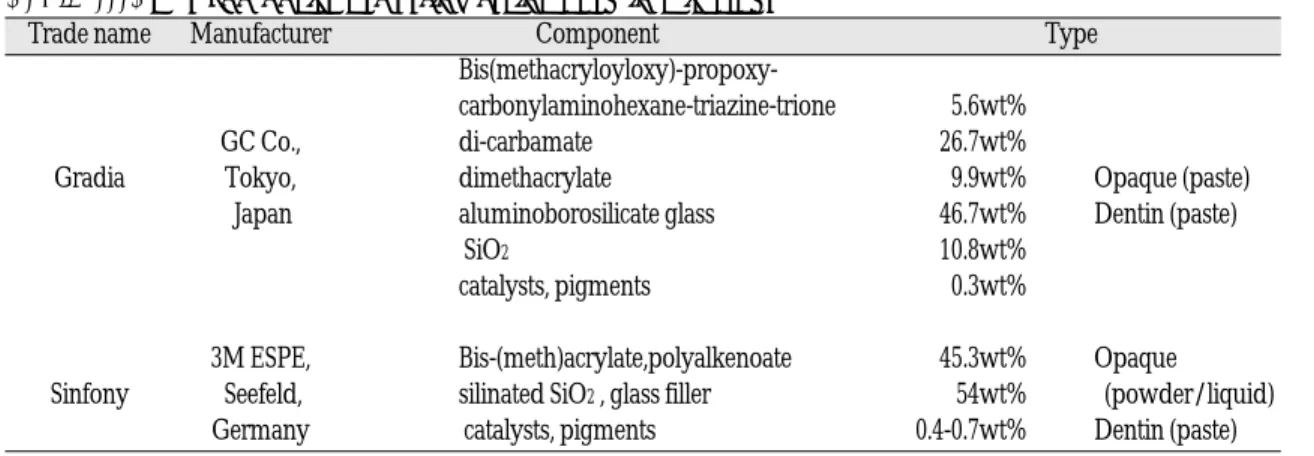
The test procedures were performed according to ISO 1047718. The materials used in this study are summarized in Table I-III.
Rectangular specimens with length of 20 mm, width of 10 mm and thickness of 2 mm were constructed. The titanium specimens consisted of titanium grade II (99.4 wt percentage titanium, 0.11 wt percentage oxygen, 0.04 wt percentage iron) and cobalt-chromium specimens consisted of 65 wt per- centage cobalt, 27.7 wt percentage chromium, 5.5 wt percentage molybdenum. They were cast from the alloy according to the manufacturers’
specifications and then all specimens were wet-
ground (Al2O3) using a Labopol-1 grinding machine (Struers, Denmark) to achieve a copla- nar surface.
Preparation of specimens for shear testing The specimens were divided into four experi- mental groups of five specimens according to the combinations of two bonding systems and two resins to cp-Ti / Co-Cr alloy as listed in Table IV.
MG and MS groups were blasted 50㎛ Al2O3 for 10 s with a sandblaster (Basic master, Renfert GmbH, Hilzingen, Germany). Air pressure was 2 bar and the distance of the nozzle from the metal surface was approximately 10mm. And then, Metal primer II was applied and dried for 60 s. RG and RS groups were blasted-clean (10 s) with 110㎛ Al2O3corundum (Rocatec Pre; 3M ESPE, Seefeld, Germany) at a pressure of 2.8 bar. In the second step, the surface was tribo- chemically coated using Rocatec Plus (3M ESPE, Seefeld, Germany) at a pressure of 2.8 bar for 13 s. And then, silane coupling agent (3M ESPE Sil;
3M ESPE, Seefeld, Germany) was applied and allowed to dry for 5 min.
Table I. The metals used in this study
Metals Manufacturer Component
cp-Ti MANFREDI Inc., Italia ASTM grade II, Ti 99.4%
Co-Cr alloy Ticonim D/V Inc., America Co 64%, Cr 27.7%, Mo 5.5%
Table II. The resin bonding systems used in this study
Trade name Manufacturer Component
Metal PrimerⅡ GC Corp., Tokyo, Japan MEPS * in methyl methacrlyate Rocatec system 3M ESPE, Seefeld, Germany Rocatec-Pre, Rocatec Plus,
3M ESPE Sil
*MEPS = methacryloyloxyalkyl thiophosphate derivative.
After surface preparation, composite veneering resin was bonded to the alloy. MG and RG groups: a thin layer of Gradia opaquer was applied twice and light-cured for 30s each with the SPEKTRA LED (Schutz Dental DmbH, Rosbach,
Germany). Thus, a brass ring with a height of 2.5mm and a diameter of 5mm was placed over the opaquer surface. The veneering composite was layered in two steps and every layer was light- cured for 30s and post-curing was performed for 3 min. MS and RS groups : Two layers of Sinfony opaquer were coated and light-cured (2×5 s) using the ESPE Visio Alpha device (3M ESPE, Seefeld, Germany). The veneer composite Sinfony was polymerized onto the opaquer lay- er in two steps and every layer was light-cured for 10 s and finally cured in vacuum in the Visio Beta device (3M ESPE, Seefeld, Germany).
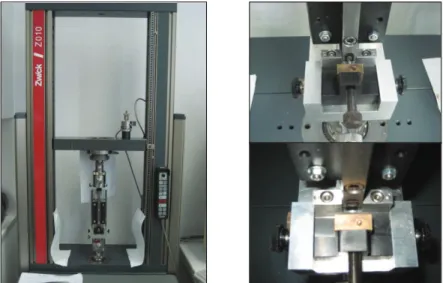
Measurement of shear bond strength Shear bond strength tests were performed with a universal testing machine (Zwick Z010, Ulm, Germany) with a pushing device used at a crosshead speed of 1mm/min until fracture (Fig.
Table III. The composite veneering resins used in this study
Trade name Manufacturer Component Type
Bis(methacryloyloxy)-propoxy-
carbonylaminohexane-triazine-trione 5.6wt%
GC Co., di-carbamate 26.7wt%
Gradia Tokyo, dimethacrylate 9.9wt% Opaque (paste)
Japan aluminoborosilicate glass 46.7wt% Dentin (paste)
SiO2 10.8wt%
catalysts, pigments 0.3wt%
3M ESPE, Bis-(meth)acrylate,polyalkenoate 45.3wt% Opaque
Sinfony Seefeld, silinated SiO2, glass filler 54wt% (powder/liquid) Germany catalysts, pigments 0.4-0.7wt% Dentin (paste)
Table IV. Experimental design
Metals Code Testing combinations
MG Sandblasting + Metal PrimerII + Gradia cp-Ti / Co-Cr MS Sandblasting + Metal PrimerII + Sinfony
RG Rocatec System + Gradia
RS Rocatec System + Sinfony
Fig. 1.Assembly for shear bond testing.
1 and 2). The shear bond strengths were calculated according to the formula : B = F / S, (B: shear bond strength (MPa), F: load at fracture (N), and S: bond- ed surfaces area (mm2).
Statistical analysis
Mean value and standard deviation were com- puted in each experimental group. Statistical analysis of the results was carried out with Mann- Whitney test and Kruskal-Wallis test with the SPSS for Windows Software (SPSS 13.0; SPSS Inc., Chicago, IL, U.S.A) at the significance level of 0.05.
RESULTS
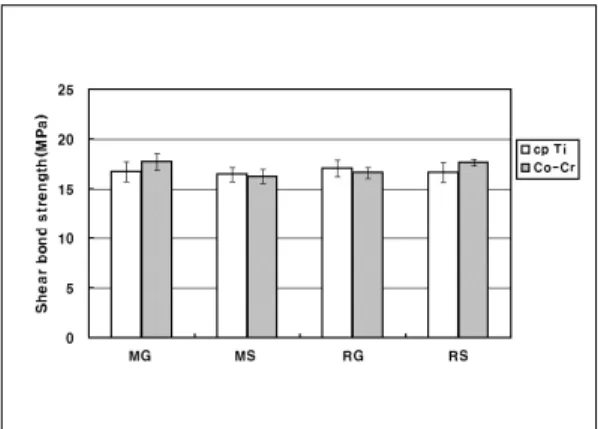
The bond strength values for the different alloys, bonding systems, and composite veneer- ing resins are summarized in Table V and Fig. 3.
Fig. 3 presents the mean bond strength cp-Ti versus Co-Cr alloy.
All tested veneer resins and bonding systems passed the requirements of ISO 10477 (>5 MPa) for bonding to cp-Ti and Co-Cr alloy.
The mean (standard deviations) of shear bond
strength of cp Ti ranged from 16.44 MPa (1.42) to 17.07 MPa (1.69). There were no significant dif- ferences between Metal Primer II and Rocatec sys- tem to cp-Ti.
The mean (standard deviations) of shear bond strength of Co-Cr alloy ranged from 16.26 MPa (1.46) to 17.70 Mpa (1.66). There were no signif- icant differences between Metal Primer II and Rocatec system to Co-Cr alloy too.
The Mann-Whitney test revealed that the vari- ance among the four groups (MG, MS, RG, RS) of each alloys were not statistically significantly different (p>0.05). And Kruskal-Wallis test demon- strated no significant difference between cp-Ti and Co-Cr alloy (p>0.05).
DISCUSSION
The new generation of light-activated laboratory resins was developed. These composites con- tain approximately 66% inorganic fillers and 33% resins matrix by volume, whereas the former generation of composites contained 33% inor- ganic fillers. Change in the size and distribution Fig. 2.Universal testing machine (Zwick Z010, Ulm, Germany).
of the filler particles, significantly improved these new composites.19,20 They are used in veneered crowns (partial or complete veneers), retainers and pontics for resin-bonded fixed par- tial dentures, and overlay removable partial den- tures and implant prosthesis.21,22
Although base metal alloys have been developed for dental restorations, a nickel-chromium-beryl- lium (Ni-Cr-Be) alloy may be undesirable because of reported Ni sensitivity in the population.23 There is also concern about the use of Be in den- tal alloys because of its potential carcinogenicity.24 To eliminate the potential health hazards of Ni and Be, Co-Cr alloys with comparable physical prop- erties are an alternative.
The use of titanium for cast restorations and fixed partial dentures has increased substantially in recent years, mainly because of the development of new generation of casting machines and invest- ment materials. Further, titanium has many advantages as a dental prosthesis material, includ- ing excellent biocompatibility, good mechani- cal properties and low density,16corrosion resis- tance and improved wear resistance.25Also, due to the passive oxide film which forms on its sur- face, resin adheres to cp Ti as effectively as it adheres to other non-noble dental alloys.26Demand is increasing for resin-veneered crowns, such as those used in telescopic prostheses like a Konus Krone-type crown, as well as those used for
fixed prostheses for implants. Titanium has excel- lent characteristics for these purposes.
Although cp-Ti and Co-Cr alloy have the advan- tages over other base metal alloys, several prob- lems worthy of attention have been reported.
One of these is the insufficient bonding between veneering resins and metal framework. Most debonding of resin-bonded prostheses is due to failure at the resin/metal interfaces.27The factors contributing to this failure are: the type of adhe- sive and the nature of the alloys, the treatment of the surfaces and the stresses undergone by the prosthesis.28
Several methods available for bonding resin veneers to cast prostheses have been developed.
Although mechanical retentions may produce high bond strength29, it can result in microleakage and require high thickness of material necessitating overcontouring of restorations.30Since the 1980s, methods have been reported to create a chemical bond between dental alloys and composites. The chemical attachment of an opaque layer to met- al surface limited microleakage at the resin-met- al interface31that occurred because of polymer- ization shrinkage32and mismatch of coefficient of thermal expansion between the composite and the Fig. 3.Graphic representation of bond strength values of all groups.
Table V. Mean shear bond strengths (MPa) and standard deviations (SD) of composite veneering resins to cp-Ti and Co-Cr using two bond- ing systems
cp-Ti Co - Cr
Groups Mean SD Mean SD
MG 16.71 2.03 17.70 1,66
MS 16.44 1.42 16.26 1.46
RG 17.07 1.69 16.61 1.06
RS 16.63 1.96 17.63 0.61
metal.33Imbery et al.29found that the chemical bonding of resin to metal required less metal and allowed more space for properly contoured and esthetic veneer resin compared with mechan- ical retention.
For this study, chemical bonding systems and their corresponding composites were selected to evaluate the effect of different surface prepa- rations (Metal Primer II and Rocatec system) on bonding between composite veneering materials (Gradia and Sinfony) and cp-Ti / Co-Cr alloy. The shear testing results showed that no significant dif- ferences in ability to bond strength were found between Metal Primer II and the Rocatec sys- tem.
Metal Primer II contains a methacryloyloxyalkyl thiophosphate derivatives (MEPS) together with a radical polymerization initiator in the single liq- uid composition. Durability of the bond to met- al alloy of composite material is considered to be derived from the resistance to detachment the opaque material from the metal surface.
Specifically, the MEPS monomer consists of three differently functioning components; methacryloyl, alkyl and thiophosphate groups. Of these, the methacryloyl group is undoubtedly indispensable to copolymerize the MEPS monomers in the primer and the matrix monomers in the opaque material. The thiophosphate group chemically bonds to metal oxides, probably bonding covalently or ionically by condensing dihydrogen oxide, i.e. water. However, the consistency of the chem- ical bond between the hydrogen phosphates and metal oxides is somewhat limited, especially against hydrolysis in the oral enviroment. The adhesive monomer therefore should have a hydrophobic component adjacent to the phosphate group to prevent penetration of water into the adhesive interface. Hence the alkyl group of the MEPS monomer forms a barrier to water penes- tration at the dihydrogen phosphate-metal oxide
interface. Although this bonding mechanism has not been confirmed by spectroscopic studies, bond strength reports support the effectives of the MEPS monomer in bonding other base metal alloys, the surfaces of which are coated with thin oxide layers.34-36Imai et al.37 reported that the combinations of adhesive primer contain- ing thiophosphate monomer and resin cement pro- duced durable bond to both noble and base met- al alloys. Taria et al.38 demonstrated Ceased Opaque Primer and Metal Primer II were supe- rior to other primers for strong bond to titanium and resin cement.
The Rocatec system consists of Rocatec Pre, Rocatec Plus of Soft, ESPE Sil. In this system, the silicate layer is formed by sandblasting with a 110㎛silicate-quartz (Rocatec Pre). When sand- blasting particles hit metal surfaces, their kinet- ic energy is transformed to thermal energy, which may reach the melting point of the metal alloy.29 The melting of the metal alloy is limited to 1 or 2 microns from the surface. The tribochemical effect of airborne particle abrasion results in deposition of molecular coating alumina and silicate particles (110㎛Rocatec Plus or 30㎛
Rocatec Soft) on the alloy surface. A silane solu- tion (3M ESPE Sil) is also applied to the tribo- chemically treated metal surface as a coupling agent between free bonds of the silicate surface on the metal and ends of organic polymer chains the opaque material.39-41
Different experimental designs have been used in other studies that have compared bond strengths with metal alloys of metal primer systems and the silicoating systems. Stefanos et al.30 used the Rocatec, Silicoater, Silicoater MD and Sebond, Spectra-Link systems for evaluating bond strength of resin to metal bonding systems and demon- strated that metal conditioner were superior to sil- icoating systems. Michael et al.42used the Rocatec, Targis Link, Metal Primer and Metal Primer Ⅱ sys-
tems for evaluating bond strength to cp-Ti and Co- Cr alloy and concluded that Targis Link (phos- phoric acid ester system) was superior to others for Co-Cr alloy, both silicoating and functional methods were successful for cp-Ti. Ohkubo et al.43 reported that Ceased Opaque Primer and Metal Primer Ⅱ exhibited greater bond strength to cast Ti and Co-Cr alloy and durability than did Metal Bond and Siloc system.
In this study, the difference between the shear bond strengths of the cp Ti and Co-Cr alloy was not significant(p>0.05). Fujishima et al.44showed the original Silicoater and the 4-META bonding system could mediate strong bonds between cp Ti and resin composite veneers used with an intermediary layer of an opaque resin, and the bond strengths were similar to those obtained with a Co-Cr alloy. Hanson et al.45demonstrated that while there were no difference between the Co- Cr and the Ti, the Co-Cr and Ti alloy showed bet- ter retention to resin than did the three gold alloys after silicoating.
Although the bond durability imparted by the single liquid metal conditioner systems need improvement over silicoating systems, the use of metal priming agents offer the following advan- tages: (a) simple procedure, (b) non-necessity of a proprietary apparatus and (c) reduced cost performance.
With the results of this study the single liquid metal conditioner system can be more effective and clinically available than silicoating system which is a complicated, technique-sensitive, time-con- suming method, when non-precious metal surface is planning to be treated with in order to enhance the bond strength of resin-retained fixed prosthesis.
CONCLUSION
Within the limitations of this study, the fol- lowing conclusions were drawn:
1. The shear bond strengths of composite resins to both cast cp-Ti and Co-Cr alloy were not sig- nificantly different between Metal Primer II and Rocatec system(p>0.05).
2. No differences in bond strength were found between a cp-Ti and a Co-Cr alloy.
3. From the results above, the single liquid metal conditioner system should be more effective and available clinically than sili- coating system which is complicate, tech- nique-sensitive, time-consuming method, when non-precious metal surface is plan- ning to be treated with in order to enhance the bond strength of resin-retained fixed prosthesis.
Future studies should be performed to evaluate the long-term effects of thermal change and water storage on the resin-to-metal bond.
REFERENCES
1. Barzilay I, Michael LM, Lyndon BC, Gerald NG.
Mechanical and chemical retention of laboratory cured composite to metal surfaces. J Prosthet Dent 1988;59:131-6.
2. Rose MJ, Moore BK, Charles JG, Carlos AMV.
Microleakage and shear bond strength of resin and porcelain veneers bonded to cast alloys. J Prosthet Dent 1991;65:221-8.
3. Mukai M, Fukui H, Hasegawa J. Relationship be- tween sandblasting and composite resin-alloy bond strength by a silica coating. J Prosthet Dent 1995; 74:151-5.
4. Jones TK, Hansen CA, Singer MT, Kessler HP.
Dental implications of nickel hypersensitivity. J Prosthet Dent 1986;56:507-9.
5. Livaditis GJ, Thompson VP. Etched castings: An im- proved retentive mechanism for resin-bonded re- tainer. J Prosthet Dent 1982;47:52-58.
6. Laufer BZ, Nicholls JI, Townsend JD. SiOx-C Coating: A composite-to-metal bonding mechanism.
J Prosthet Dent 1988;60:320-7.
7. Kern M, Thompson VP. Effects of sandblasting and silica-coating procedures on pure titanium. J Dent 1994;22:300-6.
8. Tanaka T, Fujiyama E, Shimizu H, Takaki A, Atsuta M. Surface treatment of nonprecious alloys for adhesion-fixed partial dentures. J Prosthet Dent 1986:55:456-462.
9. Musil R, Tiller HJ. The adhesion of dental resins to metal surfaces. In:The Kulzer Silicoater techniqu.
1st ed.Werheim, Germany: Kulzer and Co.; 1984.
10. Schneider W, Powers JM, Pierpont HP. Bond strength of composites to etched and silica-coated porcelain fusing alloys. Dent Mater 1992;8:211- 5.
11. Larry GR, Steven DH, Steven OH, Elrod CW.
Resin to metal bond strengths using two com- mercial systems. J Prosthet Dent 1998;79:270-3.
12. Kenneth BM, Melinda MR. The shear bond strength of polymethyl methacrylate bonded to titanium par- tial denture framework material. J Prosthet Dent 1993;70:410-3.
13. Caeg.C, Leinfelder KF, Lacefield WR, Bell W.
Effectiveness of a method used in bonding resins to metal. J Prosthet Dent 1990;64:37-41.
14. Kenneth BM, Jalani F, Michael ER, Brien RL.
Silane to enhance the bond between poly- methacrylate and titanium. J Prosthet Dent 1995;73:428-31.
15. Watanabe I, Kenneth SK, Jack LK, Toru O. Effect of sandblasting and silicoating on bond strength of polymer-glass composite to cast titanium. J Prosthet Dent 1999;82:462-7.
16. Fujishima A, Fujishima Y, Jack LF. Shear bond strength of four commercial bonding systems to cp Ti. Dent Mater 1995;11:82-6.
17. Yanagida H, Matsumura Y, Taira Y, Atsuta M, Shimoe S. Adhesive bonding of composite mate- rial to cast titanium with varying surface prepa- rations. J Oral Rehabil 2002;29:121-6.
18. SN EN ISO 10477. Polymer-based crown and bridge materials. Berlin:Breuth;2000.
19. Touati B, Aidan N. Second generation laboratory composites resins for indirect restorations. J Esthet Dent 1997;9:108-18.
20. Leinfelder KF. New developments in resin restora- tive systems. J Am Dent Assoc 1997;128:573-81.
21. Vojvodic D, Jerslimov V, Celebic A, Catovic A. Bond strength of silicoated and acrylic resin bonding sys- tem to metal. J Prosthet Dent 1999;81:1-6.
22. Yoshida K, Kamada K, Taira Y, Atsuta M. Effect of three adhesive primers on the bond strengths of four lighted-activated opaque resins to noble alloy. J Oral Rehabil 2001;28:168-73.
23. Moffa JP. Biological effects of nickel-containing den- tal alloys. Council on dental materials, instru- ments and equipment. J Am Dent Assoc 1982;104:501-5.
24. Moffa JP, Guckes AD, Okawa MT, Lilly GE. An evaluation of nonprecious alloys for use with porcelain veneers. Part Ⅱ. Industrial safety and bio- compatibility. J Prosthet Dent 1973;30:432-41.
25. Ohkubo C, Shimura I, Aoki T, Hanatani S, Hosoi T, Okabe T. In vitro wear assessment of titani- um alloy teeth. J Prosth Dent 2002;11:263-9.
26. Hanson O. Strength of bond with Comspan opaque to three silicoated alloys and titanium. Scand J Dent Res 1990;101:243-251.
27. Creugers NH, Snoek PA, Van’T Hof MA, Kayser AF. Clinical performance of resin-bonded bridges:
a 5 years prospective study. Ⅲ. Failure charac- teristics and survival after bonding. J Oral Rehabil 1990;17:179-86.
28. Moulin P, Degrange M, Picard B. Influence of surface treatment on adherence energy of alloys used in bonded prosthetics. J Oral Rehabil 1999;26:413-21.
29. Tulunoglu IF, Oktemer M. Tensile strength and mi- croleakage of the bond between a nickel-chromi- um alloys and a visible light-cured resin com- posite: effect of 4-META, silicoating, and bead retention. Quintessence Int 1997;28:447-51.
30. Stefanos GK. Bond strengths of resin-to-metal bonding systems. J Prosthet Dent 1997;78:136-45 31. Imbery TA, Evanos DB, Koeppen RG. A new method of attaching cast gold occlusal surfaces to acrylic resin denture teeth. Quintessence Int 1993;24:29-33.
32. Tanoue N, Matsumura H, Atsuta M. Curing depth of four composite veneering materials polymerized with different laboratory photo-curing units. J Oral Rehabil 1998;25:348-52.
33. Strygler H, Nicholls J, Townsend JD. Microleakage at the resin-alloy interface of chemically retained composite resins for cast restorations. J Prosthet Dent 1991;65:733-9.
34. Metal Primer. Technique and operating instructions.
GC Co. Tokyo. Japan.
35. Matsumura H, Tanaka T, Atsuta M. Effect of acidic primers on bonding between stainless steels and autopolymerizing methacrylic resins. J Dent 1997;25:285-290.
36. Matsumura H, Tanaka T, Atsuta M. Adhesive bonding of stainless steels and their component met- als. J Oral Rehabil 2000;27:1054-1059.
37. Imai Y. A new metal surface treatment. An extra issue of practice prosthodontics. Ishiyaku Publishers Inc. Tokyo. pp.265-267.
38. Taria Y. Yoshida K. Matsumura H. Atsuta M.
Phosphate prosthodontic and thiophosphate primers for bonding prosthodontic luting mater- ial to titanium. J Prosthet Dent 1998;74:384-388.
39. Musil R, Tiller HJ. The molecular coupling of resin veneers to alloy surfaces. Dent Labor 1984;
32:1155-61.
40. Lindemann W. New resin-to-metal bonding sys- tems. Dent Labor 1990;38:509-14.
41. Cobb DS, Vargas MM, Fridich TA, Boschlicher MR. Metal surface treatment : characterization and effect on composite-to-metal bond strength.
Operative Dent 2000;25:427-33.
42. Michael B, Martin R, Gerhard G, Gerhard H.
Adsesive bond of veneering composites on various metal surfaces using silicoating, titanium-coat- ing or functional monomers. J Dent 2003;31:33-42.
43. Ohkubo C, Watanabe I, Hosoi T, Okabe T. Shear
bond strengths of polymethyl methacrylate to cast titanium and cobalt-chromium frameworks us- ing five metal primers. J Prosthet Dent 2000;83:50- 7.
44. Fujishima A, Miyazaki T, Suzuki E, Miyaji T.
Adhesion strength of composite resin materials for veneering to cp titanium treated by several surface treatments. Jpn J Dent Mater 1991;10:130-136.
45. Hanson O, Moberg LE. Evaluation of three sili- coating methods for resin-bonded prostheses.
Scand J Dent Res 1993;101:243-51.
Reprint request to:
HORIMLEE, D.D.S., PH.D.
DEPT. OFPROSTHODONTICS
GRADUATESCHOOL OFCLINICALDENTISTRY EWHAWOMANSUNIVERSITY
911-1 MOK-DONG,YANGCHEON-GU,SEOUL,158-710, KOREA [email protected]