ABSTRACT
Purpose: Sentinel lymph node biopsy (SLNB) has become a standard axillary staging surgery for early breast cancer, and the proportion of patients requiring axillary lymph node dissection (ALND) is decreasing. We aimed to evaluate the association between the number of sentinel lymph nodes (SLNs) retrieved and the risk of lymphedema of the ipsilateral arm.
Methods: Prospectively collected medical records of 910 patients were reviewed.
Lymphedema was defined as a difference in circumference > 2 cm compared to the contralateral arm and/or having clinical records of lymphedema treatment in the rehabilitation clinic.
Results: Together with an objective and subjective assessment of lymphedema, 36 patients (6.1%) had lymphedema in the SLNB group and 85 patients (27.0%) had lymphedema in the ALND group (p < 0.001). In a multivariate analysis of the whole cohort, risk factors significantly associated risk with the development of lymphedema were body mass index, mastectomy (vs.
breast-conserving surgery), ALND, and radiation therapy. In logistic regression models in the SLNB group only, there was no correlation between the number of retrieved SLNs and the incidence of lymphedema. In addition, in the Pearson correlation analysis, no correlation was observed between the number of retrieved SLNs and the difference in circumference between the ipsilateral and contralateral upper extremities (correlation coefficients = 0.067, p = 0.111).
Conclusion: The risk of lymphedema in breast cancer surgery and adjuvant treatments is multifactorial. The number of retrieved lymph nodes during sentinel biopsy was not associated with the incidence of lymphedema.
Keywords: Breast neoplasms; Lymphedema; Sentinel lymph node biopsy
INTRODUCTION
Lymphedema is one of the most common causes of morbidity in breast cancer patients who undergo axillary surgery [1]. Lymphedema is caused by chronic interstitial accumulation of protein-rich fluid mainly due to lymphatic damage during surgery [2]. Common symptoms
Original Article
Received: Feb 2, 2020 Revised: Jan 17, 2021 Accepted: Jan 17, 2021 Correspondence to Wonshik Han
Department of Surgery, Seoul National University College of Medicine, 103 Daehak-ro, Jongno-gu, Seoul 03080, Korea.
E-mail: [email protected]
*These authors contributed equally to this work.
© 2021 Korean Breast Cancer Society This is an Open Access article distributed under the terms of the Creative Commons Attribution Non-Commercial License (https://
creativecommons.org/licenses/by-nc/4.0/) which permits unrestricted non-commercial use, distribution, and reproduction in any medium, provided the original work is properly cited.
ORCID iDs Hong-Kyu Kim
https://orcid.org/0000-0003-4425-972X Young Wook Ju
https://orcid.org/0000-0002-3647-3323 Jun Woo Lee
https://orcid.org/0000-0003-1716-3386 Kyoung-Eun Kim
https://orcid.org/0000-0001-6487-0935 Jigwang Jung
https://orcid.org/0000-0001-7859-5380 Yumi Kim
https://orcid.org/0000-0002-0084-337X
Hong-Kyu Kim
1,2,*, Young Wook Ju
1,*, Jun Woo Lee
3, Kyoung-Eun Kim
4, Jigwang Jung
1, Yumi Kim
1, Han-Byoel Lee
1, Hyeong-Gon Moon
1,5, Dong-Young Noh
1,5, Kwan Sik Seo
6, Wonshik Han
1,51
Department of Surgery, Seoul National University College of Medicine, Seoul, Korea
2
Department of Surgery, Korea University Anam Hospital, Korea University College of Medicine, Seoul, Korea
3
Department of Surgery, Ewha Womans University Medical Center, Seoul, Korea
4
Pusan National University Hospital, Busan Cancer Center, Busan, Korea
5
Cancer Research Institute, Seoul National University, Seoul, Korea
6
Department of Rehabilitation Medicine, Seoul National University College of Medicine, Seoul, Korea
Association between Number of
Retrieved Sentinel Lymph Nodes and
Breast Cancer-related Lymphedema
Han-Byoel Lee
https://orcid.org/0000-0003-0152-575X Hyeong-Gon Moon
https://orcid.org/0000-0002-9981-0286 Dong-Young Noh
https://orcid.org/0000-0001-9418-7256 Kwan Sik Seo
https://orcid.org/0000-0002-1846-057X Wonshik Han
https://orcid.org/0000-0001-7310-0764 Conflict of Interest
The authors declare that they have no competing interests.
Author Contributions
Conceptualization: Lee JW, Lee HB, Moon HG, Noh DY, Han W; Data curation: Ju YW, Lee JW, Kim KE, Jung J, Kim Y, Seo KS; Formal analysis:
Kim HK, Ju YW, Kim Y; Investigation: Kim HK, Ju YW, Kim KE, Jung J, Seo KS; Methodology:
Kim KE, Jung J, Kim Y, Lee HB; Project administration: Lee HB, Moon HG, Seo KS;
Software: Kim Y; Supervision: Lee HB, Moon HG, Noh DY, Han W; Validation: Moon HG, Han W; Visualization: Kim HK; Writing - original draft: Kim HK; Writing - review & editing: Moon HG, Noh DY, Han W.
of lymphedema include heaviness, swelling, and stiffness of the affected extremity. It occasionally leads to cellulitis and lymphangitis and affects the overall quality of life of the patients [1,2]. Therefore, in order to minimize the incidence of lymphedema, it is important to identify the risk factors associated with it.
Sentinel lymph node biopsy (SLNB) has become a standard axillary staging procedure in early breast cancer, replacing axillary lymph node dissection (ALND) even in axillary lymph node (LN)-positive patients [3-5]. The incidence of lymphedema has decreased significantly with the increasing use of SLNB. However, some patients still develop lymphedema after undergoing only SLNB [3,6]. When performing SLNB, the number of retrieved SLNs varies between patients. Recent clinical trials showed that the accuracy of SLNB was higher with an increasing number of harvested SLNs [7,8]. However, there is a reasonable concern that harvesting more SLNs would result in a higher incidence of lymphedema of the ipsilateral arm [9,10].
In this study, we aimed to assess the association between the number of retrieved SLNs and the risk of lymphedema and axillary surgery. For this purpose, we analyzed the incidence of lymphedema according to the number of retrieved SLNs and compared it to that of patients who received complete ALND. Other risk factors of lymphedema related to the patients and treatments were also investigated.
METHODS
Patients
The study was approved by the Institutional Review Board (IRB) of Seoul National University Hospital (IRB No. 1007-211-325) and conducted in accordance with the tenets of the
Declaration of Helsinki. Patients who underwent breast surgery and axillary staging for breast cancer between January 2011 and April 2012 were selected. Among them, patients who had previously undergone breast cancer surgery and/or axillary surgery and those who had a history of receiving radiation therapy to the ipsilateral breast or axilla were excluded. Patients received optimal adjuvant radiation therapy, chemotherapy, and hormonal therapy according to the current guidelines for breast cancer. Informed consent was obtained from all enrolled patients. Finally, the prospectively collected medical records of 910 patients were reviewed.
Axillary surgery
The technique used for SLNB at our institute has been previously described in detail [11]. Sentinel LNs were identified using blue dye mapping and/or radioisotope mapping.
Immediately before surgery, 1 mL of 0.8% indigo carmine dye was intradermally injected into the periareolar area of all patients. For radioisotope mapping, Tc-99m antimony sulfur colloid (0.4 mCi) was intradermally injected into the quadrant with the tumor, 1–6 hours before surgery. Lymphoscintigraphy was subsequently performed. During surgery, blue- stained nodes or hot nodes, regarded as sentinel LNs, were harvested. Furthermore, palpable or grossly enlarged non-sentinel LNs were harvested. A pathologist intraoperatively evaluated all the retrieved LNs. Patients with tumor-positive SLNB results subsequently underwent complete level I and level II ALND.
Lymphedema definition
Lymphedema was assessed via both objective measurement of the upper extremities and
subjective evaluation of the symptoms. The circumference of both the upper extremities at 10
cm above and below the elbow were measured by a trained researcher with non-stretch tape, 1 year postoperatively. A patient with a difference in the circumference of more than 2 cm compared to that of the contralateral extremity for either the upper arm or the forearm was considered to have lymphedema. In addition, patients with lymphedema-related symptoms such as tightness, heaviness of the extremities, swelling, and stiffness of the extremities were referred to the rehabilitation clinic for further evaluation. Accordingly, patients with clinical records for the treatment of lymphedema in the rehabilitation clinic were considered to have lymphedema. Thus, lymphedema was defined as a difference in the circumference of > 2 cm, compared to that of the contralateral extremity, or having clinical records for lymphedema treatment in the rehabilitation clinic.
Statistical analysis
All statistical analyses were performed using SPSS version 25.0 software (IBM, Armonk, USA). Groups were compared using the Mann-Whitney, Fisher's exact, or χ
2test according to sample size, considering p-values less than 0.05 to be significant. A logistic regression model was used for multivariate analyses to evaluate the risk factors for lymphedema. Pearson correlation analysis was used to investigate the association between the number of retrieved LNs and the difference in the circumference of the upper extremities.
RESULTS
Patient's characteristics according to the type of axillary surgery, that is, SLNB or ALND, are presented in Table 1. The median follow-up for the whole cohort was 72 months (range, 16–83 months). There were no significant differences between the SLNB and ALND groups in mean age (52.5 ± 10.4 years vs. 51.6 ± 10.5 years; p = 0.201), body mass index (BMI; 23.1
± 3.0 kg/m
2vs. 23.5 ± 3.3 kg/m
2; p = 0.066), follow-up time (70.8 ± 8.8 months vs. 68.8
± 13.2 months; p = 0.642), and whether they received radiation therapy. The number of retrieved axillary LNs was significantly greater in the ALND group than in the SLNB group (16.1 ± 7.5 vs. 6.2 ± 3.7; p < 0.001). The number of patients with a difference of more than 2 cm in the circumference of the arm was significantly greater in the ALND group than in the SLNB group (13.0% vs. 2.7%; p < 0.001). The number of patients with clinical records for the treatment of lymphedema in the rehabilitation clinic was also significantly greater in the ALND group than in the SLNB group (21.9% vs. 3.7%; p < 0.001). On objective and subjective assessment, 36 patients (6.1%) in the SLNB group and 85 (27.0%) in the ALND group had lymphedema (p < 0.001).
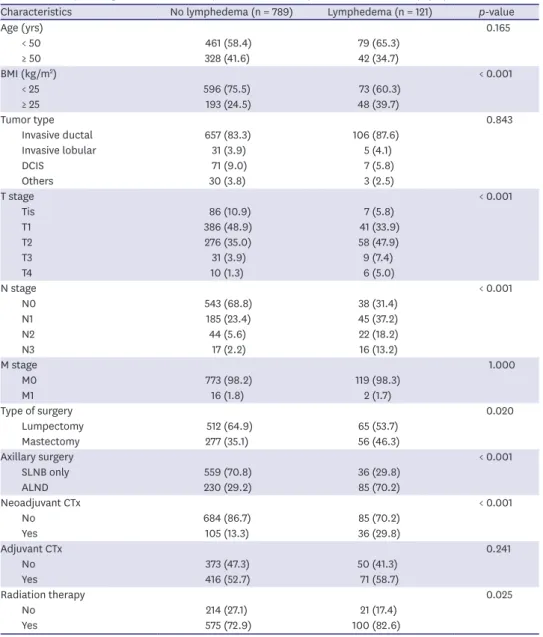
We compared the clinical parameters of patients in the entire cohort who developed and did not develop lymphedema, and identified risk factors associated with the development of lymphedema. The factors significantly associated with lymphedema development included high BMI (p < 0.001), high T stage (p < 0.001), high N stage (p < 0.001), mastectomy (vs.
breast-conserving surgery [BCS]) (p = 0.020), ALND (p < 0.001), neoadjuvant chemotherapy
(p < 0.001), and radiation therapy (p = 0.025; Table 2). On multivariate analysis, high BMI
(p = 0.004), mastectomy (p = 0.024), ALND (p < 0.001), and radiation therapy (p = 0.007)
were significantly associated with lymphedema development (Table 3). We then investigated
how the risk of lymphedema varied according to the number of retrieved LNs using logistic
regression models. In each model, the number of retrieved LNs varied, while the other
clinicopathologic variables remained fixed. We found an association between lymphedema
and the number of retrieved LNs in the entire cohort (Table 4).
To evaluate the association between lymphedema and SLNB, we performed a subgroup analysis of the patients who underwent SLNB (Table 5). In logistic regression analysis, there was no correlation between the number of retrieved LNs during SLNB and the risk of lymphedema (Table 6). The correlations between neoadjuvant chemotherapy and the risk of lymphedema persisted in each model (adjusted odds ratio, 1.906–4.209, p = 0.482).
Finally, using Pearson correlation analysis, we examined the association between the Table 1. Clinicopathologic characteristics of patients according to type of axillary surgery
Characteristics SLNB (n = 595) ALND (n = 315) p-value
Age (yrs) 48.5 ± 10.4 47.6 ± 10.5 0.201
BMI (kg/m
2) 23.1 ± 3.0 23.5 ± 3.3 0.066
Follow-up time (mo) 70.8 ± 8.8 68.8 ± 13.2 0.642
No. of retrieved lymph nodes 4.8 ± 3.1 16.1 ± 7.5 < 0.001
Tumor type < 0.001
Invasive ductal 476 (80.1) 285 (91.1)
Invasive lobular 20 (3.4) 16 (5.1)
DCIS 71 (12.0) 6 (1.9)
Others 27 (4.5) 6 (1.9)
Type of surgery < 0.001
Lumpectomy 418 (70.3) 159 (50.5)
Mastectomy 177 (29.7) 156 (49.5)
T stage < 0.001
Tis 87 (14.6) 6 (1.9)
T1 331 (55.6) 96 (30.5)
T2 169 (28.5) 165 (52.4)
T3 6 (1.0) 34 (10.8)
T4 2 (0.3) 14 (4.4)
N stage < 0.001
N0 534 (89.7) 47 (14.9)
N1 59 (9.9) 173 (54.9)
N2 2 (0.3) 63 (20.0)
N3 0 (0.0) 32 (10.2)
M stage 0.001
M0 590 (99.2) 302 (95.9)
M1 5 (0.8) 13 (4.1)
Neoadjuvant CTx < 0.001
No 553 (92.9) 216 (68.6)
Yes 42 (7.1) 99 (31.4)
Adjuvant CTx < 0.001
No 323 (54.3) 100 (31.7)
Yes 272 (45.7) 215 (68.3)
Radiation therapy 0.395
No 159 (26.7) 76 (24.1)
Yes 436 (73.3) 239 (75.9)
Difference in the arm
*< 0.001
≤ 2 cm 579 (97.3) 274 (87.0)
> 2 cm 16 (2.7) 41 (13.0)
Clinical records
†< 0.001
No 575 (96.3) 246 (78.1)
Yes 22 (3.7) 69 (21.9)
Lymphedema
‡< 0.001
No 559 (93.9) 230 (73.0)
Yes 36 (6.1) 85 (27.0)
Data are shown as mean ± standard deviation or number (%).
SLNB = sentinel lymph node biopsy; ALND = axillary lymph node dissection; BMI = body mass index; DCIS = ductal carcinoma in situ; CTx = chemotherapy.
*
Difference of > 2 cm in the circumference of the arm (either the upper arm or forearm) compared to that of the
contralateral extremity;
†Patients with clinical records for the treatment of lymphedema in the rehabilitation
clinic;
‡Lymphedema was defined as the difference of > 2 cm in the circumference compared to that of the
contralateral extremity (a) or having clinical records for lymphedema treatment in the rehabilitation clinic (b).
number of retrieved LNs and the difference in the circumference of the upper extremities.
No correlation was observed between the number of retrieved LNs and the difference in circumference between the ipsilateral and contralateral upper extremities (correlation coefficient = 0.067, p = 0.111) (Figure 1).
DISCUSSION
In this study, the incidence of lymphedema was 27% in the ALND group and 6% in the SLNB group. After adjusting for other risk factors, the associated risk factors of lymphedema development in the whole cohort were BMI, mastectomy, ALND, and radiation therapy.
Table 2. Clinicopathologic characteristics of patients who developed and did not develop lymphedema
Characteristics No lymphedema (n = 789) Lymphedema (n = 121) p-value
Age (yrs) 0.165
< 50 461 (58.4) 79 (65.3)
≥ 50 328 (41.6) 42 (34.7)
BMI (kg/m
2) < 0.001
< 25 596 (75.5) 73 (60.3)
≥ 25 193 (24.5) 48 (39.7)
Tumor type 0.843
Invasive ductal 657 (83.3) 106 (87.6)
Invasive lobular 31 (3.9) 5 (4.1)
DCIS 71 (9.0) 7 (5.8)
Others 30 (3.8) 3 (2.5)
T stage < 0.001
Tis 86 (10.9) 7 (5.8)
T1 386 (48.9) 41 (33.9)
T2 276 (35.0) 58 (47.9)
T3 31 (3.9) 9 (7.4)
T4 10 (1.3) 6 (5.0)
N stage < 0.001
N0 543 (68.8) 38 (31.4)
N1 185 (23.4) 45 (37.2)
N2 44 (5.6) 22 (18.2)
N3 17 (2.2) 16 (13.2)
M stage 1.000
M0 773 (98.2) 119 (98.3)
M1 16 (1.8) 2 (1.7)
Type of surgery 0.020
Lumpectomy 512 (64.9) 65 (53.7)
Mastectomy 277 (35.1) 56 (46.3)
Axillary surgery < 0.001
SLNB only 559 (70.8) 36 (29.8)
ALND 230 (29.2) 85 (70.2)
Neoadjuvant CTx < 0.001
No 684 (86.7) 85 (70.2)
Yes 105 (13.3) 36 (29.8)
Adjuvant CTx 0.241
No 373 (47.3) 50 (41.3)
Yes 416 (52.7) 71 (58.7)
Radiation therapy 0.025
No 214 (27.1) 21 (17.4)
Yes 575 (72.9) 100 (82.6)
Data are shown as number (%).
BMI = body mass index; DCIS = ductal carcinoma in situ; SLNB = sentinel lymph node biopsy; ALND = axillary
lymph node dissection; CTx = chemotherapy.
The risk factors for lymphedema development have been well described in previous reports [1,2,12]. Extensive surgery (mastectomy or ALND), chemotherapy, especially taxane- based regimens, and radiation therapy were associated with a higher rate of lymphedema.
Furthermore, the association between BMI and lymphedema has been observed in several studies. In those studies, a higher BMI and weight gain after surgery were suggested risk factors for lymphedema development [3,6,12,13], while in some other studies, BMI ≥ 30 kg/m
2was associated with lymphedema [14,15].
The number of retrieved LNs is also often mentioned as a risk factor for lymphedema development. Vicini et al. [16] demonstrated a trend of increased lymphedema development when 4 or more LNs were retrieved, although without statistical significance. Engel et Table 3. Multivariate analysis of factors associated with lymphedema among patients who underwent any axillary surgery (n = 910)
Characteristics Adjusted OR 95% CI p-value
BMI (kg/m
2) 0.004
< 25 1.0 (ref.)
≥ 25 1.873 1.224–2.866
T stage 0.727
Tis, T1 1.0 (ref.)
≥ T2 1.087 0.681–1.735
N stage 0.081
N0 1.0 (ref.)
≥ N1 1.733 0.934–3.213
Type of surgery 0.024
Lumpectomy 1.0 (ref.)
Mastectomy 1.755 1.076–2.864
Axillary surgery < 0.001
SLNB only 1.0 (ref.)
ALND 3.220 1.721–6.023
Neoadjuvant CTx 0.177
No 1.0 (ref.)
Yes 1.405 0.857–2.301
Adjuvant CTx 0.830
No 1.0 (ref.)
Yes 0.944 0.558–1.597
Radiation therapy 0.007
No 1.0 (ref.)
Yes 2.294 1.254–4.195
OR = odds ratio; CI = confidence interval; BMI = body mass index; SLNB = sentinel lymph node biopsy; ALND = axillary lymph node dissection; CTx = chemotherapy.
Table 4. Association between number of retrieved LN and lymphedema in patients with any axillary surgery adjusted for other potential factors (n = 910)
Sets of retrieved LN number
*Adjusted OR 95% CI p-value
≤ 4 1.0 (ref.) 0.503
> 4 1.211 0.451–4.228
≤ 10 1.0 (ref.) 0.023
> 10 1.823 0.881–5.212
≤ 20 1.0 (ref.) 0.003
> 20 2.374 1.451–5.956
≤ 30 1.0 (ref.) 0.001
> 30 3.011 1.870–6.248
LN = lymph node; OR = odds ratio; CI = confidence interval; BMI = body mass index; CTx = chemotherapy.
*
In each set, the number of retrieved lymph nodes varied, while the other clinicopathologic variables remained fixed; Fixed clinicopathologic variables: BMI (< 25 kg/m
2vs. ≥ 25 kg/m
2); type of surgery (lumpectomy vs.
mastectomy); T stage (Tis, T1 vs. ≥T2); neoadjuvant CTx (no vs. yes); adjuvant CTx (no vs. yes); radiation therapy
(no vs. yes).
al. [17] demonstrated that retrieval of 10 or more LNs was significantly associated with lymphedema. In a large population study, the number of retrieved LNs was associated with lymphedema and arm symptoms [12]. Furthermore, Kwan et al. [18] reported that an increase in the number of retrieved LNs was accompanied by a 4.1% increased risk of lymphedema. However, there is no consensus regarding the association between the number of retrieved LNs and lymphedema in patients who underwent SLNB without ALND. Sener et al. [19] demonstrated no association between the number of retrieved LNs and lymphedema in a series of 303 patients who underwent SLNB alone. In contrast, in their series of 1,338 patients, Yen et al. [20] revealed that the number of retrieved LNs was the most significant risk factor for lymphedema development, regardless of the type of axillary surgery. In the most recent study, which included a series of 936 patients [3,6], no association was reported between the number of retrieved LNs and lymphedema. The study concluded that the observed differences in the incidence of lymphedema with SLNB vs. ALND are not simply Table 5. Clinicopathologic characteristics of patients who developed and did not develop lymphedema among patients who underwent SLNB alone (n = 595)
Characteristics No lymphedema (n = 559) Lymphedema (n = 36) p-value
Age (yrs) 0.460
< 50 338 (60.5) 24 (66.7)
≥ 50 221 (39.5) 12 (33.3)
BMI (kg/m
2) 0.080
< 25 429 (76.7) 23 (63.9)
≥ 25 130 (23.3) 13 (36.1)
No. of retrieved lymph nodes 4.8 ± 3.0 5.3 ± 3.3 0.159
Tumor type 0.963
Invasive ductal 449 (80.3) 30 (83.3)
Invasive lobular 19 (3.4) 1 (2.8)
DCIS 67 (12.0) 4 (11.1)
Others 24 (4.3) 1 (2.8)
T stage 0.089
Tis 82 (14.7) 5 (13.9)
T1 312 (55.8) 19 (52.8)
T2 159 (28.4) 10 (27.8)
T3 4 (0.7) 2 (5.6)
T4 2 (0.4) 0 (0)
N stage 0.099
N0 504 (90.2) 30 (83.3)
N1 53 (9.5) 5 (13.9)
N2 2 (0.4) 1 (2.8)
N3 0 (0.0) 0 (0.0)
M stage 0.189
M0 555 (99.3) 35 (97.2)
M1 4 (0.7) 1 (2.8)
Type of surgery 0.627
Lumpectomy 394 (70.5) 24 (66.7)
Mastectomy 165 (29.5) 12 (33.3)
Neoadjuvant CTx 0.039
No 523 (93.6) 30 (83.3)
Yes 36 (6.4) 6 (16.7)
Adjuvant CTx 0.233
No 300 (53.7) 23 (63.9)
Yes 259 (46.3) 13 (36.1)
Radiation therapy 0.883
No 149 (26.7) 10 (27.8)
Yes 410 (73.3) 26 (72.2)
Data are shown as mean ± standard deviation or number (%).
SLNB = sentinel lymph node biopsy; BMI = body mass index; DCIS = ductal carcinoma in situ; CTx = chemotherapy.
related to the number of nodes removed, but that other factors, such as the global disruption of lymphatic channels that occur during ALND, must play a greater role. According to the results of this study, a number of retrieved LNs higher than 10 was associated with lymphedema, while having a number of > 4 but < 10 retrieved LNs was not (Table 4). The mean number of retrieved sentinel LNs in the SLNB only group was 4.8 (Table 1); therefore, the number of retrieved LNs during SLNB was not associated with lymphedema.
Clough et al. [21] suggested a new anatomical classification of the axilla based on the intersection of 2 anatomical landmarks, the lateral thoracic vein and the second intercostobrachial nerve. They found that 98.2% of sentinel nodes were in the medial part of
Total LN
Differ ence in cir cumfer ence
−4
0 5 10 15 20
20 18 16 14 12 10 8 6 4 2 0
−2
Correlation coefficient = 0.067, p = 0.111
Figure 1. Correlation of the difference in the circumference of affected and non-affected upper extremities and the total number of LNs retrieved (correlation coefficient = 0.067, p = 0.111).
LN = lymph node.
Table 6. Association between number of retrieved LN and lymphedema in patients who underwent SLNB alone adjusted for other potential factors (n = 595)
Sets of retrieved LN number
*Adjusted OR 95% CI p-value
≤ 2 1.0 (ref.) 0.906
> 2 0.896 0.155–5.176
≤ 3 1.0 (ref.) 0.843
> 3 1.114 0.383–3.246
≤ 4 1.0 (ref.) 0.999
> 4 1.001 0.257–3.905
≤ 5 1.0 (ref.) 0.889
> 5 0.917 0.270–3.118
≤ 6 1.0 (ref.) 0.897
> 6 0.905 0.198–4.125
LN = lymph node; SLNB = sentinel lymph node biopsy; OR = odds ratio; CI = confidence interval; BMI = body mass index; CTx = chemotherapy.
*
In each set, the number of retrieved lymph nodes varied, while the other clinicopathologic variables remained fixed; Fixed clinicopathologic variables: BMI (< 25 kg/m
2vs. ≥ 25 kg/m
2); type of surgery (lumpectomy vs.
mastectomy); T stage (Tis, T1 vs. ≥T2); neoadjuvant CTx (no vs. yes); adjuvant CTx (no vs. yes); radiation therapy
(no vs. yes).
the axilla, along the lateral thoracic vein. They recommended that, unless highly suspicious, lateral dissection and harvesting of lateral palpable non-sentinel nodes should be avoided, because the dominant node draining the arm is usually situated in the lateral pillar of the axilla, underneath the axillary vein and above the second intercostobrachial nerve [21]. This study suggested that rather than the number of sentinel nodes, the extent of surgery, especially in the lateral axilla, could contribute more to the development of arm lymphedema after surgery.
Retrieving an optimal number of SLNs enables accurate staging and appropriate adjuvant treatments. Studies reported that more retrieved SLNs correlated with a lower false negative rate. In the NSABP B-32 trial, removing 2, rather than 1, SLNs reduces the false negative rate from 17.7% to 10% [7]. Chagpar et al. [8] reported that removing 3, rather than 1, SLNs reduces the false negative rate by less than half. In addition, Ban et al. [22] and Yi et al. [23]
reported that up to 100% of metastatic SLNs were identified with the first 4 or 5 retrieved SLNs. Therefore, combined with the results that no correlation existed between the number of retrieved SLNs and lymphedema, these results suggest that surgeons can excise more than 1 or 2 sentinel nodes if they are suspicious, without worrying about lymphedema.
As mentioned earlier, BMI is a well-described risk factor for lymphedema development. One study conducted on patients who underwent SLNB only, also identified BMI as a significant risk factor [24]. In our study, BMI was found to be a risk factor for lymphedema in the whole cohort analysis; however, it was unrelated to lymphedema in the SLNB group analysis.
ALND and SLNB are procedures that differ in their aims and scope of excision; therefore, the incidence of lymphedema and associated risk factors are expected to be different. On the other hand, neoadjuvant chemotherapy is generally considered to increase the rate of BCS and reduce the incidence of lymphedema through nodal downstaging [25]. However, there have been concerns that altered lymphatic drainage after neoadjuvant chemotherapy would cause a high false negative rate of SLNB. Therefore, surgeons should be careful while opting for SLNB after neoadjuvant chemotherapy in patients, especially those with clinically LN- positive disease. Furthermore, there have been reports of a high incidence of lymphedema in groups that have undergone neoadjuvant chemotherapy [26], as well as one report in which a neoadjuvant chemotherapy group showed a higher incidence of persistent lymphedema compared to the adjuvant chemotherapy group [25]. In our study, neoadjuvant chemotherapy was revealed to be a risk factor in the group that underwent SLNB only. One possible mechanism is that chemo-agents cause generalized swelling by increasing the interstitial extracellular fluid compartment and fibrotic change of lymphatics. Another possible explanation is that surgeons may dissect more LNs in neoadjuvant chemotherapy patients to reduce the false negative rate of SLNB. Indeed, our data demonstrated that the number of retrieved sentinel LNs in the neoadjuvant chemotherapy group was marginally higher than in the non-neoadjuvant chemotherapy group (4.7 ± 3.1 vs. 6.1 ± 3.8, p = 0.066). Further studies of large populations with long term follow up data are warranted to identify the risk factors for lymphedema in patients with SLNB after neoadjuvant chemotherapy.
The criteria for lymphedema diagnosis are debatable. To date, various methods, including
circumferential tape measurement, perometry, water displacement, and relative volume
change have been introduced for objective lymphedema measurements [2]. In addition,
several studies and guidelines have suggested the use of subjective symptom evaluation,
regardless of the objective change in the affected upper extremities, for a more accurate
diagnosis [2,27,28]. Therefore, we integrated both the objective measurement of the
upper extremities and the subjective evaluation of symptoms to assess the incidence of
lymphedema. In the SLNB group, 2.7% of patients (16/595) had lymphedema on objective measurement and 3.7% (22/595) had lymphedema on subjective symptom evaluation, while the corresponding values in the ALND group were 13.0% (41/315) and 21.9% (69/315), respectively. In addition, only 9.1% of patients (2/22) with subjective symptoms had a circumference difference of more than 2 cm in the SLNB group, while the corresponding value in the ALND group was 36.2% (25/69). A difference in the results between subjective and objective assessments of lymphedema has also been observed in other studies.
Furthermore, this finding was more pronounced in patients who underwent SLNB [28].
Among the various methods used for objective lymphedema measurements, circumferential measurements with a non-stretch tape are most commonly used, owing to their low cost, easy accessibility, and reliability [2]. However, there is criticism that using the absolute circumference change in the ipsilateral upper extremity compared to baseline as a diagnostic criterion for lymphedema does not reflect the change in body size [29]. In this study, we assessed lymphedema by using the difference in the circumference of the affected and non- affected upper extremities, and not by the circumference change compared to the baseline value. However, the difference in circumference of both the upper extremities is also criticized for being considered as the existing preoperative volume difference between both upper extremities. In one study, there was already a significant volume difference in both upper extremities at baseline measurements in 30% of the enrolled patients. Ideally, assessment of both the absolute circumference change and the difference between both upper extremities for body change compensation is needed to improve the diagnosis of lymphedema.
This study has several limitations. First, several studies have highlighted the importance of baseline measurements for lymphedema measurement, but these preoperative baseline measurements were not made in our study [6]. Second, in this study, arm circumference was measured after 1 postoperative year, which could be criticized, given that 25% of lymphedema is reported to occur after 3 postoperative years [30]. Third, we evaluated subjective symptoms through a review of clinical records, without administering a questionnaire. However, since interviews and patient education can increase awareness of lymphedema, leading patients to mistake other symptoms for lymphedema symptoms [13], our method can be considered to have only evaluated true symptoms.
In conclusion, the risk factors for lymphedema development after breast cancer surgery and adjuvant treatment are multifactorial. We demonstrated that BMI, type of surgery, ALND, and radiation therapy were significant risk factors for lymphedema development in the entire cohort. In the SLNB alone group, which has a small number of retrieved LNs, neoadjuvant chemotherapy was more related to lymphedema than the number of retrieved sentinel LNs.
REFERENCES
1. Hayes SC, Janda M, Cornish B, Battistutta D, Newman B. Lymphedema after breast cancer: incidence, risk factors, and effect on upper body function. J Clin Oncol 2008;26:3536-42.
PUBMED | CROSSREF
2. McLaughlin SA, Staley AC, Vicini F, Thiruchelvam P, Hutchison NA, Mendez J, et al. Considerations for clinicians in the diagnosis, prevention, and treatment of breast cancer-related lymphedema:
recommendations from a multidisciplinary expert ASBrS panel : part 1: definitions, assessments, education, and future directions. Ann Surg Oncol 2017;24:2818-26.
PUBMED | CROSSREF
3. Goldberg JI, Wiechmann LI, Riedel ER, Morrow M, Van Zee KJ. Morbidity of sentinel node biopsy in breast cancer: the relationship between the number of excised lymph nodes and lymphedema. Ann Surg Oncol 2010;17:3278-86.
PUBMED | CROSSREF
4. Giuliano AE, Ballman KV, McCall L, Beitsch PD, Brennan MB, Kelemen PR, et al. Effect of axillary dissection vs no axillary dissection on 10-year overall survival among women with invasive breast cancer and sentinel node metastasis: the ACOSOG Z0011 (Alliance) randomized clinical trial. JAMA 2017;318:918-26.
PUBMED | CROSSREF
5. Galimberti V, Cole BF, Zurrida S, Viale G, Luini A, Veronesi P, et al. Axillary dissection versus no axillary dissection in patients with sentinel-node micrometastases (IBCSG 23-01): a phase 3 randomised controlled trial. Lancet Oncol 2013;14:297-305.
PUBMED | CROSSREF
6. McLaughlin SA, Wright MJ, Morris KT, Giron GL, Sampson MR, Brockway JP, et al. Prevalence of lymphedema in women with breast cancer 5 years after sentinel lymph node biopsy or axillary dissection:
objective measurements. J Clin Oncol 2008;26:5213-9.
PUBMED | CROSSREF
7. Krag DN, Anderson SJ, Julian TB, Brown AM, Harlow SP, Ashikaga T, et al. Technical outcomes of sentinel-lymph-node resection and conventional axillary-lymph-node dissection in patients with clinically node-negative breast cancer: results from the NSABP B-32 randomised phase III trial. Lancet Oncol 2007;8:881-8.
PUBMED | CROSSREF
8. Chagpar AB, Scoggins CR, Martin RC 2nd, Carlson DJ, Laidley AL, El-Eid SE, et al. Are 3 sentinel nodes sufficient? Arch Surg 2007;142:456-9.
PUBMED | CROSSREF
9. Zakaria S, Degnim AC, Kleer CG, Diehl KA, Cimmino VM, Chang AE, et al. Sentinel lymph node biopsy for breast cancer: how many nodes are enough? J Surg Oncol 2007;96:554-9.
PUBMED | CROSSREF
10. Lynch MA, Jackson J, Kim JA, Leeming RA. Optimal number of radioactive sentinel lymph nodes to remove for accurate axillary staging of breast cancer. Surgery 2008;144:525-31.
PUBMED | CROSSREF
11. Han A, Moon HG, Kim J, Ahn SK, Park IA, Han W, et al. Reliability of sentinel lymph node biopsy after neoadjuvant chemotherapy in breast cancer patients. J Breast Cancer 2013;16:378-85.
PUBMED | CROSSREF
12. Ahmed RL, Schmitz KH, Prizment AE, Folsom AR. Risk factors for lymphedema in breast cancer survivors, the Iowa Women's Health Study. Breast Cancer Res Treat 2011;130:981-91.
PUBMED | CROSSREF
13. McLaughlin SA, Wright MJ, Morris KT, Sampson MR, Brockway JP, Hurley KE, et al. Prevalence of lymphedema in women with breast cancer 5 years after sentinel lymph node biopsy or axillary dissection:
patient perceptions and precautionary behaviors. J Clin Oncol 2008;26:5220-6.
PUBMED | CROSSREF
14. Ridner SH, Dietrich MS, Stewart BR, Armer JM. Body mass index and breast cancer treatment-related lymphedema. Support Care Cancer 2011;19:853-7.
PUBMED | CROSSREF
15. Donker M, van Tienhoven G, Straver ME, Meijnen P, van de Velde CJ, Mansel RE, et al. Radiotherapy or surgery of the axilla after a positive sentinel node in breast cancer (EORTC 10981-22023 AMAROS): a randomised, multicentre, open-label, phase 3 non-inferiority trial. Lancet Oncol 2014;15:1303-10.
PUBMED | CROSSREF
16. Vicini F, Shah C, Lyden M, Whitworth P. Bioelectrical impedance for detecting and monitoring patients for the development of upper limb lymphedema in the clinic. Clin Breast Cancer 2012;12:133-7.
PUBMED | CROSSREF
17. Engel J, Kerr J, Schlesinger-Raab A, Sauer H, Hölzel D. Axilla surgery severely affects quality of life: results of a 5-year prospective study in breast cancer patients. Breast Cancer Res Treat 2003;79:47-57.
PUBMED | CROSSREF
18. Kwan ML, Darbinian J, Schmitz KH, Citron R, Partee P, Kutner SE, et al. Risk factors for lymphedema in a prospective breast cancer survivorship study: the Pathways Study. Arch Surg 2010;145:1055-63.
PUBMED | CROSSREF
19. Sener SF, Winchester DJ, Martz CH, Feldman JL, Cavanaugh JA, Winchester DP, et al. Lymphedema after sentinel lymphadenectomy for breast carcinoma. Cancer 2001;92:748-52.
PUBMED | CROSSREF
20. Yen TW, Fan X, Sparapani R, Laud PW, Walker AP, Nattinger AB. A contemporary, population-based study of lymphedema risk factors in older women with breast cancer. Ann Surg Oncol 2009;16:979-88.
PUBMED | CROSSREF
21. Clough KB, Nasr R, Nos C, Vieira M, Inguenault C, Poulet B. New anatomical classification of the axilla with implications for sentinel node biopsy. Br J Surg 2010;97:1659-65.
PUBMED | CROSSREF
22. Ban EJ, Lee JS, Koo JS, Park S, Kim SI, Park BW. How many sentinel lymph nodes are enough for accurate axillary staging in t1-2 breast cancer? J Breast Cancer 2011;14:296-300.
PUBMED | CROSSREF
23. Yi M, Meric-Bernstam F, Ross MI, Akins JS, Hwang RF, Lucci A, et al. How many sentinel lymph nodes are enough during sentinel lymph node dissection for breast cancer? Cancer 2008;113:30-7.
PUBMED | CROSSREF
24. Helyer LK, Varnic M, Le LW, Leong W, McCready D. Obesity is a risk factor for developing postoperative lymphedema in breast cancer patients. Breast J 2010;16:48-54.
PUBMED | CROSSREF
25. Jung SY, Shin KH, Kim M, Chung SH, Lee S, Kang HS, et al. Treatment factors affecting breast cancer- related lymphedema after systemic chemotherapy and radiotherapy in stage II/III breast cancer patients.
Breast Cancer Res Treat 2014;148:91-8.
PUBMED | CROSSREF
26. Specht MC, Miller CL, Skolny MN, Jammallo LS, O'Toole J, Horick N, et al. Residual lymph node disease after neoadjuvant chemotherapy predicts an increased risk of lymphedema in node-positive breast cancer patients. Ann Surg Oncol 2013;20:2835-41.
PUBMED | CROSSREF
27. Mansel RE, Fallowfield L, Kissin M, Goyal A, Newcombe RG, Dixon JM, et al. Randomized multicenter trial of sentinel node biopsy versus standard axillary treatment in operable breast cancer: the ALMANAC Trial. J Natl Cancer Inst 2006;98:599-609.
PUBMED | CROSSREF
28. Lucci A, McCall LM, Beitsch PD, Whitworth PW, Reintgen DS, Blumencranz PW, et al. Surgical complications associated with sentinel lymph node dissection (SLND) plus axillary lymph node dissection compared with SLND alone in the American College of Surgeons Oncology Group Trial Z0011.
J Clin Oncol 2007;25:3657-63.
PUBMED | CROSSREF
29. Armer JM. The problem of post-breast cancer lymphedema: impact and measurement issues. Cancer Invest 2005;23:76-83.
PUBMED | CROSSREF
30. Petrek JA, Senie RT, Peters M, Rosen PP. Lymphedema in a cohort of breast carcinoma survivors 20 years after diagnosis. Cancer 2001;92:1368-77.
PUBMED | CROSSREF