RESEARCH ARTICLE
Received: November 21, 2017, Revised: January 5, 2018, Accepted: January 17, 2018 ISSN 2233-7679 (Online)
†
Correspondence to: Yunhee Lee
Department of Dental Hygiene, Kyungbok University, 154 Sinpyeong-ro, Sinbuk-myeon, Pocheon 11138, Korea Tel: +82-31-539-5339, Fax: +82-31-539-5348, E-mail: [email protected]
Copyright © 2018 by Journal of Dental Hygiene Science
The Relationship between Hormone Replacement Therapy and Periodontal Disease in Postmenopausal Women
Eunsuk Ahn and Yunhee Lee †
Department of Dental Hygiene, Kyungbok University, Pocheon 11138, Korea
The purpose of this study was to investigate the relationship between hormone replacement therapy (HRT) and periodontal disease in postmenopausal women using data from the 4th and 5th Korea National Health and Nutrition Examination Survey. A total of 5,482 postmenopausal women aged 45∼75 years were included as study subjects in the final analysis. The HRT group comprised 1,035 postmenopausal women who had received HRT for at least one month, and the non-HRT group comprised 4,447 postmenopausal women who did not receive HRT. The chi-square test was used to confirm the bivariate relationship between the variables. Multinomial logistic regression analysis was used to adjust for covariance (age, education, family income, body mass index, age of menopause, alcohol, smoking, dental visit <1 per year, use of oral care products, and frequency of tooth brushing per day). After adjusting for all covariates, HRT was found to be associated with periodontal disease.
In particular, the relationship between HRT and periodontal disease was more evident in older women and women younger than 45 years of menopausal age. The relationship between HRT and periodontal disease was stronger in women who brushed their teeth less than 3 times per day, women without regular oral examination, and women who did not use oral hygiene products. The results of this study confirmed the importance of actively considering hormone therapy when determining policy recommendations for postmenopausal women. Especially, health programs such as HRT, regular dental examination, and oral care are needed for older women who have undergone premature menopause.
Key Words: Hormone replacement therapy, Menopause, Periodontal diseases
Introduction
The World Health Organization (WHO) has defined natural menopause as 12 months of continued amenorrhea without clear reasons such as pregnancy or breastfeeding 1) . Korean women’s life expectancy in 2015 was 85.2 years, 6.2 longer than men’s life expectancy of 79.0 2) . The average menopausal age is 49.7, and women spend 35.5 years, more than a third of their life, in a postmenopausal state 3) . According to Statistic Korea, postmenopausal women aged 50 years or older were estimated to account for 34.8% of all women in Korea in 2015 4) , and it is estimated that 43.2% of the women will be postmenopausal in 2030 5) . While menopause is a natural phenomenon that
occurs due to aging, the risk of osteoporotic, cardiova-
scular, and other diseases increases for women after
menopause 6) . In addition, menopause is known to affect
the oral environment, and changes in sex hormones such
as estrogen, progesterone, and testosterone have an effect
on the release of proinflammatory cytokines, which are
involved in bone resorption, and can lead to an increase in
the inflammation of periodontal tissues 7) . The oral mucosa
includes estrogen receptors, and it is known that changes
in hormone levels have a direct effect on the oral environ-
ment 8) . According to previous studies, women experience
periodontal disease related to sex hormones over the course
of decades in their life due to puberty, menstruation,
pregnancy, and menopause 9,10) .
The need for hormone replacement therapy (HRT) was raised to alleviate climacteric symptoms related to meno- pause and to improve women’s quality of life 11) . HRT decreases the loss of bone mass and plays an important role in preventing osteoporosis after menopause 12) . Pre- vious studies showed that HRT had a positive effect on preserving alveolar bone density and the number of teeth 13,14) . Similarly, when estrogen was administered to mice, the hormone was effective in preventing the loss of alveolar bone, which is caused by estrogen deficiency 15) . Meanwhile, there are conflicting reports on the degree to which HRT affects the periodontal tissue and its effect on the depth of periodontal pockets 16,17) .
These previous research findings present an association between HRT and periodontal disease in women after menopause. However, the findings are not consistent, and few studies have used representative data to analyze the association between HRT and periodontal disease. In this regard, this study aims to identify the relationship between HRT and the risk of periodontal disease in Korean postmenopausal women, as well as provide basic data to establish policies for preventing periodontal disease in postmenopausal women.
Materials and Methods
1. Subjects
First, it was necessary to define natural menopause in order to limit the subjects to postmenopausal women.
Natural menopause is defined as 12 months of continued amenorrhea without clear reasons such as pregnancy or breastfeeding 1) . Therefore, this study limited its subjects to women who were aged 45 to 75 years, based on the postmenopausal period defined by the Korean Society of Menopause, and who responded that they had natural menopause. This study excluded those who responded that they had artificial menopause due to a hysterectomy, those who were diagnosed by a doctor with diabetes, which is closely correlated to periodontal disease, and those who did not provide 1 or more responses in a questionnaire.
Questions on the age at which they began HRT and the HRT period were removed in the 5th Korea National Health and Nutrition Examination Survey (KNHANES)
(2010∼2012), so results for those questions were only included from the 4th KNHANES (2007∼2009). The total number of participants in the 4th and 5th KNHANES (those in 2011 were excluded due to an error in measure- ments among periodontal disease survey researchers) was 41,887, and among them, 5,482 were included as the final subjects. The subjects were 5,482 postmenopausal women;
1,035 who responded that they had taken female hormones for at least more than a month and 4,447 who said they had not. This study obtained and used approval for the exem- ption of a bioethics review from the Institution Bioethics Committee of Hanyang University (HYI-16-195).
2. Variables used for analysis
This study re-categorized the community periodontal index of treatment needs (CPITN), which is indicated on a scale of 0 to 4, into healthy periodontal tissue (0), gi- ngivitis (1∼2), and periodontitis (3∼4), and used these factors as dependent variables. The independent variables included previous administration of HRT (HRT+/HRT−), body mass index (BMI) (normal/obese), and age of meno- pause (younger than 45 years/45∼50 years/51 years or older). In addition, this study also included general charac- teristics such as age (45∼54 years/55∼64 years/65∼74 years), education (elementary and below/middle/high and above), and family income (low/middle low/middle upper/
upper); lifestyle habits such as alcohol (no/past/drinking) and smoking (no/yes); and the status of oral care such as dental visit in the per year (yes/no), use of oral care products (yes/no), and frequency of tooth brushing per day (less than 3 times/3 times or more).
3. Analysis method
Considering that the KNHANES was a survey using a
composite sampling design, this study generated a plan
file before analysis and analyzed the composite sampling
design. This study used the estimated variance stratum as
the stratification variable, the surveyed district as the
cluster variable, and a sampling frame as the weight; to
adjust for coverage error arising from a gap between
households and the population at the time of a survey and
non-response error caused by non-participation in the
survey, this study used correlation analysis weights and
Table 1. General Characteristics of the Study Population (n=5,482)
Characteristic Group n (weighted %)
HRT status HRT− 4,447 (81.2)
HRT+ 1,035 (18.8)
Age (y) 45∼54 1,256 (29.7)
55∼64 2,241 (42.0)
65∼74 1,985 (28.3)
Education Elementary and below 3,245 (54.5)
Middle 911 (18.5)
High and above 1,326 (27.0)
Family income
aLow 1,757 (27.7)
Middle low 1,517 (28.6)
Middle upper 1,118 (21.8)
Upper 1,090 (21.9)
Body mass index
bNormal 3,317 (60.9)
Obese 2,165 (39.1)
Age of menopause (y) <45 800 (14.1)
45∼50 1,863 (45.7)
≥51 2,819 (40.2)
Alcohol No 1,725 (29.3)
Past 2,317 (41.9)
Drinking 1,440 (28.7)
Smoking No 5,090 (91.6)
Yes 392 (8.4)
Dental visit <1 year No 4,272 (77.5)
Yes 1,210 (22.5)
Use of oral care products
No 3,964 (71.0)
Yes 1,518 (29.0)
Frequency of tooth brushing per day
<3 times 3,460 (62.4)
≥3 times 2,022 (37.6)
HRT: hormone replacement therapy.
a
Income quartile.
bAsia-Pacific Standard: normal, less than 25 kg/m
2; obese, more than 25 kg/m
2.
calculated new weights. When cases were deleted, com- posite sampling information included in the deleted data could be missing and create a biased estimator of the standard deviation; this study generated the focus group and other groups and then analyzed them. All analyses were performed using IBM SPSS Statistics ver. 22.0 (IBM Co., Armonk, NY, USA). To identify the subjects’ basic information, this study used a frequency analysis and descriptive statistics. To identify HRT differences depen- ding on demographic characteristics, lifestyle habits, and oral care, the chi-squared test was used. In addition, multinomial logistic regression analysis was conducted to identify the association between HRT and the risk of periodontal disease, and the adjusted odds ratio (adjusted OR) and 95% confidence interval (CI) were calculated.
p-values <0.05 were considered to indicate statistical significance.
Results
1. General characteristics of the subjects
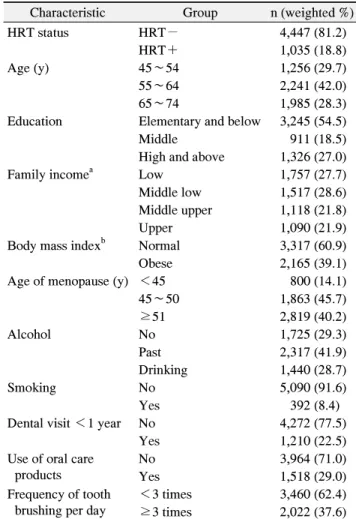
Among all 5,482 subjects, 81.2% were in the non-HRT group of women who said they had never had HRT, and 18.8% were in in the HRT group of women who said they had; the percentage of the non-HRT group was higher. For age groups, 42.0% were “55∼64 years”, 29.7%, “45∼54 years”, and 28.3%, “65∼74 years”. For education, “ele- mentary and below” accounted for more than half of the subjects 54.5%. For family income, “middle low” acco- unted for 28.6% and “low” accounted for 27.7%. For the age of menopause, “45∼50 years” accounted for the highest percentage 45.7%. For drinking, “past” accounted for the highest percentage 41.9%, and for smoking, “no”
accounted for the highest percentage 91.6%. For frequency of tooth brushing per day, “less than 3 times” accounted for 62.4%, and “3 times or more” for 37.6% (Table 1).
2. HRT status based on general characteristics, lifestyle habits, and oral care
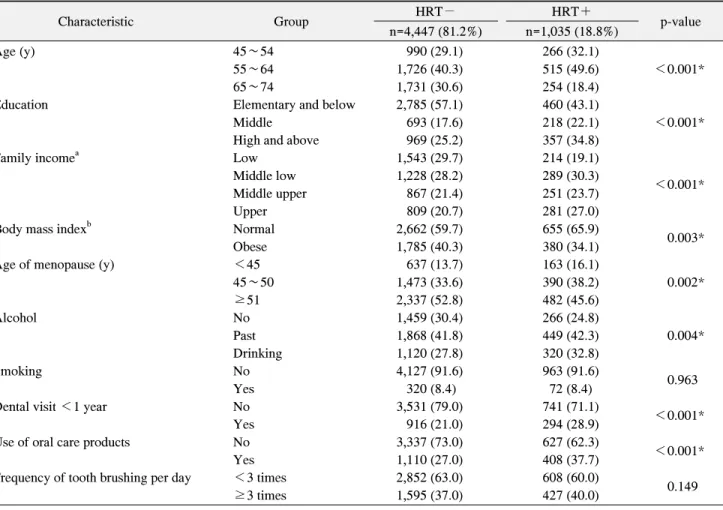
Depending on HRT, there were significant differences in age, education, family income, BMI, age of menopause, drinking, dental visit in the past 1 year, and use of oral care products (p<0.05). In both the HRT and non-HRT
groups, those aged “55∼64 years” accounted for the highest percentage, but there were differences in other age groups; 32.1% were aged “45∼54 years” years in the HRT group, whereas 30.6% were aged “65∼74 years”
years in the non-HRT group. For family income, the HRT group had a relatively higher family income level than the non-HRT group (Table 2).
3. Variables that had an effect on periodontal status
Table 3 shows the results of a multinomial logistic
regression analysis conducted to identify which variables
including HRT, general characteristics, lifestyle habits,
and oral care, had an effect on periodontal status. When
adjusting for all other variables, the non-HRT group had
Table 2. HRT Status Based on General Characteristics (n=5,482)
Characteristic Group HRT− HRT+
p-value n=4,447 (81.2%) n=1,035 (18.8%)
Age (y) 45∼54 990 (29.1) 266 (32.1)
<0.001*
55∼64 1,726 (40.3) 515 (49.6)
65∼74 1,731 (30.6) 254 (18.4)
Education Elementary and below 2,785 (57.1) 460 (43.1)
<0.001*
Middle 693 (17.6) 218 (22.1)
High and above 969 (25.2) 357 (34.8)
Family income
aLow 1,543 (29.7) 214 (19.1)
<0.001*
Middle low 1,228 (28.2) 289 (30.3)
Middle upper 867 (21.4) 251 (23.7)
Upper 809 (20.7) 281 (27.0)
Body mass index
bNormal 2,662 (59.7) 655 (65.9)
0.003*
Obese 1,785 (40.3) 380 (34.1)
Age of menopause (y) <45 637 (13.7) 163 (16.1)
0.002*
45∼50 1,473 (33.6) 390 (38.2)
≥51 2,337 (52.8) 482 (45.6)
Alcohol No 1,459 (30.4) 266 (24.8)
0.004*
Past 1,868 (41.8) 449 (42.3)
Drinking 1,120 (27.8) 320 (32.8)
Smoking No 4,127 (91.6) 963 (91.6)
0.963
Yes 320 (8.4) 72 (8.4)
Dental visit <1 year No 3,531 (79.0) 741 (71.1) <0.001*
Yes 916 (21.0) 294 (28.9)
Use of oral care products No 3,337 (73.0) 627 (62.3)
<0.001*
Yes 1,110 (27.0) 408 (37.7)
Frequency of tooth brushing per day <3 times 2,852 (63.0) 608 (60.0)
0.149
≥3 times 1,595 (37.0) 427 (40.0)
Values are presented as n (weighted %).
HRT: hormone replacement therapy.
*p<0.05.
a
Income quartile.
bAsia-Pacific Standard: normal, less than 25 kg/m
2; obese, more than 25 kg/m
2.
an adjusted OR of 1.27 (95% CI, 1.01∼1.58) to progress into gingivitis compared to the HRT group, and an adjusted OR of 1.40 (95% CI, 1.10∼1.76) to progress into periodontitis. Those aged “45∼54 years” had an adjusted OR of 1.40 (95% CI, 1.05∼1.87) to progress into gingi- vitis compared to those aged “65∼74 years”. Those with an education level of “elementary and below” had an adjusted OR of 1.41 (95% CI, 1.07∼1.85) to progress into gingivitis compared to those with an education level “high and above”, and an adjusted OR of 1.46 (95% CI, 1.11∼
1.93) to progress into periodontitis. Those who were
“obese” had an adjusted OR of 1.28 (95% CI, 1.05∼1.57) to progress into periodontitis compared to those who were
“normal”. For smoking, those who responded “yes” had
an adjusted OR of 1.51 (95% CI, 1.01∼2.27) to progress
into periodontitis. For dental visit in the past 1 year, those
who responded “no” had an adjusted OR of 1.59 (95% CI,
1.26∼1.99) to progress into gingivitis. For use of oral care
products, those who responded “no” had an adjusted OR
of 1.61 (95% CI, 1.29∼2.01) to progress into perio-
dontitis. For frequency of tooth brushing per day, those
who brushed “less than 3 times” a day had an adjusted OR
of 1.22 (95% CI, 1.00∼1.49) to progress into gingivitis,
and an adjusted OR of 1.30 (95% CI, 1.08∼1.58) to
progress into periodontitis.
Table 3. Periodontal Status Based on HRT, General Characteristics, Lifestyle Habits, and Oral Care (n=5,482)
Characteristic Group CPITN 1∼2 CPITN 3∼4
aOR (95% CI) aOR (95% CI)
HRT HRT− 1.27 (1.01∼1.58)* 1.40 (1.10∼1.76)*
HRT+ 1.00 1.00
Age (y) 45∼54 1.40 (1.05∼1.87)* 0.99 (0.75∼1.34)
55∼64 1.10 (0.87∼1.39) 1.13 (0.90∼1.42)
65∼74 1.00 1.00
Education Elementary and below 1.41 (1.07∼1.85)* 1.46 (1.11∼1.93)*
Middle 1.13 (0.84∼1.51) 0.99 (0.73∼1.37)
High and above 1.00 1.00
Family income
aLow 0.90 (0.67∼1.21) 1.20 (0.88∼1.64)
Middle low 0.86 (0.64∼1.16) 1.23 (0.91∼1.65)
Middle upper 0.99 (0.74∼1.33) 1.27 (0.96∼1.70)
Upper 1.00 1.00
Body mass index
bObese 1.07 (0.87∼1.32) 1.28 (1.05∼1.57)*
Normal 1.00 1.00
Age of menopause (y) <45 0.89 (0.69∼1.14) 1.03 (0.77∼1.38)
45∼50 1.05 (0.85∼1.30) 1.15 (0.92∼1.43)
≥51 1.00 1.00
Alcohol No 0.91 (0.71∼1.17) 0.90 (0.70∼1.16)
Past 0.95 (0.76∼1.19) 0.93 (0.74∼1.17)
Drinking 1.00 1.00
Smoking No 1.00 1.00
Yes 1.04 (0.71∼1.52) 1.51 (1.01∼2.27)*
Dental visit <1 year No 1.59 (1.26∼1.99)* 1.12 (0.87∼1.44)
Yes 1.00 1.00
Use of oral care products No 1.22 (0.98∼1.51) 1.61 (1.29∼2.01)*
Yes 1.00 1.00
Frequency of tooth brushing per day <3 times 1.22 (1.00∼1.49)* 1.30 (1.08∼1.58)*
≥3 times 1.00 1.00
p-values were analyzed by multinomial logistic regression.
HRT: hormone replacement therapy, CPITN: community periodontal index of treatment needs, CPITN 1∼2: gingivitis, CPITN 3∼4:
periodontitis, aOR: adjusted odds ratio, CI: confidence interval.
*p<0.05.
a
Income quartile.
bAsia-Pacific Standard: normal, less than 25 kg/m
2; obese, more than 25 kg/m
2.
4. HRT’s effect on periodontal status depending on age, age of menopause, and oral care
Table 4 shows the results of a multinomial logistic regression analysis conducted to identify HRT’s effect on periodontal status depending on age, age of menopause, and oral care after stratifying each variable and applying it to each model. When adjusting for other factors, those aged “65∼74 years” in the non-HRT group had an adjusted OR of 2.36 (95% CI, 1.52∼3.68) to progress into gingivitis compared to those in the HRT group, and an adjusted OR of 2.63 (95% CI, 1.69∼4.07) to progress into periodontitis. For age of menopause, those who had meno-
pause at “age 45 years or less” in the non-HRT group had an adjusted OR of 1.49 (95% CI, 1.08∼2.06) to progress into gingivitis compared to those in the HRT group, and an adjusted OR of 1.58 (95% CI, 1.14∼2.19) to progress into periodontitis.
For dental visit in the past 1 year, those who responded
“no” in the non-HRT group had an adjusted OR of 1.38
(95% CI, 1.06∼1.80) to progress into gingivitis compared
to those in the HRT group, and an adjusted OR of 1.60
(95% CI, 1.21∼2.11) to progress into periodontitis. For
use of oral care products, those who responded “no” in the
non-HRT group had an adjusted OR of 1.46 (95% CI, 1.03∼
Table 4. The Relationship between HRT and CPITN by Age, Age of Menopause, and Oral Care (n=5,482)
Stratum
CPITN
0 1∼2 3∼4
aOR aOR (95% CI) aOR (95% CI)
Age (y)
a45∼54 1.00 0.86 (0.57∼1.30) 1.03 (0.65∼1.64) 55∼64 1.00 1.23 (0.88∼1.71) 1.25 (0.89∼1.77) 65∼74 1.00 2.36 (1.52∼3.68)*** 2.63 (1.69∼4.07)***
Age of menopause (y)
b<45 1.00 1.49 (1.08∼2.06)** 1.58 (1.14∼2.19)**
45∼50 1.00 1.05 (0.72∼1.52) 1.11 (0.74∼1.65) ≥51 1.00 0.99 (0.58∼1.69) 1.61 (0.90∼2.87) Dental visit <1 year
cNo 1.00 1.38 (1.06∼1.80)* 1.60 (1.21∼2.11)**
Yes 1.00 1.11 (0.74∼1.66) 0.97 (0.65∼1.44) Use of oral care products
dNo 1.00 1.38 (0.99∼1.92) 1.46 (1.03∼2.08)*
Yes 1.00 1.20 (0.89∼1.63) 1.32 (0.97∼1.80) Frequency of tooth brushing per day
e<3 1.00 1.27 (0.93∼1.74) 1.40 (1.02∼1.91)*
≥3 1.00 1.26 (0.89∼1.77) 1.35 (0.94∼1.95) p-values were analyzed by multinomial logistic regression.
CPITN: community periodontal index of treatment needs, CPITN 1∼2: gingivitis, CPITN 3∼4: periodontitis, aOR:
adjusted odds ratio, CI: confidence interval.
*p<0.05, **p<0.01, ***p<0.001.
a
Adjusted for education, family income, body mass index (BMI), age of menopause, alcohol, smoking, dental visit <1 per year, use of oral care products, and frequency of tooth brushing per day.
b
Adjusted for age, education, family income, BMI, alcohol, smoking, dental visit <1 per year, use of oral care products, and frequency of tooth brushing per day.
c
Adjusted for age, education, family income, BMI, age of menopause, alcohol, smoking, use of oral care products, and frequency of tooth brushing per day.
d
Adjusted for age, education, family income, BMI, age of menopause, alcohol, smoking, dental visit <1 per year, and frequency of tooth brushing per day.
e