REVIEW ARTICLE
대장정결액의 변화와 새로운 발전
박정배, 이용국, 양창헌
동국대학교 의과대학 내과학교실
The Evolution of Bowel Preparation and New Developments
Jeong Bae Park, Yong Kook Lee and Chang Heon Yang
Department of Internal Medicine, Dongguk University College of Medicine, Gyeongju, Korea
Bowel preparation is essential for successful colonoscopy examination, and the most important factor is the bowel preparation agent used. However, selection of a bowel preparation agent invariably involves compromise. Originally, bowel preparation was performed for radiologic and surgical purposes, when the process involved dietary limitations, cathartics, and enemas, which had many side effects. Development of polyethylene glycol (PEG) solution led to substantive advancement of bowel preparation; however, despite its effectiveness and safety, the large volume involved, and its salty taste and unpleasant odor reduce compliance. Accordingly, modified PEG solutions requiring consumption of lower volumes and sulfate-free solutions were developed. Aqueous sodium phosphate is more effective and better tolerated than PEG solutions; however, fatal complica- tions have occurred due to water and electrolyte shifts. Therefore, aqueous sodium phosphate was withdrawn by the US Food and Drug Administration, and currently, only sodium phosphate tablets remain available. In addition, oral sulfate solution and sodium picosulfate/magnesium citrate are also available, and various studies have reported on adjunctive preparations, such as hyperosmolar or stimulant laxatives, antiemetics, and prokinetics, which are now in various stages of development. (Korean J Gastroenterol 2014;63:268-275)
Key Words: Bowel preparation; Colonoscopy; Polyethylene glycols; Sodium phosphate; Picosulfate sodium
CC This is an open access article distributed under the terms of the Creative Commons Attribution Non-Commercial License (http://creativecommons.org/licenses/
by-nc/3.0) which permits unrestricted non-commercial use, distribution, and reproduction in any medium, provided the original work is properly cited.
교신저자: 양창헌, 780-350, 경주시 동대로 87, 동국대학교 의과대학 내과학교실 소화기내과
Correspondence to: Chang Heon Yang, Division of Gastroenterology and Hepatology, Department of Internal Medicine, Dongguk University College of Medicine, 87 Dongdae-ro, Gyeongju 780-350, Korea. Tel: +82-54-770-8206, Fax: +82-54-770-8378, E-mail: [email protected]
Financial support: None. Conflict of interest: None.
INTRODUCTION
Colonoscopy is considered the optimal and standard method for evaluation of the colon. For successful colono- scopy, a skilled colonoscopist, patient cooperation, and ad- equate bowel preparation are necessary. Poor bowel prepa- ration reduces the quality of colonoscopy, increases compli- cation risk, reduces polyp detection rates, increases pain by extending insertion times, and increases medical costs.
Thus, adequate bowel preparation is essential for successful colonoscopy and this largely depends on the type of agent used for bowel preparation. An ideal bowel preparation agent
would be easily taken, inexpensive, have an excellent cleans- ing effect, and would not cause fluid or electrolyte shifts.
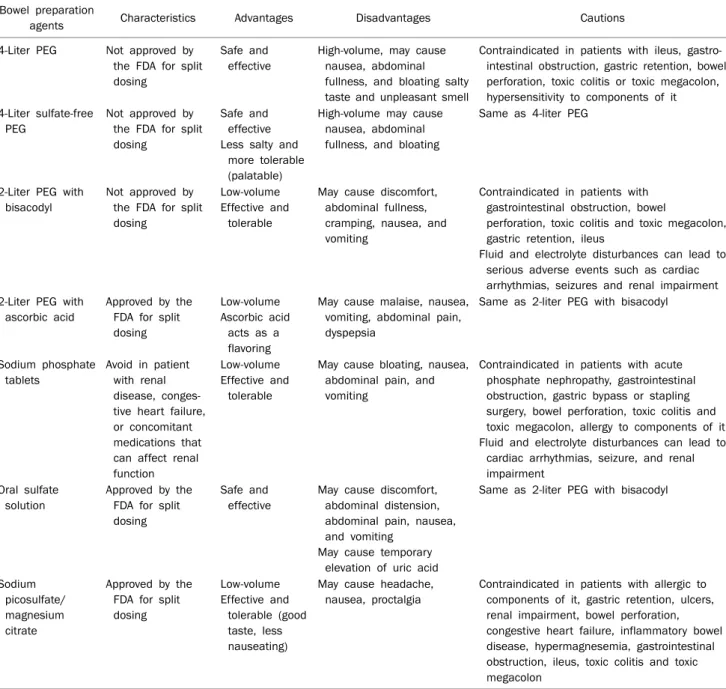
Here, we review the development of a bowel preparation agent from a historical perspective and describe agents cur- rently being developed (Table 1).
DEVELOPMENTS IN BOWEL PREPARATION
Colonoscopy preparations evolved from radiologic and surgical preparations.1 Early mechanical preparation meth- ods involved dietary limitation, administration of cathartics, and enemas during the preceding 72 hours. After admin-
Table 1. The US Food and Drug Administration (FDA)-approved Bowel Preparation Agents for Colonoscopy Bowel preparation
agents Characteristics Advantages Disadvantages Cautions
4-Liter PEG Not approved by the FDA for split dosing
Safe and effective
High-volume, may cause nausea, abdominal fullness, and bloating salty taste and unpleasant smell
Contraindicated in patients with ileus, gastro- intestinal obstruction, gastric retention, bowel perforation, toxic colitis or toxic megacolon, hypersensitivity to components of it 4-Liter sulfate-free
PEG
Not approved by the FDA for split dosing
Safe and effective Less salty and
more tolerable (palatable)
High-volume may cause nausea, abdominal fullness, and bloating
Same as 4-liter PEG
2-Liter PEG with bisacodyl
Not approved by the FDA for split dosing
Low-volume Effective and
tolerable
May cause discomfort, abdominal fullness, cramping, nausea, and vomiting
Contraindicated in patients with gastrointestinal obstruction, bowel
perforation, toxic colitis and toxic megacolon, gastric retention, ileus
Fluid and electrolyte disturbances can lead to serious adverse events such as cardiac arrhythmias, seizures and renal impairment 2-Liter PEG with
ascorbic acid
Approved by the FDA for split dosing
Low-volume Ascorbic acid
acts as a flavoring
May cause malaise, nausea, vomiting, abdominal pain, dyspepsia
Same as 2-liter PEG with bisacodyl
Sodium phosphate tablets
Avoid in patient with renal disease, conges- tive heart failure, or concomitant medications that can affect renal function
Low-volume Effective and
tolerable
May cause bloating, nausea, abdominal pain, and vomiting
Contraindicated in patients with acute phosphate nephropathy, gastrointestinal obstruction, gastric bypass or stapling surgery, bowel perforation, toxic colitis and toxic megacolon, allergy to components of it Fluid and electrolyte disturbances can lead to
cardiac arrhythmias, seizure, and renal impairment
Oral sulfate solution
Approved by the FDA for split dosing
Safe and effective
May cause discomfort, abdominal distension, abdominal pain, nausea, and vomiting
May cause temporary elevation of uric acid
Same as 2-liter PEG with bisacodyl
Sodium picosulfate/
magnesium citrate
Approved by the FDA for split dosing
Low-volume Effective and
tolerable (good taste, less nauseating)
May cause headache, nausea, proctalgia
Contraindicated in patients with allergic to components of it, gastric retention, ulcers, renal impairment, bowel perforation, congestive heart failure, inflammatory bowel disease, hypermagnesemia, gastrointestinal obstruction, ileus, toxic colitis and toxic megacolon
PEG, polyethylene glycol.
istration of clear liquid or low-residue foods, preparation was completed using cathartics and enemas. However, these preparation processes required a significant amount of time, were uncomfortable for patients, sometimes caused nu- trition defects, and disturbed fluids and electrolytes. In the 1970s, approximately 10 liters of oral lavage solution was used, which caused severe fluid and electrolyte disturbances and discomfort, thus, its use was restricted in patients with cardiac, renal, or hepatic impairment. Mannitol was used for preparation, which does not cause hypersorption or osmotic
diarrhea. However, cases of intestinal gas explosion attrib- uted to the presence of inflammable gases, chiefly hydrogen and methane produced by colonic bacteria, were reported during polypectomy or surgery, therefore, the use of mannitol was discontinued.2,3
In the 1980s, Davis et al.4 developed an osmotically bal- anced, polyethylene glycol-electrolyte lavage solution (PEG solution) that did not cause loss of water or electrolyte or suf- fer from the risk of gas explosion. The cleansing effectiveness and safety of PEG solution were confirmed by many stud-
ies,5-7 and it continues to be the preparation method of choice. However, the large volume required, as well as its salty taste, and unpleasant smell reduce compliance, thus, sulfate-free, low-volume PEG solutions were developed.
Sodium phosphate (NaP) solution osmotic agent developed in the 1990s8, which had the advantage of a low ad- ministered volume versus PEG solution, however, its dis- advantages included risks of hyperphosphatemia, hypo- calcemia, and hypokalemia in patients with renal failure, con- gestive heart failure, advanced liver disease, or an aphthous ulcer-like mucosal lesion. Around the same time, another bowel preparation method, pulsed rectal irrigation combined with magnesium citrate was developed.9 This method in- volves ingestion of 10 ounces of magnesium citrate the eve- ning before the procedure and a 30-minute infusion of short pulses of warm tap water through a rectal tube immediately before colonoscopy.10 This regimen showed no significant differences in terms of quality of colonic cleansing versus PEG solution9; however, it required more time and skilled nursing. Nevertheless, it remains a good alternative when a full-volume PEG solution cannot be tolerated.
TYPES OF BOWEL PREPARATION AGENTS
Bowel preparation agents can be classified according to three types.
- PEG solutions, oral gut lavage solutions with high-volumes.
- osmotic agents, such as sodium phosphate, magnesium citrate, lactulose, and mannitol, which draw plasma wa- ter into the bowel lumen.
- stimulants, such as caster oil, senna, sodium pico- sulfate, and bisacodyl, which stimulate the colonic peristalsis.
1. Polyethylene glycol solutions 1) Overview
Since the original development of an osmotically balanced PEG solution, better solutions have been developed. PEG sol- utions are more effective and better tolerated than regimens of diet combined with cathartic agents, high-volume bal- anced electrolyte solutions, or mannitol-based solutions,10,11 and the original 4-liter dosing regimen rapidly became the standard bowel preparation method due its characteristics of being rapid, safe, and effective. The primary mechanism
responsible for minimizing water and electrolyte shifts in- volves the inhibition of sodium ion absorption by sulfate ions.
Chloride ions needed for absorption of sodium ions are re- placed by sulfate ions, resulting in reduced absorption of so- dium ions, and little water is exchanged across the colonic membrane, which reduces electrolyte disturbance.
PEG solutions do not require a long period of dietary re- striction, and are safe for use in children, elderly persons, and in patients with renal, hepatic, or cardiac problems.12-15 In ad- dition, because they do not cause macroscopic or histologic mucosal alterations, they can also be used safely in patients with inflammatory bowel disease. However, PEG solutions are contraindicated in patients with gastric outlet ob- struction, high-grade small-bowel obstruction, significant co- lonic obstruction, perforation, diverticulitis, and hemody- namic instability, and in patients who are allergic to poly- ethylene glycol. In addition, PEG solutions have been classi- fied by the US Food and Drug Administration (FDA) as preg- nancy category C, and have been associated with Mallory- Weiss tear, toxic colitis, pulmonary aspiration, hypothermia, cardiac arrhythmias, pancreatitis, and inappropriate anti- diuretic hormone secretion.11,16,17
Disadvantages of PEG solutions include the large volume required, a salty taste and unpleasant smell, due to the pres- ence of sodium sulfate, and these reduce patient compli- ance. In practice, approximately 5% to 15% of patients do not complete the preparation.10,18,19 Furthermore, the additional use of enemas does not offer any improvement in the efficacy of PEG solutions, but considerably increases patient discomfort.20 Divided regimens are superior and better tol- erated than the standard 4-liter single dose regimen.21 In one study, ingestion of PEG solution less than 5 hours before the procedure resulted in better preparation than when ad- ministered more than 19 hours beforehand.22 According to a recent study, the method and/or timing of administration are more important determinants of quality of preparation than dietary restriction,23 and in another study, walking ex- ercise during bowel preparation was found to improve colo- noscopic bowel cleansing without significantly increasing pa- tient discomfort.24 Addition of 10 mg of oral bisacodyl to PEG was not found to result in significant improvement of colonic cleansing or overall patient tolerance when used as an ad- junct with full-volume PEG.25 However, in another study, in which efficacy and patient tolerance to 4 liters of PEG were
compared with that for 2 liters of PEG preceded by a stimulant laxative bisacodyl (20 mg), the 2-liter regimen was found to be more acceptable than the 4-liter regimen by patients and to be equally effective in terms of cleansing the colon.26-28 In addition, 2 liters of PEG plus magnesium (296 mL) or bisa- colyl (20 mg) was shown to provide better preparation quality and patient satisfaction and to reduce preparation time than the 4-liter PEG only regimen.26,29,30 In a study on the use of senna, its addition was found to be effective, safe, and well tolerated, like bisacodyl31-34; however, abdominal pain was reported by some patients administered high-dose senna (24 mg).35 On the other hand, the addition of prokinetic agents to PEG did not result in improvement of bowel prepa- ration, but reduced nausea and abdominal distress.36-38 2) Sulfate-free PEG
In an effort to overcome the objectionable smell and taste of standard PEG solutions, sulfate-free and flavored sol- utions have been developed.39 These are less salty, more pal- atable, and comparable to standard solutions in terms of ef- fective colonic cleansing and overall patient tolerance.40 Nevertheless, the volume of sulfate-free PEG required was not reduced, and thus, several attempts have been made to reduce the amount of standard PEG solution required. In one study, equally effective bowel preparation and significantly fewer clinical symptoms were observed for 20 mg oral bisa- codyl in 2 liters of sulfate-free PEG than the traditional 4 liters of PEG solutions.41
3) Low-volume PEG solutions
Low-volume PEG solutions were developed for reduction of symptoms associated with high-volume PEG, such as bloating and cramping. Low-volume (2 liters) PEG solutions containing biascodyl or magnesium citrates were compared to full-volume PEG solution (4 liters), and demonstrated sat- isfactory efficacy. In addition, 2 liters of PEG solution contain- ing ascorbic acid, which acts as a flavoring and cathartic, was found to be as effective as full-volume PEG solution,42 and has been approved by the FDA as a bowel preparation agent for split dosing. Combining over-the-counter polyethylene gly- col 3350 laxative powder and Gatorade (PepsiCo Inc., Purchase, NY, USA) or Crystal Light (Kraft Foods Inc., North- field, IL, USA) (or another clear liquid of choice) has also been shown to improve the taste and tolerability of the preparation;
however, this 2-liter regimen has not been approved by the FDA.11,43
2. Sodium phosphate solutions 1) Overview
Aqueous sodium phosphate is a low-volume hyperosmotic solution containing 48 g (400 mmol) of monobasic sodium phosphate and 18 g (130 mmol) of dibasic sodium phos- phate per 100 mL.44 Sodium phosphate, an osmotic agent, draws water from plasma into the bowel lumen, and causes peristalsis and bowel cleansing due to water retention. Thus, the use of sodium phosphate can cause large fluid and elec- trolyte shifts. In one meta-analysis, sodium phosphate was found to be more effective for bowel cleansing and better tol- erated than PEG solution,45 whereas another found that so- dium phosphate solutions were superior to PEG solutions and were better tolerated, but not significantly more effective than PEG.46 The main reasons for the improved tolerability were a better flavor and a smaller sodium phosphate solution volume.47,48 In addition, because of their effectiveness and lower cost, colonoscopists are more likely to consider sodium phosphate solutions more acceptable.10,49 However, it should be added that patients with renal failure, liver disease with ascites, or severe heart disease were excluded from most of these studies. Patients with compromised renal function, de- hydration, hypercalcemia, hypertension on angiotensin-con- verting enzyme (ACE) inhibitors, or angiotensin receptor blockers (ARBs) have experienced phosphate nephropathy after taking oral sodium phosphate solutions.50 These ef- fects appear to be age- and dose-related.51 In addition, so- dium phosphate solutions have been associated with hypo- calcemia, hypokalemia, increased plasma osmolality, hypo- natremia, and, conversely, hypernatremia.38,52,53 Rare ad- verse events, such as nephrocalcinosis with acute renal fail- ure have also been reported, particularly in patients taking ACE inhibitors, ARBs, or diuretics.53,54 Renal failure due to hy- perphosphatemia (acute phosphate nephropathy) has re- cently been reported even in patients with normal kidney function.11,55
This complication occasionally causes permanent dam- age to renal function and some patients require dialysis for a long period of time. Furthermore, it can occur several months after colonoscopy examination, thus, continuous ob- servation is required. In fact, in the United States, aqueous sodium phosphate solutions received a black box warning from the FDA for acute phosphate nephrotoxicity on
December 11, 2008, and are now only available by pre- scription in tablet form for bowel cleansing.
Sodium phosphate also causes temporary colonic mu- cosal changes, and the aphthous ulcerations produced may mimic inflammatory bowel disease,56 limiting the use of so- dium phosphate in patients suspected or with a diagnosis of inflammatory bowel disease. Although contraindicated in children under five years of age, several studies have as- sessed sodium phosphate in pediatric populations and dem- onstrated efficacies similar to those of PEG.13,57 In addition, the efficacy of sodium phosphate in elderly persons is similar to that in younger adults and comparable to that of PEG.58,59 Addition of cisapride to sodium phosphate did not result in improvement of the quality of bowel preparation,38 and the addition of carbohydrate-electrolyte oral rehydration sol- ution protected against intravascular volume contraction during preparation and was well-tolerated, and improved bowel cleansing.60,61 However, carbohydrate-electrolyte sol- ution can cause hyperglycemia in diabetes patients and hy- perkalemia in patients with renal insufficiency, thus, such pa- tients require close attention. In a study conducted for deter- mination of preference for a sodium phosphate tablet prepa- ration in patients who had previously taken a PEG solution for previous colonoscopy, sodium phosphate tablets were preferred.62 In another study, liquid sodium phosphate was found to be better tolerated and more effective in colon cleansing than a 40-tablet sodium phosphate preparation.48 Conduct of further comparative studies on sodium phos- phate tablet and liquid preparations is needed.
2) New sodium phosphate agents
Two large, identically designed, randomized, controlled, parallel group, multicenter phase III trials that compared so- dium phosphate tablets and PEG solution for colon cleansing showed equivalent results for colon cleansing, fewer gastro- intestinal side effects, and better patient toleration for the tablets.47 Subsequently, sodium phosphate tablets were ap- proved by the FDA in 2000. Each 2 g sodium phosphate tablet contains 1,500 mg of active ingredients (monobasic and di- basic sodium phosphate) and 460 mg of microcrystalline cel- lulose as a tablet binder.10 However, microcrystalline cellu- lose is insoluble in the gastrointestinal tract, obscures mu- cosal visualization, is time-consuming to remove during colonoscopy. A modified formulation with half the micro- crystalline cellulose content and a lower total dose of sodium
phosphate was developed, and use of this formulation showed good results in efficacy and tolerability studies.63,64
3. Other bowel preparation agents 1) Oral sulfate solution
Oral sulfate solution, an osmotic laxative, has been ap- proved by the FDA for split dosing with 2 liters of PEG solution and ascorbic acid. It was developed based on animal safety studies, in which its safety was compared with that of sodium phosphate solution,65 and a subsequent study on its effec- tiveness and safety in humans.66 In another study, oral sul- fate solution was found to be more effective than sulfate-free PEG (administered as a single dose) with similar tolera- bility.67
2) Sodium picosulfate/magnesium citrate
In 2012, sodium picosulfate and magnesium citrate were approved by the FDA for split dosing for colonoscopy in adults.
This regimen was compared with PEG solution and sul- fate-free PEG solution, and found to be equally or more effec- tive in colon cleansing and to show better tolerability.68,69 In one study, sodium picosulfate and magnesium citrate were compared with sodium phosphate and shown to be as effec- tive, but to have better taste and patient tolerability,70 how- ever, in another study, this regimen was found to be less effec- tive than oral sodium phosphate in terms of bowel cleansing.71 Several later studies confirmed that this regi- men provides effective bowel preparation.72,73
CONCLUSIONS
Adequate bowel preparation is essential for successful co- lonoscopy examination, and this largely depends on the type of agent used for bowel preparation. Nevertheless, poor bow- el preparation is frequent, resulting in reduced quality of colo- noscopy, including reduction of polyp detection rates and in- crease of complication risk, pain, and medical costs. Thus, selection of the most appropriate agent for each patient is im- portant, and administration methods such as split dosing, patient education including dietary modifications, and walk- ing exercise are also essential for successful examination.
REFERENCES
1. Beck DE, Harford FJ, DiPalma JA. Comparison of cleansing meth-
ods in preparation for colonic surgery. Dis Colon Rectum 1985;
28:491-495.
2. Avgerinos A, Kalantzis N, Rekoumis G, Pallikaris G, Arapakis G, Kanaghinis T. Bowel preparation and the risk of explosion during colonoscopic polypectomy. Gut 1984;25:361-364.
3. Bonnet YY, Schutz R, Chipponi J, Haberer JP, Mercier R.
Intraoperative digestive explosions after preparation with mannitol. Role of anesthetic gases. Presse Med 1983;12:171.
4. Davis GR, Santa Ana CA, Morawski SG, Fordtran JS. Develop- ment of a lavage solution associated with minimal water and electrolyte absorption or secretion. Gastroenterology 1980;78:
991-995.
5. DiPalma JA, Brady CE 3rd, Stewart DL, et al. Comparison of colon cleansing methods in preparation for colonoscopy. Gastroenter- ology 1984;86:856-860.
6. Ernstoff JJ, Howard DA, Marshall JB, Jumshyd A, McCullough AJ.
A randomized blinded clinical trial of a rapid colonic lavage sol- ution (Golytely) compared with standard preparation for colono- scopy and barium enema. Gastroenterology 1983;84:1512- 1516.
7. Thomas G, Brozinsky S, Isenberg JI. Patient acceptance and ef- fectiveness of a balanced lavage solution (Golytely) versus the standard preparation for colonoscopy. Gastroenterology 1982;
82:435-437.
8. Ell C, Fischbach W, Keller R, et al; Hintertux Study Group. A randomized, blinded, prospective trial to compare the safety and efficacy of three bowel-cleansing solutions for colonoscopy (HSG-01*). Endoscopy 2003;35:300-304.
9. Chang KJ, Erickson RA, Schandler S, Coye T, Moody C. Per-rectal pulsed irrigation versus per-oral colonic lavage for colonoscopy preparation: a randomized, controlled trial. Gastrointest Endosc 1991;37:444-448.
10. Wexner SD, Beck DE, Baron TH, et al. A consensus document on bowel preparation before colonoscopy: prepared by a task force from the American Society of Colon and Rectal Surgeons (ASCRS), the American Society for Gastrointestinal Endoscopy (ASGE), and the Society of American Gastrointestinal and Endoscopic Surgeons (SAGES). Dis Colon Rectum 2006;49:
792-809.
11. Atreja A, Nepal S, Lashner BA. Making the most of currently avail- able bowel preparations for colonoscopy. Cleve Clin J Med 2010;77:317-326.
12. Sondheimer JM, Sokol RJ, Taylor SF, Silverman A, Zelasney B.
Safety, efficacy, and tolerance of intestinal lavage in pediatric patients undergoing diagnostic colonoscopy. J Pediatr 1991;
119:148-152.
13. Gremse DA, Sacks AI, Raines S. Comparison of oral sodium phosphate to polyethylene glycol-based solution for bowel prep- aration for colonoscopy in children. J Pediatr Gastroenterol Nutr 1996;23:586-590.
14. Tolia V, Fleming S, Dubois RS. Use of Golytely in children and adolescents. J Pediatr Gastroenterol Nutr 1984;3:468-470.
15. Marschall HU, Bartels F. Life-threatening complications of naso- gastric administration of polyethylene glycol-electrolyte sol- utions (Golytely) for bowel cleansing. Gastrointest Endosc 1998;47:408-410.
16. Clark LE, Dipalma JA. Safety issues regarding colonic cleansing for diagnostic and surgical procedures. Drug Saf 2004;27:
1235-1242.
17. Nelson DB, Barkun AN, Block KP, et al. Technology Status Evaluation report. Colonoscopy preparations. May 2001. Gas- trointest Endosc 2001;54:829-832.
18. Golub RW, Kerner BA, Wise WE Jr, et al. Colonoscopic bowel prep- arations--which one? A blinded, prospective, randomized trial.
Dis Colon Rectum 1995;38:594-599.
19. Marshall JB, Pineda JJ, Barthel JS, King PD. Prospective, randomized trial comparing sodium phosphate solution with polyethylene glycol-electrolyte lavage for colonoscopy prepa- ration. Gastrointest Endosc 1993;39:631-634.
20. Lever EL, Walter MH, Condon SC, et al. Addition of enemas to oral lavage preparation for colonoscopy is not necessary. Gastroint- est Endosc 1992;38:369-372.
21. Rösch T, Classen M. Fractional cleansing of the large bowel with
"Golytely" for colonoscopic preparation: a controlled trial.
Endoscopy 1987;19:198-200.
22. Church JM. Effectiveness of polyethylene glycol antegrade gut lavage bowel preparation for colonoscopy--timing is the key! Dis Colon Rectum 1998;41:1223-1225.
23. Aoun E, Abdul-Baki H, Azar C, et al. A randomized single-blind tri- al of split-dose PEG-electrolyte solution without dietary re- striction compared with whole dose PEG-electrolyte solution with dietary restriction for colonoscopy preparation. Gastroin- test Endosc 2005;62:213-218.
24. Kim HS, Park DH, Kim JW, et al. Effectiveness of walking exercise as a bowel preparation for colonoscopy: a randomized con- trolled trial. Am J Gastroenterol 2005;100:1964-1969.
25. Brady CE 3rd, Dipalma JA, Beck DE. Effect of bisacodyl on gut lav- age cleansing for colonoscopy. Ann Clin Res 1987;19:34-38.
26. Adams WJ, Meagher AP, Lubowski DZ, King DW. Bisacodyl re- duces the volume of polyethylene glycol solution required for bowel preparation. Dis Colon Rectum 1994;37:229-233.
27. Kao D, Lalor E, Sandha G, et al. A randomized controlled trial of four precolonoscopy bowel cleansing regimens. Can J Gastroen- terol 2011;25:657-662.
28. Ker TS. Comparison of reduced volume versus four-liter electro- lyte lavage solutions for colon cleansing. Am Surg 2006;
72:909-911.
29. Sharma VK, Steinberg EN, Vasudeva R, Howden CW. Randomiz- ed, controlled study of pretreatment with magnesium citrate on the quality of colonoscopy preparation with polyethylene glycol electrolyte lavage solution. Gastrointest Endosc 1997;46:
541-543.
30. Sharma VK, Chockalingham SK, Ugheoke EA, et al. Prospective, randomized, controlled comparison of the use of polyethylene glycol electrolyte lavage solution in four-liter versus two-liter vol- umes and pretreatment with either magnesium citrate or bisa- codyl for colonoscopy preparation. Gastrointest Endosc 1998;
47:167-171.
31. Ziegenhagen DJ, Zehnter E, Tacke W, Kruis W. Addition of senna improves colonoscopy preparation with lavage: a prospective randomized trial. Gastrointest Endosc 1991;37:547-549.
32. Ziegenhagen DJ, Zehnter E, Tacke W, Gheorghiu T, Kruis W.
Senna vs. bisacodyl in addition to Golytely lavage for colono- scopy preparation--a prospective randomized trial. Z Gastroen- terol 1992;30:17-19.
33. Iida Y, Miura S, Asada Y, et al. Bowel preparation for the total colo- noscopy by 2,000 ml of balanced lavage solution (Golytely) and sennoside. Gastroenterol Jpn 1992;27:728-733.
34. Radaelli F, Meucci G, Imperiali G, et al. High-dose senna com- pared with conventional PEG-ES lavage as bowel preparation for elective colonoscopy: a prospective, randomized, investigator- blinded trial. Am J Gastroenterol 2005;100:2674-2680.
35. Amato A, Radaelli F, Paggi S, Terruzzi V. Half doses of PEG-ES and senna vs. high-dose senna for bowel cleansing before colono- scopy: a randomized, investigator-blinded trial. Am J Gastroen- terol 2010;105:675-681.
36. Rhodes JB, Engstrom J, Stone KF. Metoclopramide reduces the distress associated with colon cleansing by an oral electrolyte overload. Gastrointest Endosc 1978;24:162-163.
37. Brady CE 3rd, DiPalma JA, Pierson WP. Golytely lavage--is meto- clopramide necessary? Am J Gastroenterol 1985;80:180-184.
38. Martínek J, Hess J, Delarive J, et al. Cisapride does not improve precolonoscopy bowel preparation with either sodium phos- phate or polyethylene glycol electrolyte lavage. Gastrointest Endosc 2001;54:180-185.
39. Fordtran JS, Santa Ana CA, Cleveland MvB. A low-sodium sol- ution for gastrointestinal lavage. Gastroenterology 1990;98:
11-16.
40. DiPalma JA, Marshall JB. Comparison of a new sulfate-free poly- ethylene glycol electrolyte lavage solution versus a standard sol- ution for colonoscopy cleansing. Gastrointest Endosc 1990;36:
285-289.
41. DiPalma JA, Wolff BG, Meagher A, Cleveland Mv. Comparison of reduced volume versus four liters sulfate-free electrolyte lavage solutions for colonoscopy colon cleansing. Am J Gastroenterol 2003;98:2187-2191.
42. Corporaal S, Kleibeuker JH, Koornstra JJ. Low-volume PEG plus ascorbic acid versus high-volume PEG as bowel preparation for colonoscopy. Scand J Gastroenterol 2010;45:1380-1386.
43. Enestvedt BK, Fennerty MB, Eisen GM. Randomised clinical tri- al: MiraLAX vs. Golytely - a controlled study of efficacy and pa- tient tolerability in bowel preparation for colonoscopy. Aliment Pharmacol Ther 2011;33:33-40.
44. Schiller LR. Clinical pharmacology and use of laxatives and lav- age solutions. J Clin Gastroenterol 1999;28:11-18.
45. Tan JJ, Tjandra JJ. Which is the optimal bowel preparation for co- lonoscopy - a meta-analysis. Colorectal Dis 2006;8:247-258.
46. Belsey J, Epstein O, Heresbach D. Systematic review: oral bowel preparation for colonoscopy. Aliment Pharmacol Ther 2007;
25:373-384.
47. Kastenberg D, Chasen R, Choudhary C, et al. Efficacy and safety of sodium phosphate tablets compared with PEG solution in co- lon cleansing: two identically designed, randomized, controlled, parallel group, multicenter phase III trials. Gastrointest Endosc 2001;54:705-713.
48. Balaban DH, Leavell BS Jr, Oblinger MJ, Thompson WO, Bolton ND, Pambianco DJ. Low volume bowel preparation for colono- scopy: randomized, endoscopist-blinded trial of liquid sodium
phosphate versus tablet sodium phosphate. Am J Gastroenterol 2003;98:827-832.
49. Hsu CW, Imperiale TF. Meta-analysis and cost comparison of polyethylene glycol lavage versus sodium phosphate for colono- scopy preparation. Gastrointest Endosc 1998;48:276-282.
50. Markowitz GS, Stokes MB, Radhakrishnan J, D'Agati VD. Acute phosphate nephropathy following oral sodium phosphate bowel purgative: an underrecognized cause of chronic renal failure. J Am Soc Nephrol 2005;16:3389-3396.
51. Linden TB, Waye JD. Sodium phosphate preparation for colono- scopy: onset and duration of bowel activity. Gastrointest Endosc 1999;50:811-813.
52. Barkun A, Chiba N, Enns R, et al. Commonly used preparations for colonoscopy: efficacy, tolerability, and safety--a Canadian Association of Gastroenterology position paper. Can J Gastroen- terol 2006;20:699-710.
53. Makkar R, Shen B. What are the caveats to using sodium phos- phate agents for bowel preparation? Cleve Clin J Med 2008;
75:173-176.
54. Markowitz GS, Nasr SH, Klein P, et al. Renal failure due to acute nephrocalcinosis following oral sodium phosphate bowel cleansing. Hum Pathol 2004;35:675-684.
55. Hookey LC, Depew WT, Vanner S. The safety profile of oral so- dium phosphate for colonic cleansing before colonoscopy in adults. Gastrointest Endosc 2002;56:895-902.
56. Rejchrt S, Bures J, Siroký M, Kopácová M, Slezák L, Langr F. A pro- spective, observational study of colonic mucosal abnormalities associated with orally administered sodium phosphate for colon cleansing before colonoscopy. Gastrointest Endosc 2004;59:
651-654.
57. Curran MP, Plosker GL. Oral sodium phosphate solution: a review of its use as a colorectal cleanser. Drugs 2004;64:1697-1714.
58. Thomson A, Naidoo P, Crotty B. Bowel preparation for colono- scopy: a randomized prospective trail comparing sodium phos- phate and polyethylene glycol in a predominantly elderly popula- tion. J Gastroenterol Hepatol 1996;11:103-107.
59. Seinelä L, Pehkonen E, Laasanen T, Ahvenainen J. Bowel prepa- ration for colonoscopy in very old patients: a randomized pro- spective trial comparing oral sodium phosphate and poly- ethylene glycol electrolyte lavage solution. Scand J Gastroenter- ol 2003;38:216-220.
60. Barclay RL, Depew WT, Vanner SJ. Carbohydrate-electrolyte re- hydration protects against intravascular volume contraction during colonic cleansing with orally administered sodium phosphate. Gastrointest Endosc 2002;56:633-638.
61. Tjandra JJ, Tagkalidis P. Carbohydrate-electrolyte (E-Lyte) sol- ution enhances bowel preparation with oral fleet phospho-soda.
Dis Colon Rectum 2004;47:1181-1186.
62. Gurudu SR, Li F, Fleischer DE, et al. Patient preference and ac- ceptance with sodium phosphate tablet preparation for colono- scopy. Dig Dis Sci 2009;54:1555-1559.
63. Khashab M, Rex DK. Efficacy and tolerability of a new for- mulation of sodium phosphate tablets (INKP-101), and a re- duced sodium phosphate dose, in colon cleansing: a single-cen- ter open-label pilot trial. Aliment Pharmacol Ther 2005;21:
465-468.
64. Rex DK, Chasen R, Pochapin MB. Safety and efficacy of two re- duced dosing regimens of sodium phosphate tablets for prepa- ration prior to colonoscopy. Aliment Pharmacol Ther 2002;
16:937-944.
65. Pelham RW, Russell RG, Padgett EL, Reno FE, Cleveland Mv.
Safety of oral sulfates in rats and dogs contrasted with phos- phate-induced nephropathy in rats. Int J Toxicol 2009;28:99- 112.
66. Patel V, Nicar M, Emmett M, et al. Intestinal and renal effects of low-volume phosphate and sulfate cathartic solutions designed for cleansing the colon: pathophysiological studies in five nor- mal subjects. Am J Gastroenterol 2009;104:953-965.
67. Rex DK, Di Palma JA, Rodriguez R, McGowan J, Cleveland M. A randomized clinical study comparing reduced-volume oral sul- fate solution with standard 4-liter sulfate-free electrolyte lavage solution as preparation for colonoscopy. Gastrointest Endosc 2010;72:328-336.
68. Hamilton D, Mulcahy D, Walsh D, Farrelly C, Tormey WP, Watson G. Sodium picosulphate compared with polyethylene glycol sol- ution for large bowel lavage: a prospective randomised trial. Br
J Clin Pract 1996;50:73-75.
69. Regev A, Fraser G, Delpre G, et al. Comparison of two bowel prep- arations for colonoscopy: sodium picosulphate with magnesium citrate versus sulphate-free polyethylene glycol lavage solution.
Am J Gastroenterol 1998;93:1478-1482.
70. Schmidt LM, Williams P, King D, Perera D. Picoprep-3 is a superi- or colonoscopy preparation to Fleet: a randomized, controlled trial comparing the two bowel preparations. Dis Colon Rectum 2004;47:238-242.
71. Tjandra JJ, Chan M, Tagkalidis PP. Oral sodium phosphate (Fleet) is a superior colonoscopy preparation to Picopre (sodium pico- sulfate-based preparation). Dis Colon Rectum 2006;49:616- 620.
72. Thomson J, Phull P. Audit of bowel preparation with Picolax (sodium picosulfate plus magnesium citrate) for colonoscopy.
Int J Clin Pract 2006;60:602-603.
73. Love J, Bernard EJ, Cockeram A, et al. A multicentre, ob- servational study of sodium picosulfate and magnesium citrate as a precolonoscopy bowel preparation. Can J Gastroenterol 2009;23:706-710.