I. INTRODUCTION
The guided bone regeneration (GBR) proce- dure has been used successfully when there is insufficient bone volume for implant place- ment1-3). Bone graft materials are used in con- junction with barrier membranes to improve the outcomes of GBR procedures: they stabilize the blood clot, prevent membrane shrinkage and maintain the space available for new bone for- mation beneath the membrane4-6). Autogenous bone is the preferred augmentation material but harvesting of autogenous bone requires sur- gery, which is associated with donor site mor- bidity, a long operation and high costs7-9). A variety of graft materials are used as alter- natives to autogenous grafts10-14). Bioactive glass is considered an effective bone graft substitute because of its bone-binding properties15,16).
Chemical bonds form between bone tissue and a calcium phosphate layer formed by ion ex- change on the surface of bioactive glass17-21). Many studies have demonstrated that bioactive glass has positive effects on bone healing in human sinus floor elevation and human ex- traction sockets22-24).1)
Despite the high efficacy of bioactive glass as a grafting material for sinus floor ele- vation,22,24-27) histological validation of its effi- cacy for the treatment of horizontal ridge defi- ciency in conjunction with GBR is limited to a relatively short-term study (6 months)28). In our study, we obtained bone biopsies at various times after the operations and evaluated bone healing using histology. We evaluated the effi- cacy of bioactive glass particles of a narrow size range (Biogran®, 3i Implant Innovations, Palm Beach Gardens, FL, USA) for horizontal alveolar ridge augmentation in conjunction with
*Corresponding author : Jin-Woo Park, Department of Periodontology, School of Dentistry, Kyungpook National University, 188-1, Samduk 2Ga, Jung-Gu, Daegu, 702-412, Korea (E-mail: [email protected])
대한치주과학회지 : Vol. 36, No. 3, 2006
Histological Observations on Bone Healing with Bioactive Glass in Horizontal Ridge Augmentation: A
Report of Four Cases
Jin-Woo Park1,*, Jo-Young Suh1
1. Department of Periodontology, School of Dentistry, Kyungpook National University
the GBR procedure and titanium-reinforced ex- panded polytetrafluoroethylene (TR e-PTFE) membranes (Gore-Tex®, WL Gore & Associates, Flagstaff, AZ, USA) by histological examination of biopsies harvested at various periods of healing from 4 clinical cases.
II. MATERIALS AND METHODS
Patients and surgical procedure
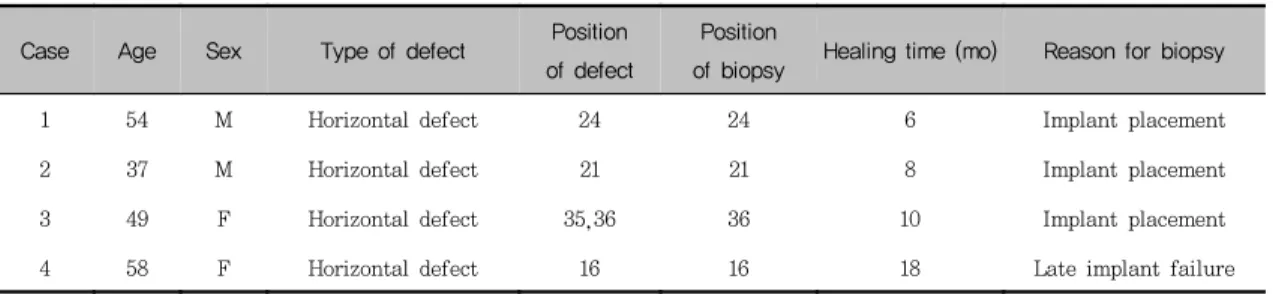
Among the patients who received bone aug- mentation surgery because of inadequate alveo- lar ridge widths for implant placement, four systemically healthy nonsmoking patients (2 men and 2 women, 37 to 58 years old) with different healing times were admitted to the study (Table 1). The patients refused permission to harvest bone for horizontal ridge augmenta- tion from intraoral sites. The GBR procedure and the need to harvest a core biopsy during surgical reentry for implant placement were explained to the patients, all of who gave their written consent. Patients received prophylactic antibiotics (750 mg of amoxicillin-clavulanate, Amocla®, Kuhnil Pharm Co., Seoul, Korea) 1 h preoperatively and then 375 mg of Amocla 3 times daily for 5 days postoperatively. They rinsed with 0.12% chlorhexidine gluconate for 1 min prior to surgery and twice daily for 2 weeks postoperatively. Full thickness flaps were
reflected and the cortical bone surface was perforated with a small round bur to stimulate bleeding from the marrow compartment. After placement of the Biogran® particles, a trimmed TR e-PTFE barrier membrane was applied to cover the grafts. The membrane was fixed to the bone with titanium membrane tacks (Frios®, Dentsply Friadent, Mannheim, Germany). The flap was adjusted to provide tension-free pri- mary closure using vertical and periosteal re- leasing incisions. Between June 2004 and July 2005, bone biopsies were taken from the im- plant sites with a 2 mm diameter trephine (Dentsply Friadent, Mannheim, Germany) dur- ing the surgical reentry procedure after at least 6 months of healing.
Sample preparation and histomorpho- metric analysis
Bone biopsies were fixed in 4% neutral buf- fered formaldehyde and then decalcified in EDTA and dehydrated in ethanol before they were embedded in paraffin. Sections 5 ㎛ thick were cut along the long axis of the core biopsy and stained with hematoxylin and eosin or Masson’s trichrome stain. Histomorphometric analysis was carried out using a light micro- scope (BX51; Olympus, Tokyo, Japan) with an image analysis system (i-Solution, iMTechnology Inc., Daejeon, Korea) under 100 × magnification.
Table 1. Clinical details of patients and biopsies.
Case Age Sex Type of defect Position
of defect
Position
of biopsy Healing time (mo) Reason for biopsy
1 54 M Horizontal defect 24 24 6 Implant placement
2 37 M Horizontal defect 21 21 8 Implant placement
3 49 F Horizontal defect 35,36 36 10 Implant placement
4 58 F Horizontal defect 16 16 18 Late implant failure
Images were captured using a digital camera (CC-12; Soft Imaging System GmbH, Munster, Germany) attached to the microscope and dis- played on a computer monitor. Four evenly spaced sections were evaluated per biopsy.
Histomorphometric measurement was used to quantify the relative amounts of different tis- sue types within the grafted area. Areas of na- tive bone were excluded from the analyses. The following variables were measured within the boundaries of the defects: area of newly formed bone (NB%, area of newly formed mineralized bone expressed as a percentage of the total de- fect area) and remaining graft particle area (BG%, residual Biogran® particle area expressed as a percentage of the total defect area). Mean values for histomorphometric variables were calculated for each sample.
III. RESULTS
Clinical observations
All of the augmented sites healed unevent- fully without any signs of inflammation or membrane exposure. The times at which surgi- cal reentry procedures were performed (6, 8, 10 and 18 months postoperatively) differed between patients because of personal reasons or implant failure. In the case of patient 4, the implant was inserted at the time of the GBR procedure
and the final prosthodontic component was in- serted 8 months after grafting. The implant was removed 7 months after functional loading because of mobility. The extraction site was closed without any grafting and subsequently healed. After 3 months, a biopsy was taken from the implant site, which included some of the previously augmented area. The augmented sites showed clinically significant increases in alveolar ridge width. All grafted sites exhibited resistance to drilling. After core biopsies were retrieved, all patients immediately received im- plants at the augmented sites. Implant stability was achieved by using long implants that en- gaged with the lateral or apical native bony wall.
Histological and histomorphometical results Histological examination revealed little new bone formation in biopsies harvested from im- plant sites up to 8 months after the operation (Figures 1 and 2). Cracking and fragmentation of BG particles were visible in all specimens.
Most remaining BG particles were encapsulated by connective tissue (Figures 1-3). In biopsies harvested at months 6 and 8, there was no evidence of incorporation of new native bone into the graft. Histomorphometry showed that the NB% at months 6 and 8 was 2.5% and 1.9%
of the total defect volumes, respectively (Table 2). The mean BG% at months 6 and 8 was
Table 2. Histomorphometry results by patients and healing time
Case Healing time (mo) NB (%) BG (%)
1 6 2.5 22.3
2 8 1.9 26.5
3 10 13.2 30.7
4 18 10.7 18.9
NB = newly formed mineralized bone, BG = remaining Biogran particles
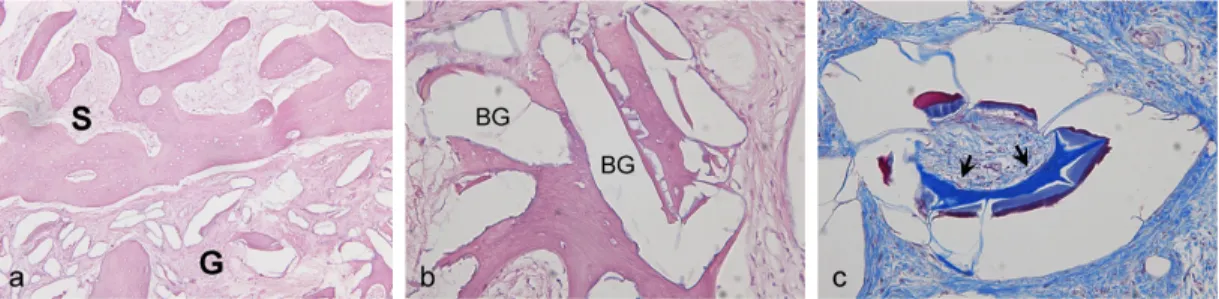
22.3% and 26.5%, respectively. A small amount of new bone ingrowth into the BG particles from native bone was observed at month 10 (Figure 3). The mean NB% was 13.2% and the mean BG% was 30.7% (Table 2). Increased new bone formation in internally excavated BG par- ticles was observed at month 18 (Figure 4).
Newly formed bone in direct contact with re- sidual graft particles was observed, but most BG particles were still surrounded by con- nective tissue and mineralized bone. In con- trast, the socket left after removal of a pre- vious implant showed more favorable bone healing (abundant and relatively
Figure 1. Case 1. (a) Buccal view of horizontal ridge deficiency of maxillary left first premolar.
(b) Occlusal view of horizontal ridge deficiency. (c) Reentry surgery at 6 months showing in- creased alveolar ridge width after membrane removal. (d) The implant was placed in the aug- mented site in such a way as to confer stability. (e) Histological section of a bone core re- trieved 6 months after grafting. The major part of the grafted site (G) consists of BG particles embedded in connective tissue. There is no integration between native bone (B) and the graft material (original magnification × 40; stained with hematoxylin and eosin).
Figure 2. Histological section of a bone core retrieved 8 months after grafting (Case 2). (a) New bone formation (arrows) is limited and is not in contact with BG particles. Most graft particles are encapsulated with fibrous tissue (original magnification × 100; stained with hem- atoxylin and eosin). (b) Higher magnification of Fig. 2a. Internal excavation and related filling of connective tissue (arrowheads) is evident in the centers of BG particles. Cracks and frag- mentation (arrows) of BG particles are evident (original magnification × 200; stained with hematoxylin and eosin).
thick trabecular bone) than areas that had pre- viously been augmented with Biogran® despite the relatively short healing period (3 months) and the absence of grafting. Histomorphometry
showed that the grafts consisted of 10.7% NB and 18.9% BG. In contrast, 41.9% of the socket left after removal of a previous implant con- sisted of newly formed bone.
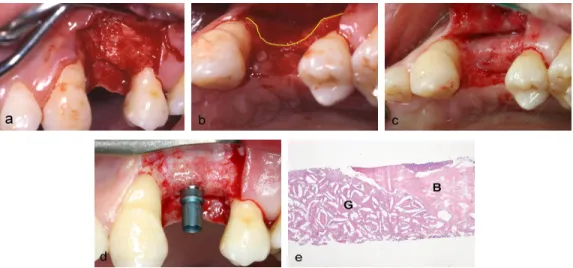
Figure 3. Case 3. (a) Narrow alveolar ridge in the posterior area of the left mandible. (b) After decortication, a titanium screw was fixed into the alveolar bone to support the barrier membrane. (c) After grafting, a TR e-PTFE membrane was fixed to the alveolar bone with membrane tacks. (d) Increased alveolar ridge width after membrane removal at surgical reentry. (e) Histological section of biopsy retrieved 10 months after grafting. Integration of BG particles with newly formed bone grown from native bone (B) is evident in some areas (arrows), but the major part consists of graft particles embedded in connective tissue (original magnification × 100; stained with hematoxylin and eosin).
Figure 4. Histological section of bone core retrieved 18 months after grafting (Case 4). (a) Site of implant removal (S) after 3 months of healing shows favorable bone formation com- posed of trabecular bone that is thicker and more abundant than that of the Biogran® grafted site (G) (original magnification × 100; stained with hematoxylin and eosin). (b) Higher magni- fication of Figure 4a. BG particles (BG) integrated into newly formed bone are evident (original magnification × 400; stained with hematoxylin and eosin). (c) Newly formed bone (arrows) is evident within the centrally excavated BG particle (original magnification × 400;
stained with Masson’s trichrome stain).
IV. DISCUSSION
In our study, when bioactive glass was used for horizontal ridge augmentation, bone healing was poor compared to that reported in other human studies22-24). Histological analysis re- vealed that bioactive glass induced little for- mation of new bone in the first 8 months after the operation (2.5%) and a relatively low per- centage of new bone in the first 18 months (10.7%), indicating that it has poor osteo- conductive properties.
Many studies suggested that ionic dissolution products and internal excavation of BG par- ticles play key roles in osteoblast differentiation and subsequent bone formation17,20,21,29). Several studies suggested that each bioactive glass particle functions as a nucleus for bone growth, thereby enhancing bone healing17,20). While many studies have demonstrated that bioactive glass has beneficial effects on bone healing in vitro, evidence from in vivo trials with humans is conflicting22-24,28,30). Tadjoedin et al24,31). re- ported that bioactive glass particles (Biogran®, 300-355 ㎛) induced 36% new bone growth at month 6 of healing after sinus floor elevation.
In contrast, Knapp et al28). demonstrated that bioactive glass had poor osteoconduction for the treatment of horizontal alveolar ridge defects in conjunction with GBR. After 6 months of healing, the grafted sites showed poor new bone formation (10% or less in 6 of 10 patients) and most residual BG particles exhibited con- nective tissue encapsulation, which is similar to our findings. Norton and Wilson30) found no evidence of new bone formation in healing ex- traction sockets 6 months after the operation and suggested that a longer time may be re-
quired for the graft-healing effect to become evident because a small amount of new bone was incorporated into sites with bioactive glass 7 months after the graft.
In our trial, the area occupied by residual BG particles was greater than that reported in other studies23,24,31). The residual Biogran® par- ticles accounted for 18.9% of the defect area after 18 months, suggesting that Biogran® de- grades slowly. In contrast, Tadjoedin et al24,31). reported that residual BG particles accounted for 8% of the defect area at 15 months and were absent at 16 months when combined with a small amount of autogenous bone in sinus floor elevation. Froum et al23). reported that residual BG particles occupied 5.5% of the areas of extraction sockets up to month 8 of healing.
Histological differences between studies may be related to differences in healing times, proper- ties of bioactive glasses, types of defects, sur- gical techniques and methods of histomorpho- metric measurement.
Although the volume of bone involved in lat- eral ridge augmentation is small compared with that involved in sinus floor elevation, most of the area to be augmented receives its blood supply from the marrow compartment of bone through cortical perforations. The cancellous portion of the alveolar ridge is reduced as atrophy of the bone progresses and the number and diameter of vessels decreases with time32). In most cases of GBR of severely atrophic al- veolar ridges, blood supply to the grafted sites is limited. The grafted sites are supplied with blood through intramarrow perforations.
Moreover, blood flow from the periosteum to the grafting materials is blocked by the barrier membrane. This differs from self-contained
defects created by surrounding bony walls in sinus floor elevation. These differences may explain the delayed resorption of BG particles and poor bone formation in our study relative to that reported in other studies because en- hanced angiogenesis emanating from the sur- rounding native bone and increased numbers of circulating stem cells contribute to graft heal- ing33-36).
In our study, newly formed bone occupied only 10.7% of the total defect area at 18 months, while 41.9% of the area of the socket from which an implant was removed consisted of trabecular bone at 3 months, which is sim- ilar to the normal trabecular bone content of the maxilla24). These findings are in agreement with the results of recently published studies in which the authors showed that Biogran® may interfere with new bone formation in animals when used with or without GBR37,38). Stavropoulos et al37). examined the long-term influence of bone substitutes combined with GBR on bone formation and demonstrated that newly formed bone occupied 12.6% of the area of Biogran® grafted defects and 88.2% of the area of non- grafted control defects after 1 year. However, it should be noted that conflicting histological results have also been reported for similar types of defects such as human extraction sockets23,30) and periodontal osseous defects39-42).
With GBR, other bone substitutes, such as deproteinized bovine bone, induced greater new bone formation than the bioactive glass used in our study. Studies of human alveolar ridge augmentation showed that deproteinized bovine bone induces 17%-27% new bone formation with a considerable degree of direct contact between newly formed bone and the residual graft after
6 months of healing11,14,43). These differences in bone healing indicate that more human histological studies are needed to confirm the effectiveness of BG in the treatment of osseous defects.
In our study, the increase in the width of the alveolar ridge induced by bioactive glass was sufficient for placement of an implant combined with a titanium reinforced e-PTFE barrier membrane but histological evaluation re- vealed poor bone healing, even after 18 months.
The limited information obtained from this case series suggests that bioactive glass particles are not suitable for bone regeneration with GBR for treatment of horizontal ridge defects.
V. REFERENCES
1. Buser D, Ingimarsson S, Dula K et al.
Long-term stability of osseointegrated im- plants in augmented bone: a 5-year pro- spective study in partially edentulous patients. Int J Periodontics Restorative Dent 2002;22:109-117.
2. Hammerle CH, Jung RE, Feloutzis A. A systematic review of the survival of im- plants in bone sites augmented with barrier membranes (guided bone regeneration) in par- tially edentulous patients. J Clin Periodontol 2002;29 suppl 3:226-233.
3. Fugazzotto PA. Report of 302 consecutive ridge augmentation procedures: technical considerations and clinical results. J Oral Maxillofac Implants 1998;13:358-368.
4. Buser D, Dula K, Belser UC, Hirt HP, Berthold H. Localized ridge augmentation using guided bone regeneration. II. Surgical procedure in the mandible. Int J Periodontics Restorative Dent 1995;15:10-29.
5. Lundgren AK, Lundgren D, Sennerby L et
al. Augmentation of skull bone using a bi- oresorbable barrier supported by autologous bone grafts. An intra-individual study in the rabbit. Clin Oral Implants Res 1997;
8:90-95.
6. Schenk RK, Buser D, Hardwick WR, Dahlin C. Healing pattern of bone regeneration in membrane-protected defects: a histologic study in the canine mandible. Int J Oral Maxillofac Implants 1994;9:13-29.
7. Clavero J, Lundgren S. Ramus or chin grafts for maxillary sinus inlay and local onlay augmentation: comparison of donor site morbidity and complications. Clin Implant Dent Relat Res 2003:5:154-160.
8. Marx RE, Morales MI. Morbidity from bone harvest in major jaw reocnstruction: a randomised trial comparing the lateral an- terior and posterior approaches to the ilium.
J Oral Maxillofac Surg 1988;48:196-203.
9. Yunger EM, Chapman MW. Morbidity at bone graft donor sites. J Orthop Trauma 1989;3:192-195.
10. Ersanli S, Olgac V, Leblebicioglu B.
Histologic analysis of alveolar bone follow- ing guided bone regeneration. J Periodontol 2004;75:750-756.
11. Meijndert L, Raghoebar GM, Schupbach P, Meijer HJA, Vissink A. Bone quality at the implant site after reconstruction of a local defect of the maxillary anterior ridge with chin bone or deproteinised cancellous bo- vine bone. Int J Oral Maxillofac Surg 2005;
34:877-884.
12. Simion M, Trisi P, Piattelli A. Vertical ridge augmentation using a membrane technique associated with osseointegrated implants. Int J Periodontics Restorative Dent 1994;14:497-511.
13. Simion M, Trisi P, Piattelli A. GBR with an e-PTFE membrane associated with DFDBA:
histologic and histochemical analysis in a human implant retrieved after 4 years of loading. Int J Periodontics Restorative Dent 1996;16:338-347.
14. Zitzmann NU, Scharer P, Marinello CP, Schupbach P, Berglundh T. Alveolar ridge augmentation with Bio-Oss: A histologic study in humans. Int J Periodontics Restorative Dent 2001;21:289-295.
15. Hench LL, Wilson J. Surface active biomaterials. Science 1984;226:303-312.
16. Hench LL. Bioceramics: from concept to clinic. J Am Ceram Soc 1991;74:1487-1510.
17. Ducheyne P, Qiu Q. Bioactive ceramics: the effect of surface reactivity on bone for- mation and bone cell function. Biomaterials 1999;20:2287-2303.
18. El Ghannam A, Ducheyne P, Shapiro IM.
Effect of serum proteins on osteoblast ad- hesion to surface-modified bioactive glass and hydroxyapatite. J Orthop Res 1999;17:
340-345.
19. Radin S, Ducheyne P, Rothman B, Conti A.
The effect of in vitro modeling conditions on the surface reactions of bioactive glass.
J Biomed Mater Res 1997;37:363-375.
20. Schepers E, De Clercq M, Ducheyne P, Kempeneers R. Bioactive glass particulate material as a filler for bone lesions. J Oral Rehabil 1991;18:439-452.
21. Xynos ID, Edgar AJ, Buttery LDK, Hench LL, Polack JM. Ionic dissolution products of bioactive glass increase proliferation of human osteoblasts and induce insulin-like growth factor II mRNA expression protein synthesis. Biochem Biophys Res Commun 2000;276:461-465.
22. Cordioli G, Mazzocco C, Schepers E, Brugnolo E, Majzoub Z. Maxillary sinus floor augmentation using bioactive glass granules and autogenous bone with simul- taneous implant placement. Clin Oral Implants Res 2001;12:270-278.
23. Froum S, Cho SC, Rosenberg E, Rohrer M, Tarnow D. Histological comparison of heal- ing extraction sockets implanted with bio- active glass or demineralized freeze-dried bone allograft: a pilot study. J Periodontol 2002;73:94-102.
24. Tadjoedin ES, de Lange GL, Lyaruu DM, Kulper L, Burger EH. High concentrations of bioactive glass material (BioGran®) vs.
autogenous bone for sinus floor elevation.
Clin Oral Implants Res 2002;13:428-436.
25. Furusawa T, Mizunuma K. Osteoconductive properties and efficacy of resorbable bio- active glass as a bone-grafting material.
Implant Dent 1997;6:93-101.
26. Trisi P, Rebaudi A, Calvari F, Lazzara RJ.
Sinus graft with Biogran, autogenous bone, and PRR: a report of three cases with his- tology and micro-CT. Int J Periodontics Restorative Dent 2006;26:113-125.
27. Turunen T, Peltola J, Yli-Urpo A, Happonen RP. Bioactive glass granules as a bone adjunctive material in maxillary sinus floor augmentation. Clin Oral Implants Res 2004;15:135-141.
28. Knapp CI, Feuille F, Cochran DL, Mellonig JT. Clinical and histologic evaluation of bone-replacement grafts in the treatment of localized alveolar ridge defects. Part 2:
bioactive glass particulate. Int J Periodontics Restorative Dent 2003;23:129-137.
29. Xynos ID, Hukkanen MVJ, Batten JJ et al.
Bioactive 45S5 stimulates osteoblast turn-
over and enhances bone formation in vitro:
Implications and applications for bone tis- sue engineering. Calcif Tiss Int 2000;
67:321-329.
30. Norton MR, Wilson J. Dental implants placed in extraction sites implanted with bioactive glass: human histology and clin- ical outcome. Int J Oral Maxillofac Implants 2002;17:249-257.
31. Tadjoedin ES, de Lange GL, Holzmann PJ, Kuiper L, Burger EH. Histological ob- servations on biopsies harvested following sinus floor elevation using a bioactive glass material of narrow size range. Clin Oral Implants Res 2000;11:334-344.
32. Solar P, Geyerhofer U, Traxler H et al.
Blood supply to the maxillary sinus rele- vant to sinus floor elevation procedures.
Clin Oral Implants Res 1999;10:34-44.
33. Marx ME. Clinical application of bone biology to mandibular and maxillary reconstruction.
Clin Plast Surg 1994;21:377-392.
34. Schmid J, Wallkamm B, Hammerle CHF, Gogolewski S, Lang NP. The significance of angiogenesis in guided bone regeneration.
A case report of a rabbit experiment. Clin Oral Implants Res 1997;8:244-248.
35. Schenk RK. Bone regeneration: Biologic basis. In: Buser D, Dahlin C, Schenk R (eds). Guided Bone Regeneration in Implant Dentistry. Chicago: Quintessence, 1994:49-100.
36. Winet H. The role of microvasculature in normal and perturbed bone healing as re- vealed by introvital microscopy. Bone 1996;
19S:39-57.
37. Moreira-Gonzalez A, Lobocki C, Barakat K et al. Evaluation of 45S bioactive glass combined as a bone substitute in the re- construction of critical size calvarial de-
fects in rabbits. J Craniofac Surg 2005;
16:63-70.
38. Stavropoulos A, Kostopoulos L, Nyengaard JR, Karring T. Deproteinized bovine bone (Bio-Oss®) and bioactive glass (Biogran®) arrest bone formation when used as an ad- junct to guided tissue regeneration (GTR).
J Clin Periodontol 2003;30:636-643.
39. Fiorellini JP. Human histologic evaluation of bioactive ceramics in the treatment of periodontal osseous defects. Int J Periodontics Restorative Dent 2000;20:459-467.
40. Lovelace TB, Mellonig JT, Meffert RM et al. Clinical evaluation of bioactive glass in
the treatment of periodontal osseous defects in humans. J Periodontol 1998;69:1027-1035.
41. Nevins ML, Camelo M, Nevins M et al.
Human histologic evaluation of bioactive ceramics in the treatment of periodontal osseous defects. Int J Periodontics Restorative Dent 2000;20:459-467.
42. Rosenberg ES, Fox GK, Cohen C. Bioactive glass granules for regeneration of human periodontal defects. J Esthet Dent 2000;
12:248-257.
43. Norton MR, Odell EW, Thompson ID, Cook RJ.
Efficacy of bovine bone mineral for alveolar augmentation: a human histologic study. Clin Oral Implants Res 2003; 14:775-783.
-Abstract-
수평적 치조제증대술에 사용된 Bioactive glass의 골재생에 관한 조직학적 관찰: 증례보고
박진우, 서조영
경북대학교 치과대학 치주과학교실
임프란트 식립을 필요로 하는 환자의 수평적 치조제 결손의 증대를 위해 골유도재생술과 병용한 bioactive glass (BG) (Biogran®) 이식의 골재생 양상을 각기 다른 치유기간을 부여한 4명의 환자에서 평가하였다. 6, 8, 10, 18개월의 치유기간 후 임프란트 식립부위에서 조직절편을 채득하여 골재생을 조직계측학적으로 평가하였 다. 임프란트 식립을 위한 surgical reentry시 모든 이식부위는 임상적으로 명확한 수평적 치조제 폭경의 증가 를 관찰할 수 있었다. 하지만 조직학적 분석결과 BG는 불량한 골전도성을 나타내었다. 6, 8개월의 치유기간후, 이식부위에서 신생골이 거의 관찰되지 않았으며(2.5%이하), 이식부와 기존 골의 경계부위에서 BG particle에 대한 신생골 성장과 결합양상 또한 관찰할 수 없었다. 10개월의 치유기간후 기존 골조직으로부터 성장한 신생 골의 BG particle과의 직접적인 접촉양상을 일부 관찰할 수 있었다. 이식부는 13.2%의 광물화된 신생골조직을 보였고, 대부분의 BG particle은 결체조직으로 둘러싸여 있었다. 18개월의 치유기간이 부여된 환자의 조직절편 에서 신생골은 이식부의 10.7%를 차지하여 비교적 낮은 신생골 형성양을 나타내었고, 이식부에 존재하는 잔존 BG particle은 대부분은 결체조직으로, 일부분에서 광물화된 골조직으로 둘러싸여 있었다. 6, 8, 10, 18개월에 서 잔존 BG particle양은 전체 이식부 면적에 대해서 각기 22.3%, 26.5%, 30.7%, 18.7%로 나타났다. 본 증례 보고는 비록 한정적인 4명의 환자에서의 조직계측학적 평가결과이지만, 수평적 치조제 결손의 증대를 위해 골 유도재생술과 병용한 bioactive glass이식은 불량한 골전도성으로 인해 효과적인 골재생을 위한 이식재로서는 적절하지 않을 수 있음을 나타낸다.2)
Key words : bioactive glass, guided bone regeneration, horizontal ridge augmentation, human histology