ABSTRACT
Background: The mortality risk of coronavirus disease 2019 (COVID-19) is higher in patients with older age, and many elderly patients are reported to require advanced respiratory support.
Methods: We reviewed medical records of 98 patients aged ≥ 65 years who were hospitalized with COVID-19 during a regional outbreak in Daegu/Gyeongsangbuk-do province of Korea.
The outcome measures were in-hospital mortality and the treatment with mechanical ventilation (MV) or high-flow nasal cannula (HFNC).
Results: The median age of the patients was 72 years; 55.1% were female. Most (74.5%) had at least one underlying condition. Overall case fatality rate (CFR) was 20.4%, and median time to death after admission was 8 days. The CFR was 6.1% among patients aged 65–69 years, 22.7% among those aged 70–79 years, and 38.1% among those aged ≥ 80 years. The CFR among patients who required MV was 43.8%, and the proportion of patients received MV/HFNC was 28.6%. Nosocomial acquisition, diabetes, chronic lung diseases, and chronic neurologic diseases were significant risk factors for both death and MV/HFNC. Hypotension, hypoxia, and altered mental status on admission were also associated with poor outcome.
CRP > 8.0 mg/dL was strongly associated with MV/HFNC (odds ratio, 26.31; 95% confidence interval, 7.78–88.92; P < 0.001), and showed better diagnostic characteristics compared to commonly used clinical scores.
Conclusion: Patients aged ≥ 80 years had a high risk of requiring MV/HFNC, and mortality among those severe patients was very high. Severe initial presentation and laboratory abnormalities, especially high CRP, were identified as risk factors for mortality and severe hospital course.
Keywords: COVID-19; Outcome; Elderly; Risk Factors
Original Article
Received: May 6, 2020 Accepted: Jun 7, 2020 Address for Correspondence:
Kyong Ran Peck, MD, PhD
Division of Infectious Diseases, Samsung Medical Center, Sungkyunkwan University School of Medicine, 81 Irwon-ro, Gangnam-gu, Seoul 06351, Republic of Korea.
E-mail: [email protected] Hyun-Ha Chang, MD, PhD
Division of Infectious Diseases, Department of Internal Medicine, School of Medicine, Kyungpook National University and Kyungpook National University Hospital, 130 Dongdeok-ro, Jung-gu, Daegu 41944, Republic of Korea.
E-mail: [email protected]
*Ji Yeon Lee, Hyun Ah Kim, and Kyungmin Huh contributed equally to this work.
© 2020 The Korean Academy of Medical Sciences.
This is an Open Access article distributed under the terms of the Creative Commons Attribution Non-Commercial License (https://
creativecommons.org/licenses/by-nc/4.0/) which permits unrestricted non-commercial use, distribution, and reproduction in any medium, provided the original work is properly cited.
ORCID iDs Ji Yeon Lee
https://orcid.org/0000-0002-2788-1392 Hyun Ah Kim
https://orcid.org/0000-0002-9125-7156 Kyungmin Huh
https://orcid.org/0000-0002-5140-3964 Miri Hyun
https://orcid.org/0000-0003-0062-342X
Ji Yeon Lee ,1* Hyun Ah Kim ,1* Kyungmin Huh ,2* Miri Hyun ,1
Ji-Young Rhee ,3 Sukbin Jang ,3 Ji-Yeon Kim ,4 Kyong Ran Peck ,2 and Hyun-Ha Chang 5
1 Division of Infectious Diseases, Department of Medicine, Keimyung University Dongsan Hospital, Keimyung University School of Medicine, Daegu, Korea
2 Division of Infectious Diseases, Department of Medicine, Samsung Medical Center, Sungkyunkwan University School of Medicine, Seoul, Korea
3 Division of Infectious Diseases, Department of Medicine, Dankook University School of Medicine, Cheonan, Korea
4 Division of Infectious Diseases, Department of Medicine, Seongnam Citizens Medical Center, Seongnam, Korea
5 Division of Infectious Diseases, Department of Internal Medicine, School of Medicine, Kyungpook National University, Daegu, Korea
Risk Factors for Mortality and
Respiratory Support in Elderly Patients Hospitalized with COVID-19 in Korea
Infectious Diseases,
Microbiology & Parasitology
Ji-Young Rhee
https://orcid.org/0000-0003-4664-7048 Sukbin Jang
https://orcid.org/0000-0003-4783-8110 Ji-Yeon Kim
https://orcid.org/0000-0002-8713-1497 Kyong Ran Peck
https://orcid.org/0000-0002-7464-9780 Hyun-Ha Chang
https://orcid.org/0000-0002-9405-2121 Disclosure
The authors have no potential conflicts of interest to disclose.
Author Contributions
Conceptualization: Peck KR, Chang HH.
Methodology: Kim HA, Huh K, Rhee JY, Peck KR, Chang HH. Data curation: Lee JY, Kim HA, Hyun M, Rhee JY, Jang S, Kim JY, Chang HH.
Formal analysis: Huh K. Writing - original draft:
Huh K. Writing - review & editing: Huh K, Peck KR, Chang HH.
INTRODUCTION
Coronavirus disease 19 (COVID-19) is an infectious disease caused by a novel coronavirus, severe acute respiratory syndrome coronavirus-2 (SARS-CoV-2). Approximately 3 months after the first report in Wuhan, China, the number of cases exceeded 400,000 by late March.1 High viral shedding early in the disease course and slow progression make the effort for containment extremely difficult, and a large surge of cases has been observed in Europe and North America.2,3 Its clinical course ranges from asymptomatic infection to acute respiratory distress syndrome (ARDS) and death.4 Although most patients undergo mild febrile illness, a relatively large proportion of patients need hospitalization and respiratory support such as high-flow nasal cannula (HFNC) or mechanical ventilation (MV).5 Case fatality rates (CFRs) vary significantly by country, as the magnitude and velocity of surge greatly affect the care of patients. However, severe cases and mortality are consistently reported among the elderly, and patients aged ≥ 60 years comprise the majority of fatal cases in both China and Italy.6,7 Despite the importance of old age with respect to outcome, there have been no reports specifically aimed at examining the clinical characteristics and treatment outcomes in elderly patients with COVID-19 who require hospitalization. Information on the outcomes in this population, especially the need for MV/HFNC that requires specialized machines and considerable resources, is necessary for the public health response and planning.
Since February 19, 2020, a regional outbreak of COVID-19 occurred in the Daegu/Gyeongsangbuk- do province of Korea (Fig. 1). Owing to an expanded testing capacity and rapid public health response, most patients are considered diagnosed and monitored. Although the healthcare capacity has been overstretched during the outbreak, the CFR observed in the area is substantially lower than the CFRs reported in China and Italy, suggesting that the healthcare system has been largely capable of providing adequate care for patients.8,9 The clinical data from Daegu/
Gyeongsangbuk-do province would provide useful information regarding the characteristics of COVID-19 in a situation that is different from the other two gravely affected countries.
Thus, we conducted a retrospective study to elucidate the clinical characteristics and risk factors for mortality and the need for MV/HFNC in elderly patients hospitalized with COVID-19.
Date
Daily No. of new cases
Feb 16
Feb 19
Feb 22
Feb 25
Feb
28 Mar
2 Mar
5 Mar
8 Mar
11 Mar
14 Mar
17 Mar
20 Mar
23 700
500
200 600
400
100 300
0
Daegu Gyeongsangbuk-do South Korea (total)
Fig. 1. Daily number of new cases in Daegu/Gyeongsangbuk-do and in Korea.
METHODS
Study population and data sources
We obtained medical records of patients aged ≥ 65 years who were admitted with laboratory- confirmed COVID-19 in four hospitals between February 18 and March 4, 2020. The end date was set to ensure that all patients were observed for at least 14 days after admission, as the median time from onset to MV was 10.5 days in a previous report and 75th percentile of time to death after symptom onset was reported to be 14 days.9,10 All patients were residents in the Daegu/Gyeongsangbuk-do province, and diagnosis of COVID-19 was made using a real-time reverse-transcriptase polymerase chain reaction (RT-PCR) assay of a nasopharyngeal swab or sputum according to the national guidelines.
Electronic medical records were reviewed to extract demographic characteristics, comorbidities, clinical features and laboratory findings on the day of admission, clinical course, treatment, and outcome. Patients were followed until death or discharge from hospital, whichever came first.
Study outcomes and definitions
The outcome measures were all-cause in-hospital death and MV/HFNC. We did not include care in intensive care units (ICUs) as an outcome measure as many mechanically ventilated patients were treated outside an ICU due to a shortage of ICU beds. The severity of the clinical course was evaluated through the highest respiratory support required during the hospital stay. They were categorized into none, supplementary oxygen (via nasal prong or facial mask), HFNC, MV, and extracorporeal membrane oxygenation. Noninvasive positive pressure ventilation was not administered to any of our study patients. Nosocomial acquisition was defined as a diagnosis of COVID-19 during admission in an acute-care hospital or a long-term care facility for other unrelated illnesses. The modified early warning score (MEWS) and national early warning score 2 (NEWS2) were calculated as previously described.11,12
Statistical analysis
Patient characteristics were summarized and compared among outcomes using Student's t-test or Mann-Whitney U test for continuous variables and χ2 or Fisher's exact test for categorical variables, as appropriate. In-hospital mortality of the two groups was compared using the Kaplan-Meier curve. A receiver operating characteristic curve was used to evaluate the accuracy of the prognostic factors. All tests were two-tailed, and significance was assessed at P < 0.05. R version 3.6.1 (R Foundation for Statistical Computing, Vienna, Austria) was used for the analyses.
Ethics statement
The study was approved by the Institutional Review Board of the Samsung Medical Center (SMC 2020-03-116-001) with waived informed consent.
RESULTS
We identified 98 patients hospitalized with COVID-19 who were aged ≥ 65 years. Fifty-four patients (55.1%) were female, and the median age was 72 (interquartile range [IQR], 68–79;
range, 65–93) years. Most patients (74.5%) had underlying conditions; hypertension (52.0%), diabetes (27.6%), cardiovascular diseases (16.3%), chronic neurologic disease (14.3%), and malignancy (11.2%) were common comorbidities. Eight patients (8.2%) had chronic lung
disease, and six patients (6.1%) had chronic kidney disease. None of the patients had end- stage renal disease requiring dialysis before their COVID-19 diagnosis. Lopinavir/ritonavir or darunavir/ritonavir was administered to 75 patients (76.5%) and hydroxychloroquine to 59 patients (60.2%). Systemic glucocorticoids were administered to 28 patients (28.6%). The median time of follow-up since admission was 18 (IQR, 13–22) days.
Risk factors for mortality
Twenty patients died during their hospital stay, and the overall CFR was 20.4% (Table 1). The median time to death after admission was 8 (IQR, 5–11) days. The CFR among male patients was significantly higher than that among female patients (31.8% vs. 11.1%, P = 0.023). Age
(continued to the next page) Table 1. Characteristics of the patients by mortality
Characteristics Survival (n = 78) Mortality
Death (n = 20) OR (95% CI) P value
Female, sex 48 (61.5) 6 (30.0) 0.27 (0.09–0.77) 0.023
Age, yr 71.0 (67.0–78.0) 77.0 (73.0–83.5) 0.003
65–69 31 (39.7) 2 (10.0) 0.012
70–79 34 (43.6) 10 (50.0)
≥ 80 13 (16.7) 8 (40.0)
Nosocomial acquisition 5 (6.4) 7 (35.0) 7.86 (2.16–28.57) 0.002
Comorbidities
Any 53 (67.9) 20 (100.0) N/A 0.008
Diabetes 16 (20.5) 11 (55.0) 4.74 (1.68–13.38) 0.005
Hypertension 38 (48.7) 13 (65.0) 1.95 (0.70–5.42) 0.294
Chronic lung disease 3 (3.8) 5 (25.0) 8.33 (1.80–38.68) 0.008
Cardiovascular disease 13 (16.7) 3 (15.0) 0.88 (0.23–3.45) > 0.999
Chronic renal disease 3 (3.8) 3 (15.0) 4.41 (0.82–23.78) 0.097
Chronic liver disease 1 (1.3) 2 (10.0) 8.56 (0.73–99.61) 0.105
Chronic neurologic disease 6 (7.7) 8 (40.0) 8.00 (2.36–27.16) 0.001
Cancer 7 (9.0) 4 (20.0) 2.54 (0.66–9.71) 0.228
Immunosuppressant use 0 (0.0) 1 (5.0) N/A 0.204
Clinical manifestations on admission
Heart rate 84.7 ± 16.9 94.0 ± 17.6 0.032
≥ 90 29 (37.2) 10 (50.0) 1.69 (0.63–4.55) 0.430
Systolic blood pressure, mmHg 138.1 ± 25.3 114.0 ± 24.4 < 0.001
< 110 8 (10.3) 8 (40.0) 5.83 (1.84–18.53) 0.004
Vasopressor use 4 (5.1) 4 (20.0) 4.63 (1.04–20.47) 0.052
Respiratory rate (n = 94) 20.0 (18.0–20.5) 23.0 (20.0–28.0) < 0.001
≥ 20 52/75 (69.3) 19/19 (100.0) N/A 0.005
Oxygen saturation by pulse oximetry on room air, % (n = 77) 96.0 (93.5–98.0) 90.5 (85.0–95.0) 0.010
< 95 19/59 (32.2) 11/18 (61.1) 3.31 (1.11–9.88) 0.054
Body temperature, °C 37.0 (36.5–37.9) 37.3 (36.6–37.8) 0.375
Altered mental status 7 (9.0) 11 (55.0) 12.40 (3.83–40.11) < 0.001
MEWS 2.0 (1.0–3.0) 4.0 (3.0–5.0) < 0.001
NEWS2 1.0 (0.0–2.0) 4.5 (2.0–6.0) 0.001
Laboratory findings on admission
White blood cell count, /mm3 5,135.0 (4,140.0–6,730.0) 7,855.0 (6,610.0–14,445.0) < 0.001
Neutrophil count, /mm3 3,403.8 (2,430.0–4,790.0) 6,451.2 (5,260.1–11,532.2) < 0.001
> 4,500, /mm3 21 (26.9) 16 (84.2) 14.48 (3.83–54.78) < 0.001
Lymphocyte count, /mm3 1,251.4 (895.7–1,510.0) 636.4 (519.1–858.6) < 0.001
< 900 20 (25.6) 15 (78.9) 10.88 (3.23–36.63) < 0.001
Blood urea nitrogen, mg/dL 15.7 (12.0–20.0) 36.4 (16.5–45.0) < 0.001
> 20 20 (25.6) 14 (70.0) 6.77 (2.29–19.99) 0.001
Serum creatinine, mg/dL 0.8 (0.7–1.0) 1.4 (1.0–2.1) < 0.001
> 1.0 22 (28.2) 17 (85.0) 14.42 (3.84–54.14) < 0.001
Lactate dehydrogenase (n = 77), IU/L 507.0 (449.0–677.0) 599.0 (557.0–744.0) 0.053
> 600 21/68 (30.9) 4/9 (44.4) 1.79 (0.44–7.35) 0.461
C-reactive protein, mg/dL 2.6 (0.6–7.1) 12.8 (9.6–18.6) < 0.001
> 8.0 19 (24.4) 18 (90.0) 27.95 (5.93–131.63) < 0.001
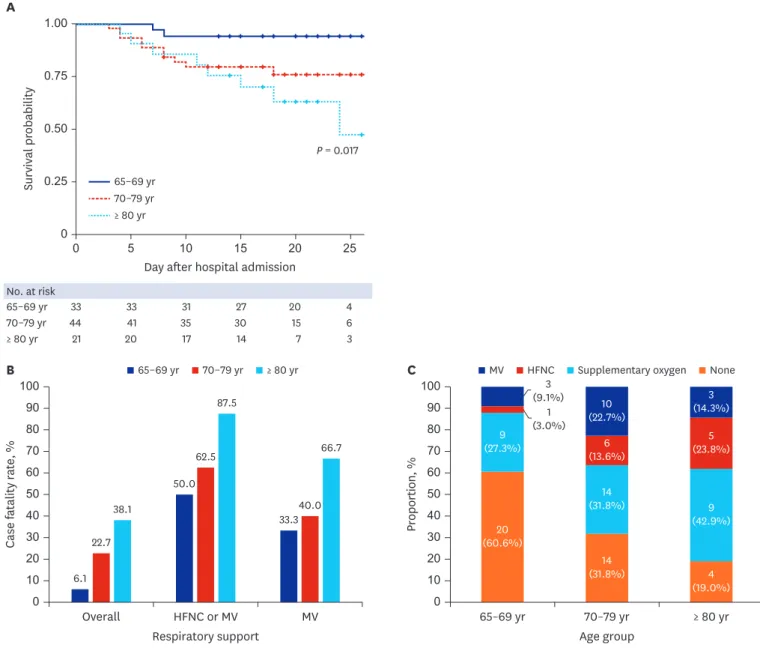
was a significant predictor of mortality (Fig. 2A); the CFR was 6.1% among patients aged 65–
69 years, 22.7% among those aged 70–79 years, and 38.1% among those aged ≥ 80 years died.
The substantial effect of age on outcome was observed consistently when CFR was examined according to severity. The CFR among patients ≥ 80 years of age who required HFNC or MV was 87.5%, substantially higher than that of lower age groups (Fig. 2B). In addition, the time to death was longer in patients aged ≥ 80 years (median, 11 days; IQR, 6–15 days) than in patients aged 70–79 years (median, 7 days; IQR, 4–8 days), although the difference was not statistically significant (P = 0.141). The overall CFR among patients who required MV was 43.8% (n = 7/16). All 12 patients whose highest respiratory support was HFNC, who declined to be intubated, died.
Nosocomial acquisition was also a significant risk factor for mortality (odds ratio [OR], 7.86; 95% confidence interval [CI], 2.16–28.57; P = 0.002). All patients who died had at least one underlying condition. Among comorbidities, diabetes (OR, 4.74; 95% CI, 1.68–13.38;
P = 0.005), chronic lung diseases (OR, 8.33; 95% CI, 1.80–38.68; P = 0.008), and chronic neurologic diseases (OR, 8.00; 95% CI, 2.36–27.16; P = 0.001) were significantly associated with mortality. Severe manifestations on the day of admission were also associated with an increased risk of death. Systolic blood pressure < 110 mmHg (OR, 5.83; 95% CI, 1.84–18.53; P = 0.004), oxygen saturation by pulse oximetry < 95% on room air (OR, 3.31; 95% CI, 1.11–9.88; P = 0.054), and altered mental status (OR, 12.40; 95% CI, 3.83–40.11; P < 0.001) were significant predictive factors for mortality. In addition, all patients who died presented with respiration rates ≥ 20/min on admission, except one patient who had to be intubated before vital signs could be recorded.
MEWS and NEWS2 scores were both significantly higher in patients who died later.
Among laboratory findings, a higher white blood cell count (P < 0.001), lymphocyte count
< 900/mm3 (OR, 10.88; 95% CI, 3.23–36.63; P < 0.001), blood urea nitrogen > 20 mg/dL (OR, 6.77; 95% CI, 2.29–19.99; P = 0.001), serum creatinine > 1.0 mg/dL (OR, 14.42; 95% CI, 3.84–
54.14; P < 0.001), and C-reactive protein (CRP) > 8.0 mg/dL (OR, 27.95; 95% CI, 5.93–131.63;
P < 0.001) were associated with mortality.
Table 1. (Continued) Characteristics of the patients by mortality
Characteristics Survival (n = 78) Mortality
Death (n = 20) OR (95% CI) P value
Radiologic findings on admission
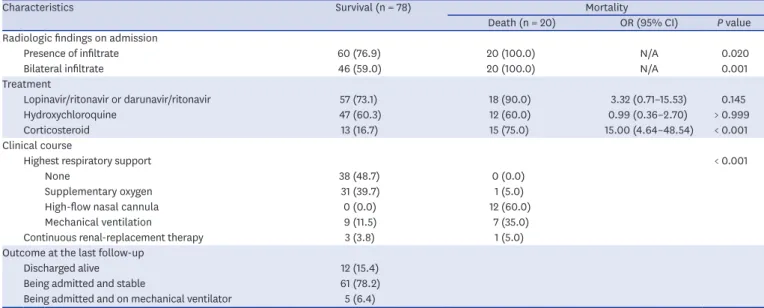
Presence of infiltrate 60 (76.9) 20 (100.0) N/A 0.020
Bilateral infiltrate 46 (59.0) 20 (100.0) N/A 0.001
Treatment
Lopinavir/ritonavir or darunavir/ritonavir 57 (73.1) 18 (90.0) 3.32 (0.71–15.53) 0.145
Hydroxychloroquine 47 (60.3) 12 (60.0) 0.99 (0.36–2.70) > 0.999
Corticosteroid 13 (16.7) 15 (75.0) 15.00 (4.64–48.54) < 0.001
Clinical course
Highest respiratory support < 0.001
None 38 (48.7) 0 (0.0)
Supplementary oxygen 31 (39.7) 1 (5.0)
High-flow nasal cannula 0 (0.0) 12 (60.0)
Mechanical ventilation 9 (11.5) 7 (35.0)
Continuous renal-replacement therapy 3 (3.8) 1 (5.0)
Outcome at the last follow-up
Discharged alive 12 (15.4)
Being admitted and stable 61 (78.2)
Being admitted and on mechanical ventilator 5 (6.4)
Data are presented as mean ± standard deviation, median (interquartile range) or number (%).
OR = odds ratio, CI = confidence interval, N/A = not available, MEWS = modified early warning score, NEWS2 = national early warning score 2.
Risk factors for advanced respiratory support
The overall proportion of patients received MV/HFNC was 28.6%. Older patients were more likely to need MV or HFNC; among patients aged 65–69 years, 12.1% received MV/HFNC, but 36.9% of patients aged ≥ 70 years needed MV/HFNC (Fig. 2C). Similarly, the proportion of patients who required supplementary oxygen was also higher in the older age groups.
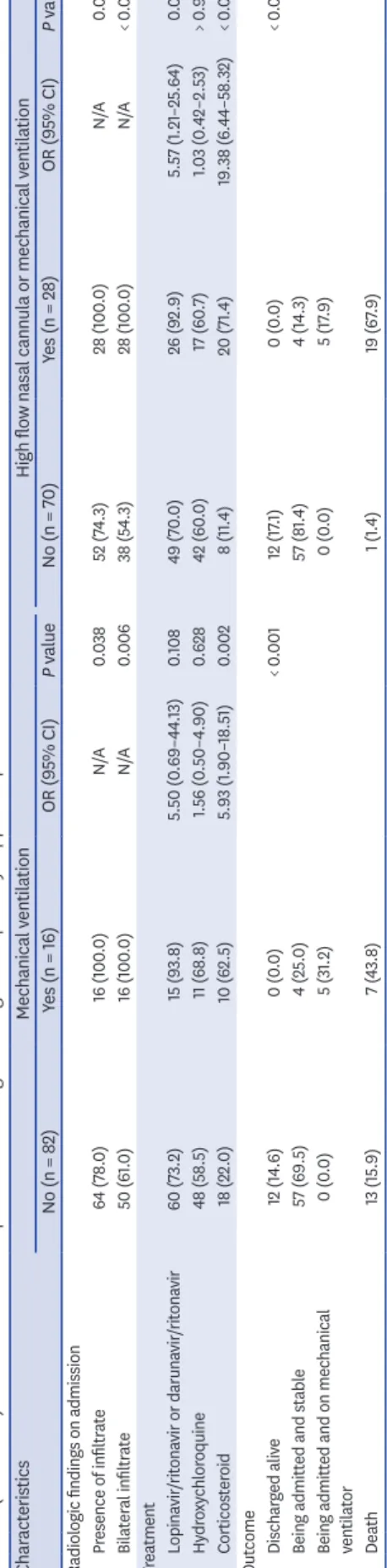
Diabetes (OR, 2.75; 95% CI, 1.07–7.05; P = 0.058), chronic lung diseases (OR, 4.86; 95% CI, 1.08–21.93; P = 0.041), and chronic neurologic diseases (OR, 4.27; 95% CI, 1.32–13.77; P = 0.021) were associated with the need for MV/HFNC (Table 2). Patients who presented with hypotension (OR, 8.41; 95% CI, 2.57–27.49; P < 0.001), tachypnea or hypoxemia (OR, 3.25; 95% CI, 1.13–9.33;
P = 0.048), or altered mental status (OR, 45.33; 95% CI, 9.22–222.96; P < 0.001) were more
00 5
0.75
0.25 1.00
0.50
Survival probability
Day after hospital admission
10 15 20 25
65–69 yr 33 33 31 27 20 4
70–79 yr 44 41 35 30 15 6
≥ 80 yr 21 20 17 14 7 3
No. at risk
P = 0.017 65–69 yr
70–79 yr
≥ 80 yr
A
(60.6%)20 (27.3%)9
(3.0%)1 (9.1%)3
(31.8%)14 (31.8%)14 (13.6%)6 (22.7%)10
(19.0%)4 (42.9%)9 (23.8%)5 (14.3%)3
0 10 20 30 40 50 60 70 80 90 100
65–69 yr 70–79 yr ≥ 80 yr
Proportion, %
Age group
MV HFNC Supplementary oxygen None
6.1
50.0
33.3 22.7
62.5
38.1 40.0
87.5
66.7 65–69 yr 70–79 yr ≥ 80 yr
0 10 20 30 40 50 60 70 80 90 100
Overall HFNC or MV MV
Case fatality rate, %
B C
Respiratory support
Fig. 2. Mortality and the highest respiratory support by age group.
(A) Survival curve of study patients by age group. (B) Case fatality rate by the highest respiratory support and age group. (C) Highest respiratory support by age group. Number of patients and proportions among each age group were shown.
HFNC = high flow nasal cannula, MV = mechanical ventilation.
(continued to the next page)
Table 2. Characteristics of the patients according to the highest respiratory support required CharacteristicsMechanical ventilationHigh flow nasal cannula or mechanical ventilation No (n = 82)Yes (n = 16)OR (95% CI)P valueNo (n = 70)Yes (n = 28)OR (95% CI)P value Female sex47 (57.3)7 (43.8)0.58 (0.20–1.71)0.47043 (61.4)11 (39.3)0.41 (0.17–1.00)0.077 Age, yr72.0 (67.0–79.0)74.0 (70.0–78.0)0.46771.0 (67.0–78.0)75.5 (71.5–82.0)0.026 65–6930 (36.6)3 (18.8)0.29329 (41.4)4 (14.3)0.037 70–7934 (41.5)10 (62.5)28 (40.0)16 (57.1) ≥ 8018 (22.0)3 (18.8)13 (18.6)8 (28.6) Nosocomial acquisition10 (12.2)2 (12.5)1.03 (0.20–5.21)> 0.9995 (7.1)7 (25.0)4.33 (1.24–15.10)0.035 Comorbidities Any61 (74.4)12 (75.0)1.03 (0.30–3.55)> 0.99949 (71.0)24 (85.7)2.57 (0.79–8.33)0.207 DM20 (24.4)7 (43.8)2.41 (0.80–7.31)0.13215 (21.4)12 (42.9)2.75 (1.07–7.05)0.058 Hypertension40 (48.8)11 (68.8)2.31 (0.74–7.24)0.23434 (48.6)17 (60.7)1.64 (0.67–3.99)0.388 Chronic lung disease6 (7.3)2 (12.5)1.81 (0.33–9.89)0.6133 (4.3)5 (17.9)4.86 (1.08–21.93)0.041 Cardiovascular disease13 (15.9)3 (18.8)1.22 (0.31–4.91)0.72213 (18.6)3 (10.7)0.53 (0.14–2.01)0.546 Chronic renal disease3 (3.7)3 (18.8)6.08 (1.11–33.41)0.0533 (4.3)3 (10.7)2.68 (0.51–14.16)0.349 Chronic liver disease2 (2.4)1 (6.2)2.67 (0.23–31.31)0.4181 (1.4)2 (7.1)5.31 (0.46–61.05)0.196 Chronic neurologic disease12 (14.6)2 (12.5)0.83 (0.17–4.14)> 0.9996 (8.6)8 (28.6)4.27 (1.32–13.77)0.021 Cancer6 (7.3)5 (31.2)5.76 (1.50–22.09)0.0165 (7.1)6 (21.4)3.55 (0.98–12.77)0.071 Immunosuppressant use1 (1.2)0 (0.0)N/A> 0.9990 (0.0)1 (3.6)N/A0.286 Clinical manifestations on admission Heart rate86.6 ± 17.186.6 ± 19.10.99884.2 ± 16.392.8 ± 18.70.027 ≥ 9031 (37.8)8 (50.0)1.65 (0.56–4.83)0.52724 (34.3)15 (53.6)2.21 (0.91–5.39)0.125 Systolic blood, mmHg137.9 ± 25.3109.1 ± 21.5< 0.001141.6 ± 24.1112.3 ± 21.8< 0.001 < 1109 (11.0)7 (43.8)6.31 (1.89–21.08)0.0045 (7.1)11 (39.3)8.41 (2.57–27.49)< 0.001 Vasopressor use2 (2.4)6 (37.5)24.00 (4.25–135.39)< 0.0010 (0.0)8 (28.6)N/A< 0.001 Respiratory rate (n = 94)20.0 (18.0–22.0)23.0 (20.0–30.0)0.00420.0 (18.0–20.0)23.0 (20.0–30.0)< 0.001 ≥ 2059/82 (72.0)12/12 (100.0)N/A0.03547/70 (67.1)24/24 (100.0)N/A0.003 Oxygen saturation by pulse oximetry on room air (n = 77), %95.0 (92.5–97.5)92.0 (85.0–98.0)0.38996.0 (94.0–98.0)90.5 (85.0–96.5)0.013 < 9525/68 (36.8)5/9 (55.6)2.15 (0.53–8.75)0.30018/57 (31.6)12/20 (60.0)3.25 (1.13–9.33)0.048 Body temperature, °C37.1 (36.5–37.9)37.2 (36.5–37.8)0.82537.0 (36.5–37.9)37.2 (36.6–37.80.359 Altered mental status11 (13.4)7 (43.8)5.02 (1.55–16.24)0.0092 (2.9)16 (57.1)45.33 (9.22–222.96)< 0.001 MEWS2.0 (1.0–3.0)3.0 (2.0–3.5)0.0262.0 (1.0–2.0)3.5 (2.5–5.0)< 0.001 NEWS21.0 (0.0–3.0)2.0 (1.0–5.0)0.2811.0 (0.0–2.0)4.5 (2.0–5.5)0.001 Laboratory findings on admission White blood cell count, /mm35,180.0 (4,140.0–6,960.0)9,105.0 (6,690.0–14,200.0)0.0014,975.0 (4,090.0–6,200.0)8,480.0 (6,690.0–14,095.0)< 0.001 Neutrophil count, /mm33,480.0 (2,430.0–4,870.0)7,858.4 (5,201.3–10,034.1)< 0.0013,215.0 (2,320.0–4,236.8)6,584.6 (5,557.0–11,501.6)< 0.001 > 4,500, /mm325 (30.5)12 (80.0)9.12 (2.37–35.17)0.00114 (20.0)23 (85.2)23.00 (6.84–77.33)< 0.001 Lymphocyte count, /mm31,235.0 (834.0–1,510.0)598.3 (514.4–1,164.3)0.0031,294.3 (930.0–1,770.0)636.4 (519.1–908.7)< 0.001 < 90025 (30.5)10 (66.7)4.56 (1.41–14.72)0.01715 (21.4)20 (74.1)10.48 (3.73–29.43)< 0.001 Blood urea nitrogen, mg/dL16.0 (12.0–22.0)23.1 (15.2–41.0)0.02615.0 (12.0–19.0)25.9 (15.2–42.9)< 0.001 > 2025 (30.5)9 (56.2)2.93 (0.98–8.75)0.09016 (22.9)18 (64.3)6.08 (2.34–15.76)< 0.001 Serum creatinine, mg/dL0.9 (0.8–1.1)1.2 (0.7–2.2)0.0610.8 (0.7–1.0)1.2 (0.9–2.0)0.001 > 1.029 (35.4)10 (62.5)3.05 (1.01–9.23)0.08019 (27.1)20 (71.4)6.71 (2.53–17.78)< 0.001 Lactate dehydrogenase (n = 77), IU/L510.0 (454.0–686.0)628.5 (517.0–1,010.0)0.113502.0 (449.0–686.0)590.0 (556.0–741.0)0.088 > 60021/69 (30.4)4/8 (50.0)2.29 (0.52–10.02)0.42620/64 (31.2)5/13 (38.5)1.38 (0.40–4.73)0.747 C-reactive protein, mg/dL2.8 (0.7–8.9)12.8 (8.3–16.4)< 0.0012.2 (0.4–5.7)12.2 (8.7–16.4)< 0.001 > 8.024 (29.3)13 (81.2)10.47 (2.74–40.09)< 0.00113 (18.6)24 (85.7)26.31 (7.78–88.92)< 0.001
CharacteristicsMechanical ventilationHigh flow nasal cannula or mechanical ventilation No (n = 82)Yes (n = 16)OR (95% CI)P valueNo (n = 70)Yes (n = 28)OR (95% CI)P value Radiologic findings on admission Presence of infiltrate64 (78.0)16 (100.0)N/A0.03852 (74.3)28 (100.0)N/A0.007 Bilateral infiltrate50 (61.0)16 (100.0)N/A0.00638 (54.3)28 (100.0)N/A< 0.001 Treatment Lopinavir/ritonavir or darunavir/ritonavir60 (73.2)15 (93.8)5.50 (0.69–44.13)0.10849 (70.0)26 (92.9)5.57 (1.21–25.64)0.032 Hydroxychloroquine48 (58.5)11 (68.8)1.56 (0.50–4.90)0.62842 (60.0)17 (60.7)1.03 (0.42–2.53)> 0.999 Corticosteroid18 (22.0)10 (62.5)5.93 (1.90–18.51)0.0028 (11.4)20 (71.4)19.38 (6.44–58.32)< 0.001 Outcome Discharged alive12 (14.6)0 (0.0)< 0.00112 (17.1)0 (0.0)< 0.001 Being admitted and stable57 (69.5)4 (25.0)57 (81.4)4 (14.3) Being admitted and on mechanical ventilator0 (0.0)5 (31.2)0 (0.0)5 (17.9) Death13 (15.9)7 (43.8)1 (1.4)19 (67.9) Data are presented as mean ± standard deviation, median (interquartile range) or number (%). OR = odds ratio, CI = confidence interval, DM = diabetes mellitus, N/A = not available, MEWS = modified early warning score, NEWS2 = national early warning score 2.
Table 2. (Continued) Characteristics of the patients according to the highest respiratory support required
likely to require MV/HFNC during their subsequent hospital stay. All patients who required vasopressors also needed MV/HFNC (n = 8). MEWS and NEWS2 were significantly higher in those who received MV/HFNC. Among laboratory findings on admission, a high white blood cell count, lymphocyte < 900/mm3 (OR, 10.48; 95% CI, 3.73–29.43; P < 0.001), blood urea nitrogen
> 20 mg/dL (OR, 6.08; 95% CI, 2.34–15.76; P < 0.001), serum creatinine > 1.0 mg/dL (OR, 6.71;
95% CI, 2.53–17.78; P < 0.001), and CRP > 8.0 mg/dL (OR, 26.31; 95% CI, 7.78–88.92; P < 0.001) were predictive factors for higher respiratory support.
A high CRP level (> 8.0 mg/dL) showed the highest risk for a severe clinical course in our patients, so its diagnostic characteristics was compared with those of two commonly used prognostication scores (Table 3). High CRP levels showed higher sensitivity, specificity, and positive predictive value in predicting the need for MV/HFNC. The negative predictive values were comparable. The area under the receiver operating characteristic curve was also larger for high CRP level.
DISCUSSION
In our study of patients aged ≥ 65 years with COVID-19, a high mortality rate and severe clinical course frequently requiring advanced respiratory support were observed. The CFR (20.4%) in our patients was markedly higher than the overall mortality of COVID-19 in Korea (approximately 1.4%).13 Approximately 29% needed MV or HFNC, and the CFR among that subgroup was very high (67.9%). Most patients had at least one underlying condition, which complicated the clinical course.
Age was the most important preexisting risk factor for mortality and MV/HFNC. In particular, patients aged ≥ 80 years had a 38.1% chance of receiving MV/HFNC. Among them, only one patient survived but was still on a mechanical ventilator at the time of data entry. The effect of older age on mortality has also been reported in China and Italy, which is consistent with our findings.6,7 Furthermore, our data demonstrated the resources required to manage elderly patients with COVID-19. Combined with the relative risk of infection by age group and population distribution, our results provide critical information needed by healthcare facilities and public health authorities to prepare ventilators and HFNC machines to meet the expected demand.
However, it should also be noted that no patients who used HFNC without further planning for MV survived in our study. The interpretation of our results is limited by the small number, but the limited role of HFNC alone may be taken into consideration when resources are extremely overwhelmed. As previous studies from China reported a lower mortality rate of patients treated with HFNC, there exists the possibility that our observation is specific to elderly patients.14,15 Nosocomial acquisition and the presence of comorbidities were identified as important risk factors for mortality. Our results suggest that outbreaks in hospitals and long-term care Table 3. Diagnostic characteristics of MEWS, NEWS2, and CRP > 8.0 mg/dL for predicting the use of high flow nasal cannula or mechanical ventilation. 95% CIs are shown in parentheses
Criteria Sensitivity Specificity Positive predictive value Negative predictive value Area under ROC curve
MEWS ≥ 3 0.75 (0.58–0.92) 0.76 (0.66–0.86) 0.51 (0.35–0.68) 0.90 (0.82–0.98) 0.754 (0.652–0.855)
NEWS2 ≥ 2 0.80 (0.63–0.98) 0.65 (0.53–0.77) 0.44 (0.28–0.61) 0.90 (0.81–0.99) 0.725 (0.615–0.834)
CRP > 8.0 mg/dL 0.86 (0.73–0.99) 0.81 (0.72–0.91) 0.65 (0.50–0.80) 0.93 (0.87–1.00) 0.836 (0.755–0.916) MEWS = modified early warning score, NEWS2 = national early warning score 2, CRP = C-reactive protein, CI = confidence interval, ROC = receiver operating characteristic.
facilities would result in grave consequences, which has been observed in the United States.16 One interesting finding in our study is the lack of association between hypertension and mortality. Previous large-scale epidemiological data from the Chinese Center for Disease Control and Prevention reported that patients with hypertension had a high risk of death, similar to those in patients with chronic lung disease.6 Other studies also showed that hypertension is associated with mortality or ICU care,5,15,17 but conflicting reports also exist.10,18 In our study, hypertension was not a statistically significant risk factor in elderly patients, of whom about a half had hypertension. Isolated hypertension is generally not regarded as an important prognostic factor in infectious diseases; thus, the possibility of confounding should be examined in future studies.
A severe initial presentation, namely hypotension, tachypnea, hypoxia, or altered mental status, was indeed associated with a poor outcome. Two commonly used prognostication scores (MEWS and NEWS2) also correlated well with mortality. Among laboratory findings, leukocytosis, lymphopenia, and high CRP levels were associated with mortality and the need for MV/HFNC. Such an association has been reported in previous studies on the overall population and in critically ill patients.10,14,15 Furthermore, we observed a very high degree of association with CRP; its OR for mortality was 25.33, and the OR for MV/HFNC was 25.08.
When the cutoff was set at 8.0 mg/dL, elevated CRP had better diagnostic characteristics than those of MEWS and NEWS2. These two scores measure vital signs only, so a high CRP could be a useful addition for initial triage. Neutrophilia, lymphopenia, and elevated lactate dehydrogenase or D-dimer have been associated with severe course and mortality in previous reports, but a strong association of CRP was also reported in one study that specifically examined the risk factors for ARDS and death.5 However, it is unclear whether this association reflects the degree of cytokine storm that leads to ARDS or the severity of viral infection.19 Nonetheless, this study suggests that respiratory support might be prepared in advance for patients with high CRP as well as with MEWS ≥ 3 or NEWS ≥ 2.
Our study has several limitations. First, it was a retrospective study with a relatively small number of patients. The possibility of confounding cannot be excluded. Multivariable analysis using logistic regression was attempted, but an adequate model could not be constructed because of the small number and high collinearity between variables. Second, our study subjects consisted of hospitalized patients; thus, those deemed to be sufficiently fit for home isolation were not included. This explains the high mortality and severity observed in our cohort. Therefore, our results are not generalizable to mild cases. Finally, although we limited our study to patients with a follow-up duration of ≥ 14 days, a substantial proportion of patients were still hospitalized at the time of data entry. Although the risk of death was low after 14 days of admission in patients (Fig. 2A), further follow-up is necessary. Despite these limitations, we believe that our results provide valuable information on the clinical outcomes and resource requirements of care for elderly patients with COVID-19 who have been shown to be the most vulnerable. We thought that waiting for the negative conversion of RT-PCR and subsequent discharge of patients would add little value to our results and delay the delivery of these important data.
In a retrospective study on elderly patients hospitalized with COVID-19, a high need for MV/HFNC and poor outcomes were observed. Patients aged ≥ 80 years had a high risk of requiring MV/HFNC, and mortality among those patients with severe disease was extremely high. A severe initial presentation and laboratory abnormalities were identified as risk factors for mortality and severe hospital course. In addition to high MEWS or NEWS2
scores, high CRP level was strongly associated with severity, suggesting its role in triage and prognostication.
REFERENCES
1. World Health Organization. Coronavirus Disease 2019 (COVID-19) Situation Report - 65. Geneva: World Health Organization; 2020.
2. Kim JY, Ko JH, Kim Y, Kim YJ, Kim JM, Chung YS, et al. Viral load kinetics of SARS-CoV-2 infection in first two patients in Korea. J Korean Med Sci 2020;35(7):e86.
PUBMED | CROSSREF
3. Zou L, Ruan F, Huang M, Liang L, Huang H, Hong Z, et al. SARS-CoV-2 viral load in upper respiratory specimens of infected patients. N Engl J Med 2020;382(12):1177-9.
PUBMED | CROSSREF
4. Tian S, Hu N, Lou J, Chen K, Kang X, Xiang Z, et al. Characteristics of COVID-19 infection in Beijing. J Infect 2020;80(4):401-6.
PUBMED | CROSSREF
5. Wu C, Chen X, Cai Y, Xia J, Zhou X, Xu S, et al. Risk factors associated with acute respiratory distress syndrome and death in patients with coronavirus disease 2019 pneumonia in Wuhan, China. JAMA Intern Med. Forthcoming 2020. DOI: 10.1001/jamainternmed.2020.0994.
PUBMED | CROSSREF
6. Wu Z, McGoogan JM. Characteristics of and important lessons from the coronavirus disease 2019 (COVID-19) outbreak in China: summary of a report of 72 314 cases from the Chinese Center for Disease Control and Prevention. JAMA 2020;323(13):1239.
PUBMED | CROSSREF
7. Onder G, Rezza G, Brusaferro S. Case-fatality rate and characteristics of patients dying in relation to COVID-19 in Italy. JAMA. Forthcoming 2020. DOI: 10.1001/jama.2020.4683.
PUBMED | CROSSREF
8. Korean Society of Infectious Diseases; Korean Society of Pediatric Infectious Diseases; Korean Society of Epidemiology; Korean Society for Antimicrobial Therapy; Korean Society for Healthcare-associated Infection Control and Prevention; Korea Centers for Disease Control and Prevention. Report on the epidemiological features of coronavirus disease 2019 (COVID-19) outbreak in the Republic of Korea from January 19 to March 2, 2020. J Korean Med Sci 2020;35(10):e112.
PUBMED | CROSSREF
9. Korean Society of Infectious Diseases and Korea Centers for Disease Control and Prevention. Analysis on 54 mortality cases of coronavirus disease 2019 in the Republic of Korea from January 19 to March 10, 2020. J Korean Med Sci 2020;35(12):e132.
PUBMED | CROSSREF
10. Huang C, Wang Y, Li X, Ren L, Zhao J, Hu Y, et al. Clinical features of patients infected with 2019 novel coronavirus in Wuhan, China. Lancet 2020;395(10223):497-506.
PUBMED | CROSSREF
11. Subbe CP, Kruger M, Rutherford P, Gemmel L. Validation of a modified Early Warning Score in medical admissions. QJM 2001;94(10):521-6.
PUBMED | CROSSREF
12. Royal College of Physicians. National Early Warning Score (NEWS) 2: Standardising the Assessment of Acute-illness Severity in the NHS. Updated Report of a Working Party. London: Royal College of Physicians; 2017.
13. Korea Centers for Disease Control and Prevention. Updates on COVID-19 in Republic of Korea (25 March 2020).
Cheongju: Korea Centers for Disease Control and Prevention; 2020.
14. Yang X, Yu Y, Xu J, Shu H, Xia J, Liu H, et al. Clinical course and outcomes of critically ill patients with SARS-CoV-2 pneumonia in Wuhan, China: a single-centered, retrospective, observational study. Lancet Respir Med 2020;8(5):475-81.
PUBMED | CROSSREF
15. Zhou F, Yu T, Du R, Fan G, Liu Y, Liu Z, et al. Clinical course and risk factors for mortality of adult inpatients with COVID-19 in Wuhan, China: a retrospective cohort study. Lancet 2020;395(10229):1054-62.
PUBMED | CROSSREF
16. Arentz M, Yim E, Klaff L, Lokhandwala S, Riedo FX, Chong M, et al. Characteristics and Outcomes of 21 Critically Ill Patients With COVID-19 in Washington State. JAMA 2020;323(16):1612.
PUBMED | CROSSREF
17. Wang D, Hu B, Hu C, Zhu F, Liu X, Zhang J, et al. Clinical characteristics of 138 hospitalized patients with 2019 novel coronavirus-infected pneumonia in Wuhan, China. JAMA 2020;323(11):1061.
PUBMED | CROSSREF
18. Zhang JJ, Dong X, Cao YY, Yuan YD, Yang YB, Yan YQ, et al. Clinical characteristics of 140 patients infected with SARS-CoV-2 in Wuhan, China. Allergy. Forthcoming 2020. DOI: 10.1111/all.14238.
PUBMED | CROSSREF
19. Channappanavar R, Perlman S. Pathogenic human coronavirus infections: causes and consequences of cytokine storm and immunopathology. Semin Immunopathol 2017;39(5):529-39.
PUBMED | CROSSREF