• 검색 결과가 없습니다.

An Analysis of a Causal Relationship between a Franchise Coffee Shop's Servicescape Factors and the Ability to Provide Service with Customer Satisfaction and Loyalty

N/A
N/A
Protected

Academic year: 2021

Share "An Analysis of a Causal Relationship between a Franchise Coffee Shop's Servicescape Factors and the Ability to Provide Service with Customer Satisfaction and Loyalty"

Copied!
12
0
0

로드 중.... (전체 텍스트 보기)

전체 글

(1)

1.Introduction

There is diastrophism in the coffee shop industry. Since cheaply costed coffee drinks, from 500 won, are introduced

* The present study is a published paper at 2016 Je-Ju International Conference by Korea distribution Science Association. This study has been revised reflecting 2 discussants and 3 anonymous reviewer's opinion.

** Adjunct, Doctoral Student, Graduate School of Hotel,

Restaurant Management, Sang Myung University. Seoul, Korea.

Tel; +82-31-246-6886. E-mail: [email protected].

*** Doctoral Student, Graduate School of Hotel, Restaurant Management, Sang Myung University, Seoul, Korea, Tel: +82-02-6205-3340. E-mail: [email protected].

**** Corresponding Author, Professor, Graduate School of Business Management, Gachon University, Seoul, Korea,

Tel: +82-02-409-2020, E-mail: [email protected].

mainly from convenience stores, a franchise coffee shop’s position has been weakened as they sell expensive coffee (e.g., Americano), priced between 3,000 – 4,000 won.

Therefore, to maintain their positions, franchise coffee shops put a lot of efforts to try out broad scale changes, in terms of their structure of the organization and their brands (Daily economic newspaper, 2016).

Even though sales are gradually increasing in franchise coffee shops, which sell expensive coffee, their development seems slow. The main cause might be negative correlation between the number of faltered coffee consumption in the franchise coffee shops and rapidly increased number of shops. Except the coffee shops which sell high quality or low-priced coffee, other SMEs are suffering from the current phenomenon.

Print ISSN: 1738-3110 / Online ISSN 2093-7717 http://dx.doi.org/10.15722/jds.14.7.201607.33

An Analysis of a Causal Relationship between a Franchise Coffee Shop’s Servicescape Factors and the Ability to Provide Service with Customer

Satisfaction and Loyalty*

6)
Gyu-Sam Hwang**, Hye-Sook Kim***, Sang-Youn Lee****

Received: April 09, 2016. Revised: July 03, 2016. Accepted: July 15, 2016.

Abstract

Purpose – This study aims to provide domestic franchise coffee shops with useful information by analyzing the impact of servicescape and the ability to provide service on the customer satisfaction and loyalty in franchise coffee shops in Seoul.

Research, data, and Methodology – The data were collected for a month from 1

st

in February, 2016 through judgement sampling. Then, the available collected data were analyzed with SPSS 19.0 package.

Results – The results from this study are as follows. First, the servicescape factors, which have impact on a franchise coffee shop’s customer satisfaction, are determined to be interior, cleanliness and coziness. Next, the ability to provide service affects customer satisfaction. Third, servicescape factors have impacts on customer satisfaction. Also, the service from a coffee shop affects customer loyalty. Therefore, a customer’s satisfaction through services of a coffee shop has an impact on customer loyalty.

Conclusions – It is important to have not only the ability to provide service but also servicescape factors, such as interior, cleanliness and coziness in order to be distinct from other competitors. These difference might create customer satisfaction and retention which will bring profits.

Keywords: Franchise Coffee Shop, ServiceScape, Ability to Provide Service, Customer Satisfaction, Customer Loyalty.

JEL Classifications: L80, M31, M55.

(2)

As a consequence, this industry pointed out that the only factors to compete with low-priced convenience store coffee are distinctive taste and interior. It is also projected that different types of side menus will be developed to supplement beverages, not only coffee (Lee, 2014).

In the past, the purpose of going to franchise coffee shops was just to drink coffee; however, now it has been changed to spend and enjoy individual’s time in there.

Moreover, since coffee shops with creative interior are popular, many coffee shops with special themes are emerging (Jeon & Jo, 2011).

These franchise coffee shops made a difference on the physical environment which was not considered as an important factor in the past. To fulfil customer needs and expectations, there is an increased attention on the physical environment, including tangible and physical evidence.

Servicescape of franchise coffee shops turned intangible products, such as service, into tangible products which play crucial role as reducing uncertainty and increasing buying confident of customers (Son, 2013). This means that customers are spending long time and having greater frequency to encounter the physical environment of the shop, such as convenience of parking, exterior, music, coziness, color and light.

Byun et al. (2014) put emphasis on the importance of servicescape in the environment which provides service.

Furthermore, Kim et al. (2013) argued that the physical environment has impact on customers’ feelings, such as joyfulness and enlightenment, which also affect their revisitation and time of stay in the shop. However, the most crucial factor is the moment of service encounter between an employee and a customer, which create a positive or negative image of the brand. This image is also related to the reliability of the coffee shop and word-of-mouth effect.

From this view, there must be a huge impact of servicescape on customer satisfaction and the intention to repurchase. Even though there have been researches about franchise coffee shop’s servicescape (Lee, 2014; Park, Kim, Choi & Lee, 2013; Ko & Lee, 2012; Choi &Yoo, 2011; Um, 2010), research regarding the impact of servicescape, which includes employee’s ability to provide service, on customer satisfaction and loyalty is insufficient.

As a result, this report will analyze how a franchise coffee shop’s servicescape and the ability to provide service affect customer satisfaction and loyalty. To fide out the relationship and provide this information to domestic coffee shops, customers of franchise coffee shops in Seoul were asked about their satisfaction and loyalty toward franchise coffee shop’s servicescape, including the ability of employee to deliver service.

2. Literature Review 2.1. Servicescape

Servicescape was first introduced by Kotler (1973) with the word, atmospheric, when he investigated about physical environment. After that Baker (1987) defined the word, store environment, by including not only artificial and physical environments, but also comprising all intangible evidence which can be seen, such as the moment when service encounters. The store environment embraces three elements:

ambient factor, design factor, and social factor.

Contrary to making the physical environment to natural and social factors, Bitner (1992) considered the environment as servicescape. It was defined as a controllable artificial environment which composes ambient atmosphere, arrangements and functionalities of a place, signs, symbols, artificial objects and so on. A lot of research is also conducted in Korea (Seo & Lee, 2013; Kim, 2013; Park, 2013; Gwon & Han, 2014; Gwon, 2014; Bae, 2014; Park &

Kim, 2014; Jung & Kim, 2015; Choi, Im, & Moon, 2015;

Shin et al., 2015; Lee & Park, 2015; Han & Lee, 2016).

Um (2010) composed a franchise coffee shop’s servicescape by five components: coziness of seats, working environment, aesthetic impression, cleanliness, and accessibility. It has been shown that working environment, coziness and aesthetic impression have impact on customer satisfaction. Jeon & Jo (2011) argued that a franchise coffee shop’s physical environment is composed of coziness of seats, attractiveness, cleanliness, harmony, environment, crowded and freshness.

Moreover, Lee & Seo (2012) compared outbound and inbound franchise coffee shops and stated that attractiveness of design, functionality of space and freshness are included in the physical environment.

Ko & Lee (2012) considered working environment, coziness of seats, cleanliness, aesthetic impression and accessibility as the factors of servicescape. After analyzing the impact of each factor on customer satisfaction and the intention of revisitation, it was possible to figure out that working environment and cleanliness affect all of the variations. Park (2013) organized with cleanliness, spatiality and convenience, while Bae (2014) analyzed spatiality, security and freshness. While conducting a research about the relationship between servicescape with social environment and customers’ emotional responses and intention of actions, Byun et al. (2014) found that delight is affected by aesthetic impression, freshness and the image of employees, activation is affected by convenience, and visible side has a positive impact on both delight and enlightenment.

Summarizing the composition of physical environment, it

was possible to find out that the foundation of various

research was Bitner (1992) and Baker (1987)’s studies. This

report will be based on Bitner (1992), Jeon & Jo (2011) and

Ko & Lee (2012)’s researches and will study three factors of

(3)

servicescape, interior, cleanliness and coziness.

2.2. The Ability to Provide Service

The behavior of providing service is the level of service of the moment when an employee deliver service to customer. Gronroos (1990) defined the behavior of providing service as the customer recognition of the gap between expected and actual service. Kim & Won (1992) defined the level of delivered service as the level of performance when providing service products. Although an employee’s behavior of providing service is an important factor which is directly related to customer satisfaction in the service industry, there is not much research dealing with the service delivering behavior (Han & Lee, 2016).

Jo (2006) analyzed the impact of an airline’s service orientation on the behavior of providing service. Moreover, Kim & Lee (2013) conducted a research regarding the impact of the success factor of innovative service in a hotel business on concentration on duties and the behavior of providing service. Hwang, Song, & Lee (2014) proposed the needfulness of strategic management of human resource which reflects the nature of department to improve the level of delivering service. As a result of the impact of servicescape on each employee’s emotional reactions and motivations, Han and Lee (2016) also analyzed motivation of hoteliers have an impact on the behavior of offering service.

This study defined the behavior of providing service as a performance of the service provider and a level of the performance, based on Han & Lee (2016)’s research.

2.3. Customer Satisfaction

The idea of customer satisfaction has a long history in terms of marketing. The studies about customer behavior consider customer satisfaction as the key factor during the post-purchase period, because customer satisfaction has a positive impact on repetitive purchase and word-of-mouth.

Customer satisfaction is essential to run a business since customers with high loyalty increase profits through bringing more customers by positive word-of-mouth (Kim, 2012).

Oliver (1996) defined satisfaction as customers’ reaction to determine whether their needs and wants are fulfilled or not. Johnson and Grayson (2005) argued that customer satisfaction is the result of interaction whilst receiving service and is affected by the value of provided service. Yoon (2012) stated that it is a perceived achievement and a function of expectation which are based on the experience of customers.

From the previous research, it was possible to understand that customer satisfaction is one of the most important factors in marketing process. Customer satisfaction has a substantial impact on customer attitude, loyalty, intention of repurchase, word-of-mouth, conversion of products and

complaints, and it is meaningful in marketing strategies (Han, 2015; Kim et al., 2012; Choo, Bae, & Jo, 2011;

Ruiz-Molina, Gil-Saura, & Berenguer-Contri, 2009; Kim &

Lee, 2016).

Customer satisfaction is defined as overall assessment of what customer experienced, including the interaction with the service provider. Therefore, positive evaluation on the service provider will have a positive effect on the business (Macintosh, 2007). This proves that customer satisfaction reflects not only perceive reactions, but also all the experiences and emotional reactions whilst receiving the service (Edvardsson, 2005).

This study defined customer satisfaction as the level of satisfaction which is perceived by customers, based on Oliver (1996), Kim (2012) and Kim et al. (2012).

2.4. Customer Loyalty

From a corporation’s perspective, it requires a lot of efforts to retain customers by preventing them from going to competitors and letting them keep purchase products or services of the business. To retain current customers, the priority must be high-quality service by which customers can be satisfied.

The concept of customer loyalty has been treated as broader idea than customer satisfaction by many researchers (Kim, 1996). Most studies regarding customer loyalty have applied the concept of satisfaction to analyze the impact of satisfaction on customer loyalty (Koo et al., 2015). While conducting a research about strategic mechanism to minimize perceived risks, Kandampully & Liam (2001) and Florian & Bayoun (2004) considered loyalty as intention of repurchase and recommendation. Lee (2010) argued customer loyalty as a behavior and an attitude toward products or service and as an amicable attitude towards the brand, stores, employees and provided services and the intention to repurchase and revisit, which are resulted from tendency to be loyal to the business. Joo (2013) stated customer loyalty as a behavior and an attitude of a customer who keeps purchasing from one service provider and has positive perception about the provider. Yoon (2013) found that there are two strategies to retain customers, which are an aggressive strategy to attract new customers and a defensive strategy to retain current customer.

This study defined customer loyalty as the perceived intention to revisit from customers based on Jin (2011), Kim (2012) & Joo (2013).

3. Research Model and Selecting Hypothesis 3.1. Research Model and Hypothesis

The purpose of this research is to analyze the impact of

(4)

servicescape and the ability to provide service on satisfaction and loyalty of the customers who go to franchise coffee shops in Seoul. Based on Bitner (1992), Jeon & Jo (2011) and Ko & Lee (2012)’s studies, it was possible to build and design models; moreover, hypotheses, regarding the ability to deliver service, were set by referring to Han &

Lee (2016)’s research. Customer satisfaction hypotheses were based on Oliver (1996), Kim (2012) & Kim et al.

(2012)’s research. Moreover, Jin (2011), Kim (2012) & Joo (2013)’s studies were referred as setting hypotheses about customer loyalty.

Based on previous studies, it was possible to draw

<Figure 1> to analyze an impact of a franchise coffee shop’s servicescape and the ability to deliver service on customer satisfaction and loyalty and the impact of customer satisfaction and customer loyalty.

<Figure 1> Research model.

<Hypothesis 1> A franchise coffee shop’s servicescape factors will have a positive impact on customer satisfaction.

<Hypothesis 2> A franchise coffee shop’s the ability to provide service will have a positive effect on customer loyalty.

<Hypothesis 3> A franchise coffee shop’s servicescape factors will positively affect customer satisfaction.

<Hypothesis 4> A franchise coffee shop’s the ability to provide service will have a positive impact on customer loyalty.

<Hypothesis 5> a franchise coffee shop’s customer satisfaction will have a positive impact on customer loyalty.

3.2. Operational Definitions of Variables

The operational definitions of variables which are used in the model are stated below.

3.2.1. Operational Definitions of Independent Variables

1) Interior

Interior was estimated according to interior, styles, decorations, panorama, exterior and the arrangement of tables and chairs. By conducting factor analysis, all these elements are defined as “interior”.

2) Cleanliness

Cleanliness was estimated based on cleanliness of floor, corridor, tables, chairs, restrooms and facilities, also including freshness. All of these factors are considered as

“cleanliness” via the process of factor analysis.

3) Coziness

Coziness was based on different factors, such as appropriate temperature, scent, atmosphere of lights and background music. These factors are also considered as

“coziness” by going through the coding process.

4) The ability to provide service

This variable includes reliability, assurance, promptness, effort to provide standardized service, complaint resolving skill, customer satisfaction regarding service, provided service followed by service sequence and friendly voice. By conducing factor analysis and the coding process, all of these elements are defined as “the ability to provide service”.

3.2.2. Operational Definitions of Dependent Variables 1) Customer Satisfaction

Customer satisfaction was estimated based on overall satisfaction, satisfaction regarding provided service, satisfaction regarding atmosphere and satisfied taste. By going through the coding process, it was able to fine one common these of those factors, which is “customer satisfaction”.

2) Customer Loyalty

Continuous purchase after increasing price, continuous purchase even though the price is higher than competitors, recommendations to others and continuous visitation are considers as “customer loyalty” via the process of coding and analysis of each element.

3.3. Formation of Questionnaire and Evaluation Methods

3.3.1 Formation of Questionnaire

<Table 1> shows the components of questionnaire.

(5)

<Table 1> Formation of questionnaire.

3.3.2. Sampling and Analysis Methods

By targeting customers of franchise coffee shops in

Seoul, the relationship between of a franchise coffee shop’s servicescape and the ability to deliver service and customer satisfaction and loyalty was analyzed for one month, from

Variables Content Number of

questions Reference

A franchise coffee shop’s servicescape factions (independent

variables)

Interior Interior, styles, decorations, panorama, exterior

and the arrangement of tables and chairs 5 Jeon & Jo (2011); Ko

& Lee (2012) Cleanliness Cleanliness of floor, corridor, tables, chairs,

restrooms and facilities, including also freshness 5 Jeon & Jo (2011); Ko

& Lee (2012) Coziness Appropriate temperature, scent, atmosphere of

lights and background music 4 Jeon & Jo (2011);

Ko& Lee (2012) The ability to provide

service (independent variable)

Reliability, assurance, promptness, effort to provide standardised service, complaint resolving skill, customer satisfaction regarding service,

provided service followed by service sequence and friendly voice 7 Han & Lee (2016) Customer satisfaction

(dependent variable) Overall satisfaction, satisfaction regarding provided service, satisfaction

regarding atmosphere and satisfied taste 4 Kim (2012)

Customer loyalty (dependent variable)

Continuous purchase after increasing price, continuous purchase even though the price is higher than competitors, recommendations to others

and continuous visitation 4 Jin (2011); Kim

(2012); Jo (2013) Demographics Gender, marriage status, education, age, occupation, annual income 4

<Table 2> Demographic trend of respondents

Classification Frequency Percent Classification Frequency Percent

Gender Male 165 41.5

Age

Less than 20 18 4.5

Female 233 58.5 20-29 227 57.0

Total 398 100.0 30-39 96 24.1

Marriage status

Not married 303 76.1 40-49 34 8.5

Married 95 23.9 50-59 19 4.8

Total 398 100.0 Above 60 4 1.0

Education

Under high

school graduate 43 10.8 Total 398 100.0

University graduate (including enrolled

students)

299 75.1

Occupation

Student 181 45.5

Above post graduate (including enrolled

students)

56 14.1 Employee 106 26.6

Total 398 100.0 Self-employed 23 5.8

Annual income

Less than

20,000,000 won 146 36.7 Public servant 3 .8

20,000,000–29,99

9,999 70 17.6 Housewife 26 6.5

30,000,000-39,99

9,999 67 16.8 Profession 31 7.8

40,000,000-49,99

9,999 23 5.8 Other 28 7.0

50,000,000-59,99

9,999 20 5.0 Total 398 100.0

60,000,000-69,99

9,999 21 5.3

More than

70,000,000 51 12.8

Total 398 100.0

(6)

February, 2016. Judgement sampling was used to collect data, and 398 out of 400 were analyzed by using SPSS 19.0 statistics package.

To find out trend in demographics, frequency analysis was conducted. To examine the reliability and validity of measurements, which are a franchise coffee shop’s service scape, the ability to provide service, customer satisfaction and loyalty, factor analysis and reliability analysis were also conducted. To find out correlations among variables, correlation analysis was conducted while regression analysis was conducted to assess hypotheses.

4. Result

4.1. Trends of Demographics

The result of frequency analysis regarding demographics of respondents are show in <Table 2>.

4.2. Analysis of Reliability and Validity of Questionnaire Methods

4.2.1. The Analysis of Reliability and Validity of a Franchise Coffee Shop’s Servicescape

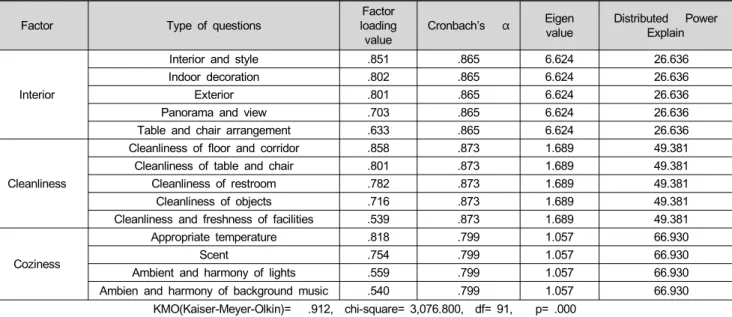
<Table 3> is the result of the examination of reliability and validity of a franchise coffee shop’s servicescape.

According to the result of <Table 3>, the factors of a franchise coffee shop’s servicescape are identified as three elements with distributed power explain of 66.930%. The value of KMO is greater than 9.0, which is a good value. In addition to Bartlett’s test, everything is related to conduct factor analysis. Since the value of chi-square (3,076.800) and p (.000) indicate a possibility to conduct factor analysis, reliability and validity of variables, used in this research, are confirmed.

4.2.2. The result of reliability and validity of the ability to provide service

The result of reliability and validity of the ability to provide service is shown in <Table 4>.

According to <Table 4>, a franchise coffee shop’s ability to provide service is extracted as one and show 60.520% of distributed power explain. The value of KMO is positive, higher than 0.8, and from Bartlett’s test, everything is related to conduct factor analysis. Reliability and validity of variables in this research are proved with the value of chi-square (1,410.552) and p (.000).

4.2.3. The result of reliability and validity of a franchise coffee shop’s customer satisfaction and loyalty The result of reliability and validity of a franchise coffee shop’s customer satisfaction and loyalty are indicated in

<Table 5>.

<Table 3> The result of reliability and validity of a franchise coffee shop’s servicescape.

Factor Type of questions Factor

loading

value Cronbach’s α Eigen

value Distributed Power Explain

Interior

Interior and style .851 .865 6.624  26.636

Indoor decoration .802 .865 6.624  26.636

Exterior .801 .865 6.624  26.636

Panorama and view .703 .865 6.624  26.636

Table and chair arrangement .633 .865 6.624  26.636

Cleanliness

Cleanliness of floor and corridor .858 .873 1.689  49.381

Cleanliness of table and chair .801 .873 1.689  49.381

Cleanliness of restroom .782 .873 1.689  49.381

Cleanliness of objects .716 .873 1.689  49.381

Cleanliness and freshness of facilities .539 .873 1.689  49.381

Coziness

Appropriate temperature .818 .799 1.057  66.930

Scent .754 .799 1.057  66.930

Ambient and harmony of lights .559 .799 1.057  66.930

Ambien and harmony of background music .540 .799 1.057  66.930

 KMO(Kaiser-Meyer-Olkin)= .912, chi-square= 3,076.800, df= 91, p= .000

(7)

According to <Table 5>, a franchise coffee shop’s customer satisfaction is extracted as one with the distributed power explain of 73.308%. The value of KMO is positive, higher than 0.8, and from Bartlett’s test, everything is related to conduct factor analysis. Reliability and validity of variables in this research are proved with the value of chi-square (829.923) and p (.000).

Moreover, a franchise coffee shop’s customer loyalty is extracted as one with the distributed power explain of 70.724%. The value of KMO is normal, higher than 0.6, and

from Bartlett’s test, everything is related to conduct factor analysis. Reliability and validity of variables in this research are proved with the value of chi-square (1,252.463) and p (.000).

4.3. Analysis of correlation

The result of correlation analysis of extracted factors is shown in <Table 6>.

<Table 5> The result of reliability and validity of a franchise coffee shop’s customer satisfaction and loyalty.

Factor Type of questions Factor loading

value Cronbach’s α Eigen value Distributed Power Explain Customer

satisfaction

Satisfied overall .867 .878 2.932 73.308

Satisfied with service .861 .878 2.932 73.308

Satisfied with atmosphere .860 .878 2.932 73.308

Satisfied with taste .836 .878 2.932 73.308

KMO(Kaiser-Meyer-Olkin)= .809, chi-square= 829.923, df= 5, p= .000

Customer loyalty

Continuous purchase after price

increased .893  .861 2.829  70.724

Continuous purchase even though

price is higher than competitors .881  .861 2.829  70.724

Recommend to others .818 .861 2.829  70.724

Continuously comeback .765 .861 2.829  70.724

KMO(Kaiser-Meyer-Olkin)= .657, chi-square= 1,252.463, df= 6, p= .000

<Table 6> The result of the correlation analysis.

Factor Average Standard

deviation (1) (2) (3) (4) (5) (6)

Interior (1) 3.67 .71 1  

Cleanliness (2) 3.68 .71 .528** 1  

Coziness (3) 3.75 .69 .615** .624** 1  

Ability to provide service (4) 3.88 .67 .396** .601** .501** 1

Customer satisfaction(5) 3.86 .70 .548** .620** .602** .609** 1

Customer retention (6) 3.47 .86 .371** .487** .428** .474** .607** 1

**p<0.01

<Table 4> The result of reliability and validity of the ability to provide service.

Factor Type of questions Factor loading

value Cronbach’s α Eigen

value Distributed Power Explain

The ability to provide

service

Constantly provided service .828 .889 4.236  60.520

Promptness .806 .889 4.236  60.520

Effort to standardise service .806 .889 4.236  60.520

Complaint resolution .774 .889 4.236  60.520

Customer satisfaction regarding service .753 .889 4.236  60.520

Provided service following service sequence .737 .889 4.236  60.520

Friendly voice .736 .889 4.236  60.520

 KMO(Kaiser-Meyer-Olkin)= .887, chi-square= 1,410.552, df= 21, p= .000

(8)

From the result of <Table 6>, since most of exponents of correlations are less than 0.7, it is possible to say that there is no correlation among factors. These factors are independent to each other and able to be distinguished.

This proves discriminant validity. According to the result of factor analysis, each factor has a higher correlation with its own components. This proves convergent validity. Therefore, concept validity has been proved through discriminant and convergent validity.

4.4. Evaluating Hypothesis

4.4.1. Evaluating <Hypothesis 1>

A franchise coffee shop’s servicescape (interior, cleanliness and coziness) factors’ which impact on customer satisfaction has been analyzed through multiple regression analysis.

Independent variables in this analysis are interior, cleanliness and coziness, and a dependent variable is customer satisfaction.

According to the result of regression analysis, R squared is 0.485 and F, which checks statistical relativeness about regression, is 123.589. Therefore, significance level is reasonable with p-value of .000.

To conduct multiple regression analysis, there should not be multicollinearity among independent variables. Through multicollinearity, it is possible to identify VIF. If the value of VIF is lower than 10, there is no multicollinearity. In <Table

7>, since the biggest VIF value is 2.010, there is no issue about multicollinearity.

Enter method was used to put all variables, and because of the significance level of t value, interior, cleanliness and coziness are affecting customer satisfaction.

4.4.2. Evaluating <Hypothesis 2>

The impact of a franchise coffee shop’s ability to provide service on customer satisfaction has been analyzed through simple regression analysis. An independent variable in this analysis is the ability to provide service, and a dependent variable is customer satisfaction.

According to the result of <Table 8>, R square is 0.371 and F, which checks statistical relativeness about regression, is 233.674. Therefore, significance level is reasonable with p-value of .000.

To conduct simple regression analysis, there should not be multicollinearity among independent variables. Through multicollinearity, it is possible to identify VIF. If the value of VIF is lower than 10, there is no multicollinearity. In<Table

8>, since the biggest VIF value is 1.000, there is no issue about multicollinearity.

Enter method was used to put all variables, and because of the significance level of t value, the ability to provide service has an impact on customer satisfaction.

<Table 7> Result of regression analysis of a franchise coffee shop’s servicescape factors and customer satisfaction.

Factors Non-standardised coefficient Standardised coefficient

t P value

Collinearity

B Standard error Beta allowance VIF

(constant) .840 .160 5.259 .000**  

Interior .204 .047 .205 4.335 .000** .587 1.702

Cleanliness .348 .047 .351 7.372 .000** .578 1.731

Coziness .264 .053 .258 5.030 .000** .497 2.010

R2= .485, F=123.589, df1=3, df2=394, p=.000

**p<0.01

<Table 8> Result of regression analysis of a franchise coffee shop’s ability to provide service and customer satisfaction.

Factors Non-standardised coefficient Standardised coefficient

t P value Collinearity

B Standard error Beta Allowance VIF

(constant) 1.374 .165 8.337 .000  

Ability to provide

service .640 .042 .609 15.286 .000** 1.000 1.000

R2= .371, F=233.674, df1=1, df2=396, p=.000

**p<0.01

(9)

4.4.3. Evaluating <Hypothesis 3>

A franchise coffee shop’s servicescape (interior, cleanliness and coziness) factors’ which impact on customer loyalty has been analyzed through multiple regression analysis. Independent variables in this analysis are interior, cleanliness and coziness, and a dependent variable is customer loyalty.

According to the result of <Table 9>, R square is 0.267 and F, which checks statistical relativeness about regression, is 47.914. Therefore, significance level is reasonable with p-value of .000.

To conduct simple regression analysis, there should not be multicollinearity among independent variables. Through multicollinearity, it is possible to identify VIF. If the value of VIF is lower than 10, there is no multicollinearity. In<Table 9>, since the biggest VIF value is 2.010, there is no issue about multicollinearity.

Enter method was used to put all variables, and because of the significance level of t value, cleanliness and coziness have an impact on customer loyalty.

4.4.4. Evaluating <Hypothesis 4>

The impact of a franchise coffee shop’s ability to provide service on customer loyalty has been analyzed through simple regression analysis. An independent variable in this

analysis is the ability to provide service, and a dependent variable is customer loyalty.

According to the result of <Table 10>, R square is 0.225 and F, which checks statistical relativeness about regression, is 114.922. Therefore, significance level is reasonable with

p-value of .000.

To conduct simple regression analysis, there should not be multicollinearity among independent variables. Through multicollinearity, it is possible to identify VIF. If the value of VIF is lower than 10, there is no multicollinearity. In <Table 10>, since the biggest VIF value is 1.000, there is no issue about multicollinearity.

Enter method was used to put all variables, and because of the significance level of t value, the ability to provide service has an impact on customer loyalty.

4.4.5. Evaluating <Hypothesis 5>

The impact of a franchise coffee shop’s customer satisfaction on customer loyalty has been analyzed through simple regression analysis. An independent variable in this analysis is customer satisfaction, and a dependent variable is customer loyalty.

<Table 9> Result of regression analysis of a franchise coffee shop’s servicescape factors and customer loyalty.

Factors Non-standardised coefficient Standardised coefficient

t P value

Collinearity

B Standard error Beta Allowance VIF

(constant) .797 .233   3.421 .001    

Interior .116 .069 .095 1.687 .092 .587 1.702

Cleanliness .409 .069 .338 5.949 .000** .578 1.731

Coziness .199 .077 .159 2.595 .010** .497 2.010

R

2

= .267, F=47.914, df1=3, df2=394, p=.000 

**p<0.01

<Table 10> Result of regression analysis of a franchise coffee shop’s ability to provide service and customer loyalty.

Factors Non-standardised coefficient Standardised coefficient

t P value

Collinearity

B Standard error Beta Allowance VIF

(constant) 1.108 .224   4.951 .000    

Ability to provide

service .609 .057 .474 10.720 .000** 1.000 1.000

R2= .225, F=114.922, df1=1, df2=396, p=.000 

**p<0.01

(10)

According to the result of <Table 11>, R square is 0.516 and F, which checks statistical relativeness about regression, is 422.246. Therefore, significance level is reasonable with p-value of .000.

To conduct simple regression analysis, there should not be multicollinearity among independent variables. Through multicollinearity, it is possible to identify VIF. If the value of VIF is lower than 10, there is no multicollinearity. In<Table 11>, since the biggest VIF value is 1.000, there is no issue about multicollinearity.

Enter method was used to put all variables, and because of the significance level of t value, customer satisfaction has an impact on customer loyalty.

5. Conclusion

5.1. Summary of Results of Research and Indications This report analyzed the impact of a franchise coffee shop’s servicescape and the ability to provide service on customer satisfaction and loyalty. To analyze those factors, customers of franchise coffee shops in Seoul were asked about the relationship between servicescape, including employee’s ability to deliver service, customer satisfaction and loyalty. Following contents are the summary of analysis.

First, by analyzing the impact of a franchise coffee shop’s servicescape factors (interior, cleanliness and coziness) on customer satisfaction through multiple regression analysis, interior, cleanliness and coziness are identified as important.

It was identified that cleanliness of floor, corridors, tables, chairs, restrooms and facilities, also freshness, is considered as the most effective on customer satisfaction. Furthermore, there should be more investments on interior and coziness.

Second, through simple regression analysis, a franchise coffee shop’s ability to provide service was identified to be influential on customer satisfaction. Constant service, provided service based on service sequence, promptness, effort to standardize service, complaint resolution, customer satisfaction on service and friendly voice are considered to have a substantial impact on customer satisfaction. Therefore, there should be business strategies to improve this part.

Next, by analyzing the impact of a franchise coffee shop’s servicescape factors (interior, cleanliness and coziness) on customer loyalty through multiple regression cleanliness and coziness are identified as important. While cleanliness and coziness have an impact on both customer satisfaction and loyalty, interior has an impact on only customer satisfaction.

Therefore, it is suggested to invest on making a coffee shop with comfortable atmosphere rather than invest on interior.

Fourth, through simple regression analysis, a franchise coffee shop’s ability to provide service was identified to be influential on customer loyalty. Since the ability provide service has an impact on both customer satisfaction and loyalty, it is recommended to put more efforts on making service and marketing strategies to improve the ability to deliver service.

Finally, by analyzing the impact of customer satisfaction on customer loyalty, there was a positive result. It means that customer satisfaction should be achieved to retain more customers. To increase loyalty level, it sounds reasonable to develop marketing strategies which are customer oriented.

Based on the analysis, implications are stated below.

First, there has been intensified bloodshed among domestic coffee shops due to cut-throat competition. This means that coffee market competition, in which supply overruns demand, is getting deepened. Especially, foreign coffee shop’s sales are increasing faster compared to that of domestic coffee shop. In the future, domestic coffee shops should establish strategies which provide each coffee shop competitiveness through differentiated brand value, service, and interior atmosphere.

Second, based on the result that customer satisfaction has a direct impact on customer loyalty, it is important to provide not only the ability to provide service, but also provide different servicescape factors, interior, cleanliness and coziness, from competitors to brand the business. This distinctiveness will become the main reason of revisitation which will lead to dramatic increase in profits.

5.2. Limitations and Further Recommendations

There is a limitation of sampling since this study focused on Seoul. Therefore, it was not possible to consider regional limitations and cultural differences. Moreover, respondents of

<Table 11> Result of regression analysis of a franchise coffee shop’s customer satisfaction and customer loyalty.

Factors Non-standardised coefficient Standardised coefficient

t P value

Collinearity

B Standard error Beta Allowance VIF

(constant) .138 .170 .812 .417  

Ability to provide service .864 .043 .707 19.879 .000** 1.000 1.000

R2= .516, F=422.246, df1=1, df2=396, p=.000

**p<0.01

(11)

the survey were mainly those who are aged among 20 – 30, which might have a limitation to reflect all types of customers. For the further research, it is recommended to cover regional limitations and cultural differences. Moreover, it is required to have well-presented sample, regarding demographics.

References

Bae, Hyun-Soo (2014). Research about the relationship between a five-star hotel kitchen’s physical environment and chief’s emotional reaction and group cohesiveness. Research on Restaurant Management, 17(2), 299-323.

Baker, J. (1987). The role of the environment in marketing services; The consumer perspective. In Czepiel, J, A., Congram, C., & Shanahan, J. (ed.). The Services Challenge: Integrating for Competitive Advantage(pp.

79-84), Chicago, IL: American Marketing Association proceedings series.

Bitner, M. J. (1992). Servicescapes: The impact of physical surroundings on customers and employees. Journal of Marketing, 56, 57-71.

Byun, Gwang-In, & Oh, Ji-Hyun (2014). The impact of franchise coffee shops’ customers who perceived cultural marketing strategies on attitude of brand and customer loyalty: Focusing on Starbucks. Tourism Research, 39(1), 167-190.

Choi, Hyung-Min, & Yoo, Han-Na (2011). An exploratory research of the relationship between a franchise coffee shop’s servicescape and a customer’s brand attitude and brand loyalty. Food Space Research, 6(1), 17-31.

Choi, Sung-Hwan, Im, Geun-Youk, & Moon, Sang-Ki (2015).

A research about the impact of servicescape on customer emotion and retention of relationship:

Focusing on family restaurants. Tourism & Leisure Research, 27(1), 365-380.

Choo, Na-Young, Bae, Sung-Woo, & Jo, Song-Hyun (2011).

A relationship among core service quality, relationship benefits, attractiveness of alternatives, switching cost, customer satisfaction and intention to revisit. Korea Sport Industry & Management Research, 16(6).59-71.

Edvardsson, B. (2005). Service quality: Beyond cognitive assessment. Managing Service Quality, 15(2), 127-131.

Florian, W., & Bayon, T. (2004), Satisfaction, loyalty and word of mouth within the customer base of a utility provider: Differences between stayers, switchers and referral switcher. Journal of Consumer Behavior, 3(3), 211-220.

Gronroos, C. (1990). An applied service marketing theory.

European Journal of marketing, 16(7), 30-41.

Gwon, Hwi-Jung, & Han, Hwi-Sub (2014). The research about the impact of a hotel’s restaurant’s physical environment on the image of the restaurant, and the impact of the image on satisfaction, intention to revisit, the hotel’s image and the intention to stay in the hotel. Research of Tourism and Leisure, 26(2), 105-122.

Gwon, Jung-Hwi (2014). The impact of hotel buffet’s physical environment on emotional reaction and conversion barriers. Korea Restaurant Industry Research, 10(1), 43-58.

Han, Do-Kyung (2015). A research about the impact of domestic franchise coffee shops’ service quality on customer satisfaction and customer loyalty.

Restaurant Management Research, 18(1), 189-209.

Han, Yu-Jung, & Lee, Hyung-Ryung (2016). The impact of a hotel’s servicescape, depending on employees’

emotional reactions and motivations, on service providing behavior. Restaurant Management Research, 19(1), 243-264.

Hwang, Mi-So, Song, Young-Sun, & Lee, Hwi-Soo (2014).The impact of hotel employee’s departments and self-directedness on the quality of service. Hotel Management Research, 14(4), 113-131.

Jeon, Min-Su,& Jo, Mi-Na (2011). The impact of real condition and physical environment of a franchise coffee shop on customer behavior intention: Focusing on university students in Seoul and Gyungki areas.

Korea Food Cookery Science Research, 27(6), 825-838.

Jo, Joo-Eun (2006). The impact of domestic airline flight attendants’ service-orientation on the ability to provide service. Tourism Research, 20(1), 169-182.

Johnson, D., & Grayson, K., (2005). Cognitive and affective trust in service relationships, Journal of Business Research, 58(4), 500-507.

Jong, Hwi, & Kim, Young-Gyu (2015).The research about the structural relationship between a hotel restaurant’s physical environment and customer behavior intention. Tourism Research, 30(3), 451-463.

Kandampully, J., & Liam, B. (2001), Service guarantees: A strategic mechanism to minimize customers’

perceived risk in service organizations. Managing Service Quality, 11(2), 112-120.

Kim,Gyeong-Cho (2013). A Study on the Effects of Super-Supermarket Service Quality on Satisfaction inStore Selection. Journal of Industrial Distribution &

Business, 4(2), 41-49.

Kim, Gwon-Dong, Kim, Koo-Nyun, & Kim, Mo-Ran (2013).

The impact of a hotel’s servicescape on the job satisfaction and concentration on structure: Mediated effect of perceived and emotional reaction. East and North Tourism Research, 9(4), 269-291.

Kim, Jae-Hong, Lee, Hye-Yun, & Baek, Mi-Young (2012).

(12)

The impact of loyalty benefits of hotel service on customer satisfaction and intention of conversion and retention – Verification of controls depending on individuals. Tourism Research, 27(4).117-139.

Kim, Joon-Young, & Lee, Hyung-Ryong (2013). The impact of a hotel business’ successful factor of service innovation on concentration on job and behavior of a service provider. Tourism Research, 27(6), 409-430.

Kim, Ki-Duck, & Kim, Duck-Hwi (1999). The research about customer satisfaction in the non-profit organisation.

Customer Satisfaction Management, 1(1), 34-41.

Kim, Pan-Jin, & Lee, Jin-Young (2016). A Study on the Effects of Perceived Quality on Whitening Cosmetics’

Satisfaction and Repurchase: Focused on University Students. East Asian Journal of Business Management, 6(2), 15-22.

Kim, Sung-Hyuck, & Won, Young-Hwi (1992). Research about job satisfaction and level of service delivery.

Tourism Research, 16,17-32.

Ko, Bum-Suck, & Lee, Soo-Jin (2012). The impact of a franchise coffee shop’s servicescape on customer satisfaction and intention of revisitation and recommendation. Korea Restaurant Industry Research, 8(2), 63-91.

Koo, Dong-Woo, Lee, Sae-Mi, & Kim, Il-Ho (2015). The impact of coffee brands’ customers’ the sense of unity on participation, customer satisfaction and band loyalty: Focusing on franchises. Research about Customer Satisfaction, 17(1), 67-87.

Kotler, P. (1973). Atmospherics as a marketing tool. Journal of Retailing, 49(4), 48-64.

Lee, Hyung-Joo, & Seo, Ji-Yeon (2012). The impact of experience in a franchise coffee shop on brand attitude, brand attachment and brand loyalty.

Restaurant Management Research, 15(5), 105-128.

Lee, Sang-Hyun, & Park, Chul-Ju (2015). “Servicescape”

Differentiation in a Hair Salon. Journal of Distribution Science, 13(9), 71-79

Lee, Seung-Ik (2014). The impact of servicescape, including image of a coffee shop employees, on customer emotional reaction and the intention of behavior – focusing on Gwang-jo and Southern Jeon-ra regions.

Research of Hotel Resort, 13(3), 193-214.

Macintosh, G. (2007). Customer orientation, relationship

quality, and relational benefits to the firm. Journal of Service Marketing, 21(3), 150-159.

Oliver, M. (1996). Understanding disability: From theory to practice. Basingstoke: MacMillan.

Park, Gyu-Eun, Kim, Moon-Myung, Choi, Sung-Il, & Lee, Soo-Bum (2013). The impact of a franchise coffee shop’s servicecape on employees’ emotional reaction, physiological reaction and job satisfaction. Research of Hotel Management, 22(4), 1-17.

Park, Ho-Jung, & Kim, Si-Joong (2014). The research about the impact of a hotel kitchen’s physical environment on job satisfaction and organizational commitment.

Korea Restaurant Industry Research, 10(1), 7-18.

Park, Young-Jae (2013). The impact of a franchise pizza restaurant’s physical environment on the service quality and the intention of behavior. Research of Hotel Management, 22(4), 37-83.

Ruiz-Molina, M. E., Gil-Saura, I., & Berenguer-Contri, G.

(2009). Relational benefits and loyalty in retailing: an inter-sector comparison. International. Journal of Retail & Distribution Management, 37(6), 493-509.

Seo, Kyung-Do, & Lee, Jung-Eun (2013). The relationship among servicescape, relationship benefit, quality of relationship and the intention of behavior. Tourism Research, 28(4), 373-393.

Shin, Chung-Sub, Hwang, Gyu-Sam, Lee, Hye-Won, & Cho, Sun-Rae (2015). The Impact of Korean Franchise Coffee Shop Service Quality and Atmosphere on Customer Satisfaction and Loyalty. East Asian Journal of Business Management, 5(4), 47-57.

Son, Jae-Geun (2013). The relationship among a franchise coffee shop’s servicescape, brand assets and quality of relationship. Tourism Research, 28(4), 101-115.

Um, Young-Ho (2010). The impact of a franchise coffee shop’s servicescape on customer satisfaction and relationship achievements. Tourism Research, 24(3), 329-344.

Yoon, Dae-Gyun (2012). Research of the relationship among

of relationship benefits, trust, customer satisfaction

and the intention of retain relation of customers of

casino. Korean Management Research, 25(5),

2413-2432.

수치

Table  and  chair  arrangement .633 .865 6.624  26.636

참조

관련 문서

The purpose of this study is to examine the effect of logistics service quality and relationship orientation factors on customer satisfaction and loyalty in

Hotel buffet impact of the physical environment on service quality and customer satisfaction and customer loyalty in the restaurant: My five star hotels

Key words: airport duty free shop, utilitarian and hedonic shopping values, shopping behavior, customer

Kang, The Effect of Service Quality of Fitness Program on Customer Satisfaction, Trust, and Repurchasing in a Public Sport Center, Unpublished master’s