1. Introduction
Adventure leisure is the fastest growing area of tourism [1], nevertheless, it has not attracted much
research attention in its field [2]. What then are the psychological factors of a participant enjoying an active outdoor leisure activity? Most studies have primarily focused on the effects of participants’ activities, while
A Cognitive Scale Development and Psychological Model Verification of the Pursuit of Adventure Leisure Activities
Jae-Hyun Kwak, Kyung-Wan Hong
*Department of Tourism Management, Keimyung University
모험적 여가활동의 인지 차원 척도 개발과 모형검증
곽재현, 홍경완*
계명대학교 관광경영학과
Abstract The purpose of this study is to explore the experience of participants in the adventurous leisure activities and to examine the structural relations of the cognitive experience, the emotional experience and adherence intention.
Robust quantitative measures were developed from rich qualitative data. The five dimensions selected from two preliminary tests were being away, technical enhancement, fascination with nature, challenge, and interpersonal trust.
The cognitive dimensions have a significant effect on the emotional arousal–pleasure dimension. Our study also shows a positive causal relationship between emotional experience and adherence intention. Implications of this study include 1) a developed questionnaire for measuring the cognitive experience dimension of adventure leisure and establishing a foundation for future research, and 2) an identified psychological model among cognitive, emotion, and intention. We offer opportunities to better understand the psychological factors that motivate participation in adventure leisure.
Key Words : Adventure leisure, Cognitive experience, Arousal, Structure equation model, Adherence intention
요 약 본 연구의 목적은 여가체험으로서의 모험적 활동을 탐색하고 인지적 체험과 정서적 체험, 그리고 만족과 지속의도
의 구조적 관계를 확인하는 것이다. 예비연구를 통해 도출된 척도를 토대로 실증적인 연구를 수행하였고. 고독감, 자기향상 감, 자연신비감, 도전감, 대인신뢰감을 포함하는 5가지 인지적 체험차원이 도출되었으며 세부적인 문항은 총 20개이다. 실증 분석 결과, 모험적 여가 참가자들은 체험의 인지적 요소들을 어떻게 지각하는가에 따라 자신들의 감정이 결정될 수 있다는 점이 발견되었으며, 감정체험은 다시 전반적인 체험만족과 지속의도에 영향을 준다는 사실을 확인하였다. 결론적으로 각성 과 즐거움이 고독감, 자연신비감, 도전감, 대인신뢰감 등의 모험적 여가활동의 인지적 체험과 체험 만족을 연결해주는 매개 변수의 역할을 하는 것으로 확인되었으며, 결국 각성과 즐거움의 두 감정체험차원은 모험적 여가활동을 설명하는 핵심적인 기제임이 확인된 것이다. 따라서 본 연구의 결과가 모험적 여가의 중요성을 학계에 알리는 계기가 되길 바라며 , 연구자들 로 하여금 생산적인 후속 연구가 촉발되길 기대한다.
주제어 : 모험적 여가, 인지적 체험, 각성, 구조모형방정식, 지속의도
*Corresponding Author : Kyung-Wan Hong([email protected]) Received January 4, 2018
Accepted March 20, 2018
Revised February 28, 2018 Published March 28, 2018
little research has been conducted on the experiential components of adventure leisure activities [3-9]. In particular, exploring the psychological factors of purposeful participation in adventurous leisure activities with an awareness of the risks involved offers insights into the fundamental nature of why humans engage in leisure activities [10]. In other words, although participants choose to expose themselves to challenging situations, even though the goal of leisure activities is to gain satisfaction, relaxation and pleasure, conjecture can be made that they participate because they expect the activity will bring positive outcomes offsetting any difficulties encountered during the process [11].
Therefore, a noteworthy area of investigation and detailed analysis includes the specific characteristics of adventurous leisure activities in order to better understand the behaviorally oriented leisure needs and the psychological variation of those who participate.
However, because little research has been conducted on the cognitive experience of adventure leisure activities [12,13], the present study includes a preliminary study on the cognitive dimensions involved. In addition, we examine the causal relationship between the identified cognitive dimensions and emotional dimensions to test a psychological model of adventure leisure. Therefore, our aim is to find the causal relationship between cognitive dimensions and emotional arousal and to determine whether the emotional dimension leads to adherence intention regarding leisure activities.
Accordingly, this study involves the following process:
the cognitive experience dimensions of participants in adventure leisure activities are identified (Preliminary study I) based on the identified dimensions of the cognitive experience, questionnaire items to be included in the main study are developed (Preliminary study II) the causal relationship between emotional arousal and pleasure is identified using items of the cognitive experience dimensions, and the psychological model of adventure leisure activities is tested using the adherence intention variable (Main Study).
2. Literature review
2.1 Cognitive dimension of adventure leisure Adventure leisure activities offer a constant challenge resulting in pleasure, satisfaction and refreshment, it is therefore common for people to become easily immersed in such activities [14,15].
Consequently, for this study, adventure leisure is defined as “active outdoor leisure engaged in with the awareness of the risk involved grounded on the spirit of challenge-seeking.”
Farber and Hall [16], explored the structure of leisure experiences in terms of emotional aspects and suggest that the cognitive experience in leisure tourism causes an emotional experience. Individuals have varying cognitive and emotional experiences depending on their motive, process, and the outcomes of participating in leisure activities. However, different behavioral directions may spring from the same need;
therefore, to understand leisure activities, we require an explanation of the behavioral patterns that vary across individuals, and this involves consideration of the psychological state they seek. In this context, Arnould and Price developed a measure to explain three cognitive dimensions: 1) harmony with nature, 2) communitas, and 3) personal growth and renewal [8].
However, research on the comparative analysis of
leisure activities using this measure is lacking. Studies
utilizing the measure were primarily concerned with
the scale development method, consumer behavior, and
marketing. Also, their researches were conducted on a
single item (rafting). We, therefore, concluded that
identifying specific cognitive dimensions inherent in
adventure leisure activities based on a review of
previous literature studies would be ineffective. Thus,
the present study explores the cognitive dimensions of
participants of scuba diving (as an adventure leisure
activity) and develops a measure based on the
identified cognitive dimensions to determine the causal
relationship between the cognitive and emotional
dimensions.
2.2 Pleasure-arousal model
The discussions about the interaction of affect and cognition are still proceeding in psychology [17,18].
Emotions are composed of two separate dimensions, arousal and pleasure. It is proved that pleasure is influenced by arousal [17,19]. This approach makes sense to explain emotions [20]. The dimension supposes that the emotional area is comprised of unspecific factors (arousal pleasure and dominance [21,22]. However, because 'dominance' requires a cognitive approach, this is not suitable for expressing pure emotional experiences [23]. Whereas pleasure considers the level to which a person feels good, blissful or satisfied in a situation, while arousal considers the extent to which a person feels stimulated and active. In current studies, there has been considerable consensus in respect to their bi-dimensional character [24-26].
2.3 Adherence intention
Exercise adherence intention refers to participating in a form of exercise and regularly engaging in the activity as well as indicates ongoing participation in the exercise, which involves adherence to or the continuation of the exercise and the frequency, intensity, and duration of exercise [27]. Dishman [27]
uses the term “percentage of attendance” to represent these aspects, and many other scholars have also defined exercise adherence intention as the attendance rate. Also, exercise adherence means that a specific individual participates in exercise and regularly engages in the activity and indicates their adherence or dedication to the exercise [28]. They classified the components of adherence intention into the intention to continue participating in the future and the word-of-mouth intention, which involves telling others about their participation in exercise, and recommended that future studies find variables that influence the components. It was also found that adherence intention increases with the satisfaction derived from participation, the accumulated experience of
satisfactory participation results in even greater motivation for exercise adherence intention, and when accompanied by clear physical and biological reinforcements, exercise adherence intention can predict exercise adherence and activate powerful psychological variables. However, Wankel [29] argues that measuring exercise adherence intention with attendance rate (i.e., exercise participate rate) is inappropriate because it fails to consider the participant’s motive and efforts.
Researchers express a wide variation in their views on adherence intention.
2.4 Preliminary study I 2.4.1. Participant observation
Participant observation and a focus group interview were used to explore participants’ cognitive experience dimensions. Participant observation was carried out four times. To collect varying responses according to diving skills, one observation was made in the diving training pool and three observations were made at sea.
Data were collected by the researcher asking participants brief questions as well as observing their behavior, facial expressions, and dialogue. Observations were recorded by the researcher in real time, and in consideration of the researcher’s limited field of view, underwater video footage and photographs taken before and after the dives were also used as data. Participants were only briefed on the purpose of recording and observation after the observation was complete in order to report on their natural state and behavior. Data analysis was performed after obtaining the participants’
consent that the documented data could be used for the study.
2.4.2 Focus group interview
The interviewees consisted of two teams of college club members and a team of enthusiast club members.
The interviews were conducted with consideration of the extent to which they expressed themselves freely, their age, gender, active engagement, and expertise.
The three groups, comprising a team of undergraduate
club members, a team of graduate club members, and a team of enthusiast club members, were interviewed separately. Semi-structured interviews were conducted, and the recordings and transcriptions of the interviews were analyzed (e.g., why do you scuba dive?). The process followed an inductive coding procedure and content analysis was used. After analyzing the transcribed content, semantic categorization and organization of the content were conducted, followed by comparison of the groups. To avoid subjective interpretation, the analysis results were presented to those who were observed and interviewed for verification and necessary modifications. Additionally, in order to evaluate the reliability, the final results were generated after a discussion with two professors in leisure studies, two professors in marketing, and one psychologist.
2.4.3 Results of qualitative research analysis Results of the preliminary study showed that scuba diving participants felt a strong fascination with nature, interpersonal trust, technical enhancement, challenge, and sense of being away. This may offer a basis for explaining the psychological need to adhere to the activity through their improved skills (technical enhancement) as well as building trust with peers (interpersonal trust) on the foundation of a harmony with and an understanding of the value and wonder of nature, which they had not experienced in ordinary urban life (fascination with nature). The deep sea scuba diving activity is perceived by the participant as a temporary exit from society and they experience a mesmerizing sense of being away in the pursuit of harmony with nature. It can be construed that this process motivates the participants who used to be uninterested in scuba diving to become avid enthusiasts, and the spirit of challenge-seeking for awakening and getting away from the usual routine underlies this mechanism.
2.5 Preliminary study II
Based on the results of interviews and observation of the participants as well as a review of the literature [30,31], 41 preliminary questions were developed.
Considering the importance, the overlap of items, and ambiguities in meaning, 13 of the 41 items were deleted leaving 28 items eligible for use in the first survey.
Content validity was established by an expert review and the clarity of expression of individual items was amended by the evaluation of a linguist for accuracy of meaning. Two items deemed unnecessary by experts were removed leaving a final 26 items for the cognitive dimensions measure of adventure leisure. The questionnaires with the final 26 questions, selected through the content validation process, were sent to the members of six leisure clubs (scuba diving, mountain biking, rafting, skiing, snowboarding, and college mountain climbing) over a period of about four weeks between February 16 and March 14, 2015. The six most popular and common adventure leisure activities were chosen to ensure the representativeness of the sample for the population. Out of 251 questionnaires sent out, 242 (61 scuba diving, 49 MTB, 42 rafting, 55 skiing and snowboarding, and 44 mountain climbing) were used in the analysis for the dimensionality test after the exclusion of nine questionnaires that were either unreturned, incomplete, or contained invalid responses or errors.
2.5.1 Results of item development
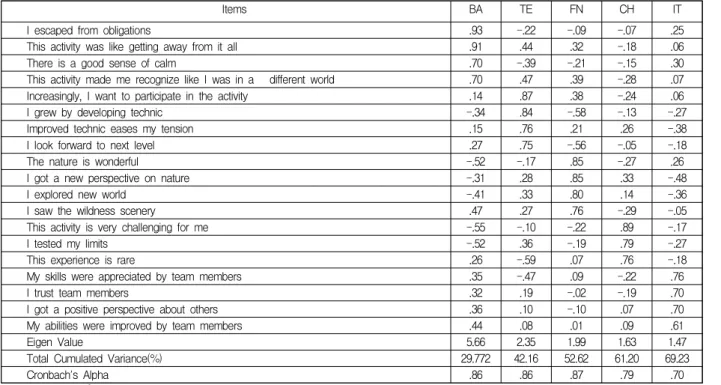
Two pilot tests were conducted in order to determine which items would be included in the main study. Based on test results, 20 items in five dimensions were selected. The five dimensions are: 1) being away (BA), 2) technical enhancement (TE), 3) fascination with nature (FN), 4) challenge (CH), and 5) interpersonal trust (IT). The cumulative explanatory power of the factors was 69.23%, which is above the standard. Therefore, the five dimensions are regarded as factors that sufficiently represent the concepts of the individual items.
The five cognitive dimensions of adventurous leisure
identified and developed in the preliminary studies are predicted to have a significant effect on the emotional arousal–pleasure dimension. In McIntyre and Roggenbuck’s research [32], which demonstrated the affective changes of cave-rafting participants resulting from interactions with the natural environment, participants’ emotions changed according to the stimulus of the given environment (e.g., feeling excited or relaxed according to the novelty and/or familiarity of the environment). Based on this argument, it is predicted that the five cognitive dimensions of adventure leisure will provide participants with opportunities to obtain emotional experiences and have significant causal relationships with their levels of emotional arousal and pleasure. We therefore hypothesize the following: Accordingly, this study involves the following process:
Hypothesis 1 (H1): The cognitive response to the adventure leisure experience has a significant effect on the emotional arousal level of participants.
Hypothesis 2 (H2): The cognitive response to the adventure leisure experience has a significant effect on the level of pleasure of participants.
Ajzen [33] found that leisure adherence was influenced by personal, social, and environmental variables through various interactions among the variables. This was consistent with the findings of McAuley and Jacobson [34]. The present study predicts the positive causal relationship between emotional experience and adherence intention. Hence, our third hypothesis is as follows:
Hypothesis 3 (H3): The emotional experience of adventure leisure activity participants has a positive influence on adherence intention.
3. Methodology
3.1 Participants
Data for this study were collected from six groups in adventure leisure activity clubs (scuba diving, MTB,
rafting, skiing, snowboarding, and climbing). These groups were selected because they enjoy activity. This study used a questionnaire-based survey with a stratified random sampling. A total of 302 questionnaires were distributed with a return of 291 (M=32.52, SD=9.321), and valid responses represented the following activity clubs: scuba diving 83 (M=33.02, SD=10.729), MTB 52 (M=28.25, SD=4.580), rafting 57 (M=29.18, SD=7.305), skiing, snowboarding 58 (M=35.93, SD=11.116), and climbing 41 (M=36.71, SD=6.427). Of the respondents, 194 (66.7%) were male, and 97 (33.3%) were female. Their ages ranged from 20 to 63 years.
3.2 Measures
To confirm content validity, the 4-part questionnaire was tested and supplemented. First questionnaire handles the scale about cognitive experience. The cognitive dimension with 20 items (⍺=.865) as five factors from the pilot study are being away (⍺=.860), technical enhancement (⍺=.858), fascination with nature (⍺=.867), challenge (⍺=.703), and interpersonal trust. Parts 2 through 4 of the questionnaire were designed on the basis of a review of the previous studies and specific characteristics of adventure leisure.
Specifically, Part 2 deals with the measurement of emotion experience with 9 items [17,21,35] and four items were applied to measure arousal such as stimulating, tense, exciting, and anxious. The pleasure dimension was measured by five items that include happy, pleased, enjoyment, fulfilled, and contented. Part 3 deals with adherence intention measurement with 4 items [36]. Lastly, final Part assures respondent information with 6 items including demographic characteristics.
3.3 Procedure
All procedures for the study period of about a month
were in accordance with the ethical standards. The
nature and purpose of the study were explained to the
participants. Questionnaires were collected onsite. The
administration of the complete questionnaires took approximately 10 to 15 minutes to complete.
3.4 Analysis
Using the valid 291 returned questionnaires, the statistics package SPSS 21.0 was utilized for frequency analysis, descriptive statistics, factor analysis and reliability analysis, and AMOS 18.0 was used for confirmation of validity and hypothesis testing for the adventure leisure activity cognitive experience scale.
To delineate underlying factors of cognitive dimension on adventure leisure, we conducted exploratory factor analysis. Five factors are extracted and named based on the underlying items such as being away, technical enhancement, fascination with nature, challenge, and interpersonal trust along with preceding study.
4. Results
4.1 Respondents’ profile
A total of 302 questionnaires were distributed and 301 (99.6%) were collected, of which 291 (96.7%) were
valid with 10 (3.3%) being discarded due to incompleteness of the responses. The respondents’
profile includes 194 (66.7%) male participants and about 231 (79.8%) were aged between 20 and 36 years; in addition, 190 (65.2%) of the participants are married and around 90% hold a university degree or higher.
4.2 Internal consistency and validity
Table 1 presents result of exploratory factor analysis. The factorial validity of this scale and other scales was tested using both principal component analysis (PCA) and confirmatory factor analysis (CFA).
The twenty-item scale was first subjected to PCA using SPSS Version 21. The one item of challenge was excluded due to less than standard (0.6) for commonality. The scree plot also showed a clear break after the first component. Using Cattell’s scree test, it was settled to maintain one component for further analysis.
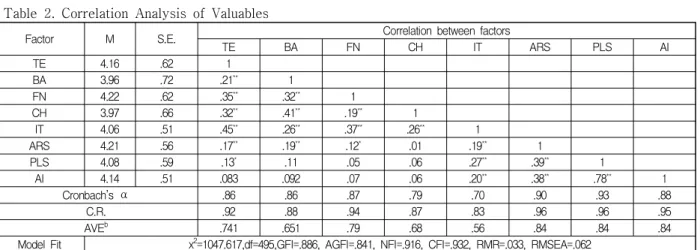
Table 2 presents the correlation and reliabilities of the constructs studies. CFA is next used to confirm the factor loadings of the five constructs and to assess the model fit [37]. Convergent validity of CFA results
Table 1. Result of exploratory factor analysis
Items BA TE FN CH IT
I escaped from obligations .93 -.22 -.09 -.07 .25
This activity was like getting away from it all .91 .44 .32 -.18 .06
There is a good sense of calm .70 -.39 -.21 -.15 .30
This activity made me recognize like I was in a different world .70 .47 .39 -.28 .07
Increasingly, I want to participate in the activity .14 .87 .38 -.24 .06
I grew by developing technic -.34 .84 -.58 -.13 -.27
Improved technic eases my tension .15 .76 .21 .26 -.38
I look forward to next level .27 .75 -.56 -.05 -.18
The nature is wonderful -.52 -.17 .85 -.27 .26
I got a new perspective on nature -.31 .28 .85 .33 -.48
I explored new world -.41 .33 .80 .14 -.36
I saw the wildness scenery .47 .27 .76 -.29 -.05
This activity is very challenging for me -.55 -.10 -.22 .89 -.17
I tested my limits -.52 .36 -.19 .79 -.27
This experience is rare .26 -.59 .07 .76 -.18
My skills were appreciated by team members .35 -.47 .09 -.22 .76
I trust team members .32 .19 -.02 -.19 .70
I got a positive perspective about others .36 .10 -.10 .07 .70
My abilities were improved by team members .44 .08 .01 .09 .61
Eigen Value 5.66 2.35 1.99 1.63 1.47
Total Cumulated Variance(%) 29.772 42.16 52.62 61.20 69.23
Cronbach's Alpha .86 .86 .87 .79 .70
KMO=.807, X2=2940.309,df=190, p=.000
should be supported by average variance extracted, construct reliability and item reliability [37]. The average extracted variances of all constructs range between 0.56 and 0.79 which are above the suggested value of 0.5. These indicate that the measurement model has good convergent validity. T-values for all the standardized factor loadings of items are revealed to be significant. Furthermore, construct reliability estimates ranging 0.83 - 0.94, which exceed the critical value of 0.7, indicate a satisfactory estimation.
Accordingly, the hypothesized measurement model is reliable and meaningful to test the structural relationships among the constructs.
As shown Table 2, the structural model provided a relatively good fit. In order to examine the model fit, thus, this study uses sample size dependent (rather than sample size independent) measures of
goodness-of-fit. The x
2/d.f. ratio of less than 5 is used as the common decision rule of an acceptable overall model fit. The normed x
2of model is 2.1 (i.e.1047.62/495), indicating an acceptable fit.
Furthermore, other indicators of goodness-of-fit are GFI =0.89, AGFI =0.84, NFI= 0.92, CFI = 0.93, RMSEA=
0.06, and RMR=0.03. The results confirmed the existence of seven factors. The scales can be used for model verification with acceptable reliability and validity.
4.3 Model and hypothesis testing
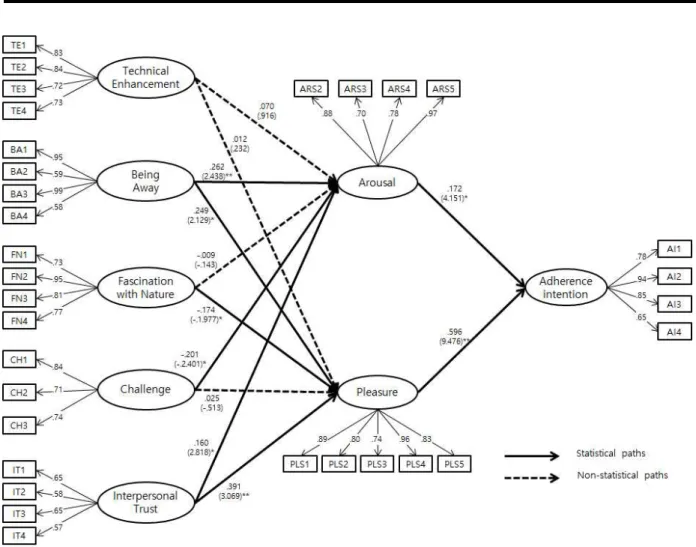
To test the research hypotheses, covariance structure analysis for the research model was conducted and the path coefficients and CR values between theoretical variables were obtained. In the structural equations, the theoretical foundation of
Table 2. Correlation Analysis of ValuablesFactor M S.E. Correlation between factors
TE BA FN CH IT ARS PLS AI
TE 4.16 .62 1
BA 3.96 .72 .21** 1
FN 4.22 .62 .35** .32** 1
CH 3.97 .66 .32** .41** .19** 1
IT 4.06 .51 .45** .26** .37** .26** 1
ARS 4.21 .56 .17** .19** .12* .01 .19** 1
PLS 4.08 .59 .13* .11 .05 .06 .27** .39** 1
AI 4.14 .51 .083 .092 .07 .06 .20** .38** .78** 1
Cronbach’s ⍺ .86 .86 .87 .79 .70 .90 .93 .88
C.R. .92 .88 .94 .87 .83 .96 .96 .95
AVEb .741 .651 .79 .68 .56 .84 .84 .84
Model Fit x2=1047.617,df=495,GFI=.886, AGFI=.841, NFI=.916, CFI=.932, RMR=.033, RMSEA=.062
** p< .01*p< .05, C.R.=Construct Reliability
Table 3. Results of the hypotheized structural model
Path(hypothesis) Path
Coefficient Standard
Error C.R P-Value Test
Result
H1-1. technical enhancement→ arousal .07 .08 .92 .36 Reject
H1-2. being away→ arousal .26 .07 2.44 .00** Accept
H1-3. fascination with nature→ arousal -.01 .04 -.14 .89 Reject
H1-4. challenge→ arousal -.20 .03 -2.40 .04* Accept
H1-5. interpersonal trust→ arousal .16 .06 2.82 .04* Accept
H2-1. technical enhancement→ pleasure .012 .20 .23 .82 Reject
H2-2. being away→ pleasure .25 .17 2.13 .02* Accept
H2-3. fascination with nature→ pleasure -.17 .15 -1.98 .03* Accept
H2-4. challenge→ pleasure .03 .10 -.51 .61 Reject
H2-5. interpersonal trust→ pleasure .39 .07 3.07 .00** Accept
H3-1. arousal→ adherence intention .17 .05 4.15 .03* Accept
H3-2. pleasure→ adherence intention .60 .07 9.48 .00** Reject
R2(arousal)=.170 R2(pleasure)=.132 R2(adherenceintention)=.562
Model fit X2=1006.499(p=.000), df=508, X2/df=1.981, GFI=.896, AGFI=.853, NFI=.921, CFI=.938, RMR=.037, RMSEA=.058
previous research is important. Therefore, the nomological validity of the hypotheses based on the theoretical foundation can be verified through testing the significance of directionality.
4.3.1 Relationship between cognitive dimensions and emotional arousal Among the five cognitive experience factors, three factors –being away, challenge, and interpersonal trust – explained the level of emotional arousal as an aspect of participants’ emotional experience of adventure leisure activities whereas technical enhancement and fascination with nature did not have a significant effect on the emotional arousal level. Fascination with nature had a positive effect on pleasure as an attribute of pleasure and fun rather than emotional arousal as an attribute of excitement and tension. In particular, technical enhancement, which refers to the
improvement of skills during participation in the activity, did not have a significant effect on either emotional arousal or pleasure. Therefore, H1 was partially supported.
4.3.2 Relationship between cognitive dimensions and pleasure
Among the five cognitive experience factors, three factors –being away, fascination with nature, and interpersonal trust– explained the level of pleasure as another aspect of participants’ emotional experience of adventure leisure activities whereas technical enhancement and challenge did not have a significant effect on pleasure level. The relationship between the other three dimensions and pleasure has been verified in several studies, supporting the findings of the present study [8,16,38,39]. Therefore, H2 was partially supported.
Fig. 1. SEM result
4.3.3 Relationship between emotional dimensions and adherence intention As the analysis results showed that participants’
emotional experience had a significant effect on the intention to adhere to the activities, H3 was accepted.
In addition, emotional arousal was found to have both a direct and an indirect effect on adherence intention.
Moreover, all five cognitive experience factors had an indirect effect on adherence intention. These results demonstrate the mediation effect of emotional experiences, such as arousal and pleasure, in the process of developing adherence intention and are likely to develop the current understanding of the “cognitive experience → adherence intention” relationship [40].
5. Discussion
5.1 Conclusions and Implications
With this study we seek to better understand the psychological factors that motivate the pursuit of and participation in adventure leisure and the causal relationship between cognitive and emotional dimensions and to determine whether the emotional dimension leads to leisure activities adherence intention. Results of our study show that, among the five cognitive dimensions, being away and interpersonal trust had a significant effect on both emotional responses (arousal and pleasure), while fascination with nature and challenge had a significant effect on pleasure only and arousal only, respectively.
Conversely, technical enhancement was found to have no significant effect on either arousal or pleasure.
These results are in line with Bandura’s conclusions that specific knowledge or skill improvement alone cannot affect the emotional response because the characteristics of technical enhancement are closer to those of competency, which refers to an individual’s ability rather than efficacy [41,42], which regards psychological growth. In other words, proficiency with equipment and improvement in skills alone will not
explain the level of tension-seeking and pleasure.
Results showed that participants experienced the emotional arousal level at which tension and excitement occur from attempts to take on challenges and overcome fear. In addition, because it is an activity enjoyed in an open natural environment, participants built relationships with peers and participated side by side. As a result, in addition to improving their skills, they may have experienced excitement and interest based on their trust in each other. A notable finding of the study was that being away, which was generally thought to have a strong causal relationship with relaxation, also affected arousal. Moreover, it was found that the explanatory power of being away was the strongest among all the effects examined for testing the three research hypotheses of this study, accounting for 26.2% of the variation in emotional arousal. This can be interpreted as the surge in energy and excitement induced by the situation itself through the unexpected sense of freedom experienced during highly physical outdoor activities. In contrast, contrary to the expectation that participants would feel more alive and excited through the positive perception of nature, fascination with nature did not significantly influence emotional arousal.
Among the five cognitive dimensions of adventure leisure activity participants, three dimensions –being away, fascination with nature, and interpersonal trust–
explained the pleasure level. The dimesions of technical enhancement and challenge were found to have no significant effect; this finding requires an interpretation that differs from that of previous study on the psychological experience of participants of leisure activities. Skill improvement in previous study was closely related to a sense of competence and ultimately focused on the positive psychological state generated at the time of the self-expression need and others’
approval. In contrast, technical enhancement in the
present study was conceptualized as an attractive
element that allows self-growth and adherence to
activities through improvement in skills; therefore, the
findings of previous study did not support those of the present study with regard to technical enhancement.
The relationships between pleasure and the significantly influential dimensions (being away, fascination with nature, and interpersonal trust) suggest that adventure leisure participants have more in-depth opportunities to explore nature than do participants of other leisure activities, and consequently they perceive engagement in these activities with peers as a connection to such an environment and a type of pleasure that only adventure leisure offers.
Furthermore, they were found to experience pleasure through a sense of intentional isolation that they could experience when they wanted to be alone for a while, or even in the context of a group activity, in addition to the pleasure from interactions with others in a group setting. These results be meaningful in the extension of previous studies (40, 41).
Results showed that the emotional dimensions were the driving force for adhering to participation in the activities and had strong causal relationships with the intention to continue the activity. Consistent with previous leisure experience research, the results of the present study showed that only satisfied participants adhered to the activities and made efforts toward adherence. When a positive emotion is generated from an experience, it can lead to adherence intention.
Therefore, there is a strong likelihood for the causal relationships of cognitive dimensions → emotional dimensions → adherence intention of adventure leisure activities to occur.
The implications of this study include an exploration of the cognitive dimensions of adventure leisure activities and consequently present data to inform and direct future research. This has particular importance in that the study not only identified the experience dimensions of scuba diving, but also that the dimensions are applicable to research on the psychological factors of the increasing number of adventure leisure participants. Next, we developed a questionnaire for measuring the cognitive experience
dimension of adventure leisure, establishing a foundation for future research on the subject. It is expected that the measure developed in this study will help future researchers save time and encourage the development of a more sophisticated measure through critical reviews and comparative studies. Finally, the findings on the cognitive responses of participants of adventure leisure activities have practical implications and may be used by businesses and club managers in order to develop essential and effective programs for establishing a system that successfully meets the needs of participants.
5.2 Limitations and Future Directions
Despite the contribution of employing various research methods and the interdisciplinary approach, this study has certain limitations. Research was conducted based on the assumption that scuba diving is representative of adventure leisure, and the scale was verified with six adventure leisure activities to provide conclusive evidence. Nevertheless, previous research to confirm whether the cognitive dimension identified in this study has sufficient explanatory power is lacking.
Therefore, the results of this study are insufficient for application to all adventure leisure activities due to the lack of support by comparative studies. In addition, regarding whether the measure developed in this study as a groundbreaking effort focused on the unique features of adventure leisure activities in the leisure tourism experience research could provide universal standards applicable to the vast scope of adventure leisure, the measure is both “satisfactory” and “in need of multidimensional verification.” While obtaining study results using the “satisfactory” measure has positive implications, the need for multidimensional verification of the measure remains a limitation. However, this is a problem of sample limitation, which is commonly identified in scale development research [43-45].
Therefore, a comprehensive study of various types of
activities and samples is required. However, in the
present study, the scales developed in the preliminary
study and the results of factor analysis performed using SPSS and AMOS in the main study showed sufficient reliability in terms of model fit and convergent and discriminant validity, despite the concern that the high reliability shown during scale development may decrease in later reliability evaluations. In other words, modification and improvement of the measure into a more sophisticated and refined measure will become increasingly feasible as more research on adventure leisure is conducted.
Therefore, research on the subject needs to continue, and the ongoing interaction between research and scale development is expected to offer opportunities to better understand the psychological foundation of those who participate in adventure leisure.
REFERENCES
[1] J. Swarbrooke, C. Beard, S. Leckie & G. Pomfret. (2003).
Adventure tourism : The new frontier
. Oxford : Butterworth-Heinemann.[2] Y. Mu & S. Nepal. (2016). High mountain adventure tourism: Trekkers’ perceptions of risk and death in Mt.
Everest region.
Asia Pacific Journal of Tourism Research, 21(5),
500-511.[3] J. H. Park. (2017). A study on the effective ways of charity campaigns: focused on a classification of charity case studies.
Journal of the Korea Convergence Society, 8(12),
227-234.[4] C. Chen & L. Leung. (2016). Are you addicted to Candy Crush Saga? An exploratory study linking psychological factors to mobile social game addiction.
Telematics and Informatics, 33(4),
1155-1166.[5] S. H. Kim. (2018). The effect of life sports participation of life sports athletes in Mungyung city on life satisfaction.
Journal of Convergence for Information Technology, 8(1),
123-130.[6] S. W. Lee. (2015). Effects of positive attitude of laughter recreation convergence education on psychological happiness.
Journal of the Korea Convergence Society, 6(5),
295-302.[7] J. H. Park & K. J. Lee. (2017). Realization of user-centered smart factory system using motion recognition.
Journal of Convergence for Information
Technology, 7(6),
153-158.[8] E. J. Arnould & L. L. Price. (1993). Rivermagic:
Extraordinary experience and extended service encounter.
Journal of Consumer Research, 20(June),
24-45.[9] A. W. Ewert & S. J. Hollenhorst. (1997). Adventure recreation and its implications for wilderness.
International Journal of Wilderness, 3(2),
21-26.[10] P. Lynch & M. Dibben. (2016). Exploring motivations for adventure recreation events: A New Zealand study.
Annals of Leisure Research, 19(1),
80-97.[11] T. D. Hinch & J. E. S. Higham. (2001). Sports tourism:
A framework for research.
International Journal of Tourism Research, 3,
45-58.[12] M. S. Houge & J. H. Kerr. (2017). Positive motivational experience over a three-day outdoor adventure trek in Peru.
Journal of Adventure Education and Outdoor Learning, 17(1),
4-17.[13] R. C. Mannell, D. A. Kleiber, & M. Staempfli. (2016).
In A handbook of leisure studies
. Psychology and social psychology and the study of leisure, Palgrave Macmillan: London, UK.[14] D. E. Little. (2002). Women and adventure recreation:
Reconstructing leisure constraints and adventure experiences to negotiate continuing participation.
Journal of Leisure Research, 34(2),
157-177.[15] M. J. Kane & R. Zink. (2004). Package adventure tours:
Markers in serious leisure careers.
Leisure Studies, 23(4),
329-345.[16] M. E. Farber & T. E. Hall. (2007). Emotion and environment: Visitors' extraordinary experiences along the Dalton Highway in Alaska.
Journal of Leisure Research, 39(2),
248-270.[17] J. C. Chebat & R. Michon. (2003). Impact of ambient odors on mall shoppers' emotions, cognition and spending.
Journal of Business Research, 56(7),
529-539.[18] D. C. Park. (2017). Effect of movie audience’s degree of attention on experience of presence, emotional touch, memory.
Journal of Digital Convergence, 15(4),
413-419.[19] J. A. Russell & G. Pratt. (1980). A description of the affective quality attributed to environments.
Journal of Personality and Social Psychology, 38(2),
311-322.[20] S. Menon & B. Kahn. (2002). Cross-category effects of induced arousal and pleasure on the internet shopping experience.
Journal of Retailing, 78,
31-40.[21] A. Mehrabian & J. A. Russell. (1974).
An approach to
environmental psychology.
Cambridge, MA, USA: TheMIT Press.
[22] J. A. Russell. (1980). A circumplex model of affect.
Journal of Personality and Social Psychology, 39(6),
1160-1178.[23] A. Mattila & Z. Wirtz. (2000). The role of pre-consumption affect in post-purchase evaluation of service.
Psychology & Marketing, 17(7),
587-605.[24] H. Mano & R. L. Oliver. (1993). Assessing the dimensionality and structure of the consumption experience: Evaluation, feeling and satisfaction.
Journal of Consumer Research, 20(3),
451-466.[25] D. S. Youm. (2017). The effect of perceived enjoyment and user characteristics on intention of continuous use of mobile social network games: Focusing on mediation effect of flow experience.
Journal of Digital Convergence, 15(9),
415-425.[26] L. Feldman. (1998). Discrete emotions or dimensions?
The role of valence focus and arousal focus.
Cognition and Emotion, 12(4),
579-599.[27] R. K. Dishman. (1988).
Exercise adherence: Its impact on public health
. Champaign, IL, USA: Human Kinetics.[28] R. S. Weinberg & D. Gould. (1995).
Foundations of sport exercise psychology.
Champaign, IL, USA: Human Kinetics.[29] L. M. Wankel. (1993). The importance of enjoyment to adherence and psychological benefits from physical activity.
International Journal of Sport Psychology, 24(2),
151-169.[30] R. F. Devellis (2012).
Scale development: Theory and applications (3rd)
. Chapel Hill: University of North Carolina Press.[31] P. E. Spector. (1992). Summated rating scale construction: An introduction. Newbury Park, London, UK: Sage.
[32] N. McIntyre & J. W. Roggenbuck. (1998). Nature/person transaction during an outdoor adventure experience: A multiphasic analysis.
Journal of Leisure Research, 30(4),
401-422.[33] I. Ajzen. (2002). Perceived behavioral control, self-efficacy, locus of control, and theory of planned behavior.
Journal of Applied Social Psychology, 32(4),
665-683.[34] E. McAuley & L. Jacobson. (1991). Self-efficacy and exercise participation in sedentary adult females.
American Journal of Health Promotion, 5(3),
185-207.[35] F. M. Floyd. (1997). Pleasure, arousal, and dominance:
Exploring affective determinants of recreation satisfaction.
Leisure Science, 19(2),
83-96.[36] T. Lam & C. H. C. Hsu. (2006). Predicting behavioral intention of choosing a travel destination.
Tourism Management, 27(4),
589-599.[37] J. F. Hair, R. E. Anderson, B. J. Babin, & W. C. Black.
(2010).
Multivariate data analysis: A global perspective (Vol. 7).
Upper Saddle River, NJ, USA: Pearson.[38] R. B. Hull. (1990). Mood as a product of leisure: Causes on consequences.
Journal of Leisure Research, 22(2),
99-111.[39] L. Zarantonello & B. H. Schmitt. (2013). The impact of event marketing on brand equity: The mediating roles of brand experience and brand attitude.
International Journal of Advertising, 32(2),
255-280.[40] J. E. Bigne, L. Andreu, & J. Gnoth. (2005). The theme park experience: An analysis of pleasure, arousal and satisfaction.
Tourism Management, 26(6),
833-844.[41] A. Yeksel & F. Yeksel. (2007). Shopping risk perceptions: Effects on tourists' emotions, satisfaction and expressed loyalty intentions.
Tourism Management, 28(3),
703-713.[42] A. Bandura. (2006). Guide for constructing self-efficacy scales: In F. Pajares & T. Urdan (Eds.).
Self-efficacy beliefs of adolescents, 5,
307-337.[43] C. S. Andreassen, T. Torsheim, & G. S. Brunborg.
(2012). Pallesen, S. Development of a facebook addiction scale.
Psychological Reports, 110(2),
501-517.[44] E. Guadagnoli & W. F. Velicer. (1988). Relation of sample size to the stability of component patterns.
Psychological Bulletin, 103(2),
265-275.[45] H. U. Shin & B. R. Kang. (2014). A study on development of the job functional assessment scale for people with disabilities.