INTRODUCTION
Eutrophication in freshwater ecosystems is a worldwide problem resulting in extensive blooms of blue-green algae. These blooms have caused problems, such as foul odors, decreased aesthetic value, deterioration of water quality, and ecologi- cal damage (Sigee et al., 1999). To control nui- sance algal blooms, direct applications of chemi- cals such as cupric-sulfate, smazine, dichromate, ozone and L-lysine have been conducted (Jeffries
and Mills, 1990; Takamura et al., 2004). However, these applications have also caused damage to aquatic ecosystems by killing off beneficial organ- isms (Reyssac and Pletikosic, 1990). Thus, pan- ecological and environmental approaches have been sought for lake water conservation (Brabrand et al., 1983).
Predator-prey interactions are crucial processes of energy flow through food chains in ecosystems.
In particular, grazing pressure by higher trophic level organisms appears to be a major contribu- tor to the loss of phytoplankton blooms. High tro-
─
─ 67 ──
Effects of Zooplankton Grazing on the Suppression of Harmful Algal Blooms by the Rotifer
Brachionus calyciflorus in Freshwater Ecosystems
Baek, Seung Ho
1,2, Sung-Su Hong
1, Shin-Young Song, Hae-Ok Lee
1and Myung-Soo Han
1,*
(Department of Environmental Engineering, Graduate School of Engineering, Hanyang University, Seoul 133-791, Korea
1Department of Life Sciences, College of Natural Sciences, Hanyang University, Seoul 133-791, Korea
2Korea Ocean Research & Development Institute, South Environment Research Department, Geoje 656-830, Korea)
To study the influence of the rotifer Brachionus calycif lorus on harmful algal bloom suppression, we focused on assessing the rotifer’s abilities using several prey species : Microcystis aeruginosa, Synechocystis sp., Chlorella vulgaris and Coelastrum sp. of the warm-weather species and the cold-weather centric diatom Stephanodiscus hant- zchii. Grazing effects and growth rates of rotifers B. calycif lorus were 94.5% and 1.29 d--1, respectively, for Synechocystis sp., 87.4% and 0.60 d--1, respectively, for M. aerugi- nosa, 95.2% and 0.65 d--1, respectively, for C. vulgarisTM, 78.6% and 0.45 d--1, respective- ly, for C. vulgaris UTEX., 86.5% and 0.99 d--1, respectively, for Coelastrum sp., and 82.6%
and 0.40 d--1, respectively, for S. hantzchii. Of these, although the growth of Synecho- cystis and Coelastrum was effectively suppressed by rotifer grazing, efficient suppres- sion effects on Stephanodiscus blooms were unexpected. The present study revealed that reproduction of B. calycif lorus was greatly influenced by its food types in the initial stages and the efficiencies of bio-agents as sole food sources vary depending on the target algae and the agent.
Key words : rotifer Brachinus calyciflorus, grazing effect, harmful algae suppression
*Corresponding author: Tel: 02) 2220-0956, Fax: 02) 2296-1741, E-mail: [email protected]
phic level predators such as zooplankton may experience not only food quantity constraints on growth, but also food quality constraints (Lürling, 2006). The grazing and digestion rates of zooplank- tons also depend on algal cell and colony shape and size, wall architecture, absence or presence of spines, and bristles (Porter, 1973).
Rotifers are generally considered phagotrophs because of their considerable filtration activity.
They are widely used as living food for fish and shellfish larvae culture due to their suitable size and nutritional value (Navarro, 1999; Nandini, 2000). Also, large brachionids rotifers, Brachio- nus calyciflorus, are particularly suitable test organisms for eco-toxicological studies because of their global distribution, rapid reproduction, short generation time, simplicity of culture and avail- ability of resting eggs (Radix et al., 2002). More than three generations are produced within 72 h, which constitutes one of the shortest life cycles of any animal (Radix et al., 2002). Therefore, the rotifer may be expected to be a contributor to the loss of their algae bloom in freshwater ecosystem because they have considerable grazing impact on the biomass of small size phytoplankton. This study investigated the growth and grazing rates of rotifer B. calyciflorus on six different prey types, and discussed the extent of the rotifer’s biological control on harmful algae bloom by top- down effects.
MATERIALS AND METHODS
1. Isolation and culture of the rotifer Brachionus calyciflorus
A rotifer B. calyciflorus, was isolated from the Pal’dang Reservoir (37�31 ′620′′N, 127�16′853′′E) in July 2002, in Korea. To isolate the healthy roti- fer, 10 females were individually kept in a 20 mL test tube for 10 days using a micropipette under
an inverted microscope (Stemi SV11, ZEISS, Ger- many). We established a monoclonal rotifer cul- ture using a repetitive serial isolation process consisting of enrichment, dilution and single cell isolation steps. Rotifers were maintained by con- densed Chlorella
TM(Daesang Co., Korea) as prey.
Culture conditions of the rotifer in the laboratory were performed at 28� C in CB media under a light intensity of 35~40 μmol m
-2s
-1of a cool white fluorescent lamp with a 12 : 12 h light : dark cycle.
2. Cultures of six prey types
To understand the growth and grazing effects of the rotifer Brachionus calyciflorus, we used the following species as prey : two species of cya- nophyceae : Synechocystis sp. PCC6803 and Mic- rocystis aeruginosa MA001; three strains of chlo- rophyceae : Chlorella vulgaris
TM, Chlorella vul- garis UTEX26, and Coelastrum sp.; and one spe- cies of bacillariophyceae : Stephanodiscus hant- zchii CCAP1079/4 (Table 1).
Synechocystis sp. and M. aeruginosa were ob- tained from Kyungpook National University and Inje University in Korea. C. vulgaris
TMwas re- ceived from Daesang Co., in Korea. S. hantzchii was obtained from the Culture Collection of Algae and Protozoa, USA. Also, Chlorella vulgaris UTEX was obtained from UTEX Culture Collection of Algae, USA. Coelastrum sp. were isolated from the Pal’dang Reservoir.
Of these, Synechocystis sp. and M. aeruginosa were cultured at 28� C in BG-11media. Chlorella
TMand C. vulgaris UTEX were cultured at 28� C in PP media. Coelastrum sp. and S. hantzchii were grown at 28� C in BG-11 media and at 15� C in DM media, respectively. Preys were chosen from the exponential growth phase, and were monitored by an inverted microscope (Stemi SV11, ZEISS, Germany). All experiments were performed under a light intensity of 35~40 μmol m
-2s
-1using a cool white fluorescent lamp with a 12 : 12 h light :
Table1. Experiments information of rotifer Brachionus calyciflorus on six prey types as sole food sources.
Prey species Source Temp. Medium Initial prey conc
(cells mL-1)
Synechocystis sp. PCC6803 Kyungpook National Univ. 28�C BG-11 4.4×10⁶
Microcystis aeruginosa Inje Univ. 28�C BG-11 4.4×10⁶
Chlorella vulgarisTM Daesang Co., in Korea 28�C PP 15×106
Chlorella vulgaris UTEX26 UTEX Culture Collection of Algae 28�C PP 2.8×10⁵
Coelastrum sp. Isolation from Pal’dang Reservoir 28�C BG-11 8.1×10⁶
Stephanodiscus hantzschii CCAP Culture Collection of Algae 15�C DM 4.0×10⁴
dark cycle.
3. Feeding experiments
To evaluate the food selectivity and quality of the prey fed to the rotifer B. calyciflorus, the roti- fer was put into 500 mL conical flasks containing 300 mL of exponential-phase cultures of the follow- ing test-cultures of Synechocystis sp., M. aerugino- sa, C. vulgaris
TM, C. vulgaris UTEX, Coelastrum sp., and S. hantzchii as sole food sources. The initial densities of these prey ranged from 4×10
4cells mL
-1to 1.5×10
7cells mL
-1, which are consid- ered their bloom concentrations in the Pal’dang Reservoir. B. calyciflorus had been starved for 2 days to minimize possible residual growth result- ing from ingestion of prey during batch culture.
No rotifers were added for the control. The initial densities of rotifers were 2 inds. mL
-1. Triplicate cultures were incubated for 7 days at 15� C only for S. hantzchii and 28� C for the other prey under a light intensity of 35~40 μmol m
-2s
-1of a cool white fluorescent light with a 12 : 12 h light : dark cycle. To monitor changes in the concentration of prey algae and rotifers, each flask was gently swayed and 5 mL of culture suspension was col- lected every day. These samples were fixed with a Lugol solution (final concentration 2%). Rotifer monitoring was measured daily by a 1 mL Sedg- wick-Rafter chamber under an inverted micro- scope. Prey organism counting was performed daily by a hemocytometer. Differences between the sole food treatment and control without food were tested using a one-way ANOVA.
The specific growth rates of rotifers were esti- mated by Eq. 1.
μ= =lnN
t-lnN
0/t
1-t
0(Eq. 1) where N
tand N
0were rotifer population densi- ties in ind. mL
-1at the initial time (t
0) and at 4 days (t
1). Grazing effects of the rotifers were cal- culated by Eq. 2.
Grazing effects (%)= =(1-T
t/C
t)×100 (Eq. 2) where T (treatment) and C (control) are the B.
calyciflorus population densities with- and with- out and t is the inoculation time (4 days).
RESULTS
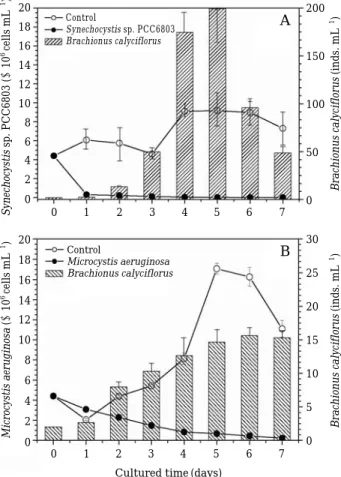
Rotifer B. calyciflorus showed active growth when feeding on cyanophyceae Synechocystis sp.
(Fig. 1A). After being inoculated for one day, the prey population sharply decreased in the treat- ment and had a continuously low population den- sity, implying that the rotifer had fed on most of the prey. Rotifer abundances gradually increased during the first 3 days, then they significantly increased between the 3
rdand 5
thday. In contrast, Synechocystis sp. density in the control was clear- ly higher than that in treatments (ANOVA, F
control/treatment
= =9.235, P⁄0.001). For the cyanophyceae, M. aeruginosa, the rotifer gradually increased on the final day, whereas M. aeruginos gradually decreased in the treatment and increased in the control within pass of culture times (Fig. 1B;
ANOVA, F
control/treatment= =288.36, P⁄0.001). The functional response of rotifer B. calyciflorus on C. vulgaris
TM(ANOVA, F
control/treatment= =1312.5, P⁄0.001) and C. vulgaris UTEX (ANOVA, F
control/treatment
= =78.41, P⁄0.001) significantly differed even though they are from the same species (Figs.
2A, B; P⁄0.001). C. vulgaris
TMsharply decreased after the first day, and then remained at low densities. On the other hand, C. vulgaris UTEX gradually decreased in the final experiments.
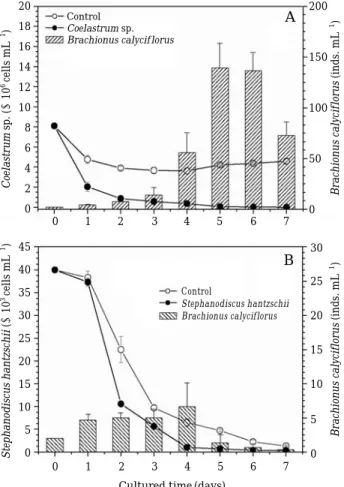
Chlorophyceae Coelastrum sp. also sharply de- creased in the treatments, and then continuously remained at low densities (ANOVA, F
control/treatment= =1610.5, P⁄0.001). Rotifer abundances increas- ed after 3 days (Fig. 3A). These trends were simi- lar to that of rotifer B. calyciflorus on cyanophy- ceae, Synechocystis sp. mentioned above. Finally, we did not observe significant rotifer proliferation when they were allowed to feed on diatom S.
hantzschii. Reducing trends of S. hantzschii in the control and in the treatment were similar on the final day, although there was a significant difference between the control and the treatment (Fig. 3B; F
control/treatment= =463.7, P⁄0.001).
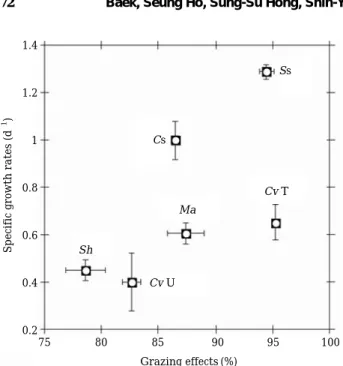
Specific growth rates and grazing effects of roti- fer B. calyciflorus feeding on several prey measur- ed during the 4-day culture are shown in Fig. 4.
Grazing effects and growth rates of rotifers were 94.5% and 1.29 d
-1, respectively, for Synechocys- tis sp., 87.4% and 0.60 d
-1, respectively, for M.
aeruginosa, 95.2% and 0.65 d
-1, respectively, for C. vulgaris
TM, 78.6% and 0.45 d
-1, respectively, for C. vulgaris UTEX., 86.5% and 0.99 d
-1, respec- tively, for Coelastrum sp., and 82.6% and 0.40 d
-1, respectively, for S. hantzchii. Therefore, three strains, Synechocystis sp., Coelastrum sp., and C.
vulgaris
TMtriggered high growth of B. calyciflo-
rus, while M. aeruginosa, S. hantzschii and C.
vulgaris UTEX induced relatively low B. calyci- florus growth effects.
DISCUSSION
The prey species of Microcystis, Synechocystis, Chlorella and Coelastrum are often found during warm seasons above 20� C, while Stephanodiscus is more common during cold seasons below 20� C in the Pal’dang Reservoir (Han et al., 2002; Hong et al., 2002). The reservoir provides drinking water and industrial water for a population of more than 20 million. These organisms are repre- sentative causative species of harmful algal blooms in the reservoir, and have caused serious problems
such as the deterioration of water quality. To control the harmful algal blooms, previous stud- ies have confirmed the abilities of some allelo- chemicals (Park et al., 2006), aquatic bacteria (Kang et al., 2005; Kim et al., 2007), grazing or- ganisms such as heterotrophic nanoflagellates (Kim et al., 2006) and ciliates (Kim et al., 2007).
However, algal bloom suppression by the grazing pressure of rotifers is not fully understood. This study investigated the functional response of roti- fer B. calyciflorus on several prey to provide a better understanding of the biological control ef- fects.
Genus Brachionus produced a significantly smaller number of eggs on nutrient limited food than on non-limited food, which has also been observed in Daphnia (Urabe and Sterner, 2001;
Lürling, 2006). Reproduction of B. calyciflorus as
Fig. 1. Changes in B. calyciflorus while feeding on Sy- nechocystis sp. PCC6803 (A) and Microcystis aeru- ginosa MA001(B) as sole food sources. Controls refer to treatments without food. Histograms with oblique lines are the biomass of B. calyciflorus.
Data represent mean abundances of B. calyciflo- rus and prey species±standard error.
Synechocystissp. PCC6803 (×106cells mL-1)Microcystis aeruginosa(×106cells mL-1) Brachionus calyciflorus(inds. mL-1)Brachionus calyciflorus(inds. mL-1)
20 18 16 14 12 10 8 6 4 2 0
20 18 16 14 12 10 8 6 4 2 0
200
150
100
50
0
30
25
20
15
10
5
0
0 1 2 3 4 5 6 7
0 1 2 3 4 5 6 7
Cultured time (days) Control
Synechocystis sp. PCC6803 Brachionus calyciflorus
Control
Microcystis aeruginosa Brachionus calyciflorus
A
B
Fig. 2. Changes in B. calyciflorus while feeding on Chlo- rella vulgarisTM(A) and Chlorella vulgaris UTEX 26 (B) as sole food sources. Controls refer to treat- ments without food. Histograms with oblique lines are the biomass of B. calyciflorus. Data represent mean abundances of B. calyciflorus and prey spe- cies±standard error.
Chlorella vulgaris TM(×106cells mL-1)Chlorella vulgaris UTEX (×105cells mL-1) Brachionus calyciflorus(inds. mL-1)Brachionus calyciflorus(inds. mL-1)
20 18 16 14 12 10 8 6 4 2 0
20 18 16 14 12 10 8 6 4 2 0
30
25
20
15
10
5
0
30
25
20
15
10
5
0
0 1 2 3 4 5 6 7
0 1 2 3 4 5 6 7
Cultured time (days) Control
Chlorella vulgarisTM Brachionus calycif lorus
Control
Chlorella vulgaris UTEX26 Brachionus calycif lorus
A
B
suspension-feeders relies on algal prey (Mohr and Adrian, 2002). They are also able to regulate their food uptake by modification of their feeding behav- iors with respect to prey density and type of prey (Navarro, 1999; Mohr and Adrian, 2002). Accord- ing to Lürling (2006), egg production of the roti- fer B. calyciflorus is influenced by the nutritional quality and quantity of food. In the present study, B. calyciflorus abundances gradually decreased after being inoculated for 3~4 days when fed on C.
vulgaris
TM, C. vulgaris UTEX and S. hantzschii compared to other prey types such as Synecho- cystis sp., and Coelastrum sp.. Indeed, when feed- ing on Synechocystis sp. and Coelastrum sp., the rotifer induced the longest lasting egg holdings and the lowest mortality from the 5th to the 7th
day. In the cases of S. hantzschii and C. vulgaris UTEX, the rotifer produced egg holdings for only a short period at the beginning of the culture, implying that the abundances of adults could not remain at high levels due to the loss of egg hold- ing and production in the initial stages. Schröder (2005) also suggested that the population dynam- ics of the rotifer were likely affected by the initi- ation of sexual reproduction and the diapausing of resting eggs. Our findings revealed that the egg production of B. calyciflorus was greatly influ- enced by its food types in the initial stages, as mentioned by Mohr and Adrian (2002). Moreover, zooplankton should be able to gain at least some important nutrients by feeding on protozoans to maintain their metabolic demands (Porter et al., 1985; Sanders and Wickham, 1993).
Recently, zooplankton grazing has received at- tention as a tool for water quality management in relation to biomanipulation (Reynolds, 1994;
Kobayashi et al., 1996). In lakes and reservoirs, Brachionus and Daphnia individuals are regard- ed as key zooplankton grazers in reducing the biomass of phytoplankton because they have a broader food-particle size range (Burns, 1968;
Kobayashi et al., 1996) and show little selectivity in their type of food items (Kerfoot and Kirk, 1991;
Mohr and Adrian, 2002). The fact that B. calyciflo- rus gained at least some nutritional benefit from feeding on Synechocystis, Microcystis, C. vulga- ris
TMand Coelastrum implies that these prey organisms have a supplemental effect to algal prey. However, feeding by these rotifer in the presence of algal prey C. vulgaris UTEX and Ste- phanodiscus seems to be inefficient for B. calyci- florus. Generally, zooplankton grazing depends on algal cell size and colony shape, and grazing rates increases exponentially with increasing body sizes of zooplankton. Rothhaupt (1990) re- ported that B. calyciflorus feed most efficiently on particles with an equivalent spherical diame- ter (ESD) around 10 μm. Based on the ESD of tested organisms, they was arranged the follow- ing; Synechocystis (2.35±0.46 μm)⁄Microcystis (3.0~4.5 μm)⁄Chlorella (3.7±0.52 μm)⁄Coelas- trum (6~10 μm)⁄Stephanodiscus (12 μm) (Rot- hhaupt, 1990; Pagano, 2008). Indeed, the grazing effects and growth rates of rotifer B. calyciflorus were depended on the ESD of prey, except when feeding Coelastrum (Fig. 4). Therefore, prey selec- tion of B. calyciflorus might be expected to reflect their food size and qualities, suggesting that the
Fig. 3. Changes in B. calyciflorus while feeding on Chl- orella vulgarisTM (A) and Stephanodiscus hantz- schii CCAP 1079/4 (B) as sole food sources. Con- trols refer to treatments without food. Histograms with oblique lines are the biomass of B. calyci- florus. Data represent mean abundances of B.
calyciflorus and prey species±standard error.
Coelastrum sp. (×106cells mL-1)Stephanodiscus hantzschii(×103cells mL-1) Brachionus calyciflorus(inds. mL-1)Brachionus calyciflorus(inds. mL-1)
20 18 16 14 12 10 8 6 4 2 0
45 40 35 30 25 20 15 10 5 0
200
150
100
50
0
30
25
20
15
10
5
0
0 1 2 3 4 5 6 7
0 1 2 3 4 5 6 7
Cultured time (days) Control
Coelastrum sp.
Brachionus calycif lorus
Control
Stephanodiscus hantzschii Brachionus calyciflorus
A
B
rotifer could be contributed to the control of popu- lation of small sizes algae in freshwater ecosys- tem.
In general, egg production and growth rate for most zooplankton species is influenced by the relationship between food and temperature (Ricci, 2001; Mohr and Adrian, 2002). Brachionus is in the pantropical genus with a capacity to success- fully reproduce at temperatures greater than 25
� C (Ricci, 2001). Park et al. (2001) also reported dramatic growth rates of rotifer B. calyciflorus at high temperatures ranging from 28 to 32� C. In fact B. patulus grows well even at 35� C (Sarma and Rao, 1990). In contrast, the abundance of B.
calyciflorus was maintained relatively high around 15� C in Lake Müggelsee, Germany (Mohr and Adrian, 2002). The S. hantzschii bloom occurs annually in the Pal’tang Reservoir, mainly dur- ing the cold season (from late autumn to the fol- lowing spring) when temperatures are below 20� C (Han et al., 2002; Hong et al., 2002), while rotifer B. calyciflorus has a capacity to successfully re- produce at temperatures higher than 20� C (Park et al., 2001). In the present study, the rotifer in treatment remained at a lower level of abun- dance, and grazing effects and growth rates of
the rotifer also had low values compared to other prey experiments. These rotifer growths may be related to the temperature conditions, suggesting that B. calyciflorus can negatively affect the di- atom S. hantzschii, which dominates in cold wa- ters. According to Kang et al. (2005), S. hantzschii blooms were strongly suppressed by algicidal bacteria in the laboratory and in a mesocosm field study. Therefore, S. hantzschii bloom control maybe not be feasible via grazing pressure be- cause B. calyciflorus does not have a strong capa- city to successfully reproduce under low temper- atures.
Genus Microcystis is a common harmful cyano- bacteria which usually blooms in tropical fresh- water ponds and lakes (Pearl, 1988). Their colo- nial structure and production of microtoxins are defensive functions against the grazing pressure of predators, such as zooplankton (De Bernardi and Giussani, 1990). Also, the growth status of zooplankton grazing on phytoplankton depends on different prey (Nandini, 2000). Our data show that the grazing effects and growth rates of roti- fers B. calyciflorus were 87.4% and 0.60 d
-1, res- pectively, for M. aeruginosa. These were relative- ly lower levels than those of some prey. Ecological- ly, a bloom event of a phytoplankton species is a function not only of relative specific growth rates, but also of the mortality rate by grazing. M. aeru- ginosa population dynamics would also be affect- ed by mesozooplankton grazing, and hence lower grazing pressures on a given organism may create an advantage over competitors (Fulton and Paerl, 1987; Nandini, 2000). In particular, the M. aeru- ginosa is believed to constitute a poor food source for zooplankton due to their colonial structure and production of microtoxins (De Bernardi and Giussani, 1990; Lürling, 2003). Therefore, altho- ugh M. aeruginosa bloom suppression by the graz- ing pressure of a rotifer was partly accepted, more attention should be paid to the biological control effects because M. aeruginosa have a bet- ter advantage with regards to defensive functions against the grazing pressure of predators.
In conclusion, the rotifer B. calyciflorus had a good effect on controlling Synechocystis and Coelas- trum, but was inefficient for the suppression of Stephanodiscus. The efficiencies of bio-agents as sole food sources in this study depended on the target algae. Further studies focusing on the rela- tionship between co-applied bio-agents and chan- ges of nutrients balance in aquatic ecosystems is
Fig. 4. Grazing effects and specific growth rates of B. caly- ciflorus while feeding on several algal prey. Ss : Synechocystis sp. PCC6803, Ma : Microcystis aeru- ginosa, Cv T : C. vulgarisTM, Cv U : C. vulgaris UTEX26, Cs : Coelastrum sp., Sh : Stephanodiscus hantzschii CCAP 1079/4.
Specific growth rates (d-1) 1.4
1.2
1
0.8
0.6
0.4
0.2
75 80 85 90 95 100
Grazing effects (%) Cs
Ss
Cv T
Cv U Sh
Ma
needed for controlling harmful algal blooms.
ACKNOWLEDGEMENTS
We are grateful to A. Turner for his construc- tive comments on the English of this manuscript.
We also thank to Dr. K.S. Shin for valuable com- ments. This work was supported by the Research Fund of HYU (HYU-2008-T).
LITERATURE CITED
Brabrand, A., B.A. Faafeng, T. Kallquist and J.P.
Nilssen. 1983. Biological control of undesirable cyanobacteria in culturally eutrophic lakes. Oecolo- gia 60: 1-5.
Burns, C.W. 1968. The relationship between body size of filter-feeding Cladocera and the maximum size of particle ingested. Limnology and Oceanography 13: 675-678.
De Bernardi, R. and G. Giussani. 1990. Are blue green algae a suitable food for zooplankton? An overview.
Hydrobiologia 200/201: 29-41.
Fulton, R.S. and H.W. Pearl. 1987. Toxic and inhibi- tory effects of the blue-green alga Microcystis aeru- ginosa on herbivorous zooplankton. Journal of Plankton Research 9: 837-838.
Han, M.S., Y.Y. Aug and S.S. Hong. 2002. Ecological studies on Pal’tang River-Reservoir system in Korea 4. Dynamics on inorganic nutrients, POM and phytoplankton succession in the lower stream Kyungan. Korean Journal of Limnology 35: 1-9.
Hong, S.S., S.W. Bang, Y.O. Kim and M.S. Han. 2002.
Effects of rainfall on the hydrological condition and phytoplankton community structure in the riverine zone of the Pal’tang Reservoir, Korea. Journal of Freshwater Ecology 17: 507-520.
Jeffries, M. and D. Mills. 1990. Freshwater ecology- Principles and applications. Belhavan Press, Lon- don, UK.
Kang, Y.H., J.D. Kim, B.H. Kim, D.S. Kong and M.S.
Han. 2005. Isolation and characterization of a bio- agent antagonistic to diatom, Stephanodiscus hant- zschii. Journal of Applied Microbiology 98: 1030- 1038.
Kerfoot, W.C. and K.L. Kirk. 1991. Degree of taste discrimination among suspension-feeeding clado- cerans and copepods: implication for detritivoey and herbivory. Limnology and Oceanography 36:
1107-1123.
Kim, B.H., S.J. Hwang, Y.O. Kim, S.O. Hwang, N, Takamura and M.S. Han. 2007. Effects of biologi- cal control agents on nuisance cyanobacterial and diatom blooms in freshwater systems. Microbes and Environments 22: 52-58.
Kim, B.R., S. Nakano, B.H. Kim and M.S. Han. 2006.
Grazing and growth of the heterotrophic flgagellate Diphylleia rotans on the cyanobacterium Micro- cystis aeruginosa. Aquatic Microbial Ecology 45:
163-170.
Kobayashi, T., P. Gibbs, P.I. Dixon and R.J. Shiel.
1996. Grazing by a river zooplankton community:
Importance of microzooplankton. Marine and Fresh- water Research 47: 1025-1036.
Lürling, M. 2003. Effects of microcystin-free and mic- rocystin-containing strains of the cyanobacterium Microcystis aeruginosa on growth of the grazer Daphnia magna. Environmental Toxicology 18:
202-210.
Lürling, M. 2006. Investigation of a rotifer (Brachio- nus calyciflorus)-green alga (Scenedesmus pectina- tus) interaction under non- and nutrient-limited conditions. Annales de Limnologie 42: 9-17.
Mohr, S. and R. Adrian. 2002. Effects of Brachionus calyciflorus and Brachionus rubens on a manipu- lated freshwater microbial community. Journal of Plankton Research 24: 25-31.
Nandini, S. 2000. Responses of rotifers and cladoce- rans to Microcystis aeruginosa (Cyanophyceae): A demographic study. Aquatic Ecology 34: 227-242.
Navarro, N. 1999. Feeding behaviour of the rotifers Brachionus plicatilis and Brachionus rotundifor- mis with two types of food: live and freeze-dried microalgae. Journal of Experimental Marine Bio- logy and Ecology 237: 75-87.
Pagano, M. 2008. Feeding of tropical cladocerans (Moina micrura, Diaphanosoma excisum) and roti- fer (Brachionus calyciflorus) on natural phytoplank- ton: effect of phytoplankton size-structure. Jour- nal of Plankton Research 30: 401-414.
Park, H.G., K.W. Lee, S.H. Cho, H.S. Kim, M.M. Kim and H.S. Kim. 2001. High density culture of the freshwater rotifer, Brachionus calyciflorus. Hydro- biologia 446/447: 369-374.
Park, M.H., M.S. Han, C.Y. Ahn, H.S. Kim, B.D. Yoon and H.M. Oh. 2006. Growth inhibition of bloom- forming cyanobacterium Microcystis aeruginosa by rice straw extract. Letters in Applied Microbiology 43: 307-312.
Paerl, H.W. 1988. Nuisance phytoplankton blooms in coastal, estuarine and inland waters. Limnology and Oceanography 33: 823-847.
Porter, K.G. 1973. Selective grazing and differential digestion of algae by zooplankton. Nature 244:
179-180.
Porter, K.G., E.B. Sherr, B.F. Sherr, M. Pace and R.W. Sanders. 1985. Protozoa in planktonic food web. Journal of Protozoology 32: 409-415.
Radix, P., G. Severin, K.W. Schramm and A. Kettrup.
2002. Reproduction disturbances of Brachionus calyciflorus (rotifer) for the screening of environ- mental endocrine disrupters. Chemosphere 47:
1097-1101.
Reynolds, C.S. 1994. The ecological basis for the suc- cessful biomanipulation of aquatic communities.
Archiv Hydrobiologie Stuttgart 130: 1-33.
Reyssac, S.J. and M. Pletikosic. 1990. Cyanobacteria in fishponds. Aquaculture 88: 1-20.
Ricci, C. 2001. Dormancy patterns in rotifers. Hydro- biologia 446/447: 1-11.
Rothhaupt, K.O. 1990. Differences in particle size- dependent feeding efficiencies of closely related rotifer species. Limnology and Oceanography 35:
16-23.
Sanders, R.W. and S.A. Wickham. 1993. Planktonic protozoa and metazoa: Predation, food quality and population control. Mar. Microb. Food Webs 7:
197-223.
Sarma, S.S.S. and T.R. Rao, 1990. Population dynam- ics of Brachionus patulus Müller (Rotifera) in rela- tion to food and temperature. Proceedings of the Indian Academy of Sciences. Animal Sciences 99:
335-343.
Schröder, T. 2005. Diapause in monogonont rotifers.
Hydrobiologia 546: 291-306.
Sigee, D.C., R. Glenn, M.J. Andrews, E.G. Bellinger, R.D. Epton and H.A.S. Hendry. 1999. Biological control of cyanobacteria: principles and possibili- ties. Hydrobiologia 395/396: 161-172.
Takamura, Y., T. Yamada, A. Kimoto, N. Kanehama, T. Tanaka, S. Nakadaira and O. Yagi. 2004. Growth inhibition of microcystis cyanobacteria by L-lysine nad disappearance of natural microcystis blooms with spraying. Microbes and Environments 19:
31-39.
Urabe, J. and R.W. Sterner. 2001. Contrasting effects of different types of resource depletion on life his- tory traits in Daphnia. Functional Ecology 15: 165- 174.
(Manuscript received 6 January 2009, Revision accepted 18 February 2009)