국내외 경도인지장애 노인의 비약물적 중재에 대한 통합적 문헌고찰
제주한라대학교 간호학과 조교수이정은
An Integrated Literature Review of Non-pharmacological Intervention in Older Adults with Mild Cognitive Impairment
JUNGEUN LEE
Assistant Professor, College of Nursing, Cheju Halla University
요 약 본 연구의 목적은 국내외 경도인지장애 노인의 비약물적 중재에 대한 통합적 문헌고찰을 통해 비약물적 중재 프로그램 개발을 위한 기초자료를 제공하기 위함이다. 국내외 경도인지장애 노인의 비약물적 중재연구에 대한 통합적 문헌분석 결과, 최종 16개의 논문이 선정되었다. 비약물적 중재 프로그램의 전반적인 경향은 모두 인지강화를 주목적으 로 하되 국내연구는 운동요법 등의 신체적 활동보다 음악치료와 웃음요법 등의 정서적 활동이 병합된 경우가 많은 반면, 국외연구는 정서적 활동보다는 신체적 활동을 병합한 연구가 많았다. 중재 프로그램 효과는 결과변수에 따라 다르게 나타났는데 일차적 변수는 인지기능과 우울로 나타났고, 이차적 변수는 신체적 기능, 일상생활수행능력과 자기효능감에 중재 효과가 있는 것으로 나타났다. 본 연구결과를 토대로 경도인지장애 노인의 치매예방을 위한 다양한 비약물적 중재 프로그램 개발을 통해 임상현장에서 적용할 수 있는 다학제적 접근에 기여할 수 있을 것이다.
주제어 : 경도인지장애, 비약물적 중재, 통합적 문헌고찰, 노인
Abstract We aimed to provide evidences for developing non-pharmacological intervention in older adults with Mild Cognitive Impairment(MCI) by integrated literature review. The final 16 papers were selected as a result of an integrated literature analysis. All of them are focused on strengthening cognitive activities, while Korean studies have often merged emotional activities such as music therapy and laughter therapy rather than physical activities such as exercise therapy, international studies have combined physical activities rather than emotional activities. The effects of non-pharmacological intervention differed according to the outcome variables. The primary variables were cognitive function and depression, and secondary variables were found to have effects on physical function, activities of daily living (ADL), and self-efficacy. This study contributes to a multidisciplinary approach that can be applied in the clinical field through the development of various non-pharmaceutical intervention for the prevention of dementia in the older adults with MCI.
Key Words : Mild Cognitive Impairment, Non-pharmacological Intervention, Integrated Literature Review, Older Adults.
*Corresponding Author : JUNGEUN LEE([email protected]) Received February 7, 2021
Accepted March 20, 2021 Revised February 22, 2021
Published March 28, 2021
1. 서론
정상적인 노화와 치매 사이의 과도기적 단계 (transitional stage)로 간주되고 있는 경도인지장애는 [1] 치매의 발병을 줄이기 위한 조기진단과 치료의 시점 으로 치매로의 진행을 지연시키거나 예방할 수 있다는 점에서 중요한 의의를 가진다. Petersen 등 [2]이 제시한 경도인지장애의 진단기준을 살펴보면 1) 주관적인 기억 력 문제호소, 2) 나이와 교육정도에 비해 객관적으로 증 명되는 기억력 손상, 3) 전반적인 인지기능 유지, 4) 일상 생활수행능력 손상없음, 5) 치매가 아님으로 구성된다.
국내 경도인지장애 유병률은 22.4% [3]였으며 경도인지 장애 진료환자의 연도별 증감률이 43.9%로 나타났다[4].
또한 경도인지장애 노인이 치매로 악화되는 비율이 연간 12∼15%였으며[5,6] 65세 이상의 정상 노인이 치매로 악화되는 비율이 1∼2% [7]로 나타나 경도인지장애 진단 을 받은 경우 치매의 발병위험이 일반인에 비해 매우 높 음을 알 수 있다. 경도인지장애를 조기 발견하여 치매의 발병을 2년 정도 지연시킬 경우 20년 후에는 치매유병률 이 80% 수준으로 낮아지고 중증도도 감소되는 것으로 나타났다[8]. 따라서 치매예방을 위해서는 경도인지장애 를 조기에 발견하여 신체적·정서적 문제뿐 아니라 인지 기능 저하와 같은 위험요인을 지속적으로 관리하여 치매 로의 이환을 줄이는 것이 매우 중요하다.
경도인지장애는 치매와 달리 통찰력과 학습기능이 남 아있고 대뇌의 가소성과 인지적 보유능력이 있어서 치매 로의 진행을 예방하기 위해서는 지속적인 교육이 필요하 다[9]. 그러나 경도인지장애 노인들은 치매관련 교육을 받았어도 일회성으로 끝나 치매의 위험요인이나 조기발 견 및 치매예방을 위한 행위가 지속적으로 연결되지 않 으므로 효율적인 이행이 어려운 경우가 많다[9]. 이에 경 도인지장애 노인의 치매로의 진행을 예방하기 위해서는 인지기능 향상을 위한 중재활동 뿐 아니라 이에 대한 적 극적인 참여와 스스로 치매예방을 위한 건강행위의 지속 적인 교육을 포함한 비약물적 중재의 필요성을 제기하고 있다[9,10].
비약물적 중재는 경도인지장애 노인의 치매 진행 및 질병 완화에 효과적이며, 인지기능 향상에도 긍정적인 효 과가 있는 것으로 나타났다[11]. 이에 경도인지장애 노인 의 추후 치매로의 이환율이 정상 노인에 비해 높음을 고 려했을 때 이들을 위한 비약물적 중재연구 분석은 매우 시급하다[9]. 경도인지장애 노인의 비약물적 중재에 대한 문헌고찰 선행연구들을 살펴보면, 국외연구로는 2개의
DB(PsychInfo 와 MEDLINE)만을 활용한 체계적 문헌 고찰[12]과 국내연구로는 국내논문 11개 만을 대상으로 한 통합적 문헌고찰[13]이 있을 뿐이다. 이들은 단지 국 외나 국내연구만을 대상으로 매우 제한적인 범위 내에서 진행되어 다양한 국내외 비약물적 중재 프로그램의 경향 을 확인하고 효과를 논하기에는 한계가 있다. 따라서 본 연구에서는 국내외 경도인지장애 노인의 비약물적 중재 및 효과에 대한 통합적 문헌고찰을 통해 비약물적 중재 프로그램 개발을 위한 학문적인 기초자료를 제공하고자 한다.
2. 연구목적
본 연구는 최근 10년간 국내외 경도인지장애 노인의 비약물적 중재 프로그램을 통합적으로 고찰함으로써, 중 재 내용과 결과를 파악하고자 시행하였다. 따라서 구체적 인 연구의 목적은 다음과 같다.
1) 국내외 경도인지장애 노인의 비약물적 중재 프로그램 과 관련된 논문의 일반적 특성을 파악한다.
2) 국내외 경도인지장애 노인의 비약물적 중재 프로그램 의 경향을 확인한다.
3) 국내외 경도인지장애 노인의 비약물적 중재 프로그램 의 효과를 파악한다.
3. 연구방법 3.1 연구설계
본 연구는 국내외 경도인지장애 노인 대상의 비약물적 중재 프로그램과 관련된 논문들을 고찰함으로써 중재연 구의 경향과 중재효과를 확인하여 비약물적 중재 프로그 램 개발 관련 기초자료를 마련하기 위한 방법론적 연구 이다.
3.2 연구절차
본 연구는 현재 국내외 경도인지장애 노인을 대상으로 수행한 비약물적 중재와 관련된 논문을 분석하기 위해 Whittemore와 Knafl [14]가 제시한 통합적 문헌고찰 방법 을 사용하였다. 이는 문제규명(Problem identification), 문 헌검색(Literature search) , 문헌평가(Data evaluation), 문 헌분석(Data analysis), 그리고 문헌제시(Presentation) 5
Identification
Journal records identified through DB searching
(n=289)
Thesis & Dissertation records identified through DB searching
(n=305)
↓ ↓
Records identified through DB searching
(n=594) → Duplicates removed
(n=85)
Screening
↓
Titles and abstracts screened
(n=509) →
Records excluded with reasons (n=334)
-Survey(n=130)
-Contents development studies(n=29) -Pharmacological intervention(n=62) -Qualitative studies(n=35) -Not related subject study(n=78)
↓
Eligibility Full-text articles assessed for eligibility
(n=175) →
Full-text articles excluded with reasons (n=159) -Single group study(n=43)
-No Mean & SD to pretest & posttest(n=16) -Different contents of intervention(n=54) -Combined studies(Pharmacological &
non-pharmacological intervention)(n=39) -No pretest homogeneity(n=7) ↓
Included Studies included in quantitative synthesis (n=16)
Fig. 1. Literature review process of the study 단계로 구성되며, 본 연구의 진행과정은 다음과 같다.
3.2.1 문제규명(Problem Identification)
본 연구에서 경도인지장애 노인을 대상으로 비약물적 중재 프로그램과 관련하여 제기하는 문제는 다음과 같다.
1) 국내외 경도인지장애 노인을 대상으로 비약물적 중재 프로그램의 일반적 특성은 어떠한가?
2) 국내외 경도인지장애 노인을 대상으로 수행한 비약물 적 중재 프로그램의 경향은 어떠한가?
3) 국내외 경도인지장애 노인을 대상으로 수행한 비약물 적 중재 프로그램의 효과는 어떠한가?
위에서 제기된 3가지 문제는 치매로 아직 진행되지 않 은 전 단계인 경도인지장애 노인의 치매 예방을 위해 필 요한 비약물적 중재 프로그램의 효과를 검증하고 연구경 향을 분석하여 확대된 후속연구의 방향성을 제안하기 위 함이다.
3.2.2 문헌검색(Literature search)
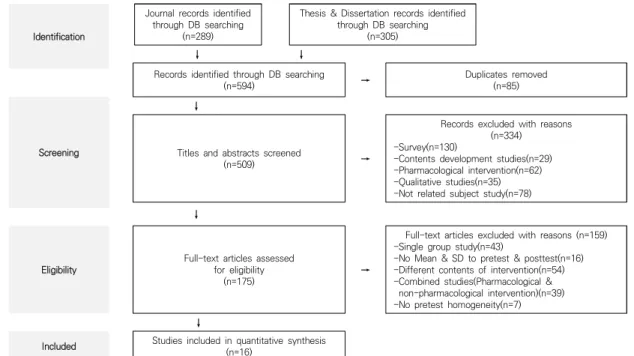
본 연구는 경도인지장애 노인을 대상으로 한 비약물적 중재프로그램을 확인하기 위해 체계적인 문헌검색을 수 행하였다(Fig. 1). 2010년 1월 1일부터 2019년 12월 1 일까지 경도인지장애 노인 대상의 비약물적 중재연구 관
련 국내외 학술지를 다음의 네 단계로 검색하였다.
첫 번째 단계로, 국내 DB는 KISS, RISS와 KoreaMed에서, 국외 DB는 PubMed, EBSCO Publishing(CINAHL)과 ProQuest Central에 게재된 연구를 대상으로 하였다. 검색어는 대상자 AND 중재 AND 결과의 조합으로 검색하였다. 대상자는 ‘경도인지 장애(mild cognitive impairment)’, 또는 ‘노인(elderly or older people)’으로, 중재는 ‘프로그램(program)’ 또 는 ‘중재 (intervention)’ 또는 ‘치료(therapy)’, 그리고 결과는 ‘인지기능(cognitive function)’으로 검색한 결 과 국내외 학술지 논문은 289개, 국내외 학위논문은 305 개로 1차적으로 검색된 문헌은 총 594개였다. 두 번째 단계로, 서지반출프로그램(Endnote 7x)을 이용하여 제 목, 저자, 연도를 중심으로 중복논문 85개를 제거하였다.
학술지와 학위논문이 중복된 경우 학술지 논문을 선택하 였으며 중복논문을 제외하고 2차적으로 509개의 논문이 선정되었다. 세 번째 단계로, 연구논문의 제목과 초록을 중심으로 연구대상, 연구설계 제외기준을 적용하여 검토 하였고 초록만으로 선정이 어려운 경우 전문을 찾아 확 인하였다. 이에 334개의 논문이 제거되었는데 배제사유 는 조사연구 130개, 프로그램, 게임, 어플리케이션, 시스 템, 콘텐츠 지도안 등 개발연구 29개, 약물적 중재연구 62개, 질적연구 35개, 그리고 관련 없는 주제 연구 78개
로 3차적으로 175개의 논문이 선정되었다. 네번째 단계 로, 선정기준에 따라 175개의 논문 전문을 중심으로 체 계적으로 검토한 결과 159개의 논문이 제거되었다. 배제 사유는 단일집단 연구 43개, 중재전후 평균, 표준편차 등 을 제시하지 않은 연구 16개, 중재종류가 약물요법이나 한방요법 연구 54개, 약물적 & 비약물적 통합연구 39개 그리고 사전 동질하지 않은 연구 7개로 최종적으로 16개 의 논문이 선정되었다. 이에 최종적으로 경도인지장애 노 인 대상의 비약물적 중재연구로 선택된 총 16개 문헌(국 내 8개, 국외 8개)을 중심으로 Fig 1과 같이 평가 및 분 석하였다.
가. 문헌검색에 사용된 키워드
1) 대상자: 경도인지장애(mild cognitive impairment) 또 는 노인(elderly or older people)
2) 중재: 프로그램(program) 또는 중재 (intervention) 또 는 치료(therapy)
3) 결과: 인지기능(cognitive function) 나. 문헌검색의 선정기준
1) 기간: 2010년 1월 1일부터 2019년 12월 1일 2) 대상자: 65세 이상의 경도인지장애 노인 3) 연구설계: 대조군이 있는 실험연구 4) 중재방법: 비약물적 중재연구
5) 중재결과: 인지기능을 포함한 모든 변수 다. 문헌검색의 배제기준
1) 연구설계시 대조군이 있는 실험연구가 아닌 경우(예:
조사연구, 질적연구, 사례연구 등의 비실험연구, 단일 군 사전-사후연구 등)
2) 결과변수로써 비약물적 중재 프로그램 효과를 보고하 지 않은 연구(예: 전후 평균, 표준편차 등을 제시하지 않은 연구, 사전 동질하지 않은 연구)
3) 약물적 & 비약물적 통합연구
4) 약물적 중재연구(예: 약물요법, 한방요법 등)
3.2.3 문헌평가(Data evaluation)
본 연구에서는 최종 선정된 16개의 문헌 질적수준을 평가하기 위해 Arbesman, Scheer와 Lieberman [15]
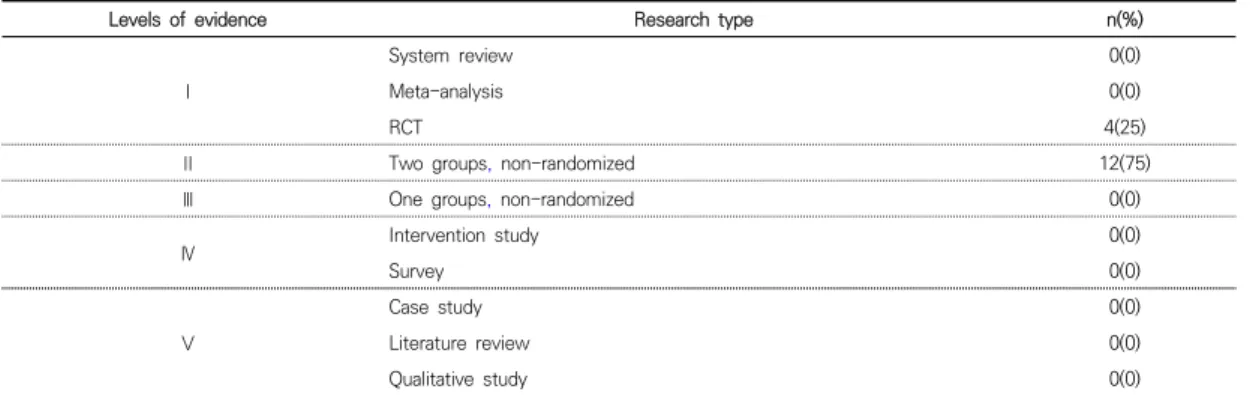
이 개발한 근거기반 연구수준 5단계를 바탕으로 분석한 결과, Table 2와 같이 근거수준I의 RCT 4개, 근거수준
Ⅱ의 두집단 비무작위 연구 12개였다.
3.2.4 문헌분석(Data analysis)
본 연구의 목적에 적합하게 최종 분석된 16개의 중재 연구를 분석하기 위해 일반적 특성, 중재 구성과 결과의 세 가지 형식으로 나누어 분석하였다. 일반적 특성에서는 저자(년), 연구대상자 수와 연구설계, 중재 구성에서는 중 재유형 및 내용, 기간 및 빈도, 그리고 중재 제공자, 결과 에 있어서는 측정 시점과 결과변수로 Table 1, 3과 같이 구성하였다.
3.2.5 문헌제시(Presentation)
본 연구의 목적을 바탕으로 분석한 문헌고찰 내용을 제시하면 Tables 1,2,3,4와 같다.
4. 연구결과
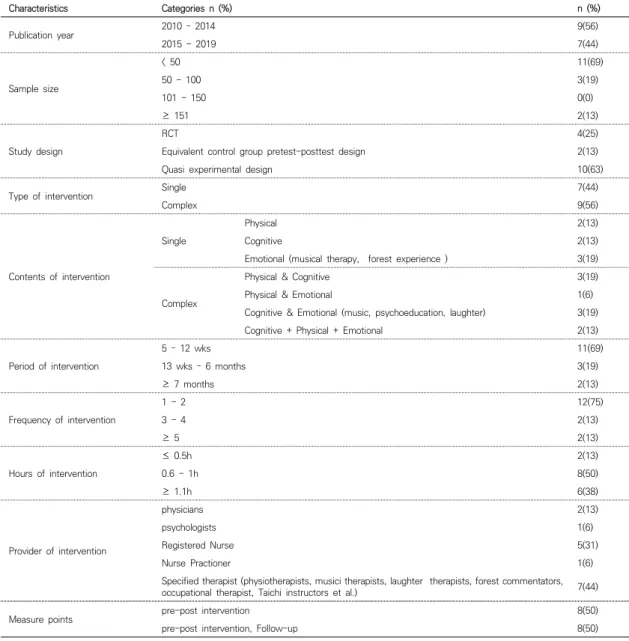
4.1 통합적 문헌고찰 대상 문헌의 일반적 특성 최종 분석된 16개 논문을 대상으로 일반적 특성을 확 인한 결과는 다음과 같다(Table 1). 연도별 분포는 2010 년부터 2014년 까지 9개(56%)로 2014년 이전에 다소 많은 추세를 보였고, 중재연구에 참여한 대상자 수는 50 명 미만이 11개(69 %)로 가장 많았으며, 연구설계는 유 사 실험연구가 10개(63%)로 절반이상을 차지하였다. 중 재유형은 복합중재 9개(56%)로 단일중재(44%)보다 많았 으며, 중재 내용은 단일중재의 경우, 신체적, 인지적 활동 이 각각 2개(13%)로 동일하였고, 정서적 활동이 3개 (19%)로 나타났다. 복합중재의 경우, 인지적·정서적 활동 과 신체적·인지적 활동이 각각 3개(19%)로 가장 많았으 며 신체적·인지적·정서적 활동의 3개 영역이 통합된 연구 는 2개(13%)였다. 중재기간은 5주에서 12주가 11개 (69%)로 가장 많았고, 중재 빈도는 1-2회가 12개(75%) 로 대부분을 차지하였다. 회기당 중재시간은 0.6시간에 서 1시간이 8개(50%)로 절반이상이었으며, 중재 제공자 는 심리치료사, 음악치료사, 웃음치료사 등의 전문치료사 (Specified therapist)가 7개(44%)로 대부분을 차지하 였고, 전문간호사와 심리학자가 각각 1개(6%)로 가장 적 었다. 측정시기는 중재 전후와 추가적인 Follow-up 기 간이 있는 경우가 각각 8개(50%)로 동일하게 나타났다.
4.2 국내외 경도인지장애 노인을 위한 비약물적 중재 프로그램의 경향
본 연구에서 최종 선정된 16개 논문의 국내외 비약물
Characteristics Categories n (%) n (%)
Publication year 2010 – 2014 9(56)
2015 - 2019 7(44)
Sample size
< 50 11(69)
50 - 100 3(19)
101 - 150 0(0)
≥ 151 2(13)
Study design
RCT 4(25)
Equivalent control group pretest-posttest design 2(13)
Quasi experimental design 10(63)
Type of intervention Single 7(44)
Complex 9(56)
Contents of intervention
Single
Physical 2(13)
Cognitive 2(13)
Emotional (musical therapy, forest experience ) 3(19) Complex
Physical & Cognitive 3(19)
Physical & Emotional 1(6)
Cognitive & Emotional (music, psychoeducation, laughter) 3(19)
Cognitive + Physical + Emotional 2(13)
Period of intervention
5 – 12 wks 11(69)
13 wks – 6 months 3(19)
≥ 7 months 2(13)
Frequency of intervention
1 - 2 12(75)
3 - 4 2(13)
≥ 5 2(13)
Hours of intervention
≤ 0.5h 2(13)
0.6 - 1h 8(50)
≥ 1.1h 6(38)
Provider of intervention
physicians 2(13)
psychologists 1(6)
Registered Nurse 5(31)
Nurse Practioner 1(6)
Specified therapist (physiotherapists, musici therapists, laughter therapists, forest commentators,
occupational therapist, Taichi instructors et al.) 7(44)
Measure points pre-post intervention 8(50)
pre-post intervention, Follow-up 8(50)
Table 1. General Characteristics of the Intervention Studies
적 중재 프로그램을 분석한 결과, 국내외 중재유형과 구 성내용에 있어서 다소 경향이 다른 것으로 Table 3, 4와 같이 나타났다.
국외연구의 경우, 중재유형에 있어서는 단일중재 (19%)보다는 복합중재(31%)가 많았고 구성내용에 있어 서는 단일중재와 복합중재가 다소 차이가 있었다. 단일중 재는 인지적 활동 (6%)보다는 신체적 활동(13%)이 주를 이루었고, 복합중재는 인지적 활동(인지자극과 인지기능 향상프로그램)을 통한 인지강화를 주목적으로 하되 정서 적 활동(음악요법)보다는 신체적 활동 (에어로빅, 댄스,
스트레칭, 핸드볼 등의 운동요법)이 병합(19%)된 경우가 더 많았다.
국내연구의 경우, 중재유형에 있어서는 단일중재와 복 합중재가 각각 50%로 동일하였고, 구성내용에 있어서는 국외연구와 다소 상반된 경향을 보였다. 단일중재는 인지 적 활동(6%)보다는 정서적 활동(19%)이 더 많았고, 복합 중재는 인지적 활동을 중심으로 신체적 활동(6%)보다는 정서적 활동(19%)이 병합된 경우가 많았다.
이에 국내외 비약물적 중재 프로그램의 경향은 크게 두가지로 나타났다. 첫째, 국내외 연구 모두 인지강화에
Levels of evidence Research type n(%)
Ⅰ
System review 0(0)
Meta-analysis 0(0)
RCT 4(25)
Ⅱ Two groups, non-randomized 12(75)
Ⅲ One groups, non-randomized 0(0)
Ⅳ Intervention study 0(0)
Survey 0(0)
Ⅴ
Case study 0(0)
Literature review 0(0)
Qualitative study 0(0)
Table 2. Qualitative Level of research
중점을 두되 국내는 운동요법 등의 신체적 활동보다 음 악치료, 웃음요법 등의 정서적 활동이 병합된 경우가 많 은 반면, 국외는 정서적 활동보다는 신체적 활동을 병합 한 연구가 많았다. 둘째, 국내연구는 2019년도부터 신체 적·인지적·정서적 3개 영역의 통합적 중재가 증가하기 시 작하였다[9, 16].
4.3 국내외 경도인지장애 노인을 위한 비약물적 중재 프로그램 효과
본 연구에서 최종 선정된 16개 논문의 비약물적 중재 프로그램 효과는 결과변수(일차적 변수, 이차적 변수)에 따라 다르게 나타났다(Table 3,4). 일차적 변수는 인지기 능과 우울이었는데 인지기능은 16개의 모든 연구에서, 우울은 12개의 연구에서 주요변수로 측정되었다. 인지기 능의 경우, 기억력[17], 집행기능[10], 전두엽 인지기능과 주의집중력[18], 그리고 언어기능·추상력과 시공간구성 능력[19]이 향상된 것으로 나타났다. 우울은 11개의 연 구에서 경도인지장애 노인의 우울을 감소시키는 효과가 있었으나 Joosten 등 [20]의 연구에서는 통계적으로 유 의하지는 않는 것으로 나타났다.
이차적 변수는 16개의 논문 중 9개의 비약물적 중재 연구에서 신체적 기능[10, 19, 21], 일상생활수행능력/수 단적일상생횔수행능력[16,28, 29]과 자기효능감[9, 22, 23]을 결과변수로 측정하였다. 신체적 기능에 있어서 3 개의 연구 중 1개[19]와 일상생활수행능력/수단적일상생 횔수행능력에 있어서 3개의 연구 중 1개[16]를 제외하고 는 모두 긍정적인 효과가 있는 것으로 나타났다. 특히 자 기효능감에 있어서는 3개의 연구 모두 비약물적 중재효 과가 있는 것으로 나타났다. Klusmann 등[10]의 복합중 재에서는 걷기의 운동요법과 인지기능요법의 병합을 통 해 신체적 기능에 긍정적인 효과가 있는 것으로 나타났
으며, Devenney 등[21]의 단일중재에서는 에어로빅과 스트레칭·근긴장운동을 통해 신체적 활동을 포함한 심혈 관계기능 향상에 효과가 있는 것으로 나타났다. McDougall 등[22]은 기억력훈련과 건강증진프로그램을 통해 경도인 지장애 노인의 기억력 자기효능감이 향상됨을 보여주었고, Ji 와 Kim [23]은 인지훈련과 웃음치료를 통해, Song 등 [24]은 인지향상프로그램의 단일중재를 통해 경도인지장 애 노인의 자기효능감 향상에 효과가 있는 것으로 나타 났다. 추가적으로 삶의 질, 치매예방행위, 질병인식, 그리 고 무력감 등으로 중재효과를 측정하였다. Joosten 등 [20]의 연구에서는 경도인지장애 노인의 기억재활과 심 리적 교육을 통해 질병에 대한 인식과 무력감이 향상되 었고 Kim과 Yang [25]은 음악요법의 단일중재가 기분 상태와 무력감에 효과가 있음을 확인하였다. Kim 등 [9]
의 신체적· 인지적·정서적인 통합적 접근의 자기관리 중 재프로그램에서는 경도인지장애 노인의 치매예방행위를 증진시키고 삶의 질이 향상되는 긍정적인 효과가 있는 것으로 나타났다.
5. 논의
본 연구결과를 토대로 국내외 경도인지장애 노인의 비 약물적 중재연구의 경향과 효과에 대해 논의하고자 한다.
5.1 국내외 경도인지장애 노인을 위한 비약물적 중재연구의 경향
국내외 경도인지장애 노인 대상의 비약물적 중재에 대 한 통합적인 문헌분석 결과, 선행연구들의 전반적인 경향 은 인지기능 향상을 위한 인지훈련에 중점을 두되 신체 적 활동이나 정서적 지지를 위한 중재가 병합된 통합적
Author (year,
country) Sample size Study design
Intervention
Measure
points Outcome variables (*significant) Type(single, complex) & contents Perio
d Freq /wk hrs
/S Provider (setting)
Klusmann et al.
(2010, Germany)
EG : Computer (92) Exercise (91) CG (76)
(Total; 259)
RCT
[Complex Intervention : physical+
cognitive]
Physical exercise : aerobic endurance, strength, and flexibility training
Complex cognitive task
mont6
hs 3 1.5h
a certified sports physician & an experienced computer teacher(
schools and fitness centers)
pre-inteven tionpost-inteve ntion
Cognitive function (memory*, executive function*) Physical exercise*
-self-reported exercise level -meters completed in 6m in walking test Joosten
et al.
(2011, Netherlan ds)
EG (47) CG (40) (Total; 87)
Quasi experim ental design
[Complex Intervention : cognitive+
emotional]]
Cognitive behavioural therapy
Memory rehabilitation
Psychoeducation : acquisition of knowledge & skills to adequately cope with MCI-associated symptoms
wks10 1 2h
psychologists(
memory clinics of 4 hospitals)
pre-inteven tionpost-inteve ntion 6-8 months after intevention
Cognitive function*
Depression Acceptance &
Helplessness of illness*
Sense of Competence*
Sugano et al.
(2012, Japan)
EG :
Cognitive function prog(17) Physical function prog(14) CG (13) (Total; 44)
Equivale ntcontrol group prettest –posttes tdesign
[Complex Intervention : physical+
cognitive]
Physical function program:
- aerobic training
- warm-up, walking, & calisthenics
Cognitive function program:
- memory/learning - attention - verbal fluency - visuospatial function - reasoning
wks8 1 1h N/M (localcommunity)
pre-inteven tionpost-inteve ntion
Cognitive function : 5-Cog
-memory: cued recall*
-attention: A set-dependent activity -verbal fluency (language) -visuospatial: Clock drawing -abstract reasoning : similarity Physical function :finger
movement (motor function) Cross et
al.(2012, USA)
MT (50) DT (50) (Total; 100)
Quasi experim ental design
[Complex Intervention : physical +emotional]
MT: listen music(30min) on a CD at
10amDT: jazz, ballet, salsa, swing, jitterbug, modern with the same music as MT
wks8 5 0.5h RNs, psychology assistants, or LVNs (the board and care facility)
pre-inteven tion3, 10 days post-inteve ntion
Cognitive function(memory)*
Depression*
Rojas et al. (2013, Argentina )
EG (24) CG (22) (Total; 46)
RCT
[Single Intervention : cognitive]
Cognitive intervention program
Cognitive stimulation training : -Episoodic memory encoding strategies -Executive control training techniques.
-metacognition & cognitive self-efficacy -general information about cognitive changes observed in normal aging, MCI, and dementia, and instructions on how to use these strategies in daily life and external aids (calendars, agendas, routines, checklists)
mont6
hs 1 2h
experienced neurophysiolo gists (hospital-base d outpatient memory clinics)
pre-inteven tion12 months after intevention
Cognitive function)*
Comprehensive neuropsychological functin)*
Wei & Ji (2014, China)
EG (30) CG (30) (Total; 60)
Equivale ntcontrol group prettest –posttes tdesign
[Single Intervention : physical]
Handball training program : toss, hi, bounce, pass, grab, field going, roll, pinch training
mont6
hs 5 0.5h
physiotherapis ts(Nnursing home)
pre-inteven tionpost-inteve ntion 3, 6 months post-inteve ntion
Cognitive function*
Daily living function*
Devenne (3centers in Europe, RCT [Single Intervention : physical] 12 3 0.75 Supervised pre-inteven Cognitive function*
Table 3. An integrated literature review of non-pharmacological intervetnion studies for older adults with MCI (International)
y et al.
(2017, Ireland)
Germany and Ireland).
EG : Aerobic exercise (75) Streching and toning (75) CG (75) (Total; 225)
Physical exercise programme - extensive aerobic exercise - stretching & toning - (non-aerobic) exercise
months h instructors (health centers)
tionpost-inteve ntion 6, 12 months post-inteve ntion
Cardiovascular fitness*
Physical activity*
Quality of life*
Depression*
Frailty and epigenetic changes*
McDougal l, et al.
(2019, USA)
EG (19) CG (20) (Total; 39)
RCT
[Complex Intervention : cognitive +emotional]
Senior WISE Memory training
Memory training : 4 components of self-efficacy theory: enactive mastery experience, vicarious experience, verbal persuasion, and physiologic arousal.
Health promotion training: focus on successful aging with interactive health discussions
mont24
hs 2 1h N/M
pre-inteven tion2, 6, 14, 26 months post-inteve ntion
Cognitive function(memory)*
Memory Self-Efficacy*
Depression*
S: Session; CG: Control Group; EG: Experimental Group; DT: Dandce Therapy; MT: Music Therapy; N/M : Not /Mentioned; RN: Registered Nurse; Freq : Frequency; LVN:Licensed Vocational Nurse; MCI:Mild Cognitive Impairment.
인 접근이라는 것이다. 이는 기억장애 노인의 경우, 신체 적·인지적·정서적 영역을 포함한 복합적인 문제 발생으 로 인해 효과적인 중재프로그램으로 단일활동보다 복합 활동이 긍정적인 효과가 있음을 보여준 연구결과[32,33]
와도 상통한다. 국외연구 먼저 살펴보면, Klusmann 등 [10]은 경도인지장애 노인의 신체적·인지적 활동의 복합 적인 중재를 통해 대상자의 인지기능이 향상되었으며, Sugano 등 [19]은 공을 이용한 운동프로그램과 에피소 드를 기억하게 하고 집중력을 향상시키는 인지기능프로 그램의 병합을 통해 cued recall(memory)이 증진되었 음을 보고하였다. Cross 등 [17]은 5개의 인지기능(기억 력, 언어유창성, 시공간능력, 추상력, 주의집중력) 강화를 주목적으로 하는 인지기능프로그램과 에어로빅과 손운동 을 통한 운동요법을 통해 경도인지장애 노인의 인지기능 이 향상되고 우울이 감소함을 확인하였다. 국내연구를 살 펴보면, Kim 등 [9]은 인지자극, 인지훈련과 인지재활로 구성된 인지중재프로그램을 통해 대상자의 인지기능, 치 매예방행위, 자기효능감, 그리고 삶의 질이 향상되었고 우울이 감소하였음을 나타냈다. Kim과 Yang [25]은 경 도인지장애 노인에게 음악치료를 적용한 결과 대상자의 기분상태 및 무력감이 유의하게 감소함을 보여주었으며, Ji와 Kim [23]은 웃음요법이 병합된 인지강화프로그램 을 제공한 결과 실험군이 대조군에 비해 전두엽기능을 포함한 인지기능과 자기효능감이 향상되었고 우울이 감 소되었음을 확인하였다. 이 연구에서는 자기효능감 강화 를 위한 전략으로 언어적 설득을 위해 강의를 통해 인지 기능 개선의 가능성을 강조하였고, 대리경험을 위해 유사 경험을 공유하였고, 성취경험을 위해 개인과제에 대한 칭
찬과 과정완수시 수료증과 출석상을 수여하였으며, 그리 고 정서적 각성 완화를 위해 웃음요법과 7주 동안의 웃 음요법을 녹화한 동영상 시청을 활용하였다[23].
2019년 이전에는 주로 신체적, 인지적, 또는 정서적 영역의 단일중재 또는 복합중재가 국내외에서 활발하게 진행 된 반면, 2019년 이후에는 국내에서 다양한 영역의 통합적 접근이 증가하기 시작하였다. Park 등[16]은 경 도인지장애 노인에게 주 1회(50분), 12주 동안 신체적 활동(타이운동, 손운동), 인지적 활동(뇌활동: 퀴즈 메모 리게임)과 정서적 활동(art therapy: 민요부르기, 바구니 만들기)의 통합적인 인지훈련프로그램을 적용한 결과, 인 지기능이 향상되었고 우울이 감소하였으나 수단적일상생 활수행능력에는 효과가 없는 것으로 나타났다. Kim 등 [9]은 주 2회(90분), 5주 동안 신체적 활동(손운동), 인 지적 활동(기억력향상훈련, 치매예방과 건강한생활습관 교육)과 정서적 활동(노래부르기, 그림그리기)의 자기관 리중재프로그램을 적용한 결과, 인지기능. 치매예방행위, 자기효능감과 삶의 질이 향상되고 우울이 감소하였음을 보여주었다. 노인들에게 남아있는 인지적 보유능력을 증 가시켜 인지기능 저하를 지연시킬 수 있는 보호기전의 역할을 가능하게 하기 위해서는 단일영역이 아닌 포괄적 인 인지영역 훈련을 위한 복합중재가 중요한 것으로 나 타났다[26]. 이처럼 2019년도부터 다양한 영역의 통합적 접근의 비약물적 중재가 활발하게 된 배경은 2018년 전 까지 단일중재[21, 24, 25, 27-30]보다 단일중재의 병합 인 복합중재가 경도인지장애 노인의 치매 예방에 긍정적 효과가 있다는 것이 검증되었고[10, 17-19, 20, 22 23], 더 나아가 신체적·인지적·정서적 영역을 포함한 통합적
Author (year)
Sample (EG/CG)size
Study design
Intervention
Measure points Outcome variables (*significant) Type(single, complex) & contents Perio
d Freq /wkhrs/
S Provider (setting) Kim &
Yang(2013) EG (10) CG (10) (Total; 20)
Quasi experim ental design
[Single Intervention] : emotional]
Musical therapeutic program (singing + playing handbell)
Begining: rapport buid-up
Middle: experience music through achievement
Ending: freely select song for positive content & finish
wks 2 0.8h6 Musician therapists (day care center)
pre-intevention post-inteventio n
Cognitive function*
Feeling conditions*
Helplessness*
Han et al. (2014)
MCI (12) AD (10) (Total; 22)
Quasi experim ental design
[Single Intervention :emotional]]
Musical therapy
Begin: Hello song & games
Main: sing a song, playing an instrument
End: Singing a single folk song
wks 2 0.8h8
Musician therapists (demenia clinic in a hospital)
pre-intevention post-inteventio n
Cognitive function*
Depression*
Anxiety*
ADL*
Ji &
Kim(2014) EG (18) CG (18) (Total; 36)
Quasi experim ental design
[Complex Intervention : cognitive + emotional]
Combined laughter therapy cognitive enhancement program
Cognitive training :attention, memory, orientation &
execution
Laughter dance routine
wks 1 1.5h8
RNs, laughter clinical therapists
(dementia support center)
pre-intevention post-inteventio n
Cognitive function*
Depression*
Self efficacy*
Kim &
Kim(2015) EG (20) CG (18) (Total; 38)
Quasi experim ental design
[Complex Intervention : physical+ cognitive]
exercise-cognitive combined dual-task program
Exercise : aerobic, strength
Cognitive stimulation : calculation, naming of picture-match/memorize,
naming backwards
wks 2 1h RNs(day care 8 centers)
pre-intevention post-inteventio n
General cognitive function*
Frontal cognitive function*
Attention/work ing memory function*
Depression*
Song et al.
(2018) EG (20) CG (27) (Total; 47)
Quasi experim ental design
[Single Intervention]: cognitive]
Cognitive Improvement Program -Multiplication table learning/games -Match the number of people -Computing Bingo
-Know your location & direction -Jigsaw Puzzles
wks 1 1h12
RNs who completed dementia course(dementia support center)
pre-intevention post-inteventio n
Cognitive function*
Depression*
Self esteem*
Jun et al. (2019)
EG (28) CG (29) (Total; 27)
Quasi experim ental design
[Single Intervention]: emotional]
Forest intervention program.
Feeling : walk through the forest
Observing :finding and observing a variety of small creatures and inanimate objects
Thinking : see how the forest in learn the principles
Being : observe traces of animals and learn ecology.
Sharing :express seeds and learn strategies.
Expressing: become a forest commentator on a free topic.
Joining :crop harvesting.
Impression :watching and impressing the changing forests
wks 1 2h8 Forest
commentators,Occup ational therapist specializing in dementia for the elderly(Dementia Relief Center=>outside forest)
pre-intevention post-inteventio n
Cognitive function Depression*
Quality of life*
Park et al.
(2019) EG (12) CG (15) (Total; 27)
Quasi experim ental design
[Complex Intervention: physical+ cognitive+emotional]
Cognitive training program
Physical exercise : Silver Tai Chi, hand exercise, eurhythmics, strength exercise
Brain activity : quiz, memory game
Art therapy : folk painting, making a basket with cardboard
wks 1 0.8h12
Gerontological nurse practitioner, RNs, Laughter/sports/art therapists,Taichi instructors (public health center)
pre-intevention 8weks post-inteventio n12weks post-inteventio n
Cognitive function*
Depression*
IADL
Kim et al. (2019)
EG (20) CG (27) (Total; 47)
Quasi experim ental design
[Complex Intervention :physical + cognitive+emotiona ] Self-care intervention program
Health education : dementia prevention and a healthy lifestyle
Cognitive training and health responsibility
Interpersonal support : hand exercie, sing a song, drawing an infinity symbol
Self-actualization : writing a new address, phone numbers of family members
wks 2 1.5h5
Psychiatric RNs who had 15years of clinical experience(senior welfare cnters).
pre-intevention post-inteventio n9wks post-inteventio n
Cognitive function*
Depression*
Dementia preventive behavior*
Self efficacy*
Quality of life*
S: Session; AD: Alzeimer’s Disease; CG: Control Group; EG: Experimental Group; Freq: Frequency: IADL: Instrument Activities of Daily Living.
Table 4. An integrated literature review of non-pharmacological intervetnion studies for older adults with MCI (Korean)
접근이 인지기능 뿐 아니라 자기효능감, 치매예방행위, 삶의 질을 향상시키고 우울을 감소시키는 효과가 있었다 [9,16]는 다양한 비약물적 중재연구들이 선행되었기 때 문이다. 이에 국내외 경도인지장애 노인 대상의 비약물적 중재 관련 통합적 문헌고찰을 통해 아직 학습기능이 남 아 있는 경도인지장애 노인들에게 신체적·인지적·정서적 영역을 포함한 통합적 구성의 다양한 컨텐츠를 기반으로 다학제적 중재프로그램 개발이 필요하다고 생각된다.
5.2 국내외 경도인지장애 노인을 위한 비약물적 중재연구의 효과
국내외 경도인지장애 노인 대상의 비약물적 중재연구 의 효과를 분석한 결과, 대부분 유지기를 두지 않고 중재 전후만 측정하여[10,19,23,25,29] 중재효과의 지속성을 평가하는데 제한이 있었다. 한편, Wei 와 Ji[28]는 핸드 볼 운동요법의 제공 전후와 follow-up 기간(3, 6개월 후)에 중재효과를 측정한 결과, 인지기능이 지속적으로 증가하다가 중재 후 6개월 시점에 다소 감소하는 것으로 나타났다. Kim 등[9]은 신체적·인지적·정서적인 통합적 접근의 자기관리프로그램을 5주 제공한 후 중재 전후와 9주의 유지기를 두어 중재효과를 측정한 결과, 경도인지 장애 노인의 치매예방행위와 자기효능감이 중재 후까지 는 다소 증가추세를 보였으나 유지기 후에 모두 감소하 는 것으로 나타났다. 이는 중재완료 4주후인 유지기에 다 소 감소하는 양상을 보인 치매예방행위와 자기효능감에 대해서 중재 5주로 충분치 않았을 가능성을 고려하여 중 재회기를 늘리고 중재완료 4주후에 추가중재를 적용하면 프로그램 효과가 지속될 수 있을 것으로 생각한다.
Greenway 등 [31]은 경도인지장애 노인과 돌봄자 대상 으로 6주간(12회기) 기억력중재프로그램을 적용한 후, 기억력이 중재직후까지는 유의하게 증가하였으나 8주후 (중재완료 2주후)와 6개월 추후조사시 감소하여 추후 반 복연구시 추가중재(booster session)가 필요함을 강조 하였다. 또한 노인의 건강증진행위에 가족지지가 직접적 인 영향을 미친다는 점[34]을 고려할 때 노인에게 가장 중요한 지지체계인 가족의 참여를 통한 중재효과의 확장 도 중요한 전략이라고 할 수 있다. 따라서 경도인지장애 노인 대상의 비약물적 중재의 긍정적인 효과를 위해서는 가족의 참여를 동반하되 중재 후 일정한 유지기를 두어 시간경과에 따른 종속변수들의 변화양상을 확인하고 추 가중재(booster session)를 적용하여 프로그램 효과를 재평가함으로써 중재효과를 지속시킬 수 있는 중재전략 을 개발해야 할 것으로 사료된다.
6. 결론 및 제언
본 연구의 목적은 국내외 경도인지장애 노인의 비약물 적 중재연구의 경향 및 효과에 대한 통합적 문헌고찰을 통해 추후 경도인지장애 노인을 위한 비약물적 중재프로 그램 개발을 위한 기초자료를 제공하기 위함이다. 본 연 구에서 국내외 경도인지장애 노인 대상의 비약물적 중재 연구를 검색한 결과, 최종 16개의 논문이 선정되었다. 국 내외 중재 프로그램의 구성에 있어서 국내연구는 운동요 법 등의 신체적 활동보다 음악치료, 웃음요법 등의 정서 적 활동이 병합된 경우가 많은 반면, 국외연구는 정서적 활동보다는 신체적 활동을 병합한 연구가 많았고 2019 년도부터 신체적·인지적·정서적 영역을 포함한 통합적 중재가 증가하기 시작하였다. 국내외 비약물적중재프로 그램 효과는 결과변수(일차적 변수, 이차적 변수)에 따라 다르게 나타났다. 일차적 변수는 인지기능과 우울로 나타 났고, 이차적 변수는 신체적 기능, 일상생활수행능력(ADL)과 자기효능감으로 나타났다.
경도인지장애 노인 대상의 국내외 비약물적 중재연구 가 활발하게 이루어지고 있으나, 아직 국내외 체계적인 문헌고찰은 거의 없는 실정이며 다양한 비약물적 중재 효 과를 명확하게 결론 내릴 수 있는 중재전략을 강화할 필 요가 있다. 따라서 본 연구를 통해 다음과 같이 제언한다.
1) 경도인지장애 노인의 치매 예방을 위해 필요한 통합 적인 비약물적 중재프로그램의 지속적인 효과를 위해 서는 추가중재를 통해 확인할 수 있는 종단적 연구를 제언한다.
2) 경도인지장애 노인을 위한 비약물적 중재요법으로 신 체적, 인지적, 정서적 영역을 포함한 다양한 컨텐츠를 개발하여 임상현장에서 적용할 수 있는 다학제적 접 근이 필요하다.
3) 경도인지장애의 모든 유형은 추후 치매로 이환될 가 능성을 갖고 있으므로 조기에 발견하여 진행 속도를 지연시키기 위한 효율적인 중재방안을 개발하는 데 있어서 다양한 대상군을 통해 반복연구 함으로써 경 도인지장애 유형별로 세분화된 중재프로그램 개발을 제언한다.
REFERENCES
[1] R.C. Petersen, B. Caracciolo, C. Brayne, S. Gauthier, V.
Jelic & L. Fratiglioni. (2014). Mild cognitive impairment: a concept in evolution.
Journal International Medicine. 275(3)
, 214– 228.[2] R. C. Petersen, G. E. Smith, S. C. Waring, R. J. Ivnik, E. G. Tangalos & E. Kokmen E. (1999). Mild cognitive impairment: clinical characterization and outcome.
Arch Neurol
,56(3),
303-308.[3] Ministry of Health and Welfare·National Institute of Dementia (2016).
Korean Dementia Observatory 2017
. Report NIDR-1704-0019.[4] National Health Insurance Service·Ilsan Hospital Health insurance policy research (2015. 9. 14).
4.3 Increase of MCI among 5years.
H-well National Health Insurance, 1-10.[5] J. J. Manly, M. X. Tang, N. Schupf, Y. Stern, J. P.
Vonsattel & R. Mayeux. (2008). Frequency and course of mild cognitive impairment in a multiethnic community.
Ann Neurol, 63(4),
494-506.[6] E. Teng, P.H. Lu & J. L. Cummings (2007).
Neuropsychiatric symptoms are associated with progression from mild cognitive impairment to Alzheimer’s disease.
Dementia and Geriatric Cognitive Disorders
,24,
253-259.[7] L. McDowell, G. Hill & J. Lindsay. (2001). An overview of the canadian study of Health and aging.
Intrenational Psychogeriatrics
,13(1),
7-18.[8] Ministry of Health and Welfare (2012. 7. 27).
The 2nd National dementia management general strategies (2013-2015)..
1-24.
[9] M.S. Kim, M. Gang, J.Lee & E. Park. (2019). The Effects of Self-Care Intervention Programs for Elderly with Mild Cognitive Impairment.
Issues Ment Health Nurs, 40(11),
973-980.[10] V. Klusmann, A. Evers, R. Schwarzer, P. Schlattmann, F.M. Reischies, L. Heuser, & F.C. Dimeo.(2010).
Complex mental and physical activity in older women and cognitive performance: a 6-month randomized controlled trial.
Journal of Gerontology: MEDICAL SCIENCES, 65(6),
680–688.[11] S. Belleville.(2008). Cognitive training for persons with mild cognitive impairment.
International Psychogeriatrics, 20(1),
57-66.[12] M. J. Chandler, A. C. Parks, M. Marsiske, L. J. Rotblatt
& G. E. Smith.(2016). Everyday Impact of Cognitive Interventions in Mild Cognitive Impairment: a Systematic Review and Meta-Analysis.
Neuropsychol Rev, 26(3),
225– 251.[13] D. R. Kim. (2017). An Integrative Review of Non-pharmacological Intervention in Elderly Patients with Mild Cognitive Impairment.
Journal of the Korea Convergence Society, 8(5),
243-253.[14] R. Whittmore & K. Knafl. (2005). The integrative review:Updated methodology.
Journal of Advanced Nursing, 52(5)
, 546-553.[15] M. Arbesman, J. Scheer & D. ieberman.(2008). Using AOTA's Critically Appraised Topic(CAT) and Critically Appraised Paper(CAP) series to link evidence to practice.
OT Practice, 13(5),
18-22.[16] Y. Park, H. Oh. (2019). Development and Evaluation of a Community based Multifaceted Cognitive Training Program for the Elderly with Mild Cognitive Impairment.
J Korean Acad Community Health Nurs, 30(2),
119-129.[17] K. Cross, R. Flores, J.Butterfield, M.Blackman, & S.
Lee. (2012). The effect of passive listening versus active observation of music and dance performances on memory recognition and mild to moderate depression in cognitively impaired older adults.
Psychol Rep, 111(2)
, 413-423.[18] K.A. Kim & O.S. Kim. (2015). The effects of exercise-cognitive combined dual-task program on cognitive function and depression in elderly with mild cognitive impairment.
Korean Journal of Adult Nursing, 27(6),
707-717.[19] K. Sugano, M. Yokogawa, S. Yuki, C. Dohmoto, M.
Yoshita, T. Hamaguchi & M. Yamada. (2012). Effect of cognitive and aerobic raining intervention on older adults with mild or no cognitive impairment: a derivative study of the nakajima project.
Dement Geriatr Cogn Dis Extra, 2(1),
69-80.[20] B.L.W. Joosten-Weyn,. S.C. Roelofs, M.J.
Vernooij-Dassen, J.B. Prins, M.G. Olde Rikkert, & R.P.
Kessels. (2011). Long-term effects of group therapy for patients with mild cognitive impairment and their significant others: a 6 to 8month follow-up study.
Dementia, 12(1),
81-91.[21] K.E. Devenney, M.L. Sanders, B. Lawlor, M.G. M. Olde Rikkert & S. Schneider. (2017). The effects of an extensive exercise program on the progression of Mild Cognitive Impairment (MCI): study protocol for a randomised controlled trial.
BMC Geriatrics, 17,
75-85.[22] G.J. McDougall, I.M. McDonough & M. LaRocca.
(2019). Memory Training for Adults with Probable Mild Cognitive Impairment: A Pilot Study.
Aging Ment Health. 23(10),
1433– 1441.[23] E. J. Ji & O. S. Kim. (2014). Effect of the laughter therapy combined with cognitive reinforcement program for the elderly with mild cognitive impairment.
Korean Journal of Adult Nursing
,26(1),
34-45.[24] M.K. Song, S.O. Kim & C.S. Kim. (2018). The intervention effect of cognitive improvement program for elderly with mild cognitive impairment.
Jouranl of Korean Public Health Nursing, 32
(1),
81-95.[25] D.Y. Kim & E.A. Yang. (2013). The effect of therapeutic music activity upon mood state and powerlessness in the elderly with mild cognitive impairrment.
Korean Journal of Music Therapy, 15(2)
, 73-94.[26] C. C. Walton, A. Kavanagh, L.A. Downey, J. Lomas, D.A. Camfield, & C. Stough. (2015). Online cognitive training in healthy older adults:a preliminary study on the effects of single versus multi-domain training.
Translational Neuroscience, 6(1),
13-19.[27] G.J. Rojas, V. Villar, M. Iturry, P.Harris, C. M. Serrano, J.A. Herrera & R.F. Allegri. (2013). Efficacy of a cognitive intervention program in patients with MCI.
International psychogeriatrics, 25(5),
825-831.[28] X.H. Wei & L.L. Ji. (2014). Effect of handball training on cognitive ability in elderly with mild cognitive impairment.
Neurosci Lett, 566,
98-101.[29] H.J. Han, S.J. Son, J.W. Ha,J.H.Lee,S.A. Kim & S.Y. Lee.
(2014). The effect of group musical therapy on depression and activities on daily living in patients with cognitive decline.
Dement Neurocognitive Disord, 13(4),
107-111.[30] A.Y. Jun, K.S. Lee, S.M. Lee. (2019). Effects of the forest experience intervention program on depression, cognitive function, and quality of life in the elderly people with mild cognitive impairment.
Korean J Health Educ Promot. 36
(3),
73-82.[31] M.C. Greenaway, N.L. Duncan & G.E. Smith. (2013).
The memory support system for mild cognitive impairment: randomized trial of a cognitive rehabilitation intervention.
Int J Geriatr Psychiatry, 28,
402–409.[32] S.Y. Kim & S.G. Baek.(2015).The Effect of Combined Cognitive-Motor Learning Program with Mild Cognitive Impairment Elderly Patients.
Journal of Digital Convergence,
13(10), 587-595.[33] H. W. Oh & K.K. Kim. (2016). The Effect of Convergence Tailed Occupational Therapy Activities Program on Mental Stability and Social Participation in Elderly People with Mild Cognitive Impairment.
Journal of Digital Convergence, 14
(4), 449-457.[34] H.J. Ju & H. K. Kong.(2019). A Study on the Relationship Between the Variables Related to the Health Promoting Behavior of the Elderly.
Journal of Digital Convergence, 17(2),
243-254.이 정 은(Jung-Eun Lee) [정회원]