서 언
대부분의 식물은 동물과 다르게 뿌리 정착 후에는 이동성이 결여되어 비 생물학적인 스트레스(온도, 가뭄, 염, ABA, 산화) 에 대해 회피 할 수 있는 능력이 떨어진다. 그러므로 생존을 위 해서는 식물 스스로가 스트레스에 대해 적응해기 위해서 여러 경로를 통한 방어기작을 발달시키고 그로 인해 내성을 증가시 켜 왔으며, 스트레스에 대한 내성을 가지지 못하면 생태계에서 사라지는 특징을 가지고 있다(Abe et al., 1997; Bohnert and Jense, 1996). 식물이 환경적인 스트레스에 노출되었을 때 일어
나는 반응 및 형태적 변화와 더불어 방어기작에 대한 많은 연구 를 통해 관련 유전자들의 기능이 밝혀지고 있다(Hasegawa et al., 2000; Miura et al., 2001). 따라서 여러 가지 환경 스트레 스에 대해 적응 할 수 있는 유전자는 자원식물이나 식용작물에 대해서 저항성을 증가시키는데 중요한 유전자원으로 활용은 유전자 발현의 변화와 세포의 대사 작용 변화를 통하여 식물의 생장률과 생산성의 변화를 일으킨다(Kwon et al., 2010). 해변 가에 서식하는 염색식물 중 ice plant와 콩과 식물에서는 가뭄 스트레스 시 IMT (Inositol methyltransferase), OEP (Ononitol epimerase) 유전자의 대량 발현을 통해 스트레스에 저항성을 보이면서도 생성된 물질은 항당뇨와 관련된 기능성 물질을 축 적시켜 고기능성 물질 생산에 가능성을 보이고 있으며(Vernon and Bohnert, 1992; Chiera et al., 2006) 여뀌 추출물에서는
비 생물학적 스트레스 시 벼에서 OsABF3 유전자 분리와 ABA 신호전달 대한 연구
안철현
1
, 박훤범2
*1
국립한국농수산대학 교양공통학과,
2수원대학교 바이오화학산업학부
Studies on OsABF3 Gene Isolation and ABA Signal Transduction in Rice Plants Against Abiotic Stress
Chul-Hyun Ahn
1
and Phun-Bum Park2
*1
Department of General Education, Korea National College of Agriculture and Fisheries, Jeonju 54874, Korea
2
Department of biochemical industry, The University of Suwon, Suwon 18323, Korea
Abstract - Abscisic acid (ABA) is an important phytohormone involved in abiotic stress tolerance in plants. The group A bZIP transcription factors play important roles in the ABA signaling pathway in Arabidopsis but little is known about their functions in rice. In our current study, we have isolated and characterized a group A bZIP transcription factor in rice, OsABF3 (Oryza sativa ABA responsive element binding factor 3). We examined the expression patterns of OsABF3 in various tissues and time course analysis after abiotic stress treatments such as drought, salinity, cold, oxidative stress, and ABA in rice. Subcellular localization analysis in maize protoplasts using a GFP fusion vector further indicated that OsABF3 is a nuclear protein. Moreover, in a yeast one-hybrid experiment, OsABF3 was shown to bind to ABA responsive elements (ABREs) and its N-terminal region found to be necessary to transactivate a downstream reporter. A homozygous T-DNA insertional mutant of OsABF3 is more sensitive to salinity, drought, and oxidative stress compared with wild type plants & OsABF3OX plants. In addition, this Osabf3 mutant showed a significantly decreased sensitivity to high levels of ABA at germination and post-germination. Collectively, our present results indicate that OsABF3 functions as a transcriptional regulator that modulates the expression of abiotic stress- responsive genes through an ABA-dependent pathway.
Key words -
ABA dependent, Abiotic stress, ABREs, bZIP, OsABF3
*교신저자: [email protected] Tel. +82-31-220-2236
ⓒ 본 학회지의 저작권은 (사)한국자원식물학회지에 있으며, 이의 무단전재나 복제를 금합니다.
Original Research Article
Wnt/β-catenin 신호전달계를 활성화 시켜서 항비만 효과가 있 다고 보고되었다(Kim and Kim, 2016). 2003년에 발생한 혹서 로 인해 유럽의 농작물 생산량이 30% 감소했다고 보고된 바 있 다(Ciais et al., 2005). 따라서 비 생물학적 스트레스는 식물의 생장과 작물 생산성을 저해하는 장애물이며, 또한 이러한 반응 을 이해하는 것은 식물과학 연구에 있어 중요한 문제라고 할 수 있다. 애기장대(Arabidopsis)에서 밝혀진 연구를 통해 스트레 스에 관여하는 호르몬 중 ABA는 식물에서 종자의 휴면, 성숙, 저해 그리고 세포 분열의 저해 등과 같은 생명 현상과 관련된 기 능을 하는 동시에 각종 스트레스 상황에서 많은 유전자들의 발 현을 조절함으로써 내성을 가지게 한다는 연구 결과가 있고 (Leung and Giraudat, 1998; Shinozaki and Yamaguchi- Shinozaki, 2000; Yamaguchi-Shinozaki and Shinozaki, 2005), 이를 통해 식물이 스트레스에 적응하는 경로에는 ABA- 의존적 경로와 ABA-비 의존적 경로가 존재하는 것이 밝혀지면 서(Kim, 2007; Lu et al., 2008) ABA-의존적 경로는 스트레스 에 반응하는 유전자의 발현을 증강시키는 것을 알게 되었다 (Finkelstein et al., 2002; Himmelbach et al., 2003; Shinozaki and Yamaguchi-Shinozaki, 2000; Xiang et al., 2008; Zhu, 2002). 따라서 식물이 다양한 비 생물학적 스트레스에 반응, 적 응하는 동안 많은 스트레스와 연관된 유전자들의 전사가 유도 될 수 있는 신호를 전달하여 스트레스 저항과 연관된 기능을 가 진 단백질들이 축적된다. 스트레스로 인해 유도되는 유전자의 전사조절은 ABA 신호전달에 따라 식물이 스트레스 상황에 적 응하는데 중요한 역할을 한다(Zhu, 2002).
전사인자(transcription factors)는 식물의 생장, 발달, 생물 학적 스트레스, 비 생물학적 스트레스를 포함하는 생물학의 모 든 면에서 중요한 조절자 역할을 한다(Singh et al., 2002).
Basic leucine zipper (bZIP) 전사인자 family는 DNA에 결합하 는 basic region과 이량화에 관여하는 leucine zipper region으 로 구성되어 있다(Hurst, 1994; Jakoby et al., 2002). 이러한 bZIP 전사인자 중 일부가 ABA-responsive elements (ABREs) 와 상호작용 하는데 이 ABREs는 PyACGTGGC core sequence를 포함하는 cis-acting element를 포함하고 있으며, ABA에 의해 유도되는 유전자의 promoter region에 존재한다. Arabidopsis mesophyll 원형질체를 사용하여 실험한 결과 ABRE를 가지고 있는 reporter 유전자의 전사가 ABFs와 AREB1, AREB2에 의해 증강되는 것으로 보고되었다(Nakashima et al., 2006; Uno et al., 2000). 애기장대에서 아미노산 서열의 유사성에 따라 75개 의 bZIP 전사인자를 10개의 subfamilies로 분류하였다. 이 중 A
group은 13개의 ABF를 포함하며, 주로 성장하는 조직에서 ABA 혹은 스트레스 신호전달에 관련된 역할을 한다(Jakoby et al., 2002). 이 중 ABF2/AREB1, ABF4/AREB2, ABF3는 ABA, 탈수, 염분 스트레스에 의해 이들 유전자의 전사가 증가하며(Uno et al., 2000), 애기장대와 벼에서 ABF3의 과발현은 가뭄에 내성 을 증가 시킨다(Kang et al., 2002; Oh et al., 2005). 또한 벼에 서 ABA 신호전달의 양성 조절자인 ObZIP23, OsbZIP72의 과발 현은 비 생물학적 스트레스에 대한 내성을 증가시키는 것으로 보고되었다(Xiang et al., 2008). ABRE1, ABRE2, ABF3는 가뭄 스트레스에 대한 내성에 관련된 ABRE 의존적인 ABA 의존적 신 호전달을 조절하는 주된 전사인자들이며, 완전한 활성을 위해 서는 ABA가 필요하다는 사실이 입증되고 있다. 애기장대는 쌍 떡잎 식물에서 중요한 모델 식물이고, 벼는 전 세계에서 가장 중 요한 주요 작물이며, 외떡잎 식물의 분자 생물학 연구에 중요한 모델식물이다. 따라서 벼에서 비 생물학적 스트레스에 반응하 는 bZIP에 대한 연구는 외떡잎식물의 분자 생물학적 연구뿐만 아니라 생명공학에 의한 비 생물학적 스트레스에 내성식물을 개선하는 것에도 중요하다. 본 연구는 식물의 환경 스트레스에 대해 내성이 증가되는 알려진 ABRE-binding bZIP 전사인자 중에서 아직 기능이 밝혀지지 않은 OsABF3 유전자를 분리하고 발현 양상을 파악하여 궁극적으로 식물의 비생물학적 스트레 스에 의해 유도되는 bZIP 전사인자인 OsABF3의 특성을 조사 하였다.
재료 및 방법
식물 재료, 성장 조건, 스트레스 처리 방법
야생형 벼(Oryza sativa L. cultivar Dongjin) 표면을 70%
ethanol로 소독 하고 멸균수에 4℃, 암상태에서 하루 동안 침종 시킨 후 식물 배양기에서 2주간 수경재배 하였다(28℃, 80%
humidity, 14/10시간 day/night photoperiod). 2주간 키운 벼 를 각각의 가뭄(10% polyethylene glycol (PEG)), 염분(250 mM NaCl), 산화스트레스(10 ㎛ Methyl Viologen (MV)), 저온(4℃), ABA (100 ㎛) 스트레스를 0, 3, 6, 12, 24, 48시간 동안 처리하 였다.
cDNA 클로닝
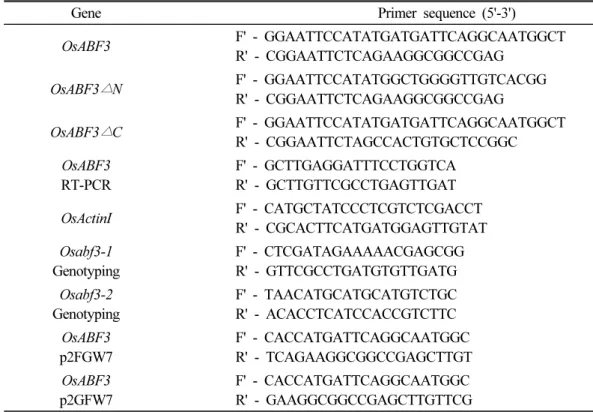
야생형 벼(Oryza sativa L. cv. Dongjin)에서 OsABF3 full length cDNA, OsABF3△N, OsABF3△C를 클로닝하기 위해 각 각의 primer를 제작한 후(Table 1), Ex Taq (Takara)을 이용하
여 PCR하여 각각 증폭시킨 뒤 전기영동으로 확인하였다. PCR 증폭 산물인 각각의 DNA 조각을 MEGAquick-spin PCR &
Agarose Gel DNA Extraction Kit (iNtTON)을 이용하여 elution 한 뒤 NdeI, EcoRI restriction enzyme (NEB)를 이용하 여 PCR product 양 끝과 pGADT7, pGBKT7 벡터를 절단한 뒤 각각의 벡터에 클로닝 하였다.
RT-PCR 수행
각각의 샘플 식물에 스트레스를 처리한 후 시간대 별로 채취 한 벼 조직 0.06 g을 액체 질소에 얼린 후 조직분쇄기인 MM301 Glinder와 bead를 2 ㎖ e-tube 넣고 20회, 초/1분간 rpm 속도로 흔들어 조직을 파쇄 한 뒤 e-tube 반대 방향으로 뒤집어 한 번 더 조직을 파쇄 하였다. 파쇄 한 조직을 RNeasy Plant Mini Kit (QIAGEN)로 분리한 뒤 RNA 4 ㎍을 DiaStar 2X RT Pre-Mix (SolGent co., Ltd.)를 이용하여 cDNA를 합성하였고, OsABF3 RT-PCR Primer (Table 1)와 FR-Taq polymerase (Biomedic) 로 PCR (95℃ 5분 – 1 cycle/ 95℃ 1분, 55℃ 1분, 72℃ 1분 – 30 cycle/ 72℃ 10분 – 1 cycle) 한 뒤 2% agarose gel로 전기영동으 로 확인하였다(Fig. 1).
Table 1. Primer sequences used in the PCR
Gene Primer sequence (5'-3')
OsABF3 F' - GGAATTCCATATGATGATTCAGGCAATGGCT R' - CGGAATTCTCAGAAGGCGGCCGAG
OsABF3△N F' - GGAATTCCATATGGCTGGGGTTGTCACGG R' - CGGAATTCTCAGAAGGCGGCCGAG
OsABF3△C F' - GGAATTCCATATGATGATTCAGGCAATGGCT R' - CGGAATTCTAGCCACTGTGCTCCGGC OsABF3
RT-PCR
F' - GCTTGAGGATTTCCTGGTCA R' - GCTTGTTCGCCTGAGTTGAT OsActinI F' - CATGCTATCCCTCGTCTCGACCT
R' - CGCACTTCATGATGGAGTTGTAT Osabf3-1
Genotyping
F' - CTCGATAGAAAAACGAGCGG R' - GTTCGCCTGATGTGTTGATG Osabf3-2
Genotyping
F' - TAACATGCATGCATGTCTGC R' - ACACCTCATCCACCGTCTTC OsABF3
p2FGW7
F' - CACCATGATTCAGGCAATGGC R' - TCAGAAGGCGGCCGAGCTTGT OsABF3
p2GFW7
F' - CACCATGATTCAGGCAATGGC R' - GAAGGCGGCCGAGCTTGTTCG
Fig. 1. Expression analysis of the OsABF3 gene in various rice tissues under normal conditions and in leaves under different stress conditions.
(A) Expression pattern of OsABF3 gene under various tissues of rice. (B-F) Expression pattern of the OsABF3 gene under conditions of drought (10% PEG), salinity (250 mM NaCl), oxidative stress (10 ㎛ MV), cold (4℃), and ABA (100 ㎛) treatment of rice seedlings at 0, 3, 6, 12, 24 and 48h after stress onset. The rice actin1 gene was used as an internal control. Similar results were obtained from three repeat experiments.
GFP fusion 단백질의 세포내 발현
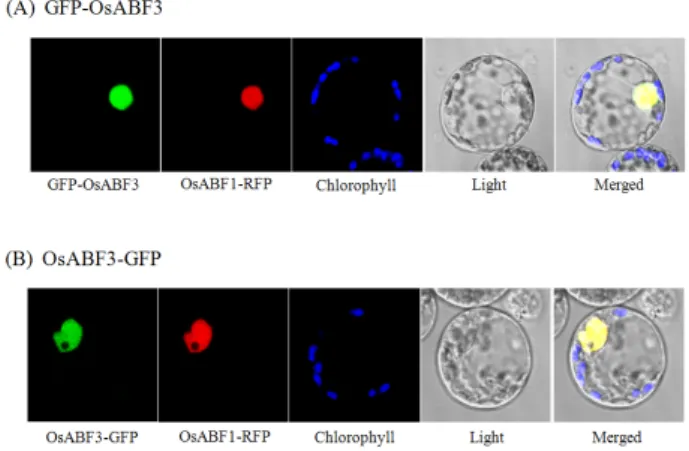
cDNA를 주형으로 OsABF3 p2FGW7 (N- terminal) primer, OsABF3 p2GWF7 (C- terminal) primer, TaKaRa Ex Taq (Takara)을 이용하여 PCR 한 OsABF3 full-length cDNA를 pENTR/D-TOPO vector (Invitrogen)에 삽입한 뒤 LR clonase (Invitrogen)을 이용하여 destination 벡터인 p2FGW7 (N-terminal), p2GWF7 (C- terminal)에 클로닝 하였다. CaMV35S promoter 가 포함된 벡터에 각각 클로닝 된 GFP-OsABF3, OsABF3-GFP fusion clone을 PEG-calcium mediated method를 이용하여 옥 수수 mesophyll 원형질체에 형질전환한 후 12-24시간 동안 incubation하여 발현을 관찰하였다. 이 때 chlorophyll auto- fluorescence를 chloroplast marker로 OsABF1-RFP를 nuclear marker로 사용하였고, fusion protein의 발현은 confocal microscope (LSM 510 META, Carl Zeiss, Jena, Germany)를 이용하여 관찰하였다.
Yeast one hybrid 실험
OsABF3와 ABA responsive elements (ABREs)가 상호작용 하는지 알아보기 위해 yeast one hybrid 실험을 하였다. Yeast strain은 lacZ reporter system을 가진 pYC-Int 벡터의 Sma I cloning site에 Em1a element (GGACACGTGGCG) primer를 삽 입하여 제작한 pYC-Int/ABRE, pYC-Int YIP yeast cell을 이용 하였다. pGADT7 벡터에 각각 클로닝 된 OsABF3 full-length cDNA, OsABF3△N, OsABF3△C (Fig. 3A)를 small-scale LiAc 방법을 이용하여 pYC-Int, pYC-Int/ABRE에 형질전환 하 여 SD Ura-, Trp- 배지에서 배양하였다. 그 후 SD Ura-, Trp- 배지에 계대하였고, O-nitrophenyl-β-D-galactopyranoside (ONPG)를 기질로 이용하여 β-galactosidase activity를 측정 하였다.
효모에 형질전환 후 활성 확인
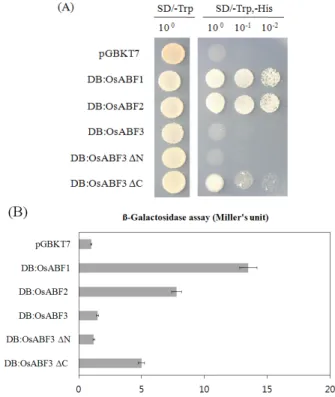
OsABF3의 transactivation 능력을 측정하기 위해 yeast one-hybrid 실험을 이용하였다. pGBKT7 벡터에 각각 클로닝 된 OsABF3 full-length cDNA, OsABF3△N, OsABF3△C 플라 스미드(Fig. 3B)를 small-scale LiAc 방법을 이용하여 AH109 strain에 형질전환하여 SD Trp- 배지에 배양하였다. 그 후 AH109 strain의 reporter 유전자 중 하나인 Histidine이 빠진 SD Trp-, His- (+3AT) 배지에 농도별로 배양하여 colony 생성여부 를 관찰하였고, SD Trp-, His- (+3AT) 배지에 계대한 후 ONPG 를 기질로 이용하여 β-galactosidase activity를 측정하였다.
결과 및 고찰
비 생물학적 스트레스 조건에서 OsABF3의 발현
줄기와 잎 그리고 비 생물학적 스트레스 조건에서 OsABF3의 발현 패턴을 분석하기 위해 정상 조건과 비 생물학적 스트레스 (가뭄, 염분, 저온, ABA, 산화) 조건에서 키운 잎을 각각 시간대 별로 RT-PCR을 수행 하였다. 결과적으로 가뭄(Fig. 1B), 산화 (Fig. 1D), 저온(Fig. 1E) 스트레스를 처리 후 3시간 때부터 OsABF3의 전사량이 증가하였으며, 저온 스트레스는 증가된 상 태가 계속적으로 유지되는 반면 가뭄과 산화 스트레스는 각각 6시간, 12시간 때부터 급격하게 감소하는 것을 관찰할 수 있었 다. 또한 염분(Fig. 1C), ABA (Fig. 1F)를 처리 했을 때에는 6시 간 때부터 전사량이 증가된 것을 관찰할 수 있었으며, 염분 스트 레스에서는 계속적으로 증가된 상태가 유지되었지만 ABA 스트 레스를 처리 했을 때에는 24시간 때부터 전사량이 약하게 감소 되는 것을 알 수 있었다. 이러한 결과들로 보아 OsABF3의 전사 는 다양한 비 생물학적 스트레스에 의해 증가됨을 알 수 있었다.
OsABF3의 세포내 위치 확인
CaMV35S 프로모터에 의해 제어되는 GFP-OsABF3와 OsABF3- GFP fusion 단백질을 옥수수 mesophyll 원형질체에 삽입시킨 뒤 형광 현미경으로 발현을 관찰하여 OsABF3의 세포내 위치를 확인하였다. OsABF1-RFP를 핵 표지자로 사용하였으며, GFP-
Fig. 2. Subcellular localization of GFP-OsABF3 and OsABF3- GFP fusion proteins in transfected mesophyll protoplasts of maize. (A) GFP-OsABF3; (B) OsABF3-GFP Chlorophyll autofluorescence and OsABF1-GFP were used as chloroplast and nuclear markers, respectively. A false color (blue) was used to monitor chlorophyll autofluorescence to distinguish it from GFP (green) and RFP (red) fluorescence.
OsABF3와 OsABF3-GFP fusion protein 모두 옥수수(mazie) 원형질체의 핵에서 발현됨을 알 수 있었다(Fig. 2). 따라서 OsABF3는 핵 단백질임이 증명되었다.
OsABF3의 ABRE-mediated DNA-binding 확인
클로닝 된 플라스미드들과 양성 대조군들을 yeast strain YIP에 삽입하여 SD Ura-, Leu- 배지에 배양하였고, ONPG 기 질을 이용하여 β-galactosidase activity를 측정하였다(Fig.
3). 그 결과 OsABF3△C에 비해 OsABF3△N이 높게 측정되었 다. Cis-acting element가 포함된 ABREs와 OsABF3가 결합하 는데 OsABF3 C-terminal 부분이 필수적이라는 것을 확인하 였다.
형질전환 후 OsABF3의 활성 측정
클로닝 된 플라스미드와 양성대조군인 BD: OsABF1, BD:
OsABF2와 음성대조군인 pGBKT7 벡터를 yeast strain AH109 에 형질 전환하여 SD Trp-, His- 배지에서 농도별로 키워 콜로 니 생성여부를 관찰하였고(Fig. 4A), ONPG 기질을 이용하여 β- galactosidase activity를 측정하였다(Fig. 4B). 그 결과 BD:
OsABF3△C에서는 전사촉진 능력이 관찰되었지만, BD:OsABF3 와 BD:OsABF3△N에서는 관찰되지 않았다. 이것은 OsABF3의 N-terminal 부분도 transactivation 하는데 꼭 필요한 부분이 라는 것을 알 수 있었으며, OsABF3 N-terminal 부분은 하위 유
전자의 전사를 조절하는 transcriptional activator라는 것을 알 수 있었다. 더 나아가 OsABF3 전체 cDNA에서 transactivation 이 억제된 것으로 보아 OsABF3의 C-terminal 부분에 trans- activation을 저해하는 부분이 존재할 것이라는 추측하였다.
적 요
ABA는 식물에서 비 생물학적 스트레스 내성에 관여하는 중 요한 식물 호르몬이다. 애기장대의 group A bZIP 전사인자는 ABA 신호전달 과정에 중요한 역할을 한다고 알려져 있다. 그러 나 벼에서는 group A bZIP 전사인자의 기능이 잘 알려져 있지 않다. 따라서 우리는 벼에서 group A bZIP 전사인자인 OsABF3 (Oryza sativa ABA responsive element binding factor 3)를 연 구하였다. 이를 위해 벼의 다양한 조직과 다양한 스트레스(가 뭄, 염분, 저온, ABA, 산화 스트레스)에 따른 OsABF3 발현 패턴 을 분석하였다. 또한 maize의 원형질체에서 GFP fusion 벡터를 사용한 세포 내 위치 분석을 통해 OsABF3가 핵단백질이라는 것 을 확인하였다. Yeast one-hybrid 실험을 통해 OsABF3의 C- terminal 부분이 ABREs에 결합한다는 것과 N-terminal 부분 이 하위 유전자의 transactivation 하는데 필요하다는 것을 알 Fig. 3. ABRE-mediated DNA-binding assays of the OsABF3
ptotein using Y1H assay.
Fig. 4. Transactivation activity assays of the OsABF3 protein using Y1H assay.
수 있었다. 그리고 T-DNA가 삽입된 OsABF3의 homozygous 돌연변이체가 야생형과 과발현체에 비해 발아와 발아 후 단계 에서 고농도의 ABA에 대한 민감도가 더 감소한 것을 알 수 있 었다. 결과적으로 종합해 볼 때 OsABF3는 ABA의 의존적인 경로를 통해 비 생물학적 스트레스에 반응하는 유전자의 발현 을 조절하는 기능을 하는 전사 조절자이다. 또한 OsABF3의 transactivation을 측정하는 실험에 있어서 억제 domain이 존 재한다는 결과를 얻었다.
References