- 1256 -
Dielectric barrier discharge 플라즈마 펄스 레이져 증착법을 통해 성장한 nitrogen 도핑 된 산화아연 박막의 광학적 특성
이득희*, 김상식**, 이상렬*
한국과학기술연구원*, 고려대**
Optical properties of nitrogen doped ZnO thin films grown by dielectric barrier discharge plasma-assisted pulsed laser deposition
Deuk-Hee Lee*, Sangsig Kim**, Sang Yeol Lee*
Korea Institute of Science and Technology (KIST)*, Korea University**
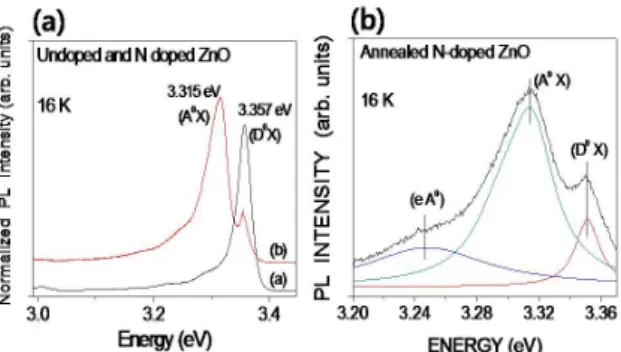
Abstract - We have grown, for the first time to our knowledge, N-doped ZnO thin films on sapphire substrate by employing novel dielectric barrier discharge in pulsed laser deposition (DBD-PLD). DBD guarantees an effective way for massive in-situ generation of N-plasma under the conventional PLD process condition. Low-temperature photoluminescence spectra of the N-doped ZnO film provided near band-edge emission after thermal annealing process. The emission peak was resolved by Gaussian fitting to find a dominant acceptor-bound exciton peak (A
0X) that indicates the successful p-type doping of ZnO with N.
1. 서 론
ZnO has gained considerable attention as a promising material for short-wavelength optoelectronic devices, such as photodetectors, light emitting diodes, and laser diodes, due to its wide band gap of 3.37 eV and large exciton binding energy of 60 meV at room temperature.
1 Normally, undoped ZnO exhibits n-type conductivity. The realization of p-type ZnO that is considered as a key issue for more advanced application of the material has been proven difficult due to the self-compensating effect of native defects and interstitial ions.
2
Fortunately, thanks to the considerable worldwide efforts, investigations on p-type ZnO have proceeded at a rapid pace and various elements have been demonstrated as p-type dopants, including group-V and group-I elements. Among them, N appears promising candidate considering its size and energy level. However, the resultant p-type ZnO:N films are usually unstable. Recently, in order to overcome the difficulties, a theory for large-sized-mismatched group-V dopants based on first-principles calculations has been presented.
3 Also, several groups have reported p-type conductivity in ZnO by doping with large-sized-mismatched impurities, such as P, As, Ag, and Sb. Generally, the substitution of the lattice oxygen with nitrogen in ZnO has been recognized as a potential mechanism for p-type doping of ZnO, however, according to Zunger’s “practical doping rules,”
4 the p-type doping under equilibrium conditions is difficult to be achieved be cause the spontaneous compensation of the defects that yield the excessive electrons overwhelms doping pathways when the pinning energy is reached. Similar work done by Marfaing and Lusson shows that p-type doping of ZnO by the substituting nitrogen is limited by the trade-off between zinc enrichment (i.e. higher solubility) and oxygen enrichment (i.e. lower compensation of the acceptors). Even though many studies have tried to prepare the N-doped p-type ZnO, therefore, rectifying junctions, and even ZnO homojunction LEDs, they do not guarantee the reliability, stability along with efficiency of the p-type doped ZnO.
In this work, N-doped ZnO film has been grown on sapphire substrates by novel dielectric barrier discharge method in pulsed laser deposition (DBD-PLD). Importantly, it has a critical meaning in the diversification of the tools to realize the reliable and effective p-type doping of ZnO. The structural and optical properties of the N-doped p-type ZnO thin films are discussed with the results of x-ray diffraction
(XRD), x-ray photoelectron spectroscopy (XPS), and photoluminescence (PL) to verify the successful p-type doping.
2. 본 론 2.1 실험방법
N-doped ZnO thin film was prepared by the combined method of DBD and PLD by which the N-doping source was generated with the identical process condition for normal PLD process. During growth, the pressure of background gas was maintained at 350 mTorr. The c-axis sapphire substrate was used for the film synthesis. For the laser ablation in PLD, Nd:YAG laser with the laser frequency of 5 Hz, and the laser energy density of 1 J/cm
2 was used. The thickness of the resultant thin films was measured to be about 300 nm.
Thermal annealing was carried out at 800 °C for 15 min under oxygen ambient. The structural property of the samples was investigated by using XRD where a Ni-filtered Cu Kα source was used, and the binding structural properties were analyzed with XPS. The optical properties were characterized by PL with a He-Cd laser as a light source of the excitation wavelength of 325 nm and the power of 20mW.
2.2 결과 및 검토
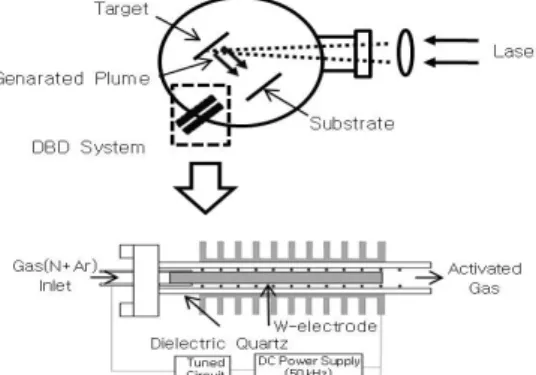
Figure 1 shows the schematic diagram of DBD equipment that is designed for the generation and the supply of active nitrogen source. Quartz tube which has a relatively high dielectric constant ( ε
r=3.9) has been used as a dielectric barrier material in the discharge zone. A discharge electrode, tungsten (W) or molybdenum (Mo) was used as a power electrode at the center of quartz tube and aluminum radiator was used for the ground at outer quartz. To generate micro-discharge between power electrode (W or Mo) and inner wall of quartz tube, alternate current (AC) was applied between W-rod and Al-electrode. For the purpose of effective cooling originating in micro-discharge, aluminum that has a round shape with a large number of fins was added. Cooling water and cooling fan were also set up at the region of aluminum radiator. W electrode was pressed into stainless tube, which was extended to quartz tube using ultra-Torr joint to insulate another unit. AC power was supplied at the
Fig. 1. Schematic of combined DBD-PLD system and DBD system.
2009년도 대한전기학회 하계학술대회 논문집 2009. 7. 14 - 17