* To whom correspondence should be addressed.
E-mail: [email protected] doi:10.7464/ksct.2012.18.4.366 청정소재제품기술
Synthesis and Optical Properties of Acrylic Copolymers Containing AlQ
3Pendant Group for Organic Light Emitting Diodes
Eun-Young Kim
†, Sung-Hyun Myung, Young-Hee Lee, and Han-Do Kim*
Department of Organic Material Science and Engineering, Pusan National University San 30 Jangjeon-dong, Geumjeong-gu, Busan 609-735, Korea
†
Institute of Industrial Science and Technology, Pukyong National University 45 Yongso-ro, Nam-gu, Busan 608-737, Korea
(Received for review September 6, 2012; Revision received October 22, 2012; Accepted October 26, 2012)
요 약
펜던트기가 tris(8-hydroxyquinoline) aluminum (AlQ
3)으로 된 아크릴 단량체(HEMA-p-AlQ
3) (HEMA = 2-hydroxyethyl metha- crylate)를 각각 메틸메타크릴레이트(MMA), 아크릴로니트릴(AN), 순수 HEMA와 공중합하여 3가지 아크릴 공중합체 [MMA-co-HEMA-p-AlQ
3(공중합체 1), AN-co-HEMA-p-AlQ
3(공중합체 2), HEMA-co-HEMA-p-AlQ
3(공중합체 3)]를 라디 칼 공중합법으로 합성하였다. 25 wt%의 HEMA-p-AlQ
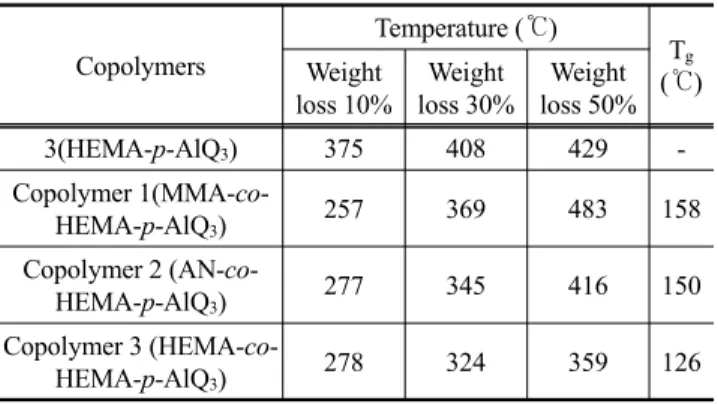
3를 함유한 공중합체 1,2,3의 유리전이온도(T
g)는 각각 158, 150, 126
℃로 나타났으며, 이는 유기발광다이오드(organic light emitting diodes, OLED)로써 지녀야 하는 우수한 열 안정성을 만족하 였다. 그리고 이들 공중합체는 테트라하이드로퓨린, 디메틸포름아미드, 톨루엔 및 클로로포름 등과 같은 용매에 잘 용해되 었으며, 자외선-가시광선의 흡수 및 발광 거동이 순수 AlQ
3와 거의 동일함을 알 수 있었다. 또한 이들 공중합체를 스핀 코팅 하여 녹색의 OLED 디바이스를 제조한 후 전류 밀도-전압 곡선을 비교하였다. 공중합체 3을 사용한 OLED 디바이스의 on-set 전압은 약 2 볼트로써 다른 두 공중합체 OLED 디바이스의 전압(공중합체 1: 약 3 볼트, 공중합체 2: 약 4 볼트) 보다 낮 음을 알 수 있었다.
주제어 : AlQ
3, 유기발광다이오드, 아크릴레이트, 공중합체
Abstract : Three acrylic copolymers containing tris(8-hydroxyquinoline) aluminum (AlQ
3) pendant group (25 wt%), acrylate- co-HEMA-AlQ
3(25 wt%), were successfully synthesized by free radical polymerization from acrylates [methyl methacrylate (MMA), acrylonitrile (AN) or 2-hydroxyethyl methacrylate (HEMA)] with HEMA functionalized with AlQ
3pendant groups (HEMA-p-AlQ
3). The glass transition temperatures (T
g) of MMA-co-HEMA-p-AlQ
3(copolymer 1), AN-co-HEMA-p-AlQ
3(copolymer 2) and HEMA-co-HEMA-p-AlQ
3(copolymer 3) were found to be 158, 150 and 126 ℃, respectively. They have good thermal stability: a very desirable feature for the stability of OLEDs. Their solubility, thermal properties, UV-visible absorption and photoluminescence behaviors were investigated. They were found to be soluble in various organic solvents such as tetra- hydrofuran (THF), dimethylformamide (DMF), toluene and chloroform. It was also found that the UV-visible absorption and photoluminescence behaviors of these copolymers were similar to those of pristine AlQ
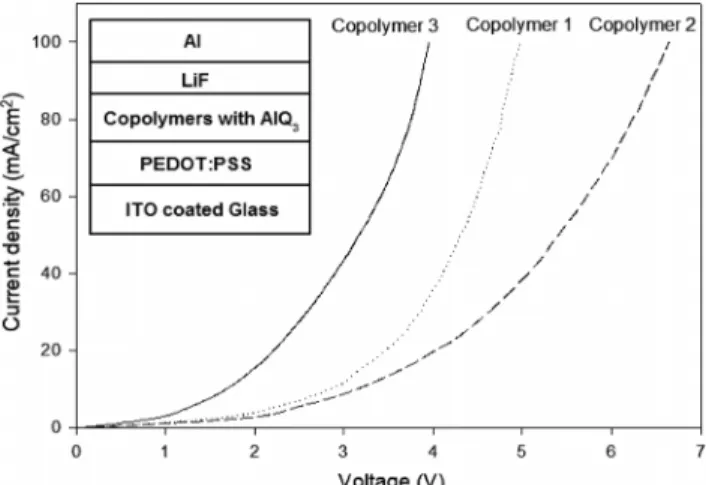
3. Green organic light-emitting diodes (OLEDs) have also been fabricated using these copolymers as light emission/electron transport components obtained easily by spin coating, and their current density voltage (J-V) curves were compared. The OLED device of the copolymer 3 had the lowest turn-on voltage of about 2 V compared to other copolymer types devices.
Keywords : AlQ
3, Organic light emitting diode, Acrylate, Copolymer
1. Introduction
The field of organic electronics has generated intense research efforts, spurred on by the promise of a viable alternative to the inorganic materials platform, especially for large-area, flexible electronics applications. Significant progress has been demon- strated towards the realization of efficient organic light emitting diodes (OLEDs) for flat-panel displays and lighting[1], thin-film
field-effect transistors (TFTs)[2], photodetectors for large-area detector arrays[3], and organic photovoltaic cells for low-cost solar energy generation[3,4]. In all of these organic device em- bodiments, optimization of charge injection/extraction and carrier transport is critically important towards their technological success. Efficient injection or extraction requires low energetic barriers while competent transport demands highly conductive transport layers.
Tris(8-hydroxyquinoline) aluminum (AlQ
3), a complex first
used in 1987 by Tang and Van Slyke for efficient organic light
emitting diodes (OLEDs) that required low driving voltages[5],
366
has since become one of the most powerful emitting materials for OLED devices. There has been abundant progress in its op- tical properties, such as color tuning[6-8], enhancement of elec- troluminescence (EL) and photoluminescence (PL) efficiency[9], and white light emission[10,11]. However, the majority of re- search in this area so far focused on field emission and electro- luminescence of bulks of nanorods or nanowires for vacuum and OLED devices[12-15], and most of the AlQ
3nanostructures used were synthesized by traditional vapor deposition based methods[12-14].
AlQ
3is one of the most widely used electron-transporting, host emitting materials in OLEDs due to their thermal stability, easiness in synthesizing and purification, high fluorescence and good electron-transporting mobility. One disadvantage in the application of AlQ
3is its limited processability, since it must be deposited via thermal evaporation, during which isomerization or oligomerization occur upon high-temperature sublimation[16].
Another disadvantage comes from the crystallization of AlQ
3, which takes place under working conditions and may result in device failures. Therefore, materials with AlQ
3are needed that combine the processing properties of polymers and the fluo- rescent properties of AlQ
3. A convenient low cost manufacturing method is solution processing, such as spin coating and possibly inkjet printing in the OLED industry[17], with a mix of AlQ
3and conducting polymer; however, phase separation occurred in their system and led to poor optical properties[18]. Also they found that the low solubility of AlQ
3in most polymers makes it difficult to cast a homogeneous and transparent thin film.
Several efficient methods to synthesize AlQ
3containing poly- mers have been reported. Lu et al.[19] prepared a polymer fully functionalized with AlQ
3in a post-polymerization step, and Meyers et al.[20] synthetic method was based on a fully func- tionalized monomer, which eliminated the cross-linking. How- ever, the solubility of these polymers was not good. Also, Du et al.[21] synthesized a series of 8-hydroxyquinoline metal chelate containing polymers through the copolymerization of metalo- quinolate-pendant monomers with methyl methacrylate (MMA) by the Meyers modified method.
In this regard, the following point was desirable and signifi- cant for our study: i) synthesis of the copolymers with 2-hydro- xyethyl methacrylate (HEMA) functionalized with AlQ
3pendant groups (AlQ
3-HEMA) to increase solubility and, ii) development of a route for the facile fabrication of OLED using the resulting copolymers bearing AlQ
3-HEMA (25 wt%). In this study, a series of polymers were synthesized using the radical copoly- merization of various unsaturated monomers [MMA, acryloni- trile (AN), and HEMA] with AlQ
3-HEMA. The structures of the monomers and copolymers were characterized by proton nuclear magnetic resonance spectroscopy (
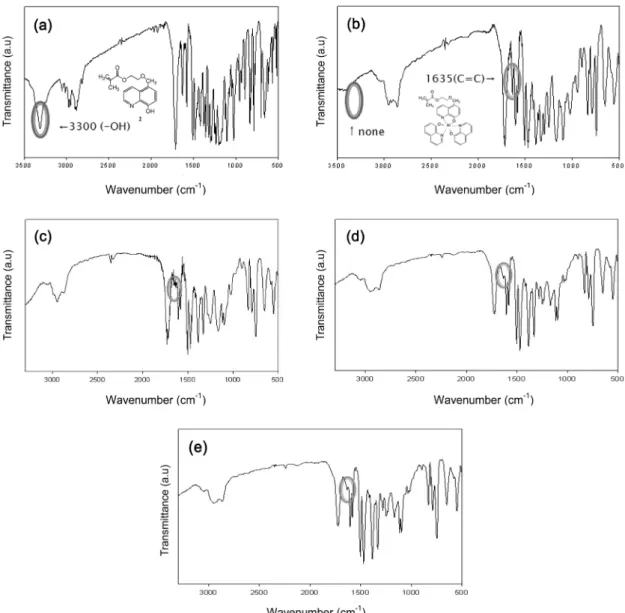
1H-NMR), Fourier
transform infrared spectroscopy (FT-IR) and thermal analysis was performed on differential scanning calorimeter (DSC), ther- mogravimetric analysis (TGA). The optical properties of copoly- mers were measured by UV-visible and PL spectrophotometer.
Copolymer films were prepared by spin-coating of the copolymer solutions on quartz substrate.
2. Experimental 2.1. Materials
8-Hydroxyquinoline, HEMA, MMA and AN were purchased from Sigma Aldrich and were distilled before use. Hydroquinone and azobisisobutyronitrile (AIBN) were purified by recrystalli- zation. Other solvents were purchased from Junsei Chemical and purified before use. Column chromatography was performed on silica gel (Merck silica gel 60, mesh size 0.2-0.5 µm).
2.2. Synthetic methods
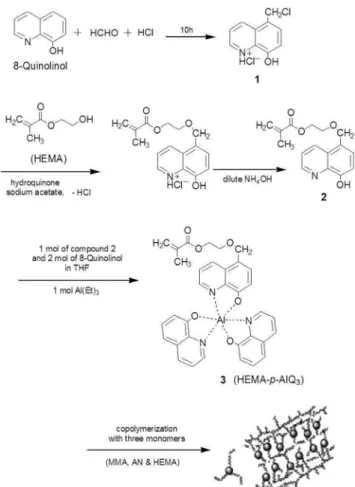
2.2.1. Synthesis of compound (1) and (2) in Scheme 1 5-Chloromethyl-8-quinolinol hydrochloride (1) was synthesi- zed according to the literature procedure[22]. A 0.04 mol of 8-quinolinol was added into a solution of 50 mL of hydrochloric acid and 0.08 mol of 37% formaldehyde in a 250 mL three necked flask. The reaction mixture was treated with hydrogen chloride gas for 90 min and stirred for 10 h. The yellowish pre- cipitates were obtained on a filtering and washed with acetone several times and dried under vacuum at 40 ℃ for 12 h.
5-(2-Methacryloethyloxymethyl)-8-quinolinol (2) was synthe- sized according to the literature procedure[21]. The mixture of 0.0434 mol of sodium acetate, 0.04 g of hydroquinone and 40 g of HEMA was added to a 100 mL three necked flask with a magnetic stirrer and refluxed at 50 ℃ for 1.5 h. And then 0.0434 mol of compound (1) was added to the mixture and heated at 80 ℃ for 5 h. After cooling, the mixture was poured into a large amount of cooled water and neutralized with dilute ammonia. It washed with a large amount of water and collected by filtration and dried at room temperature in desiccator. The white solid product was obtained by four re-crystallizations from petroleum ether.
2.2.2. Synthesis of AlQ
3pendent monomer (3)
To a 150 mL three necked flask equipped with a nitrogen
inlet and a magnetic stirrer, triethylaluminum (1 M solution in
hexane; 10 mL, 0.01 mol) was added via syringe, and then
subsequently adding 8-hydroxyquinoline (0.02 mol) in anhydrous
THF. After 2 days of stirring, compound (2) (0.001 mol) in
anhydrous THF was added. And then additional 8-hydroxy-
quinoline 0.019 mol in anhydrous THF was added; the mixture
was stirred for 24 h. The mixture was filtered and removed
the insoluble AlQ
3and purified by column chromatography (silica gel, 1 : 1 toluene/CHCl
3); it was then concentrated under reduced pressure. The product was precipitated from petroleum ether and dried under vacuum at 40 ℃.
2.2.3. Synthesis of copolymers (1, 2 and 3)
Copolymers 1, 2 and 3 were synthesized by radical polymeri- zation from AlQ
3pendant monomer (3), three monomers (MMA, HEMA and AN), initiator (AIBN, 0.1 wt%) and solvent (hexane/
THF: 1/1) at 80 ℃ for 4 h. The reaction mixture was allowed to cool down to 60 ℃ for few h, and then to reflux at 100
℃ for 1 h. The final reaction mixture was precipitated with methanol, washed several times and filtered the copolymer 1, 2 and 3 were obtained after drying in vacuum at 50 ℃.
2.2.4. Fabrication of OLED device
Organic light-emitting diodes were fabricated by using succe- ssive spinning coating method of PEDOT/PSS (50 nm) and polymer containing AlQ
3(100-200 nm), and then doping Al electrodes with LiF (0.5 nm) on top of ITO glass substrates.
Prior to the deposition of organic layers, the ITO substrate was cleaned with UV ozone cleaner. The deposition of materials was performed under vacuum for 1 h. After doping Al electrode with LiF, the OLED materials was hardened for 10 min, and then annealed at 100 ℃ for 20 min. In this study, OLED device was composed of the hole injection & transfer layer, an emi- ssive layer, the electron injection & transfer layer, and anode and cathode terminal: Anode (indium tin oxide, ITO)/poly3,4- ethylenedioxythiophene-poly (styrenesulfanate), PEDOT-PSS/
copolymer/lithium fluoride/cathode (Al).
2.3. Characterization 2.3.1. Structural analysis
1