Metformin Inhibits Hepatic Gluconeogenesis Through AMP-Activated Protein Kinase–Dependent Regulation of the Orphan Nuclear Receptor SHP
Yong Deuk Kim,1Keun-Gyu Park,2Yong-Soo Lee,1Yun-Yong Park,1Don-Kyu Kim,1
Balachandar Nedumaran,1Won Gu Jang,3Won-Jea Cho,4Joohun Ha,5In-Kyu Lee,3Chul-Ho Lee,6and Hueng-Sik Choi1
OBJECTIVE—Metformin is an antidiabetic drug commonly used to treat type 2 diabetes. The aim of the study was to determine whether metformin regulates hepatic gluconeogenesis through the orphan nuclear receptor small heterodimer partner (SHP; NR0B2).
RESEARCH DESIGN AND METHODS—We assessed the reg- ulation of hepatic SHP gene expression by Northern blot analysis with metformin and adenovirus containing a constitutive active form of AMP-activated protein kinase (AMPK) (Ad-AMPK) and evaluated SHP, PEPCK, and G6Pase promoter activities via transient transfection assays in hepatocytes. Knockdown of SHP using siRNA SHP was conducted to characterize the metformin- induced inhibition of hepatic gluconeogenic gene expression in hepatocytes, and metformin– and adenovirus SHP (Ad-SHP)–
mediated hepatic glucose production was measured in B6- Lepob/obmice.
RESULTS—Hepatic SHP gene expression was induced by met- formin, 5-aminoimidazole-4-carboxamide-1--D-ribofuranoside (AICAR), and Ad-AMPK. Metformin-induced SHP gene expres- sion was abolished by adenovirus containing the dominant negative form of AMPK (Ad-DN-AMPK), as well as by compound C. Metformin inhibited hepatocyte nuclear factor-4␣– or FoxA2- mediated promoter activity of PEPCK and G6Pase, and the inhibition was blocked with siRNA SHP. Additionally, SHP knockdown by adenovirus containing siRNA SHP inhibited met-
formin-mediated repression of cAMP/dexamethasone-induced hepatic gluconeogenic gene expression. Furthermore, oral ad- ministration of metformin increased SHP mRNA levels in B6- Lepob/ob mice. Overexpression of SHP by Ad-SHP decreased blood glucose levels and hepatic gluconeogenic gene expression in B6-Lepob/obmice.
CONCLUSIONS—We have concluded that metformin inhibits hepatic gluconeogenesis through AMPK-dependent regulation of SHP. Diabetes 57:306–314, 2008
M
etformin (1,1-dimethylbiguanide hydrochlo- ride) is a hypoglycemic agent used exten- sively for the treatment of type 2 diabetes (1–2). Metformin is a biguanide agent, as are buformin and phenformin. The principal function of met- formin is to reduce hepatic glucose production and to improve peripheral insulin sensitivity, thus ameliorating hyperglycemia (3– 4). Metformin has also been shown to enhance glucose uptake in the muscles (5), while reducing levels of plasma triglycerides (6) and nonesterified fatty acids (7). Metformin has been shown to activate AMP- activated protein kinase (AMPK) via an LKB1-dependent mechanism (1–2,8).AMPK is a well-known serine/threonine kinase that functions as an intracellular energy sensor and has been implicated in the modulation of glucose and fatty acid metabolism (8 –9). AMPK is activated by physiological stimuli including exercise, muscle contraction, and hor- mones such as adiponectin and leptin, as well as by physiological stresses, glucose deprivation, hypoxia, oxi- dative stress, and osmotic shock conditions (10 –11). Once activated, AMPK inhibits gluconeogenesis and lipogenesis while promoting both fatty acid oxidation and lipolysis.
Activation of AMPK by the AMPK activators 5-amino- imidazole-4-carboxamide-1--D-ribofuranoside (AICAR) and metformin has been shown to inhibit the expression of two key hepatic gluconeogenic genes, PEPCK and G6Pase, which, in turn, suppresses gluconeogenesis (12–13). How- ever, the molecular mechanism underlying the AMPK- mediated transcriptional regulation of PEPCK and G6Pase has not been fully elucidated.
The small heterodimer partner (SHP; NR0B2) is an atypical orphan nuclear receptor that lacks a conventional DNA-binding domain and consists only of a putative ligand-binding domain (14). SHP represses the transcrip- tional activity of a number of nuclear receptors (15–22), as well as hepatocyte nuclear factor (HNF)-4␣ (NR2A1), FoxO1 (also known as FKHR) (23), and the forkhead transcription factor FoxA2 (also referred to as HNF-3)
From the 1Hormone Research Center, School of Biological Sciences and Technology, Chonnam National University, Gwangju, Republic of Korea; the
2Department of Internal Medicine, Keimyung University School of Medicine, Daegu, Republic of Korea; the3Department of Internal Medicine, Kyungpook National University School of Medicine, Daegu, Republic of Korea; the
4College of Pharmacy and Research Institute of Drug Development, Chonnam National University, Gwangju, Korea; the5Department of Biochemistry and Molecular Biology, Medical Research Center for Bioreation to Reactive Oxygen Species, Kyung Hee University College of Medicine, Seoul, Republic of Korea; and the6Korea Research Institute of Bioscience and Biotechnology, Daejeon, Republic of Korea.
Address correspondence and reprint requests to Hueng-Sik Choi, PhD, Hormone Research Center, School of Biological Sciences & Technology, Chonnam National University, Gwangju, 500-757, Republic of Korea. E-mail:
Received for publication 20 March 2007 and accepted in revised form 26 September 2007.
Published ahead of print at http://diabetes.diabetesjournals.org on 1 Octo- ber 2007. DOI: 10.2337/db07-0381.
Additional information for this article can be found in an online appendix at http://dx.doi.org/10.2337/db07-0381.
ACC, acetyl-CoA carboxylase; Ad-AMPK, adenovirus AMPK; Ad-DN-AMPK, adenovirus dominant negative form of AMPK; Ad-SHP, adenovirus SHP;
AICAR, 5-aminoimidazole-4-carboxamide-1--D-ribofuranoside; AMPK, AMP- activated protein kinase; CA-AMPK, constitutively active AMPK; DMEM, Dulbecco’s modified Eagle’s medium; DN-AMPK, dominant negative mutant AMPK; GAPDH, glyceraldehyde-3-phosphate-dehydrogenase; HNF, hepato- cyte nuclear factor; LRH-1, liver receptor homolog-1; SF-1, steroidogenic factor-1; SHP, small heterodimer partner.
© 2008 by the American Diabetes Association.
The costs of publication of this article were defrayed in part by the payment of page charges. This article must therefore be hereby marked “advertisement” in accordance with 18 U.S.C. Section 1734 solely to indicate this fact.
(24), which are the primary transcription factors that regulate PEPCK and/or G6Pase expression. Recent evi- dence suggests that SHP may perform a function in glucose homeostasis by the regulation of hepatic glucone- ogenesis. Yamagata et al. (23) showed that the expressions of hepatic gluconeogenic genes, including PEPCK, G6Pase, and fructose 1,6-bis phosphatase (FBP1), are inhibited by bile acids in a SHP-dependent manner. In our previous study, it was shown that SHP inhibits PEPCK, G6Pase, and CYP7A1 expression via the repression of FoxA2-mediated transcriptional activity (24). However, no study has examined whether SHP expression is induced by pharmacological agents, such as the AMPK activators that suppress hepatic gluconeogenic genes, or whether met- formin-induced suppression of hepatic gluconeogenic gene expression is mediated by SHP.
In this study, we investigated whether metformin in- duces hepatic SHP gene expression and whether this effect is mediated by AMPK. In addition, we have attempted to ascertain whether metformin-induced inhibition of hepatic gluconeogenesis is consequently mediated by SHP.
RESEARCH DESIGN AND METHODS
Chemicals. Metformin (1,1-dimethylbiguanide hydrochloride; Sigma, St.
Louis, MO), 8-bromoadenosine 3,5-cyclic monophosphate (Sigma), dexameth- asone (Sigma), and insulin (Norvolin R; Green Cross, Yongin, Korea) were dissolved in the manufacturer-recommended solvents.
Plasmids and DNA constructions.The siRNAs of human SHP (24) and the plasmids encoding for the dominant negative mutant AMPK (DN-AMPK) and a constitutively active form of AMPK (CA-AMPK or␣-312 AMPK) (25) have been previously described. The reporter plasmids encoding for the human G6Pase promoter (⫺1,227/⫹57) and the rat PEPCK promoter (⫺2000/⫹73) were generously provided by Dr. D. Schmoll (26) and Dr. R.W. Hanson (27), respectively. Mouse G6Pase cDNA was purchased from Korea UniGene Information (Kugi, Korea), and mouse PEPCK cDNA was provided by Dr. J.B.
Kim (Department of Biological Sciences, Seoul, Korea). Human, rat, and mouse SHP cDNAs (28) and human and mouse SHP promoters (24) were prepared as described previously. Liver receptor homolog-1 (LRH-1), steroi- dogenic factor-1 (SF-1) cDNA, and the sft4 reporter gene were prepared as described previously (17,20,28).
Preparation of recombinant adenovirus. An adenovirus encoding for full-length human SHP (24), c-Myc–tagged DN-AMPK, and CA-AMPK (25) have been previously described. To block the expression of SHP, an adenovirus- mediated siRNA for SHP was constructed. Briefly, the cDNA sequence (239GACAGTAGCCTTCCTCAGGAA259) of an siRNA specific to mouse SHP was incorporated into the pAdTrack-CMV shuttle vector. The vector construct was then electroporated into BJ5138 cells, and a recombinant vector was generated using the AdEasy adenoviral vector system. The recombinant viruses were amplified in HEK-293 cells and isolated via cesium chloride density centrifugation (Sigma). The viruses were collected and desalted, and the titers were measured using Adeno-X Rapid titer (BD Bioscience, San Jose, CA) according to the manufacturer’s instructions.
Cell culture and transient transfection assays.HepG2 (human hepatoma) and H4IIE (rat hepatoma) cells were cultured in Dulbecco’s modified Eagle’s medium (DMEM) (Gibco-BRL, Grand Island, NY) supplemented with 10% fetal bovine serum (FBS; Hyclone, Logan, UT) and antibiotics in a humidified atmosphere containing 5% CO2at 37°C. AML12 (mouse hepatocyte) cells were cultured with DMEM/F-12 medium (Gibco-BRL) supplemented with insulin- transferrin-selenium (ITS; Gibco-BRL) and dexamethasone (40 ng/ml; Sigma) and antibiotics in a humidified atmosphere containing 5% CO2 at 37°C.
Transient transfections were conducted using LipofectAmine 2000 reagent (Invitrogen, Carlsbad, CA) in accordance with the manufacturer’s instruc- tions. The total amount of DNA was adjusted to 1g/well via the addition of the appropriate amount of pcDNA3 empty vector, and 0.2g cytomegalovirus
-galactosidase plasmids were cotransfected as an internal control. After 24 h of transfection, the cells were incubated for 12 h in the presence or absence of metformin and subsequently harvested. The luciferase activity was mea- sured and then normalized to the -galactosidase activity. The data are representative of a minimum of three to five independent experiments.
Isolation and culture of primary rat hepatocytes.Rat primary hepato- cytes were isolated from the livers of 7-week-old male Sprague-Dawley rats.
The rats were anesthetized with sodium pentobarbital (50 mg/kg body wt),
and the livers of the animals were exposed surgically. The liver was first perfused with resuspension buffer (150 mmol/l NaCl, 10 mmol/l KCl, 1 mmol/l NaH2PO4䡠2H2O, 0.8 mmol/l NaH2PO4䡠12H2O, 1 mmol/l EGTA, 0.8 mmol/l NaHCO3, 10 mmol/lD-glucose, and 10 mmol/l HEPES, pH 7.2) at 30 –50 ml/min for 5–10 min and then perfused with collagenase solution (9.5 g/l Hank’s balanced salt solution, 0.8 mmol/l NaHCO3, 0.9 mmol/l CaCl2䡠2H2O, 10 mmol/l HEPES, and 0.5 g/l collagenase IA [Sigma], and 50 mg/l trypsin inhibitor, pH 7.5) at 30 –50 ml/min for 5–10 min. After perfusion, the liver was chopped finely in a Petri dish and then filtered through an 85-m pore mesh. The hepatocytes were collected by centrifugation at 800 rpm for 2–5 min at 4°C.
The viability of the hepatocytes was measured by trypan blue exclusion and was consistently in excess of 85%. All hepatocytes were seeded onto collagen type 1– coated 60-mm dishes (1⫻ 106cells/ml; IWAKI Scitech Div, Tokyo, Japan) in William E medium (Sigma). After 6 h of incubation, the medium was exchanged with DMEM without serum, and the hepatocytes were utilized for Northern blot analysis.
Northern blot analysis.HepG2, H4IIE, and AML12 cell lines, as well as rat primary hepatocytes were maintained in the indicated media. At a confluence level of⬃80%, the cells were subjected to serum starvation (medium with 0.5%
FBS). After 24 h of starvation, the cells were treated with metformin (0.5–2 mmol/l), 8-br-cAMP (500mol/l), and dexamethasone (1 mol/l) (cAMP/Dex) and were subsequently infected with adenoviral vectors expressing SHP, AMPK, or siRNA SHP for 24 h in both a time- and dose-dependent manner in both the hepatoma cells and primary hepatocytes. The cells were subse- quently harvested at the indicated times, and total RNA was isolated using TRIzol reagent (Invitrogen, Carlsbad, CA) according to the manufacturer’s instructions. Aliquots of 30g of total RNA from each of the samples were used for Northern blot analysis as described previously (29). The probe labeling of each of the cDNAs for SHP, PEPCK, G6Pase, and glyceraldehyde- 3-phosphate-dehydrogenase (GAPDH) with [␣-32P]dCTP was performed using a random-primer DNA labeling system (Amersham Biosciences, Little Chal- font, U.K.). The expression of all transcripts was normalized to GAPDH levels.
Western blot analysis.H4IIE cells were treated with metformin, AICAR, and compound C for 12 h, and the cells were then harvested and homogenized in lysis buffer containing 50 mmol/l Tris-HCl (pH 8.0), 150 mmol/l NaCl, 5 mmol/l EDTA, 0.5% Nonidet P-40, 100 mmol/l phenylmethylsufonyl fluoride, 1 mol/l dithiothreitol, 1 mg/ml leupeptin, and 1 mg/ml aprotinin. The cell lysates (40
g/lane) were separated via SDS-PAGE on 8% gel, and the proteins were transferred to Hybond-C Extra nylon membranes. The membranes were probed with a monoclonal phospho–AMPK-␣ antibody (Thr 172 [phosphory- lated at threonine 172]; Cell Signaling Technology), a polyclonal AMPK-␣ antibody (Cell Signaling Technology), and a polyclonal phospho–acetyl-CoA carboxylase (ACC) (Ser 79 [phosphorylated at serine 79]; Upstate, Charlottes- ville, VA), and then developed using an ECL Western blot detection kit (Amersham Bioscience). Each of the membranes was also probed with a
-actin antibody to verify equal protein loading in each lane.
Animals.Seven-week-old male Sprague-Dawley rats (Daehan Biolink, Chun- gbuk, Korea), each of which weighed 200 –230 g, and 8-week-old female B6-Lepob/obmice (Korea Research Institute of Bioscience and Biotechnology, Daejeon, Korea) were housed in an animal facility under the following conditions: 22⫾ 2°C, 55 ⫾ 5% humidity, and a 12-h light/dark cycle with ad libitum access to water and a standard laboratory diet. Metformin was orally administered (from 50 to 400 mg/kg body wt) to 8-week-old female B6-Lepob/ob mice in both a time- and dose-dependent manner following an overnight fasting condition (12 h) and feeding condition. The mice were infected with adenoviral vector expressing SHP (1⫻ 109p.f.u.) by tail-vein injection for indicated time points in feeding condition. Livers from metformin-treated and adenovirus-infected mice were used in the preparation of total RNA and Northern blot analysis. Before the isolation of the liver, the blood glucose levels of each mouse were measured at the indicated times with a glucose meter (Accu-Check Active; Roche Diagnostics). All experimental procedures involving animals were approved by the Chonnam National University Insti- tutional Animal Use and Care Committee and conducted in accordance with the National Institutes of Health animal research standards.
Statistical analysis.Data are expressed as means⫾ SEM. ANOVA was used to determine significant differences as detected by Duncan’s multiple compar- ison test. Values of P⬍ 0.01 were considered to be statistically significant. All experiments were performed at least three times.
RESULTS
Metformin induces SHP gene expression and pro- moter activity. To determine whether metformin regu- lates SHP gene expression, Northern blot analysis was performed on metformin-treated hepatoma cells and rat primary hepatocytes. SHP gene expression was increased
Y.D. KIM AND ASSOCIATES
significantly by metformin in a time- and dose-dependent manner in HepG2, H4IIE, and AML-12 cells (Fig. 1A-C). In rat primary hepatocytes, SHP gene expression was also increased by metformin treatment, in a pattern similar to that observed in the tested hepatoma cells (Fig. 1D). SHP gene expression had increased by 6 h and reached maxi- mum levels by 24 h of metformin treatment in majority of the cell lines.
To test whether metformin regulates SHP promoter activity, we conducted transient transfection assays using a reporter gene containing⫺2.2 kb of the human or mouse SHP gene promoter. In HepG2 and AML-12 cells, met- formin significantly increased SHP promoter activity in a dose-dependent manner (Fig. 1E and F). These results show that metformin regulates SHP gene expression via an increase in SHP promoter activity.
AMPK induces SHP gene expression. To investigate whether the regulation of SHP by metformin is mediated by AMPK, we evaluated the effect of AMPK on mRNA levels and SHP promoter activity in primary hepatocytes using an adenoviral vector that expressed either the constitutively active form of AMPK (Ad-AMPK) or the adenovirus dominant negative form of AMPK (Ad-DN- AMPK). Overexpression of AMPK with Ad-AMPK induced SHP gene expression in primary heptatocytes. In contrast, metformin-stimulated SHP gene expression was inhibited by Ad-DN-AMPK (Fig. 2A). Ad-AMPK also increased SHP gene expression in both HepG2 and AML-12 cells, whereas metformin-induced SHP gene expression was dramatically repressed by Ad-DN-AMPK in these hepatoma cells (data not shown). In HepG2 and AML-12 cells, both AICAR and the constitutively active AMPK (CA-AMPK) increased SHP promoter activity in a dose-dependent manner, whereas
compound C and DN-AMPK inhibited metformin-induced SHP promoter activity (Fig. 2B and C). Collectively, these results show that both metformin-induced gene expres- sion and promoter activity of SHP are mediated by AMPK.
We also assessed the levels of AMPK phosphorylation in the presence and absence of metformin, AICAR, and compound C using an anti–phospho-ACC Thr172 AMPK antibody. AICAR and metformin increased ACC and AMPK phosphorylation, whereas compound C caused a reduc- tion in ACC and AMPK phosphorylation, even in the presence of metformin in H4IIE cells (supplemental Fig.
1A [available in an online appendix at http://dx.doi.org/
10.2337/db07-0381]). To determine whether AMPK-medi- ated induction of SHP gene expression regulates hepatic gluconeogenic gene expression in H4IIE cells, we infected the hepatoma cell lines with Ad-AMPK or Ad-DN-AMPK.
Ad-AMPK increased SHP gene expression and repressed PEPCK and G6Pase mRNA levels in cells treated with cAMP/Dex to induce hepatic gluconeogenic gene expres- sion. Ad-DN-AMPK did not increase SHP gene expression and also failed to repress cAMP/Dex-induced PEPCK and G6Pase gene expression (supplemental Fig. 1B). Taken together, these results indicate that AMPK induces SHP gene expression and inhibits the expression of hepatic gluconeogenic genes.
Induction of SHP gene expression by metformin in- hibits the expression of hepatic gluconeogenic genes.
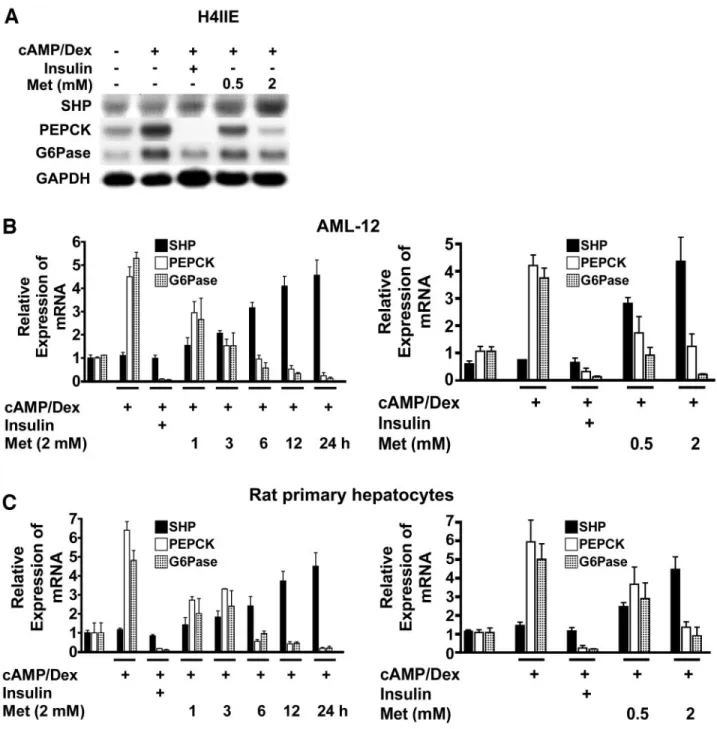
To determine whether metformin-mediated SHP gene ex- pression is involved in the regulation of hepatic glucone- ogenesis, we measured the effects of metformin on the expression of SHP and hepatic gluconeogenic genes. After 12 h of pretreatment with cAMP/Dex, hepatoma cells and primary hepatocytes were treated with various metformin
FIG. 1. Metformin induces SHP promoter activity and gene expression in hepatoma cell lines and primary hepatocytes. A-D: HepG2, H4IIE, and AML12 cell lines and rat primary hepatocytes were cultured under serum-free conditions for 24 h. These cells were then treated with various dose of metformin for 12 h or for various time periods up to 24 h. SHP gene expression was confirmed by Northern blot analysis. SHP gene expression was normalized to GAPDH expression. Data are representative of three independently performed experiments. E and F: The effect of metformin on the activity of human (hSHP) and mouse (mSHP) SHP promoter reporter constructs was assessed. SHP promoters construct (200 ng) were transiently transfected into HepG2 and AML12 cells. The cells were incubated in the presence or absence of various concentrations of metformin, and luciferase activity was measured after 36 h. Luciferase activity was normalized to-galactosidase activity to correct for variations in transfection efficiency, and LRH-1 was used as a positive control. Data shown represent the means of five independent experiments. Data are expressed as fold activations relative to the control (ⴞSEM). Met, treated with metformin.
concentrations for 12 h, and gene expression was evalu- ated. The expression of two key hepatic gluconeogenic genes, PEPCK and G6Pase, increased in response to cAMP/Dex and was reduced in response to insulin. As shown in Fig. 3A, metformin (0.5 to 2 mmol/l) induced SHP gene expression and repressed the cAMP/Dex-induced expression of PEPCK and G6Pase in a dose-dependent manner in H4IIE cells. The induction of SHP by metformin also inhibited hepatic gluconeogenic gene expression in a time- and dose-dependent manner in AML12 cells (Fig. 3B) and rat primary hepatocytes (Fig. 3C). These results indicate that metformin-induced SHP gene expression is associated with the repression of SHP target genes in- volved in gluconeogenesis in hepatocytes.
SHP mediates metformin-induced inhibition of the promoter activities and expression of hepatic glu- coneogenic genes. SHP interacts with and represses a nuclear receptor, LRH-1. However, SHP does not inhibit the LRH-1–related nuclear receptor SF-1 (17,28,30). Be- cause SHP operates as a transcriptional repressor, we examined whether metformin specifically regulates LRH-1 transcriptional activity. Figure 4A shows that metformin inhibited the transcriptional activity of LRH-1 but failed to inhibit the transactivation of SF-1. Moreover, knockdown of SHP via siRNA SHP rescued the repressed transcrip- tional activity of LRH-1, whereas no change in SF-1 transcriptional activity was observed. These results indi-
FIG. 2. Metformin-induced upregulation of SHP gene expression is mediated by AMPK. A: Rat primary hepatocytes were infected with Ad-AMPK at a multiplicity of infection (MOI) of 30 or 60 for 24 h. Cells were infected with Ad-DN-AMPK for 24 h after 12 h of metformin treatment (2 mmol/l). SHP expression was determined via Northern blot analysis. SHP expression was normalized to GAPDH as an internal control. The data presented are representative of three independently performed Northern blot analyses. B and C: HepG2 and AML12 cell lines were transiently transfected with the indicated reporter genes and treated with the AMPK activator AICAR or the AMPK inhibitor compound C in the presence or absence of metformin for 12 h after transfection. The cells were cotransfected with CA-AMPK, DN-AMPK in the presence or absence of metformin for 12 h after transfection. Luciferase activity was normalized to-galactosidase activity to correct for variations in transfection efficiency. The data presented are representative means from five independent experiments. The data are expressed as fold activation relative to the control (ⴞSEM). Com C, treated with compound C; Met, treated with metformin.
Y.D. KIM AND ASSOCIATES
cate that metformin specifically regulates the nuclear receptors that are specific targets of SHP.
The promoter activity of PEPCK and G6Pase is regu- lated by the transcription factors HNF-4␣ and/or FoxA2.
To determine whether metformin-induced SHP expression regulates the transcription factors involved in the regula- tion of the PEPCK and G6Pase promoters, we examined the effects of metformin on transactivation by HNF-4␣ and/or FoxA2. In the presence of HNF-4␣, metformin repressed PEPCK promoter activity with a pattern similar to that observed with SHP, and promoter activity was recovered significantly by knockdown of SHP gene expres- sion with siRNA SHP (Fig. 4B). Similarly, FoxA2-induced G6Pase promoter activity was repressed significantly by
SHP and metformin, and this activity was recovered when the cells were treated with siRNA SHP (Fig. 4C). We also determined that in the presence of FoxO1, metformin inhibited hepatic gluconeogenic gene promoter activity with an effect similar to that observed with SHP, and the activity was recovered as the result of knockdown of SHP gene expression via siRNA SHP (supplemental Fig. 2).
Collectively, these results indicate that metformin-induced SHP gene expression inhibits the function of transcrip- tional factors that regulate hepatic gluconeogenesis.
To confirm whether metformin-induced downregulation of hepatic gluconeogenic genes is dependent on SHP gene expression, we assessed the effects of SHP on metformin- induced inhibition of PEPCK and G6Pase gene expression
FIG. 3. Metformin-induced SHP gene expression inhibits hepatic gluconeogenic gene expression. A-C: Metformin inhibited 8-Br-cAMP/Dex- induced PEPCK and G6Pase gene expression in H4IIE and AML12 cells and in rat primary hepatocytes. After 12 h of pretreatment with cAMP/Dex and Insulin (30 nmol/l) for 6 h, the cultures were treated with metformin at various doses and for various times. The mRNA levels were analyzed via Northern blot analysis using SHP, PEPCK, and G6Pase probes and normalized to an internal control (GAPDH). Three independent analyses were performed. Data are expressed as fold activations relative to the control (ⴞSEM). Met, treated with metformin.
FIG. 4. Metformin inhibits the promoter activities and gene expression of PEPCK and G6Pase through SHP. A: HepG2 cell lines were cotransfected with the sft-4 reporter gene (200 ng), LRH-1 (100 ng), and SF-1 (100 ng) and incubated in the presence or absence of metformin for 12 h. Alternatively, the cells were cotransfected with LRH-1, SF-1, the sft-4 reporter gene, and the siRNA SHP or the siRNA scrambled and incubated in the presence or absence of metformin. B and C: HepG2 cell lines were cotransfected with 200 ng each of the PEPCK and G6Pase reporter genes and HNF-4␣ or FoxA2 coupled with SHP and, after 24 h of transfection, were incubated in the indicated quantities of metformin for 12 h. Luciferase activity was measured after 36 h and was normalized to-galactosidase activity. Alternatively, cells were cotransfected with the PEPCK and G6Pase promoter constructs, either HNF-4␣ or FoxA2, and the siRNA SHP or siRNA scrambled and incubated in the presence or absence of metformin. Luciferase activity was normalized to-galactosidase activity to correct for variations in transfection efficiency. The data presented represent the means of five independent experiments. Data are expressed as fold activation relative to the control (ⴞSEM). D: H4IIE cell lines were infected with 60 MOI of adenoviral vector expressing siRNA SHP tagged with GFP for 24 h. The cells were pretreated in the presence of cAMP/Dex with or without adenoviral vector expressing siRNA SHP. After infection with adenovirus siRNA-SHP (Ad-siRNA-SHP), H4IIE cell lines were treated with the indicated doses of metformin. The levels of SHP, PEPCK, and G6Pase mRNA were determined via Northern blot analysis. The mRNA levels were normalized to GAPDH levels. These results were independently performed at three times. Met, treated with metformin; siRNA Scram, transfected with siRNA scramble.
Y.D. KIM AND ASSOCIATES
in H4IIE cells. Overexpression of SHP using adenovirus SHP (Ad-SHP) significantly repressed both cAMP/Dex- induced PEPCK and G6Pase gene expression in a time- and dose-dependant manner (supplemental Fig. 3). How- ever, SHP knockdown with adenovirus siRNA-SHP reversed metformin-induced inhibition of cAMP/Dex-in- duced PEPCK and G6Pase gene expression, whereas a control siRNA (Ad-scramble) exerted no discernable ef- fects on the metformin-induced inhibition of hepatic glu- coneogenic gene expression (Fig. 4D). These results indicate that the induction of SHP gene expression by metformin has a significant effect on the downregulation of hepatic gluconeogenesis.
Metformin and SHP decrease blood glucose levels and the expression of PEPCK and G6Pase gene in the livers of B6-Lepob/ob mice. To determine whether met- formin-induced SHP inhibits blood glucose levels and hepatic gluconeogenic genes expression in vivo, the ex- pression of SHP and hepatic glucose production were analyzed in the metformin-treated B6-Lepob/ob mice. As shown in Fig. 5A, blood glucose levels in the fasting condition were significantly decreased by metformin in a dose-dependent manner compared with those in the feed-
ing condition, which are comparable to normal blood glucose levels. However, metformin increased SHP mRNA levels and phosphorylation of ACC and AMPK in a dose- dependent manner for 6 h (supplemental Fig. 4), whereas the expression of gluconeogenic genes was significantly repressed compared with the feeding condition. Interest- ingly, metformin increased SHP gene expression within 6 h, which repressed PEPCK and G6Pase gene expression resulting in reduction of blood glucose levels (Fig. 5B).
These data suggest that induction of SHP gene by met- formin results in decrease of blood glucose levels through the repression of hepatic gluconeogenic gene expression.
To confirm the effects of SHP on blood glucose levels through the repression of hepatic gluconeogenic genes expression, we infected Ad-SHP into B6-Lepob/obmice via tail vein injection. To verify the transduction efficiencies of adenovirus-expressing green fluorescent protein–tagged SHP, we examined the mouse livers using fluorescence microscopy at the indicated time period (data not shown).
As shown in Fig. 5C, overexpression of SHP by Ad-SHP hugely decreased the blood glucose levels and PEPCK and G6Pase gene expression. Taken together, these results indicate that the induction of SHP gene expression by
FIG. 5. SHP overexpression reduces blood glucose levels, PEPCK, and G6Pase gene expression in B6-Lepob/obmice. A: Blood glucose levels of 8-week-old female B6-Lepob/obmice were measured in a dose-dependent manner after oral administration of metformin (50 – 400 mg/kg body wt) at 6 h fasting and feeding condition. Total RNA (30g) was extracted from liver tissues at the indicated times after metformin treatment, and the levels of SHP, PEPCK, and G6Pase mRNA were normalized to GAPDH mRNA. All mice were separated into experimental groups (nⴝ 4 mice per group). B: 8-week-old female B6-Lepob/obmice were determined at the indicated time periods after the oral administration of metformin (400 mg/kg body wt) in the feeding condition. Total RNA (30g) was extracted from liver tissues at the indicated times after metformin treatment.
The levels of SHP, PEPCK, and G6Pase mRNA were determined via Northern blot analysis. The mRNA levels were normalized to GAPDH levels.
All mice were separated into experimental groups (nⴝ 5 mice per group). C: Blood glucose levels of 8-week-old female mice were measured after tail vein injection with Ad-Mock or Ad-SHP for 84 h in the feeding condition. SHP, PEPCK, and G6Pase gene expression in the livers of B6-Lepob/ob female mice were assessed after tail-vein injection with Ad-Mock or Ad-SHP (nⴝ 5 mice per group). Total RNA (30 g) was extracted from liver tissues 84 h after infection and analyzed via Northern blotting using SHP, PEPCK, and G6Pase probes. The mRNA levels were normalized to that of GAPDH. Ad-Mock, injected with empty vector; Ad-SHP, injected adenovirus expressing SHP; Con, injected with saline; Met, injected with metformin. *P < 0.001 compared with Con (injected saline).#P < 0.001 compared with Ad-Mock.
metformin regulates hepatic glucose production via the inhibition of hepatic gluconeogenic gene expression in vivo.
DISCUSSION
In this study, we found that metformin increased SHP gene expression via AMPK activation and inhibited the expres- sion of the hepatic gluconeogenic genes PEPCK and G6Pase via upregulation of SHP. The inhibitory effects of metformin on hepatic gluconeogenic gene expression were blocked via the knockdown of SHP using siRNA SHP. Moreover, these effects of metformin, which were characterized in both hepatoma and hepatic cells, were observed to occur in a similar fashion in metformin- treated B6-Lepob/ob mice. SHP gene expression was in- creased by metformin, and adenovirus-mediated SHP overexpression caused a reduction in the expression of hepatic gluconeogenic genes. Consequently, blood glucose levels were also reduced in the obese mice.
SHP plays a pivotal role in cholesterol and glucose metabolism (15,23,31–33). The synthesis of bile acid from cholesterol is regulated by the rate-limiting enzyme cho- lesterol 7␣-hydroxylase (CYP7A1) (19). Bile acid is an endogenous ligand of the farnesoid X receptor, which can profoundly activate SHP transcription (34), and SHP de- creased the expression of CYP7A1 via the inhibition of LRH-1 activity (19,35). Additionally, bile acid–induced SHP can downregulate PEPCK and G6Pase expression by the repression of the transcriptional activity of HNF-4␣, FoxO1, and FoxA2 (23–24). However, the correlation between SHP expression and type 2 diabetes, and/or antidiabetic agent, has not been previously elucidated. In this study, we report that metformin, a drug commonly used in the treatment of type 2 diabetes, represses the expression of PEPCK and G6Pase genes by increasing SHP gene expression, both in vitro and in vivo. As the inhibition of hepatic gluconeogenic gene expression by metformin is mediated via an AMPK pathway, we examined whether AMPK caused an increase in SHP expression. Indeed, our data indicated that Ad-AMPK, as well as AICAR, increased SHP gene expression. Furthermore, this induction was abolished in the presence of Ad-DN-AMPK or compound C. These results indicate that metformin-induced SHP gene expression is mediated via AMPK activation. Collec- tively, these results show that the AMPK-mediated upregu- lation of SHP gene expression may be one of the mechanisms inherent to the negative regulation of hepatic gluconeogenic genes by metformin.
As previously mentioned, SHP inhibits PEPCK and G6Pase gene expression via the repression of HNF-4␣, FoxO1, and FoxA2 activity (23–24). Thus, we determined whether HNF-stimulated gluconeogenic genes can be downregulated by metformin-induced SHP. In the present study, it was demonstrated that metformin inhibited HNF- 4␣–, FoxO1-, and/or FoxA2-stimulated PEPCK and/or G6Pase promoter activity and that this repression was abolished by siRNA SHP. Overall, the results of the present study demonstrate that metformin can inhibit HNF-stimu- lated PEPCK and G6Pase promoter activity via the induc- tion of SHP. In addition, the expression of hepatic gluconeogenic genes is also modulated by cAMP and glucocorticoid receptor, which are stimulated by glucagon and glucocorticoid, respectively (15,36). Our data indi- cated that SHP inhibited cAMP/Dex-induced PEPCK and G6Pase gene expression. However, when endogenous SHP
was blocked, metformin failed to downregulate the cAMP/
Dex-stimulated expression of PEPCK and G6Pase. AMPK activation causes a rapid reduction in PEPCK and G6Pase expression via the inhibition of the transcriptional activity of HNF-4␣ and the stabilization of FoxO1 (37–38). Our data also indicated that PEPCK and G6Pase expression were reduced in the presence of metformin within a short period of time. Therefore, we propose that metformin may regulate the expression of hepatic gluconeogenic genes via two different pathways. The first of these is a short-term pathway, involving the protein stabilization or phosphor- ylation of AMPK-targeted transcription factors and coac- tivators, and the second is a long-term effect exerted via the induction of SHP gene expression due to metformin treatment. Metformin was recently shown to reduce sig- nificantly blood glucose levels and hepatic gluconeogenic gene expression in the livers of obese and diabetic mice (39). The results of our study have demonstrated that metformin induces SHP gene expression, which, in turn, reduces the expression of hepatic gluconeogenic genes and blood glucose levels in B6-Lepob/ob mice. Consistent with our previous observations, we have also determined that the adenovirus-mediated overexpression of SHP in- hibited the expression of PEPCK and G6Pases and also reduced blood glucose levels in B6-Lepob/obmice. Collec- tively, our results indicate that metformin-induced inhibi- tion of hepatic gluconeogenesis is mediated via the upregulation of SHP gene expression.
In conclusion, metformin causes increases in hepatic SHP gene expression via an AMPK-dependent pathway and also results in the reduction of hepatic glucose pro- duction in vivo. The results of the present study suggest that the regulation of SHP gene expression and promoter activity by metformin may represent a novel pathway that could be modulated to enhance the treatment of type 2 diabetes. To elucidate more clearly the role of SHP in AMPK-mediated hepatic glucose metabolism, it will be useful to generate liver-specific SHP knock-out animals in the future.
ACKNOWLEDGMENTS
This study was supported by the Korea Science and Engineering Foundation through the National Research Lab program funded by the Ministry of Science and Technology (M10500000047-06J0000-04710) and the Korea Research Foundation (2006-005-J03003). Y.D.K. is sup- ported by a postdoctoral fellowship from the Brain Korea 21 program.
We thank Drs. David D. Moore, Yoon-Kwang Lee, and Young-Joo Park (Baylor College of Medicine, Houston, TX) for their critical suggestions and technical assistance.
We also thank Yuan Bin Xie and other lab members for their helpful discussions.
REFERENCES
1. Zakikhani M, Dowling R, Fantus G, Sonenberg N, Pollak M: Metformin is an AMP kinase-dependent growth inhibitor for breast cancer cells. Cancer Res66:10269 –10273, 2006
2. Zhou G, Myers R, Li Y, Chen Y, Shen X, Fenyk-Melody J, Wu M, Ventre J, Doebber T, Fujii N, Musi N, Hirshman MF, Goodyear LJ, Moller DE: Role of AMP-activated protein kinase in mechanism of metformin action. J Clin Invest108:1167–1174, 2001
3. Bailey JC, Turner RC: Metformin. N Engl J med 334:574 –579, 1996 4. Kirpichnikov D, Mcfarlane SI, Sowers JR: Metformin: an update. Ann
Intern Med137:25–33, 2002
5. Musi N, Hirshman MF, Nygren J, Svanfeldt M, Bavenholm P, Rooyackers O, Zhou G, Williamson JM, Ljungvist O, Efendic S, Moller DE, Thorell A, Y.D. KIM AND ASSOCIATES
Goodyear LJ: Metformin increases AMP-activated protein kinase activity in skeletal muscle of subjects with type 2 diabetes. Diabetes 51:2074 –2081, 2002
6. DeFronzo RA, Goodman AM: Efficacy of metformin in patients with non-insulin– dependent diabetes mellitus. N Engl J Med 333:541–549, 1995 7. Abbasi F, Kamath V, Rizvi AA, Carantoni M, Chen YD, Reaven GM: Results of a placebo-controlled study of the metabolic effects of the addition of metformin to sulfonylurea-treated patients: evidence for a central role of adipose tissue. Diabetes Care 20:1863–1869, 1997
8. Shaw RJ, Lamia KA, Vasquez D, Koo SH, Bardeesy N, DePinho RA, Montminy M, Cantley LC: The kinase LKB1 mediates glucose homeostasis in liver and therapeutic effects of metformin. Science 310:1642–1646, 2005 9. Zang M, Zuccollo A, Hou X, Nagata D, Walsh K, Herscovitz H, Brecher P, Ruderman NB, Cohen RA: AMP-activated protein kinase is required for the lipid-lowering effect of metformin in insulin-resistant human HepG2 cells.
J Biol Chem279:47898 – 47905, 2004
10. Carling D: The AM: P-activated protein kinase cascade–a unifying system for energy control. Trends Biochem Sci 29:18 –24, 2004
11. Kemp BE, Stapleton D, Campbell DJ, Chen ZP, Murthy S, Walter M, Gupta A, Adams JJ, Katsis F, van Denderen B, Jennings IG, Iseli T, Michell BJ, Witters LA: AMP-activated protein kinase, super metabolic regulator.
Biochem Soc Trans31:162–168, 2003
12. Lochhead PA, Salt IP, Walker KS, Hardie DG, Sutherland C: 5-Aminoimi- dazole-4-carboxamide riboside mimics the effects of insulin on the expres- sion of the 2 key gluconeogenic genes PEPCK and glucose-6-phosphatase.
Diabetes49:896 –903, 2000
13. Cool B, Zinker B, Chiou W, Kifle L, Cao N, Perham M, Dickinson R, Adler A, Gagne G, Iyengar R, Zhao G, Marsh K, Kym P, Jung P, Camp HS, Frevert E: Identification and characterization of a small molecule AMPK activator that treats key components of type 2 diabetes and the metabolic syndrome.
Cell Metab3:403– 416, 2006
14. Seol W, Choi HS, Moore DD: An orphan nuclear hormone receptor that lacks a DNA binding domain and heterodimerizes with other receptors.
Science272:1336 –1339, 1996
15. Borgius LJ, Steffensen KR, Gustafsson JA, Treuter E: Glucocorticoid signaling is perturbed by the atypical orphan receptor and corepressor SHP. J Biol Chem 277:49761– 49766, 2002
16. Gobinet J, Auzou G, Nicolas JC, Sultan C, Jalaguier S: Characterization of the interaction between androgen receptor and a new transcriptional inhibitor, SHP. Biochemistry 40:15369 –15377, 2001
17. Lee YK, Moore DD: Dual mechanisms for repression of the monomeric orphan receptor liver receptor homologous protein-1 by the orphan small heterodimer partner. J Biol Chem 277:2463–2467, 2002
18. Zhang M, Chiang JY: Transcriptional regulation of the human sterol 12alpha-hydroxylase gene (CYP8B1): roles of hepatocyte nuclear factor 4alpha in mediating bile acid repression. J Biol Chem 276:41690 – 41699, 2001
19. Lu TT, Makishima M, Repa JJ, Schoonjans K, Kerr TA, Auwerx J, Mangelsdorf DJ: Molecular basis for feedback regulation of bile acid synthesis by nuclear receptors. Mol Cell 6:507–515, 2000
20. Sanyal S, Kim JY, Kim HJ, Takeda J, Lee YK, Moore DD, Choi HS:
Differential regulation of the orphan nuclear receptor small heterodimer partner (SHP) gene promoter by orphan nuclear receptor ERR isoforms.
J Biol Chem277:1739 –1748, 2002
21. Goodwin B, Watson MA, Kim H, Miao J, Kemper JK, Kliewer SA: Differ- ential regulation of rat and human CYP7A1 by the nuclear oxysterol receptor liver X receptor-alpha. Mol Endocrinol 17:386 –394, 2003 22. Yeo MG, Yoo YG, Choi HS, Pak YK, Lee MO: Negative cross-talk between
Nur77 and small heterodimer partner and its role in apoptotic cell death of hepatoma cells. Mol Endocrinol 19:950 –963, 2005
23. Yamagata K, Daitoku H, Shimamoto Y, Matsuzaki H, Hirota K, Ishida J,
Fukamizu A: Bile acids regulate gluconeogenic gene expression via small heterodimer partner-mediated repression of hepatocyte nuclear factor 4 and Foxo1. J Biol Chem 279:23158 –23165, 2004
24. Kim JY, Kim HJ, Kim KT, Park YY, Seong HA, Park KC, Lee IK, Ha H, Shong M, Park SC, Choi HS: Orphan nuclear receptor small heterodimer partner represses hepatocyte nuclear factor 3/Foxa transactivation via inhibition of its DNA binding. Mol Endocrinol 18:2880 –2894, 2004
25. Lee M, Hwang JT, Lee HJ, Jung SN, Kang I, Chi SG, Kim SS, Ha J:
AMP-activated protein kinase activity is critical for hypoxia-inducible factor-1 transcriptional activity and its target gene expression under hypoxic conditions in DU145 cells. J Biol Chem 278:39653–39661, 2003 26. Schmoll D, Walker KS, Alessi DR, Grempler R, Burchell A, Guo S, Walther
R, Unterman TG: Regulation of glucose-6-phosphatase gene expression by protein kinase Balpha and the forkhead transcription factor FKHR: evi- dence for insulin response unit-dependent and -independent effects of insulin on promoter activity. J Biol Chem 275:36324 –36333, 2000 27. Lechner PS, Croniger CM, Hakimi P, Millward C, Fekter C, Yun JS, Hanson
RW: The use of transgenic mice to analyze the role of accessory factor two in the regulation of phosphoenolpyruvate carboxykinase (GTP) gene transcription during diabetes. J Biol Chem 276:22675–22679, 2001 28. Park YY, Kim HJ, Kim JY, Kim MY, Song KH, Park KC, Yu KY, Shong M,
Kim KH, Choi HS: Differential role of the loop region between helices H6 and H7 within the orphan nuclear receptors small heterodimer partner and DAX-1. Mol Endocrinol 18:1082–1095, 2004
29. Song KH, Park JI, Lee MO, Soh JM, Lee KS, Choi HS: LH induces orphan nuclear receptor Nur77 gene expression in testicular leydig cells. Endo- crinology142:5116 –5123, 2001
30. Li Y, Choi MH, Suino K, Kovach A, Daugherty J, Kliewer SA, Xu HE:
Structural and biochemical basis for selective repression of the orphan nuclear receptor liver receptor homolog 1 by small heterodimer partner.
Proc Natl Acad Sci U S A102:9505–9510, 2005
31. Watanabe M, Houten SM, Moschetta A, Mangelsdorf DJ, Heyman RA, Moore DD, Auwerx J: Bile acids lower triglyceride levels via a pathway involving FXR, SHP and SREBP-1c. J Clin Invest 113:1408 –1418, 2004 32. Wang L, Kim CS, Lee YK, Moore DD: Resistance of SHP-null mice to bile
acid-induced liver damage. J Biol Chem 278:44475– 44481, 2003
33. Boulias K, Katrakili N, Bamberg K, Underhill P, Greenfield A, Talianidis I:
Regulation of hepatic metabolism pathways by the orphan nuclear recep- tor SHP. EMBO J 24:2624 –2633, 2005
34. Sinal CJ, Tohkin M, Miyata M, Ward JM, Lambert G, Gonzalez FJ: Targeted disruption of the nuclear receptor FXR/BAR impairs bile acid and lipid homeostasis. Cell 102:731–744, 2000
35. Goodwin B, Jones SA, Price RR, Watson MA, Mckee DD, Moore LB, Galardi C, Wilson JG, Lewis MC, Roth ME, Maloney PR, Willson TM, Kliewer SA: A regulatory cascade of the nuclear receptors FXR, SHP-1, and LRH-1 represses bile acid biosynthesis. Mol Cell 6:517–526, 2000 36. Koo SH, Flechner L, Zhang X, Screaton RA, Jeffries S, Hedrick S, Xu W,
Boussouar F, Brindle P, Takemori H, Montminy M: The CREB coactivator TORC2 is a key regulator of fasting glucose metabolism. Nature 437:1109 – 1114, 2005
37. Hong YH, Varanasi US, Yang W, Leff T: AMP-activated protein kinase regulates HNF4␣ transcriptional activity by inhibiting dimmer formation and decreasing protein stability. J Biol Chem 278:27495–27501, 2003 38. Barthel A, Schmoll D, Kruger KD, Roth RA, Joost HG: Regulation of the
forkhead transcription factor FKHR (FOXO1a) by glucose starvation and AICAR, an activator of AMP-activated protein kinase. Endocrinology 143:3183–3186, 2002
39. Heishi M, Ichihara J, Teramoto R, Itakura Y, Hayashi K, Ishikawa H, Gomi H, Sakai J, Kanaoka M, Taiji M, Kimura T: Global gene expression analysis in liver of obese diabetic db/db mice treated with metformin. Diabetologia 49:1647–1655, 2006