PC12 세포주에서 Translationally Controlled Tumor Protein에 의한 Mitogen-activated Protein Kinases 활성 조절
김미연·김미영# 이화여자대학교 약학대학
(Received August 30, 2010; Revised September 16, 2010; Accepted Revised September 16, 2010)
Regulation of Mitogen-activated Protein Kinases by Translatoinally Controlled Tumor Protein in PC12 Cells
Mi-Yeon Kim and Miyoung Kim#
College of Pharmacy, Center for Cell Signalling & Drug Discovery Research, Ewha Womans University, Seoul 120-750, Korea
Abstract — Translationally controlled tumor protein (TCTP) activates basophils to release histamine and causes chronic inflammation. It was also reported that TCTP significantly reduced in brain of Alzheimer’s Disease and Down Syndrome as compared to normal person, suggesting that TCTP might be involved in cognitive function. We wondered whether TCTP could act as a general inducer in neurotransmitters release in brain. We, therefore, investigated the role of TCTP in PC12 cell line which expressed neuronal properties. We found that TCTP could activate JNK, and the activity was inhibited by pretreatment of dicoumarol, a JNK inhibitor. However, TCTP could not activate ERK that has known to be involved in neu- rotransmitter release. These suggest TCTP did not participate in neurotransmitter release from PC12 cells, and TCTP might not be a general inducer in neurotransmitter release.
Keywords □ translationally controlled tumor protein, mitogen-activated protein kinase, histamine, PC12 cells, neu- rotransmitter
IgE-dependent histamine releasing factor(HRF)라고도 불리 우는 translationally controlled tumor protein(TCTP)은 후기 알 러지반응 환자의 분비액이나 기관지 폐포세척액 등에서 발견되 며, 후기 알러지반응 동안 호염기구와 비만세포로부터 히스타민 을 유리시키는 것으로 생각되고 있다.1-3)호염기구에서 TCTP는 특정한 IgE가 존재할 때에만 히스타민을 분비하게 하는 것으로 알려졌으나, 이 후 IgE의 종류, FcεR 존재 유무에 상관없이 TCTP가 염증세포에서 히스타민, IL-4, IL-13 등의 분비를 조절 하는 것이 관찰됨으로써 TCTP가 IgE가 아닌 특이적 수용체에 결합하여 기능할 것이라는 가능성이 제시되었다.4-9) TCTP는 만 성 염증반응이나 알러지성 천식환자에서 호염기구를 활성화시키 고, 호염기구 외에도 후기 알러지 반응에 관여하는 염증세포에 작용하여 다양한 cytokine들을 유리시키기 때문에 후기 알러지
반응에서 중요한 인자로 생각되고 있다.2,10-12)또한 알러지 반응 에 관여하기 위해서는 intermolecular disulfide bond를 통한 TCTP의 dimerization이 필요하다는 것이 최근 보고되었다.13)
히스타민은 뇌에 고루 분포하는데, 뉴런에 저장되어 있다가 일 정한 자극에 의해 분비되어 신경전달물질로 작용한다. 섬유소 말 단에서 분비된 히스타민은 뉴런뿐 아니라 astrocyte나 혈관에도 작용하며 다양한 히스타민 수용체에 결합한다.14,15)뇌에는 히스 타민 수용체가 고루 분포하는데 이것은 histaminergic system이 뇌활동을 조절하는 중심부로 작용할 수 있다는 것을 제시한다.
또한 히스타민이 학습이나 기억과 같은 다양한 생리활성을 조절 하는데 관여한다는 것도 알려져 있다.16,17)
TCTP는 다운증후군이나 알쯔하이머 질환을 갖고 있는 환자 의 뇌에서 감소됨이 보고되었는데, 알쯔하이머 질환이나 다운증 후군 환자의 뇌에서는 histaminergic system 또한 손상되어 있 다고 한다.18)이는 인식, 지각 능력 저하를 보이는 치매와 같은 퇴행성 질환에서의 있어서 TCTP가 관여할 가능성을 제시하여 준다.
#본 논문에 관한 문의는 저자에게로
(전화) 02-3277-3018 (팩스) 02-3277-3051 (E-mail) [email protected]
종설
TCTP는 호염기구에 작용하여 세포 내의 칼슘 농도를 변화시 키고, Syk, Akt, MEK, ERK를 인산화시킴으로써 히스타민 분비 를 유발한다는 것이 보고되었다.19)신경전달물질 분비에 있어서 는 탈분극의 결과로 칼슘이 유입되고 이후 Ras-의존적으로 MAPK/ERK가 활성화된다는 보고가 있다.20)따라서 TCTP가 신 경세포에 대해서도 신호전달체계를 활성화시킴으로써 신경전달 물질 분비를 유발시키는 작용이 있는지를 알아보고자 하였다. 본 실험에서는 도파민 등의 신경전달물질을 분비한다고 알려진 PC12 세포에 TCTP를 처리했을 때, 신경전달물질 분비에 관련된다고 알려져 있는 세포전달신호들이 활성화되는지를 알아보았다.
실험방법
TCTP의 발현, 분리 및 정제
pET32a(+)/ratTCTP를 E. coli BL21(λDE3)pLysS에 trans- formation시키고 배양하여 재조합 단백질의 합성을 유도하였다.
배양액은 His · Bind resin을 이용하여 Ni2+과 결합한 His-tagged TCTP 단백질을 elution buffer(20 mM Tris-HCl pH 8.0, 500 mM NaCl, 60 mM imidazole, pH 7.9)로 용출시켜 수거하였 다. 용액에 첨가되어 있는 imidazole 등의 salt를 제거하기 위해 2l의 20 mM Tris-HCl, 50 mM NaCl, 1 mM EDTA(pH 7.4)에 투석한 후 이를 anion exchange column인 DEAE를 사용해 재 정제하였다. DEAE column은 3차 증류수를 약 5분간 흘려주어 세척한 후 20 mM Tris-HCl, 50 mM NaCl, 1 mM EDTA(pH 7.4)을 약 40분간 흘려보내 안정화 시켰다. 앞에서 투석한 단백질 을 column에 loading하고 다시 0~400 mM의 NaCl을 흘려 보내 농도구배별로 1 ml/min씩 sample을 받았다. 이 분획들을 SDS- PAGE 한 후 coomassie brilliant blue 염색을 해 TCTP가 elution 되는 분획만 선별하였다. 이를 vivaspin(vivascience)을 사용해 버 퍼 조성을 PBS로 치환하면서 농축하였다.
PC12 세포주 배양
PC12 세포주는 10% horse serum, 5% fetal bovine serum (FBS), 100 units/ml penicillin, 100 units/ml streptomycin을 첨 가한 RPMI 1640 배지에서 배양하였고, 5일에 한번씩 105~106 cells/ml로 분주하였다. PC12 세포를 70~80% 정도 자랄 때까지 배양한 후, poly-L-lysine으로 코팅된 6 well plate에 seeding하 였다. 24시간 후 0.5% FBS가 포함된 RPMI 1640 배지에서 15 시간 serum starvation하였다.
Cell lysis 및 Immunoblotting
Starvation한 PC12 세포를 37oC로 가온한 KRH(125 mM NaCl, 5 mM KCl, 2 mM CaCl2, 10 mM HEPES, 1.2 mM MgSO4, 1.2 mM KH2PO4, 6 mM Glucose, 5 mM NaHCO3)를
이용해 2회 씻어주고 KRH에 0, 20, 40, 80, 160, 200 µg/ml의 농도가 되도록 TCTP를 혼합해서 5분과 20분 처리하였다. 반응 이 끝나면 37oC로 가온한 KRH로 세포를 2회 씻어주고, tyrosine phosphatase 저해제(1 mM NaF, 2 mM Na3VO4)를 첨가한 lysis buffer(1% NP-40, 1% sodium deoxycholate, 150 mM NaCl, 1 mM EDTA, 50 mM Tris-HCl, pH 7.4)를 세포에 가해 얼음에 서 30~60분 동안 방치하였다. 12,000×g로 10분간 원심분리해 서 debris를 제거한 후 얻어진 상등액을 12% SDS-PAGE를 통 해 분리하였고, Western Blotting 하였다.
실험결과
TCTP의 발현, 정제 및 확인
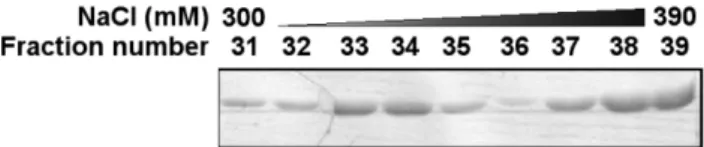
pET32a(+)/ratTCTP가 E. coli BL21(λDE3)pLysS에 trans- formation되어 안정하게 유도되는지를 coomassie brilliant blue 염색으로 확인해 본 결과 42 kDa 단백질이 과발현됨을 확인할 수 있었다(data not shown). NaCl 농도구배별로 받아진 각 분획 을 15 µl씩 loading하였고, 염색결과 300~390 mM NaCl로 elution된 분획들에서 TCTP를 확인할 수 있었으며(Fig. 1), 300~
390 mM NaCl의 농도구배 구간에서 3개의 단백질 peak이 관찰 되었다(data not shown).
단백질의 분획별 Assay
HPLC상에서 나타나는 3개의 peak 중 활성을 나타내는 peak 이 어떤 것인지 알아보기 위하여 분획 32~39 사이에서 얻어진 TCTP를 PC12 cell에 20분 동안 40 µg/ml로 처리하였다. 이를 이용한 Western blotting 결과 모든 분획에 의해 JNK의 인산화 가 control에 비해 증가하는 것을 볼 수 있었다(Fig. 2). 또한 모 든 분획이 동일한 정도로 JNK를 활성화 시키는 것을 확인 할 수
Fig. 1 − Purification of His-tagged TCTP by DEAE ion exchange chromatography. Peak fractions obtained by gradient were stained with coomassie brilliant blue staining. TCTP was eluted at the NaCl concentration of 300~390 mM. Lane 1, Eluted protein at 300~310 mM NaCl, fraction 31; Lane 2, Eluted protein at 310~320 mM NaCl, fraction 32; Lane 3, Eluted protein at 320~330 mM NaCl, fraction 33; Lane 4, Eluted protein at 330~340 mM NaCl, fraction 34; Lane 5, Eluted protein at 340~350 mM NaCl, fraction 35; Lane 6, Eluted protein at 350~360 mM NaCl, fraction 36; Lane 7, Eluted protein at 360~370 mM NaCl, fraction 37; Lane 8, Eluted protein at 370~380 mM NaCl, fraction 38; Lane 8, Eluted protein at 380~390 mM NaCl, fraction 39.
있었다. 이후의 실험에서는 NaCl 300~390 mM 사이에서 elution 된 분획을 모두 합하여 사용하였다.
TCTP에 의한 MAPK 활성
PC12 세포를 6 well plate에 12~24시간 동안 배양한 후 0.5%
FBS가 첨가된 RPMI 배지에서 14~16시간 동안 serum starvation을 하였다. KRH에 0, 20, 40, 80, 160, 200 µg/ml의 농도가 되도록 TCTP를 혼합해서 5분과 20분 동안 37oC에서 반 응시켰다. Western blotting 결과 40 µg/ml TCTP로 20분 동안
자극하였을 때 ERK, JNK, P38의 MAPK 중 JNK의 인산화 정 도가 가장 강하였으며 ERK, P38에서는 아무런 변화가 없었다 (Fig. 3A~D). JNK inhibitor인 dicoumarol(10 µM)로 한 시간 동 안 전처리 한 후 동일한 실험을 진행해 본 결과 TCTP 처리로 인한 JNK 활성이 억제되는 것을 확인할 수 있었고 이로써 처리 한 TCTP에 의해서 JNK가 활성화되었음을 재확인할 수 있었다 (Fig. 3E).
Endotoxin이 signaling에 미치는 영향
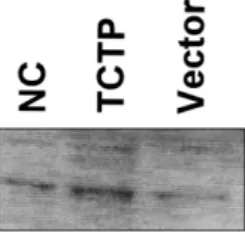
Kang 등은 Escherichia coli에 transformation해서 재조합 단백 질을 만들 때 혼입된 bacterial endotoxin에 의해 B cell이 activation될 수 있다는 가능성을 제시하였다.12) 이 외에도 lipopolysaccharide(LPS)에 의해 U937 세포에서는 transcription factor인 NF-κB가 활성화된다는 보고가 있었다.21)따라서 앞에 서 살펴본 TCTP에 의한 JNK의 인산화가 단백질에 혼입된 endotoxin의 효과 때문인지를 확인하기 위하여 TCTP cDNA가 들어있지 않은 빈 벡터 pET32a(+)만을 같은 조건에서 induction 하여 PC12 세포에 처리해 보았다(Fig. 4). 실험 결과 TCTP를 처리한 cell에서는 JNK의 인산화를 볼 수 있었으나 빈 벡터 유 래 단백질만을 처리한 세포에서는 JNK에 아무런 변화가 없었다.
이로부터 JNK의 인산화가 혼입된 endotoxin의 효과가 아닌 TCTP 고유의 작용임을 알 수 있었다.
Fig. 2 − All fractions of TCTP induced JNK activation in PC12 cells.
PC12 cells were treated for 20 min with 40µg/ml of TCTP (lane 2~8) or left untreated (lane 1). f32, Eluted protein at 310~320 mM NaCl; f33, Eluted protein at 320~330 mM NaCl; f34, Eluted protein at 330~340 mM NaCl; f35, Eluted protein at 340~350 mM NaCl; f37, Eluted protein at 360~370 mM NaCl; f38, Eluted protein at 370~380 mM NaCl; f39, Eluted protein at 380~390 mM NaCl. Cell lysates (60µg) were separated, blotted and analyzed using anti-phospho JNK antibody.
Fig. 3 − TCTP stimulated JNK, not ERK in PC12 cells. PC12 cells were treated as described above. The cells were then washed with KRH and lysed. The 60µg of each samples were loaded onto 10% SDS-PAGE gel and analyzed by Western blot. (A) Anti-p-JNK monoclonal antibody was used. (B) Anti-JNK antibody was used after striping. (C) Anti-p-ERK monoclonal antibody was used. (D) Anti-p-P38 Monoclonal antibody was used. (E) 10µM of dicoumarol was pretreated for 1 h, and 40 µg/ml TCTP was treated for 20 min. 60 µg of cell extracts were analyzed by Western blotting with anti-phospho-JNK antibody.
고 찰
TCTP가 히스타민 외에 다른 신경전달물질 분비에 관여하는 지 알아보기 위해 PC12 세포를 이용하여 MAPK 활성 여부를 알아보았다. MAPK는 serine/threonine kinases로 다양한 cellular target을 가지며, 세포 내에서 일어나는 많은 반응을 조 절하는 주요 인자로 작용한다. 보통 MAPK는 호르몬, 성장인자, 라디칼, mitogens, UV 등 다양한 외부 자극에 의해 활성화 되며, serine/threonine과 tyrosine 잔기에 인산화가 일어나면 활성화 되면서 핵으로 이동하게 된다. Rosen 등은 PC12 세포에서의 신경전달물질 분비는 탈분극에 의해 칼슘이 유입되고 이를 통해 Ras 의존적 MEK/MAPK 활성화에 기인하다고 보고한 바 있다.20)
PC12 세포에서의 신경전달물질 분비에는 ERK가 관여한다는 보고를 바탕으로22) PC12 세포에 TCTP 처리시 ERK가 활성화 될 것을 기대했으나, 실험결과 JNK만이 활성화됨을 확인할 수 있었다. 이는 신경전달물질 분비에 관여하는 TCTP의 활성형이 알러지 반응에 관여하는 활성형처럼 dimerization된 형태로 작용 하기 때문일 수 있다. 최근 본 실험실에서는 TCTP 전체 단백질 의 경우 dimer를 형성할 수 없으나 NH2-말단이 잘려진 단백질 의 경우 dimer를 형성할 수 있고 알러지 반응에도 관여할 수 있 음을 보고한 바 있다.13) 따라서 신경전달물질 분비에도 dimer 형 태의 단백질이 작용할 가능성이 있다. 또한 TCTP가 히스타민 외에 다른 신경전달물질의 분비에는 관여하지 않을 가능성도 배 제할 수 없다.
TCTP에 의해 분비되는 히스타민과 퇴행성 질환과의 상관 관 계를 규명하는 연구는 활발히 진행되고 있으나 TCTP 자체가 어 떤 메커니즘을 경유하여 신경전달물질을 분비하며 왜 다운 증후 군이나 알쯔하이머 질환을 나타내는 환자의 뇌에서 감소하는지 는 아직 연구가 미흡한 상태로 더 연구해볼 일이다. 또한, 본 실 험에 의하면 TCTP는 뇌에서 히스타민 외에 다른 신경전달물질 분비에는 관여하지 않을 가능성이 있으나 다른 신경세포에 대한 TCTP의 역할은 더 연구가 필요할 것으로 사료된다.
결 론
본 실험은 신경세포의 특성을 지닌 PC12 세포에 TCTP를 처 리함으로써 TCTP가 신경전달물질 분비에 관여하는 신호전달체 계를 활성화시킬 수 있는지를 알아본 것이다. PC12 세포를 이용 한 실험 결과 TCTP는 신경전달물질 분비에 관여하는 것으로 알 려진 ERK를 활성화시키지는 못했다. 따라서, TCTP는 뇌에서 히스타민 외에 다른 신경전달물질 분비에는 관여하지 않을 가능 성이 있다.
감사의 말씀
본 연구는 2010학년도 이화여자대학교 지원에 의한 결과이며, 이에 감사드립니다.
참고문헌
1) Warner, J. A., Pienkowski, M. M., Plaut, M., Norman, P. S. and Lichtenstein, L. M. : Identification of histamine releasing factor(s) in the late phase of cutaneous IgE-mediated reactions. J. Immunol. 136, 2583 (1986).
2) Yoneda, K., Rokutan, K., Nakamura, Y., Yanagawa, H., Kondo- Teshima, S. and Sone, S. : Stimulation of human bronchial epithelial cells by IgE-dependent histamine-releasing factor. Am. J. Physiol. Lung Cell Mol. Physiol. 286, L174 (2004).
3) MacDonald, S. M., Rafnar, T., Langdon, J. and Lichtenstein, L. M. : Molecular identification of an IgE-dependent histamine- releasing factor. Science 269, 688 (1995).
4) Thueson, D. O., Speck, L. S., Lett-Brown, M. A. and Grant, J. A. : Histamine-releasing activity (HRA). I. Production by mitogen- or antigen-stimulated human mononuclear cells. J.
Immunol. 123, 626 (1979).
5) Sanchez, J. C., Schaller, D., Ravier, F., Golaz, O., Jaccoud, S., Belet, M., Wilkins, M. R., James, R., Deshusses, J. and Hochstrasser, D. : Translationally controlled tumor protein: a protein identified in several nontumoral cells including erythrocytes. Electrophoresis 18, 150 (1997).
6) MacDonald, S. M., Lichtenstein, L. M., Proud, D., Plaut, M., Naclerio, R. M., MacGlashan, D. W. and Kagey-Sobotka, A. : Studies of IgE-dependent histamine releasing factors:
heterogeneity of IgE. J. Immunol. 139, 506 (1987).
7) Sampson, H. A., Broadbent, K. R. and Bernhisel-Broadbent, J. : Spontaneous release of histamine from basophils and histamine-releasing factor in patients with atopic dermatitis and food hypersensitivity. N. Engl. J. Med. 321, 228 (1989).
8) Beaven, M. A. and Baumgartner, R. A. : Downstream signals initiated in mast cells by Fc epsilon RI and other receptors.
Fig. 4 − Effect of endotoxin on TCTP-induced JNK activation. PC12 cells were treated for 20 min with 40µg/ml TCTP or pET empty vector protein or left untreated (negative control, NC). Cell lysates (60µg) were seperated, blotted and analyzed using anti-phospho JNK antibody.
Curr. Opin. Immunol. 8, 766 (1996).
9) MacDonald, S. M. : Human recombinant histamine-releasing factor. Int. Arch. Allergy. Immunol. 113, 187 (1997).
10) Bheekha-Escura, R., MacGlashan, D. W., Langdon, J. M. and MacDonald, S. M. : Human recombinant histamine-releasing factor activates human eosinophils and the eosinophilic cell line, AML14-3D10. Blood. 96, 2191 (2000).
11) MacDonald, S. M. : Histamine-releasing factors. Curr. Opin.
Immunol. 8, 778 (1996).
12) Kang, H. S., Lee, M. J., Song, H., Han, S. H., Kim, Y. M., Im, J. Y. and Choi, I. : Molecular identification of IgE-dependent histamine-releasing factor as a B cell growth factor. J.
Immunol. 166, 6545 (2001).
13) Kim, M., Min, H. J., Won, H. Y., Park, H., Lee, J. C., Park, H. W., Chung, J., Hwang, E. S. and Lee, K. : Dimerization of translationally controlled tumor protein is essential for its cytokine-like activity. PLoS One. 4, e6464 (2009).
14) Onodera, K., Yamatodani, A., Watanabe, T. and Wada, H. : Neuropharmacology of the histaminergic neuron system in the brain and its relationship with behavioral disorders. Prog.
Neurobiol. 42, 685 (1994).
15) Passani, M. B., Bacciottini, L., Mannaioni, P. F. and Blandina, P. : Central histaminergic system and cognition. Neurosci Biobehav Rev. 24, 107 (2000).
16) Schneider, C., Risser, D., Kirchner, L., Kitzmuller, E., Cairns, N., Prast, H., Singewald, N. and Lubec, G. : Similar deficits of
central histaminergic system in patients with Down syndrome and Alzheimer disease. Neurosci Lett. 222, 183 (1997).
17) Fernandez-Novoa, L. and Cacabelos, R. : Histamine function in brain disorders. Behav Brain Res. 124, 213 (2001).
18) Kim, S. H., Cairns, N., Fountoulakisc, M. and Lubec, G. : Decreased brain histamine-releasing factor protein in patients with Down syndrome and Alzheimer's disease. Neurosci Lett.
300, 41 (2001).
19) Vonakis, B. M., Macglashan, D. W., Jr., Vilarino, N., Langdon, J. M., Scott, R. S. and MacDonald, S. M. : Distinct char- acteristics of signal transduction events by histamine-releasing factor/translationally controlled tumor protein (HRF/TCTP)- induced priming and activation of human basophils. Blood. 111, 1789 (2008).
20) Rosen, L. B., Ginty, D. D., Weber, M. J. and Greenberg, M. E. : Membrane depolarization and calcium influx stimulate MEK and MAP kinase via activation of Ras. Neuron. 12, 1207 (1994).
21) Legrand-Poels, S., Maniglia, S., Boelaert, J. R. and Piette, J. : Activation of the transcription factor NF-kappaB in lipopoly- saccharide-stimulated U937 cells. Biochem. Pharmacol. 53, 339 (1997).
22) Bloch-Shilderman, E., Jiang, H., Abu-Raya, S., Linial, M. and Lazarovici, P. : Involvement of extracellular signal-regulated kinase (ERK) in pardaxin-induced dopamine release from PC12 cells. J. Pharmacol. Exp. Ther. 296, 704 (2001).