http://dx.doi.org/10.7236/JIWIT.2012.12.3.1
JIWIT 2012-3-1
멀티미디어 무선인지 시스템을 위한 퍼지 기반의 동적 패킷 스케줄링 알고리즘
Fuzzy-based Dynamic Packet Scheduling Algorithm for Multimedia Cognitive Radios
니구웬 탄 퉁
*, 구인수
**Nguyen Thanh Tung and Insoo Koo
요 약 무선 통신 시스템의 새로운 패러다임인 중의 하나인 무선 인지 시스템에서 다양한 종류의 멀티미디어 트래 픽 지원이 예상된다
. 2
차 사용자들이 요구하는 서비스 품질을 만족하기 위하여,
패킷 우선권 기반의 정적 자원할당 기법이 고려될 수 있다.
하지만,
이 기법은 높은 우선권을 갖는 응용 서비스의 서비스 품질을 쉽게 만족시킬 수 있으 나,
낮은 우선권을 갖는 응용 서비스의 서비스 품질은 저하될 수 있다.
이에 본 논문에서는 퍼지 이론 기반의 동적 패킷 스케줄링 알고리즘을 제안한다.
제안된 기법에서는 동적 패킷 스케줄러가 각 패킷의 우선권과 지연 마감 시간(delay deadline)
을 입력으로 갖는 퍼지 규칙에 따라,
각 패킷의 우선권을 동적으로 변경하여 패킷 손실율을 최소화하 는 관점에서 기 사용자 채널을 통해 다음 가용한time slot
에 어떤2
차 사용자가 데이터를 전송할 지를 결정한다.
시 뮬레이션을 통해 제안된 알고리즘이 우선권 기반의 정적 자원할당기법 보다 패킷 손실율을 더 향상 시킬 수 있음을 보였다.
Abstract Cognitive radio, a new paradigm for wireless communication, is being recently expected to support various types of multimedia traffics. To guarantee Quality of Service (QoS) from SUs, a static packet priority policy can be considered. However, this approach can easily satisfy Quality of Service of high priority application while that of lower priority applications is being degraded. In the paper, we propose a fuzzy-based dynamic packet scheduling algorithm to support multimedia traffics in which the dynamic packet scheduler modifies priorities of packets according to Fuzzy-rules with the information of priority and delay deadline of each packet, and determines which packet would be transmitted through the channel of the primary user in the next time slot in order to reduce packet loss rate. Our simulation result shows that packet loss rate can be improved through the proposed scheme when overall traffic load is not heavy.
Key Words : Cognitive radio network, packet scheduling, Quality of Service(QoS), packet loss, delay deadline.
*준회원, 울산대학교, 전기공학부
**정회원, 울산대학교, 전기공학부 (교신저자)
접수일자 2012년 4월 27일, 수정완료 2012년 5월 27일 게재확정일자 2012년 6월 8일
Received: 27 April 2012 / Revised: 27 May 2012 / Accepted: 8 June 2012
**Corresponding Author: [email protected]
School of Electrical Engineering, University of Ulsan,, Korea
Ⅰ. Introduction
Cognitive radio (CR), first introduced by Joseph
Mitola, is recently considered as one of the most
promising solutions to alleviate the problem of
spectrum scarcity by allowing secondary user (SU) to
access to the license frequency channel under the condition that SUs do not cause any harmful interference for any primary user (PU) activities at all.
Through spectrum sensing, SUs can detect and utilize idle primary channels to transmit their packets while SUs vacate the channel whenever SUs sense the presence of any packet from PUs. This strategy is called opportunistic spectrum access. Recently, researchers have paid more attention to the issues of average packet delay and of the QoS provision for the secondary users
[1-6].
In the reference
[1], the authors proposed a dynamic channel selection algorithm as a priority virtual queue interface, for autonomous wireless users transmitting delay-sensitive multimedia applications over cognitive radio networks. In the reference
[2], the authors studied the multi-dimension Markov chain to model time slot allocation and proposed a general channel allocation model for multimedia traffic over the centralized cognitive radio network. In the reference
[3], the authors presented a game-theoretic solution for wireless resource management for delay-sensitive multimedia applications. In the reference
[4], the authors analyzed queuing packet delay of cognitive radio networks supporting heterogeneous traffics. The authors also considered and classified packets into three classes:
namely PU packets (PUPs), delay-sensitive SU packets (DSPs), and delay-insensitive SU packets (DIPs) with their priority levels of PUPs, DSPs, and DIPs as 0, 1 and 2 from high to low. In the reference
[5], the authors investigated the average waiting time of packets with different priorities in cognitive radio networks. The authors stated that the average waiting time of packets for SU does not only depend on the size of packets and arrival rate of the SU traffic but also depends on the arrival rate and size of packets from PU. In the reference
[6], the authors proposed a solution to the multimedia transmission problem over cognitive radio networks in lossy environment where SUs are allowed to share spectral resources using the Time Division Multiple Access method based on the Opportunistic
Spectrum Sharing.
In all these approaches above mentioned, however packets with absolute static priorities are only considered in which packets with high priority are always transmitted first. Subsequently, the average waiting time of high priority packets in queue will be smaller than that of lower priority packets. As a result, the QoS requirement of high priority applications is easily satisfied while that of lower priority applications is not being satisfied. Packets belonging to low priority applications will suffer from large amounts of delays and be thus dropped. Therefore, there is the need of supervising the deadline of each packet to satisfy the QoS requirements in the cognitive radio networks.
In the paper, we propose a fuzzy-based dynamic packet scheduling algorithm to support multimedia traffics in which the dynamic packet scheduler modifies priorities of packets according to fuzzy rules by considering the information of priority and delay deadline of each packet, and determines which packet would be used through the primary channel in the next time slot in order to reduce packet loss rate. We also model the process of information exchange and negotiation among SUs into a virtual system in which each SU can send its necessary information to the system. We use a fuzzy logic controller (FLC) to supervise the remaining deadline of each packet and then modify original priority of each packet, if necessary, in order that packets with low priority can be still transmitted first without causing loss to other higher priority packets due to deadline violation.
Subsequently, the FLC can be considered as a tool for negotiation among SUs in order to satisfy the QoS requirement in terms of delay bound.
The remainder of this paper is organized as follows:
in Section II, the related work is briefly presented. The
system model is investigated in Section III. Section IV
presents the simulation results, followed by the
conclusions in Section V.
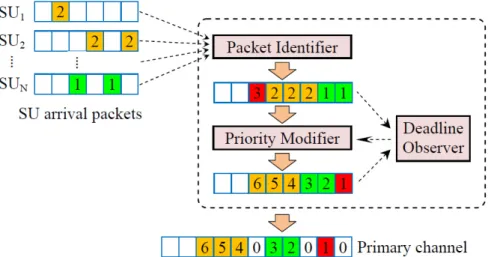
그림 3. 제안된 패킷 스케줄러를 위한 시스템 모형.
Fig. 3. Virtual model for the proposed packet scheduler.
Ⅱ. System Model
In this paper, we consider a cognitive radio network as shown in Fig. 1, similarly to
[6]. The network consists of N SUs sharing the same channel with primary networks comprising M PUs. SUs are allowed to access to the primary channel whenever there is no PU packet from PUs.
그림 1. 고려된 인지 무선 네트워크.
Fig. 1. Cognitive Radio Network (CRN).
We assume that the channel time is divided into equal time lots whose structure as shown in the Fig. 2.
At the beginning of each time slot in the period of sensing time, the activity of the PU is detected. If the channel is sensed idle, SU can exploit the availability of the channel during the current time slot. Packet sizes of PUs and SUs are assumed to be same. Hence, each packet is transmitted in only one time slot. It is also
assumed that the average traffic arrivals of services from SUs and of PUs follow the Poisson process.
그림 2. 기 사용자 채널 접속을 위한 시간 프레임 구조.
Fig. 2. Time frame structure for channel access to the primary user channel.
For the multimedia communication, different types of services have a different QoS requirement and take different amounts of resources. Consequently, the packet loss due to deadline violation is different. In the reference
[7], for example video applications require a low packet loss, but they are typically not interactive and so packet delay and delay variation can be higher.
Voice services, on the other hand, require low delay and delay variation because they are interactive, but can usually withstand a limited number of packets containing voice samples being lost by the network.
In order to control the packet traffics of SUs, in the
paper we model the processing of packets into a virtual
system as shown in the Fig. 3. The system has the
functions of identification, classification and priority
modification of SU arrival packets. Firstly, the Packet Identifier will identify the priority level of packets according to their services from SU. From the information of priority level of the packet, the delay bound is extracted. Heterogeneous services have different delay requirement, and therefore, different priorities also have different delay bounds. Secondly, the Deadline Observer in the system will stringently supervise the remaining deadline of each packet in the buffer. Finally, the Priority Modifier will adjust priority of packets according to the fuzzy rule with information of remaining deadline and the original priority of each packet to guarantee that packets would be transmitted timely. In the Fig. 3, for example the packet with priority 3 is about to be dropped because it stayed in the buffer before there are new packets coming. In this case, its priority is adjusted in order that it can be transmitted before its deadline. The fuzzy rule for the priority modifier will be explained later.
Ⅲ. The Proposed Packet Scheduling Algorithm
In this section, we describe the proposed Fuzzy-based dynamic packet scheduling algorithm for the channel allocation among CR users. At first, we explain the static priority packet scheduling algorithm as a reference, and then the proposed scheme.
1. Static priority (SP) packet scheduling algorithm
In this scheme, all packets in the buffer are sorted according to their assigned priorities. The priorities of packets are pre-determined, and utilized to determine which packet will be transmitted in the next free time slot. Packets with high priority is always considered transmitting first, and therefore, the average waiting time of high priority packets in the queue will be smaller than that of low priority packets.
2. Dynamic priority (DP) packet scheduling It is clear that, due to very good treat for packets with high priority, the QoS of corresponding services is easily guaranteed while packets with lower priority can be dropped due to the deadline violation. Subsequently, it will better to allow low priority packets to be transmitted firstly by changing their priority values in the case that packets with low priority are about to be dropped while there are higher priority packets that have marginal time to transmit before the deadline.
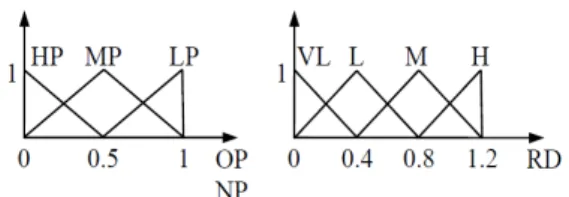
With this motivation, in the paper we utilize a Fuzzy Logic Controller (FLC) to perform modification of priority level of packets as a DP scheduler. Instead of considering all packets in the buffer, we can consider a small number of packet in a part of the buffer called Transmission Window (TW) in order to reduce the processing overhead of scheduling. Based on the original priority (OP) and remaining deadline (RD) of each packet in the TW, the FLC will modify priority of each packet, and thus, each packet in the TW will be assigned a new priority (NP).
The FLC has two input linguistic variables (i.e OP and RD) and one output linguistic variable (i.e NP), respectively. The input linguistic variable OP and the output linguistic variable NP are characterized by a term set of three fuzzy sets: namely high priority (HP), medium priority (MP) and low priority (LP). The other input linguistic variable RD is characterized by a term set of four fuzzy sets: namely very low (VL), low (L), medium (M) and high (H). The membership functions of FLC are shown in Fig.4.
그림 4. 제안된 퍼지 제어기를 위한 membership 함수.
Fig. 4. Membership functions for Fuzzy Logic Controller(FLC).
The table 1 shows the fuzzy inference rules for the FLC. It is noteworthy that there are modifications of priority level. For example, in rules 1 and 5 when packet has a very low RD, the FLC will modify the current priority into a new priority level, from LP to MP or MP to HP. Conversely, when packets have much amount of RD as in the rule 8 and 10, the current priority level will be adjusted to lower priority levels.
표 1. 제안된 퍼지 제어기에서 사용된 퍼지 규칙.
Table 1. Fuzzy rule base for Fuzzy Logic Controller(FLC).
After the modification of packet priories, the virtual system will decide whether a packet in the TW should be transmitted or not based on its assigned MP. If MP of a packet is higher, the packet will have higher possibility to be transmitted. This stage of process is therefore similar to that of SP scheduling. When two packets or more in the TW have an equal value of their MPs, the packet with a smaller RD will be transmitted.
Ⅳ. Simulation Results
In the section, we explain simulation result for a cognitive radio network with 5 SUs when the number of PUs changes from 1 to 10. The channel bandwidth is assumed 2Mbps. The packet size is assumed as 256 bytes. We consider three priority services for SUs, and the Poisson arrival rates
,
, and
of the first, the second and the third service of SUs are given as
60, 40 and 30 packets per second, respectively.
Therefore, packets also have three priority levels corresponding with three mentioned applications: the high priority packets (1st priority packet), the medium priority packets (2nd priority packet) and the low priority packet (3rd priority packet). The Poisson arrival rates
of PU is assumed to be 40 packets per second. The delay bounds for each packet of the first, the second and the third service are assumed to be 8, 15 and 30 slots.
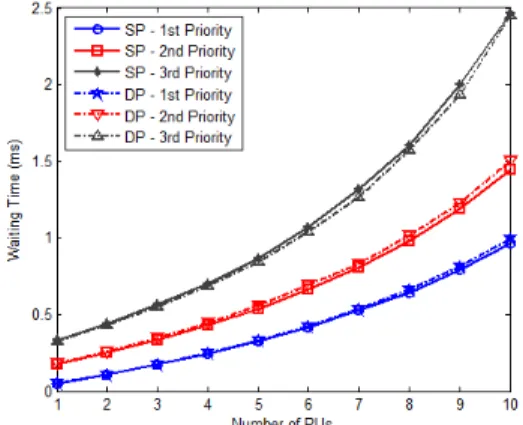
그림 5. TW의 크기가 4인 경우, 스케줄링 알고리즘에 따른 평균 패킷 지연 시간.
Fig. 5. Average packet delay on the queue when TW = 4.
그림 6. TW의 크기가 8인 경우, 스케줄링 알고리즘에 따른 평균 패킷 지연 시간.
Fig. 6. Average packet delay on the queue when TW = 8.
Fig. 5 and Fig. 6 show the average delay of three types of packet when TW is 4, and 8 respectively. It can be clearly observed that as the degree of the PU traffic increases, the average waiting time of all packets also increases. It can be inferred that when the number of PUs increases, the opportunity for SUs to access the primary channel is reduced. In detail, the 3rd priority packet has the most significant delay followed by of the 2nd priority packet and the 1st priority packet. The 1st priority packet has the less increase in delay. On the other hand, a very slight decrease of average waiting time of packet with high priority and medium priority can be found when the DP scheduling is used.
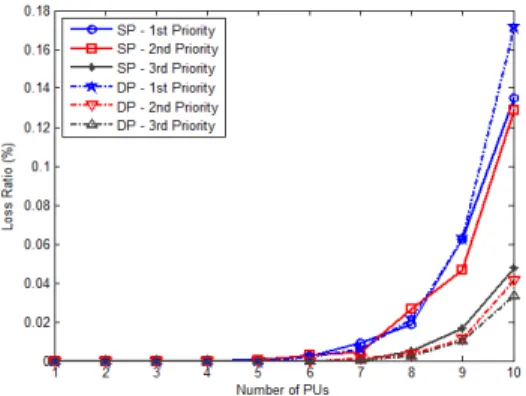
그림 7. TW의 크기가 4인 경우, 스케줄링 알고리즘에 따른 패킷 손실율.
Fig. 7. Packet loss due to deadline violation when TW = 4.
그림 8. TW의 크기가 8인 경우, 스케줄링 알고리즘 에 따른 패킷 손실율.
Fig. 8. Packet loss due to deadline violation when TW = 8.
Fig.7 and Fig. 8 show the packet loss ratios for two scheduling algorithms. It is observed that the packet loss of the second and the third services is improved in different degrees when the DP scheduling is used. But much benefit to the second service is observed. For the first service, the packet loss ratio of the DP scheduling remains the same level with that of the SP scheduling until when the number of PUs does not exceed 9 or 8 in case that TW is 4 or 8, respectively. This is because remaining deadline of all packets will be small when the PU traffic is large. In that case, the SP scheduler treats the high priority packet more than the DP scheduler, which results in a good packet loss for the first service. As the result, the DP scheduler only holds the packet loss ratio of the first service at the same level as the SP scheduler to some extent of the number of PUs.
Ⅴ. Conclusion
In this paper, we have proposed a dynamic packet scheduling algorithm using the fuzzy logic to supervise the deadline of packets in the transmission window in order to reduce packet loss rate. The simulation results showed that the proposed scheme can enhance QoS of medium and low priority packets while obtaining same level of packet loss for the high priority packets as that of the static priority packet scheduling when the number of PUs is limited.
Reference
[1] H.-P. Shiang and M. van der Schaar, “Queuing-based dynamic channel selection for heterogeneous multimedia applications over cognitive radio networks,” IEEE Trans. Multimedia, vol. 10, no. 5, pp. 896–909, Aug. 2008.
[2] Tigang Jiang, Honggang Wang, and Yan Zhang,
“Modeling channel allocation for multimedia
※ This work was supported by KRF funded by the MEST Mid-Carrier Researcher Program 2011-0017922