• 검색 결과가 없습니다.

The Effect of Storage Period and Temperature on Egg Quality in Commercial Eggs

N/A
N/A
Protected

Academic year: 2021

Share "The Effect of Storage Period and Temperature on Egg Quality in Commercial Eggs"

Copied!
8
0
0

로드 중.... (전체 텍스트 보기)

전체 글

(1)

The Effect of Storage Period and Temperature on Egg Quality in Commercial Eggs

Min Hee Lee, Eun Jung Cho, Eun Sik Choi and Sea Hwan Sohn

Department of Animal Science and Biotechnology, Gyeongnam National University of Science and Technology, Jinju 660-758, Korea

ABSTRACT Consumers demand fresh and high-quality eggs. Egg quality may be represented by shell color, shell weight, egg weight, shell thickness, shell density, albumen height, yolk color, albumen pH and viscosity. Various factors such as strain, age of hen, storage temperature, humidity, the presence of CO

2

and storage time affect egg quality. Therefore, we investigated the effects of storage time and temperature on egg quality to define the freshness of Korean market eggs. A total of 1,800 eggs were used for this experiment and were separated into 45 treatments with 40 eggs in each. The treatments were consisted of 15 storage periods (2 d to 30 d) and 3 storage temperatures (2 ℃, 12℃, 25℃). Each egg was weighed and broken, and the height of the thick albumen, Haugh units (HU), egg shell color and yolk color were measured by a QCM+system. We also observed the physiochemical properties of eggs such as yolk pH, albumen pH and albumen viscosity. The egg weight, shell weight, albumen height, HU and albumen viscosity significantly decreased with increasing storage time and temperature.

However, the albumen and yolk pH significantly increased with increasing storage period and temperature. The interaction effects between the storage period and temperature were significant for shell weight, shell density, egg weight, albumen height, HU, yolk color, yolk pH, albumen pH and albumen viscosity. In the analysis of the correlation with egg quality, the storage temperature exhibited a higher correlation coefficient than the storage period. In conclusion, storage time and temperature are the major factors affecting egg quality, but the storage temperature is a more sensitive determinant of egg quality deterioration compared with the storage period.

(Key words : egg quality, storage period, storage temperature, Haugh units)

To whom correspondence should be addressed : [email protected]

INTRODUCTION

Eggs are an important food resource that contributes to human public health, as well as an animal protein food with high nutritional value. Furthermore, eggs are one of the most widely popular foods because of their relatively low price.

Recently consumers demand fresh and high-quality eggs.

Therefore, fresh and hygienic eggs should be supplied. Egg quality can be represented by shell color, shell weight, egg weight, shell thickness, shell density, albumen height, yolk color, albumen pH and viscosity. These egg quality traits can be divided into external and internal quality. A standard mea- sure of internal egg quality is expressed by the albumen quality or Haugh unit (HU), which is calculated from the height of the inner thick albumen and the weight of the egg (Haugh, 1937; Eisen et al., 1962; Hunton, 1987; Williams, 1992). Albumen quality is also an indicator of egg freshness.

Albumen quality is influenced by genetic factors (Johnson, and Merritt, 1955; Ahn et al., 1997; Hartmann et al., 2003;

Zhang et al., 2005; Wolc et al., 2012) and environmental

factors such as temperature, humidity, the presence of CO

2

, and storage time (Walsh et al., 1995; Scott and Silversides, 2000; Silversides and Villeneuve, 1994; Samli et al., 2005).

Among these factors, storage time and temperature are the major factors affecting egg quality (Silversides and Scott, 2001; Jones and Musgrove, 2005; Samli et al., 2005; Jin et al., 2011; Shin et al., 2012). Albumen height and HU de- crease during storage, and albumen quality gradually decreases with increasing temperature. Eggs stored at 25℃ showed a 53.5% decrease in HU and a 47.5% decrease in albumen height after 7 d and showed a significant decrease in vitelline membrane strength and an increase in yolk index (Kirunda and McKee, 2000; Carraro and Antunes. 2001; Jones et al., 2002). Therefore, internal egg quality declines with storage time. The degradation in egg quality due to storage results in albumen thinning, increasing pH, weakening and stretching of the vitelline membrane and increasing water content in the egg yolk (Scott and Silversides, 2000; Hammershoj et al., 2002; Silversides and Budgell, 2004; Hidalgo et al., 2006;

Karoui et al., 2006; Huang et al., 2012). The changes of al-

(2)

bumen quality during egg storage were well described by Silversides and Villeneuve (1994).

Based on egg freshness and food safety, the laws and re- gulations regarding market eggs are vary by country. In the US, the USDA requirement for shell eggs is to be washed and sanitized before they reach the consumer and to store them at temperatures below 7.2 ℃ to inhibit the growth of pathogens. The sell by date of market egg is 30 d after packing (USDA-FSIS, 2015; American Egg Board, 2015). EU egg marketing laws states that class A eggs must not be washed or cleaned in any way. EU law also states that eggs should in general not be refrigerated before sale to the final con- sumer. The best before date of market eggs must not exceed 28 d after being laid (EUR-Lex, 2015). The current egg grading regulations in Korea have existed since 2007 (Act No. 8852, 2015). The regulations stipulated that shell eggs must be stored and distributed at 0 ∼15℃, and processed egg products must be stored below 10 ℃. The term of validity of market eggs is not specified. The regulations of Korean market eggs do not reflect the current market because the breed of chickens, raising management system, egg distribution channels and customer demands are very different from the past. Thus, we investigated the effects of the storage period and tem- perature for shell eggs on the egg quality to define the fresh- ness of eggs.

MATERIALS AND METHODS

Eggs were obtained from 60-wk-old Hyline Brown commer- cial layers that were raised at Sangol Farm, Sancheong, Korea.

All hens were housed in windowless and environmentally controlled rooms and in battery cages with five hens per cage (420 cm

2

/hen) equipped with nipple drinkers, automatic chain trough feeders and a wire egg collector. The hens were fed a compound feed and were given water ad libitum. The room temperature was kept at 21 ∼22℃ and artificial light consisted of 15 h of light and 9 h of dark. A total of 1,800 eggs were used for this experiment. Fresh eggs were collected within 2 h of being laid. Each of the 40 sampled eggs was stored in chambers for 2, 4, 6, 8, 10, 12, 14, 16, 18, 20, 22, 24, 26, 28 or 30 d in a refrigerator (2℃), at cool temperature (12℃), or at high temperature (25℃). The relative humidity was 50

to 60% for all treatments. Thus, 1,800 eggs were collected and separated in to 45 treatments (15 storage periods × 3 storage temperatures) with 40 eggs in each. Each egg was weighed and broken, and the height of the thick albumen, egg shell color and yolk color were measured by a QCM+

system (TSS Ltd. York, England). Haugh units (HU) were calculated from the egg weights and albumen heights using the HU formula [HU=100 log (H—1.7 W

0.37

+7.57)]. The egg shell thickness was measured by micrometer (Series 293-IP65, Mitutoyo Corp. Kanagawa, Japan) and the egg shell density (mg/cm

2

) was calculated using QCM egg ware soft ware (TSS Ltd. York, England). The pH of the albumen and yolk was measured for 10 eggs in each treatment by pH meter (Hanna HI 99161, Woonsocket, RI, USA). The viscosity of the abumen was measured using a Brookfield DV-E viscometer (Brook- field Engineering Laboratories Inc., Middleboro, MA, USA) following the manufacturer’s recommended procedure and was standardized using a liquid silicon standard provided by the company. The data were analyzed using the SAS statistical package (SAS Institute Inc., Cary, NC, USA). An ANOVA using a general linear model included the main effects of sto- rage period and storage temperature of the eggs and the two- way interactions between these factors. Significant differences between means were determined by the Tukey’s honestly significant difference procedure. Correlation coefficients bet- ween the storage factors and the egg quality parameters were also analyzed by the Pearson correlation coefficients procedure.

RESULTS AND DISCUSSION

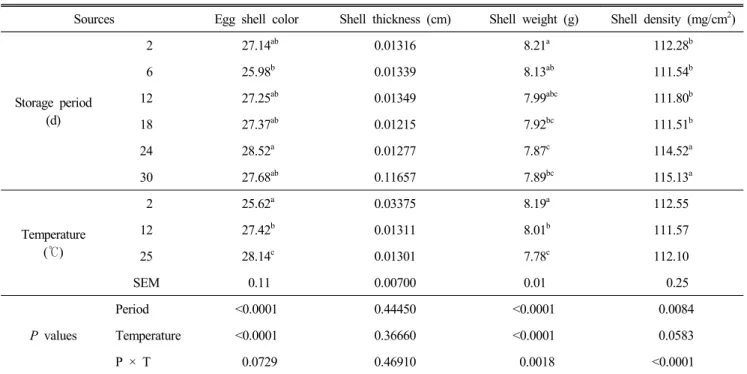
The effects of storage period and temperature on egg quality traits are shown in Table 1, 2 and 3. The storage period and temperature significantly affected almost all of parameters of internal and external egg quality. Egg weight, shell weight, albumen height, HU and albumen viscosity significantly de- creased with increased storage period and temperature (p<0.01).

However, the albumen and yolk pH significantly increased

with increasing storage period and temperature. Egg shell

density and yolk color significantly increased with storage

period. The interaction effects between storage period and

temperature were significant for shell weight, shell density,

egg weight, albumen height, HU, yolk color, yolk pH, albumen

(3)

Table 1. Effects of the storage period and temperature on the egg shell qualities

Sources Egg shell color Shell thickness (cm) Shell weight (g) Shell density (mg/cm

2

)

Storage period (d)

2 27.14

ab

0.01316 8.21

a

112.28

b

6 25.98

b

0.01339 8.13

ab

111.54

b

12 27.25

ab

0.01349 7.99

abc

111.80

b

18 27.37

ab

0.01215 7.92

bc

111.51

b

24 28.52

a

0.01277 7.87

c

114.52

a

30 27.68

ab

0.11657 7.89

bc

115.13

a

Temperature ( ℃)

2 25.62

a

0.03375 8.19

a

112.55

12 27.42

b

0.01311 8.01

b

111.57

25 28.14

c

0.01301 7.78

c

112.10

SEM 0.11 0.00700 0.01 0.25

P values

Period <0.0001 0.44450 <0.0001 0.0084

Temperature <0.0001 0.36660 <0.0001 0.0583

P × T 0.0729 0.46910 0.0018 <0.0001

Table 2. Effects of the storage period and temperature on internal egg qualities

Sources Egg weight (g) Albumen height (mm) Haugh unit Yolk color

Storage period (d)

2 61.99

a

7.51

a

85.04

a

6.14

e

6 61.68

a

6.51

b

77.66

b

5.46

d

12 59.97

b

5.87

c

72.28

c

7.07

c

18 59.27

b

5.42

cd

67.04

d

7.12

bc

24 57.78

c

5.30

d

68.67

d

7.67

a

30 57.58

c

5.04

d

64.56

e

7.34

ab

Temperature ( ℃)

2 61.52

a

7.78

a

87.03

a

7.00

a

12 60.25

b

6.26

b

77.17

b

6.76

b

25 57.37

c

3.42

c

50.08

c

6.41

c

SEM 0.09 0.05 0.46 0.03

P values

Period <0.0001 <0.0001 <0.0001 <0.0001

Temperature <0.0001 <0.0001 <0.0001 <0.0001

P × T <0.0001 <0.0001 <0.0001 <0.0001

pH and albumen viscosity (p<0.05).

For the interaction effects on egg qualities, egg weight was not significantly decreased by storage from 0 to 10 d at 2℃

and 12℃. When the storage temperature was increased to 25

℃, however, the egg weight dramatically decreased from 62.9

to 52.6 g at 2 and 30 d of storage period (Fig. 1). These re-

sults are in agreement with those of Jin et al. (2011) and Samli

et al. (2005), who reported significant egg weight reductions

of approximately 3% within 10 d of storage at 29℃. Similar

weight losses were also reported by Akyurek and Okur (2009).

(4)

Table 3. Effects of storage period and temperature on the phy- siochemical properties of eggs

Sources Yolk

pH

Albumen pH

Albumen viscosity Storage

period (d)

10 5.46

b

8.46

b

7.03

a

20 5.76

a

8.60

a

3.55

b

30 5.73

a

8.31

c

3.98

b

Temper ature

( ℃)

2 5.64 8.03

c

7.79

a

12 5.62 8.68

b

5.23

b

25 5.68 8.83

a

0.31

c

SEM 0.02 0.05 0.55

P values

Period <0.0001 <0.0001 <0.0001 Temperature 0.0229 <0.0001 <0.0001 P × T 0.0315 <0.0001 0.0165

2 ℃ 12 ℃ 25 ℃

Fig. 1. The interaction effect of storage period and temperature on egg weight.

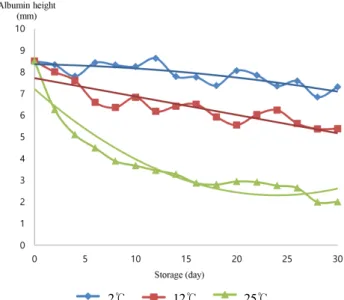
Significant deteriorations were observed in albumen height and HU due to storage period and temperature. The albumen height decreased from 8.5 to 7.3 mm at 2℃ and from 8.5 to 5.4 mm at 12℃ during 30 d of storage, and this decline was further extended to 2 mm at 25℃ storage (Fig. 2). The patterns of HU were similar as those of albumen height.

Storage at temperatures greater than 12 ℃ also caused con- siderable deterioration in HU, which decreased from 91.5 to 84.6 at 2 ℃ and from 91.5 to 70.7 at 12℃ and to 32 at 25℃

during 30 d of storage. The HU decreased below 70 from 4 d storage at 25℃ (Fig. 3). These results were consistent with

2 ℃ 12 ℃ 25 ℃

Fig. 2. The interaction effect of storage period and temperature on egg albumen height.

previous studies (Tona et al., 2004; Jones and Musgrove, 2005; Akyurek and Okur, 2009; Shin et al., 2012). Scott and Silversides (2000) reported a significant decrease from 9.16 to 4.75 mm in albumen height during 10 d storage at room temperature. Samli et al. (2005) reported that the albumen height decreased from 8.6 to 6.2 at 5℃ during 10 d of storage, and this decline was further extended to 3.8 and 2.8 at 21 and 29℃ storage. Jin et al. (2011) demonstrated that

2 ℃ 12 ℃ 25 ℃

Fig. 3. The interaction effect of storage period and temperature

on the Haugh unit of eggs.

(5)

HU decreased from 91.3 to 72.63 at 21℃ and from 87.62 to 60.92 at 29 ℃ during 10 d of storage, whereas no decline was found at 5℃. The results showed that the storage period and temperature adversely affected HU. According to the USDA- Agricultural Marketing Service guidelines (USDA-AMS, 2015), grade A determinations begin at HU less than 72. In our study, this level was not reached until after 30 d of storage at cold temperature. Jones et al. (2002) and Jones and Mus- grove (2005) reported that a decline to grade A in HU values in commercial eggs occurred after 6 wks of storage at refri- gerated temperatures.

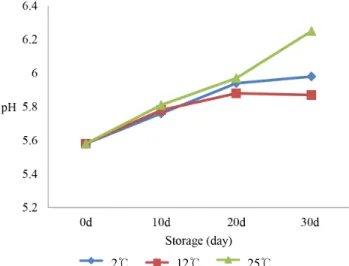
With respect to the effect of storage period and tempera- ture on the physiochemical properties of eggs, we observed a significant increase in albumen pH with increasing storage temperature and period (Fig. 4). The albumen pH is not affected by storage time at 2 ℃. Albumen alkalizing was ac- celerated by increasing storage temperature with the interaction of storage period. The yolk pH value significantly increased with increasing storage period (Fig. 5). High storage tempe- rature also significantly increased the yolk pH after 20 d.

Although the pH of the egg albumen and yolk increased along with the storage time and temperature, the changes of yolk pH were not as large as that of the albumen pH. Previous studies reported that the yolk pH was significantly affected by storage period but not by temperature (Samli et al., 2005;

Akyurel and Okur, 2009; Jin et al., 2011). Significant physical

2 ℃ 12 ℃ 25 ℃

Fig. 4. The interaction effect of storage period and temperature on egg albumen pH.

2 ℃ 12 ℃ 25 ℃

Fig. 5. The interaction effect of storage period and temperature on egg yolk pH.

changes occurred in the albumen viscosity with increasing temperature and storage period. Albumen viscosity was 19.7 in the fresh eggs but declined to 0.781 during 30 d of storage at 25℃. Albumen viscosity decreased rapidly during the first 10 d of storage at all storage temperatures. Increasing storage time and temperature diluted the egg albumen. Increasing the internal temperature of the egg results in breakdown of the protein structures of the thick albumen and vitelline mem- brane (Jones, 2007). Increasing storage time and temperature accelerates to the passage of some components of the albumen pass through the yolk membrane, reducing egg viscosity (Heath,

2 ℃ 12 ℃ 25 ℃

Fig. 6. The interaction effect of storage period and temperature

on the viscosity of the egg albumen.

(6)

1977; Ahn et al., 1999).

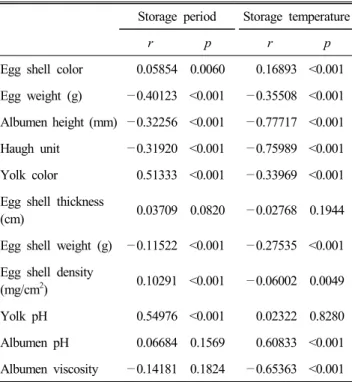
In this study, storage period and temperature significantly affected almost all of the internal and external egg quality parameters. As shown in Table 4, we calculated the correla- tion coefficients of storage period and temperature on egg quality traits. Storage time and temperature were negatively correlated with egg weight, albumen height, HU, egg shell weight and albumen viscosity but were positively correlated with egg shell color, yolk pH and albumen pH. Among these correlation coefficients, storage temperature showed the highest negative correlation coefficients with albumen height (r= — 0.78). The parameters of egg quality deterioration were simi- larly affected by storage time and temperature. However, the interaction effects between storage period and temperature were significant in most of the parameters of internal egg quality. As shown in Table 4 and Fig. 1 to 6, storage tem- perature was a more sensitive determinant of egg quality deterioration than storage period. Fig. 2 and 3 showed that the storage temperature was an absolute factor in determining the internal egg quality because the albumen height and HU dramatically decreased after being stored for 2 d at storage temperatures up to 25 ℃. Similar interaction effects also occu-

Table 4. Correlation coefficients of the storage period and tem- perature on egg quality traits

Storage period Storage temperature

r p r p

Egg shell color 0.05854 0.0060 0.16893 <0.001 Egg weight (g) —0.40123 <0.001 —0.35508 <0.001 Albumen height (mm) —0.32256 <0.001 —0.77717 <0.001 Haugh unit —0.31920 <0.001 —0.75989 <0.001 Yolk color 0.51333 <0.001 —0.33969 <0.001 Egg shell thickness

(cm) 0.03709 0.0820 —0.02768 0.1944

Egg shell weight (g) —0.11522 <0.001 —0.27535 <0.001 Egg shell density

(mg/cm

2

) 0.10291 <0.001 —0.06002 0.0049 Yolk pH 0.54976 <0.001 0.02322 0.8280 Albumen pH 0.06684 0.1569 0.60833 <0.001 Albumen viscosity —0.14181 0.1824 —0.65363 <0.001

rred for the albumen pH and albumen viscosity (Fig. 4 and 6).

With increasing storage period and temperature, the deteriora- tion of egg quality was attributed to water loss by evaporation through the pores in the shell and the escape of carbon dioxide from the albumen (Robinson, 1987; Samli et al., 2005). Con- sequently, the egg storage temperature and storage period are the most important factors to be considered to define the freshness of eggs.

ACKNOWLEDGENTS

This work was supported by Gyeongnam National Uni- versity of Science and Technology Grant 2014.

REFERENCES

Act No. 8852. Ordinance of the Ministry of Food, Agri- culture, Forestry and Fisheries. Livestock Industry Act.

Statutes of the Republic of Korea. Available from: http://

www.law.go.kr/lsInfoP.do?lsiSeq=136435#0000 Accessed Nov. 2, 2015.

Ahn DU, Sell JL, Jo C, Chamruspollert M, Jeffrey M 1999 Effect of dietary conjugated linoleic acid on the quality characteristics of chicken eggs during refrigerated storage.

Poult Sci 78: 922-928.

Ahn DU, Kim SK, Shu H 1997 Effect of egg size and strain and age of hen on the solids content of chicken eggs.

Poult Sci 76:914-919.

American Egg Board, Shell egg distribution. Available from:

http://www.aeb.org/egg-industry/industry-facts/egg-product ion-and-consumption Accessed Nov. 2, 2015.

Akyurek H, Okur AA 2009 Effect of storage time, tempe- rature and hen age on egg quality in free-range layer hens.

J Anim Vet Adv 8:1953-1958.

Carraro AC, Antunes AJ 2001 Unidade Haugh como medida da qualidade de ovos de galinha armazenados sob refri- geracao. Sci Agríc 58: 681-685.

Eisen EJ, Bohren BB, Mckean HE 1962 The Haugh unit as a measure of egg albumen quality. Poult Sci 41:1461-1468.

EUR-Lex. EU egg marketing regulations. Available from:

http://eur-lex.europa.eu/legal-content/en/ALL/?uri=CELEX

:32008R0589 Accessed Oct. 20, 2015.

(7)

Hammershoj M, Larsen LB, Andersen AB, Quvist KB 2002 Storage of shell eggs influences the albumen gelling pro- perties. LWT-Food Sci Technol 35:62-69.

Hartmann C, Johanson K, Strandberg E, Rydhmer L 2003 Genetic correlations between the maternal genetic effect on chick weight and the direct genetic effects on egg composition traits in a White Leghorn line. Poult Sci 82:

1-8.

Haugh RR 1937 The Haugh unit for measuring egg quality.

US Egg Poult Mag 43:522-555, 572-573.

Heath JL 1977 Chemical and related osmotic changes in egg albumen during storage. Poult Sci 56:822-828.

Hidalgo A, Rossi M, Pompei C 2006 Estimation of equi- valent egg age through furosine analysis. Food Chem 94:

608-612.

Huang Q, Qiu N, Ma MH, Jin YG, Yang H, Geng F, Sun SH 2012 Estimation of egg freshness using S-ovalbumin as an indicator. Poult Sci 91:739-743.

Hunton P 1987 Laboratory evaluations of egg quality. In: Egg Quality- Current Problems and Recent Advances. R. G.

Wells and C. G. Belyavin, ed. Butterworths, London. pp.

87-102.

Jin YH, Lee KT, Lee WI, Han YK 2011 Effects of storage temperature and time on the quality of eggs from laying hens at peak production. Asian-Aust J Anim Sci 24:279- 284.

Johnson AS, Merritt ES 1955 Heritability of albumen height and specific gravity of eggs from White Leghorns and Barred Rocks and the correlations of these traits with egg production. Poult Sci 34:578-587.

Jones DR, Musgrove MT 2005 Effects of extended storage on egg quality factor. Poult Sci 84:1774-1777.

Jones DR, Tharrington JB, Curtis PA, Anderson KE, Keener KM, Jones FT 2002 Effects of cryogenic cooling of shell eggs on egg quality. Poult Sci 81:727-733.

Jones DR 2007 Egg functionality and quality during long-term storage. Int J Poult Sci 6:157-162.

Karoui R, Kemps B, Bamelis F, De Ketelaere B, Decuypere E, De Baerdemaeker J 2006 Methods to evaluate egg freshness in research and industry: A review. Eur Food Res Technol 22:727-732.

Kirunda DFK, McKee SR 2000 Relating quality characteri-

stics of aged eggs and fresh eggs to vitelline membrane strength as determined by a texture analyzer. Poult Sci 79:

1189-1193.

Robinson DS 1987 The chemical basis of albumen quality.

In: Egg Quality-Current Problems and Recent Advances.

R. G. Wells and C. G. Belyavin, ed. Butterworths, London.

pp. 179-191.

Samli HE, Agma A, Senkoylu N 2005 Effects of storage time and temperature on egg quality in old laying hens. J Appl Poult Res 14:548-553.

Scott TA, Silversides FG 2000 The effect of storage and strain of hen on egg quality. Poult Sci 79:1725-1729.

Shin D, Narciso-Gaytán C, Regenstein JM, Sánchez-Plata MX 2012 Effect of various refrigeration temperatures on quality of shell eggs. J Sci Food Agric 92(7):1341-1345.

Silversides FG, Budgell K 2004 The relationships among mea- sures of egg albumen height, pH, and whipping volume.

Poult Sci 83:1619-1623.

Silversides FG, Scott TA 2001 Effect of storage and layer age on quality of eggs from two lines of hens. Poult Sci 80:1240-1245.

Silversides FG, Villeneuve P 1994 Is the Haugh unit correction for egg weight valid for eggs stored at room temperature?

Poult Sci 73:50-52.

Tona K, Onagbesan O, De Ketelaere B, Decuypere E, Brug- geman V 2004 Effects of age of broiler breeders and egg storage on egg quality, hatchability chick quality, chick weight and chick post hatch growth to 42 days. J Appl Poult Res 13:10-18.

United States Department of Agriculture, Agricultural Marke- ting Service (USDA-AMS), United States standards, grades, and weight classes for shell eggs. Available from: http://

www.ams.usda.gov/AMSv1.0/getfile?dDocName=STELDE V3004376 Accessed Oct. 20, 2015.

United States Department of Agriculture, Food Safety and In- spection Service (USDA-FSIS), Salmonella enteritidis risk assessment. Available from: http://www.fsis.usda.gov/ophs/

risk/ Accessed Oct. 20, 2015.

Walsh TJ, Rizk RE, Brake J 1995 Effects of temperature and carbon dioxide on albumen characteristics, weight loss, and early embryonic mortality of long stored hatching eggs.

Poult Sci 74:1403-1410.

(8)

Williams KC 1992 Some factors affecting albumen quality with particular reference to Haugh unit score. World’s Poult Sci J 48:5-16.

Wolc A, Arango J, Settar P, O’Sullivan NP, Olori VE, White IMS, Hill WG, Dekkers JCM 2012 Genetic parameters of egg defects and egg quality in layer chickens. Poult Sci 91:1292-1298.

Zhang LC, Ning ZH, Xu GY, Hou ZC, Yang N 2005 He-

ritabilities and genetic and phenotypic correlations of egg quality traits in brown-egg dwarf layers. Poult Sci 84:

1209-1213.

Received Feb. 17, 2016, Revised Feb. 19, 2016, Accepted

Mar. 9, 2016

수치

Table  1.  Effects  of  the  storage  period  and  temperature  on  the  egg  shell  qualities
Table  3.  Effects  of  storage  period  and  temperature  on  the  phy-  siochemical  properties  of  eggs
Fig.  4.  The  interaction  effect  of  storage  period  and  temperature  on  egg  albumen  pH.
Table  4.  Correlation  coefficients  of  the  storage  period  and  tem-  perature  on  egg  quality  traits

참조

관련 문서