녹차 추출물의 첨가가 간장 양념계육의 냉장 저장 중 이화학적 특성에 미치는 영향
김갑돈1․정진연2․정은영1․서현우1․김상호3․강근호3․최양호1,4․주선태1,4,†
1경상대학교 대학원 응용생명과학부(BK21),2진주산업대학교 양돈과학기술센터,
3농촌진흥청 국립축산과학원,4경상대학교 농업생명과학연구원
Effects of Addition of Green Tea Extracts on Physicochemical Properties of Seasoned Chicken with Soy Sauce during Cold Storage
Gap-Don Kim1, Jin-Yeon Jeong2, Eun-Young Jung1, Hyun-Woo Seo1, Sang-Ho Kim3, Guen-Ho Kang3, Yang-Ho Choi1,4 and Seon-Tea Joo1,4,†
1Division of Applied Life Science (BK21 Program), Gyeongsang National University, Jinju 660-701, Korea
2Swine Science and Technology Center, Jinju National University, Jinju 660-758, Korea
3National Institute of Animal Science, RDA, Korea
4Institute of Agriculture & Life Science, Gyeongsang National University, Jinju 660-701, Korea
ABSTRACT The objective of this study was to investigate the effects of addition of green tea extracts on physicochemical properties and shelf-life of seasoned chicken with soy sauce during cold storage. Treatments (C, T1 and T2) containing various levels (0, 1 and 2%, respectively) of green tea extracts were manufactured, and we investigated pH, meat color (L*, a*, b*), volatile basic nitrogen (VBN), thiobarbituric acid reactive substances (TBARS), total plate counts, fatty acid composition and sensory scores during cold storage for 16 days. T1 and T2 have more dark color than control during storage time. VBN, TBARS and total plate count of control were significantly higher than those of T1 and T2 at the latter storage time (p<0.05). Also, VBN, TBARS and total plate count of all treatments was increased with storage time. Linoleic acid was the highest value in control which had the highest value of TBARS in day 16 (p<0.05). Aroma value of control was significantly higher in storage time except day 16 than those of T1 and T2 (p<0.05). Acceptability value of control was significantly higher than those of T1 and T2 in day 4, 8 and 12 (p<0.05).
(Key words : green tea extract, seasoned chicken, soy sauce)
†To whom correspondence should be addressed : [email protected]
서 론
최근 식품산업은 소비자의 편리와 기호에 따라 간편하게 요리하여 먹거나 바로 먹을 수 있는 제품, 즉 ready-to-cook (RTC) 및 ready-to-eat(RTE) 식품에 큰 비중을 두고 있는 추 세다(Wong and Kitts, 2002). 양념육은 근육식품 중 RTC 식 품으로 우육, 돈육 및 계육을 이용하여 많이 제조되어 소비 되고 있으나, 양념육과 같이 RTC 식품이나 RTE 식품은 각 종 유해 미생물에 대해 안전성이 매우 낮다(Grant and Patter- son, 1992; Hao et al., 1998). 특히 계육은 다른 축종에 비하여 백색근섬유가 많은데(Nakamura et al., 2004), 백색근섬유가 많으면 단백질 변성이 쉽게 일어난다(Ryu et al., 2008). 따라 서 미생물 안전성이나 저장성을 높이기 위하여 가공 시에
각종 합성 보존제나 천연 물질을 첨가하는데, 일반적으로 항 균 및 항산화 기능뿐 아니라 식품의 향미 증진 기능이나 생 리활성 기능을 함께 가진 천연 물질 또는 식물 추출물을 선 호하고 있다. 이러한 기능을 하는 대표적인 물질로는 phenol 화합물, tocopherol, 녹차 추출물(Jo et al., 2003), lactoferrin (Branen and Davidson, 2000; Chantaysakorn and Richter, 2000) 및 각종 herbs (Lipsky, 2000) 등이 있다. 이 중 식품 보존제로 서의 기능과 생리활성 기능을 모두 갖추고 있는 녹차 추출 물이 식품에 널리 이용되고 있다.
녹차의 주요 성분은 flavonoid류를 비롯하여 anthoxanthin 류, anthocyanin류, leucoxanthin류 및 catechin류 등 다양한 물 질들이 있는데, 특히 catechin은 녹차의 25∼35%(건조 녹차 잎 기준, Nagle et al., 2006)를 차지하고 있는 polyphenol의 유
도체로서 항암(Katiyar and Mukhtar, 1996), 혈압 강하(Henry and Stephen-Larson, 1984), 항바이러스(Nakayama et al., 1993), 항산화(Yoshino et al., 1994), 혈당 강하(Matsumoto et al., 1993), 총콜레스테롤 및 중성지방 저하(Chan et al., 1999) 등 의 기능을 하며, 주요 catechin으로 epicatechin(EC), gallocate- chin(GC), epigallocatechin(EGC), epigallocatechin gallate(EGCG), gallocatechin gallate(GCG), epicatechin gallate(ECG) 및 cate- chin gallate (CG) 등이 있다. Catechin의 항산화 능력은 bu- tylated hydroxytoluene(BHT), butylated hydroxyanisole(BHA), tertiary butyl hydroquinone(TBHQ) 및 천연항산화물질인 vita- min E와 비슷한 것으로 보고되고 있다(Wanasundara and Sha- hidi, 1998).
따라서 본 연구는 다른 근육 가공 식품보다 미생물 안전성 이나 저장성에 취약한 RTC 식품의 하나인 양념계육에 있어 서 녹차 추출물의 첨가가 저온 저장 중 이화학적 특성 및 미생 물 안전성과 저장성에 미치는 영향을 알아보고자 실시하였다.
재료 및 방법 1. 녹차 추출물 제조
녹차는 경남 하동군에서 채취한 2번 차를 증제 가공한 것 을 사용하였으며, 녹차 200 g에 증류수 1,000 mL를 가하여 95℃에서 1시간 동안 환류 냉각 장치(EYELA, Tokyo Rikaki- kai Co. Japan)를 이용하여 추출하고, 여과지(Whatman No. 2) 를 이용하여 여과한 후 사용하였다.
2. 양념육 제조
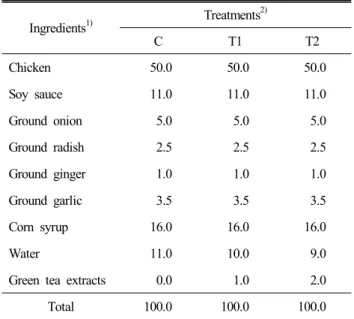
도계장에서 구입한 계육의 흉근을 발골하여 양념육의 원 료로 사용하였으며, 양념은 시중의 대형유통매장에서 구입 하여 사용하였다. 녹차 추출물의 첨가 수준은 원료육에 대한 중량비로 처리구별로 각각 0, 1, 2%로 하였으며, Table 1에 따 라 양념육을 제조하였다. 제조한 양념육은 polyethylene film 포장지로 진공포장하여 저온 저장실(0~2℃)에서 16일 동안 저장하며 양념육의 품질 특성을 조사하였다.
3. 실험 항목 및 방법
1) pH
시료 3 g을 증류수 27 mL와 함께 균질기(T25-Basic, IKA, Malaysis)로 14,000 rpm에서 균질하여 pH-meter(MP230, Mett- ler Toledo, Switzerland)로 측정하였다.
Table 1. Formula for the manufacture of seasoned chicken with soy sauce containing different levels of green tea extracts
Ingredients1)
Treatments2)
C T1 T2
Chicken 50.0 50.0 50.0
Soy sauce 11.0 11.0 11.0
Ground onion 5.0 5.0 5.0
Ground radish 2.5 2.5 2.5
Ground ginger 1.0 1.0 1.0
Ground garlic 3.5 3.5 3.5
Corn syrup 16.0 16.0 16.0
Water 11.0 10.0 9.0
Green tea extracts 0.0 1.0 2.0
Total 100.0 100.0 100.0
1)Unit : %.
2)C: Control (without green tea extracts); T1: 1.0% green tea extracts added on chicken content; T2: 2.0% green tea extracts added on chicken content.
2) 육색
Chromameter(CR-300, Minolta Co., Japan)를 사용하여 동일 한 방법으로 5회 반복 측정으로 명도(L*), 적색도(a*) 및 황색 도(b*)값을 조사하였고, 표준색판은 Y=93.5, a=0.3132, y=
0.3198였다.
3) Volatile Basic Nitrogen (VBN)
Conway 미량 확산법을 이용하여 시료 10 g에 증류수 90 mL를 가하여 균질한 후 Whatman No. 1로 여과하여 100 mL 로 정용한 용액 1 mL를 Conway unit 외실에 넣고, 내실에는 0.01 N H2BO3 1 mL와 지시약(0.066% methyl red+0.066% bro- mocresol green in ethanol=1:1)을 40 μL 가하였다. 5% K2CO3
1 mL를 외실에 주입 후 즉시 밀폐시켜 37 ℃에서 2시간 동 안 반응시키고 0.02 N H2SO4로 내실의 H2BO3를 적정하였다.
4) Thiobarbituric Acid Reactive Substances (TBARS)
Burge and Aust(1978)의 방법에 의해 시료 5 g에 butylated hydroxyanisole 50 μL와 증류수 15 mL를 가하여 균질화 시 킨 후, 균질액 1 mL와 2 mL의 thiobarbituric acid/trichloro- acetic acid 혼합용액을 넣어 혼합한다. 혼합용액을 90℃의 항
온소조에서 15분간 반응시킨 후, 냉각시켜 3,000 rpm에서 10 분간 원심분리 후 상층액을 회수하여 531 nm에서 흡광도를 측정하여 계산하였다.
TBARS=흡광도 수치×5.88
5) 미생물 총 균 수
양념육 저장 중의 미생물 증식 정도를 측정하기 위하여 시료 20 g에 0.1% 멸균 peptone수 180 mL를 첨가하여 stoma- cher를 이용하여 1분간 균질화 하였고, 0.1% 멸균 peptone 수 를 이용하여 단계 희석하였다. Plate count agar(DifcoTM, Bec- ton, Dickinson and Company, USA)에 도말하여 36℃에서 48
Table 2. Gas Chromatography condition for analysis of fatty acid composition
Items Condition
Model Hewlett Packard 6890N Gas
Chromatography
Column Supelco waxTM 10 fused silica capillary column
60 mm × 0.32 mm × 0.25 μm film thickness
Detector/temperature Flame Ionization Detector (FID)/250℃ Initial temperature/time 180℃/6 min
Rate 5℃/min
Final temperature/time 240℃/20 min Injector temperature 250℃
Carrier gas N2
Split ratio 10:1
Table 3. Changes in pH values of seasoned chicken containing different levels of green tea extracts during cold storage for 16 days
Items Treatments1)
Storage days
1 4 8 12 16
pH
C 6.20±0.01Ba 6.18±0.02Aab 6.16±0.01Ab 6.10±0.01Bb 6.16±0.03Bb
T1 6.29±0.02Aa 6.14±0.05Ac 6.10±0.02Bc 6.13±0.01Ac 6.22±0.01Ab
T2 6.09±0.01Cb 6.04±0.01Bc 6.05±0.02Cc 6.09±0.01Bb 6.16±0.01Ba
1)Treatments are the same as in Table 1.
A~CMeans±SD with different superscripts in the same row are significantly different (p<0.05).
a~cMeans±SD with different superscripts in the same column are significantly different (p<0.05).
시간 배양시켰다(1979).
6) 지방산 조성
지방산 조성은 먼저 Folch et al.(1957)의 방법에 따라 시료 로부터 지질을 추출하여 Morrison and Smith(1964)의 방법으 로 methylation하여 gas chromatography(6890N, Agilent Tech- nologies, Germany)로 분석하였고, gas chromatography 조건은 Table 2와 같다.
7) 관능평가
관능 평가는 잘 훈련된 관능 평가 요원 10명을 선발하여 각 시험구별로 9점 척도묘사분석(descriptive analysis with scaling)으로 양념육의 향, 불쾌취, 다즙성, 연도 및 종합적 기 호도를 평가하였다.
4. 통계 분석
본 실험의 결과는 SAS/PC(SAS, 1999)를 이용하여 분산분 석을 수행하였고, 평균간 유의성 검정은 Duncan의 Multiple range test로 처리간의 결과 차이를 분석하였다.
결과 및 고찰 1. pH의 변화
녹차 추출물을 첨가한 양념계육의 저장 중 pH 변화를 Ta- ble 3에 나타내었는데, 모든 처리구가 저장 기간이 증가함에 따라 pH가 감소하였다가 다시 증가하였고, 처리구별 차이에 있어서는 T1 처리구가 저장 8일을 제외한 모든 저장 기간에 가장 높은 값을 나타내었으며(p<0.05), T2 처리구는 저장 기간 동안 가장 낮은 값을 나타내었다(p<0.05). 양념으로 사용된 간장 내 여러 가지 물질의 가수 분해로 인해 발생되는 펩타
이드, 아미노산 및 유리지방산 등(Shieh et al., 1982)과 미생물 성장에 따른 젖산 생성(Langlosis and Kemp, 1974)이 pH를 감소시킨다는 보고와 달리 Deymer and Vandekerckove(1979) 에 따르면 단백질 완충 물질의 변화, 전해질 해리의 감소 및 아미노산 분해에 따른 염기성기의 노출로 인해 pH가 오히려 상승한다고 했는데, 본 연구에서는 저장 초기에는 간장에 포 함된 물질의 영향 및 미생물의 성장에 따라 pH가 감소하였 다가 양념계육 내 단백질의 분해 등으로 pH가 다시 증가한 것으로 사료된다.
2. 육색
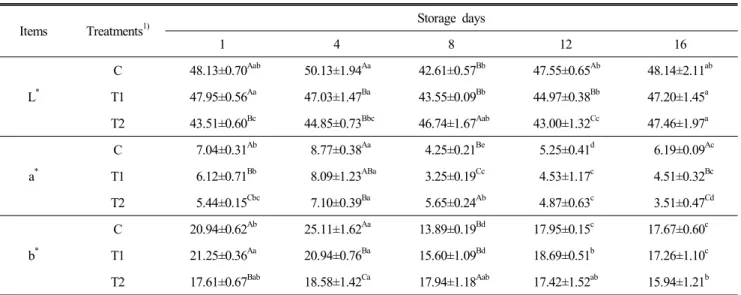
Table 4에 저장 중 육색(L*, a*, b*)의 변화를 나타내었는데, 명도(L*)에 있어서는 대조구가 저장 8일 및 16일을 제외하고 가장 높은 값을 나타내었고(p<0.05), 저장 16일에는 처리구 간 유의적인 차이를 나타내지 않았다(p>0.05). 저장 기간에 따라 대조구와 T1 처리구는 저장 8일 및 12일에 낮은 값을 나타내었고(p<0.05), T2 처리구는 저장 1일 및 12일에 가장 낮은 값을 나타내었다(p<0.05). 적색도(a*)는 대조구가 저장 8일 및 12일을 제외하고 유의적으로 가장 높은 값을 나타내 었고(p<0.05), 저장 12일에는 처리구간 차이를 보이지 않았 다(p>0.05). 모든 처리구는 저장 초기(1일, 4일)의 적색도(a*) 가 저장 후기보다 상대적으로 높은 값을 나타내었다(p< 0.05).
한편, 황색도(b*)의 경우, 저장 1일 및 4일에는 대조구가 가
Table 4. Changes in CIE L*, a* and b* values of seasoned chicken containing different levels of green tea extracts during cold storage for 16 days
Items Treatments1)
Storage days
1 4 8 12 16
L*
C 48.13±0.70Aab 50.13±1.94Aa 42.61±0.57Bb 47.55±0.65Ab 48.14±2.11ab
T1 47.95±0.56Aa 47.03±1.47Ba 43.55±0.09Bb 44.97±0.38Bb 47.20±1.45a
T2 43.51±0.60Bc 44.85±0.73Bbc 46.74±1.67Aab 43.00±1.32Cc 47.46±1.97a
a*
C 7.04±0.31Ab 8.77±0.38Aa 4.25±0.21Be 5.25±0.41d 6.19±0.09Ac
T1 6.12±0.71Bb 8.09±1.23ABa 3.25±0.19Cc 4.53±1.17c 4.51±0.32Bc T2 5.44±0.15Cbc 7.10±0.39Ba 5.65±0.24Ab 4.87±0.63c 3.51±0.47Cd
b*
C 20.94±0.62Ab 25.11±1.62Aa 13.89±0.19Bd 17.95±0.15c 17.67±0.60c
T1 21.25±0.36Aa 20.94±0.76Ba 15.60±1.09Bd 18.69±0.51b 17.26±1.10c
T2 17.61±0.67Bab 18.58±1.42Ca 17.94±1.18Aab 17.42±1.52ab 15.94±1.21b
1)Treatments are the same as in Table 1.
A~CMeans±SD with different superscripts in the same row are significantly different (p<0.05).
a~eMeans±SD with different superscripts in the same column are significantly different (p<0.05).
장 높은 값을 나타내었고(p<0.05), 저장 8일에는 T2 처리구 가 가장 높은 값을 나타낸(p>0.05) 반면, 저장 12일 및 16일 에는 처리구간 유의적인 차이를 나타내지 않았다(p>0.05).
Jo et al.(2003)에 따르면 녹차 분말이 돈육 패티의 육색을 다 소 암적색으로 만든다고 하였는데, 본 연구의 결과 저장 초 기에 녹차 추출물을 첨가하지 않은 대조구가 L*, a*, b*모두 높은 값을 나타내었다. 따라서 녹차 추출물이 양념계육의 색 을 다소 어둡게 하였고, 저장 후기에는 a*(저장 16일)를 제외 하고는 처리구간 차이가 없는 것을 알 수가 있는데, 이는 녹 차 성분이 시간이 경과함에 따라 자가 분해 또는 미생물에 의한 분해로 인해 그 영향이 미미해진 것으로 사료된다. 한 편, Yin et al.(1993)는 Oxymyoglobin의 산화에 의한 metmyo- globin의 생성은 지방산화와 관계가 있고, 이는 항산화제의 상태에 영향을 받는다고 했으며, Greene(1969)은 식육에서 항산화제가 식육의 육색을 보호한다고 했으나, 본 연구에서 는 녹차 추출물이 항산화제로서의 기능은 하더라도 녹차 추 출물 특유의 짙고 어두운 색으로 인해 양념계육에서 myo- globin의 안정성 및 육색 보호에는 큰 영향을 미치지 못한 것 으로 사료된다.
3. VBN, TBARS 및 총균
각종 근육식품에서는 단백질의 가수분해에 따른 아미노산 과 펩타이드의 증가 및 Pseudomonas geniculata 등과 같은
Gram 음성균에 의한 요소 및 아미노산의 분해(Lefebvre et al., 1994)로 인해 휘발성 염기태 질소 화합물이 형성되는데, 이에 따라 저장 기간이 증가함에 따라 VBN이 모든 처리구에서 증 가(p<0.05)하는 것을 Fig. 1에서 알 수가 있다. 한편, 처리구 간 차이는 저장 16일에만 대조구가 T1 및 T2 보다 유의적으 로 높은 값을 나타내었을 뿐(p<0.05), 다른 기간에는 처리구 간 차이가 나타나지 않았다(p>0.05). 이러한 결과는 녹차 추 출물을 첨가하지 않은 대조구가 저장 후기에 T1 및 T2 처리 구에 비해 유의적으로 높은 값을 나타낸 미생물의 결과(Fig.
3)처럼 녹차 성분의 항균 기능(Banon et al., 2007)이 미생물 의 결과에 영향을 미치고, 이것은 또 VBN의 결과에 다소 영 향을 준 것으로 사료된다.
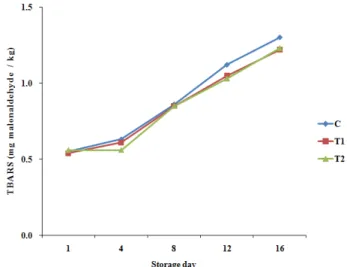
한편, 지방산패도를 나타내는 TBARS는 Fig. 2에 결과를 나타내었다. 처리구간 차이는 저장 4일, 12일 및 16일에 대 조구가 유의적으로 가장 높은 값을 나타내었고(p<0.05), 저장 1일 및 8일에는 처리구간 차이를 나타내지 않았다(p>0.05).
저장 기간이 증가함에 따라서는 모든 처리구가 점진적으로 증가하는 결과를 나타내었다(p<0.05). 처리구간 차이는 녹차 catechin 물질의 항산화 작용(McCarthy et al., 2001; Yoshino et al., 1994)에 의한 것으로 사료된다.
미생물의 변화(Fig. 3)에서는 대조구가 저장 4일, 12일 및 16일에 가장 높은 값을 나타내었고(p<0.05), 모든 처리구가 저장 기간이 증가함에 따라 증가한 것을 알 수가 있었다 (p<0.05). 처리구간 미생물의 차이는 TBARS의 결과와 비슷
Fig. 1. Changes in VBN values of seasoned chicken containing di- fferent levels of green tea extracts during cold storage for 16 days. The differences among the treatments are significant at 16 of storage day (p<0.05). Treatments are the same as in Table 1.
한 경향을 나타내었는데, 저장 기간 동안 대체로 녹차 추출 물을 첨가한 처리구가 대조구에 비해 미생물의 증식 정도가 더 낮은 것을 알 수가 있다. 이는 녹차 catechin 물질의 항균 작용(Banon et al., 2007)에 의한 것으로 사료된다. 따라서 이 로 인한 미생물의 결과는 또한 전술한 바와 같이 pH 및 VBN 의 결과에도 영향을 준 것으로 사료된다.
Fig. 2. Changes in TBARS values of seasoned chicken containing different levels of green tea extracts during cold storage for 16 days. The differences among the treatments are significant at 4, 12 and 16 of storage day (p<0.05). Treatments are the same as in Table 1.
Fig. 3. Changes in total plate count values of seasoned chicken con- taining different levels of green tea extracts during cold sto- rage for 16 days. The differences among the treatments are significant at 4, 12 and 16 of storage day (p<0.05). Treat- ments are the same as in Table 1.
4. 지방산 조성
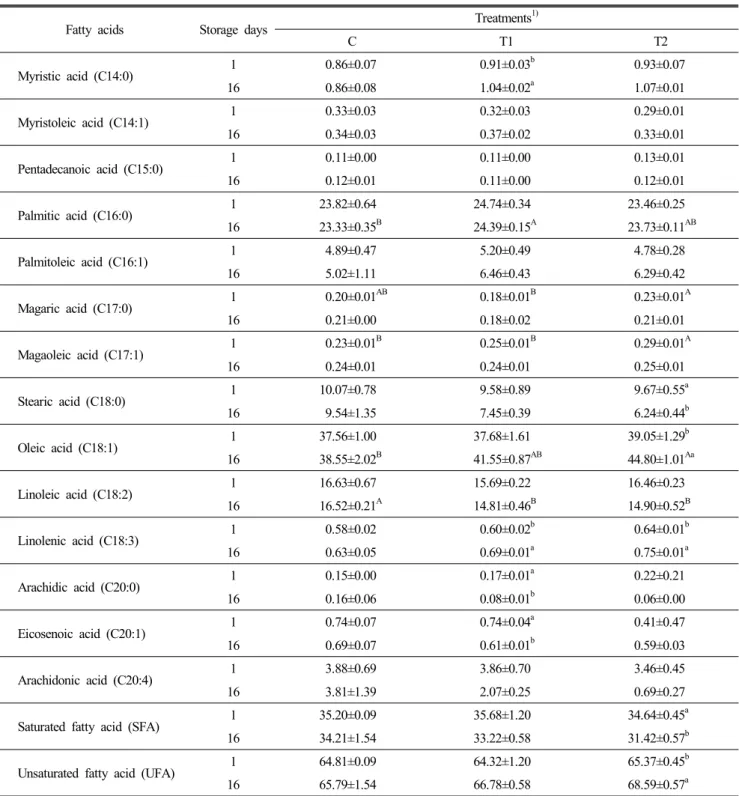
저장 1일 및 16일의 양념계육 지방산 조성을 Table 5에 나
Table 5. Fatty acid composition of seasoned chicken containing different levels of green tea extracts at 1 and 16 day
Fatty acids Storage days Treatments1)
C T1 T2
Myristic acid (C14:0) 1 0.86±0.07 0.91±0.03b 0.93±0.07
16 0.86±0.08 1.04±0.02a 1.07±0.01
Myristoleic acid (C14:1) 1 0.33±0.03 0.32±0.03 0.29±0.01
16 0.34±0.03 0.37±0.02 0.33±0.01
Pentadecanoic acid (C15:0) 1 0.11±0.00 0.11±0.00 0.13±0.01
16 0.12±0.01 0.11±0.00 0.12±0.01
Palmitic acid (C16:0) 1 23.82±0.64 24.74±0.34 23.46±0.25
16 23.33±0.35B 24.39±0.15A 23.73±0.11AB
Palmitoleic acid (C16:1) 1 4.89±0.47 5.20±0.49 4.78±0.28
16 5.02±1.11 6.46±0.43 6.29±0.42
Magaric acid (C17:0) 1 0.20±0.01AB 0.18±0.01B 0.23±0.01A
16 0.21±0.00 0.18±0.02 0.21±0.01
Magaoleic acid (C17:1) 1 0.23±0.01B 0.25±0.01B 0.29±0.01A
16 0.24±0.01 0.24±0.01 0.25±0.01
Stearic acid (C18:0) 1 10.07±0.78 9.58±0.89 9.67±0.55a
16 9.54±1.35 7.45±0.39 6.24±0.44b
Oleic acid (C18:1) 1 37.56±1.00 37.68±1.61 39.05±1.29b
16 38.55±2.02B 41.55±0.87AB 44.80±1.01Aa
Linoleic acid (C18:2) 1 16.63±0.67 15.69±0.22 16.46±0.23
16 16.52±0.21A 14.81±0.46B 14.90±0.52B
Linolenic acid (C18:3) 1 0.58±0.02 0.60±0.02b 0.64±0.01b
16 0.63±0.05 0.69±0.01a 0.75±0.01a
Arachidic acid (C20:0) 1 0.15±0.00 0.17±0.01a 0.22±0.21
16 0.16±0.06 0.08±0.01b 0.06±0.00
Eicosenoic acid (C20:1) 1 0.74±0.07 0.74±0.04a 0.41±0.47
16 0.69±0.07 0.61±0.01b 0.59±0.03
Arachidonic acid (C20:4) 1 3.88±0.69 3.86±0.70 3.46±0.45
16 3.81±1.39 2.07±0.25 0.69±0.27
Saturated fatty acid (SFA) 1 35.20±0.09 35.68±1.20 34.64±0.45a
16 34.21±1.54 33.22±0.58 31.42±0.57b
Unsaturated fatty acid (UFA) 1 64.81±0.09 64.32±1.20 65.37±0.45b
16 65.79±1.54 66.78±0.58 68.59±0.57a
1)Treatments are the same as in Table 1.
A,BMeans±SD with different superscripts in the same column are significantly different (p<0.05).
a,bMeans±SD with different superscripts in the same row are significantly different (p<0.05).
타내었다. 저장 1일에는 T1 처리구가 margaric acid 및 ma- gaoleic acid에서 가장 높은 값을 나타내었고(p<0.05), 저장
16일에는 palmitic acid, oleic acid 및 linoleic acid에서 처리구 간 유의적인 차이(p<0.05)를 보였는데, 대조구는 palmitic acid와 oleic acid에서는 가장 낮은 값을 보였으나 linoleic acid 에서는 가장 높은 값을 나타내었다(p<0.05). 저장 기간의 증 가에 따른 변화는 T1 및 T2 처리구에서 나타났는데, T1 처리 구의 경우 myristic acid 및 linolenic acid는 저장 초기보다는 후기가 더 높은 비율(%)을 나타내었고, arachidic acid 및 eico- senoic acid는 낮은 비율(%)을 나타내었다(p<0.05). T2 처리 구에서는 stearic acid 및 포화 지방산의 비율(%)이 저장 후기 에 낮은 값을 나타낸 반면, oleic acid, linoleic acid 및 불포화 지방산의 비율(%)은 높은 값을 나타내었다(p<0.05). Elmore et al.(1999)은 불포화도가 높을수록 유리라디칼의 생성이 많 고, 다가불포화지방산이 풍부할수록 산화가 쉽게 일어난다 고 하였는데, 불포화지방산 중 oleic acid(C18:1)에 이어 비율 (%)이 높은 linoleic acid(C18:2)의 경우 저장 16일에 대조구 가 가장 높은 값을 나타내었는데(p<0.05), 이 때 지방산패도
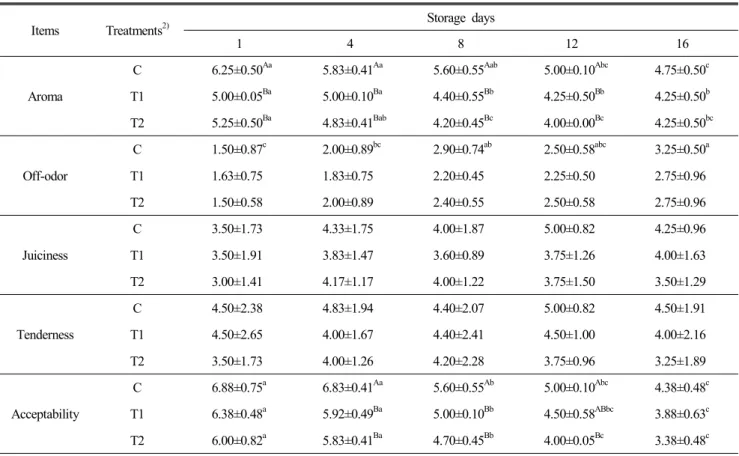
Table 6. Sensory scores1) changes of seasoned chicken containing different levels of green tea extracts during cold storage for 16 days
Items Treatments2)
Storage days
1 4 8 12 16
Aroma
C 6.25±0.50Aa 5.83±0.41Aa 5.60±0.55Aab 5.00±0.10Abc 4.75±0.50c
T1 5.00±0.05Ba 5.00±0.10Ba 4.40±0.55Bb 4.25±0.50Bb 4.25±0.50b
T2 5.25±0.50Ba 4.83±0.41Bab 4.20±0.45Bc 4.00±0.00Bc 4.25±0.50bc
Off-odor
C 1.50±0.87c 2.00±0.89bc 2.90±0.74ab 2.50±0.58abc 3.25±0.50a
T1 1.63±0.75 1.83±0.75 2.20±0.45 2.25±0.50 2.75±0.96
T2 1.50±0.58 2.00±0.89 2.40±0.55 2.50±0.58 2.75±0.96
Juiciness
C 3.50±1.73 4.33±1.75 4.00±1.87 5.00±0.82 4.25±0.96
T1 3.50±1.91 3.83±1.47 3.60±0.89 3.75±1.26 4.00±1.63
T2 3.00±1.41 4.17±1.17 4.00±1.22 3.75±1.50 3.50±1.29
Tenderness
C 4.50±2.38 4.83±1.94 4.40±2.07 5.00±0.82 4.50±1.91
T1 4.50±2.65 4.00±1.67 4.40±2.41 4.50±1.00 4.00±2.16
T2 3.50±1.73 4.00±1.26 4.20±2.28 3.75±0.96 3.25±1.89
Acceptability
C 6.88±0.75a 6.83±0.41Aa 5.60±0.55Ab 5.00±0.10Abc 4.38±0.48c
T1 6.38±0.48a 5.92±0.49Ba 5.00±0.10Bb 4.50±0.58ABbc 3.88±0.63c
T2 6.00±0.82a 5.83±0.41Ba 4.70±0.45Bb 4.00±0.05Bc 3.38±0.48c
1)Sensory scores were assessed on 9 point scale where 1=extremely low, 9=extremely high.
2)Treatments are the same as in Table 1.
A,BMeans±SD with different superscripts in the same row are significantly different (p<0.05).
a~cMeans±SD with different superscripts in the same column are significantly different (p<0.05).
(TBARS)에서도 대조구가 가장 높은 값을 나타내었다(p<
0.05).
5. 관능적 특성
Table 6에 녹차 추출물을 첨가한 양념계육의 저장 기간 중 관능평가의 결과를 나타내었는데, 향에 있어서는 저장 16일 을 제외하고 대조구가 가장 높은 값을 나타내었고(p<0.05), 모든 처리구가 저장 후기보다 초기에 높은 값을 나타내었다 (p<0.05). 불쾌취는 저장 기간 동안 처리구간 차이를 나타내 지 않았고(p>0.05), 저장 기간의 증가에 따른 변화는 대조구 에서 저장 초기보다 후기에 더 높은 결과를 나타내었다(p<
0.05). 다즙성과 연도에서는 유의적인 차이를 나타내지 않았 고(p>0.05), 종합적인 기호도는 저장 기간이 증가함에 따라 모든 처리구가 낮은 값을 나타내었으며(p<0.05), 저장 4일, 8 일 및 12일에 녹차 추출물을 첨가한 T1 및 T2 처리구보다 대 조구의 기호도가 더 높은 결과를 나타내었다(p<0.05). 이러
한 결과는 녹차 특유의 냄새가 강하여 양념 냄새를 다소 상 쇄시킨 것으로 사료되며, 짙고 어두운 녹차 추출물의 색이 양념계육의 색을 다소 어둡게 만들어 기호성을 떨어뜨린 것 으로 판단된다. 이러한 녹차 특유의 색과 냄새에 대한 문제 는 방사선 조사(Jo et al., 2003) 등의 방법으로 해결할 수가 있을 것으로 사료된다.
적 요
Ready-to-cook 식품으로 미생물 안전성이나 저장성이 상 대적으로 낮은 양념계육에 녹차 추출물을 첨가함으로써 냉 장 저장 기간 동안 녹차 catechin류에 의한 양념계육의 미생 물 안전성 및 저장성 등에 대한 효과를 조사하였다. pH는 모 든 처리구가 저장 기간의 증가에 따라 감소하였다가 다시 증가하였고, 육색에 있어서는 녹차 추출물이 양념계육을 다 소 어둡게 하였으며, 저장 후기에는 a*를 제외하고 처리구간 차이를 나타내지 않았다(p>0.05). VBN, TBARS 및 총균의 변화에서는 저장 후기에 대조구가 T1 및 T2 처리구에 비해 유의적으로 높은 값을 나타내었다(p<0.05). TBARS의 값이 다른 처리구보다 높은 값을 나타내었던 대조구의 저장 16일 지방산 조성의 변화는 linoleic acid에서 가장 높은 값을 나타 내었다(p<0.05). 녹차 특유의 짙은 색과 냄새로 인해 양념계 육의 향을 다소 없애고 기호도를 떨어뜨린 결과를 나타내었 다. 따라서 녹차 추출물이 양념계육의 미생물 안전성 및 저 장성 증대에 효과가 있었으나, 향 및 기호성에는 부정적인 영향을 미친 것으로 나타났다.
(색인어 : 녹차 추출물, 양념계육, 저장 품질)
사 사
본 연구는 농림수산식품부 농림기술개발사업(106127-03- SB-010)의 지원에 의해 이루어졌으며, 김갑돈, 서현우, 정은 영은 교육인적자원부 제2단계 BK21 사업의 장학금을 수혜 받았습니다.
인용문헌
Banon S, Diaz P, Rodriguez M, Garrido MR, Price A 2007 Ascorbate, green tea and grape seed extracts increase the
shelf life of low sulphite beef patties. Meat Sci 77:626-633.
Branen J, Davidson PM 2000 Activity of hydrolyzed lactoferrin against foodborne pathogenic acteria in growth media: The effect of EDTA. Letters in Applied Microbiology 30:233- 237.
Buege JA, Aust SD 1978 Microsomal lipid peroxidation. Me- thods in Enzymology 52: 302-310.
Chan PT, Fong WP, Cheung YL, Huang Y, Ho WKK, Chen ZY 1999 Jasmine green tea epicatechins are hypolipidemic in amsters (Mesocricetus auratus) fed a high fat diet. J Nutr 129:1094-1101.
Chantaysakorn P, Richter RL 2000 Antimicrobial properties of pepsin-digested lactoferrin added to carrot juice and filtrates of carrot juice. J Food Protection 63:376-380.
Deymer DI, Vandekerckhove P 1979 Compounds determining pH in dry sausage. Meat Sci 3:161.
Elmore JS, Mottram DS, Enser M, Wood JD 1999 Effect of polyunsaturated fatty acid composition of beef muscle on the profile of aroma volatiles. J Agricultural and Food Chem 47:1619-1625.
Folch J, Lees M, Sloane-Stanley GH 1957 A simple method for the isolation and purification of total lipid from animal tissue.
J Biol Chem 26:497-507.
Grant I, Patterson M 1992 Sensitivity of foodborne pathogens to irradiation in the components of a chilled ready meal.
Food Microbiology 9:95-103.
Greene BE 1969 Lipid oxidation and pigment changes in raw beef. J Food Sci 34; 110-112.
Hao YY, Brackett R, Doyle M 1998 Inhibition of Listeria monocytogenes and Aermonans ydrophila by plant extracts in refrigerated cooked beef. Food Microbiology 9:95-103.
Henry JP, Stephen-Larson P 1984 Reduction of chronic psycho- social hypertension in mice by decaffeinated tea. Hyperten- sion 6:37-444.
Jo C, Son JH, Son CB, Byun MW 2003 Functional properties of raw and cooked pork patties with added irradiated, freeze- dried green tea leaf extract powder during storage at 4℃.
Meat Sci 64:13-17.
Katiyar SK, Mukhtar H 1996 Tea in chemoprevention of cancer:
epidemiologic and experimental studies (Review). Int J Oncol 8:21-238.
Langlosis BE, Kemp JD 1983 Microflora of fresh and dry-cured
hams and affected by fresh ham storage. J Animal Sci 38:
525.
Lefebvre N, Thibault C, Charbonneau R, Piette JPG 1994 Im- provement of shelf-life by irradiation 2: Chemical analysis and sensory evaluation. Meat Sci 36:377-380.
Lipsky J 2000 Spicing up the value of steak with pre-seasoning.
Meat Marketing and Technology 8:56-57.
Matsumoto N, Ishigaki F, Ishigaki A, Iwashima H, Hara Y 1993 Reduction of blood glucose levels by tea catechin. Biosci Biotech Biochem 57:525-527.
McCarthy TL, Kerry JP, Kerry JF, Lynch PB, Buckley DJ 2001 Assesment of the antioxidant potential of natural food and plant extracts in fresh and previously frozen pork patties.
Meat Sci 57:177-184.
Morrison WR, Smith LM 1964 Preparation of fatty acid methyl esters and dimethylacetals from lipids with boron fluoride- methanol. J Lipid Res 5:600.
Nagle DG, Ferreira, Zhou YD 2006 Pigallocatechin-3-gallate (EGCG): Chemical and biomedical perspectives. Phytoche- mistry 67:1849-1855.
Nakamura YN, Iwamoto H, Shiba N, Miyachi H, Tabata S, Nishimura S 2004 Developmental stages of the collagen con- tent, distribution and architecture in the pectoralis, iliotibialis lateralis and puboischio femoralis muscles of male Red Cor- nish×New Hampshire and normal broilers. British Poultry Science 45:31-40.
Nakayama M, Suzuki K, Toda M, Okubo S, Hara Y, Shima-
mura T 1993 Inhibition of the infectivity of influenza virus by tea olyphenols. Antiviral Res 21:289-299.
Ryu YC, Choi YM, Lee SH, Shin HG, Choe JH, Kim JM, Hong KC, Kim BC 2008 Comparing the histochemical charac- teristics and meat quality traits of different pig breeds. Meat Sci 80:363-369.
Shieh YSC, Beuchat LR, Worthington RE, Philips RD 1982 Physical and chemical changes in fermented peanut and soy- bean pastes containing kojis prepared using Aspergillus oryzae and Rhizopus oligosporous. J Food Sci 47:523-529.
Wanasundara UN, Shahidi F 1998 Antioxidative and prooxidant activity of green tea extract in marine oils. Food Chemistry 63:335-342.
Wang HF, Tsai YS, Lin ML, Ou AS 2006 Comparison of bio- active components in GABA tea and green tea produced in Taiwan. Food Chemistry 96:648-653.
Wong PYY, Kitts DD 2002 The effects of herbal pre-seasoning on microbial and oxidative changes in irradiated beef steaks.
Food Chemistry 76:197-205.
Yin MC, Faustman C, Riesen JW, Williams SN 1993 The effects of α-tocopherol and ascorbate upon oxymyoglobin and pho- spholipid oxidation. J Food Sci 58:1273-1276.
Yoshino K, Hara Y, Sano M, Tomita I 1994 Antioxidative effects of black tea theaflavins and thearubigin on lipid peroxida- tion of rat liver homogenates induced by tert-butyl hydroper- oxide. Biol Pharm Bull 17:146-149.
(접수: 2010. 9. 6, 수정: 2010. 9. 17, 채택: 2010. 9. 20)