• 검색 결과가 없습니다.

Laparoscopic Treatment of Hepatic Abscess Caused by an Ingested Foreign Body

N/A
N/A
Protected

Academic year: 2021

Share "Laparoscopic Treatment of Hepatic Abscess Caused by an Ingested Foreign Body"

Copied!
4
0
0

로드 중.... (전체 텍스트 보기)

전체 글

(1)

Journal of Minimally Invasive Surgery Vol. 22. No. 4, 2019 https://doi.org/10.7602/jmis.2019.22.4.177

Laparoscopic Treatment of Hepatic Abscess Caused by an Ingested Foreign Body

Dong Hee Kim, M.D., Ph.D., Min Sung Kim, M.D., Jin Wan Park, M.D., Yeon Soo Chang, M.D., Ph.D.

Department of Surgery, Eulji Medical Center, Eulji University College of Medicine, Seoul, Korea

Pyogenic hepatic abscess caused by an ingested foreign body is extremely uncommon, and reports on the laparoscopic treatment for it are very rare. We report here on a case of hepatic abscess caused by an ingested chicken bone which was treated with a laparoscopic approach. A 61-year-old man visited an emergency room with the chief complaints of high fever. He was diagnosed with pyogenic liver abscess that contained a sharp calcified foreign body seen on a CT-scan. At first, percutaneous transhepatic drainage of the abscess was performed to achieve recovery of the patient’s condition.

Subsequent laparoscopic exploration found and removed the foreign body in the lesser sac. The foreign body turned out to be an ingested chicken bone. The patient was discharged on the 10th day after surgery.

Keywords: Hepatic abscess, Foreign body, Laparoscopy

Received November 25, 2019 Accepted November 28, 2019

Corresponding author Yeon Soo Chang

Department of Surgery, Eulji Medical Center, Eulji University College of Medicine, 68 Hangeulbiseok-ro, Nowon-gu, Seoul

01830, Korea Tel: +82-2-970-8688 Fax: +82-2-970-8227 E-mail: [email protected]

ORCID:

https://orcid.org/0000-0002-6570-5920

This is an Open Access article distributed under the terms of the Creative Commons Attribution Non-Commercial License (http://

creativecommons.org/licenses/by-nc/4.0/) which permits unrestricted non-commercial use, distribution, and reproduction in any medium, provided the original work is properly cited.

Copyright © 2019 The Journal of Minimally Invasive Surgery. All rights reserved.

Journal of Minimally Invasive Surgery
pISSN 2234-778X •eISSN 2234-5248 J Minim Invasive Surg 2019;22(4):177-180

CASE REPORT

INTRODUCTION

An ingested foreign body commonly passes through the gastrointestinal tract without any problems, and a hepatic ab- scess is serious septic condition that is usually caused by peri- portal and biliary infection.

1

Pyogenic hepatic abscess caused by an ingested foreign body is extremely uncommon and reports of laparoscopic treatment are very rare. We report here on a case of hepatic abscess caused by an ingested chicken bone which was treated with a laparoscopic approach.

CASE REPORT

A 61-year-old man visited our emergency room with the chief complaints of sustained high fever for 8 days. He had no

special medical history, and he didn’t recall any event of for- eign body ingestion.

His vital signs showed a high fever of 40

o

C. On physical examination, no specific gastrointestinal signs or symptoms were found. Simple X-ray of the abdomen showed normal findings. The laboratory results showed leukocytosis (12,300/

mm

3

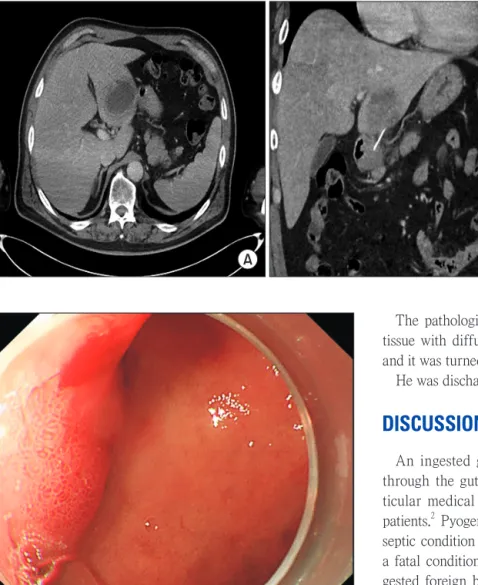
), a normal level of hepatic enzymes (AST: 31 IU/L and ALT: 36 IU/L), and total bilirubin (0.7 mg/dl), and elevated levels of both creatinine (1.58 mg/dl) and C-reactive Protein (7.99 mg/dl). The enhanced abdominal CT scan revealed a 5.8 cm sized hypodense mass in the left hepatic lobe and a 3 cm sized sharp calcified foreign body between the left hepatic lobe and gastric antrum (Fig. 1). He was diagnosed with a pyogenic liver abscess that contained a foreign body.

Gastroduodenoscopy showed an edematous, hypertrophic

mucosal lesion that had a central erosion at the lesser curva-

(2)

Dong Hee Kim et al.

Journal of Minimally Invasive Surgery Vol. 22. No. 4, 2019

178

ture of the distal stomach but didn’t find a foreign body in the stomach and duodenum (Fig. 2).

Interventional percutaneous transhepatic drainage of the abscess and administration of antibiotics was the first step of treatment for the patient’s conditions.

Streptococcus constellatus species was isolated from the pus culture, which suggested that the pathogen of the hepatic ab- scess was derived from the pharynx.

Subsequent laparoscopic exploration was performed seven days after abscess drainage. A dense inflammatory adhesion was found between the hepatoduodenal ligament and the left lobe of the liver. Careful dissection found and removed the foreign body in the lesser sac (Fig. 3).

The pathologic findings of the foreign body showed bony tissue with diffuse hemorrhage and focal inflammatory cells and it was turned out to be an ingested chicken bone.

He was discharged on the 10th day after surgery.

DISCUSSION

An ingested gastrointestinal foreign body usually passes through the gut without any special incident, and this par- ticular medical situation is encountered in less than 1% of patients.

2

Pyogenic hepatic abscess is usually derived from a septic condition of the portal-biliary system, and this can be a fatal condition. Pyogenic hepatic abscess caused by an in- gested foreign body is a very unusual case and laparoscopic treatment of it has rarely been reported.

3-7

Although a hepatic abscess has classic symptoms of fever, pain and jaundice, those patients with hepatic abscess caused by a gastrointestinal foreign body usually manifest nonspecific symptoms (fever, anorexia, pain, etc.) and this condition can be silent. Our patient had only high fever without any gastro- intestinal symptoms. The interval between clinical presenta- tion and foreign body ingestion can vary from one week to even after one year.

8

The patient’s history is very important to find the clue for making the proper diagnosis. However, most of patients, in- cluding our patient, do not remember the episode of foreign body ingestion and only 5% of patients could recall the event.

2

Various kind of foreign body has been reported, which include toothpick, fish bone, chicken bone, needle, pen, etc.

Among these, fish bone (33%) is most commonly reported as the cause of hepatic abscess.

2

Radiologic examination should be first step of the objective diagnostic procedure. A simple abdominal X-ray is usually per- formed, but its sensitivity shows a disappointing result of 39%

A B

Fig. 1. (A) 5.8 cm sized rim enhanced hypodense mass at left hepatic lobe (hepatic abscess). (B) 3 cm sized sharp linear foreign body between left hepatic lobe and gastric antrum.

Fig. 2. Endoscopic finding showed edematous mucosal lesion which has

central erosion at lesser curvature of distal stomach. No foreign body was

found.

(3)

Laparoscopic Treatment of Hepatic Abscess

www.e-jmis.org

179

for fish bones. An abdominal CT scan is a promising diag- nostic tool that can detect simultaneously the hepatic abscess and the foreign body with high sensitivity of 90%.

7

Endoscopy can be added for searching for the ingested foreign body if the foreign body has not fully penetrated the gastrointestinal tract.

We performed the endoscopy to search the foreign body shown on CT, but we failed to find it. The endoscopic findings showed edematous mucosal erosion at the lesser curvature of the distal stomach, which was highly suspected to be the site of perforation. Yu et al.

1

and Panebianco et al.

3

reported that peristaltic wave caused gradual migration of foreign body through thick gastric wall and progressive inflammatory ad- hesion of adjacent organs, and the omentum can surround and seal the perforation.

Since the stomach (40.9%) and duodenum (20.5%) are the most common sites of perforation by the foreign bodies, the left lobe of the liver is commonly affected because of its ana- tomical location.

2

The right lobe of the liver can be affected by migration of a foreign body from the ascending colon. Fu- jiwara et al.

9

reported a hepatic abscess in the Spiegel lobe by foreign body penetration.

The principle of treatment should include adequate drainage of the hepatic abscess, complete removal of the foreign body and closure of the perforation site.

8

Recurrence of abscess was reported in case that was treated conservatively without removal of the foreign body.

10

Reported treatments of hepatic abscess caused by an ingested foreign body vary from conser- vative management, endoscopic removal of the foreign body and both laparoscopy and/or open hepatectomy. Laparoscopic treatments have rarely been reported. The laparoscopic ap- proach can be technically challenging due to dense inflam- matory adhesion around the perforated site, and the nearby liver and adjacent organs. Further, small sized foreign body buried in inflammatory tissue might be difficult to find and completely remove. Lau et al.

11

reported image-guided per- cutaneous transhepatic removal of a fish bone from a hepatic abscess.

In conclusion, hepatic abscess caused by an ingested foreign body is very rare. Early appropriate diagnostic and therapeutic strategies should be established, including abscess drainage and removal of the foreign body. A laparoscopic approach can be useful and effective to treat this condition.

ORCID

Dong Hee Kim, https://orcid.org/0000-0001-9910-8414 Min Sung Kim, https://orcid.org/0000-0001-6370-7239 Jin Wan Park, https://orcid.org/0000-0002-3816-8357 Yeon Soo Chang, https://orcid.org/0000-0002-6570-5920

AUTHORS’ CONTRIBUTIONS

Conceptualization: YSC. Formal analysis: MSK. Methodol- ogy: JWP. Writing-original draft: DHK. Writing-review and editing: YSC.

CONFLICT OF INTEREST

None.

FUNDING

None.

ACKNOWLEDGMENTS

None.

REFERENCES

1) Yu W, Yu H, Ling J, et al. Hepatic Abscess Secondary to Stomach Perforation by a Fish Bone: a Rare Cause of Hepatic Abscess.

Ann Hepatol 2018;17:880-883.

2) Chong L-W, Sun C-K, Wu C-C, Sun C-K. Successful treatment

A B

Fig. 3. (A) Laparoscopic removal of for-

eign body in dense inflammatory adhe-

sion between hepatoduodenal ligament

and left hepatic lobe. (B) Foreign body

was ingested chicken bone.

(4)

Dong Hee Kim et al.

Journal of Minimally Invasive Surgery Vol. 22. No. 4, 2019

180

of liver abscess secondary to foreign body penetration of the ali- mentary tract: a case report and literature review. World J Gastro- enterol 2014;20:3703-3711.

3) Panebianco A, Lozito RC, Prestera A, et al. Unusual liver abscess secondary to ingested foreign body: laparoscopic management. G Chir 2015;36:74-75.

4) Tan CH, Chang SYH, Cheah YL. Laparoscopic Removal of Intra- hepatic Foreign Body: A Novel Technique for Management of an Unusual Cause of Liver Abscess--Fish Bone Migration. J Laparo- endosc Adv Surg Tech A 2016;26:47-50.

5) Turaihi H, Assam J, Zanfes J, Thambi-Pillai T. Laparoscopic Treatment of a Pyogenic Hepatic Abscess Caused by Transmural Duodenal Perforation of a Toothpick. S D Med 2017;70:369-371.

6) Chou D-A, Hung M-C, Lai J-C, Huang WS-W. Pyogenic hepatic abscess induced secondary to toothpick penetration of stomach.

Turk J Gastroenterol 2018;29:241-242.

7) Bekki T, Fujikuni N, Tanabe K, Amano H, Noriyuki T, Naka- hara M. Liver abscess caused by fish bone perforation of stomach wall treated by laparoscopic surgery: a case report. Surg Case Rep 2019;5:2019;5:79.

8) Pérez Saborido B, Bailón Cuadrado M, Velasco López R. A liver abscess secondary to a toothpick: a rare complication of accidental foreign body ingestion. Rev Esp Enferm Dig 2019;111:167-168.

9) Fujiwara Y, Shiba H, Nakabayashi Y, Otsuka M, Yanaga K. He- patic abscess in the Spiegel lobe caused by foreign body penetra- tion: report of a case report. Surg Case Rep 2017;3:2017;3:24.

10) Ng CT, Htoo A, Tan SY. Fish bone-induced hepatic abscess:

medical treatment. Singapore Med J 2011;52:e56-e58.

11) Lau CW, Wong KM, Gogna A. Image-guided Percutaneous Tran-

shepatic Removal of Fish Bone from Liver Abscess. J Radiol Case

Rep 2017;11:1-7.

수치

Fig. 1. (A) 5.8 cm sized rim enhanced  hypodense mass at left hepatic lobe  (hepatic abscess)
Fig. 3. (A) Laparoscopic removal of for- for-eign body in dense inflammatory  adhe-sion between hepatoduodenal ligament  and left hepatic lobe

참조

관련 문서

That is, the expansion of material by high temperature and distortion by cooling during welding process is caused by tensile and compressive residual stresses in welding

Moreover, the paper analyzes the policy changes caused by the relationship between the government and congress in the process of making foreign policy in

Haemorragic fever with renal syndrome (HFRS) caused by Hantanvirus has been one of the principal acute febrile disease in Korea. Hantaviruses are carried by numerous

Type 2 The number of lines degenerate to a point but there is no degeneration of two dimensional phase regions.. Non-regular two-dimensional sections.. Nodal plexi can

Type 2 The number of lines degenerate to a point but there is no degeneration of two dimensional phase regions.. Non-regular two-dimensional sections. Nodal plexi can be

The main body of the study examines the linguistic origin and meaning of prāṇa as it is very important in yoga training and the meaning of prāṇāyāma in

 Assuming the materials exist as a continuum, meaning the matter in the body is continuously distributed and fills the entire region of space it occupies..  A continuum is

Biological treatment of wastewater is an economical green technology, however, the effluent water quality of a biological wastewater treatment facility is