An Integrated Game Theoretical Approach for Primary and Secondary Users Spectrum
Sharing in Cognitive Radio Networks
Jong Gyu Kim
†, Khanh-Huy Nguyen
††, Jungtae Lee
†††, Won-Joo Hwang
††††ABSTRACT
In this paper, we address the problem of bandwidth sharing among multiple primary users and multiple secondary users in a cognitive radio network. In cognitive radio networks, effective spectrum assignment for primary and secondary users is a challenge due to the available broad range of radio frequency spec- trum as well as the requisition of harmonious coexistence of both users. To handle this problem, firstly, Bertrand game model is used to analyze a spectrum pricing in which multiple primary users emulate with each other to acquire maximal profit. After that, we employ Cournot game to model the spectrum sharing of secondary users to obtain optimal profit for each user also. Simulation results show that our scheme obtains optimal solution at Nash equilibrium.
Key words: Cognitive radio, Primary user, Secondary user, Spectrum sharing, Bertrand game, Cournot game.
※ Corresponding Author : Won-Joo Hwang, Address : (621-749) Obangdong, Gimhae, Gyeongnam, Korea, TEL:
+82-55-320-3847, FAX : +82-55-322-6275, E-mail : ichwang.inje.ac.kr
Receipt date : May 17, 2011, Revision date : Oot. 31, 2011 Approval date : Dec. 7, 2011
††††
School of Computer Information, Yeungjin College, South Korea.
(E-mail : [email protected])
††††
Dept. of Information and Communications Engineer- ing, HSV-TRC, Inje University, South Korea.
(E-mail : [email protected])
††††
School of Computer Science and Engineering, Pusan National University.
(E-mail : [email protected])
††††
Dept. of Information and Communications Engineer- ing, HSV-TRC, Inje University, South Korea.
1. INTRODUCTION
Recently, because of the increase in bandwidth demand of new wireless applications, radio fre- quency spectrum has become congested. Cognitive radio technology is one of promising candidates to supply high bandwidth for mobile users via diverse wireless architectures, and permits the secondary users to dynamically access the licensed bands
used by primary users. Software defined radio technique and cognitive radio were presented in [1]
to improve radio frequency spectrum utilization.
An extensive survey about the functionalities and research challenges of cognitive radio networks was introduced in [2]. With cognitive radio techni- que, radio frequency spectrum can be shared be- tween primary and secondary users. When the as- signed spectrum of primary user (PU) is not en- tirely used, the primary user is willing to sell spec- trum occasions to secondary services to enhance the usage of spectrum and also achieve higher revenue. The secondary users (SUs) then will share the spectrum that secondary services bought from primary users. However, because of the available broad range of radio frequency spectrum as well as the requisition of harmonious coex- istence of both primary and secondary user, effi- cient dynamic spectrum allocation is really a challenge.
Game theory has been identified as one of key
techniques for effective spectrum management of
cognitive radio to attain the desired objectives,
maximizing throughput and channel utilization [3].
In [4], an introduction to game theory is described.
In [5], a competitive pricing model for spectrum sharing using Bertrand game was proposed. A game theoretical adaptive channel allocation was presented in [6]. In [7], it introduced a multi-winner spectrum auction framework, and developed suit- able mechanisms for that kind of auction. Cournot game is also used to model the problem of band- width allocation among SUs in cognitive radio net- works [8]. In [9], a non-cooperative game-theoret- ic framework was proposed for radio resource management in 4G heterogeneous wireless access networks. A resource management method in wireless mesh network is provided in [10]. Using game theory, from existing works, they separated the bandwidth sharing into two cases: the spec- trum allocation schemes for PUs and the spectrum allocation scheme for SUs. Regarding the spectrum allocation schemes for PUs, they focus on max- imizing profit of PUs and also determined the total bandwidth can be shared to SUs, but it does not concern about spectrum sharing among SUs to get optimal profit for SUs. On the other hand, the spec- trum allocation schemes for SUs assume the total shared bandwidth from PUs without concerning whether that value is optimal for PUs or not. They focus on only spectrum assignment for SUs.
Therefore, there is no significant relationship be- tween the profit of PUs and profit of SUs which is meaningful and always required in real models.
In this paper, we address the problem of band- width sharing among multiple primary users and multiple secondary users in a cognitive radio network. The purpose is to optimize both the profit of PUs and SUs within a rational connection be- tween the spectrum sharing models, thus it also enhances spectrum utilization. In order to handle this problem, we propose a mixed game theoretical approach. Firstly, Bertrand game model is used to analyze a spectrum pricing in which a few primary users offer spectrum access occasions to a secon-
dary service. We formulate this problem as an oli- gopoly market in which a few firms (i.e., PUs) em- ulate with each other in terms of price of commod- ity (i.e, spectrum) provided to the market to ach- ieve maximal profit. In this case, for a PU, the bandwidth demand of the secondary service is pre- sented based on a spectrum demand function and the cost of spectrum sharing is defined based on quality of service (QoS) attenuation. We consider the Nash equilibrium as the solution of this game.
Obtaining that solution, we determine the ag- gregate spectrum sold for the secondary service.
It is also the amount of available bandwidth that can be shared to SUs. Next, we employ Cournot game to model the spectrum sharing of secondary users. Here, we also formulate this problem as an oligopoly market where a few firms (i.e., SUs) compete with each other in terms of quantity of commodity to obtain optimal profit value. For each SU, a revenue function is created by considering utility and the cost is modeled based on the loss of QoS and payment for using spectrum within a relationship with the result of the previous Bertrand game model. The Nash equilibrium is re- garded as a solution of this game. We utilize the iterative algorithm to obtain the Nash equilibrium.
The rest of this paper is organized as follows.
Section 2 describes the system model and assumptions. In Section 3, we present game models and formulate the problem. Simulation results are shown in Section 4, and Section 5 concludes the paper.
2. SYSTEM MODEL
We consider a cognitive radio network with M
primary users and a secondary service serving N
secondary users as shown in Figure 1. In this case,
primary user operating on the frequency spec-
trum
tends to sell its unused bandwidth (e.g.,
time slots in TDMA or radio frequencies in FDMA)
at price
(per unit of bandwidth) to the secondary
Fig. 1. System model for spectrum sharing.
service for monetary gains. The spectrum then can be shared for N secondary users. Each secondary user is allocated a portion of the total shared spectrum
. After spectrum assignment, the sec- ondary users use adaptive modulation to convey in the assigned spectrum in order to improve effi- ciency of the transmission.
Using adaptive modulation, transmission rate of users is dynamically adjusted based on the trans- mission channel quality. We can compute the spec- tral efficiency of the transmission for users as follows [5, (1)]. In order to guarantee QoS for users, the bit error rate (BER) must be maintained less than or equal to the target BER level (
).
By channel evaluation, we suppose that the SNR information is available at the receiver.
3. SPECTRUM SHARING MANAGEMENT SCHEME
In this section, we formulate the spectrum shar- ing problem among PUs and SUs as oligopoly markets. We first utilize Bertrand game to model a spectrum pricing of PUs. And then, a Cournot game model is proposed to handle the problem of spectrum assignment for SUs.
3.1 Oligopoly Market Competition, Bertrand and Cournot game
In cognitive radio networks, radio frequency
spectrum can be shared among primary users (licensed users) and secondary users (unlicensed users) to increase spectrum usage and also to gain profit for primary users (spectrum owners). Hence, an economic model would be suitable for primary users and secondary users to effectively share the spectrum. We will describe the spectrum sharing problem as oligopoly market competitions in which a number of firms compete with each other in- dependently to obtain the maximum profit by gov- erning quantity or price of commodity provided to the market. The oligopoly market is a kind of mar- ket where a small number of firms control a partic- ular market. In this market structure, action of one firm may be observed by other firms and the deci- sion of each firm is affected by actions of other firms. This situation can be modelled using Ber- trand and Cournot game models.
Let's repeat basic concept about Bertrand and Cournot game models. These game models consid- er a competition between two firms produce a same product. The cost of each firm to make product is constant and each firm wants to maximize its profit by control price or quantity of product. The profit function is total revenue (the price multiply by the quantity) minus total costs. In Bertrand model, the profit is formulated as a function of price:
with
is price of product, . Then each firms will manage its price to maximize its profit. By contrast, in Cournot model, the profit is formulated as a function of quantity:
, with
is quantity of product. Each firms will con- trol its quantity to get the optimal profit.
When primary users do not use fully the allo-
cated spectrum, they are willing to share its spec-
trum to secondary users to get more revenue (thus
profit). This can be considered as a trading com-
petition where there are many primary users
(sellers) offer spectrum to the secondary service
(buyer). The question is how to determine the
spectrum price of each primary user to maximize
the profit. To handle this question, therefore, a
Bertrand game model is well suit with price emu- lation to attain the optimal pricing strategy for PUs. In this game, the players are PUs. The play- ers compete with each other in terms of the price of commodity. The strategy of each player is the price per unit of bandwidth (represented by
) which is non-negative. The payoff of each player
is the profit (i.e., revenue minus cost) denoted by
. On the other hand, after determining the shared spectrum from PUs to the secondary serv- ice, SUs will share together this spectrum quantity.
The problem here is how to set the spectrum size for each SU to optimize the profit of each SU.
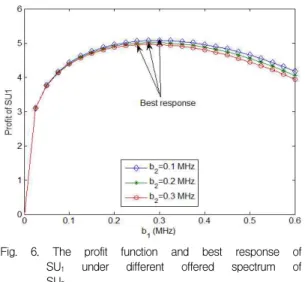
Accordingly, a Cournot game model is compatible with spectrum sharing problem among SUs. In this game, the players are SUs. The players compete with each other in terms of requested spectrum size, i.e., the quantity of commodity. The strategy of each secondary user corresponds to the allo- cated spectrum size (represented by
) which is also non-negative. The profit of each player (represented by
) can be calculated from the cost and the revenue gained from utilization the allo- cated spectrum as well.
3.2 Spectrum Pricing Competition Scheme for Primary Users
For each primary user , the spectrum is sold to the secondary service is the spectrum demand for frequency spectrum
at the secondary service. The spectrum demand function
of secondary service can be described from [5] as fol- lows:
≠
where
denotes the spectral efficiency of trans- mission of a SU utilizing spectrum
, ∈
denotes the spectrum substitutability parameter
and p
p
M denotes the set of prices offered by PUs,
∪p
i .
The revenue of each PU includes benefits from selling a portion of its spectrum and utilization its remaining spectrum. We can formulate the benefit of utilization the remaining spectrum based on considering it is as capacity of the bandwidth.
Thus, Shannon formula is applied to do this.
Therefore, the revenue function
for primary user is described as follows:
log
where
denotes the constant weights,
is the size of allocated spectrum for PU ,
is the SNR at the receiver of PU .
In order to define the cost function, we consider the QoS degradation of the PUs. Sharing a portion of the spectrum with the secondary service may make attenuation in the QoS performance of the PUs. If the required bandwidth for primary con- nections to the PU is insufficient, the PU has to
“compensate” to the connections, and this is re- garded as the cost of spectrum sharing with secon- dary service. The cost function
for primary user is expressed as follows:
where
denotes the constant weight for the cost function,
is the required bandwidth for pri-
mary connections,
is the spectral efficiency of PU . Consequently, the pofit function for PU can be obtained as follows:
log
Thus, we find the optimal solution to maximize the profit of each primary user as follows:
∀
The Nash equilibrium was defined in [4] as a
strategy profile in which no player can increase his
profit, given actions of other players. In this game,
the Nash equilibrium is achieved based on the best response function that is the best strategy of one player given strategies of other players. The best response function of PU is defined as follows:
0
( ) arg max ( ).
i P
i i i
p
BR p-
U p
>
= The set
p
p
p
Mdenotes the Nash equili- brium of this game if and only if
∀
Mathematically, we can acquire the Nash equili- brium by solving the following set of equations:
for all
(1)
log
When all parameters in (1) are given, the optimal solution
can be achieved by solving the above set of linear equations. Based on
, we obtain the size of the shared spectrum from the spectrum de- mand functions
. For the case of M=2, the set of equations in (1) can be described as in (2) and (3).
3.3 Spectrum Sharing Scheme for Secondary Users
In order to quantify the revenue of secondary users, we employ the concept of utility to denote the revenue gained from an allocated bandwidth.
The utility function
(i.e., the revenue) of sec- ondary user assigned a frequency spectrum
from the secondary service is defined as follows [11]:
log
where
and are constants indicating the scale and the shape of the utility function, respectively.
The cost function of a secondary user is consid- ered based on the payment of the secondary user for using the shared spectrum and the the attenu-
ation in the QoS performance. Because SUs do not always must utilize fully the shared spectrum, we define the cost per unit of bandwidth which the secondary has to pay is
where
is average cost per unit of bandwidth which the secondary bought from PUs given from solving (1) and
is non-negative constant weight corresponding to each SU. Besides, if the frequency spectrum allocated to the SU is not enough for secondary connections to the SU, this is also considered as the lost of QoS perform- ance. Hence, this degradation is a part of the cost function. Therefore, the cost function
for sec- ondary user is shown as follows:
where
is constant weight,
is the required bandwidth for secondary connections,
is the spectral efficiency of SU . Consequently, the pofit function for SU can be obtained as follows:
log
where {b
b
N} denotes the set of spectrum allo- cated to SUs. We represent
is the size of the total shared spectrum, our objective function for the spectrum sharing problem of the secondary user is
≤
≠
≥ ∀
Here, we also consider the Nash equilibrium as a solution of this game and use the best response function to obtain the Nash equilibrium. We define the best response function of SU as follows:
( ) arg max ( )
j j
S
j j j
b X
BR b-
U b
Î
=
where
∪{b
j} and
≠
. Similarly,
the set
{b
b
b
N} denotes the Nash equili-
Figure 3. Nash equilibrium and Best response functions.
() 1
( ) 2 ( ) 2
2 1 2 1
1 2
2 2 2 2
( ) ( ) ( ) ( ) ( ) ( ) ( ) ( )
1 2 1 1 2 1 ( ) 1 1 1 2
1 1
2 2 2 2 2
1 2 ( ) 2 ( )
(2 ) (1 )
1 1 1 1
log(1 ) 2
( )
1 1 1 1 1
p
p p
s s p p p s p s
rep p
k
c k c k
p p
k k c c k k k k k
B W
n
n n n n
n g n
n n n n n
+ - +
- - - -
- +
= + + - + -
- - - - - (2)
() 2
( ) 2 ( ) 2
2 2 2 2
2 1
2 2 2 2
( ) ( ) ( ) ( ) ( ) ( ) ( ) ( )
2 1 1 2 2 2 ( ) 2 2 2 1
2 1
2 2 2 2 2
1 2 ( ) 2 ( )
(2 ) (1 )
1 1 1 1
log(1 ) 2
( )
1 1 1 1 1
p
p p
s s p p p s p s
rep p
k
c k c k
p p
k k c c k k k k k
B W
n
n n n n
n g n
n n n n n
+ - +
- - - -
- +
= + + - + -
- - - - - (3)
Fig. 2. Profit of PU
1vs. offered price.
brium of this game if and only if
∀
Mathematically, we can obtain the Nash equili- brium by solving the following set of equations:
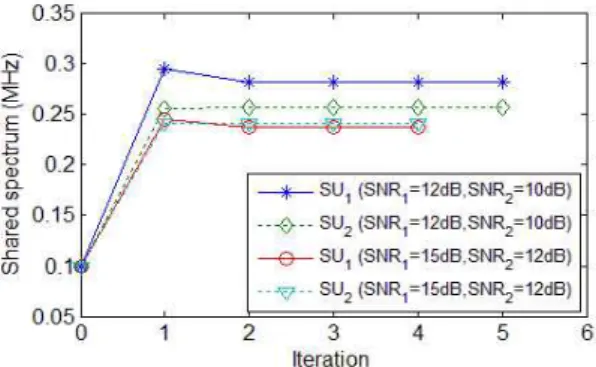
for all . However, we can see that re- solving the above set of equations to achieve the Nash equilibrium is quite complex because these equations are not linear. In this paper, we utilize the iterative algorithm [9]. We begin with the starting points
. We compute new vari- ables in the next iteration based on the current var- iables and the algorithm is finished when the dif- ference between the next variables and the current variables is less than the limitary value .
4. NUMERICAL ANALYSIS
4.1 Spectrum Pricing Competition of Primary Users
We consider the case of a cognitive radio envi- ronment with two primary users and a secondary service. We create parameter set based on the pa- rameter setting in [5]. The target BER for users is
. The required bandwidth for pri- mary connections of each PU is
= 2 Mbps.
We assume the frequency spectrum allocated to each PU is
= 2 MHz and the weight constants
= 10,
= 1. The SNR at the receiver of users change from 9 to 22 dB and the spectrum sub- stitutability parameter varies from 0.1 to 0.6. We
assume
= 20 dB,
= 19 dB,
= 10 dB and = 0.4 in the main case.
We first evaluate variance of the profit of the
PU with offered price. Figure 2 shows that the
profit of the PU is a function of offered price. When
the offered price increases, the profit first increases
because there is more the generated revenue corre-
sponding to higher price. Until a certain value, the
profit decrease due to reduction of bandwidth de-
mand from the secondary service. The price make
the maximal profit is the best response. Hence, we
can find the optimal offered price of a PU given
the prices of other PUs. Moreover, we also see that
a larger offered price of PU2 results in a higher
optimal price as well as a little higher the maximal
profit value of PU1. That is because of when the
offered price of PU2 increases, the bandwidth de-
mand to PU1 is increased. Therefore, PU1 may of-
fer the higher price to obtain the higher profit.
Fig. 3. Nash equilibrium and Best response functions.
Fig. 4. Optimal price under different channel qualities corresponding to PU
1.
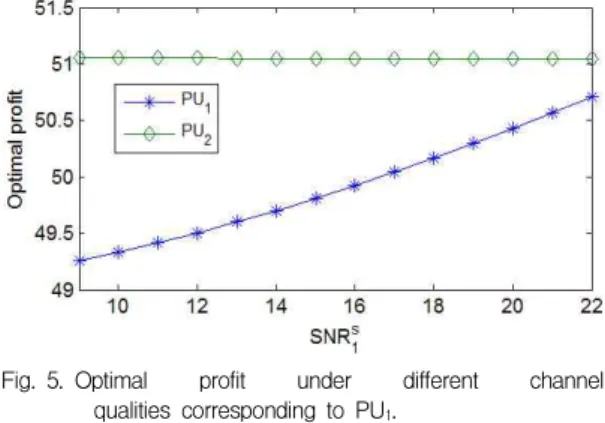
Fig. 5. Optimal profit under different channel qualities corresponding to PU
1.
The Nash equilibrium and the best response functions of PUs are shown in Figure 3 under differ- ent channel quality represented through different SNR values of the secondary service. The Nash equilibrium is indicated in which the best response functions of PUs intersect. When the channel quality becomes better (i.e., the SNR value of the secondary service is higher), the bandwidth demand is increased. As a result, PUs can offer the higher price.
Figure 4 and 5 show the price and the profit of both PUs at the Nash equilibrium under different channel qualities corresponding to PU1. When the channel quality corresponding to PU1 becomes bet- ter, the bandwidth demand to PU1 is higher as well.
Hence, PU1 can offer the higher price and amount of sharing spectrum in order to obtain the higher profit. Because of the smaller bandwidth demand,
the price and the profit of PU2 are mitigated when the price and the profit of PU1 are gained.
4.2 Spectrum Sharing Competition of Secon- dary Users
We consider the case of a cognitive radio envi- ronment with two secondary users sharing a fre- quency spectrum given from spectrum pricing competition of primary users. This size of the total shared spectrum is = 0.5663 MHz and = 1.1638.
The target BER for both SUs is
. The required bandwidth for secondary connections of each SU is
= 0.4 Mbps,