1. INTRODUCTION
Traffic violations are reported as one of the fac- tors which cause accidents on the roads. The traf- fic violation can be classified into two categories:
major or minor. Some known offenses can include driving under the influence of alcohol, reckless driving and driving while intoxicated [1]. Misbe- having drivers might continue and provoke major traffic violation if they are not properly handled.
In general, a minor traffic offense will not result in the offender being arrested or sent to jail. The driver typically receives a citation that requires the
payment of a fine, an appearance in court, or both.
The major issue in court appearance is the evi- dence to convict the driver of his violations.
Vehicular cloud computing (VCC) integrated with intelligent transportation system (ITS) sector avails suitable framework for reporting those acts of violations.
ITS was introduced to provide safer trans- portation environment through a variety of appli- cations and has attracted attentions because of its direct effect on economic growth [2]. Vehicular ad hoc network (VANET) is a self-organized plat- form where the vehicles are assumed to possess
Secure and Privacy Preserving Protocol for Traffic Violation Reporting in Vehicular
Cloud Environment
Lewis Nkenyereye
†, Kyung-Hyune Rhee
††ABSTRACT
Traffic violations such as moving while the traffic lights are red have come from a simple omission to a premeditated act. The traffic control center cannot timely monitor all the cameras installed on the roads to trace and pursue those traffic violators. Modern vehicles are equipped and controlled by several sensors in order to support monitoring and reporting those kind of behaviors which some time end up in severe causalities. However, such applications within the vehicle environment need to provide security guaranties. In this paper, we address the limitation of previous work and present a secure and privacy preserving protocol for traffic violation reporting system in vehicular cloud environment which enables the vehicles to report the traffic violators, thus the roadside clouds collect those information which can be used as evidence to pursue the traffic violators. Particularly, we provide the unlinkability security property within the proposed protocol which also offers lightweight computational overhead compared to previous protocol. We consider the concept of conditional privacy preserving authentication without pairing operations to provide security and privacy for the reporting vehicles.
Key words: Vehicular Cloud Computing, Traffic Violation Reporting, Authentication, Conditional Privacy Preservation
※ Corresponding Author : Kyung-Hyune Rhee, Address:
(48513) 45 Yongso-ro, Nam-Gu. Busan, Republic of Korea, TEL : +82-629-6247, FAX : +82-626-4887, E-mail : khrhee
@pknu.ac.kr
Receipt date : Feb. 1, 2016, Revision date : Apr. 28, 2016 Approval date : May 31, 2016
††
Department of IT Convergence and Application Engineering, Pukyong National University
(E-mail : [email protected])
††
Department of IT Convergence and Application Engineering, Pukyong National University
※ This work was supported by a Research Grant of
Pukyong National University (2016 year).
wireless communication devices called on board unit (OBU) and road side units (RSUs) fixed along the roads to enable both vehicle to vehicle (V2V) and vehicle to infrastructure (V2I) communications [3]. A dedicated short range communications (DSRC) standardized by the IEEE is availed for the communication between vehicles and RSUs. The limited computational capabilities of VANETs are relieved by vehicular cloud computing (VCC) into which vehicle's devices are connected to cloud servers to perform complicated computational op- erations [4]. Based on a vehicular cloud computing architecture, we present a secure and privacy pre- serving protocol for traffic violation reporting in vehicular cloud environment and use conditional privacy preserving technique [5] to guarantee the security of reported messages.
Vehicular cloud computing is a new techno- logical concept integrating cloud computing in a vehicular environment. In [6], the authors defined three types of architectures depending on the com- bination of VANETs and cloud computing. A clas- sification for vehicular cloud-based services and their respective potential security threats were also presented. The authors pointed out the feasibility and practicability of vehicular cloud compared to VANETs. VANETs has received much attention on secure protocols for diversified applications [2,3,6,7,8,9]. The majority of the proposed protocols suggest security mechanisms which could be adopted in order for the vehicles to securely receive road services such as navigation services.
The traffic violation scenario in VANETs or VCC has not received much attention in the literature. One of the relevant work addressing the specific scenario was presented by Mallissery et al, [10]. The authors presented a transport and traffic rule violation monitoring services in ITS based on pseudo identity for guaranteeing vehicles anonymity. However, for their protocol, an attacker can link the pseudo identify of a reporting vehicle to trace its itinerary. Thus the protocol does not
provide unlinkability of traffic violation messages.
Furthermore, their protocol lacks security analysis and the used security primitive considerably affect the violation message overhead.
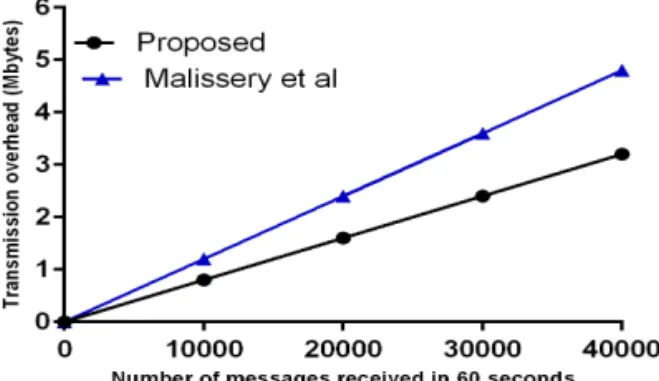
In this paper, to overcome the weakness of Mallissery et al.’s, we make use of ECC-based conditional privacy preserving authentication (CPPA) technique [5] to provide privacy and authentication of the reporting vehicles. The transmission over- head of the proposed protocol achieves better per- formance compared to Mallissery et al, [10].
2. SYSTEM MODEL
In this section, we present the system archi- tecture, security objectives and the description of the main phases of the proposed protocol.
2.1 System Architecture
We describe the application model of our secure and privacy preserving protocol for traffic violation reporting in vehicular cloud environment. In figure 1, let assume that the red vehicle is moving on the highway and violates the speed limit. The sur- rounding vehicles record the violation through their in-built sensors and transmit the information to the traffic center (TC) through the roadside cluds (RSCs). Any vehicle within the violating vehicle's vicinity records the violation and transmits the re- port to the RSC. Later on, the RSC transmits the data to TC which could avail those information to the justice sector once requested. Our system model comprises of a trusted authority (TA), RSC, TC and vehicles equipped with OBU as described in Fig. 1.
∙TA: It is in charge of the registration of all entities inside our system and issues cryptographic materials during the system initialization.
∙RSCs: They are databases located along the
roads and accessible by the vehicles. In this case,
any recorded violation is transmitted to TC through
RSC. We assume that RSC has sufficient compu-
tational capabilities to allow realtime communica- tion with the TC.
∙TC: It is a server located in the cloud con- trolled by the transportation authority. Beyond the routine activities, it is also in charge of keeping the file of traffic violators which could be used as evidence in court.
∙Vehicle: Each vehicle is equipped with an OBU capable of performing cryptographic oper- ations.
2.2 Security Objectives
Our proposed protocol should satisfy the follow- ing security requirements:
∙Identity privacy preserving: The real identity of a vehicle transmitting a violation reporting mes- sage should be kept anonymous from other vehicle within the same RSC range. Otherwise, an attacker can use the real identity of the reporting vehicle to produce impersonation attacks.
∙Authentication: Each vehicle should be au- thenticated before it transmits a violation reporting message.
∙Unlinkability: RSC and malicious user should not be able to link two messages sent by the same reporting vehicle.
∙Traceability: TA should be able to reveal the
real identity of the vehicle in case of complaints.
2.3 Proposed Protocol description
From the above described architecture, our se- cure and privacy preserving protocol for traffic vi- olation reporting is comprised of two phases:
System initialization and Violation reporting.
∙System Initialization: TA sets up its master secret key and its corresponding public key. TA assigns a real identity to each vehicle and forwards securely the vehicle real identity and the master secret key to the vehicle.
∙Violation Reporting: When a vehicle sensor records any kind of violation, the vehicle first com- putes its pseudo-identity to be used during the vi- olation reporting phase. The vehicle OBU further generates a ID-based signature on the violation re- porting message which is sent to RSC. The com- munication between RSC and TC is not empha- sized, rather adopt existing protocols such as [8].
Upon receiving the violation message from the ve- hicle, RSC verifies the vehicle's signature and stores the message in its database. In this paper we adopt CPPA in [5] as our building blocks.
3. PROTOCOL DESCRIPTION
The protocol description is made by the system initialization phase and the violation reporting phase as follows:
3.1 System Initialization
In initialization phase, TA generates system pa- rameters and issues keys to the registering ve- hicles as follows:
∙Chooses an additive group with a prime or- der and ∈ , where consists of all points on a non-singular elliptic curve and is a generator of .
∙Chooses ∈
∗
as the private key of the sys-
tem and computes the system public key
.
Fig. 1. System architecture.
∙Assigns an identity
to each vehicle
.
∙Provides
with
securely. We as- sume that
is pre-loaded into
's tamper- proof device.
∙Publishes the system parameters
where
→
and
× →
are two secure hash functions.
3.2 Violation Reporting
When detecting a traffic violation action through the sensors within the vehicle, the reporting vehicle
performs the following:
∙Choose a random nonce ∈
∗
, compute
,
⊕
, and sets its pseudo-identity as
∙Generate its signing key as
mod
where
and
is the time stamp.
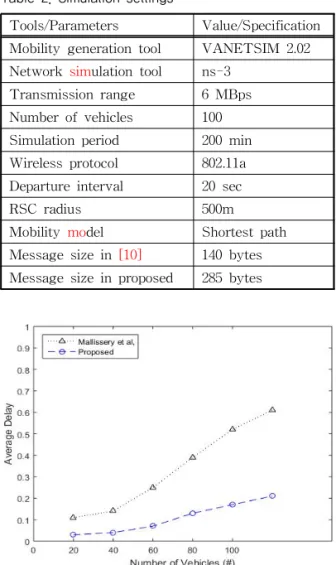
To generate a signature on the traffic violation message , we take the same reporting elements in [10] which are made of anonymous identity, Day, Date, Time, Latitude, Longitude, Vehicle Location, Sensor type and Sensor value for fair comparison.
performs the following:
∙Choose a random nonce ∈
∗
and compute
,
. The signature
on the message is computed as
mod .
∙The vehicle sends
to
3.3 Violation message verification
To verify the message,
performs the fol- lowing after checking the freshness of
:
∙Compute
and
∙Then check if
is valid. The consistency can be proven as follows:
After recovering the violation message, in non- rushing hours,
transmit the violation mes- sages to TC. Thus, TC would be able to use those information to convince the drivers of their viola- tions.
4. ANALYSIS
In this section, we give the evaluations of the proposed protocol in terms of security analysis, transmission overhead and average delay.
4.1 Security Analysis
We analyse the security of the proposed protocol based on the afore-mentioned security objectives.
∙Identity privacy preserving: The real identity of a vehicle transmitting a violation reporting mes- sage cannot be obtained by an attacker since the used identity is
with
and
⊕
. The at- tacker has to overcome the hardness of Computa- tional Diffie-Hellman problem, thus the privacy of the reporting vehicles is guaranteed.
∙Authentication: The authentication of the ve- hicle is assured by the signature generated by the violation reporting vehicle. The verifier checks if the equation
is valid.
Based on Discrete Logarithm problem, no adver- sary can forge a valid message.
∙Unlinkability: Before a vehicle sends a viola- tion reporting message, it first generates two ran- dom ∈
∗
and ∈
∗