Rayon계 ACF의 표면 산소관능기 도입과 Primary amine의 흡착 거동
김병구 * ․신해근․서정규․이문용․지상운
KT&G 중앙연구원 (2009년 6월 15일 접수)
Adsorption Behavior of Primary amine on Activated carbon Rayon-fiber Surfaces as Induced by Oxygen Functional
Complexes
Byeoung-Ku Kim * , Hae-Geun Shin, Jung-Kyu Seo, Moon-Young Lee and Sang-Un Ji KT&G Central Research Institute
(Received June 15, 2009)
ABSTRACT : Activated carbon fiber (ACF) was surface modified by nitric acid to improve the adsorption efficiency of the propylamine. Functional groups and textural properties of modified ACF were investigated. The total surface acidity increased about 7 times to that of as-received ACF by modification with 1 M nitric acid solution, carboxylic and phenolic groups mainly increased.
However, the specific surface areas and the total pore volumes of the modified ACFs were decreased by 5–8% due to the increased blocking (or demolition) of micropores in the presence of newly introduced complexes. Despite the decrease of textural properties, it was found that the amount of propylamine adsorbed by the modified ACFs was increased by approximately 17%. The oxygen and nitrogen contents on the modified ACF increased by 1.5 and 3 times compared with the as-received ACF. From the XPS results, it was observed that propylamine reacted with strong or weak acidic groups, such as -COOH or -OH on the ACF surfaces, resulting in the formation of pyrrolic-, pyridonic- or pyridine-like structures.
Key words : Activated carbon fibers, Surface oxygen complexes, Propylamine, Surface treatment.
INTRODUCTION
Primary, secondary, tertiary and heterocyclic amines feature bad odors and strong toxicity.
Secondary and tertiary amines would react with
*연락저자 : 305-805 대전광역시 유성구 신성동 302 번지, KT&G 중앙연구원
*Corresponding author : KT&G Central Research Institute, 302 Shinseong-dong, Yuseong-gu, Daejeon 305-805,
Korea (phone: 82-42-866-5601 ; fax: 82-42-866-5426; e-mail : [email protected])
precursor of n-nitrosoamines which are capable of harming the human body and especially some of the these known carcinogenic materials (Pietshch et al., 2001; Akita et al., 1996; Neurath et al., 1964). Propylamine(PA) one of the
primary amines has boiling temperature of 49
o
C, features volatile, stimulus properties and thus, spreads in the environment conveniently and generates the smell of ammonia. It is accompanied with the polarity and the strong toxic level(LD50
orally in rats) of 0.57 g/kg(Budavari et al., 1983). In order to eliminate amines in waste water, various techniques were studied such as microbial degradation, polyaluminum chloride or the flocculation using Fe(III)ClSO4
, adsorption(Elvers, 1991; Ono et al., 1996; Knepper et al., 1999; Hwang et al., 1994).Turk et al. reported that activated carbon(AC) eliminated amines in atmosphere rapidly. Islam and Chakmaa investigated the break-through on the amines in the activated carbon bed.
Boger et al. studied adsorption and desorption behavior of the amines on adsorbents such as AC and Y-zeolite by applying the VTSA (combined vacuum and temperature swing adsorption).
The activated carbon fiber(ACF) generally has the specific surface area larger than that of AC and the micropores which were existed on
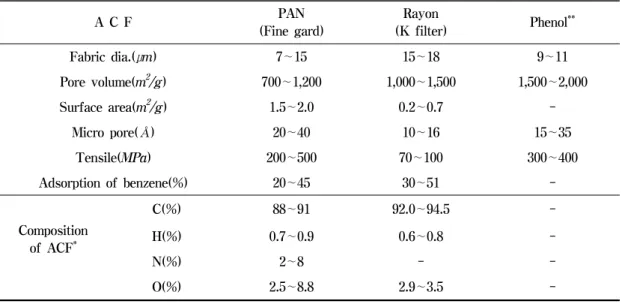
Table 1. Characteristics of the physicochemical for activated carbon fibers
A C F PAN
(Fine gard)
Rayon
(K filter) Phenol
**
Fabric dia.(
μ m)
7∼15 15∼18 9∼11Pore volume(m
2 /g)
700∼1,200 1,000∼1,500 1,500∼2,000Surface area(m
2 /g)
1.5∼2.0 0.2∼0.7 -Micro pore(Å) 20∼40 10∼16 15∼35
Tensile(MPa) 200∼500 70∼100 300∼400
Adsorption of benzene(%) 20∼45 30∼51 -
Composition of ACF
*
C(%) 88∼91 92.0∼94.5 -
H(%) 0.7∼0.9 0.6∼0.8 -
N(%) 2∼8 - -
O(%) 2.5∼8.8 2.9∼3.5 -
* Plastics, vol. 32, No. 12. 86∼91 ** JIS K 1474
external surface of ACF. Therefore, not only the adsorption capacity but also the rate of adsorption was noticeably more advanced than AC (Ryu, 1990; Kim et al., 1992). To verify the effect of functional groups of ACF on PA adsorption, we investigated to the adsorption of PA on as-received and surface modified ACF in this study. For the purpose, ACF was modified with nitric acid and characterized the structural properties. And the adsorption capacity of PA on ACFs were analyzed from the adsorption isotherms of PA.
Through the XPS analysis, the nitrogen functional groups and the oxygen functional groups were examined and verified for the changes of surface functional groups and the composition ratios.
EXPERIMENTAL
Materials
ACF used in this experiment was the Rayons based ACF(S
BET
1423 m2
/g, KF-1500, Toyobo Co., Japan) and the Coconut based AC(SBET
1100 m
2
/g, Han-Il Green Tech Inc., South Korea). In order to remove impurities, the materials were rinsed 3 times with the distilled water, incubated in a dryer at 383 K for 24 hours, and stored in a desiccator. Table 1 shows characteristics of the physicochemical for ACFs.A 10 g ACFs were treated with 500 mL nitric acid solution with respect to concentration for 1 hour at boiling point.
Measuring the amount of functional groups Surface functional groups of the as-received (V-ACF) and the surface modified ACF(A-ACF)s were analyzed by Boehm’s titration method (Boehm, 1966) using automatic titrater(Metrohm 798/778) to calculate the amounts of functional groups and the total surface acidity(Jung et al., 1997) of ACFs.
Pore characterization
The structural and morphology of the ACFs were investigated from the nitrogen adsorption isotherm(ASAP-2010) and SEM observation.
BET-specific surface area (S
BET
), total pore volume (Vt
) and average pore size (Dpore
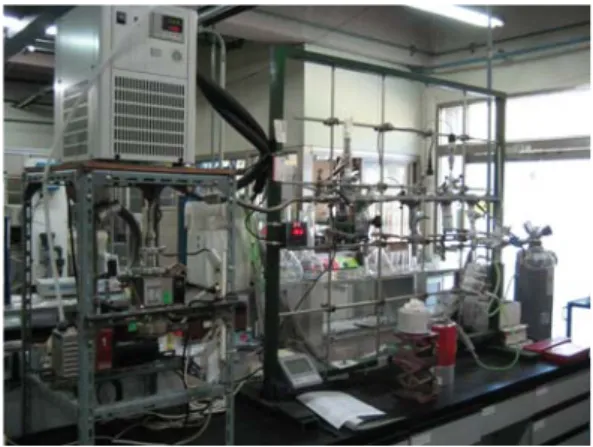
) were calculated from the adsorption isotherms.Primary amine(propylamine, PA) adsorption The adsorption isotherms of propylamine (CH
3
-CH2
-CH2
-NH2
, Sigma-Aldrich Co., MW 59.11, Bp 49o
C) were measured by the volumetric adsorption system as shown in Fig.1. The adsorption was carried out after the ACF was completely degassed at 473 K under 10
-7
torr by using the molecular diffusion pump. Propylamine adsorption was proceeded until the relative pressure (P/Po) was close to 1, where the propylamine was regarded as an ideal gas and the adsorption amount of propylamine that corresponded to the adsorbent was calculated by applying the pressure difference between before and the after the adsorption into the ideal gas equation.Fig. 1. Image of volumetric adsorption system for PA adsorption on ACFs.
XPS analysis
The chemical composition changes of the ACF surface were analyzed with the XPS (ESCA210;
VG Scientific Co.). The X-ray source for the measurement was non-monochromatic MgK
α .
The working pressure was maintained under 10-11
mbar. A shirly type background was employed and the peaks were analyzed by asymmetric Gausian-Lorentzian Sum Function (80:20).RESULTS AND DISCUSSION
Surface functional groups
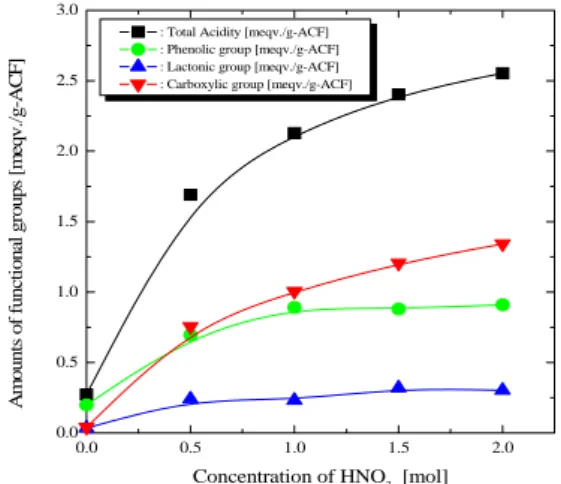
Fig. 2 shows amounts of surface functional group and the total surface acidity of the acid modified ACF(A-ACF). The total surface acidity of the ACF increased with respect to concentration of nitric acid. The acidity of 1M-HNO
3
modified ACF was 2.2 meqv./g which was 7 times higher than 0.25 meqv./g of the as-received. Previous studies(Brett et al., 1993;Teng et al., 2001) reported that the nitric acid was effective to introduce the acidic surface functional groups onto the surface of the ACF than other acids. When ACF was modified with 2M-HNO
3
, the total surface acidity was approximately 2.5 meqv./g which was closed to 10 times that of the as-received ACF(V-ACF).The total surface acidity of ACF increased with the amount of carboxylic groups which known strong acidic and phenolic groups which had weak acidic characteristics. The lactonic groups which accompanied moderate acidic characteristics did not increased so much as other functional groups after surface modification, thus lactonic groups scarcely influenced the total surface acidity.
The textural properties of the ACFs before and after the acid treatment are shown in Table 2. The V-ACFs had 1423 m
2
g−1
of specific surface area and 1418 m2
g−1
of micropore area, as shown in Table 2. This indicates that0.0 0.5 1.0 1.5 2.0
0.0 0.5 1.0 1.5 2.0 2.5 3.0
: Total Acidity [meqv./g-ACF]
: Phenolic group [meqv./g-ACF]
: Lactonic group [meqv./g-ACF]
: Carboxylic group [meqv./g-ACF]
A m ount s of f unct iona l gr oups [ m eqv. /g -A C F ]
Concentration of HNO 3 [mol]
Fig. 2. Amounts of surface functional groups and total surface acidity on acid modified ACFs with respect to concentration of HNO
3
for 1 hour.Table 2. Textural properties of the ACFs before and after the acid treatment S
BET a
Smicro
b
VTc
Dpd
V-ACFS A-ACFS
1423 1308
1418 1302
0.554 0.527
15.6 16.1 a : Specific surface area (m
2
g−1
) from BET equation (P/P0
= 0.05-0.1)b : Specific surface area of micropores (m
2
g-1
) : from DR equation c : Total pore volume (cm3
g−1
) Vads
. (P/P0
= 0.995) ×0.001547 d : Average pore diameter of micropore (Å) 4 ×Smicro /V micro
V-ACFs are highly microporous. In case of the A-ACFs, it can be seen that the pore structures were somewhat diminished, by approximately 8%, and that the fraction of micropore area was also slightly reduced, from 99.65 to 99.54%.
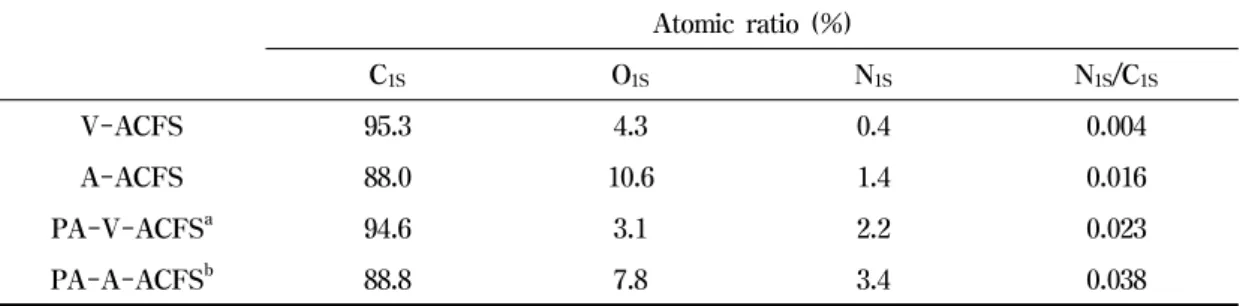
To observe the chemical composition on the carbon surfaces before and after the acid treatment, X-ray photoelectron spectroscopy was used, as shown in Table 3.
It can easily be seen that the surfaces of the V-ACFs were mainly composed of carbon, with a small amount of oxygen. However, it was found that the oxygen content of the A-ACFs was significantly increased, from 4.3 to 10.6%, whereas the carbon content decreased. This result explicitly shows the forming (or introducing) of surface oxygen complexes as a result of the treatment.
To facilitate detailed understanding, the O1s peaks before and after the treatments are deconvoluted into surface oxygen complex contributions, as shown in Fig. 3, and the specific ratios of the contributions are also provided. The O1s peaks of the ACFs show four line shapes with binding energies at 530.9, 532.4, 533.8, and 535.2 eV assigned to C=O, C–O, O-C=O and chemisorbed O
2
(or H2
O), respectively. It was found that the ratios of C=O and O–C=O increased whereas that of C–O decreased. This result indicates that severe oxidation leads to a decrease in the ratio of C–O, resulting in an increase in those of C=O and O–C=O.
Table 3. Elemental compositions of the ACFs before and after the propylamine(PA) adsorption.
Atomic ratio (%)
C
1S
O1S
N1S
N1S
/C1S
V-ACFS 95.3 4.3 0.4 0.004
A-ACFS 88.0 10.6 1.4 0.016
PA-V-ACFS
a
94.6 3.1 2.2 0.023PA-A-ACFS
b
88.8 7.8 3.4 0.038a : Propylamine absorbed V-ACFs.
b : Propylamine absorbed A-ACFs.
Fig. 3. Specific ratios of surface functional groups of the ACFs in the O1s-XPS results.
Fig. 4 illustrates the adsorption isotherms of PA on the V-ACFs at 298 K. It was found that the amount of adsorbed PA rapidly increased as a result of the micropore filling effects under 0.1 relative pressure, and then reached a plateau at 1.0 of relative pressure, as representative of a typical Type I isotherm.
The PA-adsorption curve for the A-ACFs showed a pattern similar to that for the V-ACFs, but the total PA-adsorption amount was larger than that for the V-ACFs. It is interesting that the amount of PA adsorbed on the A-ACFs increased, whereas the specific surface area decreased, after the acid treatment.
This result clearly shows that PA adsorption is
0.0 0.2 0.4 0.6 0.8 1.0
0 100 200 300 400
: as-received : 1M-HNO 3 : Coconut based AC
A d so rp ti on of p rop y la m in e [m g/ g- A C F ]
Relative Pressure [P/P O ]
Fig. 4. Adsorption isotherms of propylamine on the ACFs before and after the acid treatment (temperature 298 K).
largely affected not only by the textual properties of adsorbents but also by surface oxygen complexes (or functionalities).
To understand the PA adsorption behavior, an XPS measurement (especially N1s peak) was performed. As shown in Table 3, the amount of N1s was significantly increased after the PA adsorption, the result of which can be attributed to the nitrogen in the PA adsorbed. As shown in Fig. 3, it was found that the amounts of C–
O and O–C=O somewhat decreased whereas that of C=O increased. This result leads to one assumption: The basic constituents of PA reacted with the acidic groups of the ACFs,
resulting in the formation of C=O groups and a small amount of water.
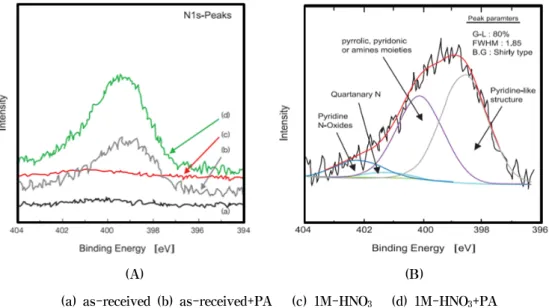
In the case of the N1s investigation, it was found that the intensities of PA-V- and PA-A-ACFs were predominantly enhanced, as illustrated in Fig. 5(A). As shown in Fig. 5(B), pyrrolic-, pyridonic- or pyridine-like structures were found in the deconvoluted peaks. These results explicitly support the conclusion that PA was adsorbed on the ACFs, and that the adsorption behavior had a significant relation to the surface oxygen complexes.
This result probably meant that propylamine was strongly adsorbed on carbon surfaces by a strong physical bond, such as hydrogen bonds.
The surfaces of activated carbon fibers were chemically excited after the acidic treatments, and there should be many broken carbon–carbon bonds and newly conformed carbon–hydrogen groups. If the hydrogen bonding were conformed between propylamine and hydrogen on the carbon surface, that could lead the nitrogen content (or nitrogen containing functional groups).
An adsorption mechanism of propylamine by the activated carbon fiber(ACFs)
A propylamine adsorption experiment of the activated carbon fiber(ACFs) indicates that the amount of adsorption by nitric acid-treated ACF(A-ACF)s increased by more than 20% of that of the original ACFs sample. Figure 6 shows the chemical reaction of carboxyl group-containing compounds and amines. This is
C-R O OH
CH-R H
H O
H
O C-R
H
CH-R R'NH .. 2
+ R'NH
OH - +
R'N OH +..
OH R'N
(R=Surface of ACF and R'=Aliphatic compound)
Fig. 6. Reaction of amines and carboxyl group of ACFs.
(A) (B)
(a) as-received (b) as-received+PA (c) 1M-HNO
3
(d) 1M-HNO3
+PAFig. 5. N1s-XPS spectra of the ACFs (A) and a deconvoluted N1s-XPS spectrum of PA-V-ACFs (B).
comprised in the reduction reactions of amine.
The propylamine having non-pair electron attack to carbonyl group as a nucleophilic as generated a H
2
O+
of good leaving group. The hydrogen of amine donor the electron to C-N bond then, it is formed an imine by leaving H2
O+
.Fig. 7 represents the reaction between propylamine and phenyl group formed on the surface of absorbent. Like Figure 6, the phenyl group is generated a weak-combined H
2
O+
by attacking the amine group and alkylation reaction of amine, which generate the newly N-C combination(Graham et al., 2000).HO CH 2 -R H
CH 2 -R R'NH .. 2
+ -
+ R'NH
(R=Surface of ACF and R'=Aliphatic compound)
Fig. 7. Reaction of amines and phenyl group of ACFs.As shown in Fig. 8, After carboxyl group of lactone on the surface of absorbent is generated a weak-combined H
2
O+
by attacking propylamine, the reaction process of the reducing amine is generated C=N and the double bond according to the donor of hydrogen electron(Graham et al., 2000).R'NH 2
.. + C
O
H + O
R R'NH C
O O
R -
H +
R'N C O O
R
R'N C O
R H
H
(R=Surface of ACF and R'=Aliphatic compound)
Fig. 8. Reaction of amines and lactone group of ACFs.
According to the former chemical reaction and the experiment results of XPS and TGA, the propylamine adsorption by nitric acid-treated ACF(A-ACF)s is increased the amount of adsorption larger than the non-nitric acid-treated ACFs by chemical reaction of functional group and amine, like Figure 9. Carboxylic, phenolic, and lactonic groups on the surface of absorbent also become a hydrogen bonding with moisture.
When absorbent has moisture, the absorption capability can be decreased because of losing the absorbable space by the hydrogen bonding with functional group and moisture.
C O O
COOH
OH COOH
NH 2 NH 2
NH 2 NH 2
NH 2
COOH
COOH
NH 2 NH 2
COOH
OH
O H O C
H HN COOH
HN
O C H
N HN
Hydrophobic Face Carbonyl group
Lactone group
propyl amine
phenol group
-
+
1
3
3
2
Fig. 9. A model of adsorption mechanism between activated carbon fiber and propylamine.
CONCLUSIONS
Due to the HNO
3
treatment, the acid functional groups, carboxylic group and phenolic groups had all increased on the ACF surface.Thus, the amount of adsorption with the basic propylamine increased as well. However, the HNO
3
treatment induced the decrease in specific surface area by 8% and total pore volume by 4.8%. The surface elemental composition ratiosof the HNO
3
treated ACFs were 1.5 times the oxygen and 3 times the nitrogen of the raw ACFs. The result of the Nls and Ols peak analysis for the propylamine adsorbed ACF suggested that the propylamine was bonded to two carbons existed on the ACF surface and adsorb in pyridine-like structure and pyrrolic or amines structures. As the propylamine were adsorbed, the each composition ratio of the ACF with the strong acid –COOH and that with the weak acid –C-OH or that with C-O-C was decreased when compared to HNO3
treated and raw ACFS. However, there was increase in composition ratio of the neutral –C=O (BE=530.9 eV) which incorporated with low binding energy. This led to a reason that there was a large increase in the amount of –C=O functional group yielded from either the neutralizations or the hydrogen bondings among the acid functional groups which represented either the strong acid or weak acid of the ACF surface and the amine group (-NH2
) of propylamine which represented the base.Conclusively, the amount adsorption of propylamine was increased by treating the ACF surface with HNO
3
to increase the acidity.We chemically and physically illustrate a model that the propylamine is adsorbed on ACFs. We consider the adsorption mechanism about the chemical reaction of acid functional group (carboxyl, phenol, lactone groups on the surface of the activated carbon) and the absorbable propylamine.
REFERENCES
Akita, S. and Takeuchi, H. (1996) Equilibrium Distribution of Aromatic Compounds between Aqueous Solution and Coacervate of Nonionic. Surfactants. Sep. Sci. Technol.
3l: 401-412.
Boehm, H. P. (1966) Advances in Catalysis.
Vol.16, Academic Press, New York 179.
Boger, T., Salden, A. and Eigenberger, G. (1997)
A combined vacuum and temperature swing adsorption process for the recovery of amine from foundry air.
Chemical Engineering and Processing 36: 231-241.
Brett, C. M. A. and Oliveira, B. A. M. (1993)
Electrochemistry Principles, methods and applications. Oxford University Press, New
York.Budavari, S., Blumetti, R. F., Otterbein, E. S.
and Windholz, M(Ed.). (1983) The Merck
Index, 10th ed., Merck &Co., Inc., Rahway,
N. J., U. S. A. 7743.Elvers, B.(Ed.) (1991) Ullmanns Encyclopedia of
Industrial1.
Chemistry, 5th ed. VCH, Weinheim and New York.Graham S. T. W. and Craig B. F. (2000)
Organic Chemistry 7th: 791-805.
Hwang, Y. W., Matsuo, T., Hanaki, K. and Suzuki, N. (1994) Removal of odorous compounds in wastewater by using activated carbon, ozonation and aerated biofilter. Water Research 28(11): 2309-2319.
Islam, M. R. and Chakmaa, A. (1990) Simulation of activated carbon adsorbers used in gas plants. Gas Separation & Purification 4(2):
103-108.
Jung, C. H., Jung, H. H., Moon, J. K., Oh, Y. Z.
and Ryu, S. K. (1997) The adsorption of chromium(VI) from liquid waste onto activated carbon fibers. HWAHAK KONGHAK 35(4):
538-544.
Kim, Y. O., Ko, K. R., Park, Y. T. and Ryu, S.
K. (1992) Adsorption of Solute Pitch-based Activated Carbon Fiber from Aqueous Solution. HWAHAK KONGHAK 30(3): 347-356.
Knepper, T. P., Sacher, F., Lange, F. T., Brauch, H. J., Karrenbrock, F., Roerden, O.
and Lindner, K. (1999) Detection of polar organic substances relevant for drinking water. Waste Management 19: 77-99.
Neurath, G., Pirmann, B. and Wichern, H. (1964) The question of the N-Nitrosocompounds in tobacco smoke.
Beitr. Tabakforsch.
2:311-319.
Ono, Y., Somiya, I., Kawaguchi, T. and Mohri, S. (1996) Evaluation of toxic substances in effluents from a wastewater treatment plant. Desalination 106: 255-261.
Pietshch, J., Sacher, F., Schmidt, W. and Brauch, H. J. (2001) Polar nitrogen compounds and their behaviour in the drinking water treatment process.
Wat. Res.
35(15):3537-3544.
Ryu, S. K. (1990) Porosity of Activated Carbon Fiber. High Temperature-High Pressure 22:
345-354.
Teng, H., Tu, Y. T., Lai, Y. C. and Lin, C. C.
(2001) Reduction of NO with NH
3
over carbon catalysts, The effects of treating carbon with H2
SO4
and HNO3
. Carbon 39:575-582.
Turk, A., Mehlman, S. and Levine, E. (1973) Comparative odor control performance of activated carbon and permanganated alumina. Atmospheric Environment 7(11):
1139-1148.