자생 엉겅퀴의 부위별 기능성 성분 및 항산화 효과
김은미†․원선임1
김포대학 호텔조리과, 1한림대학교 식품영양학과
Functional Composition and Antioxidative Activity from Different Organs of Native Cirsium and Carduus Genera
Eun-Mi Kim† and Sun-Im Won1
Department of Hotel Culinary Arts, Kimpo College, 1Department of Food science & Nutrition, Hallym University
Abstract
This study was conducted to investigate the functional composition and antioxidant activity of Cirsium and Carduus genera based on different parts. Leaves of Cirsium setidens Nakai contained 23.66% protein and seeds of Carduus crispus L contained 25.30% lipid. Extraction yields of Cirsium and Carduus genera were higher in leaves than in any other parts of the plants. Total phenolics and total flavonoid content were abundant in extracts of leaves, steam and root of C. japonicum var. ussuriense, and the flower extract of C. setidens Nakai. Silymarin was not found in extracts of Cirsium and Carduus genera. Acacetin was identified in leaf or flower extracts of C. setidens Nakai, or in leaf and steam extracts of C. pendulum Fisch ex DC. Apigenin was identified in the flower extracts of Cirsium and Carduus genera and constituted 7.16 mg/g in C. japonicum var. ussuriense. Cynarin was present at 5.55 mg/g in the seed extract of C.
setidens Nakai, and narirutin represented 19.56 mg/g and, 4.18 mg/g of the seed extracts of C. pendulum Fisch ex DC and, Carduus crispus L, respectively. 2,2-Diphenyl-1-2-picrylhydrazyl (DPPH) radical scavenger activity was higher in flower extracts of C. setidens Nakai than in the other genera. Photochemiluminescence activity was 2.3 nmol in leaves and flower extracts of C. setidens Nakai and flower extract of Carduus crispus L. Flowers and seeds of C. setidens Nakai shoe potential as new functional materials.
Key words: Cirsium, Carduus, silymarin, acacetin, apigenin, cynarin, narirutin, antioxidative activity
†Corresponding author: Eun-Mi Kim, Department of Hotel Culinary Arts, Kimpo College
Tel: 031-999-4667 Fax: 031-999-4675
E-mail: [email protected]
I. 서 론
엉겅퀴속(Cirsium Miller)은 국화과(Asteraccac)의 국화아 과(Asyeroideae) 엉겅퀴족(Cynareae) 엉겅퀴아족(Carduinae) 에 속하는 식물군으로 전 세계적으로 250~300여 종이 한국, 중국, 일본, 만주, 러시아 그리고 대만 등의 북반 구 온대지역을 비롯하여 북미, 유럽, 북아프리카 등에 분 포한다(Song MJ와 Kim H 2007). 엉겅퀴(Cirsium japonicum var. ussuriense or DC)는 2년 초로 연한 줄기는 껍질을 벗겨서 생으로 먹거나 나물로 먹으며, 큰 엉겅퀴(Cirsium pendulum Fischer ex DC)는 다년초로 어린 순은 나물로 먹는다. 고려엉겅퀴(Cirsium setidens Nakai)는 ‘곤드레’라 고도 하며, 다년초로 산과 들판에 약간 그늘진 곳에 자라
고, 4~5월경 어린 순을 나물, 국, 볶음 등으로 먹는 우리 나라 특산물의 하나이다. 지느러미엉겅퀴(Carduus crispus L.)는 전 세계적으로 100여 분류군이 분포하고 있는 속 으로 2년초이고 우리나라에서는 귀화식물로 1종이 전국 적으로 분포하고 있으며, 연한 줄기는 껍질을 벗겨 생으 로 먹거나 나물로 먹고, 전초(全草)는 강장 및 지혈제로 사용된다(국립수목원 2008, Lee YM 등 2008, Lim SS 등 1997a, Suh JT 등 1995).
국내․외 엉겅퀴 연구를 보면, 고려엉겅퀴의 잎에는 칼 륨 함량이 많고, 항산화 활성(Lee SH 등 2006)과 항암활 성이 있다(Lee WB 등 2002)고 하였다. 엉겅퀴속 식물은 생리활성이 뛰어난 apienin, luteolin, myricetin, kaemferol, pectolinarin, 5,7-dihtdroxy-6,4'-dimethoxyflavone, hispidulin- 7-neo-hesperioside를 포함한 약 78종의 flavonoid가 확인 되었으며, apigenin은 암예방 효과 및 신경보호 효과, 항 염증, 항진경 및 항균작용 등의 생리 활성이 있다고 보고 하고 있다(Chung MS 등 2007, Liu S 등 2006, Lee HK
등 2003, Lee MK 등 2002, Lim SS 등 1997b). 또한 엉 겅퀴는 지질과산화를 억제하고 glutathione reductase의 활 성을 증가시켜 알코올 해독을 촉진시키므로 간 보호 작 용이 있으며(Park JC 등 2004), ICR 쥐에게 300 mg/kg 투여 시 항우울 작용이 있음을 확인 하였다(Park HK 등 2006). 고지혈증 시 혈청 지질 함량을 감소시키고, 간장 내 총 콜레스테롤, 중성지질 등의 농도를 감소시키므로 간 손상을 지연시킬 수 있다(Lim SS과 Lee JH 1997, Lim SS 등 1997a). 엉겅퀴 꽃 추출물에서 apigenin, luteolin이 검출되었으며(Kim SJ와 Kim GH 2003), 엉겅퀴 잎 추출 물은 항류마티스성의 효과가 있다고 하였다(Lee JH 등 2008). 흰무늬엉겅퀴(Silybum marianum)에 함유된 silymarin 은 flavolignan으로 간장 보호작용과 알코올 유도지질 산 화의 예방 및 알코올성 간경화 등에 대한 보호효과가 있 어 LDL(Low density lipoprotein)에 대한 항산화효과가 있 으며(Wallace SN 등 2005, Saller R 등 2001, Mourelle M 등 1989, Ingelman-sundberg M 등 1988, Lee BC 등 1997a, Lee BC 등 1997b), 총페놀 함량이 448.8 mg/g으로 항산 화제로 사용될 수 있다(Kim KB 등 2006)고 하였다. 큰 엉겅퀴(Chon SU 등 2006)와 아티쵸크(Artichoke, Cynara scolymus L.)는 항산화효과가 있고, cynarin, apigenin, 7-O- glucosides, cynarin, narirutin, gallic acid, caffeic acid 부 위별로 검출되었으며(Jun NJ 등 2007, Thi BHT와 Park MK 2008), 바늘엉겅퀴(Cirsium rhinoceros)에서는 noriso- prenoids과 pectolinarigenin, apigenin, cirsimaritin의 플라 보노이드가 검출되었다(Chung AK 등 2002). 또한 큰엉 겅퀴에서 cirsimaritin을 검출하였다(Yun HS와 Chang IM 1978). 가시엉겅퀴(Cirsium xanthocanthum)의 뿌리에서는 linarin이 검출되었다(Lee YC와 Park YH 1984). 울릉엉겅 퀴(C. nipponicum Makino)는 울릉도에 흔히 자라는 국화 과의 다년초로서 지상부와 뿌리가 출혈, 염증성 질환, 급 성간염으로 인한 황달 및 고혈압 등에 사용되어 오고 있 다(Lee JH와 Lee KR 2005).
그러나 이러한 과학적인 근거에도 불구하고 지느러미 엉겅퀴에 대한 연구는 아직까지 전무하며 간에 좋은 효 과가 있는 silymarin이 함유되어 있다고 밝혀진 흰무늬 엉겅퀴는 유럽남부와 아시아가 원산지로 남아메리카, 유 럽, 아프리카에서 재배되고 있고 우리나라에서는 한의원 에서 수입을 통해 사용되고 있는 실정이다.
따라서 본 연구에서는 예전부터 식용과 민간요법으로 사용되어온 산채류인 김포에 자생하는 4종의 엉겅퀴, 고 려엉겅퀴, 큰엉겅퀴, 지느러미 엉겅퀴의 부위별 일반성분 을 분석하고, 추출물에 대한 플라보노이드계 성분의 정량 및 항산화 효과에 대하여 연구하여 기능성 식품 개발의 기초자료로 제공하고자 하였다.
II.재료 및 방법
1. 실험재료
본 실험에 사용한 시료는 김포에서 자생하는 엉겅퀴, 고려엉겅퀴, 큰엉겅퀴, 지느러미엉겅퀴 4종을 2008년 6월 7일~9월 17일까지 채취하여 사용하였다. 엉겅퀴는 고양 리, 고려엉겅퀴는 월곶면과 갈산리, 큰엉겅퀴는 용강리, 지느러미엉겅퀴는 월곶면과 고막리에서 각각 채취하였 다. 채취한 엉겅퀴는 꽃, 잎, 줄기, 뿌리로 나누어 흐르 는 물로 깨끗이 씻어 실내에서 3일간 음건(陰乾)하였다.
시료는 잎, 줄기, 뿌리, 꽃으로 나누어 분쇄기(Jam-606.
Hanil, Korea)를 이용하여 분말로 만들었다. 잎과 씨는 그 대로 꽃은 손으로 잘게 뜯어 분쇄기에 넣어 갈고, 줄기와 뿌리는 잘게 자른 후에 분쇄기를 이용하여 분말(50 mesh) 로 만들었다. 분말의 시료는 모두 냉동보관(-70℃)하면서 실험에 사용하였다.
2. 일반성분 분석
엉겅퀴의 각 부위별 일반성분은 AOAC의 방법(AOAC 1990)에 따라 분석하였다. 수분은 105℃ 상압가열 건조 법, 조회분은 직접회화법, 조단백질은 Kjeldhal법으로 단 백질 자동 분석 dist장치(CH/B-339 illation unit, Buchi, Switzland)를 사용하였다. 조지방은 soxhlet법으로 extrac- tion system B-811(Buchi, switzland)을 사용하였다. 탄수화 물은 100에서 수분, 조회분, 조단백질, 조지방 함량을 뺀 값으로 하였다.
3. 추출물 조제
추출물은 시료 분말(50 mesh)을 각각 50~60 g을 플라 스크에 넣고 메탄올(SK chemical, Korea) 1 L를 가하여 실온에서 24시간 정치한 후 1시간 동안 sonication(power sonic 420, 화신테크, Korea)하여 추출하였다. 추출액은 여 과지를(Filter paper: 110 mm, Whatman, England) 이용하 여 여과시킨 후 감압저온농축기(Vacuum rotary evaporator, Buchi, switzerland)로 농축하여 총 3회 반복 추출하였고 질소농축기(MG-2200, Eyela, Japan)로 농축하여 최종 추 출물을 얻어 시료로 사용하였다. 각 추출물의 수율(%)을 계산하였다.
4. 총페놀(Total phenolic content, TPC) 함량 측정 총페놀의 함량은 Folin-Ciocalteu법을 사용해 측정하였 다(Folin O와 Ciocalteu V 1927, Singleton YL과 Rossi JA 1965). 건조 시료를 DMSO(sigma aldrich, USA)에 1 mg/
mL 농도로 맞추어 TPC 측정에 이용하였다. 시료 0.25 mL 에 Folin-Ciocalteu regent를 0.75 mL 가하여 잘 혼합한 후 5분간 실온에 정치시켰다. 이용액에 7.5% Na2CO3을 2 mL 첨가하고 증류수 7 mL를 넣어 최종 볼륨을 맞추었다. 암 실에서 1시간 동안 반응시킨 뒤 univesal microplate rea-
der EL-800(BIO-TEK, Instrument, INC, USA)를 이용하 여 765 nm에서 흡광도를 측정했다. 표준시약은 gallate (sigma aldrich, USA)를 사용했으며, gallate의 농도를 달 리하여 조제한 후 표준 곡선을 작성하였다. 모든 처리는 3회 반복하여 측정하였다.
5. 플라보노이드 조성 및 총 함량(Total Flavonoid content; TFC)
플라보노이드류의 정량분석을 위하여 분석대상물질로 acacetin, apigenin, cynarin, narirutin, silymarin(chromadex, USA)을 선정하여 LC-MS(LCQ Advantage Max system, Thermo Fisher, USA)를 이용한 기기분석을 행하였다(Fu- zzati N 등 1999). LC는 HPLC와 같은 방법으로 Column 은 Agilent Pre-18, scalar(4.6 mm × 250 mm, 5 µm)을 사 용하였고, Buffer A는 formic acid를 함유한 5 mM am- monium acetate(pH 4.0), Buffer B는 MeOH: water: for- mic acid = 90:10:0.1(v/v) 0 min(40%), 35 min(85%), 45 min(100%)으로 설정하여 245 nm에서 검출하였으며, flow rate는 0.7 mL/min을 사용하였다. 5~10 µL의 농도범위 에서 검량선을 작성하였다. MS의 ESI 조건은 다음과 같 다 : sheath gas flow rate(arb) 24, spray voltage 4.8 Kv, capillary temp 250℃, capillary voltage 5 v, full scan spectra 130~500 u(negative ion mode).
총 플라보노이드 함량은 건조 시료를 DMSO(sigma aldrich, USA)에 1 mg/mL 농도로 맞추어 TFC 측정에 이용하였다. 시료 1 mL에 증류수 4 mL을 첨가해 희석 시키고 5% NaNO2을 0.3 mL 가하여 5분간 실온에 방치 한 후 10% AlCl3를 0.3 mL을 가하고 6분간 실온에서 반응시켰다. 그 다음 1 M NaOH를 2 mL를 넣고 증류수 2.4 mL를 가하여 완전히 섞어 반응시키고 최종적으로 univesal microplate reader EL-800(BIO-TEK, Instrument, INC, USA)를 이용하여 510 nm에서 흡광도를 측정하였 다. 표준시약은 (+)-catechin(sigma aldrich, USA)으로 농도 를 달리하여 조제한 후 표준곡선을 작성하였다. 모든 처 리는 3회 반복하여 측정하였다(Jung HA 등 2008).
6. 항산화능 측정
DPPH(1,1-diphenyl-2-picrylhydrazyl)를 이용한 항산화능 측정법은 시료 ethanol solution 300 µL에 3.5 mM DPPH ethanol solution 1.8 mL를 가하여 vortex mixer로 잘 혼합 하고 37℃에서 20분 동안 항온 시킨 후 univesal micro- plate reader EL-800(BIO-TEK, Instrument, INC, USA)를 이용하여 515 nm에서 흡광도를 측정하였다. 시료를 첨가 하지 않은 대조군과 비교하여 유리 라디칼 소거활성을 백분율로 나타냈으며, 기존의 항산화제인 L-ascorbic acid (sigma aldrich, USA)와 비교하였다. 각 시료의 항산화 작 용은 DPPH에 대한 전자공여능(Electron donating ability,
EDA(%))과 IC50치로 나타내었고 다음과 같이 계산하였다 (Blois MS 1958, Lim JP 등 2002).
EDA(%) = {(Control O.Da - Sample O.Db)/Control} × 100
a Control O.D : 시료 대신 DMSO 가한 시험액의 흡광도
b Sample O.D : 시료를 가한 시험액의 흡광도
Photochem을 이용한 항산화능은 ACL방법을 사용하여 분획물의 photosensitizer로부터 생성된 free radical의 소거 능을 측정하였다. 반응은 photochem(analytik jena, analytik jena Korea)을 사용하였으며 MeOH 2.3 mL와 buffer solu- tion 0.2 mL, photosensitizer 25 uL와 sample 10 uL를 혼 합하여 3분간 측정하였다. Photochem은 Luminol을 이용 한 화학발광에 대한 소거능력을 측정하는 것으로 비교 물질인 tocopherol(sigma aldrich, USA)을 이용하여 검량 선을 먼저 구한 뒤 그것을 기준으로 시료의 항산화능을 tocopherol equivalent로 표현하였다(Govindarajan R 등 2005, Vijayakumar M 등 2005).
7. 통계처리
모든 data는 SPSS 12.0 program을 이용하여 분산분석 법(ANOVA)을 이용하여 유의성을 검증하고, p<0.05 수준 에서 Duncan의 다중범위검증(Duncan's multiple range test) 에 의한 사후분석을 수행하였다.
III. 결과 및 고찰
1. 일반성분
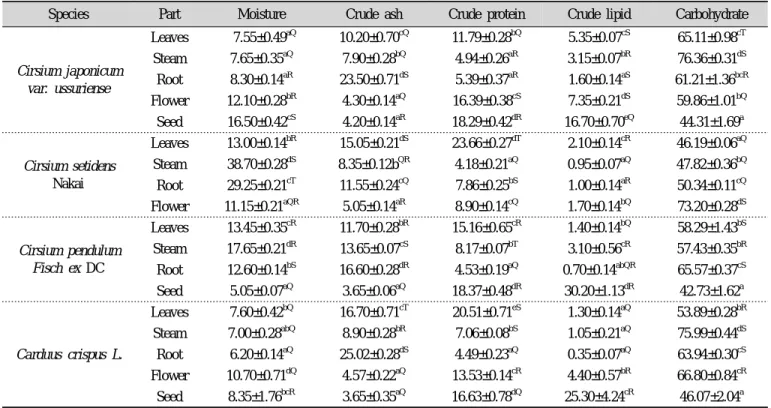
4종의 엉겅퀴를 부위별로 수분, 회분, 단백질, 지방, 탄 수화물의 함량을 분석한 결과는 Table 1과 같다. 수분함 량을 종류별로 비교하면 엉겅퀴는 꽃과 씨, 고려엉겅퀴와 큰엉겅퀴는 줄기, 지느러미엉겅퀴는 꽃에서 수분함량이 많았다. 부위별로 비교하면 잎은 고려엉겅퀴와 큰엉겅퀴 가 수분함량이 많고, 줄기와 뿌리는 고려엉겅퀴, 꽃과 씨 는 엉겅퀴가 다른 종에 비해 수분 함량이 많았다. 이는 고려엉겅퀴가 다른 종류에 비해 잎이 넓고, 줄기가 굵기 때문이며, 엉겅퀴의 꽃은 다른 종류보다 크기 때문에 씨 와 꽃에서 수분 함량이 많은 것으로 볼 수 있다.
조회분 함량을 각 종류별로 비교하면 엉겅퀴, 큰엉겅 퀴, 지느러미엉겅퀴는 뿌리에서 많았고, 고려엉겅퀴는 잎 에서 회분 함량이 많았다. 부위별로 보면 잎은 지느러미 엉겅퀴, 줄기는 큰엉겅퀴, 뿌리는 엉겅퀴와 지느러미 엉 겅퀴, 꽃은 고려엉겅퀴, 씨는 엉겅퀴가 조회분 함량이 많 았다. 조단백질 함량을 종류별로 비교하였을 때 엉겅퀴 와 큰엉겅퀴는 씨, 고려엉겅퀴와 지느러미엉겅퀴는 잎에 서 많았고, 각 부위별로 보면 잎은 고려엉겅퀴, 줄기는 큰엉겅퀴, 뿌리는 고려엉겅퀴, 꽃은 엉겅퀴, 씨는 엉겅퀴
Table 1. Proximate compositions from each part of leaf, stem, root, flower and seed in Cirsium and Carduus genus
(g/100 g DW)
Species Part Moisture Crude ash Crude protein Crude lipid Carbohydrate
Cirsium japonicum var. ussuriense
Leaves 7.55±0.49aQ 10.20±0.70cQ 11.79±0.28bQ 5.35±0.07cS 65.11±0.98cT Steam 7.65±0.35aQ 7.90±0.28bQ 4.94±0.26aR 3.15±0.07bR 76.36±0.31dS Root 8.30±0.14aR 23.50±0.71dS 5.39±0.37aR 1.60±0.14aS 61.21±1.36bcR Flower 12.10±0.28bR 4.30±0.14aQ 16.39±0.38cS 7.35±0.21dS 59.86±1.01bQ Seed 16.50±0.42cS 4.20±0.14aR 18.29±0.42dR 16.70±0.70eQ 44.31±1.69a
Cirsium setidens Nakai
Leaves 13.00±0.14bR 15.05±0.21dS 23.66±0.27dT 2.10±0.14cR 46.19±0.06aQ Steam 38.70±0.28dS 8.35±0.12bQR 4.18±0.21aQ 0.95±0.07aQ 47.82±0.36bQ Root 29.25±0.21cT 11.55±0.24cQ 7.86±0.25bS 1.00±0.14aR 50.34±0.11cQ Flower 11.15±0.21aQR 5.05±0.14aR 8.90±0.14cQ 1.70±0.14bQ 73.20±0.28dS
Cirsium pendulum Fisch ex DC
Leaves 13.45±0.35cR 11.70±0.28bR 15.16±0.65cR 1.40±0.14bQ 58.29±1.43bS Steam 17.65±0.21dR 13.65±0.07cS 8.17±0.07bT 3.10±0.56cR 57.43±0.35bR Root 12.60±0.14bS 16.60±0.28dR 4.53±0.19aQ 0.70±0.14abQR 65.57±0.37cS Seed 5.05±0.07aQ 3.65±0.06aQ 18.37±0.48dR 30.20±1.13dR 42.73±1.62a
Carduus crispus L.
Leaves 7.60±0.42bQ 16.70±0.71cT 20.51±0.71eS 1.30±0.14aQ 53.89±0.28bR Steam 7.00±0.28abQ 8.90±0.28bR 7.06±0.08bS 1.05±0.21aQ 75.99±0.44dS Root 6.20±0.14aQ 25.02±0.28dS 4.49±0.23aQ 0.35±0.07aQ 63.94±0.30cS Flower 10.70±0.71dQ 4.57±0.22aQ 13.53±0.14cR 4.40±0.57bR 66.80±0.84cR Seed 8.35±1.76bcR 3.65±0.35aQ 16.63±0.78dQ 25.30±4.24cR 46.07±2.04a Mean± SD
a,b,c/Q,R,S
: Values with the different letter are significantly different by Duncan's mutiple range test [a-d : different parts within same kind, Q-T : different kinds within same part].
와 큰엉겅퀴에서 많았다. 고려엉겅퀴의 경우 회분과 단 백질 함량이 잎에 많은데 이는 Lee SH 등(2006)의 연구 와 비슷하였다.
조지방 함량은 각 종류별로 보면 엉겅퀴, 큰엉겅퀴, 지 느러미엉겅퀴에서는 씨, 고려엉겅퀴는 잎에서 많았다. 각 부위별로 보면 잎은 엉겅퀴, 줄기는 엉겅퀴와 큰엉겅퀴, 뿌리는 엉겅퀴, 꽃은 엉겅퀴, 씨는 큰엉겅퀴와 지느러미 엉겅퀴가 많았다.
탄수화물은 각 종류별로 보면 엉겅퀴와 지느러미엉겅 퀴는 줄기, 고려엉겅퀴는 꽃, 큰엉겅퀴는 뿌리가 많았고, 각 부위별로 보면 잎은 엉겅퀴, 줄기는 엉겅퀴와 지느러 미엉겅퀴, 뿌리는 큰엉겅퀴와 지느러미엉겅퀴, 꽃은 고려 엉겅퀴, 씨는 각 종류별로 유의적인 차이가 없었다. 엉겅 퀴 잎의 회분, 조단백질, 조지방, 탄수화물 함량은 엉겅퀴 새순의 성분 분석 결과(Kim YD와 Yang WM 1986)에서 보다 더 많아 새순 보다는 좀 자란 잎의 성분이 더 많은 것을 알 수 있다.
2. 엉겅퀴 추출물의 수율
엉겅퀴 추출물의 수율은 Table 2와 같다. 엉겅퀴는 잎 >
줄기 > 꽃 > 뿌리 순으로 수율이 감소하였고, 고려엉겅퀴는 잎 > 꽃, 씨 > 뿌리 > 줄기 순이었다. 큰엉겅퀴는 잎 > 씨 >
줄기 > 뿌리 > 꽃 순이며, 지느러미엉겅퀴는 잎 > 씨 > 꽃 >
뿌리 > 줄기 순이었다. 이와 같이 4종류 엉겅퀴의 수율은 잎이 제일 높았다. Lee SH 등(2006)은 9~10월에 채취 한 고려엉겅퀴의 경우 뿌리의 수율이 제일 높았는데 이 는 채취한 시기에 따른 변화로 볼 수 있다.
3. 총 페놀 함량
총 페놀(TPC) 함량은 Table 2와 같이 동일한 종류 내 에서 보면 엉겅퀴는 잎 > 뿌리, 줄기 > 꽃, 고려엉겅퀴는 꽃 > 잎 > 씨 > 줄기, 뿌리, 큰엉겅퀴는 씨 > 잎 > 줄기, 꽃 >
뿌리, 지느러미엉겅퀴는 씨, 꽃 > 줄기, 뿌리, 잎 순이었다.
같은 부위에서 잎은 엉겅퀴 > 고려엉겅퀴 > 큰엉겅퀴 > 지 느러미엉겅퀴, 줄기는 엉겅퀴, 큰엉겅퀴, 지느러미엉겅퀴 >
고려엉겅퀴, 뿌리는 엉겅퀴 > 지느러미엉겅퀴 > 큰엉겅퀴, 고려엉겅퀴, 꽃은 고려엉겅퀴 > 지느러미엉겅퀴 > 큰엉겅 퀴 > 엉겅퀴 순이었고, 씨는 고려엉겅퀴, 큰엉겅퀴, 지느러 미엉겅퀴 간에 유의적인 차이가 없었다. 4종의 총페놀 함 량은 흰무늬엉겅퀴의 꽃과 잎(Kim KB 등 2006)에 함유 된 양(448.8 mg/g)보다 적었다. 아티쵸크(Thi BHT와 Park MK 2008)에서의 총 페놀 함량은 잎에서 568.0 mg/100 g DW로 제일 많았고 꽃, 뿌리, 줄기 순으로 함량이 낮았 으나 본 연구에 사용된 엉겅퀴류보다 함량이 낮았다.
Table 2. Extract yield, Total phenolic contents and total flavo- noid contents from each part of leaf, stem, root, flower and seed in Cirsium and Carduus genus
Species Part Extract Yield(%)
TPC (mg/g fraction)
TFC (mg/g fraction)
Cirsium japonicum var.
ussuriense
Leaves 22.94 115.72±5.08cT 173.73±6.79cS Steam 17.84 40.05±4.16bR 67.19±9.86bR
Root 10.63 42.87±3.68bS 47.58±4.93aR Flower 12.61 30.21±2.53aQ 54.12±5.88abQ
Cirsium setidens Nakai
Leaves 37.49 95.47±3.27cS 145.29±14.01bR Steam 9.46 20.93±3.68aQ 20.13±8.16aQ
Root 15.10 22.89±2.96aQ 4.44±10.79aQ Flower 21.67 105.45±4.87dT 156.73±49.75cR
Seed 21.67 71.56±5.06b 108.36±11.98bcQ
Cirsium pendulum Fisch
ex DC
Leaves 15.84 67.34±5.27cR 75.68±8.54cQ Steam 12.75 43.71±4.21bR 56.07±3.92bR Root 7.01 25.99±2.23aQR 13.59±4.93aQ Flower 4.03 40.33±2.53bR 90.06±4.08dQ Seed 17.59 78.87±5.92d 176.99±8.16eR
Carduus crispus L.
Leaves 28.32 30.49±2.57aQ 169.15±11.32eS Steam 9.57 40.62±4.64abR 35.16±14.71bQ Root 6.61 33.86±10.41abRS 17.51±15.23aQ Flower 12.33 67.06±2.12cdS 68.49±11.82cQ Seed 18.29 70.15±7.37d 93.33±1.96dQ Mean± SD
a,b,c/Q,R,S
: Values with the different letter are significantly different by Duncan's mutiple range test [a-d : different parts within same kind, Q-T : different kinds within same part].
4. 플라보노이드 조성 및 함량
총 플라보노이드(TFC) 함량은 Table 2와 같이 동일한 종류 내에서 비교하면 엉겅퀴는 잎 > 뿌리, 줄기 > 꽃, 고 려엉겅퀴는 꽃 > 잎, 씨 > 줄기, 뿌리, 큰엉겅퀴는 씨 > 꽃 >
잎 > 줄기 > 뿌리, 지느러미엉겅퀴는 잎 > 씨 > 꽃 > 줄기 >
뿌리 순이었다. 엉겅퀴 잎에서 총플라보노이드 함량이 많 이 추출되었다는 Chung MS 등(2007)의 연구와 비슷한 결과를 보였다. 꽃이나 씨의 총 플라보노이드 함량은 Lee JM 등(2001)의 연구에서 발표된 녹차의 44.7 mg/g, 가시 엉겅퀴 6.70 mg/g보다 많았다. 같은 부위에서 비교하면 잎은 엉겅퀴, 지느러미엉겅퀴 > 고려엉겅퀴 > 큰엉겅퀴, 줄 기는 엉겅퀴, 큰엉겅퀴 > 지느러미엉겅퀴, 고려엉겅퀴, 뿌 리는 엉겅퀴 > 고려엉겅퀴, 큰엉겅퀴, 지느러미엉겅퀴, 꽃 은 고려엉겅퀴 > 큰엉겅퀴, 지느러미엉겅퀴, 엉겅퀴, 씨는 큰엉겅퀴 > 고려엉겅퀴, 지느러미엉겅퀴 순이었다.
4종류 중 총 페놀과 총 플라보노이드 함량은 엉겅퀴의 잎, 줄기, 뿌리에서 많았고, 고려엉겅퀴의 꽃에서 많았다.
종류별, 부위별 추출물에 대한 acacetin, apigenin, cy- narin, narirutin, sylimarin 함량을 분석한 결과는 Table 3
과 같다. Acacetin은 고려엉겅퀴의 잎과 꽃, 큰엉겅퀴의 잎과 줄기에서 검출되었다. Acacetin(5,7-dihydroxy-4'-me- thoxyflavone)은 flavonoid 화합물로 간암세포인 Hep G2 의 증식을 저해(Hsu YL 등 2004)하며, 홍화씨(Kim JH 등 2002)와 홍화씨박(Kim JH 등 2003)의 acacetin 함량 인 13.53 ppm, 9.83 ppm 보다 낮았다.
Apigenin은 엉겅퀴, 고려엉겅퀴, 큰엉겅퀴, 지느러미엉 겅퀴의 꽃에서 검출되었고 그중 엉겅퀴 꽃에서 7.16 mg/g 으로 제일 높게 확인 되어 Kim SJ와 Kim GH(2003)의 연구와 비슷하였다. 그러나 Chung MS 등(2007)은 청주지 역의 엉겅퀴 잎(2.39 ppm), 꽃(0.39 ppm), 줄기(0.17 ppm) 에서 apigenin이 검출되었다고 하였으나 본 연구에서는 꽃에서만 검출되었고 그 양이 더 많았다. 이 함량의 차 이는 지역의 특성으로 볼 수 있다. Apigenin(4',5,7-trihy- droxyflavone)은 일반적인 방향족 화합물의 하나로 파슬 리, 양파, 오렌지, 차, 카모마일, 밀 등의 식물과 과일에 널리 분포하고 있으며, 독성이 없는 것으로 알려져 있다 (Duthie G와 Crozier A 2000). 이는 유방암 및 대장암 등 여러 가지 인체 암 세포주에서 세포성장 저해, 세포주 기 억제 및 세포사멸을 유도하며, 유방암, 난소암, 전립선 암, 대장암에서 신생 혈관 생성을 억제하며, 자궁경부암 세포주의 세포성장을 멎게 하고 세포사멸을 유도하며 anchorage-independent growth를 저해함을 보였다(Kim MH 등 2006, Oh EK 등 2008). 또한 apigenin의 항염증 작용 은 류마티스성 관절염(rheumatoid arthritis) 치료에 매우 중요하다(Jordon-Thaden IE와 Louda SM 2003, Chung MS 등 2007).
Cynarin은 고려엉겅퀴 씨에서 5.55 mg/g이 검출되었 고, narirutin은 큰엉겅퀴와 지느러미엉겅퀴 씨에서 각각 19.56 mg/g, 4.18 mg/g이 검출되었다. Cynarin은 간질환, 고지혈증, 콜레스테롤 대사에 관여하며(Jun NJ 등 2007), 아티쵸크의 뿌리 2.23 mg/100g DW(Thi BHT와 Park MK 2008), 잎에서 0.67 mg/g이 검출(Jun NJ 등 2007)되어 고려엉겅퀴 씨보다는 함량이 낮았으나 아티쵸크의 식용 부분인 미성숙 꽃(head) 부분에서는 10.15 mg/g이 함유 (Jun NJ 등 2007)되어 고려엉겅퀴 씨보다 함량이 더 많 은 것을 알 수 있었다.
Narirutin은 naringenin 골격에 nutinose의 당이 붙어 있 는 배당체의 구조를 갖는 화합물(Baik SO 등 2001)로 큰 엉겅퀴 씨에 19.56 m/g, 지느러미엉겅퀴 씨에 4.18 mg/g 이 함유되어 있다. 감귤류의 narirutin 함량은 오렌지 29.7 mg/g, 레몬 2.90 mg/g, 밀감 65.6 mg/g, 자몽 6.0 mg/g, 유자 0.49 mg/g이 함유(Baik SO 등 2001)되어 있는데 큰엉겅퀴와 지느러미엉겅퀴의 씨는 레몬, 자몽, 유자보 다 narirutin함량이 더 많은 것을 알 수 있다. 그리고 본 지역의 엉겅퀴류는 실리마린이나 실리마린 유사물질이 검 출되지 않았다.
Table 3. Acacetin, apigenin, cynarin, narirutin and sylimarin contents from each part of leaf, stem, root, flower and seed in Cirsium and Carduus genus
Species Part Acacetin Apigenin Cynarin Narirutin Sylimarin
(mg/g extract) Cirsium japonicum var.
ussuriense Flower -1) 7.16±0.58 - - -
Cirsium setidens Nakai
Leaves 0.35±0.01 - - - -
Flower 1.01±0.04 0.85±0.05 - - -
Seed - - 5.55±0.75 - -
Cirsium pendulum Fisch ex DC
Leaves 1.43±0.10 - - - -
Steam 0.68±0.04 - - - -
Flower - 2.73±0.10 - - -
Seed - 0.07±0.01 - 19.56±0.90 -
Carduus crispus L. Flower - 0.07±0.003 - - -
Seed - - - 4.18±0.10 -
1) - : not detected
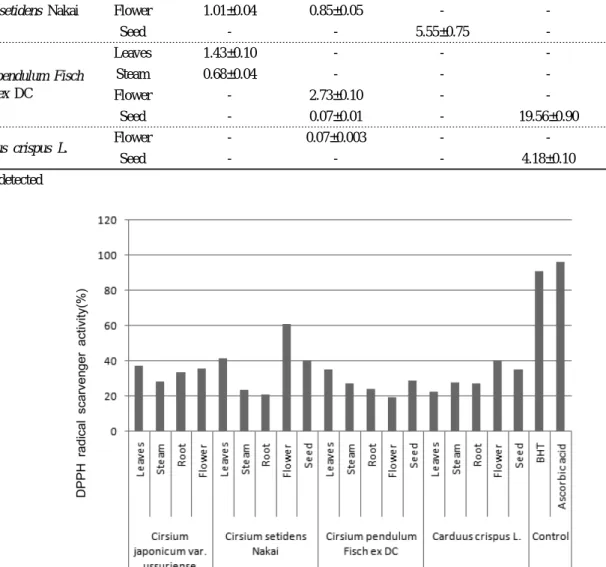
Fig. 1. DPPH radial scarvenger activity in different sections of Cirsium and Carduus genus.
6. 항산화 활성
엉겅퀴의 부위별 DPPH radical 소거활성 측정결과는 Fig. 1과 같다. 각 부위의 메탄올 추출물의 DPPH radical 소거 활성은 기존의 합성항산화제인 BHT의 DPPH ra- dical 소거활성 91.02%보다 낮았고, ascorbic acid의 DPPH radical 소거활성 96.10%보다 낮아 항산화성을 보이지 않 았으나 고려엉겅퀴 꽃에서는 61.05%로 다른 종의 각 부 위보다 높은 활성을 보였다. 또한 고려엉겅퀴를 실험한 결과 뿌리보다 잎에서 항산화 활성물질이 더 많다는데 이는 Lee SH 등(2006)의 결과와 유사하며, 합성항산화
제인 BHT보다 낮은 값을 보인 것은 항산화 활성물질이 지용성 물질 보다 수용성 물질이 많기 때문으로 보인다.
엉겅퀴의 경우 줄기 부분이 항산화 활성이 다른 부위 보 다 낮았는데 이는 Lee HK 등(2003)의 결과와 비슷하였 다. 큰엉겅퀴의 경우 잎에서 DPPH radical소거활성이 제 일 높았다(Chon SU 등 2006)는 결과와 비슷하였다.
IC50과 photochem에 의한 항산화 활성은 Table 4와 같 다. IC50은 엉겅퀴, 큰엉겅퀴, 지느러미엉겅퀴에서는 나타 나지 않았고, 고려엉겅퀴의 꽃부위에서만 132.64 µg으로 ascorbic acid의 54.42 µg보다 높았다. Photochem의 측정
Table 4. Antioxidant activity of solvent fractionation from each part of leaf, stem, root, flower and seed in Cirsium and Carduus genus
Kind Part Photochemiluminescence assay (nmol))
Cirsium japonicum var.
ussuriense
Leaves 1.757
Steam 0.784
Root 1.484
Flower 0.417
Cirsium setidens Nakai
Leaves 2.397
Steam 0.972
Root 0.540
Flower 2.750
Seed 1.161
Cirsium pendulum Fisch ex DC
Leaves 1.904
Steam 0.601
Root 0.568
Flower 0.195
Seed 0.854
Carduus crispus L.
Leaves 0.179
Steam 0.646
Root 0.521
Flower 2.353
Seed 0.778
결과 2.3 nmol이 넘는 시료는 고려엉겅퀴 잎과 꽃, 지느 러미엉겅퀴 꽃이었다. 이는 Kim CJ등(1996)이 고려엉겅 퀴 지상부에서 항산화성이 없다고 한 결과와 상반되었 는데 이는 지역적인 차이와 항산화능 측정 방법의 차이 때문으로 볼 수 있다.
IV. 요약 및 결론
농산물의 수입개방에 따른 농민의 경제적인 수요 창 출과 소비 촉진을 위하여 지역 농산물 활용 방안의 기초 자료를 제공하고자 김포에서 자생하는 엉겅퀴, 고려엉겅 퀴, 큰엉겅퀴, 지느러미엉겅퀴의 부위별 일반성분을 분 석하였고, 추출물에 대한 엉겅퀴의 우수성분으로 알려진 silymarin 존재 유무와 그 외의 플라보노이드계 성분의 정량 및 항산화 효과에 대하여 연구하였다. 각 4종류별 로 일반성분을 비교하면 다음과 같다. 수분함량은 엉겅 퀴의 꽃과 씨, 고려엉겅퀴와 큰엉겅퀴의 줄기, 지느러미 엉겅퀴의 꽃에서 많았다. 조회분 함량은 엉겅퀴, 큰엉겅 퀴, 지느러미엉겅퀴의 뿌리와 고려엉겅퀴의 잎에서 많았 다. 조지방 함량은 엉겅퀴, 큰엉겅퀴, 지느러미엉겅퀴의 씨, 고려엉겅퀴의 잎에서 많았다. 탄수화물은 엉겅퀴와 지느러미엉겅퀴의 줄기, 고려엉겅퀴의 꽃, 큰엉겅퀴의 뿌
리에 많았다. 4종류 엉겅퀴의 수율은 잎이 제일 높았으 며, 총페놀과 총플라보노이드 함량은 엉겅퀴의 잎, 줄기, 뿌리에서 많았고, 고려엉겅퀴의 꽃에서 많았다. 또한 엉 겅퀴에 많다고 알려진 실리마린이나 실리마린 유사물질 은 검출되지 않았다. Acacetin은 고려엉겅퀴의 잎과 꽃, 큰엉겅퀴의 잎과 줄기에서 검출되었다. Apigenin 함량은 엉겅퀴, 고려엉겅퀴, 큰엉겅퀴, 지느러미엉겅퀴의 꽃에서 만 검출되었고, 그중 엉겅퀴 꽃에서 7.16 mg/g으로 제일 높게 확인되었다. Cynarin은 고려엉겅퀴 씨에서 5.55 mg/g 이 검출되었고, narirutin은 큰엉겅퀴와 지느러미엉겅퀴 씨 에서 각각 19.56 mg/g, 4.18 mg/g이 검출되었다. 고려엉 겅퀴 꽃에서는 61.05%로 다른 종의 각 부위보다 DPPH radical 소거활성이 높은 활성을 보였다. Photochem의 측 정결과 2.3 nmol이 넘는 시료는 고려엉겅퀴 잎과 꽃, 지 느러미엉겅퀴 꽃이었다. 이상의 결과로 보면 곤드레로 알 려진 고려엉겅퀴는 잎을 말려 곤드레밥으로 많이 사용 하고 있으나 앞으로는 꽃과 씨를 이용한 기능성 소재의 개발과 꽃과 씨를 채취할 수 있는 방법에 대한 연구가 이루어져야 할 것으로 사료된다. 또한 현재 잘 소비되지 않지만 자생하고 있는 엉겅퀴, 큰엉겅퀴, 지느러미엉겅퀴 를 일반화하기 위한 재배 기술의 발달이 시급하다고 보 며, 채취시기에 따른 각 부위에 대한 분석 연구가 더 필 요하다고 본다.
V. 감사의 글
본 연구는 김포시농업기술센터 자생식용식물자원 가공 품 개발 연구비 지원으로 수행되었으며, 이에 감사드립 니다.
참고문헌
AOAC. 1990. Office Methods of Analysis of AOAC. Iatl, 16th ed.. Association of Official Analytical Chemists. Artington, VA, USA
Baik SO, Bock JY, Chun HJ, Jeong SI, Back SH, Oh HB, Kim IK. 2001. Analysis and quantitative distribution of glyco- sided flavonoids in citruses and Korean Chung-pi. Anal Sci Technol 14(4):340-348
Blois MS. 1958. Antioxidant determinations by the use of a stable free radical. Nature 26:1199-1200
Chon SU, Boo HO, Lee SY. 2006. Assessment on in vitro anti- oxidant properties of common thistle(Cirsium pendulum Fisch.) plant parts. Korea J Medicinal Crop Sci 14(2):
82-86
Chung AK, Kwon HC, Choi SZ, Min YD, Lee SO, Lee WB, Yang MC, Lee KH, Nam JH, Kwak JH, Lee KR. 2002.
Norisoprenoids from Circium rhinoceros. Kor J Pharmacogn 33(2):81-84
Chung MS, Um HJ, Kim CK, Kim GH. 2007. Development of functional tea product using Circium japonicum. Korean J Food Culture 22(2):261-265
Duthie G, Crozier A. 2000. Plant derived phenolic antioxidants.
Curr Opin Clin Nutr Metab Care 3: 447-451
Folin O, Ciocalteu V. 1927. On tyrosine and tryptophane deter- mination in proteins. J Biol Chem 72(Apr):627-650 Fuzzati N., Gabetta B., Jayakar K., Pace R., Peterlongo F.. 1999.
Liquid chromatography-electrospray mass spectrometric iden- tification of ginsenosides in Panax ginseng roots. J Chro- matogr A 854(1-2):69-79
Govindarajan R, Vijayakumar M, Shirwaikar A, Rawat AKS, Mehrotra S, Pushpangadan P. 2005. Activity guided iso- lation of antioxidant tannoid principles from Anogeissus Latifolia. Natural Product Sciences 11(3):174-178
Hsu YL, Kuo PL, Lin CC. 2004. Acacetin inhibits the proli- feration of Hep G2 by blocking cell cycle progression and inducing apoptosis. Biochem Pharm 67(5):823-829
Ingelman-sindberg M, Johansson I, Penttil K, Glaumann H, Lindros KO. 1988. Centrilobular expression of ethanol- inducible cytochrom P450(IIE1) in rat liver. Biochem Bio- phys Res Commun 157:55-60
Jordon-Thaden IE, Louda SM. 2003. Chemistry of Circium and Carduus a role in ecological risk assessment for biological control of weeks. Biochem Syst Ecol 31:1353-1396 Jung HA, Jung YJ, Yoon NY, Jeong DM, Bae HJ, Kim DW, Na
DH, Choi JS. 2008. Inhibitory effects of Nelumbo nucifera leaves on rat lens aldose reductase, advanced glycation endproducts formation, and oxidative stress. Food Chem Toxicol 46(12):3818-3826
Jun NJ, Jang C, Kim SC, Moon DY, Seong KC, Kang KH, Tandang L, Kim PH, Cho SK, Park KH. 2007. Radical scarvenging activity and content of cynarin(1,3-dicaffeoyl- quinic acid) in Artichoke(Cynara scolymus L.). J Appl Biol Chem 50(4):244-248
Kim CJ, Kang BH, Ryoo IJ, Park DJ, Lee HS, Kim YH, Yoo ID. 1996. Screening of biologically active compounds from various weeds. Argr Chem Biotechnol 39(5):409-413 Kim JH, Park JH, Park SD, Choi SY, Seong JH, Moon KD.
2002. Preparation and antioxidant activity of health drink with extract powers from Safflower(Carthamus tinctorius L.) seed. Korean J Food Sci Technol 34(4):617-624 Kim JH. Kim JK, Kang WW, Kim GY, Choi MS, Moon KD.
2003. Preparation of functional healthy drinks by ethanol extracts from deffated safflower seed cake. J Korean Soc Food Sci Nutr 32(7):1039-1045
Kim KB, Yoo KH, Park HY, Jeong JM. 2006. Anti-oxidative of commercial edible plant extracts distributed in Korea. J Korean Soc Appl Biol Chem 49(4):328-333
Kim MH, Jeong CS, Yoon HR, Kim GH, Lee YS. 2006.
Involvement of K+-Cl--cotransport in the apigenin-induced generation of reactive oxygen species in IMR-32 human
neuroblastoma cells. J Appli Pharmacol 14:137-142 Kim SJ, Kim GH.2003 Identification for flavones in different
parts of Cirsium japonicum. J Food Sci Nutr 8:330-335 Kim YD, Yang WM. 1986. Studies on the components of wild
vegetables in Korea. J Korean Soc Food Nutr 15(4):10-16 Lee BC, Jin SH, Cho KJ, Kim DS, Ryu BH. 1997a. Anti-
oxidative effect of silymarin purified from Silybum Mari- anum on modification of human low density lipoprotein. J Fd Hyg Safety 12(1):1-8
Lee BC, Jeong YK, Ryu BH. 1997b. Antioxidative effect of Silymarin and silybin purified from silybun marianum on oxidation of human low density lipoprotein by macrophages.
Kor J Appl Microbiol Biotechnol 25(3):286-292
Lee HK, Kim JS, Kim NY, Kim MJ, Park SU, Yu CY. 2003.
Antioxidant, antimutagenicity and anticancer activities of extracts from Circium japonicum var. ussuriense KITA- MURA. Korean J Medicinal Crop Sci 11(1):53-61 Lee JH, Lee KR. 2005. Phytochemical constituents of Circium
nipponicum (MAX.) Makino. Kor J Pharmacogn 36(2):145- 150
Lee JH, Choi SI, Lee YS, Kim GH. 2008. Antioxidant and anti-inflammatory activity of ethanol eatract from leaves of Cirsium japonicium. Food Sci Biotechnol 17(1):38-45 Lee JM, Son ES, Oh SS, Han DS. 2001. Contents of total fla-
vonoid and biological activities of edible plants. Korean J Dietary Culture 16(5):504-514
Lee MK, Moon HC, Lee JH, Kim JD, Yu CY, Lee HY. 2002.
Screening of immune enhancing activities in medicinal herbs, Compositae. Korean J Medicinal Crop Sci 10(1):51-57 Lee SH, Jin YS, Heo SI, Shim TH, Sa JH, Choi DS, Wang MH.
2006. Composition analysis and antioxidative activity from different organs of Crisium setidents Nakai. Korean J Food Sci Technol 38(4):571-576
Lee YC, Park YH. 1984. Chemical stuides on Circium species(V).
Chemical constituents of the roots of Circium xantho- canthum. Kor J Pharmacogn 15(2):74-77
Lee WB, Kwon HC, Cho OR, Lee KC, Choi SU, Baek NI, Lee KR. 2002. Phytochemical constituents of Crisium setidents Nakai and their cytotoxicity against human cancer cell lines. Arch Pharm Res 25(5):628-635
Lee YM, Park SH, Yang JC, Choi HJ. 2008. Two new natu- rallized species from Korea, Carduus natans and Lepidium latifolium. Korean J Pl Taxon 38(2):187-196
Lim JP, Song YC, Kim JW, Ku CH, Eun JS, Leem KH, Kim DK. 2002. Free rdical scarvengers from the heartwood of Juniperus chinesis. Arch Pharm Res 25:449-452
Lim SS, Kim MH, Lee JH. 1997a. Effect of Artemisia Princeps var Orientalis and Circium Japonicum var Ussuriense on liver function, body lipid and bile acid of hyperlipidemic rat. Korean Nutr Soc 30(7):797-802
Lim SS, Lee JH, Park JC. 1997b. Isolation of flavone glycoside from Circium japonicum var ussuriense and biological acti-
vity on the cardiovascular system. J Korean Soc Nutr 26(2):
242-247
Lim SS, Lee JH. 1997. Effect of Artemisia Princeps Var Orien- talis and Circium Japonicum Var Ussuriense on serum lipid of hyperlipidemic rat. Korean Nutr Soc 30(1):12-18 Liu S, Luo X, Li D, Zhang J, Qui D, Liu W, She L, Yang Z.
2006 Tumor inhibition and improved immunity in mice treated with flavone from Cirsium japonicum DC. Int Immunopharmacol 6(9):1389-1393
Mourelle M, Murrel P, Favari L, Franco T. 1989 Prevention of CCl4 induced cirrhosis by silymarin. Fundam Clin Phar- macol 3(3):183-191
Oh EK. Kim HJ, Bae SM, Park MY, Kim YW, Kim TE, Ahn WS. 2008. Apigenin-induced apoptosis in cervical cancer cell lines. Korean J Obstetrics & Gynecology. 51(8):874- 881
Park HK, Yoon SY, Choi JH, Ko HS, Suh YW, Lee YS, Kim GH, Chung MS, Cheong JH. 2006. The antidepressant effects of Circium japonicum in ICR mice. Yakkak Hoeji 50(6):429-435
Park JC, Hur JM, Park JG, Kim SC, Park JR, Choi SH, Choi JW. 2004. Effects of methanol extract of Cirsium japo- nicum var. ussuriense and its principle, hispidulin-7-O- neohesperidoside on hepatic alchohol-metabolizing enzymes and lipid peroxidation in ethanol-treated rats. Phytother Res 18(1):19-24
Saller R, Meier R, Brignoli R. 2001. The use of silymarin in the treatment of liver disease. Drugs 61:2035-2063
Singleton YL, Rossi JA. 1965. Colorimetry of total phenolics with phosphomolybdic-phosphotungestic acid reagent. Am J Enol Vitic 16(Sep):144-158
Song MJ, Kim H. 2007 Taxonomic study on Cirsium Miller (Asteraceae) in Korea based on external morphology. Korean J Pl Taxon 37(1):17-40
Suh JT, Kim WB, Kim BH, Kim JK, Choi KS. 1995. Seed gemination and cultivation method of Circium setidens under rain shelter in highland. Korean J Plant Resources, 1995 Symposium 37-38
Thi BHT, Park MK. 2008. Total phenolic compounds and flavonoids in the parts of Artichoke(Cynara scolymus L.) in Viet Nam. J Environ Scie 17(1):19-27
Vijayakumar M, Govindarajan R, Shirwaikar A, Kumar V, Rawat AKS, Mehrotra S, Pushpangadan P. 2005 Free radical scavenging and lipid peroxidation inhibition potential of Hygrophila auriculata. Natural Product Science 11(1):22-26 Wallace SN, Carrier DJ, Clausen EC. 2005. Batch solvent extr- action of flavonlignans from milk thistle(Silybum marianum L. Gaertner). Phytochem Anal 16(1):7-16
Yun HS, Chang IM. 1978. Separation and identification of cirsimarin from Circium Pendulum Fisch. Kor J Pharmacog 9(3):145-147
국립수목원. 국가생물종지식정보시스템. Available from : www.na- ture.go.kr. Assessed December 3, 2008
2009년 6월 5일 접수; 2009년 6월 26일 심사(수정); 2009년 6월 26일 채택