한국정보통신학회논문지(J. Korea Inst. Inf. Commun. Eng.) Vol. 20, No. 8 : 1494~1502 Aug. 2016
사물인터넷 기반 건강관리 스마트 주얼리 시스템
강윤정 · 윤려 · 최동운*
Smart Jewelry System for Health Management based on IoT
Yun-Jeong Kang · Li Yin · DongOun Choi
*Division of Information and Electronic Commerce, College of Business Administration, Wonkwang University, Iksan, 54538, Korea
요 약
센서를 활용한 IoT 디바이스의 사용이 증가함에 따라 센서 기반의 상황 인식을 통한 융복합형 다기능 스마트 주얼 리를 개발하였다. 현재 시장에서 공급되는 평범하고 단순한 디자인의 패션 주얼리에 사용자와의 상호작용을 고려한 스마트한 기능과 디자인을 추가였고 본 논문 에서는 스마트 주얼리에서 착장된 센서에서 개인의 생활습관 정보 데 이터를 입력받아 네트워크와 연동하고 건강관리 기능을 추가하였다. IoT 기반의 스마트 주얼리 센서가 발생시키는 데이터를 신속하게 관리할 수 있도록 온톨로지로 모델링하고 건강 정보를 서비스 할 수 있도록 스마트 주얼리 시스 템을 설계하고 구현하였다. 스마트 앱을 통해 서비스의 상태를 표시된다. 앱은 맞춤형 서비스 사용자에게 위험을 결 정하여 질환에 관한 가이드라인을 제공한다.
ABSTRACT
With the increasing availability of medical sensors and Internet of Things(IoT) devices for personal use, considering the interaction with users, it is planned to add intelligent function design to the fashionable jewelry, and develop composite multi-function intelligent jewelry through sensors identification. By means of IoT technology, while possessing communication function of intelligent jewelry, the function of intelligent jewelry can be expanded to the linkage network. In order to rapidly manage the mass data produced by intelligent jewelry sensors based on IoT, an intelligent jewelry system for health management is designed and an ontology model of intelligent jewelry system based on IoT is worked out. After the state of the services through the smart phone application is shown. The application provides a personalized service to the user and to determine the risk to show the guide lines according to the disease.
키워드 : 건강관리, 상황정보, 사물인터넷, 스마트 주얼리, 온톨로지
Key word : Context Infomation, Internet of Things, Ontology, Personal Healthcare, Smart Jewelry
Received 28 June 2016, Revised 04 July 2016, Accepted 13 July 2016
* Corresponding Author DongOun Choi(E-mail:[email protected], Tel:+82-63-850-6264)
Division of Information and Electronic Commerce, College of Business Administration, Wonkwang University, Iksan, 54538, Korea This paper was supported by wonkwang university in 2016.
Open Access
http://dx.doi.org/10.6109/jkiice.2016.20.8.1494
print ISSN: 2234-4772 online ISSN: 2288-4165Ⅰ. INTRODUCTION
With the increasing availability of medical sensors and Internet of Things (IoT) devices for personal use, a rich set of measurements about health conditions can be acquired [1]. In 2015, with the release of Apple smart watch, wearable intelligent device achieved rapid development. Meanwhile, jewelry accessories also took wearing technique as its major development direction.
Thus, considering the interaction with users, it is planned to add intelligent function and design to the fashionable jewelry through sensors identification. Through this technology, diamond jewelry has more possibilities.
Accompanied by intelligence revolution, the data produced by users is increasing day by day and the data types are becoming diversified.
Besides, Centralized prevention of various diseases is becoming a focus and the medical treatment gradually turned to taking prevention as the core. At the same time, relevant requirements on customized personal health management service on prevent, early diagnosis, maintenance and health consolidation are increasing constantly. With the coming era of mobile health care, many mobile network companies starting up business throw their eyes on this field. This is indeed a course with investment value beneficial to human beings.
In this thesis, by means of IoT technology and Big data technology, while possessing communication function of intelligent jewelry, the function of intelligent jewelry can be expanded to the linkage network. An intelligent jewelry system based on health management is designed and an intelligent jewelry system based on IoT is worked out. And, to cope with heterogeneity of the contexts acquired from IoT devices, we adopt a semantic-based approach [2, 3]. An additional desirable feature of the platform is to effectively handle the ever-evolving set of acquired medical contexts and the rules. That is, the platform should be designed to be generic for a wide range of applicability and to be effective in managing the dynamic nature of medical contexts and rules.
In this paper, we present an ontology model of various concepts and relationships in the personal healthcare. Section 2 is the summary of related works, and section 3 presents the formal model of the comprehensive knowledge base of things, concepts, and relationships in the ontology. In section 4, we present the design and the application of smart jewelry healthcare system. Section 5 is a conclusion and future research direction prediction.
Ⅱ. CORRELATION RESEARCH
2.1. Concept of Smart Jewelry
The concept of smart jewelry first appeared in 2012.
The concept is “The multifunctional (besides adornment) equipment which can communicate with wearer.” The concept of smart jewelry is shown in Fig. 1.
Fig. 1 The composition of smart jewelry
To realize the multifunction of smart jewelry, the combination of sensor technology, wireless communi- cation technology and the microprocessor is the key technology of smart jewelry’s research and development.
Sensor is a transducer whose purpose is to sense some characteristic of its environments. It detects events or changes in quantities and provides a corresponding output, generally as an electrical or optical signal [4].
Sensor can sense the physical, chemical or biological changes of light, temperature, humidity, pressure, sound, natural gas and so on. Therefore, the classification of sensor is various. It can be classified according to sense ability, function, signal transform, material, application and field.
Typical wireless communication technology consists
of Bluetooth, Zigbee, UWB, NFC and so on. These are
Wireless Communication Technology available under the wireless condition. You can choose the needed one according to different function requirement. Now Bluetooth and NFC these two kinds of wireless communication technology are the most widely used in the smart jewelry.
2.2. Semantic Technologies for Context Reasoning There have been works on applying semantic technologies for IoT context reasoning. Barbero’s work proposes a hybrid framework to offer flexible and extendible semantic reasoning methods for multiple IoT-based context-aware applications [5]. They first define service-oriented high-level architecture for the framework and Web Ontology Language (OWL) ontology models. And, to design a plug-in based flexible structure, they integrate the methods with multiple event-based processing agents. Since the framework is designed to be applied to diverse domains, the ontology models and the reasoning methods need to be refined to the personal healthcare domain. Some works focus on presenting ontology models for IoT applications such as Hachem’s work [6] and Spalazzi’s work [7].
Currently, Google File System (GFS) model based on a distributed file system [8], Map Reduce distributed computing model [9] and implemented the open source Hadoop platform [10], with high performance of the result, scalable mass data storage and the use of low cost technologies such characteristics, cloud computing research has become the most widely used in the field of data-intensive computing and storage model [11], to some extent it can be considered Hadoop has become the de facto standard for big data processing .
Based on the syntax and semantics of SPARQL and the features of Map Reduce key-value pairs, Ren Li’s work proposes a novel MapReduce-based distributed Tableau reasoning approach to check the consistency of large OWL ontologies[12].
In summary, most of the works present the conceptual design to show how to apply IoT concepts to a specific domain application and the approaches of distributed
querying and reasoning for large-scaled ontology data by utilizing cloud computing technologies. In this paper, we present a healthcare platform interacting with IoT devices such as smart jewelry.
Ⅲ. SYSTEM MODEL
3.1. Big Data System Model
IoT-based smart jewelry system is comprehensively utilize the collection, storage, analysis, and for the external environment and provides a personalized health plan to the user.
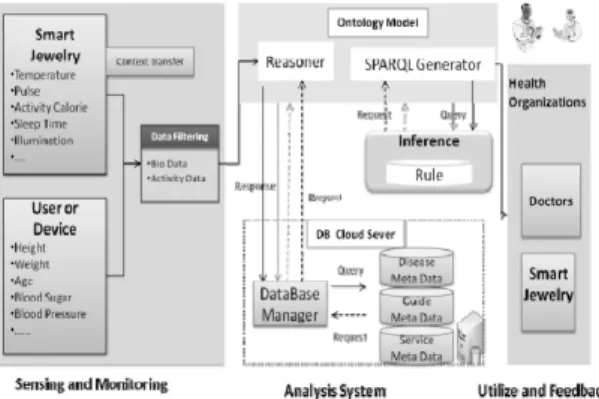
The Fig. 2 shows the configuration of a system of IoT-based Smart Jewelry proposed in this paper.
Principal part of the IoT based smart jewelry system is a configuration of the analysis information and controls the entire system. In this system, sensing data related to consisting of a feedback, like movement, body temperature and heart rate history of the individual, and the other measured biometric information to monitor the movement history information to the primary and then the analyzes to identify new health index indicating the health condition, such as life pattern from the measurement data over a long period of time. While repeating a warning that a change in health status feedback to the user in the process to manage the health of individuals.
Fig. 2 The IoT-based smart jewelry health care services configuration
In the Data Filtering thereby receiving the biometric information and lifestyle information (Activity Data) converts the format of the data in the form of OWL.
Order of the inference is an inference rule by the inference after generation of the query SPARQL to enable query processing environment of the ontology.
The information about the service can receive offers from phone and jewelry. The health care model requires the management of medical specialists, general, health care and medical care is expanded health care and general medical services through mobile observation system. Those who have a chronic disease that requires long hours and poor health management through will provide health care services and medical observation.
3.2. The Data Type
Data mining process in this paper generally includes three data type below. First, biometric data: Height, weight, blood pressure, pulse and so on. Second, lifestyle data: Smoking, eating habits, exercise habits. Third, Other data: Personal and family medical history, the environmental data and the like.
3.2.1. Biometric data
In this paper, there are three types of discriminating diseases. First, chronic diseases. Chronic diseases include hypertension, diabetes and so on. Second, adult diseases such as obesity include sieving decreases. Third, common diseases like colds or fever.
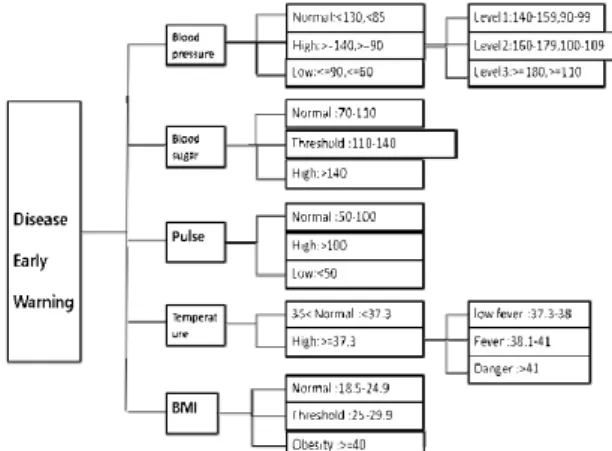
To analyze the health status of the user it should be based on user data of symptoms. The following is a combination of clinical medical knowledge that will describe the medical definition, the relationship between the normal ranges, and the condition of each index term. This data consists of data by the smart jewelry biological information sensor data, other detection data, and user equipment detects directly written to the phone.
Normal range and scope of the disease early warning indicators of the body are shown in Fig. 3.
Fig. 3 Chronic disease identification and early warning module
After analyzing the observations, the recorded value with a warning will inform the cumulative number of complications. This is intended to be comprehensive health awareness in the user evaluation report also shows. Specific methods are as follows:
Step 1: The user sets the evaluation time and biometric data value over life.
Step 2: Set the target, and observation analysis and evaluation of numerical targets should be more than the actual value of your neuropathy observed data.
Step 3: After steps 1 and 2, set the conditions to proceed with the statistical analysis of biological observations life, and calculated the cumulative number of times and the percentage of normal values and ideals levels.
Step 4: Save your longer add value assessment of the ease of viewing and comparison work in the future.
3.2.2. Lifestyle data
Between close relation to human health and lifestyles
and a healthy lifestyle is the most effective way to avoid
hooking it that well in the bottle. Conversely, good habits
should not be sources of diseases. Analysis of lifestyle
data refers to the analysis of the user's movement way,
way of life, such as exercise, sleep, food intake, and
sends a warning signal when certain indicators have
clearly exceeded the normal range. In addition, we can
set the target value of the indicator according to the user's requirements, which acts to prompt health. Through smart jewelry gyro sensor, exercise act, exercise time, activity calorie, sleep time are observed.
The result of the analysis based on the lifestyle data can be seen differently from all age, gender, occupation, lifestyle, neuropathy, the required exercise, sports events, water, food, etc.. So what I proceed on the basis of this analysis system is that users personalized plan to analyze the data for the lifestyle.
3.3. Ontology for Big Data Processing
Medical systems used by doctors collaborate with a fixed set of medical devices to acquire patients’ current health conditions. On the other hands, personal healthcare applications acquire data from heterogeneous IoT health devices such as smart jewelry. Consequently, it is technically challenging to represent things and relationships in the personal healthcare domain by mitigating heterogeneities on the smart jewelry. An ontology model is known as one of the most effective ways to integrate heterogeneous concepts and represent them in a homogeneous way [13]. It consists of a set of constraints that can be applied to classes and properties as defined by OWL (Ontology Web Language) standard for describing ontology. In this paper, we define a context using OWL and reasoning through rules (Rule) proposes personalized health management services.
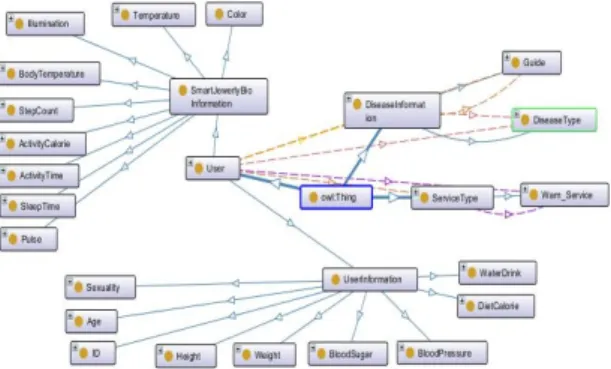
Fig. 4 OWL model of context aware data from the smart jewelry
Drawing from observations of doctors’ behaviors, we extract User, ServiceType, and DiseaseInformation as key concepts for this domain. Since our focus is on supporting personal healthcare applications, we need to manage smart jewelry used by users, which is defined as SmartJewelryBioInformation. Hence, we extract upper ontologies. And, by defining inter-relationships, we derive a domain-specific ontology as shown in Fig. 4.
With information obtained from the Smart Jewelry (SmartJewerlyBioInformation) is configured such Pulse, BodyTemperature, ActivityTime, StepCount, Activity Caloria, SleepTime. UserInformation written directly to a mobile phone consists of Age, BloodPressure, Weight.
UserInfomation class describes the health profile information by using subclass of relationship. Hence, we can easily augment personal information as a subclass of User.
Disease Information ontology represents diseases and their classifications. There may be well-defined disease hierarchies. For seamless integration, the ontology is designed with high-level type of the diseases. Once having these abstract elements, we can easily add concrete disease by using generalization relationship.
Disease Information class including such as Disease Type, Pathogenesis, Diagnosis, Treatment, Prevent and, Disease Type class based on the User class like blood pressure, blood sugar, body temperature, pulse, through clinical results to a numeric, and determine the user's risk. Guide class determines the disease risk classification via the user of the status data so that you can get guidelines for the individual disease conditions.
ServiceType class is a trial-party service such as Warn-Service and smart LED Jewelry context decisions.
DiseaseType class mainly includes Diabetes, Fever,
Hypertension, Obesity, etc. Guide class configuration
offers health guidelines for each disease and
corresponding DiseaseType class. As described in the
OWL modeling and deployment process for modeling
according to your situation around the user's situation,
defining the component and selecting the relationship
between these can be expressed clear information.
By defining the relationships between the components with the properties of OWL, we design this relationship as shown in Fig. 5.
Fig. 5 Relationship of diagnosis ontology and disease ontology
Although doctors hold extensive knowledge on diseases, it is not straightforward to figure out diseases from patients’ symptoms. To diagnose diseases, doctors should do some inferences, and they apply diagnostic rules as a baseline. In this section, we define inference rules working with the ontology. In defining inference rules, we need to deal with the following challenges:
a) Minimizing the number of inference rules: All rules should be defined exclusively. If there are a large number of rules maintained by the platform, it will result in the performance overhead to look for the right rules for the disease.
b) Coping with doctors’ evolving knowledge base:
Similar to the ontology models, inference rules should always keep an up-to-date state by reflecting doctors’
evolving knowledge base.
Therefore, we define inference rules in a generic form by considering expendability, which can be represented with diverse rule languages such as SPARQL.
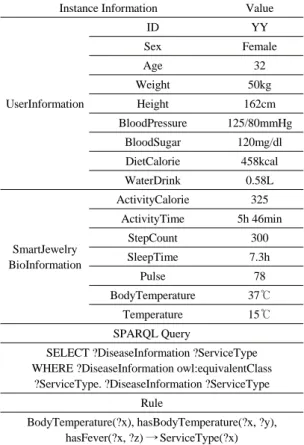
For an extendable design of the inference rules, we distinguish variable parts from common parts. Part of queries and rules to deduce the disease, and service through the user's context and ontology data is shown in Fig. 6. Converted to a status data entered after OWL and executes the inference rules to generate the query and
shows the results of inference rules. It can be obtained by the metadata for the service from the inference result of the user provided with a personalized service from the history database.
Fig. 6 SPARQL query results
Ⅳ. DESIGN AND IMPLEMENTATION
In this section, we describe the implementation of the proposed system. Through an Instance metadata it shows the state of the services through the smart phone application. The application provides a personalized service to the user and to determine the risk to show the guidelines according to the disease. After that we performed evaluations about the performance of the ontology model.
4.1. Instance and Application
The Smart Jewelry is detected on a user's biometric
information sent to your phone via Bluetooth and
uploaded to the cloud data center server via the app on
phone. Information obtained by the sensors is transmitted
to the server via a wired or wireless Internet. Based on the
ontology model, by means of data integration from smart
jewelry sensors and mobile environment, instance
information is attained, integrated and managed for
further analysis under this framework as shown in Fig. 7.
Fig. 7 Smart jewelry system framework
We use this instance and the application result to show our smart jewelry healthcare system is able to realizes user context information and provide services. The instance information value and inference rule are shown as Table 1.
Table. 1 Instance information and rule
An instance of inference results for the smart jewelry healthcare system is shown in Fig. 8, Fig. 9 and Fig. 10.
Blood sugar, blood pressure, BMI value has to be entered manually since it is not included in the detection range of the smart jewelry. For example, if you type a value of BMI appeared as sex, height, weight, age in FIG.8 to get the BMI value. The basic information of the instance: ID is YY, usage time is April 5, 2016, Female user, 32 years old, weight is 50kg, height is 162cm. BMI value is 19.1 as normal.
Fig. 8 BMI entry example
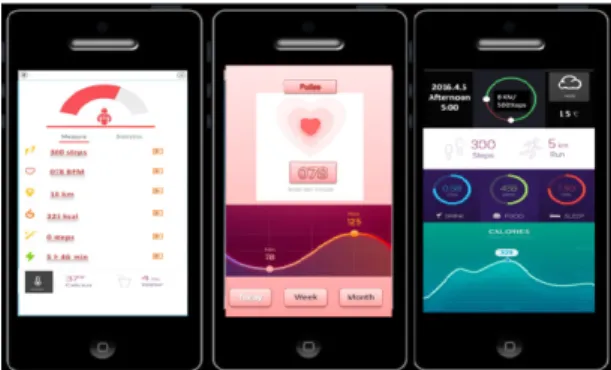
Fig. 9 is an entire screen that the value of each health care function can be monitored in real time. The specific inspection results and the trend analysis can examine the value of every individual. Fig. 9 shows a screen illustrating the detection and the momentum of the pulse and exercise. And the detail information of each part can be checked by clicking.
Instance Information Value
UserInformation
ID YY
Sex Female
Age 32
Weight 50kg
Height 162cm
BloodPressure 125/80mmHg
BloodSugar 120mg/dl
DietCalorie 458kcal
WaterDrink 0.58L
SmartJewelry BioInformation
ActivityCalorie 325
ActivityTime 5h 46min
StepCount 300
SleepTime 7.3h
Pulse 78
BodyTemperature 37℃
Temperature 15℃
SPARQL Query
SELECT ?DiseaseInformation ?ServiceType WHERE ?DiseaseInformation owl:equivalentClass
?ServiceType. ?DiseaseInformation ?ServiceType Rule
BodyTemperature(?x), hasBodyTemperature(?x, ?y), hasFever(?x, ?z) → ServiceType(?x) Pulse (?x), hasPulse (?x, ?y) → Pulse_Warn(?x) BloodSugar(?x), hasBloodSugar(?x, ?y), hasDiabetes(?x, ?z)
→ ServiceType(?x)
BloodPressure (?x), hasBloodPressure(?x, ?y), hasHypertension(?x, ?z) → ServiceType(?x)
SleepTime(?x), hasSleepTime(?x, ?y)
→ SleepTime_Warn(?x) WaterDrink(?x), hasWaterDrink(?x, ?y)
→ WaterDrink_Warn(?x) ActivityCalorie(?x), hasActivityCalorie(?x,?y)
→ ServiceType(?x)
Weight(?x),hasWeight(?x,?y),hasObesity(?x,?z)
→ ServiceType(?x)
Fig. 9 Smart jewelry detection display
After input the blood pressure value and blood sugar value, inference result is shown as Fig. 10. Users can detect their health status and symptoms in the long term through the use of smart Jewelry healthcare applications.
Further, the data of their symptoms by the detecting terminal can be transferred to the memory of the server system, or view the data as a graph of their symptoms.
Fig. 10 Guidance and Q&A display
Ⅴ. DISCUSSION AND CONCLUSIONS
Although developing personal healthcare applications become feasible, there are a number of technical challenges in developing such applications; modeling the relationships between diseases and acquired measurements, representing medical expertise in machine-readable forms, and software implementation of the medical analytic schemes. To handle the challenges,
we first formally represented concepts and relationships in the ontology model. In personal healthcare domain, users can measure their health conditions anywhere as long as they carry smart jewelry. And the platform is designed to be deployed on cloud so that all its functionalities are exposed via interfaces. We also show the state of the services through the smart phone application. The application provides a personalized service to the user and to determine the risk to show the guide lines according to the disease. Moreover, the paper has thus described a successful implementation of modern IoT technology such as wireless sensor network and big data to integrate data, add intelligent function to the fashionable jewelry, and the interaction with users was more considered.
We believe that the proposed platform can be effectively used in provisioning personal healthcare services. And in future research, we aim to perform a sensitivity analysis to evaluate the proposed framework.
We also plan to extend the smart jewelry system to provide more services such as social network services and allowing the automatic analysis of the user’s depression to predict melancholia.
REFERENCES
[ 1 ] L. Atzori, A. Iera, and G. Morabito, “The Internet of Things: A Survey,” Computer Networks, vol. 54, no.15, pp.
2787-2805, Oct. 2010.
[ 2 ] P. Barnachi, W. Wang, C. Henson, and K. Taylor,
“Semantics for the Internet of Things: Early Progress and Back to the Future,” International Journal on Semantic Web& Information Systems, Vol. 8, no. 1, pp. 1-21, Jan.
2012.
[ 3 ] Y. Huang and G. Li, “A Semantic Analysis for Internet of Things,” in Proceedings of 2010 International Conference on Intelligent Computation Technology and Automation (ICICTA 2010), Changsha, China, pp. 336-339, May. 2010.
[ 4 ] J.Gubbi, R.Buyya, S.Marusic, M.Palaniswami, “Internet of Things(IoT): A vision, architectural elements, and future directions,” Future Generation Computer Systems, vol. 29, no. 7, pp. 1645-1660, Sep. 2013.
[ 5 ] C. Barbero, P.D. Zovo, and B. Gobbi, “A Flexible Context aware Reasoning Approach for IoT Applications,” in Proceedings of 2011 12th IEEE International Conference on Mobile Data Management (MDM 2011), Luleå, Sweden, pp. 266-275, June. 2011.
[ 6 ] S. Hachem, T. Teixeira, and V. Issarny, “Ontologies for the Internet of Things,” in Proceedings of the 8th Middleware Doctoral Symposium (MDS 2011), New York, USA, Article No. 3, Dec. 2011.
[ 7 ] L. Spalazzi, G. Taccari, A. Bernadini, “An Internet of Things Ontology for Earthquake Emergency Evaluation and Response,” in Proceedings of 2014 International Conference on Collaboration Technologies and Systems (CTS 2014), Minneapolis, Minnesota, USA, pp. 528-534, May. 2014.
[ 8 ] S. Ghemawat, H. Gobioff and S.T. Leung, “The google file system,” in Proceeding of the 19th ACM Symposium on
Operating Systems Principles, New York, USA, pp. 29-43, Oct. 2003.
[ 9 ] J. Dean, S. Ghemawat, “MapReduce: simplified data processing on large clusters,” Communications of the ACM, vol. 51, no. 1, pp. 107-113, Jan. 2008.
[10] Apache, Hadoop[Online], Available: http://hadoop.Apache.
org/.
[11] C. Bizer, A. Jentzsch and R. Cyganiak, State of the LOD Cloud [Online], Available: http://lod-cloud.net/ state/.
[12] Ren Li, “Research on key Technologies of Large-Scaled Semantic Wed Ontologies Querying and Reasoning based on hadoop,” Chongqing University, Apr. 2013.
[13] N. Guarino, M. Carrara, and P. Giaretta, “An Ontology of Meta-level Categories,” in Proceedings of the 4th International Conference on the Principles of Knowledge Representation and Reasoning (KR1994), Bonn, Germany, pp. 270–280, Dec. 1994.
YunJeong Kang
received her M.S. degree in Computer Science in 1998 and her is Ph.D. degree in Division of Computer Science &
Engineering from Jeonbuk National University in 2006. Since 2010, She has been working for Wonkwang University as an adjunct professor. Her research interests include Internet of Thing, Smart Jewelry and Lifecare.
E-mail address: [email protected]
Li Yin
received B.A degree in Division of Logistics Management in 2009 and M.S degree in Division of Information Management from Beijing Jiaotong University in 2011. She research interests include Smart Jewelry, Ubiquitous Computing and Bioinformatics. E-mail address: [email protected]
Dong-Oun Choi
joined wonkwang University as an Professor in 2006. He received a Ph.D. in Division of Computer Science &
Engineering from Jeonbuk National University in 1997.He received a B.S. degree in 1984. and an M.S. degree in Division of Computer Science & Engineering from Jeonbuk National University in 1986.He research interests include Smart Jewelry, Ubiquitous Computing and Bioinformatics. E-mail address: [email protected]