Journal of Mushrooms
한 국 버 섯 학 회 지164
Research Article
This is an Open-Access article distributed under the terms of the Creative Commons Attribution Non-Commercial License (http://
creativecommons.org/licenses/by-nc/3.0) which permits unrestricted non-commercial use, distribution, and reproduction in any medium, provided the original work is properly cited.
J. Mushrooms 2017 December, 15(4):164-167 http://dx.doi.org/10.14480/JM.2017.15.4.164 Print ISSN 1738-0294, Online ISSN 2288-8853
© The Korean Society of Mushroom Science
*Corresponding author E-mail : [email protected] Tel : +82-63-238-9130 Received December 1, 2017 Revised December 18, 2017 Accepted December 26, 2017
Mycelial growth of Lentinula edodes in response to different mixing time, pressure intensity, and substrate porosity
Hyun You Chang, Geum Hui Seo, Yong Kuk Lee, and Sung Woo Jeon*
Korea National College of Agricultural and Fisheries(KNCAF), 1515, Kongjwipatjwi-ro, Wansan-gu, jeonju-si, Jeollabuk-do, Korea
ABSTRACT: Biological efficiency (BE), the ratio of fresh mushrooms harvested per dry substrate weight, expressed as the percentage of Lentinula edodes, also known as shiitake, was determined using the ‘Sanjo 701’ strain stored in the Department of Mushroom at the Korea National College of Agriculture and Fisheries. The mycelia were grown in glass columns with varying levels of moisture content and varying mixing periods of 0.5, 1, 2, and 3 hours. The substrate was sterilized using a steam pressure autoclave sterilizer at normal and high pressure to avoid contamination. The results showed that mycelial growth (126 mm/15 days) was optimized at 55% moisture content. The best mycelial growth of 117 mm/15 days was obtained with 2 hours of mixing time. Normal pressure sterilization yielded better results with mycelial growth of 96 mm/15 days at 100°C compared to 88 mm /15 days with sterilization at 121°C. Mycelial density was higher, i.e. 3(+++), with normal pressure sterilization compared to 2(++) with high pressure sterilization. Furthermore, sawdust mixed with 5%
woodchips increased the substrate porosity and yielded higher mycelial growth. Thus, we demonstrated that the optimum harvest or potential increased yield of shiitake can be obtained by modulating moisture content, mixing time, and substrate porosity.
KEYWORDS: Lentinula edodes, Sawdust, Sterilization, Wood chip, Yield
Introduction
A staple in the Asian diet for centuries, Lentinula edodes also known as the shiitake mushroom has become the second-most consumed mushroom in the world because of its great taste and versatility. In addition, shiitake is gaining worldwide recognition because of its health benefits (Bruhn, 2008). As the demand increases, different media were used in cultivating shiitake and one of them is through log cultivation. Logs are an inexpensive option to house and grow the mushroom spawn.
It is considered that the beginning of the sawdust cultivation of the shiitake through sawdust spawn started in 1936 in Kitashima, Japan. However, as the log cultivation expands further, useful hardwood resources become scarce and it turns to be more and more difficult to acquire in large quantities when necessary. In addition, shiitake log cultivation is also getting worse due to the decrease in rural labor force and the aging of growers.
In China, the test was conducted at the Shanghai Agricultural Experiment Station in 1956 for the cultivation of sawdust spawn. On the other hand, cultivation of shiitake in a plastic bag was invented in 1974 at the Taiwan Agricultural Experiment Station which led to its widespread cultivation in China, Japan and Korea (Jang, 2009).
Most commercial production of shiitake is done on synthetic logs that contain hardwood sawdust, straw or corncobs as the basal ingredients and starch-based supplements such as wheat bran, rice bran, millet, rye, and maize. Sufficient water is added to adjust the moisture content of the mix to about 60% (Royse et al., 1990; Royse and Sanchez, 2007). For commercial production, the mix is weighed and filled into plastic
165 Hyun You Chang, Geum Hui Seo, Yong Kuk Lee, and Sung Woo Jeon
bags automatically by machine so that a uniform amount is added to each bag. The bags are made of heat-resistant polypropylene and contain a special filter patch of laminated microporous plastic. The microporous patch provides a microbial barrier to contaminants and allows gas exchange with the outside environment during substrate colonization (Royse and Sanchez- Vazquez, 2001). It has been reported that shiitake production in China increased 135 fold between 1983 and 2003 (Chang and Chen, 2003).
Based from personal encounters from among experienced farmers, it can be observed that the length of mixing time period of sawdust with different level of moisture content and its sterilization process have direct impact to the production and yield as well as to the farmers’ income.
Thus, this study was conducted to evaluate how to optimize the moisture utilization of shiitake with varying length of mixing time period in relation to the substrate porosity. It has been reported that mycelial growth, primordium formation and productivity vary with different substrate types. Thereby increasing the shiitake production and income of household farmers.
Materials and Methods
The Study Area. The study was conducted at the Department of Mushroom of Korea National College of Agriculture and Fisheries.
Substrate preparation. The check substrate contains oak sawdust which is 100% sawdust that are 3mm in size. While the other substrate contains a combination of sawdust, 3mm in diameter with a mixture of 5%
woodchips, 5mm in size and rice bran (80:20). These woodchips were soaked in advance for one week in winter and four days in summer.
Mixing time period. The substrate were mixed in 0.5, 1, 2, and 3 hours to ensure moisture content distribution.
Moisture Content. Different level of moisture content were prepared setting them to 50, 55, 60, 65 and 70%.
Sterilization. The substrate was sterilized at 121°C for 40 minutes, cooled to 15°C. Pressure steam autoclave sterilizer was used under normal and high pressure sterilization. This is done to reduce contamination during the process of inoculation and improve its physical properties.
Inoculation. The substrate is inoculated with
mushroom spores or spawn after which fungal fibers known as mycelium begin to grow.
7. Contamination determination. To determine the amount of contamination of the sawdust media, 1g sample was taken from the medium prior to inoculation having various temperatures (5, 10, 15, 24oC). Having mixed with 10ml of distilled water, it is homogeneously mixed by homogenizer. In order to identify the source of contamination, it was thoroughly determined by the dilution plate method on the PDA medium.
8. Growth rate and density examination. Growth rate and density of mycelium were examined by 5 day intervals basis at 70% humidity and 22±1oC temperature.
The culture completion period, mycelial density and biological efficiency were investigated by preparing medium having a height of 17 cm and a width of 13 cm. The culture depth, mycelial density and biological efficiency were examined by treating the depth of the medium from 1/3 to 2/3.
Results and Discussion
Mycelial growth and density depending on the moisture content of the medium
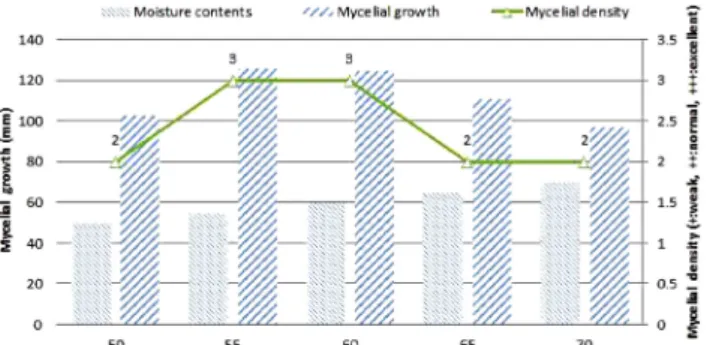
Mycelial growth and density according to wood chips 5% of 5 mm sized wood chips were added to the sawdust medium and the mycelial growth was best at 126 mm / 15 days in the treatment of 55% moisture, 125 mm / 15 days in 60% treatment, 111 mm/15 days in 65% and 103 mm/15 days in 50% (Fig. 1).
Both yield and biological efficiency (BE) were higher in the medium of 55% than in the medium of 50% or 60% moisture content. The result of this test was also high on Shen’s and Qing’s which was at 55% (2008).
Fig. 1. Mycelial growth and density of Lentinula edodes
‘Sanjo 701’ depending on the moisture content of medium.
Mycelial growth of Lentinula edodes in response to different mixing time, pressure intensity, and substrate porosity 166
Mycelial growth and density depending on the mixing time of sawdust
To compare the mycelial growth length depending on the mixing time of sawdust, sterilization was performed at a time span of 30 minutes, 1, 2, and 3 hours mixing.
When the sawdust medium was mixed for 2 hours, mycelial growth of 117 mm/15 days and density 3(+++) had the best results (Fig. 2).
Mycelial growth rate and density by sterilization method
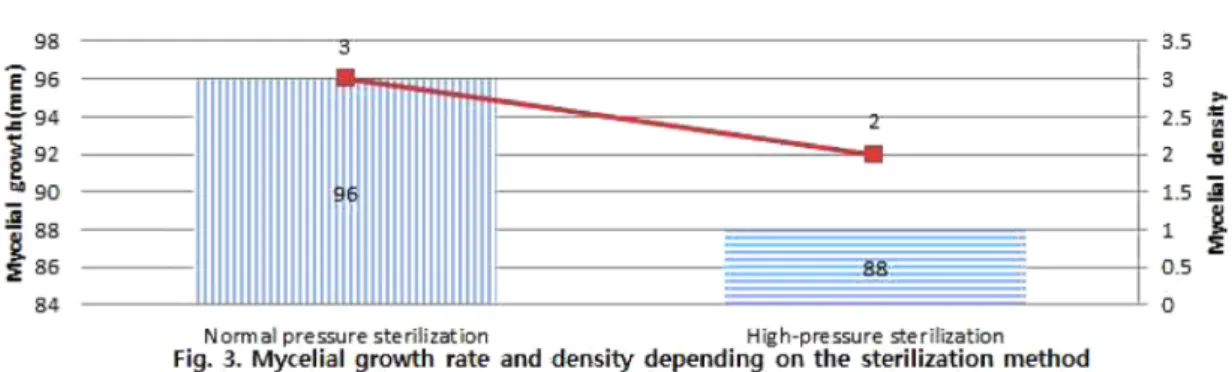
Total mycelial growth was 96mm/15 days at 100oC sterilization and 88mm /15 days sterilization at 121oC.
Mycelial density was 3(+++) at normal pressure sterilization while 2(++) at high pressure sterilization (Fig. 3).
Sterilizing the growth medium kills any potential biological contaminants before the mushroom begin to grow(Gerard, n.d.). Normal pressure sterilization has an
advantage of softening the physical structures after the sterilization of the medium and improving the growth of the shiitake. The mycelial growth was best during 8 hours of sterilization. The PH change decreased from 6.68 to 6.10, and the results of this experiment were also the same. In order to use it as a spawn, high- pressure sterilization has to be performed and for physical improvements, the growth medium was satisfying at normal pressure sterilization.
During sterilization, air pockets in the sterilizer must be vented to increase the temperature in proportion to the pressure, and the results were similar to those of Dion and Parker (2013).
Mycelial growth depending on the porosity of the substrate
The shiitake mycelium had higher demand of oxygen than other mushrooms, and the amount of porosity increased due to the use of wood chips. As a result, mycelial growth and density were estimated to be highest at 55% moisture content. The general moisture content of the sawdust medium is 65%, but for the case of the shiitake, say that it is 55%. More than 5% of wood chips with a particle size of 5 mm mixed ensuring the voids of particles had faster mycelial growth and better mycelial density than using the sawdust that is 3 mm and less in size (Royse, 2001).
According to Royse (2001), the yield varied according to the sawdust size. The yield was lowest at <0.85 mm and it was highest at 2.8-4 mm. To give out the results, the wood chip showed the highest value of 5mm standard, which was consistent with the results of (Royse, 2001)
Fig. 2. Mycelial growth and density of Lentinula edodes
‘Sanjo 701’ depending on the mixing time.
Fig. 3. Mycelial growth rate and density depending on the sterilization method mycelial density (+:weak, ++:normal, +++excellent).
167 Hyun You Chang, Geum Hui Seo, Yong Kuk Lee, and Sung Woo Jeon
Acknowledgement
The author would like to acknowledge the academic support and financial assistance of the Korea Institute of Planning and Evaluation for Technology of Food, Agriculture, Forestry and Fisheries.
References
Bruhn J. 2008. Growing shiitake mushrooms in Agroforestry Practice. Agroforestry in Action, AF1010, 1-2.
Chang ST, Chen M. 2003. History, actual situation and prospect of shiitake production. Edible Fungi. 23:2-4.
Dion M and Parker W. 2013. Steam sterilization principles.
Pharmaceutical Engin. 33:2-3.
Gerard J. (n.d.). Does Mushroom Growing Medium Need to be Sterilized? Retrieved December 20, 2017, from
Homeguides: http://homeguides.sfgate.com/mushroom-growing- medium-need-sterilized-55957.html
Jang M. 2009. High Quality shiitake bag ciultivation technique development. (M. R. Institute, Ed.) Agricultural Technology Institute.
Royce DD, Sanchez JE. 2007. Ground wheat straw as a substiture for portions of oak woodchips used in shiitake (Lentinula edodes) substrate formulae. Bioresour Technol.
98:2137-2141.
Royse DJ. 2001. Influence of substrate wood-chip particle size on shiitake (Lentinula edodes) yield. Bioresour Technol. 76: 229-233
Royce DJ, Sanchez-Vasquez JE 2001. Influence of substrate woodchip particle size on shiitake (Lentinula edodes) yield. Bioresource Technol. 76:229-233.
Royse DJ, Bahler BD, Bahler CC. 1990. Enhanced Yiled of shiitake by saccharine amendment of the synthetic substrate. Appl Environ Micorbiol. 56:479-482.