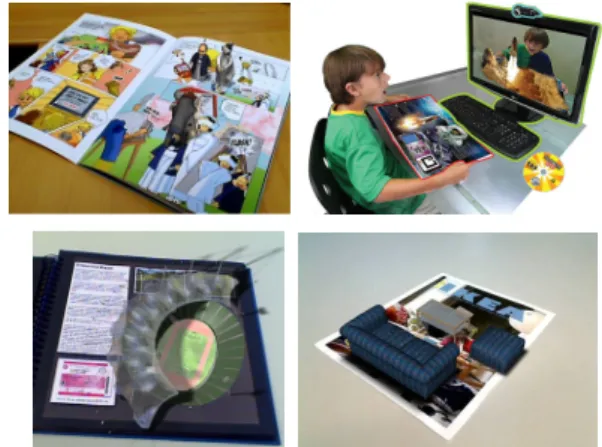
모바일 증강현실 기술 및 표준화 동향
이용환 * , 이유경, 박제호, 윤경로, 김정길 ** , 김영섭 ***
Trend of Technologies and Standardizations for Mobile Augmented Reality
Yong-Hwan Lee * , Yukyong Lee, Je-ho Park, Kyoungro Yoon, Cheong Ghil Kim ** and Youngseop Kim ***
요 약
최근 스마트폰 사용자가 늘어나면서 증강현실 (Augmented Reality) 기술을 활용한 제품 소개 또는 광고 마케팅이 활발히 이뤄지고 있다. 이는 실제 환경에 가상 물체나 정보를 합성하여 원래의 실제 환경에 존재하는 사물처럼 보이게 하는 증강현실을 활용한 애플 리케이션들이다. 본 논문에서는 모바일 환경에서 증강현실의 기술 요소 및 관련 표준화 동향을 살펴보고, 이미지 기반의 증강현실 기술에 대한 표준화 필요성에 대해 논의한다.
Key Words : Mobile Augmented Reality, Standardization, Image-based Augmented Reality, JPEG-AR
ABSTRACT
Recently, by increasing the number of smartphone users, the applications for product brochure and advertising service using a technology of augmented reality are also taking place exponentially. The term, augmented reality, is an application of providing composite view with real world and virtual world, and synthesizing the information to make it look-like things that exist in the actual environments of the original real world. In this paper, we present the trends of core technologies and the standardization related on augmented reality in the mobile environment, and discuss the necessary of standards related to image-based augmented reality.
※본 연구는 문화체육관광부 및 한국콘텐츠진흥원의 2012년 콘텐츠산업기술지원사업으로 수행되었음.
*
단국대학교 응용컴퓨터공학과 ([email protected]),**
남서울대학교 컴퓨터학과 ([email protected]),***
단국대학교 전자공학과 ([email protected]), 교신저자접수일자 : 2013년 2월 25일, 수정완료일자 : 2013년 3월 12일, 최종게재확정일자 : 2013년 3월 15일
I. Introduction
Due to the rapid and amazing development of information technology, many useful contents have been distributed as digital data in the Internet. Reflecting these trends, it has become the urgent need to provide new services and development technologies related to synthesize two or more sources. The representative example of application for the synthesis is augmented reality, which is a technology that provides a composite view of real world and computer-generated object.
As a definition of the term, AR (Augmented Reality) is a live, direct or indirect, view of a physical, real- world environment whose elements are augmented by computer-generated sensory input such as sound, video,
graphics or GPS (Global Positioning System) data [1].
Conventionally, augmentation is in real-time and in semantic context with environmental elements, such as sports scores on TV during a match. With the help of advanced AR technology, for example, adding computer vision and object recognition, the information surrounding real world of the user becomes interactive and digitally manipulable. Artificial information about the environment and its objects can be overlaid in the real world [2].
From a dozen of definition of AR, augmented reality
means a technology that provides (1) link between two or
more media with additional information, (2) immersible
media of five sense-augmentations in real- world, (3) a
composite view of the media, and (4) bi- directional
interaction on the view linked dual spaces.
This paper is organized as follows: next section describes key technical factors for enabling augmented reality applications, and Section 3 presents some of use cases of AR application. Section 4 discusses the current state-of-the-art on international standardization of AR, and the paper concludes by summarizing the study and its findings and discussing possible directions for future research in this area.
Ⅱ. Key Technical Factors for AR Applications
In order to realize augmented reality, a number of technologies are needed, which are like Display device, Camera calibration, Registration and marker, Location and/or movement tracking, User’s position and direction tracking, Object detection, 3D modeling, Creating a virtual object, Image matching between real world scene and virtual object, Representation of those technologies on the device (either mobile or wired device), Handling user interactivity, and so on.
Since many technologies are necessary to implement augmented reality, core technology factors will be catalogued with the basic criteria for AR definition.
2.1 Display device and representation technology for the contents of AR
Display device is a technology for displaying the contents of augmented reality. Depending on the type of hardware device, optical device, projector and HMD (Head-Mounted Device) are utilized. On the side of software, representation technology is needed to express the content of augmented reality on the device. Mash-up technique is one of the service technologies in representation of real world pictures and virtual entities.
As well as, augmented reality engine should support the full capabilities of presentation layer over the browser or application. Real-time rendering for computer graphics and photo-realistic method should be supported.
As shown in Figure 1, photo-realistic AR application is to achieve seamless integration of the virtual objects in the real scene. This can be done by synthesizing of the new augmented image consistently, reconstructing of the lighting condition for a given image, and computing reflection on of the surrounding on the virtual object.
Figure 1. Example of Photo-realistic AR Application
2.2 Tracking and Recognition Technology
To match and combine computer-generated images into real world, tracking is an essential technology. System should be able to track the exact location of user and user’s orientation (looking direction) and movement. For example, direction and slope of a virtual object are changed according to the movement of the user’s hand. On the focus of 2-D image, location and orientation where the photo is taken should be traced. As well as, technologies of image recognition and object identification within the image are necessary for matching the point with virtual objects. Examples for recognition technique are marker-based recognition and feature-based recognition.
Figure 2. Example of Face Tracking AR Application 1)
2.3 Image Matching and Synthesizing Technology
In an augmented reality system, mismatch between real world and virtual world leads a user to be discomfort by the gap. AR expands or enriches reality with additional information. Handling exact geometric information between real object and computer-generated object is one of the most important points in the success of the augmented reality.
2.4 User Interface and interaction technology
According to increase the user’s interaction in
augmented reality, user interface used in various device
and handling of user’s interaction is an important
technologies. For example, haptic technology is being used
1) http://www.arlab.com/in mobile devices.
2.5 Mobiles Technology for AR
From the improvements of mobile device capabilities, it is possible to utilize the technique of augmented reality on the mobile platform. In fact, recently released mobile device includes graphics accelerator, so that the device can handle a content of augmented reality in the real-time. As mainly used in mobile environments as augmented reality technology, sensor-based technologies (e.g., accelerometer, gyroscopes or GPS) can be utilized to determine the orientation and matching point of virtual object. As well as, Point-and-shoot for ubiquitous tagging technique is useful on mobile augmented reality.
Ⅲ. Use Cases of AR
This section presents use cases of augmented reality applications, focused on the 2-dimensional real world.
Figure 3 is the example of augmented reality at the museum, Guggenheim Museum, and exhibition, MoMA New York. Most museum visitors do not like to read lengthy instructions. It is imperative, therefore, that the interface be easy, simple and fun to learn. Looking at them from a museum visitor’s perspective, bringing AR to the museum is a good challenging effort.
Figure 3. Example of AR at the area of heritage 2)
AR pop-up book from mobile devices using image recognition is also one of good examples. Integrating image recognition in the design, the book can hence be enjoyed alone as a regular pop-up book, or supplemented with augmented digital content when viewed through a mobile device equipped with a camera, such as on iPad.
Interactive system for smart editing of images of man-made scenes is proposed by Zheng [4]. Starting from single images with segmented interest regions, they
2) http://www.museumsandtheweb.com/mw2010/papers/krauss/krauss.html http://blog.art21.org/2011/08/04/the-artist-is-prescient-relational-aesthetics-
and-augmented-reality/
generate cuboid proxies for partial scene modeling enabling a range of smart image manipulation.
Figure 4. Examples of Image based on AR Application 3)
Figure 5 shows that they replace furniture in one image using candidates from other images, while automatically conforming to the non-local relations extracted from the original scene, for example, the sofas have the same heights, table is correctly placed.
Figure 5. Example of interactive system based on two dimensional image [4]
Amazing new advertisement utilizes augmented reality technology to create a truly interactive media piece out of a 2-dimensional magazine advertisement. Using AR tracking technology, as a user hold the ad up to his/her camera, then he/she can see a 3-D model of a product that moves as he/she turns the sheet of paper around. MINI gives an example of AR advertisement through new technologies.
Augmented reality has become one of the hottest new advertising trends. But AR allows smart-phone users to point their phones’ cameras at certain object (be it a print
3) http://blogs.libr.canterbury.ac.nz/libnews.php?itemid=8423 http://www.geekalerts.com/popar-augmented-3d-reality-books/
advertisement or even a coffee cup) that trigger a 3D video.
Figure 6. Example of advertisement AR application 4)
Ⅳ. Standardization Bodies and Their Activities related to Augmented Reality
Few standardization committees are working on AR, and the main activities of these bodies are described in this section.
4.1 MPEG-A
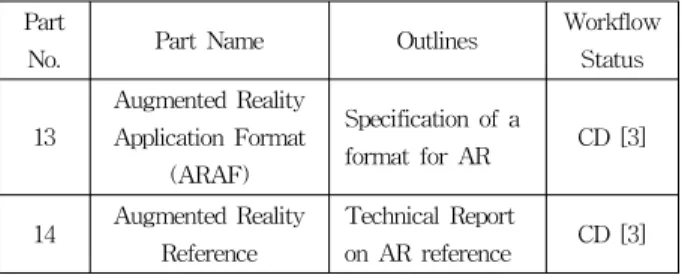
MPEG-A (Multimedia Application Format) is a suite of standards specifying application formats that involve multiple MPEG and, where required, non MPEG standards [5]. There are several parts in the MPEG-A, however, Part 13 and 14 are related technologies to augmented reality, abstracted in Table 1.
Table 1. Parts of MPEG-A and their standard status
PartNo. Part Name Outlines Workflow
Status 13
Augmented Reality Application Format
(ARAF)
Specification of a
format for AR CD [3]
14 Augmented Reality Reference
Technical Report
on AR reference CD [3]
4.2 W3C AR Community Group
W3C AR Community Group is an open forum for collaborative discussions about the intersection of Augmented Reality and the Web (simply the Augmented Web) [6]. The goal of this group is to help ensure that the disparate standards and APIs being planned and implemented by these other groups can be seamlessly integrated into this new vision for the Augmented Web.
4) http://www.gamasutra.com/blogs/RyanCreighton/20111109/90586/Dumber_than_
Advertised_5_HalfBaked_Technologies_that_Failed_to_Deliver.php
4.3 AR Standards
AR Standards Group is an international community for open and interoperable AR content and experiences. They collect and monitor progress and activities across SDO (Standard Development Organization) and relevant industry groups which provide AR technologies for industrial. Also, they provide inputs to the SDO and communities interested in AR technologies, and support a centralized place/forum for the expression of needs from the community including obstacles to the growth of AR [7].
4.4 SC24 WG9 ARC
Main mission of SC24 WG9 is to investigate the reference model of ARC (Augmented Reality Continuum), and for producing a suitable ARC RM (Reference Model) [8]. Main activities of SC29 are (a) to identify the architectural elements of ARC RM, (b) to study the relationships between ARC RM elements and define appropriate interfaces between them, (c) to develop a general purpose reference model that shows the ARC RM elements along with their interrelationships, (d) to study and identify one or more abstract levels that can support platform independence over a wide variety of platform types, and (e) to identify available standards that support one or more of the ARC RM elements.
4.5 Web3D Consortium AR
Web3D Consortium AR was formed to address the needs of projecting computer generated information into the real world [9]. Their goals include (a) to collect requirements and to describe typical use cases for using X3D in AR/MR (Mixed Reality) applications, (b) to produce and propose X3D components for AR/MR scenes and applications, and (c) to produce sample AR/MR applications using X3D to demonstrate how this functionality can work correctly.
4.6 OMA Mobile AR v1.0
OMA (Open Mobile Alliance) is the wireless industry’s
focal point for the development of mobile service enabler
specification, which support the creation of interoperable
end-to-end mobile services [10]. The version 1.0 of the
MobAR Enabler defines an overall framework that enables
mobile augmented reality services. The core functionalities
exposed by the MobAR Enabler include (a) personalization and management of AR content, (b) user interactivity handling to AR content, (c) network and client APIs, and (d) security and privacy aspects.
4.7 ARML 2.0 Standards WG
OGC (Open Geospatial Consortium) standards are developed within the OGC Standards program. The OGC Technical Committee and OGC Planning Committee work in a formal consensus process to arrive at approved or adopted OGC standards [11]. Their Implementation Standards are different from the Abstract Specification.
They are written for a more technical audience and detail the interface structure between software components. An interface specification is considered to be at the implementation level of detail.
ARML (Augmented Reality Markup Language) is a descriptive, XML based data format, specifically targeted for mobile AR applications. ARML focuses on mapping geo-referenced POIs (Points of Interests) and their metadata, as well as mapping data for the POI content provides publishing the POIs to the AR application.
4.8 Acceleration for Mobile AR by Khronos Group
Khronos group is a not for profit industry consortium creating open standards for the authoring and acceleration of parallel computing, graphics, dynamic media, computer vision and sensor processing on a wide variety of platforms and devices [12].
Ⅴ. Conclusion
Since there are three basic criteria of AR as first definition of augmented reality [2], most of services and researches have focus on three dimensional contents with the real world (e.g., MPEG-AR). As well as, some standardization committees (such as MPEG and W3C) are on the going to standard about the field of augmented reality. However, SC29 WG1 JPEG does not working on this field, even through image is a primitive and basic media of all contents. As you can see many example services of augmented reality, 2-D image based augmented reality is in progress and going on development of application, and this can make a new
industrial service in the near future. Thus, along with the provision for these kinds of services, standard approach is urgently required. As we described in the previous section, MPEG has focus on 3D video as real world scene, while we have focus on the basis of 2D image. In the use of AR technique, broadcasting with AR is one of the use cases for MPEG-AR, while AR education or advertisement based on JPEG can be one of the use scenario for image based on AR.
Since we has been focused on 2-D images, real world scene should be basically JPEG or JPEG2000 image.
However, virtual world does not matter what kind of objects are (e.g., text, 1-D sound, 2-D image or 3-D object scene). This is the key of our focus research for augmented reality, named JPEG-AR, which represents various types of virtual objects on JPEG image. For example, the camera image can be overlaid with various multimedia contents (audio, image, graphic image, video, 3D model) in real time. In the case of implementation on common mobile devices, smart-phones, iPads or a device which can support 3D display could be used as representation device.
The main contribution of this paper is that activities of several standardization bodies for augmented reality are discussed, and new AR based on 2-dimensional image is presented. As for future works, there are two main avenues for future discussion to show use scenarios, and make a framework using JPEG image as the real world on augmented reality.
참 고 문 헌
[1] Website http://en.wikipedia.org
[2] Ronald T. Azuma, A Survey of Augmented Reality, In Presence Teleoperators and Virtual Environments, vol.6, no.4, pp.355-385, 1997.
[3] ISO/IEC SC29/WG11 MPEG, Multimedia Application Formats, MPEG-A MAF Overview, WG1N10111, 2012.
[4] Youyi Zheng, Xiang Chen, Ming-Ming Cheng, Kun Zhou, Shi-Min Hu, Niloy Mitra, Interactive Images – cubiod proxies for smart image manipulation, ACM Transactions on Graphics, SIGGRAPH, vol.31, issue 4, 2012.
[5] MPEG-V and MPEG-A by SC29/WG11, available at http://wg11.sc29.org/augmentedReality/
[6] AR Community Group by W3C, available at http://www.
w3c.org/community/ar/
[7] AR Standards, available at http://www.perey.com/ ARStandards/
[8] AR Continuum (ARC) Concepts and Reference Model by
SC24 WG9, available at http://dxp.korea. ac.kr/SC24-WG9/
[9] Web3D Consortium AR Working Groups, available at http://www.web3d.org/realtime-3d/working-groups/
augmented-reality-ar/
[10] OMA Mobile Augmented Reality v1.0 by Open Mobile Alliance, available at http://technical. openmobilealliance.org /Technical/release_program/MobAr_v1_0.aspx
[11] ARML 2.0 Standards WG by Open GeoSpatial Consortium, available at http://www.opengeospatial. org/projects/groups /arml2.0swg/
[12] Acceleration and Sensor APIs for Mobile augmented reality by Khronos Group, available at http://www.khronos.org
저자
이 용 환(Yong Hwan Lee)
․1993년 2월:단국대학교 전자계산학 과 학사졸업
․1995년 2월:단국대학교 전산통계학 과 석사졸업
․2007년 2월:단국대학교 전자컴퓨터 공학과 박사졸업
․2009년 3월∼현재:단국대학교 응용컴퓨터공학과 연구교수 <관심분야> : 영상검색, 콘텐츠관리, 증강현실
이 유 경(Yu Kyong Lee)
․1999년 2월:코니티대학교 컴퓨터아 트 학사졸업
․2003년 2월:단국대학교 멀티미디어 공학 석사졸업
․2003년 9월:단국대학교 응용컴퓨터 공학과 박사과정
<관심분야> : 컴퓨터아트, 문화콘텐츠(CT), 증강현실
박 제 호(Je Ho Part)
․1985년 2월:서강대학교 전자계산학 과 학사졸업
․1993년 8월:Polytechnic Institute of NYU 석사졸업
․2000년 12월:Polytechnic Institute of NYU 박사졸업
․2003년 3월∼현재:단국대학교 컴퓨터과학과 교수 <관심분야> : 영상검색, 멀티미디어 데이터베이스, 증강현실
윤 경 로(Kyoung Ro Yoon)
․1987년 2월:연세대학교 전자전산기 공학과 학사졸업
․1989년 12월:미시건대학교 전기공학 과 석사졸업
․1999년 5월:시라큐스대학교 전산학 과 박사졸업
․2003년 9월∼현재:건국대학교 컴퓨터과학과 교수 <관심분야> : 영상검색, MPEG/JPEG, 국제표준
김 정 길(Cheong Ghil Kim) 종신회원
․1987년:Univ. of Redlands 컴퓨터과 학 학사졸업
․2003년:연세대학교 컴퓨터과학 석사 졸업
․2006년:연세대학교 컴퓨터과학 박사 졸업
․2008년~현재 : 남서울대학교 컴퓨터학과 교수
<관심분야> : 멀티미디어 임베디드 시스템, 이기종 컴퓨팅, 모바일 AR, 3D Contents
김 영 섭(Young Seop Kim)