Isolation and Identification of Antioxidant Compounds of Various Solvents Extracted from Eriobotrya japonica Leaves
Hyeon-Suk Ham, Se-Yeul Lee, Dong-Wan Lee, Jong-Hwan Seong, Han-Soo Kim, Dong-Seob Kim and Young-Guen Lee*
Department of Food Science & Technology, Pusan National University, Miryang 602-706, Korea
Received March 22, 2012 /Revised August 12, 2012 /Accepted September 18, 2012To investigate potential medicinal or functional uses of Eriobotrya japonica, this study focused on the isolation and identification of antioxidant compounds from Eriobotrya japonica leaves. Various solvents were extracted from the leaves, and their scavenging effect on 2,2-diphenyl-1-picrylhydrazyl (DPPH) radicals was measured, in addition to their superoxide dismutase-like activity, polyphenol compounds, and flavonoid content. Ethyl acetate extract exhibited the strongest scavenging effect in a 0.2 mM sol- ution of DPPH (63.24±2.20%, 81.83±2.10%, and 93.15±2.31% in 0.3, 0.7, and 1.0 mg/ml sample concen- trations, respectively). The antioxidant effect of the ethyl acetate extract and methanol extract were generally stronger than that of n-hexane extract. The extracts were further purified by repeated silica gel column chromatography. The antioxidant compounds were identified as phytol, β-sitosterol, and (-)-loliolide using GC/MS.
Key words : Eriobotrya japonica leaf, antioxidant, solvent extraction, column chromatography, GC/MS
*Corresponding author
*Tel:+82-55-350-5354, Fax:+82-55-350-5359
*E-mail : [email protected]
서 론
인체의 대사 반응에 의하여 생성되는 활성산소는 화학약품, 환경오염, 스트레스, 자외선 등, 각종 물리적, 화학적, 환경적 요인에 의해 과잉 생산되어 생체 구성성분들인 지질, 단백질, 당, DNA 등에 대하여 비선택적, 비가역적인 파괴 작용을 함으 로써 동맥경화, 심장질환, 당뇨병, 암, 노화 등을 비롯한 각종 질병을 일으키는 것[40]으로 알려져 있다. 따라서 근래 인체와 식품의 과산화물 생성방지 또는 소거효과를 갖는 항산화제를 개발하고자 많은 연구가 진행중이며, 식품에는 기존의 tert-butylhydroxytoluene (BHT), tert-butylhydroxyanisol (BHA) 등과 같은 합성 항산화제와 α-tocopherol, vitamin C, carotenoids, flavonoids와 같은 천연 항산화제가 사용되고 있 다. 그러나 BHA와 BHT 등의 합성 항산화제는 발암성과 독성 등 여러 가지 부작용[11]으로 인하여 그 사용량을 법적으로 엄격히 규제하고 있기 때문에 부작용이 거의 없으면서 합성 항산화제만큼 효능이 강력한 항산화제를 개발하려는 연구가 활발히 수행되고 있다.
한편, 비파(Eriobotrya japonica)는 장미과(Rosaceae)에 속하 는 아열대성의 상록 소교목으로 꽃은 백색으로 10~11월에 개 화하고, 황백색이나 등황색의 열매는 다음해 6월에서 7월 사 이에 수확하며, 중국이 원산지로 알려져 있다. 중국, 일본, 인 도, 스페인 등에서 주로 재배되고 있으며, 우리나라의 경우
제주도, 경남 및 전남지방 등 온화한 기후조건에서 주로 자생 하는 자원식물로 관상용 또는 약용을 목적으로 재배되고 있 다. 비파는 예로부터 민간요법으로 청폐, 진해, 건위, 거담, 이 뇨, 패혈 해소, 구토, 호흡진정, 갈증해소, 기관지염, 구역질, 딸꾹질, 부종 등에 효능이 뛰어난 것[30]으로 알려져 있다. 일 본과 중국 등 외국에서의 최근 연구에 의하면 비파 종자추출 물에서 활성산소종을 제거[42]하거나 산화적 스트레스를 억제 [19]하고, LDL 산화를 방지[28]하며, 위장염 개선효과[39] 및 알러지 피부염 억제효과[38] 등을 나타낸다고 보고하였다. 또 한 비파 잎에는 다양한 terpenoid [35,37]와 flavonoid [22] 등 의 유용한 화합물을 다량 함유하고 있으며, 항당뇨 효과[13], 항염증 및 항암효과[7], 만성기관지염 억제효과[20], corosolic acid의 glucose uptake 촉진 효과[43] 등이 알려져 있다. 국내 에서는 비파 과실이나 부위별 성분 분석[1,14,29], 비파 용매 추출물의 항산화[8,16,21,22], 항균활성[2,3,31], 항염증[26], 항 돌연변이[4,24], 항암[25,41], 항당뇨[23,34]에 관한 연구등을 비 롯하여 비파 씨의 tyrosinase 활성 저해 효과[27] 등이 보고되 어 있으며, 산업적 활용방안으로서 비파엽차[6], 비파주스[5], 비파 요구르트[18] 등의 제조에 대한 보고들이 있다.
본 연구에서는 건강 기능성 식품소재로서 가능성을 가진
비파 잎의 용매별 추출물을 대상으로 항산화 활성을 탐색하고
추출물의 분획과 분리 등으로 활성물질을 규명함으로써 비파
의 산업적 이용에 기초자료로 활용하고자 하였다.
재료 및 방법
재료
본 실험에 시료로 사용한 비파잎(Eriobotrya japonica)은 2010년 6월에 전남 완도군에서 재배된 것을 구입하여 사 용하였으며, 동결건조기(SFDSHM12, Samwon eng, Korea) 를 이용하여 -80℃에서 동결건조하고 분쇄한 후 시료로 사 용하였다.
추출 및 분리
시료의 추출은 유기용매를 사용하여 극성에 따른 분획을 실시하였다. 즉, 동결건조된 비파잎 100.0 g을 잘게 분쇄한 후 저극성 용매인 n-hexane으로 먼저 추출하여 여과한 시료를 다시 ethyl acetate (EtOAc), methanol (MeOH)을 이용하여 각각 순차적으로 3회 분획하여 추출하였다. 각 용매 추출분획 을 회전감압농축기(Eyela, N-2NW, Japan)로 감압농축하여 건 조시킨 후 n-Hexane 추출물(0.92 g), EtOAc 추출물(7.47 g), MeOH 추출물(17.35 g)을 각각 얻었다. 각 추출물에 대하여 정량적으로 2,2-diphenyl-1-picrylhydrazyl (DPPH) 소거활성, superoxide dismutase (SOD) 유사활성을 측정하고, 페놀 화합 물과 플라보노이드의 함량을 측정하였으며, 각 용매에 따른 추출물 중 강한 활성을 나타낸 EtOAc 추출물과 MeOH 추출 물에 대하여 column chromatography를 이용하여 활성물질 의 분리 정제를 실시하였다.
EtOAc 추출물 7.37 g과 MeOH 추출물 15.92 g을 n-hexane : methylene chloride : acetone 혼합용매를 용출용매로 사용하 여 silica gel (70-230 mesh, 5 cm × 60 cm)을 사용한 column chromatography를 실시하였으며 EtOAc 추출물에서 24개의 분획(EtOAc F1-F24), MeOH 추출물에서 30개의 분획(MEOH F1-F30)으로 나누었다. 각 분획물에 대하여 항산화 활성을 측 정한 결과 EtOAc F7, MeOH F16에서 비교적 강한 활성을 확 인하였다. EtOAc F7 (526.5 mg)과 MeOH F16 (55.5 mg)에 대하여 GC/MS 분석을 실시하였다. GC/MS의 분석은 GC/MS (HP 6890 series GC system + HP 5973 MSD, Hewlett Packard Co. USA)에서, HP-5 capillary column (5% phenyl methyl siloxane capillary, 30.0 m × 250 μm i.d., 0.25 μm film thickness, Hewlett Packard Co. USA), carrier gas는 He (32.6 ml/min.), Split ratio 30:1, oven 온도조건은 initial temp.
(time) 80℃ (5 min.), rate는 10℃/min., final temp. (time) 28 0℃ (20 min.)이며, injection port temp. 250℃, interface temp.
240℃ 및 70 eV의 ionization voltage의 조건으로 분석하였다.
활성 물질의 동정은 mass spectrum을 해석한 결과를 토대로 Willey library (wiley 275L.)를 참고하였다.
DPPH radical 소거활성측정
2,2-diphenyl-1-picrylhydrazyl (DPPH) radical에 의한 소거
효과는 Brand-Williams 등[9,10]의 방법에 준하여 평가하였다.
일정한 농도로 정용한 비파추출물 1 ml에 0.2 mM DPPH를 1 ml 가하였다. 혼합물을 교반하여 37℃에서 30분간 반응시키 고 UV/VIS spectrophotometer (U-2000, Hitachi, Japan)로 517 nm에서 흡광도를 측정하였다. 대조군으로는 기존에 사용 되는 합성항산화제 BHT와 BHA를 시료와 같은 농도로 조제 하여 같은 방법으로 측정하였으며 시료용액의 첨가군과 무첨 가군의 흡광도 차이로 free radical 소거활성을 백분율로 표시 하였다. 모든 실험은 3회 반복 실시하였으며 결과는 평균±표 준편차로 나타내었다.
DPPH radical scavenging activity (%)=(1-
)×100
SOD 유사활성측정
SOD 유사활성은 pyrogallol의 자동산화를 저해하는 정도 [36]로 Marklund & Marklund의 방법[33]으로 확인하였다. 일 정한 농도로 정용된 시료 0.2 ml에 pH 8.5로 보정한 Tris-HCl buffer 3 ml와 7.2 mM pyrogallol 0.2 ml을 첨가하여 25℃에서 10분간 반응시킨 후 1N-HCl로 정지시킨다. 반응액 중 산화된 pyrogallol의 양을 UV/VIS spectrophotometer (U-2000, Hitachi, Japan)로 420 nm에서 흡광도를 측정하였다. 대조군 으로는 기존에 사용되는 합성항산화제 BHT와 BHA를 시료와 같은 농도로 조제하여 같은 방법으로 측정하였으며 시료용액 의 첨가군과 무첨가군의 흡광도차이로 SOD 유사활성을 백분 율로 표시하였다. 모든 실험은 3회 반복 실시하였으며 결과는 평균±표준편차로 나타내었다.
SOD-like activity (%)=(1-
)×100
Polyphenol 화합물 함량 측정
Folin-Denis의 방법[17]을 이용하여 각 추출물의 poly- phenol 함량을 측정하였다. test tube에 일정한 농도로 정용된 시료 1 ml와 2% Na
2CO
3를 2 ml을 첨가하여 실온에서 3분간 안정화 시킨 후 folin-ciocalteu's phenol reagent 100 μl를 첨가 하여 30분간 반응시켜 UV/VIS spectrophotometer (U-2000, Hitachi, Japan)로 725 nm에서 흡광도를 측정하였다. 표준곡 선은 tannic acid를 이용하여 검량선을 작성하고 polyphenol 화합물의함량을 mg/g tannic acid로 나타내었다. 모든 실험의 검량값은 동일한 실험을 3회 반복하여 평균한 값으로 나타내 었다.
Flavonoid 화합물 함량 측정
페놀성 화합물 중 특히 각종 기능성을 나타내는 것으로 알려 진 flavonoid 함량을 알아보기 위해 다음과 같이 측정하였다.
일정한 농도로 정용된 시료 1 ml와 diethyleneglycol 2 ml,
Table 1. Scavenging activity (%) of DPPH radical of the n-hexane, EtOAc and MeOH extracts of
Eriobotrya japonica
leaf at different concentrationsSamples Concentrations (mg/ml)
0.3 0.7 1.0
n-hexane extract 45.63±1.26 48.92±1.49 52.34±1.55
EtOAc extract 63.24±2.20 81.83±2.10 93.15±2.31
MeOH extract 72.68±3.17 76.17±11.38 79.94±1.90
BHA 52.84±2.23 54.55±2.51 59.06±3.34
BHT 61.53±2.88 60.23±4.97 63.58±7.90
The data were expressed as the mean±SD (n=3).
Table 2. SOD-like activity (%) of n-hexane, EtOAc and MeOH extracts from
Eriobotrya japonica
leaf at different concentrationsSamples Concentrations (mg/ml)
0.3 0.7 1.0
n-hexane extract 55.30±6.31 54.84±3.05 54.97±3.34
EtOAc extract 50.58±6.43 48.19±8.04 46.19±8.27
MeOH extract 51.68±2.47 48.64±0.34 48.00±0.59
BHA 45.80±1.47 47.93±2.96 50.32±1.51
BHT 43.99±0.51 44.28±0.78 52.33±4.10
The data were expressed as the mean±SD (n=3).
1N-NaOH를 20 μl를 혼합하여 37℃에서 60분 동안 반응시킨 후 UV/VIS spectrophotometer (U-2000, Hitachi, Japan)로 420 nm에서 흡광도를 측정하였다. 표준물질로 rutin을 이용하 여 검량선을 작성하고 flavonoid 함량을 mg/g으로 나타내었 다. 모든 실험의 검량값은 동일한 실험을 3회 반복하여 평균한 값으로 나타내었다.
결과 및 고찰
DPPH radical 소거능
비파 잎의 각 용매 추출물의 DPPH radical 소거능을 농 도에 따라 측정한 결과는 Table 1에 나타낸 바와 같이 시료 의 농도가 증가할수록 활성이 높게 나타났다. BHA와 BHT 는 각각 52.84~59.06%와 61.53~63.58%의 활성을 나타내었으 며 n-hexane 추출물의 경우 1.0 mg/ml의 농도에서, EtOAc 와 MeOH 추출물은 0.3 mg/ml의 농도에서 50% 이상의 소 거활성을 나타내었다. EtOAc 추출물의 경우 특히 시료 농 도에 따라 DPPH의 증가 정도가 컸으며 0.7 mg/ml에서는 MeOH 추출물에 비해 더 높은 항산화 활성을 나타내었다.
또한 1.0 mg/ml의 농도에서는 n-hexane과 MeOH 추출물에 비해 EtOAc 추출물이 93.15%로 매우 뛰어난 소거활성을 보 였으며 이러한 결과는 배 등[2]의 연구에서 비파 부위별 용 매추출물에서 EtOAc 추출물의 DPPH 활성이 가장 높았다 는 보고와 비슷하였다. MeOH 추출물은 시료 농도에 따른 DPPH 활성 정도는 크게 차이가 나지 않았으나 0.3 mg/ml 에서 n-hexane 추출물과 EtOAc 추출물에 비하여 더 높은 항산화 활성을 나타내었다.
SOD 유사활성
비파 잎의 각 용매 추출물의 SOD 유사활성을 농도에 따라 측정한 결과, Table 2에 나타낸 바와 같이, 대조군인 BHA와 BHT는 각각 45.80~50.32%와 43.99~52.33%의 활성을 나타내 었으며, 비파잎의 각 용매 추출물도 이와 비슷하거나 높은 활 성을 나타내었다. 특히 n-hexane 추출물의 경우 0.3 mg/ml의 농도에서 55.30±6.31%로 가장 높은 활성을 나타내었으나 0.7 mg/ml의 농도와 1.0 mg/ml 농도에서 각각 54.84±3.05%와 54.97±3.34%으로 감소하여 농도의 증가에 따른 활성의 증가는 나타나지 않았다. DPPH radical 소거능과 SOD 유사활성의 결과가 일치하지 않은 것은 효소계 시스템(SOD 유사활성과 hydrogen peroxide 소거능)에서의 radical 소거능과 비효소계 시스템(hydroxyl radical과 DPPH radical 소거능)에서의 radi- cal 소거능이 차이를 보인다는 Calliste 등[12]의 보고와 일치하 였다.
Polyphenol 화합물 함량
Polyphenol 화합물의 함량은 Folin-Denis법[17]을 이용하
여 Folin-Ciocalteu reagent가 알칼리 조건에서 추출물의
polyphenol성 화합물에 의해 환원된 결과 노란색에서 몰리브
덴의 청색으로 발색하는 것을 원리로 분석하였다. 표준물질로
tannic acid를 이용하여 검량선을 작성하고 함량을 mg/g으로
나타내었다. 시료 농도와 725 nm에서 흡광도 간의 회귀방정식
은 y=0.0076x+0.008 (y는 725 nm에서의 흡광도이며, x는 시료
농도, r
2=0.9109)이었다. 비파 잎의 각 용매 추출물의 농도별
polyphenol 함량은 Fig. 1과 같다. 먼저 MeOH 추출물 0.3
mg/ml, 0.7 mg/ml, 1.0 mg/ml의 농도에서 각각 59.0 mg/g,
Fig. 1. Total polyphenol compound of n-hexane, EtOAc and MeOH extracts from
Eriobotrya japonica
leaf at different concentrations. The data were expressed as the mean±SD (n=3).
130.2 mg/g, 188.8 mg/g으로 가장 높게 나타났으며 n-hexane 추출물 0.3 mg/ml, 0.7 mg/ml, 1.0 mg/ml의 농도에서 각각 15.9 mg/g. 23.6 mg/g, 36.4 mg/g으로 가장 낮게 나타났다.
Kim 등[24]은 비파 잎 메탄올 추출물을 0.5 mg/g 농도에서 polyphenol 함량을 측정한 결과에서 94.2 mg/g으로 보고하여 본 결과와 유사하였다. Lee 등[31]은 건조 조건에 따른 비파 잎의 열수 추출물과 80% ethanol 추출물의 polyphenol 함량을 측정하여 동결건조한 잎에 비해 생잎의 polyphenol 함량이 더 많았으며, 동결건조한 비파 잎의 열수 추출물과 80% etha- nol 추출물의 polyphenol 함량은 각각 116.2 mg/g과 170.6 mg/g 이었고, 생잎의 열수 추출물과 80% ethanol 추출물의 polyphenol 함량은 각각 125.7 mg/g과 215.4 mg/g으로 보고 하였다. MeOH 추출물의 polyphenol 화합물이 가장 높았으 며, 가죽나무(Ailanthus altissima) 잎의 추출물에서 phenol 화 합물의 함량이 78.56∼80.40 mg/g으로 나타났다는 Lee [32]의 결과와 비교하여 보면 비파 잎의 polyphenol 화합물의 함량이 높은 수준임을 확인하였다.
Flavonoid 함량
flavonoid 화합물의 함량은 표준물질로 rutin을 이용하여 검량선을 작성하고 함량을 mg/g으로 나타내었다. 시료 농도 와 420 nm에서 흡광도 간의 회귀방정식은 y=0.0006x+0.0407 (y는 420 nm에서의 흡광도이며, x는 시료 농도, r
2=0.9882)이 었다. 비파 잎의 용매별 flavonoid 함량은 Fig. 2에 나타냈다.
시료의 농도가 증가할수록 flavonoid 함량 역시 증가하였으 며, 추출 용매 별 flavonoid 함량은 MeOH > EtOAc >
n-hexane 순이었다. Flavonoid는 페놀성 화합물의 일종이므 로 각 시료의 총 flavonoid 함량은 총 페놀성 화합물과 동일 한 경향을 보였으며, 이는 건조 조건 별 비파 잎의 열수 추출 물과 80% ethanol 추출물의 flavonoid 함량이 24.9∼110 mg/g으로 나타났다는 Lee [31]의 결과와 비교하였을 때, n-hexane 추출물은 이보다 낮았으나, EtOAc 추출물과
Fig. 2. Flavonoid compound of n-hexane, EtOAc and MeOH extract from
Eriobotrya japonica
leaf at different concentrations. The data were expressed as the mean±SD (n=3).
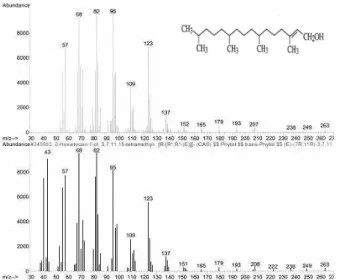
Fig. 3. Mass spectrums of phytol isolated from EtOAc F7 (a) and searched from wiley library (b).
MeOH 추출물의 flavonoid 함량은 보다 높은 수준임을 알 수 있었다. 또한 polyphenol 함량과 flavonoid 함량을 검토 한 결과, polyphenol 화합물의 대부분이 flavonoid로 구성되 어 있는 것으로 추정되었다.
생리활성물질의 분리, 정제 및 동정
Column chromatography에 의하여 EtOAc 추출물에서 24
개, MeOH 추출물 30개의 분획물들로 분리하였으며, 각 분획
물의 DPPH radical 소거능과 SOD 유사활성을 측정하여 활성
이 가장 높았던 EtOAc F7 (526.5 mg)과 MeOH F16 (55.5 mg)
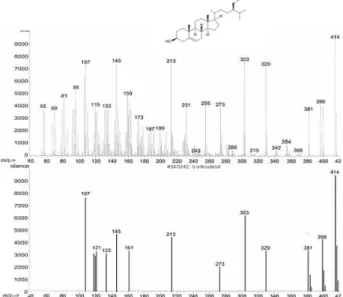
분획물에 대하여 GC/MS 분석을 실시하여 EtOAc F7에서 화
합물 1과 2를, 그리고 MeOH F16에서 화합물 3의 mass
spectrum을 Fig. 3-5와 같이 확인하였다. 화합물 1은 retention
time (t
R) 17.727에서 검출되었으며, 이의 mass spectrum과
library와의 비교를 통하여 화합물 1을 phytol로 동정하였다.
Fig. 4. Mass spectrums of
β
-sitosterol isolated from EtOAc F7 (a) and searched from wiley library (b).Fig. 5. Mass spectrums of (-)-loliolide isolated from MeOH F16 (a) and searched from wiley library (b).
t
R33.367에서 검출된 화합물 2는 β-sitosterol로, 그리고 t
R17.186에서 검출된 화합물 3은 (-)-loliolide로 동정하였다.
References
1. Bae, Y. I. and Shim, K. H. 1998. Nutrition components in different parts of Korean loquat (
Eriobotrya japonica
Lindl.).Kor. J. Postharvest Sci. Technol
. 5, 57-63.2. Bae, Y. I., Chung, Y. C. and Shim, K. H. 2002. Antimicrobial and antioxidant activities of various solvent extract from dif- ferent parts of loquat (
Eriobotrya japonica
, Lindl.).Kor. J. Food Preserv.
9, 97-101.3. Bae, Y. I., Jeong, C. H. and Shim, K. H. 2005. Antioxidative and antimicrobial activity of epicatechin isolated from leaves of loquat (
Eriobotrya japonica
).J. Food Sci. Nutr
. 10, 118-121.4. Bae, Y. I., Jeong, C. H. and Shim, K. H. 2002. Nitrite-scav-
enging and antimutagenic effects of various solvent extract from different parts of loquat (
Eriobotrya japonica
, Lindl.).Kor. J. Food Preserv.
9, 92-96.5. Bae, Y. I., Moon, J. S. and Shim, K. H. 1998. Loquat (
Eriobotrya japonica
Lindl.) juice processing and its phys- icochemical properties.Kor. J. Postharvest Sci. Technol
. 5, 270-274.6. Bae, Y. I., Seo, K. I., Park, S. K. and Shim, K. H. 1998. Loquat (
Eriobotrya japonica
Lindl.) leaf tea processing and its phys- icochemical properties.Kor. J. Postharvest Sci. Technol
. 5, 262-269.7. Banno, N., Akihisa, T., Tokuda, H., Yasukawa, K., Taguchi, Y., Akazawa, H., Ukiya, M., Kimura, Y., Suzuki, T. and Nishino, H. 2005. Anti-inflammatory and antitumor- promoting effects of the triterpene acids from the leaves of
Eriobotrya japonica
.Biol. Pharm. Bull
. 28, 1995-1999.8. Bark, Y. S., Park, Y. J., Kim, H. J., Im, M. H., Lee, M. K., Kim, Y. M., Cho, J. Y. and Heo, B. G. 2008. Physioligical activity of ethanol extract from the different plant parts of loquat (
Eriobotrya japonica
Lindl.).Kor. J. Hort. Sci. Technol
. 26, 75-80.9. Bondet, V., Brand-Williams, W. and Berset, C. 1997. Kinetics and mechanisms of antioxidant activity using the DPPH free radical method.
Food Sci. Technol.-Leb
. 30, 609-615.10. Brand-Williams, W., Cuvelier, M. E. and Berset, C. 1995. Use of a free radical method to evaluate antioxidant activity.
Lebensm.-Wiss. u.-Technol
. 28, 25-30.11. Branen, A. L. 1975. Toxicology and biochemistry of buty- lated hydroxyanisole and butylated hydroxytoluene.
J. Am.
Oil Chem. Soc
. 52, 59-63.12. Calliste, C. A., Trouilla, P., Allais, D. P., Simon, A. and Duroux, J. L. 2001. Free radical scavenging activities meas- ured by electron spin resonance spectroscopy and B16 cell antiproliferative behaviors of seven plants.
J. Agric. Food Chem
. 49, 3321-3327.13. Chen, J., Li, W. L., Wu, J. L., Ren, B. R. and Zhang, H. Q.
2008. Hypoglycemic effects of a sesquiterpene glycoside iso- lated from leaves of loquat (
Eriobotrya japonica
(Thunb.) Lindl.).Phytomedicine
15, 98-102.14. Cho, Y. S., Park, S. K. and Lee, H. Y. 1991. Composition of free sugars, organic acids and free amino acid in loquat flesh
. Kor. J. Soc. Food Nutr
. 20, 89-93.15. Chung, H. S. 2001. Isolation of new bioactive phytochem- icals from natural products.
Food Ind. Nutr.
6, 53-59.16. Eom, H. J., Kim, S. M., Pyo, B. S. and Lee, K. I. 2009.
Changes of physiological activity by drying temperature in leaf of
Eriobotrya japonica
.Kor. J. Pharmacogn
. 40, 178-183.17. Folin, O. and Denis, W. 1912. On phosphotungstic-phospho- molybdic compounds as color reagents.
J. Biol. Chem.
12, 239-243.18. Go, J. K. and Park, S. I. 2005. Preparation of stirred yoghurt from milk added with Korean loquat (
Eriobotrya japonica
Lindley).Kor. J. Food Nutr
. 18, 200-206.19. Hamada, A., Yoshioka, S., Takuma, D., Yokota, J., Cui, T., Kusunose, M., Miyamura, M., Kuotani, S. and Nishioka, Y.
2004. The effect of
Eriobotrya japonica
seed extract on oxida-tive stress in adriamycin-induced nephropathy in rats.
Biol.
Pharm. Bull
. 27, 1961-1964.20. Huang, Y., Li, J., Meng, X. M., Jiang, G. L., Li, H., Cao, Q., Yu, S. C., Lv, X. W. and Cheng, W. M. 2009. Effect of triterpene acids of
Eriobotrya japonica
(Thunb.) Lindl. leaf and MAPK signal transduction pathway on inducible nitric oxide synthase expression in alveolar macrophage of chron- ic bronchitis rats.Am. J. Chin. Med
. 37, 1099-1111.21. Jeong, Y. S., Jung, H. K., Youn, K. S., Kim, M. O. and Hong, J. H. 2009. Physiological activity of the hot water extract from
Eriobotrya japonica
Lindl.Kor. Soc. Food Sci. Nutr
. 38, 977-982.22. Jung, H. A., Park, J. C., Chung, H. Y., Kim, J. and Choi, J. S. 1999. Antioxidant flavonoids and chlorogenic acid from the leaves of
Eriobotrya japonica
.Arch. Pharm. Res
. 22, 213-218.23. Kim, E., Kim, M. S., Rhyu, D. Y., Min, O. J., Baek, H. Y., Kim, Y. J. and Kim, H. A. 2009. Hypoglycemic effect of
Eriobotrya japonica
(E. japonica) in db/db mice.Kor. J. Food Nutr
. 22, 159-165.24. Kim, H. J., Jo, C. H., Kim, T. H., Kim, D. S., Park, M. Y.
and Byun, M. W. 2006. Biological evaluation of the meth- anolic extract of
Eriobotrya japonica
and its irradiation effect.Kor. J. Food. Sci. Technol
. 38, 684-690.25. Kim, M. S., You, M. K., Rhyu, D. Y., Kim, Y. J., Baek, H.
Y. and Kim, H. A. 2009. Loquat (
Eriobotrya japonica
) extracts suppress the adhesion, migration and invasion of human breast cancer cell line.Nutr. Res. Practice
3, 259-264.26. Kim, S. H. and Shin, T. Y. 2009. Anti-inflammatory effect of leaves of
Eriobotrya japonica
correlating with attenuation of p38 MAPK, ERK, and NF-κB activation in mast cells.J.
Toxicol. in Vitro
23, 1215-1219.27. Kim, T. H., Shin, S. R., Kim, T. W., Lee, I. C., Park, M. Y.
and Jo, C. 2009. A tyrosinase inhibitor isolated from the seeds of
Eriobotrya japonica
.Kor. J. Food Preserv
. 16, 435-441.28. Koba, K., Matsuoka, A., Osada, K. and Huang, Y. S. 2007.
Effect of loquat (
Eriobotrya japonica
) extracts on LDL oxidation.J. Food Chem.
104, 308-316.29. Lee, B. Y., Park, E. M., Kim, E. J., Choi, H. D., Kim, I. H.
and Hwang, J. B. 1996. Analysis of chemical components of Korean loquat (
Eriobotrya japonica
Lindl.) fruit.Kor. J. Food Sci. Technol
. 28, 428-432.30. Lee, C. B. 1982.
Korean pictorial book of plants
. pp. 684-687.Hyangmoonsa. Seoul.
31. Lee, K. I. and Kim, S. M. 2009. Antioxidative and anti- microbial activities of
Eriobotrya japonica
Lindl. leaf extracts.Kor. J. Soc. Food Sci. Nutr
. 38, 267-273.32. Lee, Y. S. 2008. Analysis of components in the different part of
Ailanthus altissima
.Kor. J. Food Preserv
. 15, 261-268.33. Marklund, S. and Marklund, G. 1974. Involvement of super- oxide onion radical in the oxidation of pyrogallol and a con- venient assay for superoxide dismutase.
Eur. J. Biol. Chem
. 47, 468-474.34. Min, O. J., Oh, J., Kim, H. A., Kim, M. S., Baek, H. Y., Kim, Y. J. and Rhyu, D. Y. 2010. Effect of
Eriobotrya japonica
leaf and seed extracts on adipogenesis.Kor. J. Pharmacogn
. 41, 270-274.35. Nozato, N., Matsumoto, K. and Uemitsu, N. 1994.
Triterpenes from leaves of
Eriobotrya japonica
.J. Nat. Med
. 48, 336.36. Ruomei, G., Zhuobin, Y., Zhiqiang, Z. and Xiurui, G. 1998.
Mechanism of pyrogallol autoxidation and determination of superoxide dismutase enzyme activity.
J. Bioelectrochem.
Bioenergetics
45, 41-45.37. Shimizu, M., Uemitsu, N., Shirota, M., Matsumato, K. and Tezuka, Y. 1996. A new triterpene ester from
Eriobotrya japonica
.J. Chem. Pharm. Bull
. 44, 2191-2182.38. Sun, G., Zhang, Y., Takuma, D., Onogawa, M., Yokota, J., Hamada, A., Yoshioka, S., Kusunose, M., Miyamura, M., Kyotani, S. and Nishioka, Y. 2007. Effect of orally ad- ministered
Eriobotrya japonica
seed extract on allergic contact dermatitis in rats.J. Pharm. Pharmacol
. 59, 1405-1412.39. Takuma, D., Guangchen, S., Yokota, J., Hamada, A., Onogawa, M., Yoshioka, S., Kusunose, M., Miyamura, M., Kyotani, S. and Nishioka, Y. 2008. Effect of
Eriobotrya japon- ica
seed extract on 5-fluorouracil-induced mucositis in hamsters.J. Biol. Pharm. Bull
. 31, 250-254.40. Valko, M., Leibfritz, D., Moncol, J., Cronin, M. T. D., Mazur, M. and Telser, J. 2007. Free radical and antioxidants in nor- mal physiological function and human disease.
J. Biochem.
Cell Biol.
39, 44-84.41. Whang, T. E., Lim, H. O. and Lee, J. W. 1996. Anticancer effect of
Eriobotrya japonica
Lindl by specificity test with sev- eral cancer cell lines.Kor. J. Medicinal Crop Sci
. 4, 314-320.42. Yokota, J., Takuma, D., Hamada, A., Onogawa, M., Yoshioka, S., Kusunose, M., Miyamura, M., Kyotani, S. and Nishioka, Y. 2006. Scavenging of reactive oxygen species by
Eriobotrya japonica
seed extract.J. Biol. Pharm. Bull.
29, 467-471.43. Zong, W. and Zhao, G. 2007. Corosolic acid isolation from the leaves of