• 검색 결과가 없습니다.

Environmentally Friendly Controlling Way of Storm Water by Using Rain Garden

N/A
N/A
Protected

Academic year: 2021

Share "Environmentally Friendly Controlling Way of Storm Water by Using Rain Garden"

Copied!
9
0
0

로드 중.... (전체 텍스트 보기)

전체 글

(1)

Corresponding author:Kim, Sun-Mi, Korea Land Corporation, Incheon 405-841, Korea, Tel:+82-32-890-5241, E-mail:[email protected]

Received:8 August, 2007. Accepted:15 October, 2007.

- 58 -

Environmentally Friendly Controlling Way of Storm Water by Using Rain Garden

Kim, Sun-Mi

1)

and Lee, Insung

2)

1)

Korea Land Corporation,

2)

Dept. of landscape Architecture, University of Seoul.

레인가든을 적용한 환경 친화적 빗물 처리방안 검토

김선미

1)

․이인성

2)

1)

한국토지공사․

2)

서울시립대학교 조경학과

ABSTRACT

과거 빗물은 토양으로 흡수되어 정화작용을 거쳐 호수나 강으로 유입됨으로써 하천의 수질 오 염을 방지할 수 있었으나 개발로 인한 도시의 불투수층 증가로 빗물은 여과없이 도시의 오염물질 을 쓸어 내리며 하천으로 유입되어 하천의 수질 오염이 날로 심해지고 범람하는 빗물은 짧은 시간 에 도시를 물에 잠기게 한다. 오염물질을 함유한 빗물의 정화 및 빗물 유량 조절을 위한 방안으로 미국에서는 레인 가든의 조성이 활발하게 진행되고 있다. 본 원고에서는 레인 가든의 환경적 의의 와 조성방법, 그리고 빗물로부터 하천을 보호하기 위한 미국의 관련 규정을 알아보고 레인 가든의 효과에 대해 검토하고자 한다. 레인 가든은 오염 물질의 하천 유입방지 및 빗물의 저장 역할 외에 도시지역에서 최소 관리로 생물 서식처 역할을 함으로써 생태도시 조성 기술을 한 단계 높이는 방 안이 될 것이다.

Key Words: Rain Garden, Run off, Detention pond.

(2)

I. INTRODUCTION 1. Research background

Occasionally unexpected heavy rain is assumed as the cause of pollution and overflow in the river or lake. Therefore storm water management is important to keep river clean and control abrupt runoff. In this manuscript we would like to introduce the rain garden as an environmentally friendly control method of storm water.

Rain gardens were first conceived of in 1990 by storm water specialists in the state of Maryland, USA. Since then, a number of people, municipalities and organizations have influenced and enhanced the rain garden movement in the United States.

The first rain gardens were our native ecosystems (www.raingardens.org). Rain was filtered and controlled through soils, roots, and plants in our native forests, wetlands, and meadows. Most of the water that entered our surface was proper and clean. Rivers and lakes were naturally clean. When settlers cleared the land and built communities, the natural water-cleaning and controlling systems were removed. Rivers and lakes became more and more degraded as water ran off the land instead of being taken up by plants, soaking into the soil, and filtered by soils and wetlands.

Imitating the function of these natural systems that development removed, rain gardens were invented.

We would like to research the rain gardens because they can restore the natural filtering and control system, therefore, will be a new way of environmental preservation in the new developing areas.

2. Research goals & objects

1) Understanding the role of rain gardens Rain gardens were started as a new way of

controlling storm water; that is, rain gardens were meant to protect our environment from storm water and reduce runoff. By researching the rain garden's way of reducing runoff and pollution of lake, we understand learn their characteristics and roles.

2) Application of rain gardens

In the USA, many States have storm water related regulations to protect their surroundings. As a result, they have their own ways of controlling storm water. There can be a number of similar ways of protection from storm water, however, rain garden is the most environmentally friendly method.

Based on the past research, the role and necessity of rain gardens will be acquired and the application of rain gardens in the new develop- ment areas will be tested as a way of protection from storm water. for this purpose, information about the necessity, benefits, composition, location and design details of rain gardens will be reviewed.

3. Research method

Following is the research method of this study.

Related material research in rain garden

Extraction of rain garden's peculiarity and effect

Case study (Application of rain garden)

Conclusion

(3)

II. MAIN CONTENTS 1. Impact of storm water

1) The definition of storm water

Storm water is the rainfall or snowbreak that flows over yards, streets, parking lots and buildings and either enters the storm drain system or runs directly into a lake or streams. In the urban areas, rain that falls on the roof or paved areas like driveways, roads and footpaths flows directly from streets and gutters into our rivers and the ocean (www.epa.nsw.gov.au/stormwater/whatcauses.htm).

2) The impact of storm water

Highly erratic rainfall causes overflow in the city which has huge infiltration paving lots. Then storm water flows over roads, and transports pollutants to lakes and streams. Studies by the Environmental Protection Agency (EPA) have determined that up to 70% of the pollution in our surface waters is carried there by storm water runoff (www.epa.nsw.gov.au/stormwater/whatcauses.htm).

Storm water also prevents water table recharging in the ecosystem. It increases overflow and erosion surface runoff.

2. Similar ways to protect environment from storm water

1) Wet ponds-Retention ponds

A retention pond is designed to hold a specific amount of water indefinitely. Usually the pond is designed to have drainage leading to another location when the water level gets above the pond capacity. So, a water retention pond retains water all the time.

Wet ponds are storm water control structures that provide both retention and treatment of contaminated storm water runoff. A wet pond

consists of a permanent pool of water into which storm water runoff is directed. Runoff from each rainfall is detained and treated in the pond until it evaporates into the air or penetrates into the ground. By capturing and retaining runoff during storm events, wet detention ponds control both storm water quantity and quality (http:// notes.

tetratech-ffx.com/newsnotes.nsf).

2) Dry ponds - Detention ponds

A detention pond is designed to temporarily hold a set amount of water while slowly draining into another location. They are more or less around for flood control when large amounts of rain could cause flash flooding if not dealt with properly. When an area is paved or covered with a building, water runs off the property much faster than in a natural state. The total amount of discharge is the same, but the discharge happens over a shorter time.

A hydrologist will design a water detention pond to temporarily detain the water and keep the runoff to the desired rate when the rain ends.

Although, the water detention pond will be empty shortly afterwards (http://notes.tetratech-ffx.com/

newsnotes.nsf).

3. Regulation of storm water in the USA

In America, many counties have ordinances to protect their environment from storm water. The following case describes the Grand Traverse County of Michigan State soil erosion and storm water runoff control ordinance.

1) Purpose and objectives

The purpose of this ordinance is to prevent the

pollution, impairment, or destruction of a natural

resource or public trust. The specific objectives

(4)

are mainly the followings:

(1) To prevent accelerated soil erosion and to control storm water runoff from earth changes proposed within Grand Traverse County, both during and after construction.

(2) To assure that property owners control the volume and rate of storm water runoff originating from their property so that surface water and ground water quality is protected, soil erosion is minimized, and flooding potential is reduced.

2) Storm water runoff control plan

A storm water runoff control plan shall be prepared for any earth change subject to permit requirements. The plan shall be designed to effectively reduce accelerated soil erosion and sedimentation during construction and after construction is completed.

(1) A residential or environmentally sensitive site plan shall show the following:

① Location of the site

② Site characteristics, such as location of lake, stream, wetlands or existing buildings.

③ Proposed earth change activity

(2) Other land uses, site plans for earth changes shall show the following:

① A map or maps at a scale of not more than 200 feet to the inch or as otherwise determined by the Drain Commissioner, including a legal descrip- tion and site location sketch which includes the proximity of any proposed earth change to lakes or streams or both:predominant land features;

and contour intervals or slope description.

② Location of all lakes, streams, and protected wetlands partially or completely contained within the boundaries of the site or within 50 feet of the site boundary.

③ A description and the location of all existing

and proposed on-site storm water management facilities and measures.

(3) Storm water runoff calculation

3) Storm water management easements Storm water management easements shall be provided by the property owner if necessary for:

(1)access for facility inspection and maintenance, or (2)preservation of storm water runoff convey- ance, infiltration, and detention areas and facilities, including flood routes for the 100-year storm event (www.stormwatercenter.net).

4. Features of rain gardens 1) Outline

A rain garden is constructed as a place to direct the rain from the roof or driveway and is landscaped with indigenous plants. Storm water carries pollutants from yards, streets, and parking lots into the nearest body of water. Therefore a rain garden is a natural way to solve storm water pollution problems and help recharge ground water, and protect water resources.

Rain gardens have attractive landscaping features too. They feature native species of plants that are adapted to the region, and require low maintenance while providing habitat for native wildlife. In addition, a rain garden forms a bio-retention area by collecting water runoff and storing it, permitting water to filter and slowly be absorbed by the soil.

Rain gardens provide two important functions:

(i) water quantity (flood) controls; and (ii) improve- ment of water quality through removal of pollutants and nutrients associated with runoff.

2) Structures of rain garden (1) The site

Bannerman says (2003) that the rain garden is

(5)

suitable for residential area where it is used to treat storm water. The site for a rain garden should be placed strategically to intercept water runoff. Therefore rain gardens generally are situated in low-lying site in residential areas.

(2) Grass buffer strip

A grass buffer strip slows water as it enters the rain garden, and its surface filters particles from the runoff.

(3) Pond area

The depression area stores the water, provides for evaporation, and allows the particulate material, not filtered by the grass buffer, to settle to the bottom. The pond area should have a depth of 15 cm, sufficient to provide adequate water storage, but should not pond in excess of four days to avoid mosquito and other insect breeding.

(4) Mulch/Organic layer

This material provides for the decomposition of organic material, and also plays an important role in the removal of metals. Shredded hardwood mulch is the preferred choice, since it allows for maximum surface area for binding and resists flotation/washout.

(5) Planting soil

Organic matter in the form of leaf mulch (20%) blended into a sandy soil (50%) with about 30% top soil makes planting soil. The planting soil mixture provides a source of water and nutrients for the plants to sustain growth. Clay particles absorb heavy metals, hydrocarbons and other pollutants.

(6) Plant selection

A planting plan should include species that tolerate extremes. There will be periods of water inundation and very dry periods. Most riparian plant species will do well in rain gardens. The choice of species should include plants that

mimic the forest habitat and have an aesthetic landscape value such as flowers, berries, leaves or bark. Ground covers, perennials, shrubs and trees should be incorporated into the planting design (www.dof.virginia.gov/rfb/rain-gardens.shtml).

(7) Sizing the gardens

Wisconsin Department of Natural Resources (WDNR) requires that for residential areas 1% of the site area be dedicated to active infiltration.

For more dense residential and commercial properties the requirement is 2% of the site area dedicated for active infiltration.

Active Infiltration %(W) = X * (A%)Y A:the percentage specified by WDNR for

active infiltration

X:the Total Site Area in Square Feet W:the Calculated Percentage of Area for

Active infiltration

Y:the Net Developable Area in Square feet Z:the Individual Lot Area in Square Feet

(www.ci.madison.wi.us)

Figure 1. Components of a recharging garden.

(www.webdesignpros.net/consult)

3) Characteristics of rain gardens

(1) Rain Gardens are merely low spots that will be filled up with water during rainy season and become dry during dry season.

(2) Rain garden absorbs and filters rain property

(6)

that would otherwise run off and slows down the storm drain. The storm water runoff usually comes from an impervious surface that rain cannot soak into, such as a roof or parking lot, or even a lawn.

(3) Many of the plants in the garden are native to the region, and have extensive deep roots that help the garden absorb rain. The native plants do not need special attention once they are established.

(4) There is a bowl-shaped dip in the garden, which holds the rain while it soaks into the soil.

The garden bed is prepared or sometimes replaced to a depth of two feet in order to soften the soils and make the garden able to absorb water (www.dof.virginia.gov/rfb/ rain-gardens.shtml).

(5) Ease of maintenance, just routine landscaping maintenance can get effective storm water man- agement control.

III. CASE STUDY

1. Effects of rain gardens 1) Storm water management

Rain gardens are designed to retain runoff and encourage infiltration to ground water. The infiltra- tion of water into the surface soil is responsible for the largest loss of runoff in natural areas (NY State Stormwater Management Design Manual, 2006). As the storm water slows down, peak flows infiltrate through rain garden. Storm water quantity reduction in rain gardens occurs via evaporation and infiltration. These retention basins provide water storage and an area for infiltration of storm water runoff while providing attractive landscaping.

2) Effect on the quality of water

To help address the effects of rain gardens on the quality of surface and ground water, a study

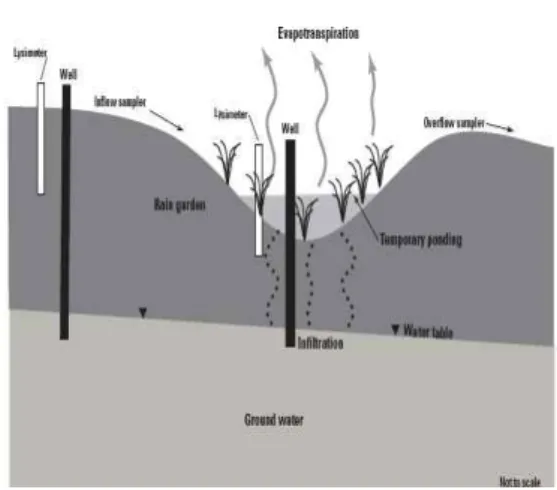
Figure 2. Schematic diagram of expected processes and monitoring points of a rain garden.

(http://pubs.usgs.gov/sir/2005/5189/PDF/

SIR2005_5189.pdf.p3)

was done by the U.S. Geological Survey (USGS) in cooperation with the metropolitan Council of the Department of Environmental Services, the Twin Cities (Minnesota and Saint-Paul), during 2002~2004.

The expected processes that occur in rain

garden are shown in the figure 2. Table 1. shows

the effects of rain gardens from a monitoring of

Woodbury rain garden in the Twin Cities, Min-

nesota. Runoff water is directed into the rain

garden through storm drainage and subsequently

allowed to pond temporarily until water can

infiltrate into the ground and be taken up by the

garden vegetation. Rain gardens are designed to

overflow during large runoff events with a specified

recurrence interval. Sampling focused primarily

on determining the concentration of a few selected

constituents considered to be indicative of runoff

including pH, nitrogen, phosphorus. Throughout

much of the study, nitrogen and total phosphorus

concentrations were lower in the overflow as

compared to the inflow, indicating that the rain

garden was assimilating much of the nutrients

(7)

Sample location (approximate number of samples;

may be fewer for some measurements)

Nitrogen, nitrite dissolved

(mg/L as N) Phosphorus dissolved (mg/L as P)

Inflow composite (8) Overflow composite (6) Background lysimeter (1) Background well (9) Raingarden lysimeter (5) Raingarden well (9)

0.07 .01 .01 .01 .01 .01

0.22 .1 .04 .03 .05 .04

Table 1. Median values of selected physical properties, chemical constituents, and nutrient species of water from the rain garden site in Woodbury, Minnesota, 2002-04(http://pubs.usgs.gov/sir/2005/5189/PDF/SIR2005_5189.pdf.p13)

that might have otherwise been transported to the overflow.

Water quality had changed little from inflow to overflow during the most recent sampling.

2. Case Study 1) Project Outline

The case study Location is Jang Ki Myeon, Yang Chon, Kim Po City, Kyeong Gi Province.

Total Area is 10,837,004m

2

, and case Study Area is 61,903m

2

, this case study area is located at near by Kimpo Canal. Project period of the case study is between 2006. 12. and 2012. 12. Planned household of the study area is 53,890 household, and case study household is 260 household.

Figure 3. Case Study Site.

2) Size of Rain Garden in residential area - Residential Area Dd-7:23,880m

2

, - Residential Area Dd-8:38,023m

2

, - total area:61,903m

2

Given a 61,903m

2

(15.3 acre) residential area with 39% dedicated to the public, the active infiltration area is calculated as follow:

W = 15.3*(.01)/61 = 0.25%

The active area needed on a 230m

2

lot (0.056 acre) is then 0.00014 acre. Every household needs

Figure 4. Residential area.

(8)

0.57m

2

for each active infiltration. Therefore the total needed active infiltration area is 0.0366 acre (260 household, 148.2m

2

).

3) Plan of Rain Garden

The total needed active infiltration area is 0.0366 acre (260 household, 148.2m

2

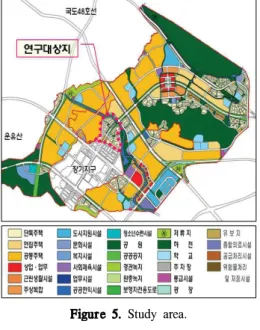
). To achieve the controlling effect, it is necessary to allocate rain gardens in green field before water stream like figure.

Figure 5. Study area.

Figure 6. Case Study Site.

4) Effect of Rain Garden

Table 2. Current Water Quality.

Point T-N(mg/L) T-P(mg/L)

W-7 5.525 0.110

W-8 6.509 0.251

자료:김포양촌지구 환경영향평가서, 2006, 한국토지 공사, 234.

Table 3. Estimated Water Quality.

Point T-N(mg/L) T-P(mg/L)

W-7 5.525→0.773 0.110→0.019

W-8 6.509→0.911 0.251→0.045

II. CONCLUSION

Last summer, erratic rainfall brought death of many fishes in Cheong Ge stream. That was caused by the flow of heavy non point source pollution into Cheong Ge stream in a short time. To solve this problem, a rain garden is an alternative solution.

The role of rain garden is emphasized as an environmentally friendly control method to protect surroundings from storm water which is becoming more serious cause of stream pollution and over- flow. This rain garden has efficiency in the role of environmental technology and landscaping in an urban area.

So far, ponds were used to retain or detain rainfall in a protective way from non point sources such as storm water. In addition to this role of controlling polluted water, the rain gardens have many advantages such as creating attractive area for wildlife and needing low maintenance.

By making rain gardens, we can have ecological

and functional garden in a time and upgrade our

(9)

environmental technology to a higher level. So we need to make rain gardens more in the residential area for the protection of our environment. And it is necessary to study more about this environ- mentally friendly control method of storm water in the future.

REFERENCES

한국토지공사. 2006. 김포양촌지구 택지 개발사 업 환경영향 평가서 231-235.

Bannerman, Roger 2003. Rain Gardens, A How-

to Manual for Homeowners. University of Wisconsin. PUB-WT-776.

New York State Gov 2006. Stormwater Manage- ment Design Manual:Chapter, 9.

www.ci.madison.wi.us

http://www.dof.virginia.gov/rfb/rain-gardens.shtml www.epa.nsw.gov.au/stormwater/whatcauses.htm http://notes.tetratech-ffx.com/newsnotes.nsf http://pubs.usgs.gov/sir/2005/5189/PDF/SIR2005_

5189.pdf

www.stormwatercenter.net

www.webdesignpros.net/consult

수치

Figure 1. Components of a recharging garden.
Figure 2. Schematic diagram of expected processes and monitoring points of a rain garden.
Table 1. Median values of selected physical properties, chemical constituents, and nutrient species of water from the rain garden site in Woodbury, Minnesota, 2002-04(http://pubs.usgs.gov/sir/2005/5189/PDF/SIR2005_5189.pdf.p13)
Table 2. Current Water Quality.

참조

관련 문서