Print ISSN: 2288-4637 / Online ISSN 2288-4645 doi:10.13106/jafeb.2021.vol8.no2.0339
The Influence of Role Models on Entrepreneurial Intention: Does Individual Innovativeness Matter?*
Tommy Christian EFRATA
1, Wirawan Endro Dwi RADIANTO
2, Junko Alessandro EFFENDY
3Received: November 05, 2020 Revised: December 30, 2020 Accepted: January 08, 2021
Abstract
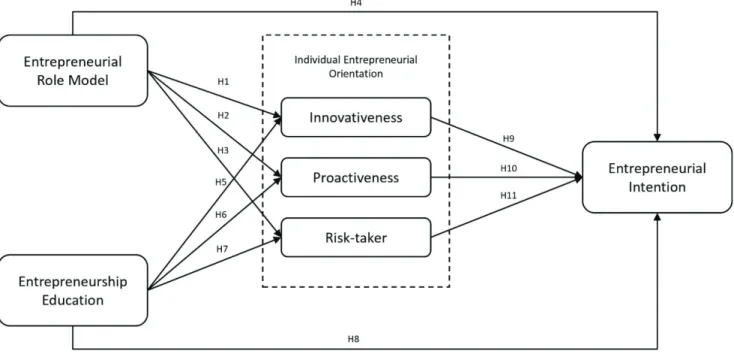
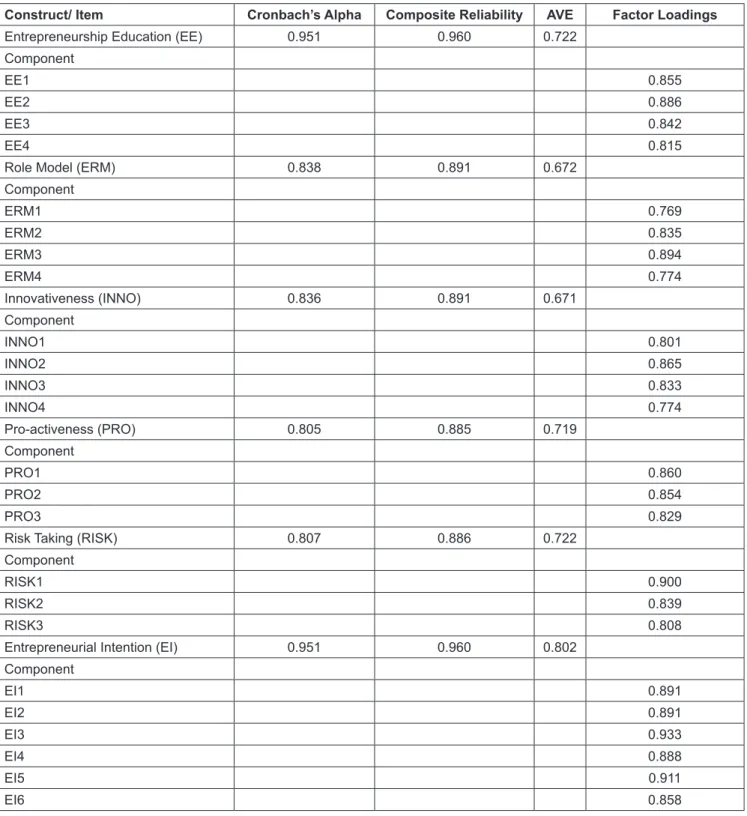
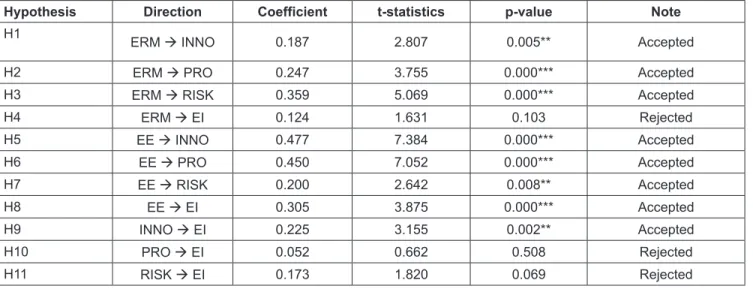
This study aims to explore the relationship between entrepreneurial role models (ERM) and entrepreneurship education (EE) on individual entrepreneurial orientation (EO) and its consequences for entrepreneurial intention (EI). Data is obtained through a survey method on 255 management and business university students who had completed the entrepreneurship education program. To evaluate the research model, the data is processed using PLS-SEM. The results of this study indicate that the existence of entrepreneurial role models and entrepreneurial education programs for students affects the components of individual entrepreneurial orientation, namely individual innovativeness, individual proactiveness, and individual risk-taker. However, ERMs do not have a direct effect on EI. The main finding of this research appears on the influence of individual EO on EI, which indicates that only individual innovativeness impacts entrepreneurial intention.
Meanwhile, personal proactiveness and risk-takers are proven to have no impact on EI. This study succeeded in filling the research gap, namely, examining the influence of ERMs on each of the components forming an individual entrepreneurial orientation (IEO) and its EI. This research model also provides a comprehensive research model on the influence of pre-entrepreneurial exposure on IEO and its consequences on EI.
Keywords: Individual Entrepreneurial Orientation, Entrepreneurship Education, Entrepreneurial Role Model, Entrepreneurial Intention, Innovativeness
JEL Classification Code: D91, L26, M13, M50
1. Introduction
Entrepreneurship is an option expected to drive economic growth in an uncertain industrial and recessionary world. Entrepreneurship drives economic growth through knowledge spillovers, job creation, providing innovative and diverse products and services, and increased market competition (Fayolle, 2007). Educating, mentoring, and interning tomorrow’s entrepreneurs might be the key to job creation, economic growth, and building sustainable community development. Young people continue to show interest in entrepreneurship as a career option but feel they need the education and experience that will help them prepare for this challenge. Several studies have been conducted to model the growth of entrepreneurial intention (EI), and have identified numerous entrepreneurial exposures that precede EI, including entrepreneurial role models (ERM), entrepreneurial education (EE), and prior entrepreneurial events (Martins & Perez, 2020; Zapkau et al., 2017). At the
*Acknowledgements:
The authors express gratitude to the Directorate of Research and Community Service, Deputy for Strengthening Research and Development, Ministry of Research and Technology/National Research and Innovation Agency of the Republic of Indonesia for the support and research grants.
1
First Author and Corresponding Author. Assistant Professor, Faculty of Management and Business, Universitas Ciputra Surabaya, Indonesia [Postal Address: CBD Boulevard, CitraLand, Surabaya 60219, Indonesia] Email: [email protected]
2
Associate Professor, Faculty of Management and Business, Universitas Ciputra Surabaya, Indonesia.
Email: [email protected]
3
Assistant Professor, Faculty of Management and Business, Universitas Ciputra Surabaya, Indonesia.
Email: [email protected]
© Copyright: The Author(s)
This is an Open Access article distributed under the terms of the Creative Commons Attribution Non-Commercial License (https://creativecommons.org/licenses/by-nc/4.0/) which permits unrestricted non-commercial use, distribution, and reproduction in any medium, provided the original work is properly cited.