DOI https://doi.org/10.9725/kts.2019.35.6.356
경계윤활에서 기계 부품 소재의 트라이볼로지적 특성에 관한 연구
김명구1ㆍ서국진2ㆍ남자현3ㆍ김대은4†
1
연세대학교 기계공학과 석사과정생
2
연세대학교 기계공학과 박사과정생
3
삼성전자 생활가전사업부 책임연구원
4
연세대학교 기계공학과 정교수
Study on Tribological Characteristics of Machine Component in Boundary Lubrication
Myeong-Gu Kim
1, Kuk-Jin Seo
2, Jahyun Nam
3and Dae-Eun Kim
4†1
M. S. Student, Department of Mechanical Engineering, Yonsei University
2
Ph. D. Student, Department of Mechanical Engineering, Yonsei University
3
Staff Engineer, Digital Appliances Business, Samsung Electronics Co., Ltd
4
Professor, Department of Mechanical Engineering, Yonsei University
(Received October 1, 2019 ; Revised November 20, 2019 ; Accepted November 23, 2019)
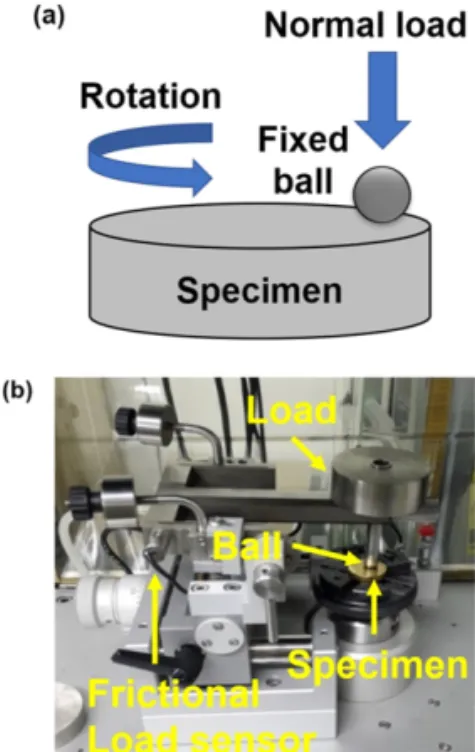
Abstract − The friction and wear between machine components directly influence the energy loss and failure in various machines. Therefore, there is always a demand for finding methods to reduce friction and wear. Of the pos- sible methods, lubrication is a widely used method for reducing friction and wear. In the case of lubrication, it is important to analyze the tribological behavior in the boundary lubrication because most of friction and wear occurs in the boundary lubrication regime. Cast iron has been regarded as a good material for industrial appli- cations due to the excellent mechanical properties and high productivity. Especially, nodular cast iron is a mate- rial that shows better mechanical properties and wear-resistance compared with cast iron due to inclusion of spheroidal graphite. In this work, we investigated the tribological characteristics of nodular cast iron with respect to different counter parts in boundary lubrication regime. Sliding tests were conducted with SUJ2, ZrO
2, Si
3N
4balls as counter parts using a pin-on-disk type tribotester. The results showed different friction and wear behav- iors with different counter parts. The case of ZrO
2showed the lowest wear rate in specimen and no significant ball wear. In case of SUJ2, it showed similar wear rate with ZrO
2case in specimen and the highest friction coef- ficient. The case of Si
3N
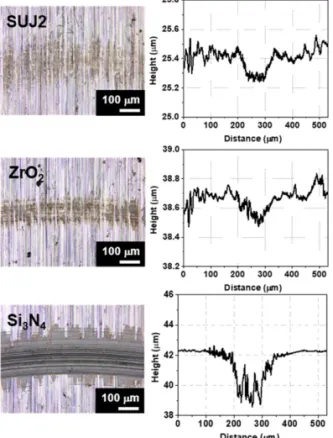
4showed the lowest friction coefficient, 33% lower than the case of SUJ2. It showed 16.9 times larger wear rate in specimen and 43% larger wear rate in ball compared to that of the SUJ2 case.
Keywords − nodular cast iron(구상흑연주철), sliding friction(미끄럼 마찰), boundary lubrication(경계윤활), friction coefficient( 마찰계수), Wear rate(마모율)
†